For many of us, history is a subject we studied in school, often reduced to memorizing dates and names that faded from memory soon after exams. Yet beyond battles and political events lies another, quieter side of history—one told through the everyday tools, objects, and inventions that shaped daily life. These artifacts may not always make it into textbooks, but they reveal an intimate, human side of the past: the ingenuity born of necessity.
The Mystery of Forgotten Objects
Hidden among the countless relics of bygone eras are tools that once played a crucial role in the lives of millions. They were fixtures in homes, indispensable to daily routines, and symbols of progress in their time. But as technology advanced, many of these devices faded into obscurity, leaving only a few surviving examples in attics, flea markets, and museum displays.
One such object—now unfamiliar to most—was once a revolutionary aid in one of humanity’s oldest and most universal chores: laundry. Its story offers a fascinating glimpse into both the hardship of domestic work in earlier times and the innovative spirit that sought to ease it.
The Evolution of Laundry
The concept of washing clothes is as old as civilization itself. Ancient Egyptians pounded garments on flat stones along the Nile. Romans used public washhouses with vats of water and natural detergents. In the Middle Ages, laundry was a communal affair, often involving boiling linens in large cauldrons over open fires.
By the 18th and 19th centuries, laundry day was an all-consuming household event—physically exhausting and time-intensive. It involved multiple stages:
- Fetching and heating water—often in large, heavy pots.
- Soaking garments in hot, soapy water.
- Scrubbing by hand using washboards or stones.
- Rinsing—sometimes in cold water outdoors.
- Wringing out excess water before hanging items to dry.
Each stage required labor, strength, and often cooperation among family members or hired help. And until the mid-20th century, most homes lacked the automated washing machines we take for granted today.
A Look Back at the Curious Device
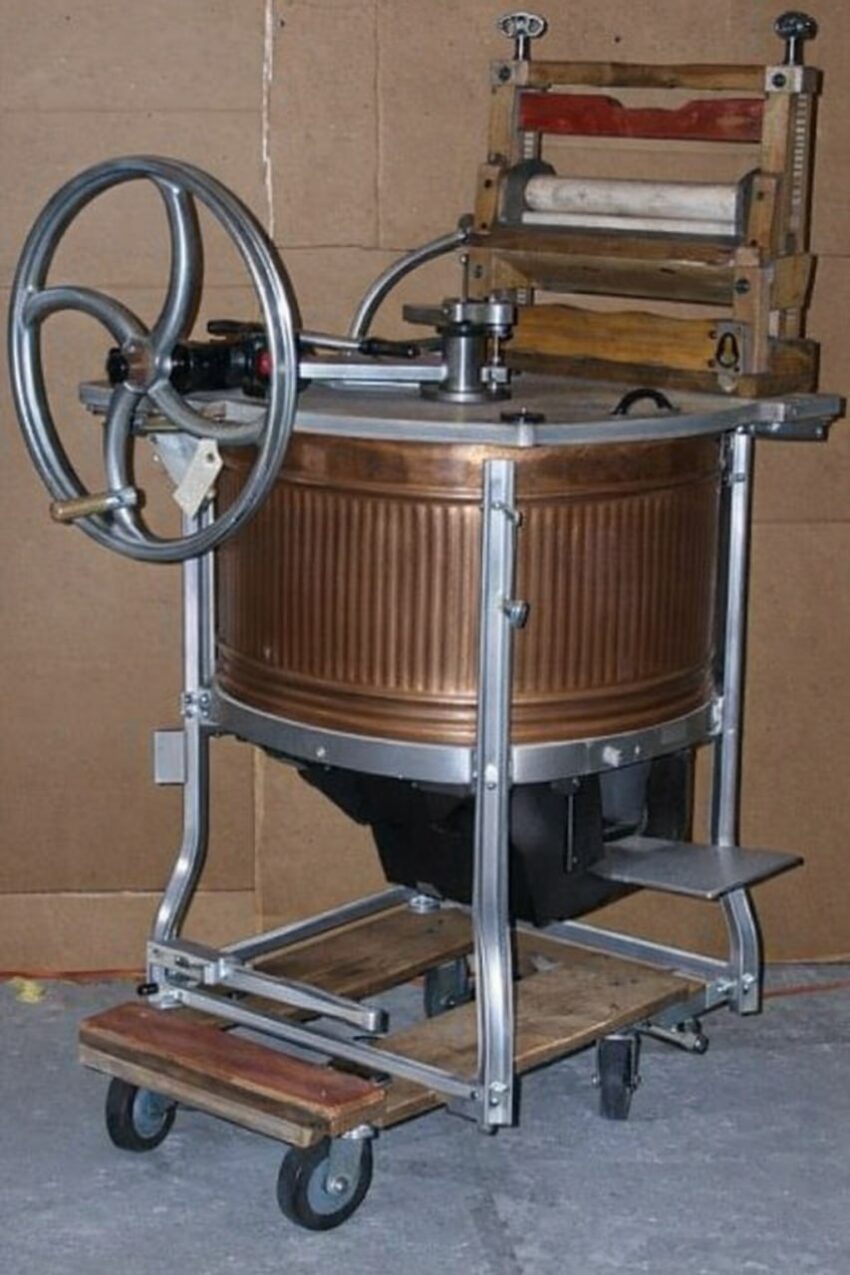
The object in question—depicted in the period images that sparked this discussion—was a marvel of its time. Small enough to fit in a home but powerful in its impact, it was designed to simplify the wringing process, a stage that was particularly strenuous. Wet clothes are heavy, and hand-twisting them dry could strain wrists and shoulders while still leaving garments damp.
This device used a pair of rollers, cranks, or levers to press water out of fabric, reducing drying time and easing physical effort. While simple by today’s standards, it represented a leap forward in domestic efficiency. Families could complete laundry day in less time, with less fatigue—a genuine quality-of-life improvement.
Uncovering the Intricacies of Laundry Day
To understand why such a tool mattered so much, imagine the rhythm of a traditional laundry day over a century ago:
- Morning: A fire would be started under a large pot of water. Soap—often homemade from animal fat and lye—would be grated or dissolved into the boiling water.
- Midday: Garments were plunged into the soapy water, stirred, and beaten to loosen dirt. This process could take hours, particularly for large items like bed linens.
- Afternoon: Clean water was drawn for rinsing. Without modern plumbing, this often meant hauling heavy buckets from a well or pump.
- Evening: Wet clothes were wrung out before being hung on lines—either outside in good weather or inside near heat sources during winter.
Every stage was a workout. Tools like the roller wringer transformed the final step into a smoother, faster process, freeing up time for other household tasks.
The Role of Innovation
This laundry device was more than a convenience—it was a symbol of progress. It reflected the growing market for domestic labor-saving tools in the late 19th and early 20th centuries. As industrialization spread, more households gained access to manufactured goods, and inventors saw opportunities to improve traditional methods.
Inventions like these also intersected with broader social changes. By reducing the physical demands of laundry, they freed up energy—especially for women, who bore the brunt of household labor—to engage in other work, education, or leisure.
Tips for Exploring History Through Artifacts
Objects like this laundry wringer tell stories far beyond their immediate function. To appreciate them fully, consider these approaches:
- Research the context – Investigate when and where the object was made, what problem it solved, and who used it.
- Visit museums – Many cultural history museums and living history villages showcase domestic tools in action.
- Connect with experts – Historians, archivists, and collectors can often share insights that bring an artifact’s story to life.
Common Questions
Q: How important is it to study historical objects like the one mentioned?
A: Studying historical objects helps us understand the evolution of daily life, the progression of technology, and the ingenuity of our ancestors. These items bridge the gap between grand historical narratives and the lived experiences of ordinary people.
Q: How can I learn more about ancient laundry practices?
A: Historical texts, diaries, and domestic guides from past centuries provide detailed descriptions. Living history museums and hands-on workshops can also demonstrate techniques in person.
Q: Are there other household tasks with a similarly rich history?
A: Absolutely. Cooking, cleaning, sewing, and farming each have deep historical roots, with their own sets of specialized tools and ingenious solutions.
Q: What lessons can we learn from studying the evolution of household tasks?
A: Tracing these changes fosters an appreciation for human creativity, adaptability, and the ongoing quest to make life a little easier.