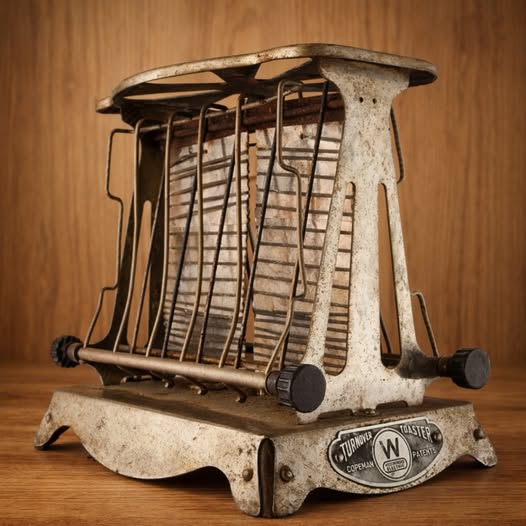

The object in the images is an early electric “turnover” toaster, commonly associated with the 1920s and identified on its front badge as a Copeman “Turnover Toaster” with a prominent “W” mark (often listed as a Westinghouse Copeman Turnover Toaster). Unlike modern pop-up toasters, this style was designed for manual control—you could see the bread browning and turn the toast over using side knobs rather than relying on an automatic spring mechanism.
Name (commonly listed): Vintage 1920s Westinghouse Copeman Turnover Toaster
Type: Early 20th-century electric countertop toaster
Key identifier: The badge reading “TURNOVER TOASTER” and “COPEMAN”, plus the large “W” emblem on the front plate
When It Appeared
Time period: Early 20th century, with many examples commonly dated to the 1920s
Context: This was a transitional era in home electrification, when countertop appliances were becoming more common but fully automatic pop-up toasters were not yet the everyday standard in many households.
Who Made It
Based on the branding visible on the toaster:
Copeman is the manufacturer name shown on the badge (the appliance is widely referred to as a Copeman Turnover Toaster).
The prominent “W” mark and common listings pairing the two names indicate it is often identified as a Westinghouse-branded Copeman turnover toaster (i.e., Westinghouse associated branding/marketing alongside Copeman manufacturing identity).
What Makes It a “Turnover” Toaster
The defining feature is the manual turning mechanism:
Wire bread cages hold slices upright.
Side knobs/handles allow the user to rotate/turn the bread so both sides toast.
The open-frame design makes browning visible, encouraging hands-on control rather than timed automation.
How It Works (Simple Step-by-Step)
Plug it in (the cord is visible in one image).
Place bread slices into the wire cages at the front.
The bread sits near the central heating area inside the frame, where an electric heating element produces radiant heat.
Monitor browning visually through the open metal framework.
Use the side knobs to turn/flip (“turn over”) the bread for even toasting.
Remove the toast when it reaches the desired color (often by sliding the cages/rack outward depending on the model).
Primary Purpose and Practical Benefits
Core function: To toast bread using electric heat
Why the design mattered in its era:
Even browning by manually turning the bread
Real-time visibility (you can watch the toast darken)
Reduced direct contact with hot surfaces because bread is held in cages and manipulated using knobs
What the Photos Reveal (Identification Checklist)
Key features visible in the images that match a classic turnover toaster:
Upright metal frame with large cutout side supports
Multiple wire cage bars forming toast holders
Two dark side knobs used to control the turning/positioning
Front badge clearly labeling “TURNOVER TOASTER” and “COPEMAN”, plus a large “W” emblem
Patina and wear consistent with early countertop appliances: oxidation, spotting, and aged metal finish
In one image, an extended rack/tray suggests a slide-out support used during loading/unloading and handling hot toast
Why Collectors Still Like It
Industrial craftsmanship: heavy metal build, visible mechanisms, and durable hardware
Design history: a clear example of pre-pop-up toaster engineering
Display appeal: distinctive silhouette and prominent badge branding