In today’s digital age, where viral content spreads within minutes and personal confessions unfold in front of millions, certain stories capture public attention not simply because they are shocking, but because they force us to confront deeper questions about identity, family, and the complexity of modern relationships.
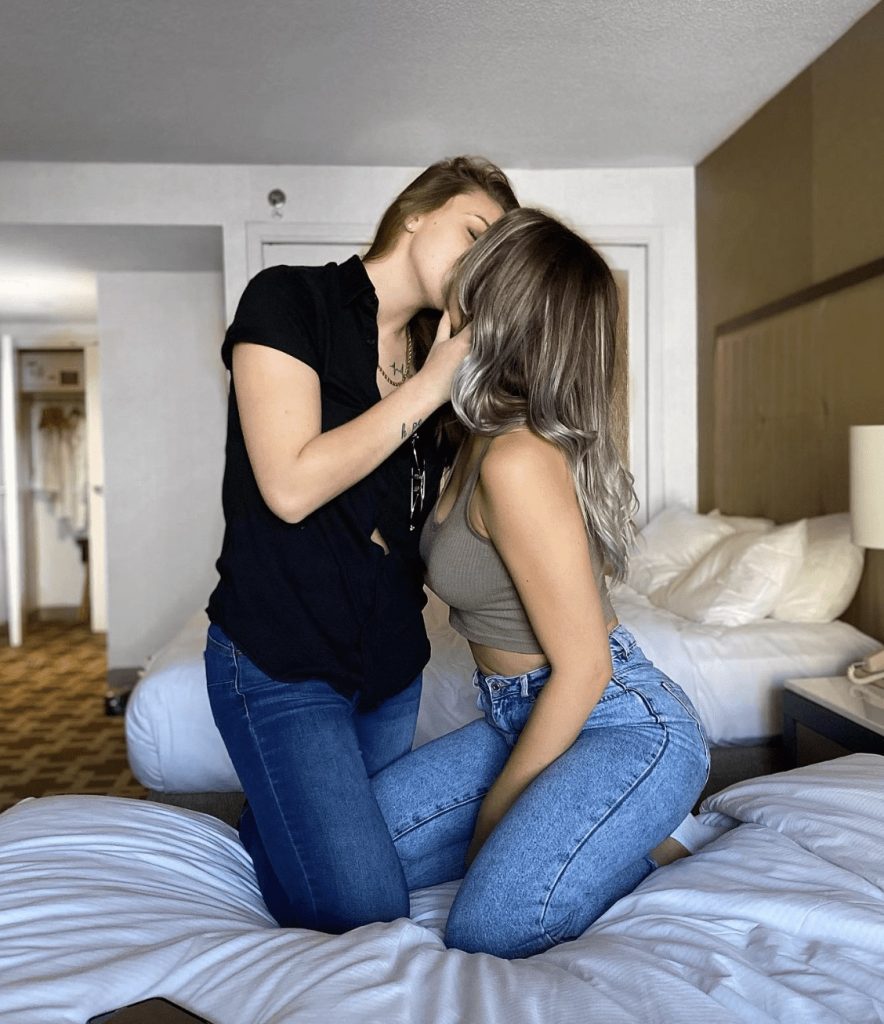
Recently, a couple known online as Carley and Mercedes found themselves at the center of one such conversation.
With nearly 600,000 followers on TikTok and a growing presence across multiple platforms, they are no strangers to public visibility. Over the past two years, they have openly shared moments from their relationship, building a loyal audience invested in their journey. But a recent revelation shifted their narrative in a way no one expected.
Two years into dating, they discovered that their mothers had both been romantically involved with the same man in the past.
That realization raised a startling possibility: could they be biological half-sisters?
The announcement came through a short TikTok video that quickly gained traction. Using a humorous but slightly uneasy audio clip that says, “Funny, yes. But not funny ‘haha,’ funny weird,” the couple framed the situation with a mix of shock and irony.
The caption read: “When you find out two years into dating that your moms both slept with the same guy.”
They followed it with a direct question to their audience: “Should we take a DNA test?”
Within days, the video soared past 7.6 million views. The reactions were immediate and intense.
Some viewers responded with humor, treating the situation as an awkward twist of fate. Others reacted with genuine concern, urging the couple to seek clarity as soon as possible. Many emphasized emotional well-being, suggesting that uncertainty of this magnitude should not be left unresolved.
What made the story even more compelling was something viewers had noticed long before the revelation.
Carley and Mercedes share noticeable facial similarities. Commenters pointed out their matching expressions, similar features, and overall resemblance. Several people admitted they had assumed the two were related before ever reading the caption.
“I always thought you two looked alike,” one user wrote.
“I genuinely thought you were sisters,” another added.
That visual resemblance added credibility to the possibility and fueled further debate. Yet, as of now, the couple has not publicly confirmed whether they have taken a DNA test or received definitive results.
And that uncertainty has only intensified the discussion.
As the video continued circulating, skepticism began to surface. Some viewers questioned whether the revelation was genuine or whether it might be a carefully crafted storyline designed to generate engagement.
In a content-driven online economy, dramatic narratives often attract attention. A number of commenters wondered aloud whether the situation was authentic or simply a viral strategy.
“I can’t tell if this is real or just TikTok drama,” one person wrote.
Another commented, “Even if this is for attention, you both seriously look like twins.”
This divide reflects a larger reality of social media culture today. Audiences crave authenticity, but they are also aware that creators operate within systems that reward emotional storytelling and high engagement.
It can be difficult to distinguish spontaneous revelation from calculated performance.
Regardless of whether the story proves entirely factual, it has resonated for reasons that go far beyond shock value.
In recent years, advances in genetic testing and ancestry platforms have made unexpected family discoveries increasingly common. DNA kits, online records, and casual conversations have revealed hidden connections in families around the world.
Stories of previously unknown siblings meeting later in life are no longer rare.
In that context, the possibility raised by Carley and Mercedes feels less impossible and more reflective of a modern era where personal histories can resurface unexpectedly.
Their situation also prompts broader questions about how relationships are defined.
Romantic partnerships are typically built on emotional bonds, shared experiences, and personal commitment. But what happens when biology introduces uncertainty? Where do emotional connections end and genetic ties begin?
These are not easy questions.
The viral nature of the story demonstrates how invested audiences become in such dilemmas. Millions of strangers are now contemplating a deeply personal issue alongside the couple.
That dynamic highlights both the power and the risk of sharing private revelations online.
Social media has transformed vulnerability into a public act. When creators share intimate developments, they invite empathy and support—but also scrutiny, judgment, and speculation.
Once a story enters the public sphere, it no longer belongs solely to those involved.
It becomes a topic of analysis, debate, and interpretation.
This raises ethical considerations about digital storytelling. At what point does openness become content strategy? When creators pose questions directly to their audience—such as whether to take a DNA test—they are not only sharing; they are engaging viewers in the unfolding narrative.
That engagement can strengthen community bonds, but it also blurs boundaries.
For viewers, there is also responsibility.
Consuming viral stories requires discernment. Not every dramatic post is fully transparent, and not every surprising revelation is entirely fabricated. Social media often blends reality with presentation.
In this case, the unanswered question keeps the story alive.
Whether Carley and Mercedes pursue genetic testing publicly or privately, their viral moment has already sparked meaningful conversations about identity, family history, and the evolving definition of relationships in the digital age.
It has encouraged many people to reflect on their own family trees, their own pasts, and the hidden connections that might exist beneath the surface.
It has also underscored how quickly personal discoveries can become global entertainment.
As technology continues to advance and social platforms continue to reward emotionally compelling narratives, similar stories are likely to emerge.
Unexpected family connections, long-buried secrets, and identity revelations are no longer confined to private living rooms. They unfold on screens, accompanied by comments, reactions, and millions of views.
In the end, the lasting impact of this story may not depend on the outcome of a DNA test.
Instead, its significance lies in the questions it has raised.
What truly defines a relationship?
How much weight does biology carry compared to shared experience?
And in an era where personal life can instantly become public content, how much of ourselves should we choose to share?
Those conversations are not going away anytime soon.
And perhaps that is why this story continues to resonate long after the initial shock has faded.