Part 1
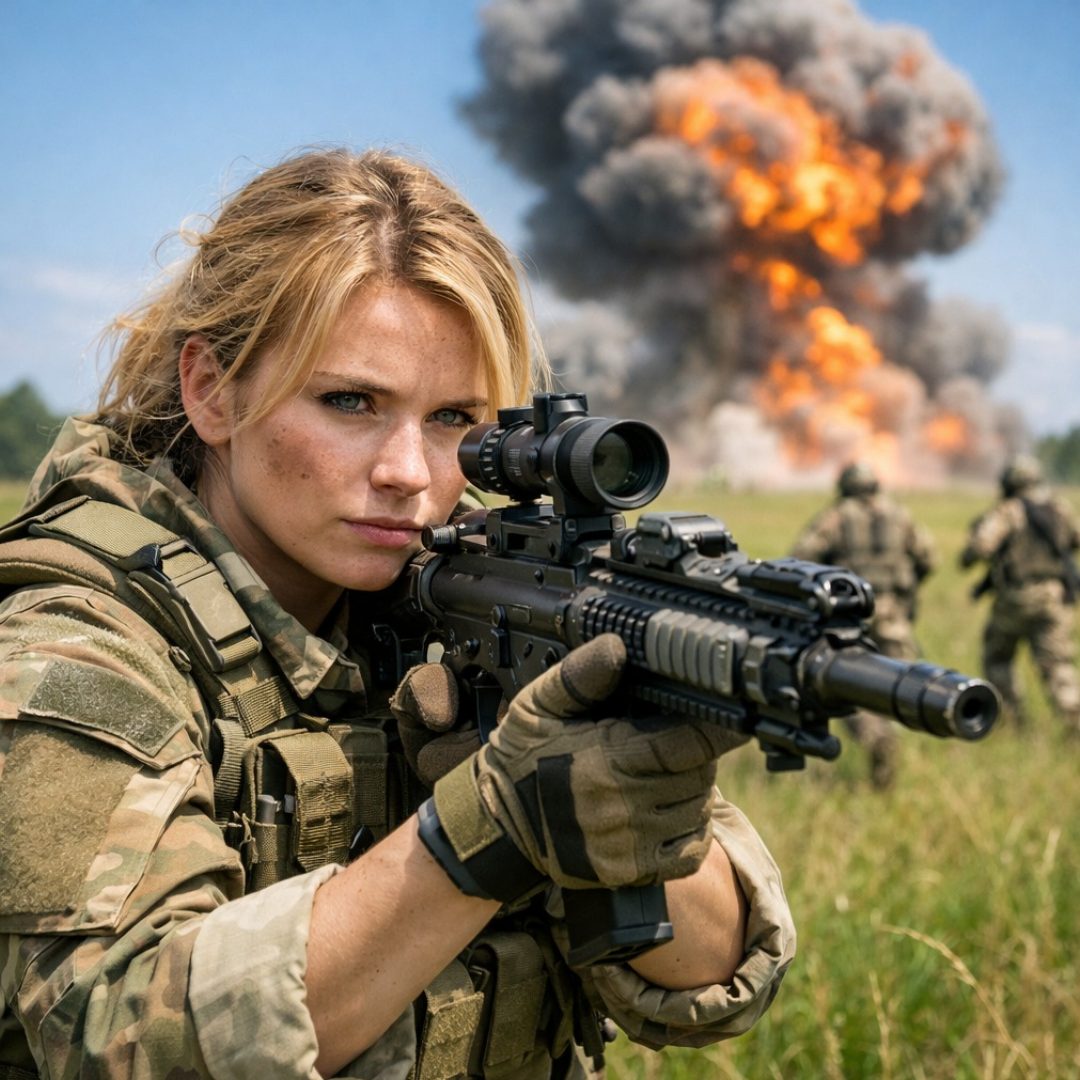
The explosion tore through the Afghan valley like a fist punching through paper, the kind of blast that made the mountains answer back. Orange flame climbed into a sky already thick with smoke. Burning diesel bit the back of every throat. Forward Operating Base Viper clung to the ridge like a stubborn scar—HESCO barriers stacked fast, plywood buildings bolted together, a thin ring of wire pretending it could keep the world out.
Mortars walked in with the patience of something hunting. Each impact sent a percussion through the ground that you felt in your teeth before you heard it. Rock fragments rained down from the ridge face. Dust drifted into every seam of gear and skin.
Lieutenant Grant “Echo” Sterling pressed his back to a blast wall and tried to make his breathing match the chaos. At thirty-four, he wore eight years of command in his shoulders: the permanent tension of a man whose job was to keep other men alive when the universe had opinions about that. His battle rifle hung at ready, not so much held as attached, an extension of muscle memory. His jaw was clenched hard enough that if he ever unclenched it, it might fall apart.
“Medic’s pinned!” someone shouted over the radio net, voice cracked by distance and static. “West wall, they’re bracketin’—”
Another mortar landed close enough to slap heat across Echo’s face. The blast wall shuddered. Someone cursed. Someone else laughed once, sharp and humorless, like the alternative was screaming.
Beside Echo, flat on the dirt in a firing position that looked almost casual, Riley “Wolf” Jensen lay behind an MK13 Mod 7. The rifle was long, heavy, and precise in the way a scalpel was precise—designed to make the world smaller. Mud streaked through her blonde hair; it had come loose from a tight braid hours ago. Her face was smeared with dust, her cheeks hollowed by dehydration and focus.
But her eyes were still.
Pale blue, unblinking, fixed through glass on the ridge line.
Echo had only been on a team with her for six days. Six. That was the kind of number you used to describe bad food or a rash, not a sniper you might trust with your life. When Command had sent her as a replacement, the message had been clear: integrate the rookie, keep the machine running.
Echo’s team was already a machine. Eight operators who moved like they shared a nervous system. They’d run these mountains long enough to know where the wind lied and where it told the truth.
And then there was Jensen.
Young. Quiet. Pretty enough that the contractors on base stared before they remembered to be respectful. Too calm by half.
Echo had decided she’d be a spotter first. Learn the terrain. Learn the rhythm. Earn her way to pulling a trigger.
Then the mortars started falling like the sky was angry.
Echo peeked around the edge of the blast wall and caught a flicker—muzzle flash upridge, distant but intentional. Someone had sighted the base. Someone had patience. A shooter was walking rounds toward the west wall where his medic was pinned.
Echo shifted, trying to get an angle, and another explosion cratered the ground thirty meters left. Dirt slapped his face. For a moment, his instincts screamed to duck, to shrink, to become less visible to whatever was calculating his death.
He barked without thinking. “Rookie, move over!”
It wasn’t a request. It was a command born of panic dressed up as leadership. Echo expected her to flinch, to scramble, to show some sign that the world was successfully breaking into that calm.
Riley didn’t move.
She adjusted her scope instead—three micro turns of her turret, a small shift of her elbow, a long exhale that sounded almost bored.
“In combat,” she said, voice flat with the strange steadiness of someone deep in a flow state, “you don’t move until the target does.”
Echo stared at her. “Now is a pretty good time to move.”
She didn’t answer him. She let the world narrow to a single bright line of geometry. Ridge. Wind. Distance.
The MK13’s report cut through the chaos like a surgical strike. Not loud compared to mortars, but crisp, decisive, the punctuation of certainty.
Two thousand meters upridge, the muzzle flash that had been tracking Echo’s position went dark.
Echo’s body reacted before his mind did. He blinked hard. He leaned out again. The ridge line was a smear of smoke and stone. No flash. No more rounds snapping close.
Riley cycled the bolt with practiced efficiency, brass ejecting in a clean arc. Her face didn’t change. Her pulse didn’t seem to change. Only her eyes shifted to the next point like she was reading a map no one else could see.
“Contact ridge, eleven o’clock high,” she murmured, more to herself than to him. “Wind’s shifting west. Three knots.”
Echo’s radio crackled again. “West wall, they’re pushin’—we need eyes on the ridge!”
Echo looked at Riley, and something unplanned tightened in his chest. Not relief—relief was too gentle a word for what she’d just done. It was the sudden realization that the rookie wasn’t a liability.
She was a solution.
“Jensen,” he said sharply, forcing his voice into command again. “You got more up there?”
Riley’s eyes moved, tracking. “Two shooters, different positions,” she said. “They’re triangulating. They think you’ll peek again.”
Echo swallowed. “And?”
“And they’re slow,” she said, almost conversational. “They don’t understand I’m already looking.”
She fired again.
Another flash went dark.
The mortars kept walking closer, but the ridge threat thinned like a fog burned off by sun. On the west wall, Echo’s medic finally got a breath of space. Operators returned fire more effectively. The base didn’t stop being under attack, but it stopped being helpless.
Echo let himself breathe once, hard. Then he turned to Riley, irritation trying to reclaim territory from shock.
“You could’ve told me you can do that,” he snapped.
Riley’s mouth twitched—not quite a smile. “You didn’t ask if I could,” she replied. “You asked me to move.”
Echo stared at her for a beat. Then another mortar hit close enough to shake sense back into his bones.
A runner skidded into their position, eyes wide. “Sir—Intel’s on the line. Downed pilot. Callsign Hawkeye. Village northeast. They need a snatch before first light.”
Echo’s stomach dropped. That was too clean. Too convenient. A rescue mission was the kind of thing everyone said yes to without thinking, because the alternative haunted you.
But Echo had learned the hard way: when timing was perfect, someone was usually lying.
Riley lifted her head from her scope. The calm in her eyes didn’t change, but something in her posture sharpened.
“That’s a trap,” she said quietly.
Echo’s first instinct was to shut that down. Rookies didn’t call traps on their first week. Rookies didn’t second-guess command intel. Rookies listened.
Then Echo remembered two muzzle flashes going dark at two thousand meters because Jensen had read a ridge like it was her childhood backyard.
He kept his voice neutral. “Why?”
Riley’s gaze drifted toward the valley where smoke curled and mortars thumped. “Because it feels like someone wants us moving,” she said. “Because the village will be too quiet. Because Hawkeye will be real or not real, but either way, someone’s expecting our pattern.”
Echo’s jaw tightened. He hated that she might be right.
He keyed his radio. “All stations, Viper. We’re wheels up in forty. Full kit. Get your people. Jensen, you’re with me.”
Riley nodded once. No triumph. No fear. Just acceptance.
As Echo moved to rally his team, he glanced back. Riley was already cleaning her scope lens with a strip of cloth, hands steady, as if the world hadn’t just tried to bury them in fire.
Echo didn’t know her story yet. He didn’t know the ghost she carried or the reason her nickname felt older than her age.
But as the mortars kept falling and the base shook, Echo realized something with the sharp clarity of survival.
If this next mission went sideways, the rookie might be the only reason anyone came home.
Part 2
They left before the sun could climb high enough to be honest.
FOB Viper shrank behind them—wire, barriers, and smoke fading into the gray-blue morning. Eight SEALs moved through the rocky terrain in a practiced flow, boots finding purchase on ancient stone. Echo took point despite the fresh ache in his shoulders from the base attack. If something went wrong, he wanted to be the first to know.
Hernandez, their designated shooter, moved with his usual precision. Four deployments had carved a certain confidence into him, the kind that looked like calm but sometimes bordered on stubbornness.
Riley moved near the middle, rifle wrapped and slung, eyes scanning without drama. Her presence changed the team’s rhythm in a way no one wanted to admit. Not because she was a woman—though that was the quiet thought no one said out loud—but because she was new. New meant unknown. Unknown meant risk.
Echo felt the village before he saw it.
The valley narrowed into a throat of stone. The path dipped and curled. The air smelled wrong—too clean, like it had been held in someone’s hand and squeezed.
Then they crested a low ridge, and the village appeared below.
No smoke from cooking fires. No dogs barking. No movement in the alleys.
Too quiet.
Echo’s neck prickled. He lifted a fist. The team froze into stillness, weapons shifting into ready positions without sound.
Riley slid closer, voice barely above breath. “Told you.”
Echo didn’t answer. He hated that she’d been right. He hated more that the quiet felt deliberate, staged, like a theater set built for blood.
The radio crackled. “Echo One, this is Viper Actual. Hawkeye last known coordinates inside village center. Window’s closing. Move.”
Echo stared down at the empty streets. “Copy,” he replied, because that was what you did, even when your instincts screamed.
They moved.
Point man Davis stepped into the village first, hugging walls, scanning windows. Echo followed two paces behind, eyes flicking between doorways and rooftops.
A metallic click whispered underfoot.
Riley’s head snapped.
“Mine—” she started.
The world became thunder.
The blast erupted fifty meters ahead, a geyser of flame and shrapnel that lifted Davis like a rag doll and threw him into the street. Echo’s stomach turned cold. A second detonation followed, then a third, perfectly timed, shredding their formation into chaos.
“Ambush!” Echo roared into the radio, voice cutting through shock. “Fall back! Fall back to the ridge!”
Gunfire exploded from every direction—windows, rooftops, alleys, doorways. A crossfire so clean it felt rehearsed. Bullets cracked past Echo’s head, snapping stone into shards. The enemy wasn’t just shooting. They were shaping the fight, driving the team into kill lanes.
Echo rose to direct a retreat and took a round through the shoulder. The impact spun him sideways. Pain flared white-hot. He hit the dirt hard, breath knocked out of him.
Hernandez fired, returning rounds toward a rooftop. Someone screamed. Someone else dragged Davis’s limp body behind cover.
Riley’s mind went quiet.
Not empty. Not numb.
Quiet like a lake in winter.
She pulled the MK13 free, wrapped sling sliding off her shoulder, and dropped into position behind a low stone wall. The chaos didn’t disappear, but it became background noise, like static behind a song.
Her scope found the first target: a shooter in a second-story window tracking Hernandez.
Exhale.
Squeeze.
The figure dropped out of view.
Riley cycled the bolt. Brass flashed. Her eyes were already moving.
Second target: rooftop, three hundred meters, feeding a machine-gun crew with hand signals.
Adjust for elevation.
Wind from the west, two knots.
Squeeze.
The rooftop body crumpled.
Echo, bleeding and half-stunned, turned his head just enough to see her. He expected panic on her face, adrenaline, fear.
He saw nothing but focus.
“Riley,” Hernandez shouted, voice tight. “We’re pinned!”
Riley didn’t answer him. She answered the problem.
Third target: hostile in a doorway, rifle angled toward the team’s rear.
Squeeze.
Fourth: behind a low wall, repositioning to flank.
Squeeze.
Fifth and sixth: a pair running between buildings, carrying an RPG tube.
Two shots, two collapses, like dominoes knocked by invisible fingers.
The machine-gun nest that had been chewing stone near Echo went silent when Riley put a round through the gunner’s shoulder and the assistant’s chest in quick succession. The weapon clattered, useless.
Echo blinked hard, trying to process. The village was still a killbox, but the most dangerous teeth were being pulled one by one.
Riley’s rifle spoke twelve times in two minutes.
Each report was crisp, each shot placed with the ruthless economy of someone solving equations under fire. No wasted rounds. No hesitation. Her world became angles and distances. Every target was a problem with only one solution.
When the twelfth shot landed, there was a moment of unnatural space.
Not peace.
Breathing room.
Echo used it like oxygen. “Move!” he barked, forcing his body to obey through pain. “Get Davis! Get out!”
Operators surged, dragging wounded, hauling gear, moving like a pack that refused to leave anyone behind. Hernandez covered. Riley shifted, watching for movement, scope gliding across windows that had gone suddenly blank.
As they pulled back toward the ridge, Echo glanced over his shoulder and saw the village in a new light.
Not a random ambush. Not a messy insurgent attack.
It had been designed.
Someone had known exactly how they’d move. Exactly where they’d step. Exactly how to corral them into death.
A helicopter’s distant thump finally cut through the valley as extraction birds approached, rotors chopping the air like an angry heartbeat.
On the dirt near the LZ, medics swarmed Davis. Echo’s shoulder burned. Someone slapped a tourniquet. Someone shouted numbers.
Hernandez, breathing hard, stared at Riley like she’d walked out of a myth. “Twelve,” he said into the radio, voice rough. “Twelve confirmed.”
Riley didn’t react to the number. She lowered her rifle and blinked once, slow, as if returning from a place where only targets existed.
Echo pushed himself upright despite hands trying to keep him down. He stared at her, pain and adrenaline twisting into something like awe.
“What the hell are you?” he rasped.
Riley finally looked at him. Her eyes were pale and steady, but now, underneath the calm, Echo caught the faintest tremor of something else—an emptiness that had nothing to do with fear.
“A sniper,” she said simply.
The helicopter dust washed over them, flattening grass and pelting skin with grit. The team loaded in, wounded and alive, because a rookie had turned a killbox into an exit.
As the bird lifted, Echo watched the village shrink below. Smoke rose. Bodies lay still. The geometry of death looked clean from above.
Riley sat across from him, hands resting on her rifle like it was the only solid thing left. Her face was unreadable, but Echo noticed something he hadn’t before.
Around her neck, tucked beneath her collar, metal glinted.
Dog tags.
Old ones.
Not hers.
Echo’s radio buzzed with base command asking for a debrief timeline. He answered automatically, but his mind was already elsewhere.
Someone had set them up.
And the rookie—Wolf Jensen—had just made herself too valuable to ignore.
Echo didn’t know whether that meant she’d be protected or targeted next.
But he knew one thing with the same certainty Riley had shown behind her scope.
This wasn’t over.
Part 3
The debrief room smelled like burnt coffee and recycled air, a windowless box where truth was negotiated in careful language. Fluorescent lights buzzed softly overhead. Echo sat at the table with his shoulder bandaged, pain dulled by meds that couldn’t touch the deeper ache of almost losing his team.
Riley sat across from him, posture straight, hands folded. Her rifle was gone—locked away under protocol—but it was like she still held it in the way her eyes tracked movement.
Two men entered with the confidence of people used to rooms bending to them.
One was a Navy captain with intelligence insignia, expression carefully neutral. The other was a civilian contractor in crisp gear and an expensive watch, the kind of accessory that screamed power without rank. His smile didn’t reach his eyes.
“Lieutenant Sterling,” the captain began, voice smooth. “Petty Officer Jensen. Exceptional marksmanship.”
The contractor flicked a glance toward a tablet in his hand. “Your performance metrics are being flagged for advanced operator consideration,” he said, as if he were describing a promotion at a tech company.
Echo watched Riley, expecting some flicker of pride. There was none. The praise slid off her like rain off glass.
“I don’t want a commendation,” Riley said quietly.
The room paused.
The captain’s eyes sharpened a fraction. “Then what do you want?”
“I want to know who set us up,” Riley replied.
Echo felt the temperature in the room shift. The contractor’s smile stayed in place, but the air around it tightened.
“The intelligence came through proper channels,” the captain said. “We are investigating the compromise.”
Riley didn’t blink. “The pilot—Hawkeye,” she said. “Was he even real?”
“That information is need-to-know,” the captain answered.
Riley’s chair scraped back as she stood, slow and controlled. “Seven men almost died for information that’s need-to-know,” she said. “I’d say we earned the need.”
The contractor leaned forward, voice silky. “Stand down, petty officer. You did your job. Let us do ours.”
Riley stared at him for a long beat. Echo couldn’t read what she saw behind her eyes, but he saw the tension in her jaw.
Then she turned and walked out without waiting for permission.
Echo opened his mouth to call her back, but the captain’s gaze pinned him. “Lieutenant,” the captain warned, tone mild and dangerous. “Control your operator.”
Echo’s voice came out colder than he intended. “With respect, sir,” he said, “she just kept seven people alive. Maybe you should control whoever fed us that intel.”
The contractor’s eyes narrowed slightly. Just a flicker. Enough for Echo to remember the man’s face.
After the meeting, Echo found Riley in her quarters—bare plywood walls, a cot, a footlocker, the kind of room that didn’t encourage softness. She sat on the edge of her bed with her dog tags in her hands, thumbs rubbing the metal like she could warm it.
Echo closed the door behind him. “You can’t talk to them like that,” he said.
Riley didn’t look up. “They can send us into a killbox like that?” she countered. “They can talk to us like we’re disposable?”
Echo exhaled. He wanted to say something like, That’s how it works. He didn’t, because even he couldn’t swallow that tonight.
“How do you know it was set up?” he asked instead.
Riley lifted her gaze, and Echo saw the answer wasn’t just tactical instinct.
“It felt familiar,” she said.
Echo’s brow furrowed. “Familiar how?”
Riley hesitated, then reached into her collar and pulled the old dog tags free. They were worn, edges smoothed by fingers. The stamped name caught the light.
JENSEN, OWEN M.
Echo’s stomach tightened. He’d heard the name in passing, years ago, like a rumor that never settled into official history.
“Your brother,” Echo said quietly.
Riley nodded once. “He died on a mission like this,” she said. “Ambush. Classified. Empty casket. Everyone told me it was enemy action.”
Echo held her gaze. “And you don’t believe that.”
Riley’s voice dropped. “I tried to access the intel database,” she admitted. “I typed his name in. Access denied. Everything’s buried.”
Echo felt a prickling along his spine. He’d seen classified walls before. They were usually there for a reason. Sometimes the reason was protection. Sometimes it was rot.
A soft tap came at Riley’s door.
Echo shifted, hand moving toward a pistol that wasn’t there. Riley’s eyes flicked sharp, calculating. She opened the door a crack.
No one stood in the hallway.
On the floor, a small military-issue thumb drive sat like a dropped tooth.
Riley stared at it for a full minute. Echo watched her hands, expecting them to shake. They didn’t.
She picked it up and closed the door.
“Could be malware,” Echo warned.
Riley nodded, already moving. She pulled out her laptop, ran it through a secure sandbox partition, then plugged in the drive with the careful precision of someone defusing a bomb.
A single audio file appeared.
Timestamp: three years ago.
Designation: JENSEN O.M. FINAL TRANSMISSION.
Riley’s throat worked as she clicked play.
Her brother’s voice filled the tiny room, distorted by distance and encryption but unmistakable.
“If you’re hearing this,” Owen said, breath rough, “something went wrong. They’re using us—our teams—to clean up operations that don’t officially exist. Trust no one above Echo. The network runs deeper than you think. They killed the others to keep it quiet—”
Static swallowed the rest. Then silence.
Riley sat motionless, eyes locked on nothing. Echo felt a cold weight settle into his chest.
Trust no one above Echo.
Echo realized two things at once.
One: Owen had trusted him, or at least trusted whatever Echo represented—someone outside the rot, someone who could act without being owned.
Two: if this message existed, someone wanted Riley to have it now.
Echo looked at the thumb drive like it might bite.
Riley’s voice came out low and steady. “They didn’t just set up our team,” she said. “They set up my brother.”
Echo’s jaw clenched. “We need to bring this to—”
“To who?” Riley cut in, pale eyes sharp. “The captain in that room? The contractor with the expensive watch?”
Echo hesitated.
Riley leaned forward, voice controlled but edged with something dangerous. “You heard Owen,” she said. “Trust no one above Echo.”
Echo felt the strange, heavy responsibility of being named in a dead man’s last warning. “Okay,” he said. “Then we do this right.”
Riley’s eyes didn’t soften, but something in her shoulders shifted slightly, like a weapon lowering a fraction.
“No revenge shots,” Echo continued. “No lone-wolf heroics. We gather evidence. We expose it. We finish what he started.”
Riley stared at Owen’s dog tags in her hand. Then she nodded once.
“Evidence,” she agreed. “Not vengeance.”
Echo’s radio buzzed in his pocket—another call, another demand, another layer of command pretending today had been normal.
Echo ignored it.
Outside, the base hummed with routine: generators, voices, boots on gravel. Inside the plywood room, a conspiracy that had started before Riley ever joined the Teams took shape in the air between them.
And Echo knew, with a clarity that matched the moment Riley dropped twelve targets in two minutes, that from this point forward the greatest threat wouldn’t be the Taliban.
It would be the people who used the war like camouflage.
Part 4
Montana had taught Riley Jensen the first rule of survival long before the Navy ever put a rifle in her hands.
Listen.
Not just to words. To wind. To silence. To the way a bird stopped singing because something moved in the brush.
She was eight the first time Owen put a .22 against her shoulder. It felt enormous, a heavy piece of metal and responsibility that should’ve scared her. Instead, she felt her brother’s steady presence beside her, his voice calm as morning fog.
“Breathe,” Owen had said. “The shot happens between heartbeats. You don’t take it. You let it come to you.”
She’d missed the tin can on the fence post again and again. Owen never snapped. He just loaded another round and pointed at the can like patience was a weapon too. On the seventh attempt, the can burst into aluminum glitter, and Owen grinned like she’d just solved a magic trick.
“There’s my wolf,” he’d said. “Quiet. Patient. Deadly.”
That was before the Teams took him. Before the telegram arrived with words that didn’t make sense. Killed in action. Covert operation. Details classified. Before their mother stopped sleeping and their father started talking less, as if every sentence might summon the wrong ghosts.
They buried an empty casket in Montana soil, because sometimes the government couldn’t even afford you a body.
Riley was nineteen three months later when she walked into a recruiting office with Owen’s dog tags cold against her chest. The recruiter looked at her slight frame, her blonde hair, her calm eyes, and suggested administrative work.
Riley didn’t argue. She slid the enlistment papers back across the desk and walked out to the range instead.
By the end of basic, she outshot every man in her platoon. By the time she reached sniper school, instructors stopped smiling at the idea of her and started watching her like a problem.
Fort Benning’s sniper pipeline didn’t care about fairness. It cared about breaking you until only the useful parts remained. Candidates dropped out with blown knees, heat injuries, panic attacks, and quiet shame. Instructors screamed inches from faces. They deprived sleep. They forced shots under pressure until your body didn’t know the difference between calm and terror.
Riley didn’t freeze.
Not during the stalking exercises where she lay motionless for sixteen hours in brutal heat, ants crawling under her collar. Not during stress shoots with instructors screaming in her ear. Not even during final evaluation when her scope fouled and she had thirty seconds to compensate.
She made the shot anyway.
Chief Ramsay, granite-faced and relentless, stared at her afterward. “Wolf,” he’d said, using Owen’s nickname without knowing its weight. “You got ice water in your veins. Just make sure it doesn’t freeze your judgment.”
Riley pinned her trident months later and shipped to Afghanistan with Owen’s dog tags and a quiet vow: she wouldn’t let his story stay buried.
Then she met Lieutenant Echo Sterling.
Echo ran his team like a Swiss watch. Every movement rehearsed. Every contingency planned until it became instinct. Riley understood the logic. Predictability inside your unit created flexibility against the enemy.
But Echo had placed her behind Hernandez, not because Hernandez was better, but because Hernandez was known.
“You’ll spot,” Echo told her on day two, voice final. “Hernandez shoots.”
Riley nodded and said nothing. Fighting on day two was how you got sidelined for day twenty. But she watched Hernandez’s positions and saw the flaw.
He was mechanical.
He took textbook angles even when terrain offered better. He followed protocol even when the wind begged for adaptation. On their first patrol, Riley called a wind shift ten minutes before it hit. Hernandez told her to call what she saw, not what she thought.
When the wind shifted exactly as she predicted, his shot went wide, and a clean mission became a chase.
Back at base, Riley stood in Echo’s makeshift office, a corner of a command tent sectioned off by cargo netting and stubborn optimism.
“You called the wind shift,” Echo said without preamble. “How?”
“Grew up in Montana,” Riley replied. “You learn to read weather or you don’t survive hunting season.”
Echo studied her, eyes sharp. “This isn’t hunting season.”
“No, sir,” Riley said. “The stakes are higher. That’s why you should let me shoot.”
The silence stretched between them like a trip wire. Echo finally nodded toward the door. “Dismissed,” he said. “We’ll discuss your role after you’ve earned the right to have opinions.”
Riley left, jaw tight, and that night she slipped into the communications tent, fingers moving fast over keys. She typed Owen’s name into the database and watched ACCESS DENIED blink red like a warning.
She logged out and returned to her bunk, dog tags cold against her chest, anger hot behind her ribs.
Then came the base attack.
Then came Hawkeye.
Then came the killbox and Riley’s rifle speaking twelve times in two minutes like the world owed her team a debt.
Now, with Owen’s final transmission echoing in her ears, Riley looked at Echo Sterling differently.
Not just as a lieutenant.
As a line.
A ceiling Owen had trusted, a boundary above which rot lived.
Echo’s voice brought her back to the present. “We have to be careful,” he said, low in her quarters. “If Owen was right, this isn’t one bad officer.”
Riley nodded slowly. “It’s a network,” she said. “Using missions as cover. Cleaning up what shouldn’t exist.”
Echo’s eyes narrowed. “Then we find where it touches the ground,” he said. “We follow the money, the logistics, the weird movements.”
Riley’s gaze sharpened. “Convoys,” she said. “Weapons transfers. People who aren’t supposed to be here.”
Echo studied her, then nodded. “I’ll pull whatever I can,” he said. “Quietly. Off the standard channels.”
Riley’s lips pressed into a thin line. “And the contractor,” she said, voice controlled. “The one in the debrief.”
Echo’s jaw flexed. “Yeah,” he said. “I noticed him too.”
Riley looked down at Owen’s dog tags, then back up, pale eyes steady. “I’m not going to shoot him,” she said, as if she had to say it aloud to make it real. “Not unless it’s combat.”
Echo held her gaze. “Good,” he said. “Because if you turn into an assassin, they win twice.”
Riley exhaled slowly. The emptiness that had followed her twelve shots still lived in her chest, but now it had a direction.
Evidence.
Exposure.
Finish what Owen started.
Outside her quarters, the base kept humming with routine. Inside, Riley felt something settle, not peace, but purpose sharpened into a blade that didn’t need rage to cut.
And somewhere out there, a network that thought it was untouchable kept moving pieces, unaware that the wolf had found its scent.
Part 5
They found the convoy two nights later, not because the intel system told them to, but because Riley’s instincts and Echo’s skepticism made them watch what nobody wanted to explain.
A supply run was scheduled through a mountain pass—six trucks, minimal escort, too exposed for Taliban territory unless someone owned the airspace. The briefing called it a high-value target interdiction. Easy win. Big impact.
Echo didn’t buy easy.
He and Riley took an overwatch position on an overlook eight hundred meters north of the pass, concealed behind tumbled stone older than war. Night vision painted the valley in pale green. The wind hummed against rock.
Echo glassed the vehicles through his scope. “This doesn’t track,” he muttered. “They’re moving like they’re not afraid.”
Riley adjusted her rifle, crosshairs drifting over the lead truck. “They’re not Taliban,” she said.
Echo’s head snapped slightly. “How do you know?”
“The interval spacing,” Riley replied. “Formation. It’s American doctrine. Tight enough for control, loose enough for IED spacing. Taliban doesn’t move like that unless they learned from us.”
Echo’s jaw tightened. Riley zoomed tighter on the second truck’s cargo bed.
“Look,” she said.
Echo followed her cue. Under nets and tarps, the shapes were wrong. Too clean. Too uniform. Not homemade. Not scavenged.
Riley’s voice stayed calm. “M4 variants,” she said. “Crates of NVG. Still in packaging.”
Echo felt his stomach drop. “What the hell…”
Below, the convoy slowed. A figure stepped out near the lead vehicle—tall, lean, wearing contractor gear that looked expensive even under night vision. He moved with the relaxed arrogance of a man who believed consequence was for other people.
Riley’s breath caught once, barely audible.
Echo glanced at her. “You know him.”
Riley didn’t take her eye from the scope. “He was in my debrief,” she said quietly.
Echo’s shoulders went tight. “What’s he doing here?”
Riley’s hand drifted to her chest, where Owen’s dog tags hung under her shirt. “My brother’s file,” she said, voice low. “I decrypted a photo last night. It was partial, but—same build. Same gait.”
Echo felt the pieces click with sick precision. “Owen uncovered this,” he murmured. “Arms transfers. Using operations as cover.”
Riley’s finger found the trigger. The crosshairs settled on the contractor’s chest. Center mass. No wind. Easy shot.
Echo’s voice cut in, gentle but firm. “Riley.”
She didn’t look at him.
“You take that shot,” Echo continued, “and you become what he is. A killer outside the law.”
Riley’s jaw flexed. “I’m already a killer,” she said, voice tight.
Echo didn’t flinch. “Combat kills,” he replied. “This is execution.”
Riley’s breathing stayed steady, but Echo saw the fight behind her eyes, the temptation of simple justice in a world that rarely offered it.
Then Owen’s voice echoed in the space between them: Trust no one above Echo.
Riley’s finger eased off the trigger.
She swallowed hard. “Evidence,” she whispered, as if reminding herself.
Echo nodded once. “Evidence,” he agreed.
Below, the contractor lifted a satellite phone to his ear. He gestured sharply, barking orders. He looked like a man running a business, not a crime.
Riley adjusted her aim six inches left.
She exhaled long, controlled.
Squeeze.
The satellite phone exploded in the contractor’s hand. Sparks and shattered plastic sprayed. The man screamed and fell, clutching his mangled hand. Chaos rippled through the convoy. Drivers shouted. Weapons came up. Men scattered for cover.
Echo stared at Riley, pulse spiking. “You just—”
“Disabled communication,” Riley said, bolt cycling. “Not him.”
She shifted to the lead truck. A second shot tore through the front tire. Rubber burst. The truck lurched, angled, blocked the pass.
Third shot: a communications array mounted on the cab shattered into sparks.
Below, men tried to get their bearings, searching the ridge line, uncertain where the shots came from. They weren’t Taliban either—too disciplined, too clean.
Echo grabbed his encrypted radio, fingers moving fast. He bypassed standard channels, reaching for a line that wasn’t supposed to exist.
“Actual, this is Echo One,” he said, voice controlled. “I have eyes on unauthorized weapons transfer. American origin. American personnel. Coordinates follow. Require immediate QRF and JAG presence.”
A pause.
Then a voice came through that made Echo’s spine straighten.
“Echo One,” the voice said, low and unmistakable. “Authenticate.”
Admiral Carrian.
JSOC commander. A man whose authority didn’t rely on yelling. A man who had personally pinned Owen Jensen’s posthumous medal three years ago.
Echo rattled off verification codes, every number crisp. Riley kept the convoy pinned, her shots methodically destroying equipment that could be used to call help or wipe digital evidence. She wasn’t killing. She was freezing the moment, holding it still until witnesses arrived.
The contractor below scrambled behind a rock, screaming orders through pain. Men tried to move the trucks. Riley put a round into the dirt three feet in front of a runner’s boots. He stopped like he’d hit a wall.
Echo glanced at Riley. “QRF inbound,” he said. “Fifteen minutes. Admiral’s coming personally.”
Riley blinked once, harsh mountain wind drying her eyes. “He’s real,” she murmured, as if she’d needed proof that anyone above the rot existed.
Below, the contractor looked up, scanning the ridge line like he could stare the threat into disappearing. His posture had changed. The arrogance was cracked now, replaced by something raw.
Fear.
Riley kept her scope on him, not to kill him, but to make sure he didn’t escape. Her rifle felt enormous against her shoulder, the weight of consequence in every ounce of metal.
“You could’ve taken the shot,” Echo said quietly, almost to himself. “No one would’ve questioned it.”
Riley’s voice was steady. “Owen didn’t die so I could become an assassin,” she said. “He died trying to do it the right way.”
The minutes stretched tight. The convoy men grew more frantic. One raised a rifle toward the ridge line. Riley shot the rifle’s stock, splintering wood, knocking it from his hands without touching his chest. The message landed hard.
Don’t make me.
Rotor thump finally rolled through the pass, low and heavy. Blackhawks crested the ridge like dark angels. Rope lines dropped. Marines and federal agents poured down like the wrath of something organized.
Men on the ground froze, then surrendered in panicked waves.
Riley and Echo stayed prone, watching, until they saw zip ties, evidence bags, cameras, witnesses. Until they saw the contractor hauled up, face twisted with rage and disbelief.
Then, slowly, Riley lowered her rifle.
For the first time in days, the emptiness in her chest didn’t feel like a void.
It felt like a door starting to close.
Not on grief.
On uncertainty.
Owen’s ghost hadn’t demanded vengeance.
It had demanded truth.
And truth, finally, had helicopters and handcuffs and an admiral who wasn’t afraid to look at what lived in the shadows.
Part 6
Admiral Carrian climbed the ridge on foot, because some things couldn’t be handled from a headset.
He was gray-haired, broad-shouldered, and carried the weight of thirty years of impossible decisions in the lines around his eyes. The rotor wash had barely settled when he stepped into Riley and Echo’s overwatch position, flanked by two agents whose faces looked carved from caution.
Carrian’s gaze swept the valley—the trucks immobilized, evidence teams swarming, the contractor zip-tied and shouting into the void.
Then his eyes found Riley.
He didn’t stare at her like a curiosity. He looked at her like a soldier.
“You’re Jensen,” he said.
Riley stood, rifle slung, posture rigid. “Yes, sir.”
Carrian’s expression softened a fraction. “Your brother would be proud,” he said.
Riley’s jaw tightened. “He should be alive,” she replied.
Carrian didn’t argue. “Yes,” he said simply. “He should.”
Echo stepped forward and rendered a crisp salute. Carrian returned it with equal precision, not as ceremony but as acknowledgment.
“Lieutenant Sterling,” Carrian said. “Your call came through the right channel. That matters.”
Echo’s voice stayed controlled. “Sir,” he said, “how deep is it?”
Carrian’s eyes flicked toward the convoy, then back. “Deep enough that your brother didn’t survive finding it,” he said to Riley. “Deep enough that you nearly didn’t survive being useful.”
Riley’s stomach tightened. “They set up Hawkeye,” she said.
Carrian’s mouth pressed into a thin line. “Hawkeye was real,” he admitted. “But the coordinates were altered. Someone wanted your team in that village for reasons that had nothing to do with rescue.”
Echo felt anger flare hot beneath his ribs. “And the intel captain?” he asked. “The contractor?”
Carrian’s voice went colder. “The contractor’s name is Mason Kline,” he said. “And he’s been moving weapons off-books for years, using war as camouflage. He doesn’t act alone.”
Riley’s hands tightened into fists at her sides. “He killed my brother,” she said, not a question.
Carrian held her gaze. “His network did,” he replied. “And they used your brother’s integrity against him.”
Riley’s voice came out low. “Then finish it,” she said.
Carrian nodded once. “We will,” he promised. “But it has to hold up. Evidence. Chain of custody. Witness statements. We do this clean or it turns into rumor, and rumor doesn’t convict anyone.”
Riley remembered the ease of center mass in her scope, the simplicity of ending Kline with one squeeze. She felt a dark, brief temptation to regret not taking it.
Then she saw the evidence teams below, photographing crates, bagging phones, ripping hard drives, documenting serial numbers.
She exhaled slowly. “Clean,” she agreed.
They returned to base under a different kind of tension.
Not incoming mortars.
Incoming pressure.
News moved fast in small worlds. By the time Riley walked into the operations tent, eyes were already on her. Not admiration. Not respect.
Calculation.
Echo was pulled into a closed-door meeting with Carrian, NCIS, and JAG. Riley sat outside, back against a wall, listening to muffled voices. Her rifle case rested beside her. Owen’s dog tags sat heavy against her chest.
Kendrick, their medic, sat down next to her with a grunt. “You good?” he asked.
Riley’s answer came out honest. “I don’t know,” she admitted.
Kendrick leaned back against the wall. “That’s normal,” he said. “You did a lot in a short time.”
Riley stared at her hands. “Twelve in two minutes,” she murmured.
Kendrick’s voice stayed gentle. “You saved seven,” he said. “Don’t forget the math goes both ways.”
Riley didn’t reply. The hollow feeling after the ambush still lived in her chest. Killing in combat wasn’t new to the Teams, but sniping was intimate in a different way. You saw the moment. You chose it. You owned it.
Now she also owned a network falling apart because she’d refused to take the easy revenge shot and instead chose the harder path.
Echo emerged from the meeting hours later looking like he’d aged a year. He crouched in front of Riley, voice low.
“Carrian’s putting us on a protected track,” he said. “We’re witnesses now, whether we like it or not.”
Riley’s eyes sharpened. “Protected how?”
Echo’s mouth twisted. “Limited movement. Restricted comms. No outside calls unless cleared. They’re worried someone will try to shut us up.”
Riley’s throat tightened. “They already tried,” she said.
Echo nodded. “Yeah,” he replied. “And now they know you can shoot a phone out of a man’s hand from a ridge.”
Riley didn’t smile.
In the days that followed, evidence compiled into something heavier than rumor. Serial numbers traced to U.S. stock. Shipping manifests altered. Payments routed through shell companies. Names surfaced that made Echo’s stomach churn—people in positions of trust, people who gave speeches about sacrifice while cashing checks in the dark.
Mason Kline stopped shouting once he realized this wasn’t a misunderstanding. In holding, he demanded lawyers. He demanded phone calls. He demanded protection.
He also demanded Riley Jensen be kept away from him, which told Riley she had gotten under his skin in a way bullets never could.
Carrian flew in twice more, each time carrying a thicker folder and a grimmer expression. He spoke to Echo and Riley in a small secure room.
“We’re going to break this,” he said. “But it will be ugly. There will be pushback. Careers will be threatened. People will call you unstable, reckless, emotional.”
Riley’s lips pressed thin. “They’ll call me a problem,” she said.
Carrian’s eyes held hers. “You are a problem,” he said. “For them. That’s the point.”
Riley felt something shift in her chest. Not pride. Not satisfaction.
Permission.
The network wasn’t a monster you could shoot. It was a machine you dismantled piece by piece.
Riley realized that her twelve shots hadn’t ended the fight. They’d only bought time.
Now she had to hold the line long enough for the truth to land.
And that required a different kind of marksmanship.
Patience.
Discipline.
Judgment that didn’t freeze.
Ramsay’s warning echoed in her mind: make sure the ice water doesn’t freeze your judgment.
Riley looked at Echo across the secure table. The lieutenant who’d called her rookie. The man Owen had trusted in his last transmission.
Echo met her gaze and gave a small, almost imperceptible nod.
They had started this as teammates.
Now they were something closer to co-conspirators against their own shadows.
Outside, the war continued, indifferent.
Inside, Riley Jensen began the slow, brutal work of finishing what her brother started—without losing herself to the easy darkness along the way.
Part 7
The first attempt to silence them came disguised as routine.
A transfer order.
Echo received it in his inbox with the kind of bland language that made danger look administrative. Temporary reassignment stateside. Immediate departure. No explanation.
Echo stared at the screen, then at Riley. “They’re trying to move us,” he said.
Riley’s eyes stayed steady. “To separate us,” she replied. “To isolate us.”
Echo nodded, jaw tight. “Carrian will fight it, but—”
“But the network’s still breathing,” Riley finished.
Carrian’s solution was swift and blunt. Riley and Echo were flown out under heavy security, not to punish them, but to keep them alive long enough to testify.
They landed on the East Coast at a quiet facility where people spoke in acronyms and doors locked behind you with soft clicks. The kind of place that didn’t exist on maps.
Riley hated it immediately.
Not because it was uncomfortable. She could sleep anywhere and eat anything. She hated it because it felt like being caged, and cages always made her think of people who wanted the truth contained.
Echo tried to keep her grounded. He ran them through daily training on a small range. He forced routine. Routine was a kind of armor.
“Breathe,” Echo told her one morning, watching her line up a shot on steel. “You’re grinding your teeth.”
Riley exhaled slowly. “I’m fine,” she said.
Echo didn’t buy it. “You’ve been awake since three,” he said. “You walked the hallway like it was a patrol route.”
Riley’s jaw tightened. “You watching me?” she snapped.
Echo’s gaze stayed calm. “I’m responsible for you,” he replied. “And you’re responsible for me. That’s how this works.”
Riley looked away, anger flickering and fading. He wasn’t wrong. She hated that he wasn’t wrong.
The facility brought in a psychologist—not as punishment, but as protocol. Riley sat in a small room with a woman whose eyes didn’t flinch.
“You killed twelve people in two minutes,” the psychologist said, voice calm. “How do you feel about that?”
Riley stared at a blank wall. “I feel like I did math,” she said.
The psychologist nodded slowly. “And after?”
Riley’s throat worked. “After I feel nothing,” she admitted. “Then I feel everything.”
It wasn’t weakness. It was truth. Riley had trained to be still, to be precise, to be a weapon with judgment. But even weapons got hot after repeated fire.
Meanwhile, the investigation moved like a storm gathering over an ocean.
Kline was indicted. So were three others tied to his logistics chain. One of them tried to bargain immediately, offering names higher up. Another threatened to expose unrelated operations if the government didn’t back off.
Carrian refused. “Let it burn,” he said in a secure call with Echo and Riley. “We’re not trading one rot for another.”
Then the second attempt came, not as paperwork, but as violence.
Riley and Echo were driven to a courthouse annex for a closed deposition. Two vehicles. Federal agents. Standard protection.
Halfway there, a truck drifted across lanes, too slow, too deliberate. It didn’t ram them. It boxed them. Forced their convoy into a narrowed stretch of road bordered by concrete barriers.
Echo’s instincts screamed. “Contact!” he shouted, even though there were no bullets yet.
Riley’s hand went to a concealed sidearm. Her eyes scanned. “They’re not trying to kill us,” she said, voice flat. “They’re trying to scare us.”
A car behind them accelerated. A man leaned out a window with something in his hands—metallic, cylindrical.
Riley’s mind snapped into the same quiet flow it found behind her scope. She drew, aimed, and fired twice through the narrow gap between vehicles.
The man’s arm jerked. The object clattered onto the road and rolled harmlessly toward the barrier.
Echo exhaled hard, hands tight on the seat. Agents surged, weapons up. The blocking truck sped away as sirens rose.
Later, in a secure room, Riley sat with her hands clasped, breathing steady while an agent replayed dashcam footage.
“You fired without hesitation,” the agent said, half accusation, half awe.
Riley’s voice stayed calm. “Because hesitation spreads,” she replied.
Echo stared at her, and for the first time in weeks, he saw something in her that wasn’t hollow.
She wasn’t just surviving.
She was adapting.
The deposition went forward that day with extra security and grim faces. Riley spoke clearly about what she saw in the village, what she heard in Owen’s file, what she observed at the convoy. Echo corroborated.
Kline’s defense tried to paint Riley as unstable, emotionally compromised by her brother’s death. They hinted she’d gone rogue, that she’d fired on American contractors without provocation.
Riley didn’t rise to it. She answered questions with crisp detail, like she was calling wind and distance.
Her calm unnerved them more than anger would have.
Outside the legal rooms, the case cracked open further. A senior intelligence official resigned suddenly. Another was placed on leave. Financial audits began.
Carrian called Riley late one night, voice quieter than usual. “You’re doing well,” he said.
Riley stared out a window at a dark field. “I don’t feel like I’m doing well,” she admitted.
Carrian’s voice softened. “Doing well doesn’t always feel good,” he said. “It just means you’re not quitting.”
Riley swallowed. “Is it worth it?” she asked.
Carrian didn’t answer quickly. When he did, his voice carried weight. “Your brother died because he believed it was worth it,” he said. “You’re alive because you’re proving him right.”
Riley closed her eyes and let the words settle.
The wolf didn’t need applause. It needed purpose.
And purpose, she was learning, didn’t come from killing.
It came from refusing to let the truth be buried, no matter how many hands tried to shovel dirt over it.
Part 8
The trial didn’t feel dramatic. It felt clinical.
Courtrooms were built to flatten stories into facts, to strip emotion out of tragedy until only what could be proven remained. Riley sat at the witness table in uniform, posture straight, eyes steady. Echo sat behind her, shoulder healed but gaze still sharp.
Mason Kline looked smaller than he had on the mountain pass. Without his gear and entourage, he was just a man in a suit, his injured hand wrapped, his expensive watch glaring under courtroom lights like a mistake.
He stared at Riley with hatred that was almost admiration in its intensity.
Riley didn’t blink.
She testified again. She described the convoy, the American weapons, the disabled satellite phone, the destroyed communications array, the call to Carrian, the seizure of evidence. She described the village ambush and the altered coordinates that sent her team into a killbox.
The defense tried to push her into emotional outbursts.
Riley refused.
When asked why she didn’t kill Kline when she had the chance, Riley answered with a calm that made the courtroom quiet.
“Because my brother didn’t die so I could become an executioner,” she said. “He died trying to do this the right way.”
The prosecutor let that hang, not as poetry, but as principle.
In the end, evidence did what anger couldn’t.
Serial numbers. Money trails. Emails. Witness statements. Altered manifests. Recorded calls. Kline’s network wasn’t just exposed; it was mapped.
Convictions landed like heavy stones.
Kline was sentenced to decades. Two intelligence officials went down with him. Others took plea deals. The machine didn’t vanish—machines rarely do—but a major gear cracked, and the noise shook the system.
The Navy reclassified Owen Jensen’s death as the result of internal compromise and operational misconduct, not enemy action. It wasn’t a resurrection. It was a correction. But for Riley, it mattered.
A month later, Riley flew home to Montana for the first time in years.
The air smelled like pine and cold earth. The mountains stood indifferent and ancient, the way they always had. Her parents’ house looked smaller than her memory, porch worn by time.
Her mother opened the door and froze when she saw Riley in dress uniform. Her eyes filled instantly. She stepped forward and grabbed Riley like she’d been holding her breath for three years.
“I didn’t think I’d see you like this,” her mother whispered into Riley’s shoulder.
Riley’s voice cracked. “I didn’t either,” she admitted.
Her father stood behind her mother, eyes wet but proud, hands clasped tight as if he’d forgotten what to do with them.
They went to the cemetery the next morning, where Owen’s headstone sat above an empty grave, the cruelest kind of marker. Riley knelt in the grass and traced his name with her fingertips.
“I didn’t fix it,” she whispered. “I couldn’t. But I proved you weren’t crazy.”
The wind moved through trees like distant water. For a moment, Riley felt Owen’s presence not as a demand, but as a quiet approval.
She stood and looked at her parents. “They told the truth,” she said. “Finally.”
Her mother wiped her cheeks. “And you?” she asked. “Are you okay?”
Riley hesitated, then answered honestly. “I’m learning,” she said.
Back at the Teams, the legend of twelve targets in two minutes had spread the way legends did—warped by distance, sharpened by retelling. Riley hated the myth. Not because it wasn’t true. Because it made her sound like a machine, and she was tired of being treated like one.
Echo had been promoted, offered a path upward that would pull him away from the field. He surprised everyone by turning it down.
“I’m staying with the team,” he said to Riley over coffee one morning. “Not because I’m afraid of a desk. Because I don’t trust desks anymore.”
Riley’s mouth twitched. “You’re getting wise,” she said.
Echo watched her carefully. “And you?” he asked. “What do you want now?”
Riley stared at her hands, then lifted her gaze. “I want to train snipers,” she said. “Not just to shoot. To think. To hold judgment under pressure. To know the difference between justice and revenge.”
Echo nodded slowly. “That’s a hell of a goal,” he said.
Riley’s voice stayed steady. “Owen taught me the shot happens between heartbeats,” she said. “But he never got to teach me what happens after. I can teach that.”
A year later, Riley stood on a range in the desert, wearing instructor insignia, watching a new class line up behind rifles. The candidates were young, hungry, and full of the kind of bravado that usually cracked under real pressure.
Riley walked the line with quiet authority. No yelling. No theatrics. Just presence.
A young operator—barely out of the pipeline—fumbled a breathing cycle and jerked the trigger. The shot went wide.
The operator cursed under their breath.
Riley crouched beside them. “Breathe,” she said calmly. “You don’t take the shot. You let it come to you.”
The operator blinked, surprised by the gentleness.
Riley’s eyes stayed steady. “And when you can take it,” she added, “you ask yourself why. Not if you can. Why.”
The operator swallowed and nodded.
Riley stood, looking downrange at steel targets that didn’t bleed and didn’t scream. She felt the ghost of the village in her bones, the echo of twelve shots that saved seven lives.
She also felt something else now.
A future.
Not simple. Not easy. But anchored.
She had honored Owen without becoming what killed him.
She had earned Echo’s trust and become the kind of operator who could hold a line that wasn’t just tactical.
And when the wind shifted—three knots west, just like always—Riley adjusted without thinking, because some lessons never left you.
They just changed what they meant.
Part 9
Years later, Riley Jensen returned to Afghanistan in a different war.
Not the one that had taken Owen. Not the one that had nearly taken Echo’s team. Time had changed the landscape, the players, the headlines. But the mountains were the same—ancient, unimpressed by human arguments.
Riley wasn’t there as a rookie. She wasn’t there as a legend.
She was there as a senior operator advising a small unit tasked with getting allies out of a collapsing situation. The mission wasn’t about trophies or kill counts. It was about names on a list, families in danger, routes that closed like jaws.
On a rooftop one night, Riley lay behind glass again, scope trained on a street where shadows moved unpredictably. Beside her, a young female operator—new to this world, hungry and scared and trying not to show either—shifted nervously.
The younger operator whispered, “How do you stay calm?”
Riley didn’t take her eye from the street. “I don’t,” she said. “I stay disciplined.”
A distant shout echoed. A vehicle backfired. The street tensed.
Riley’s breathing stayed steady. Her world narrowed to geometry, but her judgment stayed wide enough to hold consequence.
She saw a man lift a rifle in the crowd.
She could have shot him.
Instead, she watched half a second longer and saw something else—the rifle was old, slung awkwardly. The man’s hands shook. He wasn’t aiming at her team. He was aiming it upward in panic, trying to clear people away.
Riley whispered to her radio instead. “Crowd panic. Do not engage. Shift route. Use alley two blocks east.”
Her team moved. The crowd surged. The rifle vanished into bodies. No shots fired. No blood spilled. People still lived.
The younger operator stared at Riley. “You could’ve taken him,” she said.
Riley’s voice stayed quiet. “I could’ve,” she replied. “I didn’t need to.”
That night, after they successfully moved three families through a safe corridor, the unit returned to a temporary staging area. Riley sat on a step outside and let the cool air settle on her skin like a reset.
Echo called her on a secure line, voice older now, calmer. “You still out there?” he asked.
Riley smiled faintly. “Yeah,” she said. “I’m still out here.”
Echo paused. “You okay?”
Riley looked up at the Afghan sky—stars sharp, distant, uncaring. She thought of Owen. She thought of the village. She thought of Kline’s conviction. She thought of all the trainees she’d guided since, teaching them that the hardest part of a shot wasn’t pulling the trigger.
It was deciding not to.
“I’m okay,” she said. “I’m doing what matters.”
Echo’s voice softened. “Owen would’ve liked that,” he said.
Riley swallowed. “Yeah,” she murmured. “I think he would’ve.”
When the mission ended, Riley returned to the States and drove straight to Montana without telling anyone. No ceremony. No headlines. Just a need.
She stood at Owen’s headstone in the early morning, frost glittering on grass. The air smelled like pine and cold honesty.
Riley pulled Owen’s dog tags from her neck. She’d worn them for years like armor. She’d promised herself she wouldn’t take them off until the truth came out.
The truth had come out.
Slowly, brutally, but it had come.
Riley knelt and placed the dog tags at the base of the stone for a moment, metal cold against rock.
“You can rest,” she whispered. “I’ve got it now.”
She didn’t leave the tags there forever. She wasn’t erasing him. She was changing the weight she carried. After a long breath, she picked them up and tucked them into her pocket instead of around her neck.
Lighter.
Not empty.
When she returned to her truck, her phone buzzed with a message from the training cadre. New class. New candidates. New eyes that needed to learn what the world really asked of them.
Riley drove back west.
On the range the next week, she watched a nervous rookie settle behind a rifle, breathing too fast, hands too tight.
The rookie looked up at Riley and asked, “Ma’am—what if I mess up?”
Riley crouched beside them, voice calm. “Then we fix it,” she said. “You’re not here to be perfect. You’re here to be accountable.”
The rookie swallowed. “How do you know when to shoot?”
Riley’s eyes stayed steady. “When the target moves,” she said. “And when you know why it has to stop.”
The rookie nodded, shaky.
Riley stood and walked down the line, boots crunching gravel, wind brushing her face.
Behind her, the rifles cracked in controlled rhythm, steel ringing with clean hits.
Riley didn’t think about twelve targets in two minutes anymore as a legend.
She thought of it as the moment she learned what power really was.
Not the ability to kill.
The ability to choose, under pressure, to hold judgment steady.
In the end, the wolf earned her mark.
Not by becoming ruthless.
But by becoming true.
And that was the kind of ending Owen Jensen deserved.
THE END!