I stared at him as the fire spread through the front of the SUV.
“What do you mean, something?” I asked.
Aaron finally looked at me, and I could see guilt all over his face.
“This morning, when I loaded the cooler into the trunk, I dropped the house keys,” he said. “They slid under the passenger side. When I crouched down to get them, I saw a small black device strapped near the undercarriage.”
For a second, none of it made sense.
“A device?”
“I thought it might be a tracker,” he said. “Or some kind of stolen part, maybe road debris caught up there. I couldn’t see it clearly, and I didn’t want to scare you before I knew what it was.”
My mouth fell open. “So you said nothing?”
“I was going to stop at the first gas station with decent light and check it properly.” His voice cracked. “But then, once we got on the highway, I noticed a burning smell. A chemical smell. Then the temperature gauge spiked, dropped, and spiked again. That’s when I knew whatever was under there wasn’t harmless.”
The sirens were close now. Mason had quieted to frightened hiccups against Aaron’s neck. I took him from Aaron’s arms and held him, though my own hands were shaking so badly I could barely manage it.
A state trooper arrived first, followed by firefighters. Traffic slowed to a crawl. The flames were beaten back quickly, but by then the front half of the SUV was ruined. An officer led us farther from the shoulder and asked if anyone was injured. I answered automatically, still half inside Aaron’s last sentence.
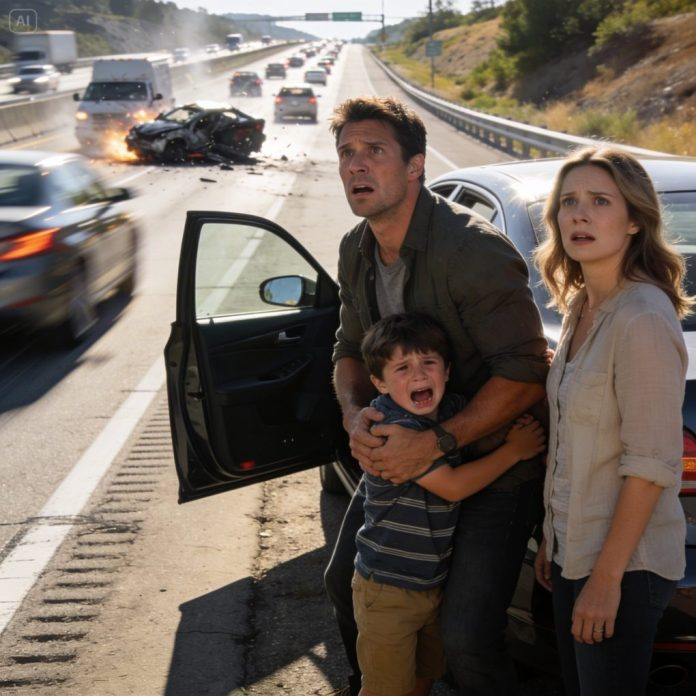
Just ten minutes into our family road trip, my husband abruptly swerved the car to the side of the highway.
“Out of the car—now!” he shouted.
Before I could react, he ripped off our seatbelts and dragged me and our four-year-old onto the roadside.
“Daddy, I’m scared!” our son cried.
Then, in the very next second, something terrifying unfolded before my eyes—leaving me frozen in disbelief.
Just ten minutes into our family road trip, my husband abruptly swerved the car onto the shoulder of the highway.
Just ten minutes into our family road trip, my husband abruptly swerved the car to the side of the highway.
“Out of the car—now!” he shouted.
Before I could react, he ripped off our seatbelts and dragged me and our four-year-old onto the roadside.
“Daddy, I’m scared!” our son cried.
Then, in the very next second, something terrifying unfolded before my eyes—leaving me frozen in disbelief.
Just ten minutes into our family road trip, my husband abruptly swerved the car onto the shoulder of the highway.
One second we were laughing about how many stuffed animals our four-year-old son, Mason, had somehow smuggled into the back seat, and the next, my husband, Aaron, had both hands locked on the steering wheel, eyes fixed on the dashboard with a look I had never seen before. He was an engineer, methodical and calm, the kind of man who checked tire pressure before long drives and packed emergency kits with labeled batteries. Panic did not belong on his face.
But panic was exactly what I saw.
The car lurched hard to the right. Gravel sprayed beneath the tires. My shoulder slammed against the passenger door.
“Aaron, what are you doing?” I yelled.
He didn’t answer. He had already thrown the gear into park.
“Out of the car—now!” he shouted.
Before I could react, he was unbuckling my seatbelt with shaking hands, then reaching into the back to rip open Mason’s car seat straps. Mason started crying instantly, confused and terrified by the force in his father’s voice.
“Daddy, I’m scared!”
“I know, buddy, I know,” Aaron said, his own voice tight with urgency. “But you have to come with me right now.”
He grabbed Mason, seized my wrist, and practically dragged us away from the car, stumbling down the embankment beside the highway. I twisted once, trying to pull free, trying to understand if he had seen smoke or smelled gas or lost his mind entirely. But the expression on his face stopped every protest.
He was not overreacting.
He was racing something invisible.
We had barely made it fifteen yards from the car when it happened.
First came a sharp metallic crack from underneath the vehicle, like a giant wrench snapping in half. Then the front of the SUV dropped violently on one side. A second later, flames burst from beneath the engine, sudden and orange and impossibly fast. Not smoke first. Not a warning hiss. Fire.
I froze where I stood.
Within seconds, thick black smoke poured upward. Drivers in the passing lane began braking. Someone leaned on their horn. Another car swerved around ours. Mason buried his face in Aaron’s shoulder, sobbing.
I couldn’t move.
Aaron pulled me farther back just as a violent pop exploded from under the hood and glass sprayed across the asphalt.
My knees almost gave out.
“Oh my God,” I whispered. “Oh my God.”
A truck pulled over ahead of us. Two men ran toward the guardrail, one already dialing 911. I stared at our burning SUV, at the suitcases visible through the back window, at the children’s snacks still in the cup holders, at the ordinary life we had packed for a three-day trip now being swallowed whole by flames.
Aaron was breathing hard, clutching Mason so tightly our son whimpered.
“How did you know?” I asked, voice shaking.
He didn’t answer immediately.
He just looked at the fire.
Then, without taking his eyes off the car, he said quietly, “Because that wasn’t an accident.”
I turned to him, certain I had misheard.
But the look on his face told me I hadn’t.
And then, over the sound of sirens growing in the distance, he said the words that made my blood run cold.
“I found something under the car this morning. I thought I was wrong. I prayed I was wrong.”
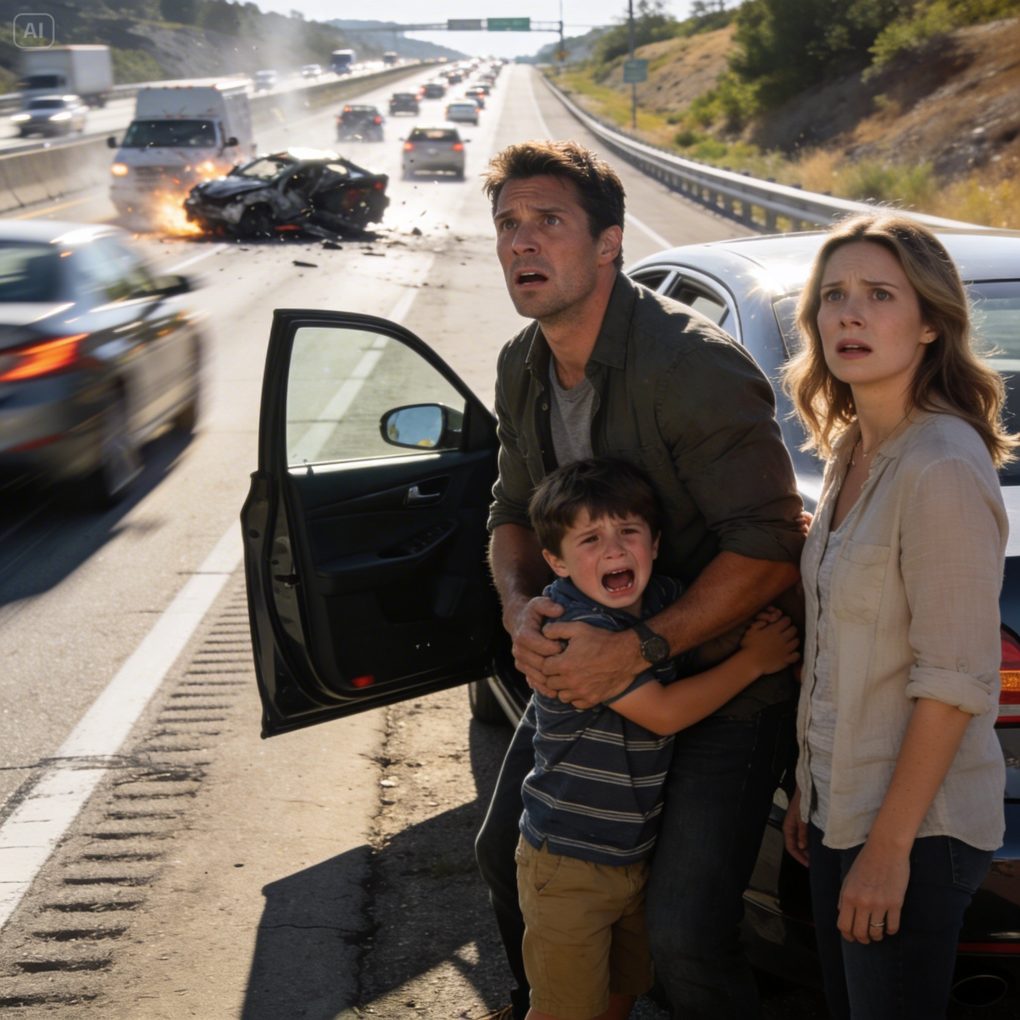
I stared at him as the fire spread through the front of the SUV.
“What do you mean, something?” I asked.
Aaron finally looked at me, and I could see guilt all over his face.
“This morning, when I loaded the cooler into the trunk, I dropped the house keys,” he said. “They slid under the passenger side. When I crouched down to get them, I saw a small black device strapped near the undercarriage.”
For a second, none of it made sense.
“A device?”
“I thought it might be a tracker,” he said. “Or some kind of stolen part, maybe road debris caught up there. I couldn’t see it clearly, and I didn’t want to scare you before I knew what it was.”
My mouth fell open. “So you said nothing?”
“I was going to stop at the first gas station with decent light and check it properly.” His voice cracked. “But then, once we got on the highway, I noticed a burning smell. A chemical smell. Then the temperature gauge spiked, dropped, and spiked again. That’s when I knew whatever was under there wasn’t harmless.”
The sirens were close now. Mason had quieted to frightened hiccups against Aaron’s neck. I took him from Aaron’s arms and held him, though my own hands were shaking so badly I could barely manage it.
A state trooper arrived first, followed by firefighters. Traffic slowed to a crawl. The flames were beaten back quickly, but by then the front half of the SUV was ruined. An officer led us farther from the shoulder and asked if anyone was injured. I answered automatically, still half inside Aaron’s last sentence.
That wasn’t an accident.
The words kept repeating in my head.
A fire investigator joined the firefighters near the vehicle. Aaron spoke to the trooper in low, clipped details. I watched the officer’s expression change almost imperceptibly from routine concern to alert focus.
Then the trooper walked back to us.
“Ma’am,” he said carefully, “your husband mentioned he may have seen an object attached under the vehicle before departure. We’re treating this as suspicious until proven otherwise.”
The highway seemed to tilt.
Suspicious.
Not faulty. Not unfortunate. Suspicious.
I looked at Aaron. “Who would do this?”
He didn’t answer right away, which terrified me more than if he had named someone immediately. It meant he had already been thinking about it.
Finally, he said, “There is one person.”
I felt cold all over.
Two weeks earlier, Aaron had testified in a civil case involving a construction company he used to consult for. The company had been accused of falsifying safety inspection reports after a parking structure partially collapsed, injuring several people. Aaron had found inconsistencies in the engineering records and refused to sign off on revised documentation. He later handed over emails showing supervisors knew about the defects before the collapse.
After that, strange things began happening.
A car sat outside our house twice in one week. Aaron received two calls from blocked numbers. One night, our side gate was left open even though we always kept it latched. He told me about the calls, but downplayed them. Said it was probably intimidation, probably bluffing by angry men desperate to avoid liability.
“Probably?” I repeated, my voice rising. “You thought this was probably bluffing?”
He looked wrecked. “I didn’t think they’d come near you or Mason.”
A detective arrived before the tow truck did. By then, Mason had fallen asleep against me from pure emotional exhaustion. The detective asked Aaron for every detail he could remember about the device, the calls, the case, the names involved. Then he asked the question I didn’t want asked.
“Did anyone know your travel plans?”
I answered before Aaron could.
“Family. A few friends. My sister saw the packed car when she dropped off a gift for Mason yesterday.”
The detective wrote that down.
And suddenly a different kind of horror opened inside me.
Because if someone had known when we were leaving, then they had not just targeted my husband.
They had waited for all three of us to be inside the car.
Part 3
By the time we reached a hotel that evening under police instruction, I felt like my body no longer belonged to me.
Mason was exhausted, confused, and clung to me every time Aaron stepped more than a few feet away. The police had taken the remains of the SUV for forensic examination, and the detective told us not to return home until officers had searched the property. Those words alone would have been enough to shatter an ordinary day. But what came next made it even worse.
Just after sunset, the detective called Aaron’s cell.
The fire had not been caused by a mechanical failure.
Remnants of an incendiary device had been recovered beneath the front half of the vehicle. It was crude, but deliberate—designed to ignite after heat and road vibration built up. Not sophisticated enough to suggest some shadowy mastermind. Worse than that, in a way. It suggested someone reckless, angry, and personal.
This was attempted murder.
I sat on the edge of the hotel bed staring at the patterned carpet while Aaron listened in silence. When he ended the call, I already knew from his face.
Mason was asleep in the other bed. The room was dim. For a long moment, neither of us spoke.
Then I asked, “Was it because of the case?”
Aaron sank into the chair across from me and pressed both hands over his mouth. “I don’t know,” he said. “But I know something else now.”
He had not told me everything.
Three days before our trip, one of the defendants in the lawsuit—a project manager named Victor Hale—had approached Aaron in the parking garage outside his office. Not to threaten him directly. Men like Victor rarely do things so cleanly. He simply stepped too close and said, You should think harder about what accidents do to families. Aaron had reported the encounter to the company’s legal team, who told him not to engage and promised to document it.
He hadn’t told me because he didn’t want to ruin the trip, didn’t want to frighten me, didn’t want to believe it was serious.
I cried then—not loudly, because Mason was sleeping—but with the kind of shaking grief that comes from standing too close to disaster and only realizing it afterward. I cried for the sound of Mason screaming on the roadside. For the image of our car burning. For the fifteen seconds between ordinary life and catastrophe. For the fact that my husband had tried to carry fear alone and nearly lost all of us because of it.
Victor Hale was arrested four days later.
Not because justice is magically swift, but because frightened people make mistakes when they act in a rage. Security footage near our neighborhood showed a rental truck following Aaron home the night before the trip. A store receipt tied to materials used in the device led investigators to a purchase made with a card belonging to Victor’s cousin. Phone records and toll camera data did the rest. Under pressure, the cousin admitted Victor had wanted to “scare” Aaron into withdrawing his testimony. Whether he truly meant only fear or something much worse no longer mattered.
He had strapped fire beneath a family car.
That truth spoke for itself.
We did take a road trip again, eventually. Not for months. The first time Aaron turned the key in a new vehicle, I felt my throat tighten. The first time Mason asked, “This car is safe, right?” I had to look away before answering. Survival does not erase terror. It teaches you how deeply normal life can crack in one second.
But it also teaches you what remains.
Aaron saw something wrong and trusted his instincts in time. He got us out. He carried our son into safety. And because of those frantic seconds on the side of the highway, Mason is still here to ask questions from the back seat, to lose toy dinosaurs under chairs, to fall asleep holding juice boxes he never finishes.
Some moments divide a life into before and after. Ours happened on the shoulder of a highway with gravel under our shoes and fire in the mirror behind us. And if this story stays with you, maybe it is because the most terrifying dangers are often the ones hidden beneath ordinary things—until one instinct, one shout, one desperate decision pulls the people you love clear in time.