It began with a sound that didn’t belong on that quiet suburban street.
A deep, thunderous roar—felt in the chest before it ever reached the ears.
Four Harley-Davidsons rolled in like distant storms, slicing through the afternoon calm. Black leather vests patched with skulls and worn emblems gleamed under the sun. Their shadows stretched long across the hot pavement, dark and imposing, like a warning.
Curtains twitched.
Parents hurriedly called their children indoors. Even the breeze seemed to hesitate as the bikes came to a stop. These men didn’t belong here—steel and noise in a world of trimmed lawns and silence.
And then, cutting through the rumble, came a voice.
Small.
Shaky.
And filled with a desperation no child should ever carry.
“Sir… would you buy my bike?”
The leader of the group—a massive man everyone called Ryder—hit the brakes. One by one, the engines dropped to a low, heavy rumble, like a beast settling into sleep.
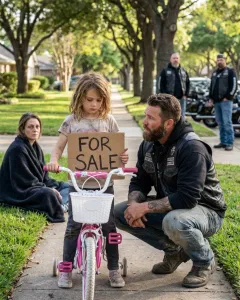
Standing at the curb was a little girl, no older than six.
Her blonde hair was messy, her dress carefully neat in a way that tried—and failed—to hide the truth. Her shoes were worn thin, telling stories of long walks with nowhere to go. Beside her stood a small pink bicycle with a white basket, glowing with the innocence of childhood.
In her hands, she clutched a piece of cardboard with crayon letters scrawled across it:
FOR SALE
Ryder killed the engine.
The silence that followed was deafening.
He swung off his bike, heavy boots striking the pavement. A few neighbors held their breath. Ryder knelt down in front of the girl, bringing himself to her eye level.
“How old are you, sweetheart?” he asked.
His voice—unexpectedly—was gentle.
“My name’s Mila,” she whispered.
Ryder looked into her eyes and felt something cold settle in his chest. They were big and clear, but behind them was something that didn’t belong there.
Exhaustion.
Not the kind from play—but the kind that comes from worry.
Behind her, beneath the shade of an old oak tree, Ryder noticed a woman slumped against the trunk. Young, but hollowed out. Wrapped in a thin blanket despite the heat, her skin pale, her body barely holding itself upright.
Ryder swallowed hard.
“Why are you selling your bike, Mila?” he asked quietly.

Her fingers tightened around the cardboard until her knuckles turned white. She took a breath, fighting tears.
“Please, sir… my mom hasn’t eaten in two days. She says she’s not hungry, but I know she’s lying. I just want her to eat.”
Something inside Ryder broke.
Beneath the tattoos, the leather, the reputation—there was a man who had buried a son, a man who believed his faith in people had died long ago. But kneeling on that sun-baked pavement, listening to a child beg for food for her mother, he felt a different fire ignite.
Not pity.
Righteous anger.
Behind him, Tank, Viper, and Mason shut off their bikes. No words were exchanged. They didn’t need to be. One look was enough.
Ryder pulled out his wallet—thick, worn—and peeled off a stack of bills. He gently placed the money into Mila’s small hand.
“Keep the bike,” he said, his voice rough. “This is for you and your mom.”
Mila stared at the cash, then at him. Tears spilled freely now. She turned and ran toward the tree, shouting for her mother.
Ryder stood.
The tenderness drained from his face, replaced by something colder. More focused.
Money would fix today.
But not what caused this.
And Ryder knew exactly who was responsible.
Mila’s mother, Claire, had once been a model employee at one of the city’s largest catering companies—owned by a man named Howard Hensley.
Publicly, Hensley was a community pillar. Smiling magazine covers. Charity galas—always with cameras.
Privately, he saw people as numbers.
When the company “restructured” to boost profits, Claire was fired without hesitation. She begged. Explained she was a single mother. Asked for time.
Hensley never looked up from his phone.
“Everyone’s replaceable,” he said. “If you can’t feed your kid, that’s not the company’s problem.”
After that, everything collapsed fast.
Savings vanished.
Bills piled up.
The apartment was gone.
Until all that remained was hunger—and a little girl selling her bike.
What Hensley hadn’t accounted for was balance.
Sometimes karma doesn’t arrive in court papers.
Sometimes it comes on four Harleys.
The bikers rode straight through downtown, traffic parting instinctively. They parked directly in front of Hensley’s glass tower, ignoring the signs and the security guard who wisely chose not to intervene.
They stormed the lobby like a coming storm. Boots echoed across marble floors. The receptionist froze as they passed.
On the top floor, Hensley was admiring his city.
The office door slammed open.
“What is this supposed to—” he began.
Then he saw Ryder.
Ryder walked to the desk and placed something on its polished surface.
The cardboard sign.
FOR SALE
Hensley’s throat tightened.
“That,” Ryder said calmly, “is the price of your greed.”
He leaned forward.
“There’s a six-year-old girl named Mila selling her pink bike so her mother can eat. Her mother—Claire—the woman you fired two months ago for prettier quarterly numbers.”
Hensley tried to speak. Failed.
“This isn’t business,” Ryder continued. “This is life. She’s starving under a tree while you pick wine for dinner.”
Tank, Viper, and Mason stood silently behind him—an unmoving wall.
“You have one chance,” Ryder said. “You can’t buy forgiveness. But you can do the right thing. Right now.”
Silence filled the room.
Finally, Hensley nodded.
That afternoon, calls were made. Checks were signed.
At sunset, the bikers returned to the park.
Claire was awake now, weak but sitting up. Food and water beside her. When Mila saw them, she ran forward and wrapped her arms around Ryder’s leg.
“Ryder!” she laughed.
Claire stood slowly, tears in her eyes.
“He called me,” she said. “He gave me my job back. Paid a year of rent near Mila’s school. He said he made a terrible mistake.”
She looked at Ryder.
“Was it you?”
Ryder shrugged.
“Sometimes people just need a reminder.”
That night, under glowing streetlights, the bikers stayed. They shared food. Laughed. Watched Tank try—and fail—to ride a tiny pink bike.
People stopped and stared.
Leather and steel beside a fragile mother and a laughing child.
And they understood something important.
Kindness doesn’t wear a uniform.
And sometimes, angels smell like gasoline.
The FOR SALE sign lay forgotten in the grass.
Because that night, nothing had to be sold.
And for one family—and one town—that made all the difference.