They brought Carla,” she cut in cheerfully. “She’s still a nurse, remember? She’s riding behind Gus with my medication in a saddlebag.”
They had actually planned this.
Eight retired bikers had pulled off a hospital extraction at three in the morning.
“Mom,” I whispered, somewhere between panic and amazement, “where are you going?”
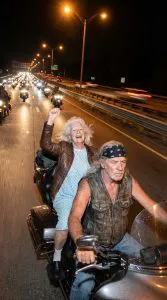
“To the coast!” she shouted over the rushing wind. “We’re going to watch the sunrise over the Atlantic. Just like the summer your father and I met.”
Then her voice softened.
“I’m wearing his jacket. I can still smell him in the leather.”
I slid down against the kitchen cabinets and sat on the cold tile floor.
For the first time in two years, my mother sounded alive.
I didn’t call the police.
I didn’t call the hospital.
I just listened to the engines roaring and my mother laughing like she had outrun death.
PART 1 — The Woman Who Refused to Wait
My mother stopped laughing the day she received her diagnosis.
Stage-four pancreatic cancer.
No surgery. No remission. No miracles left to promise.
That was two years ago.
By the time she ended up in Room 412 at Greene County Medical Center, she barely resembled the woman who raised me. Lena Callahan had spent forty years riding on the back of a Harley. She married my father, Frank “Red” Callahan, at nineteen in a courthouse while wearing borrowed boots and a denim jacket that was far too big.
She raised three daughters in a house that always smelled faintly of leather, gasoline, and burnt coffee.
https://googleads.g.doubleclick.net/pagead/ads?gdpr=0&us_privacy=1—&gpp_sid=-1&client=ca-pub-3507041317734956&output=html&h=280&adk=1903688604&adf=1054744041&pi=t.aa~a.1381849204~i.24~rp.4&w=620&fwrn=4&fwrnh=100&lmt=1773335333&rafmt=1&armr=3&sem=mc&pwprc=9535884638&ad_type=text_image&format=620×280&url=https%3A%2F%2Ffanstopis.com%2F%3Fp%3D24464%26fbclid%3DIwY2xjawQf0m5leHRuA2FlbQIxMABicmlkETFHVThGamlMcUlmeVN2WXpqc3J0YwZhcHBfaWQQMjIyMDM5MTc4ODIwMDg5MgABHvhVeQPK4CmOUUYwbRjpAMu8GysD8HK9Gz75E5cFgYLVo23-bK6zifX76J_f_aem_4Orp13Qsl4OBKJU2Yzew0A&fwr=0&pra=3&rh=155&rw=620&rpe=1&resp_fmts=3&aieuf=1&aicrs=1&fa=27&uach=WyJXaW5kb3dzIiwiMTAuMC4wIiwieDg2IiwiIiwiMTQ2LjAuNzY4MC43MSIsbnVsbCwwLG51bGwsIjY0IixbWyJDaHJvbWl1bSIsIjE0Ni4wLjc2ODAuNzEiXSxbIk5vdC1BLkJyYW5kIiwiMjQuMC4wLjAiXSxbIkdvb2dsZSBDaHJvbWUiLCIxNDYuMC43NjgwLjcxIl1dLDBd&abgtt=6&dt=1773335333021&bpp=3&bdt=3755&idt=-M&shv=r20260309&mjsv=m202603050101&ptt=9&saldr=aa&abxe=1&cookie=ID%3Da1fd618e1ac9c775%3AT%3D1765124774%3ART%3D1773335155%3AS%3DALNI_MZkJKOd3g8ndkCqgg_gkhFM-Xqtaw&gpic=UID%3D000012d26cd4a9ef%3AT%3D1765124774%3ART%3D1773335155%3AS%3DALNI_MaKqnM9jtqGRwnQpoZDJU5Wfp46ig&eo_id_str=ID%3Dc747805477639525%3AT%3D1765124774%3ART%3D1773335155%3AS%3DAA-Afjb0g3I1h5rMouZRq2Bl28XK&prev_fmts=0x0%2C980x280&nras=3&correlator=590854030619&frm=20&pv=1&u_tz=300&u_his=1&u_h=768&u_w=1360&u_ah=728&u_aw=1360&u_cd=32&u_sd=1&dmc=8&adx=203&ady=2320&biw=1345&bih=641&scr_x=0&scr_y=0&eid=31097123%2C95378425%2C95381490%2C95383700%2C95384193%2C95385043%2C95384715&oid=2&pvsid=6610433042035273&tmod=774145278&uas=0&nvt=1&ref=https%3A%2F%2Fl.facebook.com%2F&fc=1408&brdim=0%2C0%2C0%2C0%2C1360%2C0%2C1360%2C728%2C1360%2C641&vis=1&rsz=%7C%7Cs%7C&abl=NS&fu=128&bc=31&bz=1&num_ads=1&ifi=3&uci=a!3&btvi=1&fsb=1&dtd=768
She could rebuild an engine carburetor faster than most people could open a bottle of beer.
Waiting had never been her style.
Life used to chase her—not the other way around.
When my father died from a heart attack nine years earlier, something inside her dimmed. When the cancer came, the last remaining spark seemed to fade completely.
In the hospital bed, she grew smaller.
Her fiery red hair turned thin and silver. Her voice softened into a fragile whisper. She spent hours staring at the television as if it might explain why her body had suddenly betrayed her.
The chemotherapy had ended.
It hadn’t helped.
All that remained was pain management… and time.
And my mother hated waiting.
I visited every afternoon after work. I brought homemade soup, fresh flowers, and photo albums from the years when she and Dad rode along the Blue Ridge Parkway, smiling into the wind.
She would smile politely.
But her eyes always looked somewhere far away.
Then, at 3:22 a.m. on a Tuesday, my phone rang.
MOM.
I sat upright instantly, heart racing.
This is the call, I thought. The one I’ve been expecting.
I answered.
“Mom?”
Laughter.
Not a weak chuckle.
A loud, reckless laugh I hadn’t heard in years.
“Emma! Honey! I’m on a bike!”
For a moment, the words didn’t even make sense.
“What?”
“I’m riding on Ray’s bike! We’re on the highway!”
Wind blasted through the phone. Engines roared in the background.
My chest tightened. “Mom, what are you talking about? You’re supposed to be in the hospital!”
“Not anymore!”
She pulled the phone away from her mouth for a second. The unmistakable thunder of multiple Harleys filled the line.
“Your father’s club came for me, sweetheart.”

My brain struggled to catch up.
Ray Donovan—my dad’s closest friend. President of the Iron Legacy Motorcycle Club. A man who had stood beside my father through layoffs, funerals, and decades of road trips.
“They walked right into my room,” Mom said breathlessly. “Ray looked at me and said, ‘Lena, Frank would haunt us if we let you die in this bed. Get up. We’re taking you for a ride.’”
I jumped out of bed.
“Mom, you have an IV line. A central port. Oxygen—”
“They brought Carla,” she cut in cheerfully. “She’s still a nurse, remember? She’s riding behind Gus with my medication in a saddlebag.”
They had actually planned this.
Eight retired bikers had pulled off a hospital extraction at three in the morning.
“Mom,” I whispered, somewhere between panic and amazement, “where are you going?”
https://googleads.g.doubleclick.net/pagead/ads?gdpr=0&us_privacy=1—&gpp_sid=-1&client=ca-pub-3507041317734956&output=html&h=280&adk=1903688604&adf=3240102427&pi=t.aa~a.1381849204~i.107~rp.4&w=620&fwrn=4&fwrnh=100&lmt=1773335419&rafmt=1&armr=3&sem=mc&pwprc=9535884638&ad_type=text_image&format=620×280&url=https%3A%2F%2Ffanstopis.com%2F%3Fp%3D24464%26fbclid%3DIwY2xjawQf0m5leHRuA2FlbQIxMABicmlkETFHVThGamlMcUlmeVN2WXpqc3J0YwZhcHBfaWQQMjIyMDM5MTc4ODIwMDg5MgABHvhVeQPK4CmOUUYwbRjpAMu8GysD8HK9Gz75E5cFgYLVo23-bK6zifX76J_f_aem_4Orp13Qsl4OBKJU2Yzew0A&fwr=0&pra=3&rh=155&rw=620&rpe=1&resp_fmts=3&aieuf=1&aicrs=1&fa=27&uach=WyJXaW5kb3dzIiwiMTAuMC4wIiwieDg2IiwiIiwiMTQ2LjAuNzY4MC43MSIsbnVsbCwwLG51bGwsIjY0IixbWyJDaHJvbWl1bSIsIjE0Ni4wLjc2ODAuNzEiXSxbIk5vdC1BLkJyYW5kIiwiMjQuMC4wLjAiXSxbIkdvb2dsZSBDaHJvbWUiLCIxNDYuMC43NjgwLjcxIl1dLDBd&abgtt=6&dt=1773335332956&bpp=3&bdt=3690&idt=3&shv=r20260309&mjsv=m202603050101&ptt=9&saldr=aa&abxe=1&cookie=ID%3Da1fd618e1ac9c775%3AT%3D1765124774%3ART%3D1773335155%3AS%3DALNI_MZkJKOd3g8ndkCqgg_gkhFM-Xqtaw&gpic=UID%3D000012d26cd4a9ef%3AT%3D1765124774%3ART%3D1773335155%3AS%3DALNI_MaKqnM9jtqGRwnQpoZDJU5Wfp46ig&eo_id_str=ID%3Dc747805477639525%3AT%3D1765124774%3ART%3D1773335155%3AS%3DAA-Afjb0g3I1h5rMouZRq2Bl28XK&prev_fmts=0x0%2C980x280%2C620x280%2C300x600&nras=5&correlator=590854030619&frm=20&pv=1&u_tz=300&u_his=2&u_h=768&u_w=1360&u_ah=728&u_aw=1360&u_cd=32&u_sd=1&dmc=8&adx=203&ady=6665&biw=1345&bih=641&scr_x=0&scr_y=4102&eid=31097123%2C95378425%2C95381490%2C95383700%2C95384193%2C95385043%2C95384715&oid=2&pvsid=6610433042035273&tmod=774145278&uas=3&nvt=1&ref=https%3A%2F%2Fl.facebook.com%2F&fc=1408&brdim=0%2C0%2C0%2C0%2C1360%2C0%2C1360%2C728%2C1360%2C641&vis=1&rsz=%7C%7Cs%7C&abl=NS&fu=128&bc=31&bz=1&num_ads=1&ifi=4&uci=a!4&btvi=3&fsb=1&dtd=86155
“To the coast!” she shouted over the rushing wind. “We’re going to watch the sunrise over the Atlantic. Just like the summer your father and I met.”
Then her voice softened.
“I’m wearing his jacket. I can still smell him in the leather.”
I slid down against the kitchen cabinets and sat on the cold tile floor.
For the first time in two years, my mother sounded alive.
I didn’t call the police.
I didn’t call the hospital.
I just listened to the engines roaring and my mother laughing like she had outrun death.
PART 2 — The Ride That Broke the Rules
By 8:00 a.m., my phone wouldn’t stop ringing.
Voicemails from the hospital. Messages from unknown numbers. One from the hospital administrator, Thomas Keller.
“Ms. Callahan, your mother has been unlawfully removed from our care. This is a serious legal matter.”
Unlawfully removed.
As if she were stolen property.
I drove to the hospital anyway.
Room 412 was empty.
The bed was stripped. Machines silent. Nurses whispered nervously in the hallway.
Administrator Keller met me in his office—a man in his mid-fifties wearing a sharp suit and a gold watch worth more than my car.
https://googleads.g.doubleclick.net/pagead/ads?gdpr=0&us_privacy=1—&gpp_sid=-1&client=ca-pub-3507041317734956&output=html&h=280&adk=1903688604&adf=3305048599&pi=t.aa~a.1381849204~i.145~rp.4&w=620&fwrn=4&fwrnh=100&lmt=1773335420&rafmt=1&armr=3&sem=mc&pwprc=9535884638&ad_type=text_image&format=620×280&url=https%3A%2F%2Ffanstopis.com%2F%3Fp%3D24464%26fbclid%3DIwY2xjawQf0m5leHRuA2FlbQIxMABicmlkETFHVThGamlMcUlmeVN2WXpqc3J0YwZhcHBfaWQQMjIyMDM5MTc4ODIwMDg5MgABHvhVeQPK4CmOUUYwbRjpAMu8GysD8HK9Gz75E5cFgYLVo23-bK6zifX76J_f_aem_4Orp13Qsl4OBKJU2Yzew0A&fwr=0&pra=3&rh=155&rw=620&rpe=1&resp_fmts=3&aieuf=1&aicrs=1&fa=27&uach=WyJXaW5kb3dzIiwiMTAuMC4wIiwieDg2IiwiIiwiMTQ2LjAuNzY4MC43MSIsbnVsbCwwLG51bGwsIjY0IixbWyJDaHJvbWl1bSIsIjE0Ni4wLjc2ODAuNzEiXSxbIk5vdC1BLkJyYW5kIiwiMjQuMC4wLjAiXSxbIkdvb2dsZSBDaHJvbWUiLCIxNDYuMC43NjgwLjcxIl1dLDBd&abgtt=6&dt=1773335332970&bpp=3&bdt=3704&idt=3&shv=r20260309&mjsv=m202603050101&ptt=9&saldr=aa&abxe=1&cookie=ID%3Da1fd618e1ac9c775%3AT%3D1765124774%3ART%3D1773335155%3AS%3DALNI_MZkJKOd3g8ndkCqgg_gkhFM-Xqtaw&gpic=UID%3D000012d26cd4a9ef%3AT%3D1765124774%3ART%3D1773335155%3AS%3DALNI_MaKqnM9jtqGRwnQpoZDJU5Wfp46ig&eo_id_str=ID%3Dc747805477639525%3AT%3D1765124774%3ART%3D1773335155%3AS%3DAA-Afjb0g3I1h5rMouZRq2Bl28XK&prev_fmts=0x0%2C980x280%2C620x280%2C300x600%2C620x280&nras=6&correlator=590854030619&frm=20&pv=1&u_tz=300&u_his=2&u_h=768&u_w=1360&u_ah=728&u_aw=1360&u_cd=32&u_sd=1&dmc=8&adx=203&ady=8226&biw=1345&bih=641&scr_x=0&scr_y=5669&eid=31097123%2C95378425%2C95381490%2C95383700%2C95384193%2C95385043%2C95384715&oid=2&pvsid=6610433042035273&tmod=774145278&uas=1&nvt=1&ref=https%3A%2F%2Fl.facebook.com%2F&fc=1408&brdim=0%2C0%2C0%2C0%2C1360%2C0%2C1360%2C728%2C1360%2C641&vis=1&rsz=%7C%7Cs%7C&abl=NS&fu=128&bc=31&bz=1&num_ads=1&ifi=5&uci=a!5&btvi=4&fsb=1&dtd=87825
“This is reckless endangerment,” he snapped. “Your mother is terminal. Removing her could accelerate complications.”
“She wanted to go,” I replied calmly.
“She was not medically cleared—”
“She is dying,” I interrupted. “Cleared for what? More waiting?”
He stiffened.
“Hospitals follow protocols.”
“And humanity follows the heart.”
We stared at each other.
He didn’t understand.
At 9:12 a.m., my phone buzzed.
A photo.
Grainy. Taken in the early dawn light. My mother sitting on the back of Ray’s motorcycle. The ocean stretching behind her as the sunrise turned the sky gold.
She looked small inside my father’s oversized leather jacket.
But her face was glowing.
Alive.
Behind her stood the Iron Legacy brothers—weathered men guarding a promise they had made to a friend who was gone.
Keller glanced at the photo.
“This is irresponsible,” he muttered.
“No,” I said quietly. “This is mercy.”
The hospital threatened legal action against the motorcycle club.
But by noon the story had spread online.
By evening it had gone viral.
“Terminal Patient’s Last Ride.”
News vans parked outside the hospital.
Former patients began sharing stories about rigid policies and denied compassionate requests under Keller’s administration.
A former nurse sent me a private message.
“He rejected multiple compassionate discharge requests,” she wrote. “Families begged.”
It wasn’t about safety.
It was about liability.
Two days later, the thunder returned.
Eight Harleys rolled straight up to the hospital’s front entrance in broad daylight.
Ray climbed off his bike slowly.
My mother sat behind him—pale, but glowing.
He carried her back inside himself.
This time staff lined the hallway.
No one tried to stop them.
Because cameras were everywhere.
And public opinion had changed.
Mom squeezed my hand when they placed her back in Room 412.
“Worth it,” she whispered.
Forty-eight hours later, she passed peacefully.
Not staring at a television.
Not asking what time it was.
But smiling softly, with sea salt still tangled in her silver hair.
PART 3 — The Road Without an End
The funeral was anything but quiet.
Three rows of leather jackets and denim filled the front pews.
Ray stood at the podium holding a faded photograph of my parents on their first motorcycle.
https://googleads.g.doubleclick.net/pagead/ads?gdpr=0&us_privacy=1—&gpp_sid=-1&client=ca-pub-3507041317734956&output=html&h=280&adk=1903688604&adf=1636936007&pi=t.aa~a.1381849204~i.243~rp.4&w=620&fwrn=4&fwrnh=100&lmt=1773335441&rafmt=1&armr=3&sem=mc&pwprc=9535884638&ad_type=text_image&format=620×280&url=https%3A%2F%2Ffanstopis.com%2F%3Fp%3D24464%26fbclid%3DIwY2xjawQf0m5leHRuA2FlbQIxMABicmlkETFHVThGamlMcUlmeVN2WXpqc3J0YwZhcHBfaWQQMjIyMDM5MTc4ODIwMDg5MgABHvhVeQPK4CmOUUYwbRjpAMu8GysD8HK9Gz75E5cFgYLVo23-bK6zifX76J_f_aem_4Orp13Qsl4OBKJU2Yzew0A&fwr=0&pra=3&rh=155&rw=620&rpe=1&resp_fmts=3&aieuf=1&aicrs=1&fa=27&uach=WyJXaW5kb3dzIiwiMTAuMC4wIiwieDg2IiwiIiwiMTQ2LjAuNzY4MC43MSIsbnVsbCwwLG51bGwsIjY0IixbWyJDaHJvbWl1bSIsIjE0Ni4wLjc2ODAuNzEiXSxbIk5vdC1BLkJyYW5kIiwiMjQuMC4wLjAiXSxbIkdvb2dsZSBDaHJvbWUiLCIxNDYuMC43NjgwLjcxIl1dLDBd&abgtt=6&dt=1773335332992&bpp=3&bdt=3726&idt=3&shv=r20260309&mjsv=m202603050101&ptt=9&saldr=aa&abxe=1&cookie=ID%3Da1fd618e1ac9c775%3AT%3D1765124774%3ART%3D1773335155%3AS%3DALNI_MZkJKOd3g8ndkCqgg_gkhFM-Xqtaw&gpic=UID%3D000012d26cd4a9ef%3AT%3D1765124774%3ART%3D1773335155%3AS%3DALNI_MaKqnM9jtqGRwnQpoZDJU5Wfp46ig&eo_id_str=ID%3Dc747805477639525%3AT%3D1765124774%3ART%3D1773335155%3AS%3DAA-Afjb0g3I1h5rMouZRq2Bl28XK&prev_fmts=0x0%2C980x280%2C620x280%2C300x600%2C620x280%2C620x280&nras=7&correlator=590854030619&frm=20&pv=1&u_tz=300&u_his=2&u_h=768&u_w=1360&u_ah=728&u_aw=1360&u_cd=32&u_sd=1&dmc=8&adx=203&ady=11257&biw=1345&bih=641&scr_x=0&scr_y=8699&eid=31097123%2C95378425%2C95381490%2C95383700%2C95384193%2C95385043%2C95384715&oid=2&pvsid=6610433042035273&tmod=774145278&uas=3&nvt=1&ref=https%3A%2F%2Fl.facebook.com%2F&fc=1408&brdim=0%2C0%2C0%2C0%2C1360%2C0%2C1360%2C728%2C1360%2C641&vis=1&rsz=%7C%7Cs%7C&abl=NS&fu=128&bc=31&bz=1&num_ads=1&ifi=6&uci=a!6&btvi=5&fsb=1&dtd=M
“Frank used to say the road never really ends,” Ray said, his voice shaking. “It just turns into something else. We just wanted to make sure Lena got a good head start.”
As her casket was lowered, engines roared outside the cemetery gates.
But the story didn’t end there.
Public pressure forced Greene County Hospital into an internal investigation.
Emails surfaced showing Keller had rejected multiple compassionate leave requests to protect hospital liability ratings.
Within a month, he resigned while under investigation.
The hospital introduced new end-of-life compassion policies: supervised outings for terminal patients, expanded family authority, and flexible hospice options.
They called it “The Lena Clause.”
The Iron Legacy Motorcycle Club received a county commendation for advocating dignity in end-of-life care.
Ray framed it in the clubhouse beneath my father’s old riding patch.
As for me?
I started volunteering with hospice programs, helping families navigate impossible decisions.
Because I learned something at 3:22 a.m. on that kitchen floor.
Sometimes love doesn’t follow rules.
Sometimes dignity requires defiance.
Every year now, on the anniversary of that ride, we gather by the coast.
Eight bikes became twelve.
Twelve became twenty.
We call it Lena’s Sunrise Ride.
Terminal patients from across the state apply for sponsored “last rides.”
With medical supervision.
With family beside them.
With freedom.
Because a group of aging bikers refused to let a woman who lived wild spend her final days confined.
And every year, when the engines start at dawn and the Atlantic turns gold, I swear I hear it again.
My mother’s laughter.
Loud.
Wild.
Completely free.
The road didn’t end for her.
It simply turned into something else.
And this time, she’s leading the way.