Part 1
My name is Serena Waller, and on the morning of my promotion ceremony at Camp Lejeune, I stood in front of my barracks mirror and told myself one thing over and over: This is yours.
The dress blues fit like a second spine—dark coat pressed sharp enough to cut, brass buttons bright enough to catch the overhead light, the white belt spotless, the cover angled exactly the way the regulations said it should be. The eagle, globe, and anchor at my collar wasn’t just metal. It was the proof I’d earned the right to exist without apology.
Nineteen years old, about to pin on Corporal, and for the first time in my life I felt taller than the people who’d spent years trying to make me small.
The base auditorium smelled like floor polish and starch and that particular kind of pride that gathers when Marines stand in formation. It was loud without being noisy—boots shifting, families whispering, programs rustling, the occasional sharp command that snapped everyone back into place. I stood at parade rest with my platoon, jaw set, eyes forward, hands clasped behind my back.
When the announcer’s voice boomed my name—“Lance Corporal Serena Waller, promoted to Corporal”—the applause rolled through the room like a wave. I stepped out with a crisp, measured stride and started toward the stage.
I didn’t look for Harold first. I didn’t look for Jacob. I looked for my mother.
She sat in the front row, hands folded in her lap like she’d been instructed, her face too still. Beside her, Harold—my stepfather, retired Army colonel and self-appointed judge of everyone’s worth—stared at the American flag like it had personally offended him. He didn’t turn his head when I walked past. He didn’t even blink.
That old pang tried to rise in my chest, the familiar ache of wanting what I shouldn’t want anymore. I shoved it down where it belonged.
This moment was mine.
I was halfway up the stage steps when I felt it—something changing in the air, a subtle shift like a room holding its breath. Out of the corner of my eye, movement near the side entrance.
Jacob.
He stood there in faded jeans and a plain gray T-shirt, arms crossed, leaning against the doorframe like the whole ceremony was beneath him. The disrespect wasn’t accidental. It was his way of spitting without spitting.
His eyes locked onto mine, and my stomach tightened hard enough that for a second I forgot to inhale. I knew that look. I’d known it since I was a kid. It was the look he wore right before he did something cruel, the look that said he could hurt me and nobody would stop him.
He pushed off the wall and started walking—past the seats, past the families, straight toward the stage.
A few people turned their heads. Confusion fluttered through the first few rows. A staff sergeant in the aisle took a half-step forward, hesitated, probably assuming Jacob was late and didn’t know where to go. My commanding officer paused with the new chevrons in his hand, eyes tracking the movement.
Jacob climbed the steps like he belonged there.
The auditorium fell quiet in that way crowds do when they sense danger but don’t want to be the first to admit it.
I couldn’t move fast enough. I couldn’t speak fast enough. My body had the memory of being eight years old and frozen while Jacob broke something I loved and watched me cry.
He closed the distance in two strides.
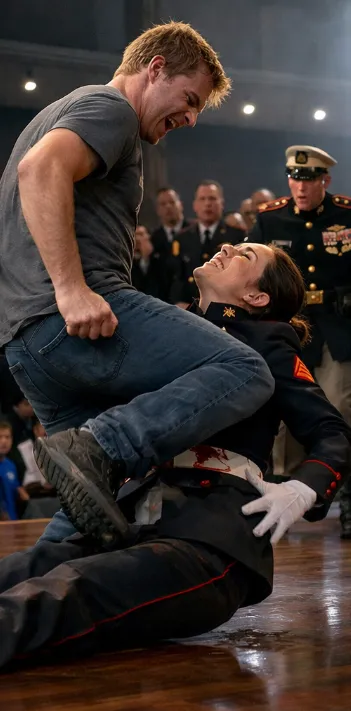
Then he drove his knee into my stomach.
The blow stole the air from my lungs so violently I made a sound I didn’t recognize. Pain burst white-hot, sharp and deep, as if something inside me had been crushed. My knees buckled. I fell hard to the polished stage, my cover rolling away, my hands scrambling for the floor like it could hold me together.
For a split second, it was only pain.
Then came the warm gush.
A spreading wetness against the pristine white belt. A stain blooming crimson where there shouldn’t be any color at all.
I looked down, and my vision blurred.
No. No, no, no.
I had been carrying a secret I hadn’t told anyone on base except the corpsman who’d confirmed the test. I hadn’t told Maria. I hadn’t told Ben. I hadn’t told my chain of command. I’d planned to. Soon. After the ceremony. After I pinned on my stripe. After I made sure this little life inside me had a stable future.
Now the future was spilling onto the stage.
The room wasn’t silent anymore. It was worse than silent. It was stunned—dozens of people locked in shock, like if nobody moved, maybe this wasn’t happening.
Through the haze, my eyes found my mother.
Help me.
She stared at me for a second, her face empty, then turned her head and fixed her gaze on the floor as if she could disappear into it.
That abandonment hurt more than the knee.
Jacob stood over me like a victor.
“She deserved it!” he roared, voice echoing off the auditorium walls. “She’s a disgrace to this family!”
I tried to breathe and couldn’t get more than a thin rasp. My hands shook. I tasted iron. My stomach cramped with a sickening certainty.
Then a voice cut through everything—deep, sharp, absolute.
“Military police!”
General Marcus Thorne moved with disciplined speed, striding toward the stage like the ground belonged to him. He didn’t look at Jacob first. He looked at me, then at the officers frozen near the steps.
“This is an assault on a United States Marine on active duty,” he said, each word landing like a gavel. “Apprehend the suspect and secure the scene. Corpsman, now. We have a Marine down.”
The MPs surged in from the aisle. Jacob’s triumph faltered as hands grabbed his arms and twisted them behind his back. He shouted, fought, cursed, but the training and numbers overwhelmed him in seconds.
General Thorne knelt beside me, his face controlled, eyes assessing.
Behind him, Harold finally stood—fists clenched, jaw tight—not in concern for me, but in fury at the spectacle, at the disgrace of attention.
General Thorne’s head snapped up. His voice rose, not a panic, but a command that filled the hall.
“She just lost the baby.”
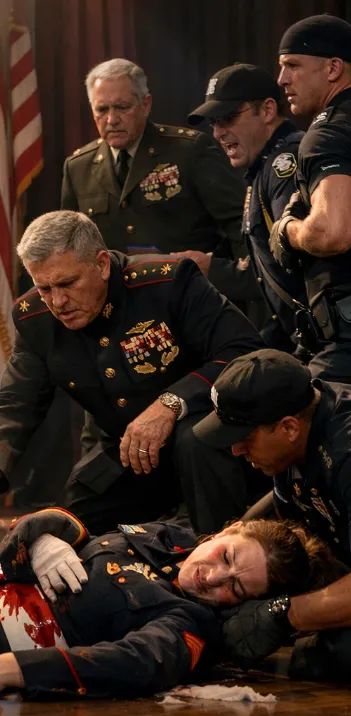
The words hit the auditorium like a physical force. I heard gasps. I heard someone sob. I watched Harold’s face flicker—anger, then calculation. My mother’s hand flew to her mouth as if she’d been wounded by the truth.
I wanted to scream at her. I wanted to laugh. I wanted to vanish.
A corpsman slid to his knees beside me, gloves snapping on, hands steady. “Stay with me, Corporal,” he said. “Look at me. Breathe for me.”
But all I could see was red against white, and the stage lights above, and my mother’s eyes refusing to meet mine.
As they lifted me onto a stretcher, the chevrons lay forgotten on the floor where my promotion had been interrupted. The applause that had welcomed me into my new rank had turned into something else—horror, outrage, a collective realization that this wasn’t a family argument.
This was war.
And the first casualty was the tiny heartbeat I’d just begun to love.
Part 2
The naval hospital smelled like antiseptic and cold air. The walls were too white, the lights too bright, the sheets too crisp—as if the building itself demanded clean outcomes.
I didn’t get one.
A doctor explained the miscarriage in careful terms, like language could soften what my body already knew. He talked about blunt force trauma, internal bleeding, the inevitability once the cramping started. He told me I’d recover physically. He didn’t mention the part that mattered: that something inside me had been stolen in the one moment I’d tried to believe life could be gentle.
When he left, I lay staring at the ceiling tiles, listening to the rhythmic beep of a monitor that tracked a heart that was still mine.
The quiet was dangerous. Quiet meant memory.
By the second night, the pain meds dulled the sharpest edges, but they couldn’t stop my mind from unlocking the room I’d kept sealed for years.
Charleston came back in flashes—humid air, the smell of old carpet, the sound of Harold’s voice over dinner like a judge delivering sentence.
“You don’t have the spine for it, Serena,” he’d sneered when I mentioned the Marines. “You’ll wash out.”
Jacob had laughed like it was a law of nature.
Those words hadn’t started when I chose the Corps. They’d started long before, back when I was eight and the word stepbrother still sounded temporary and harmless.
Jacob was two years older than me, old enough to understand what hurt and young enough to enjoy it. The first time he broke something of mine, it was my favorite doll—a cheap plastic thing with tangled hair I’d brushed until it shone.
He didn’t rip it apart in anger. He did it slowly, twisting the arm until it snapped with a dry crack. Then he held the broken piece out to me with a smile.
“Oops,” he said, and watched my face.
When I cried, my mother told me not to be dramatic.
When I complained, Harold told me to toughen up.
And when Jacob smirked, the household settled into its real shape: Jacob was allowed, and I was tolerated.
The worst memories were never the big ones. They were the small humiliations that taught me my place.
Thanksgiving when I was sixteen, the table crowded with relatives and loud talk. I’d served myself turkey, just one slice, and I was lifting my fork when Jacob leaned forward.
He didn’t say anything. He just spat.
A thick glob landed on the turkey with a wet smack that turned my stomach. My whole body went cold, fork suspended midair, the room suddenly too loud, too bright, too full of faces.
Harold saw it and laughed so hard he wiped his eyes.
“Adds flavor,” he roared. “Eat up.”
My mother snatched my plate—not to confront Jacob, not to defend me, but to erase the evidence.
“Don’t make a scene, Serena,” she hissed in my ear, frantic. “Please. Just let it go.”
She threw the plate away like it was the problem, like I was the problem, then told me to eat side dishes.
That was the lesson: swallow it. Quietly. With a smile.
The memory that came next was high school graduation. Valedictorian. Top of a class of over four hundred. I’d worked until my eyes burned, not because I loved perfection, but because I wanted something so undeniable that even Harold would have to see me.
I bought a simple white dress with money from my part-time bookstore job. Clean. Bright. Mine.
I gave my speech. The auditorium applauded. For one foolish, fragile moment, I saw my mother dab at her eyes and thought maybe something had finally cracked open.
Then we got home.
The party in the backyard was already in full swing. Balloons. Banner. Music.
Except none of it was for me.
Green and silver—Jacob’s football colors. A massive banner between oak trees: CONGRATULATIONS TO OUR FUTURE CHAMPION.
Harold had his arm slung around Jacob, bragging about a scholarship and “scouts calling,” as if Jacob’s half-decent season was equivalent to my years of work.
My mother pressed a tray into my hands.
“Serena, honey, could you take drinks around? Guests are thirsty.”
I walked the lawn in my white dress like hired help. Jacob and his friends swaggered past, and he bumped my tray with his hip.
Red punch poured down the front of my dress, staining it like blood.
“Oops,” he sneered. “Clumsy.”
Across the yard, Harold barked, “Serena, get that cleaned up. Don’t you dare ruin your brother’s party.”
Your brother’s party.
That night, I stared at myself in the dark window of my bedroom—white dress ruined, cheeks streaked with tears I refused to let out loud—and asked a question I’d been asking my whole life.
Was there anywhere on earth where I could be treated like a human being?
The answer came months later, in the form of yellow footprints at Parris Island.
At nineteen, lying in a hospital bed at Camp Lejeune, I understood something I hadn’t fully admitted before: I didn’t join the Marines just to serve.
I joined because I needed a world where rules meant something, where cruelty had consequences, where worth wasn’t decided by a man like Harold and enforced by a bully like Jacob.
And now those two worlds had collided on a stage.
I turned my head toward the window. Outside, North Carolina night pressed against the glass. The base felt far away, yet I could almost hear the echo of General Thorne’s words.
A Marine down.
Not a disgrace. Not a family problem.
A Marine.
It was the first time someone with authority had named me correctly.
And it made me realize: if my family thought they’d killed my future, they didn’t understand what they’d actually done.
They’d just awakened the part of me the Corps had forged.
The part that didn’t beg.
The part that gathered evidence.
The part that finished the fight.
Part 3
Parris Island didn’t feel like rescue when the bus doors opened. It felt like another kind of violence.
The air was thick and wet, buzzing with cicadas, and the screaming started before my boots even hit the ground. Drill instructors moved like storms in campaign covers, voices tearing through the night.
“Get off my bus!”
For the recruits around me, the chaos was shock. For me, it was familiar—yelling, humiliation, being told you were nothing.
But there was a difference that changed everything.
Harold’s rage was personal. Jacob’s cruelty was entertainment. In Charleston, my pain was the point.
At Parris Island, the pain had purpose.
They weren’t trying to destroy me for fun. They were trying to strip me down so they could build something stronger.
The days blurred into a relentless rhythm: pre-dawn runs that turned the world gray, obstacle courses under a sun that felt like punishment, hours cleaning rifles until my hands were raw. I became less Serena and more Recruit Waller, a set of movements and responses drilled into muscle memory.
In the middle of it, I learned something I’d never learned at home: misery shared becomes lighter.
My platoon—women from every corner of the country—started as strangers and quickly became necessity. You learn fast at boot camp that you don’t survive alone. A canteen passed to you when your hands shake. A whispered reminder of the next command. Someone pulling you up when your knees buckle.
The first time I truly understood it was during mail call.
Every evening, the drill instructor would step into the squad bay with a sack of letters. Names were called. Recruits would light up, clutch envelopes like oxygen, some crying quietly, some laughing at inside jokes from home.
I sat on my footlocker and waited, my heart doing something stupid—something hopeful.
I’d written home three times. Short letters. Factual. No begging. Just updates. A small part of me had believed my mother might respond if she saw me building something real.
My name was never called.
Night after night, Waller didn’t echo in the squad bay.
The silence from Charleston was louder than any drill instructor.
One evening, after the last envelope had been distributed and the squad bay hummed with the soft rustle of paper and quiet sniffles, a drill instructor stopped near my footlocker.
Gunnery Sergeant Reyes.
She was compact and hard, eyes sharp enough to pierce armor. She’d chewed out Marines twice her size and made them apologize. She didn’t offer comfort. Comfort wasn’t part of her job.
She looked down at me like she’d been assessing something for weeks.
“Waller,” she said, voice low.
“Yes, ma’am.”
She didn’t yell. She didn’t even sound angry. That made it worse.
“The family you’re looking for isn’t out there,” she said, nodding vaguely toward the world beyond the base. “It’s right here.”
I blinked.
She jerked her chin toward the squad bay—toward the women sharing cookies from home, reading letters out loud, passing photos back and forth like sacred objects.
“These are your sisters,” she said. “Act like it.”
Then she walked away.
The words lodged inside me. Not warm, not comforting. True.
The Crucible came near the end—fifty-four hours designed to break you down and see if you’d stay broken. Little sleep. Little food. Endless movement. Mud that clung like hands. Obstacles that demanded everything you had left.
On the second night, during a long march through swampy trail, my body finally quit.
My legs buckled. My pack felt filled with lead. I hit the mud and couldn’t get air into my lungs.
For a moment, I thought: This is it. I’m done.
Then Jacob’s smirk flashed in my mind. Harold’s voice. My mother turning away.
A surge of rage flooded me, hot and clean. Not chaos. Fuel.
I knew that pain. I’d lived with it my whole life. Physical agony was temporary. Returning to Charleston defeated would be permanent.
I clenched my jaw, tasted mud, forced my palms against the ground, and shoved myself back to my feet.
I marched.
When the Crucible ended, we stood exhausted on the parade deck. The drill instructors—people who had screamed us into dust—approached us one by one, faces altered by a kind of respect that felt almost unreal.
Gunnery Sergeant Reyes stopped in front of me with the eagle, globe, and anchor in her hand.
“Welcome to the brotherhood,” she said, and her voice was thick in a way I didn’t expect.
She pinned the insignia to my collar. The metal bit into my skin. I barely felt it.
What I felt was the dam inside me breaking.
Tears came hot and uncontrollable, sliding down my face as I stood at attention in front of a woman who would’ve smoked me for crying a week earlier. But she didn’t. She just nodded once, like she understood exactly what those tears meant.
They weren’t weakness.
They were arrival.
When I left Parris Island for Camp Lejeune, I carried my new identity like armor. In the Corps, your past mattered less than your performance. You did your job. You had your team’s back. They had yours.
It was simple. Clean. Safe.
At Lejeune, I found friends who didn’t ask me to earn basic dignity.
Maria was a loud Texas Marine who put hot sauce on everything and spoke her mind like it was a duty station. Ben was quiet, from rural Ohio, the kind of guy who could fix anything with a multi-tool and say more with a nod than most people could with a paragraph.
They accepted me the way the Corps often does: you show up, you work hard, you don’t quit. That’s enough.
For the first time in my life, I didn’t have to beg to be included.
Then my nineteenth birthday came, and I didn’t mention it to anyone because birthdays in Charleston had taught me not to expect anything.
I came back to my room after a long day and found it dark. I dropped instinctively into a defensive crouch, heart hammering.
Lights snapped on.
Maria and Ben and half our unit stood grinning around pizza and a crooked cupcake with a cheap candle.
They sang off-key. They laughed at my shocked face. Maria shoved the cupcake into my hands like it was an order.
Ben handed me a small box wrapped badly.
Inside was a simple silver bracelet with a tag etched in two words: Semper Fi.
Always faithful.
I cried so hard I couldn’t breathe, and nobody made fun of me for it.
That bracelet stayed on my wrist after.
Including the day I stared at a pregnancy test from the base exchange and watched two pink lines appear like a miracle and a threat.
Including the day I decided—foolishly—that my promotion ceremony might be the moment my family finally changed.
Part 4
The pregnancy made me feel two opposite things at once.
Fear, because I knew how quickly good things could be taken.
Joy, because for the first time, I could imagine building a family that didn’t run on humiliation and silence. A tiny human who would never have to earn love by carrying trays or swallowing spit.
I didn’t tell anyone at first. Not because I was ashamed, but because the joy was fragile. I wanted to hold it close until I was sure.
Then my promotion date got posted, and something inside me—some old, damaged part that still wanted my mother to look at me with pride—made a decision that, in hindsight, was a tactical error.
I mailed an invitation to Charleston.
No mention of the pregnancy. I wanted to tell them in person, imagining a scene I should’ve known was fantasy: my mother’s face softening, Harold forced into silence by my uniform, Jacob finally realizing he couldn’t touch me anymore.
A few days later, my mother called.
The number flashing on my phone hit me like a jolt—hope and dread welded together. I answered, voice brighter than I felt.
“Hi, Mom.”
Her reply had no warmth. “Serena. I got your invitation.”
A pause, the kind that meant she was choosing the angle.
“Is it really necessary to have such a big ceremony?” she asked.
I blinked, stunned. “What?”
“Well,” she said, dropping into her gentle-reasonable voice, the one designed to make me feel childish. “Jacob’s having a hard time finding a job right now. You being so… successful… it makes him feel bad. It’s putting stress on the family.”
My mouth went dry.
“Mom, it’s my promotion. It’s part of my job.”
“I know, sweetie,” she said, and sweetie felt like a slap. “But family supports each other. Try not to make everything about you.”
When we hung up, guilt tried to seep into my bones like old poison. For a few hours, I actually wondered if I should tone it down, keep my head low, make myself smaller to protect Jacob’s ego.
Then Jacob called.
He didn’t pretend.
“So I hear you’re getting another stripe,” he sneered. “Don’t get a big head. You think that uniform makes you better? You’re still just the stray my mom dragged home. A stain.”
My hand tightened around the phone until my knuckles whitened. I said nothing.
Jacob’s voice sharpened with pleasure at my silence. “I’m coming,” he hissed. “I’m going to show all your little jarhead friends what you really are.”
The line went dead.
Cold fear traced down my spine. Jacob didn’t bluff. He didn’t threaten for attention. He threatened because he meant it.
Then Harold called.
His voice was the one I remembered from childhood—commanding, icy, the voice that made rooms obey.
“Corporal Waller,” he began, using my rank like an insult. “I’ve been informed of your condition.”
My breath caught. My mother had told him. Of course she had.
“You have disgraced the Waller name,” Harold continued. “And you have disgraced that uniform. I expect you to handle this problem quietly and discreetly. And you will cancel that ridiculous ceremony.”
A problem.
My baby.
Something flipped inside me—not rage like a tantrum, but rage like clarity.
I ended the call without permission. My hands trembled afterward, but my mind felt startlingly calm.
I remembered something an instructor had said during a training brief: Your best weapon is credible evidence.
So I went off base and bought a digital voice recorder. I installed a call-recording app. I didn’t know exactly how I’d use it yet. I only knew I was done being the silent victim in their story.
Maria noticed something was wrong the next night at chow. Ben noticed too.
“Everything okay, Waller?” Ben asked, which for him was basically a speech.
“Family stuff,” I muttered.
Maria squeezed my hand. “You got us,” she said. “Remember? We’re your family here.”
That night, my mother called again, and this time her voice was frantic panic.
“Serena, listen—Jacob is on his way. He left hours ago. He’s furious. Please, for my sake, call your commanding officer. Tell them you’re sick. Cancel the ceremony.”
“No,” I said calmly. “I earned this.”
Her panic turned to accusation. “Why do you have to be so difficult? He’s your brother. He’s just hotheaded. You’re going to ruin his future.”
Hotheaded.
I inhaled slowly, and my voice came out measured, dangerous.
“Mom, I was fourteen when his hothead pushed me down a flight of stairs. I was sixteen when he spit on my food and you told me not to make a scene. I’m carrying your grandchild, and you’re begging me to hide to protect him.”
She made a choked sound.
“But he’s Harold’s son,” she whispered, like that explained everything.
And there it was. The final truth. It was never about me. It was always about Harold’s world and Jacob’s place in it.
The last thread of hope turned to ash.
I ended the call and stared at my reflection in the barracks bathroom. I expected to see a scared girl.
Instead, I saw a Marine with cold eyes and a set jaw.
They thought they were cornering a sheep.
They’d backed a wolf into a corner.
I broke protocol the next morning and went straight over ranks to the base commander’s office. I requested an urgent meeting. I brought the recordings. I brought the threats. I spoke like a Marine delivering an intelligence report, not a daughter begging for help.
General Thorne listened without interrupting, his face hardening with each recorded word.
When I finished, he nodded once.
“Thank you, Corporal,” he said. “We will not let this happen on my base.”
He arranged discreet security and alerted military police. He didn’t promise me comfort.
He promised action.
I walked out of his office with my heart hammering and my spine straight, knowing the storm was still coming.
But now, it would hit a wall.
Part 5
The ceremony began like any ceremony: controlled, polished, proud. The Marine Corps is built on the idea that order matters even when life doesn’t.
I stood in formation and focused on breathing. The bracelet on my wrist—Semper Fi—felt cool against my skin. Maria stood two rows behind me. Ben was off to the side, eyes scanning in that quiet, observant way he had. I didn’t know who else in the auditorium was there for security, but I trusted General Thorne’s word more than I’d ever trusted my mother’s.
When my name was called, I stepped forward and started the walk to the stage.
That’s when Jacob appeared at the side entrance, exactly as I’d feared. Jeans. Gray shirt. Smirk.
A few Marines in the aisle shifted. Not random movement—alert movement.
Jacob started toward the stage.
For a second, I thought: They’ll stop him. This is a base. There are rules. There are consequences.
Then Jacob moved faster than expectation. He hit the steps and climbed with an ugly confidence, like he’d done this in his head a thousand times. Like he’d rehearsed hurting me.
I saw an MP step out—but the angle, the distance, the half-second that separates prevention from response, and Jacob was already within reach.
His knee drove into my abdomen like a battering ram.
Pain detonated through me. The auditorium spun. I hit the floor hard, cover rolling away, palms scraping against polished wood.
Then the warmth. The spreading wetness. The impossible red against my white belt.
My body understood before my mind did. A deep cramp that felt like tearing. The tiny hope inside me slipping away.
I looked toward my mother out of instinct, like a child still trapped in my ribs.
She looked at me for one heartbeat, then dropped her gaze to the floor.
Harold stood, not to help, but to glare at me like I’d engineered the scene.
Jacob roared over me, soaking up the shock of the crowd.
“She deserved it! She’s a disgrace!”
Then General Thorne’s voice slammed into the room like a weapon.
“Military police!”
Everything happened fast after that—disciplined fast. MPs converged, hands on Jacob, twisting him away. Jacob fought, cursed, tried to lunge again. It didn’t matter. The Corps doesn’t negotiate with chaos.
General Thorne moved to the stage and knelt beside me, eyes assessing. He didn’t look horrified. He looked precise.
“Corpsman, now,” he ordered.
As the corpsman rushed in, General Thorne lifted his gaze to the front row. His eyes pinned Harold and Linda like targets.
“She just lost the baby,” he said, voice carrying through the stunned auditorium.
It wasn’t sympathy. It was indictment. It was a refusal to let them call it drama or disgrace.
My mother made a small sound like she’d been struck. Harold’s face tightened, but he didn’t move toward me. He didn’t reach out. He didn’t apologize. He just looked furious that a general had spoken the truth out loud.
As the corpsman worked, he spoke to me in calm commands. “Stay with me, Corporal. Breathe. Focus on my voice.”
I tried. I tried so hard.
But grief is physical. It sits in your throat and stomach and chest, heavy as armor.
They lifted me onto a stretcher. I caught one last glimpse of the stage—the dropped chevrons, the spot of blood, the bright lights that had been meant for honor and became a witness stand instead.
As the stretcher rolled past the front row, my mother finally looked up.
Our eyes met.
For a moment, I thought she might say something. Anything. Help. I’m sorry. I didn’t know. Please.
She said nothing.
And that silence, after everything, was the last thing my Charleston life had to offer me.
At the ambulance bay, Maria appeared like a shot, her face pale with fury.
“Oh my God,” she whispered, gripping my hand. “Serena, I’m here.”
Ben stood behind her, jaw clenched, eyes hard. He didn’t speak. He didn’t need to. The look on his face was a promise: this won’t be allowed to vanish.
As the doors closed and the vehicle jolted forward, I stared at the ceiling and let the pain wash through me, because fighting it felt pointless.
But beneath the pain, something else stayed alive.
A cold resolve, forged in mud and discipline and years of surviving cruelty.
Jacob had attacked me in front of my command.
Harold had tried to bury me with shame.
My mother had turned away.
And General Thorne had named me correctly.
A Marine.
If Charleston had been a prison, the Corps was a different kind of world—one that didn’t shrug at violence and call it family.
I didn’t know what justice would look like yet.
But I knew this: I would not be quiet.
Part 6
The legal process started before my bruises stopped blooming.
Because the assault happened on a federal installation, military police held Jacob, then transferred him into a chain of custody that involved civilian authorities and federal jurisdiction. The paperwork was a maze. The emotions were worse.
General Thorne visited once, briefly, and his presence filled the hospital room the way command presence always does—quiet gravity, no wasted movement.
“You did the right thing by reporting the threat,” he said. “You gave us the chance to respond.”
I swallowed against the ache in my throat. “It wasn’t enough.”
His gaze didn’t soften, but it wasn’t cruel either. “It was enough to ensure he’s in custody,” he said. “And it will be enough to ensure he faces consequences.”
A day later, Captain Jessica Morales walked into my room.
She wore Marine dress uniform with the JAG insignia, her hair pulled tight, her expression focused. She introduced herself like a mission briefing.
“I’m assigned as your legal assistance and liaison,” she said. “Because of where it occurred and the impact on readiness and morale, the command wants the case handled aggressively.”
Then her tone shifted, just slightly—human underneath the uniform.
“And because I asked for it,” she added.
I stared at her. “Why?”
Morales held my gaze. “Because I know what it is to be disbelieved by the people who were supposed to protect you,” she said. “And because your recordings are strong. We can build a case that doesn’t rely on anyone’s ‘interpretation’ of family dynamics.”
For the first time since the ceremony, I felt my lungs expand fully.
In the days that followed, grief and discipline fought inside me. Some hours, I stared at the wall and couldn’t remember how to move. Other hours, I sat up with my laptop and transcribed every recording, every threat, every manipulation.
Morales taught me how to organize pain into evidence.
Timeline. Dates. Times. Quotes. Audio files labeled and backed up. Written statements describing childhood incidents, corroborated where possible by school records, old medical visits, anything that showed pattern.
It was brutal. It was surgical.
Maria and Ben rotated visits, bringing coffee, bringing silence when I needed it, bringing laughter when I didn’t think I deserved it. They didn’t ask me to perform strength. They just stayed.
When the hearings began, I walked into the courtroom in my service uniform—not to impress anyone, but because it reminded me who I was. The green jacket sat heavy on my shoulders like responsibility. Like armor.
Jacob’s lawyer tried to turn it into a family dispute. Tried to paint me as unstable, emotional, attention-seeking. He implied the pregnancy was inconvenient, implied the loss was inevitable, implied I’d exaggerated.
Morales didn’t react. She waited.
When Jacob’s lawyer brought up my relationship status, Morales stood.
“Relevance,” she said flatly.
The judge agreed.
When Harold took the stand as a character witness, he did it with the arrogance of a man used to command. He called Jacob “passionate.” He called me “resentful.” He suggested my success had always been an attempt to compete with Jacob.
Morales approached him like a blade wrapped in velvet.
“Colonel Waller,” she said, calm. “As a retired officer, you value honor and accountability, correct?”
Harold puffed up. “Of course.”
“Then you’ll understand the seriousness of threatening a service member and attempting to interfere with official duty,” Morales said. “Did you contact Corporal Waller and refer to her pregnancy as a ‘problem’ she needed to handle quietly?”
Harold’s face darkened. “I did no such thing.”
Morales nodded once. “Understood.”
She turned to the judge. “Your honor, permission to play recorded evidence.”
The audio filled the courtroom—Harold’s voice, cold and commanding, ordering me to cancel the ceremony. Calling my baby a problem. Demanding discretion like it was a matter of family reputation.
Harold went pale in a way I’d never seen. For the first time, his power had a witness.
Then came Jacob’s recording—his promise to come and “show everyone what you are.” His hate. His intention.
The courtroom shifted. You could feel it. Narratives collapse when evidence speaks.
General Thorne testified with the calm authority of thirty years in uniform. He described the ceremony, the assault, Jacob’s shouted justification, the blood on my belt, the corpsman’s urgent response.
When the defense tried to call it misunderstanding, General Thorne’s gaze turned arctic.
“Counselor,” he said, voice low but carrying, “I have seen violence in every form. What happened on that stage was not confusion. It was an intentional assault.”
The verdict didn’t come with drama. It came with gravity.
Guilty.
Jacob was sentenced to years that wouldn’t return what he stole, but would remove him from my life by force of law. Protective orders were put in place. Trespass notices for base property. Conditions that meant if he came near me again, there would be immediate consequences.
After the sentencing, my mother tried to approach me in the hallway.
Her eyes were red. Her hands trembled. She looked small in a way that would’ve moved me once.
“Serena,” she whispered.
I didn’t step toward her.
She started talking—about stress, about Harold, about Jacob’s future being ruined, about shame.
Not once did she ask how I felt. Not once did she say the words I had needed my entire life: I’m sorry I didn’t protect you.
When she finally stopped, she looked at me like she expected forgiveness as a reward for tears.
“If you’d just been more yielding,” she said softly, “none of this would’ve happened.”
I felt something inside me go still.
Not rage. Not heartbreak.
Clarity.
“Mom,” I said quietly, “I’ve been yielding my entire life.”
Her mouth opened, then closed.
“I love you,” I continued, and it was true in the way old wounds remain part of you. “But I can’t live in their shadow anymore. I can’t.”
The words didn’t shake. My hands didn’t tremble.
My mother’s face crumpled like I’d slapped her.
I didn’t comfort her.
I walked away.
Part 7
Winning a case doesn’t feel like winning when you’re carrying loss.
After the verdict, the base moved on. Training schedules resumed. Radios crackled. Orders got issued. Marines did what Marines always do: keep functioning.
I tried to do the same, but grief doesn’t salute and disappear.
The first time I put my hand on my abdomen in the shower and felt the faint ache of bruising, I slid down the tile wall and cried until my throat hurt. It wasn’t dramatic. It was honest.
Morales checked in once after the trial, not as an attorney, but as someone who understood what came after.
“People will expect you to be ‘fine’ because the system worked,” she said. “But justice doesn’t erase injury. Don’t let anyone rush your healing.”
My command didn’t rush me. General Thorne made sure of that. I was assigned a victim advocate. I was put on a modified schedule. I was given what the Corps can offer when it tries: support without pity.
Maria moved into the role of relentless guardian, showing up at my door with food and orders.
“You’re eating,” she’d declare, like it was a direct command from headquarters.
Ben sat with me in silence when talking felt impossible. Sometimes he’d say one sentence, quiet and blunt.
“You didn’t deserve any of it.”
Those words mattered more than he knew.
At some point, the question I’d avoided surfaced: do I stay in the Marines?
Part of me wanted to run. To find peace somewhere without uniforms and ceremony stages. Another part of me—stronger now—wanted to stay because leaving felt like letting Charleston dictate my fate again.
I met with the chaplain once, not because I was religious, but because he was a calm presence trained to listen.
“Sometimes people confuse peace with distance,” he said gently. “Peace can also be staying and building a life right where the pain tried to claim you.”
I thought about the girl in the stained graduation dress. I thought about the recruit on the footlocker waiting for mail that never came. I thought about General Thorne saying, A Marine down.
And I realized the Marines hadn’t just given me justice. They’d given me a version of family that meant something.
So I stayed.
I threw myself into work the way Marines do. I trained harder. I studied. I volunteered for responsibilities. Not because I was trying to prove myself anymore, but because I was learning something new: competence can be its own kind of healing.
Months passed. The bruises faded. The grief shifted shape, less sharp but still present, like a scar you touch when you need to remember what you survived.
I started helping with a mentorship program for junior Marines—especially the ones who arrived with that look in their eyes: the look of people who’d come from chaos and were trying to learn stability.
One night, a young private in my unit lingered after training.
“Corporal,” she said, voice shaking, “can I ask you something? How do you… not let people from home get in your head?”
I stared at her for a second, seeing my own nineteen-year-old face in hers.
“You learn the difference between blood and loyalty,” I said. “And you build your life with the people who show up.”
She swallowed hard. “What if I feel guilty?”
“Guilt is a tool people use when they don’t have love to offer,” I said. “You can put it down.”
Saying it out loud felt like setting a weight off my shoulders.
A year after the ceremony, I stood in front of my unit as a newly pinned Corporal, the stripe I should’ve earned on that stage finally sitting where it belonged on my sleeve. The pinning was small, informal. No families. No speeches. Just Marines in a room, Maria grinning, Ben nodding, my commanding officer shaking my hand.
When it was done, Maria slapped my shoulder. “About time,” she said.
I laughed—really laughed—for the first time in what felt like forever.
Later that night, alone in my room, I took the bracelet off and held it in my palm. Semper Fi.
Always faithful.
I whispered a goodbye to the baby I never met—not in despair, but in honor. I didn’t know if anyone was listening. I didn’t need them to be.
I only needed to keep going.
Because the most brutal part of my story wasn’t Jacob’s knee.
It was my mother turning away.
And the strongest part wasn’t the verdict.
It was learning I could survive without her approval.
Part 8
Five years later, I stood on a different stage.
Not a promotion ceremony. Not a courtroom.
A training auditorium on base, filled with young Marines in cammies, restless and half-listening the way people do when they think a briefing won’t matter.
I had new stripes now. New responsibilities. New scars.
The Marine Corps had changed me, but not by erasing my past. By making sure my past didn’t get the final vote.
I wasn’t there as a symbol. I was there because my command asked me to speak during a safety and resilience training block—part of a program aimed at preventing domestic threats from entering the base, encouraging service members to report harassment, threats, violence.
The topic sounded sterile in the schedule.
The reality was blood on a stage.
I stepped to the podium, looked out at the faces, and felt an old flicker of fear—the memory of lights and silence and Jacob’s roar.
Then I remembered General Thorne’s voice: A Marine down.
I began without dramatics.
“My name is Staff Sergeant Serena Waller,” I said. “And years ago, someone came onto this base intending to hurt me because he couldn’t stand seeing me succeed.”
The room settled.
I didn’t give them every detail. I didn’t have to. I told them what mattered: threats are intelligence. Evidence is protection. Reporting isn’t weakness. Family doesn’t excuse violence.
When I finished, there was no applause. Not because they didn’t care. Because Marines understand when silence is respect.
Afterward, a corporal approached me, nervous.
“Staff Sergeant,” he said, “my sister’s boyfriend has been threatening her. She thinks it’s ‘not that serious’ because he’s family now. What should I do?”
I looked him in the eye.
“Take it serious,” I said. “Report it. Build a paper trail. Protect her before you’re standing at her hospital bed wishing you had.”
He nodded, swallowing hard, and walked away like he’d just been handed a mission.
That night, I drove home to a small apartment off base that finally felt like mine. The walls held photos—not of Charleston, not of my mother, not of Harold’s perfect family portrait.
Photos of Maria holding a ridiculous birthday cake. Photos of my unit on deployment training. A photo of Ben at my reenlistment ceremony, his rare smile caught mid-second like proof he was real.
And one small framed image I didn’t show many people: a tiny pair of baby booties I’d bought before I knew I’d never use them. They sat beside the bracelet, a quiet memorial that didn’t demand anything from anyone else.
I’d dated since then, cautiously. I’d learned how to let people close without handing them the keys to my worth. I’d even fallen in love once—with a Marine who didn’t confuse control with care, who listened when I said no, who didn’t flinch at my history.
We didn’t rush. We built. Brick by brick.
When I got pregnant again years later, I told my command immediately, not because I owed them my life, but because I trusted my world now. I trusted the structure. I trusted that if someone threatened me, I wouldn’t have to fight alone.
I told Maria first. She screamed so loudly over the phone I had to pull it away from my ear.
Ben just said, “Good,” in that quiet way of his, like he was approving a plan.
I didn’t tell Charleston.
I didn’t tell my mother.
Not because I wanted revenge, but because I finally understood a truth that would’ve saved my younger self years of pain: access to my life is earned, not owed.
When my child was born—a daughter with fierce lungs and a stubborn jaw—I held her against my chest and cried the kind of tears that don’t break you, only soften the hard parts.
I named her Faith.
Not because I believed everything would be okay.
Because I believed I could handle whatever wasn’t.
One afternoon, when Faith was almost two, I got a letter in the mail with my mother’s handwriting.
I stared at it for a long time.
I didn’t open it.
I placed it in a drawer and went outside to watch my daughter wobble across the grass, laughing at her own bravery.
Maria sat on my porch steps, visiting from Texas, holding a cup of coffee. “You gonna read it?” she asked.
“Maybe someday,” I said.
Ben—now living nearby after leaving active duty—was in the yard fixing a loose fence post like he couldn’t help himself.
Maria tilted her head. “You feel bad?”
I watched Faith fall onto her bottom and giggle like the ground was a friend.
“I feel free,” I said.
That was the clear ending of my story, the one people always ask for: the villain punished, the survivor healed, the family redeemed or destroyed.
Real life isn’t that clean.
Jacob went to prison, then to a life where he could no longer reach me. Harold stayed Harold, righteous and furious in his own mind. My mother stayed in the world she chose, where denial was safer than truth.
And me?
I built a new family out of loyalty and discipline and people who showed up. I built a life where love didn’t require me to shrink. I built a future that didn’t belong to Charleston.
Sometimes, late at night, when the house is quiet and Faith sleeps with her fist tucked under her cheek, I touch the old scar on my abdomen and remember the baby I lost on that stage.
I don’t forget.
I also don’t let that loss define my whole horizon.
Because the day my stepbrother attacked me, he tried to turn my triumph into my ruin.
Instead, he gave the Marine Corps a reason to stand up for me in front of everyone.
He gave me the final proof my blood family never would:
That I am worth protecting.
And that I am the kind of woman who will protect herself, her child, and anyone else who needs someone to say, clearly and out loud, the words that saved me:
A Marine down.
Not a disgrace.
A Marine.
Part 9
The first time I heard Jacob’s name again, it wasn’t from Charleston. It wasn’t from my mother. It was from a captain in my chain of command who looked uncomfortable delivering the message, like he wished it were someone else’s problem.
“Staff Sergeant Waller,” he said, holding out a manila folder. “We got a notification through the victim advocate office. Your protective order is still in effect, but Jacob Waller is eligible for parole review.”
The words hit my nervous system before they hit my brain. Eligible. Review. Parole. Like a door in a hallway I’d sealed shut was suddenly marked with a new key.
I kept my face still. Marines learn early how to keep expression from becoming confession. But my hand tightened on the folder just enough that the paper flexed.
“Understood, sir,” I said.
He nodded, relief flickering in his eyes. “They may request your statement. It’s optional, but… given the circumstances…”
Given the circumstances. The circumstances being that he assaulted me on a stage and I lost a pregnancy in front of my command. The circumstances being that his violence was not theoretical. It was documented.
I didn’t answer right away because my body had gone cold. Not fear exactly. Something like the memory of fear.
That evening, after I put Faith to bed and the apartment settled into the gentle quiet of toys tucked away and dishes drying on the rack, I sat at my kitchen table with the folder open.
The parole paperwork was clinical. Dates. Statutes. Behavior reports. Programs completed. The phrase “good conduct” appeared more than once, as if violence could be balanced out by compliance.
There was a section listing family support.
Harold’s name was on it.
My throat tightened. Even after prison. Even after the courtroom. Even after the shame he claimed I brought on the family. Harold was still backing Jacob, still building a platform beneath him.
I closed my eyes for a second and tried to breathe the way the therapist had taught me: in for four, hold for four, out for six.
From the living room, I could hear Maria laughing softly on the phone with Ben, the two of them catching up while I pretended I was listening from the kitchen. They were my steady background, my proof that loyalty could exist without blood.
Maria’s voice floated in, sharp and protective. “If he’s up for parole, you show up and bury him with words.”
Ben’s quieter voice followed. “Or don’t. But you decide.”
That was the difference between my old world and my new one. In Charleston, decisions were made for me. In the Corps, my choices mattered.
I picked up my phone and called the victim advocate.
“I want to submit a statement,” I said.
The advocate’s tone stayed calm, professional. “We can help you write it. Or you can write it yourself. You don’t need to relive anything you don’t want to.”
I looked down at the bracelet on my wrist, the old Semper Fi tag dulled from years of wear. I thought about the pregnancy I’d lost, the blood on the white belt, the way my mother stared at the floor. I thought about the second pregnancy, Faith’s fierce first cry, the small warm weight of her body against mine.
“I’ll write it myself,” I said.
When I started, I thought the words would come out like anger. They didn’t. They came out like a report.
I stated the facts: the prior pattern of abuse, the recorded threats, the assault, the medical outcome. I described the long-term impact without melodrama: the therapy, the safety planning, the changes forced on my life.
Then I wrote the sentence that mattered most.
Jacob Waller is a demonstrated risk. His release would create a foreseeable danger to me and my child.
It was strange how clean it looked on the page.
Two days later, my mother called from a number I didn’t recognize. I knew it was her anyway. Some instincts don’t fade.
I let it ring until voicemail.
Her message was shaky, breathless. “Serena, please. I heard about… the parole thing. Please don’t do anything that makes this worse. Harold says Jacob is different now. He’s sorry. We just want to move on.”
Move on. Like moving on was something you did by closing your eyes.
I didn’t call her back. I didn’t yell. I didn’t debate. I forwarded the voicemail to the victim advocate, filed it under “contact attempt,” and blocked the number.
That night, I woke up at three a.m. with my heart pounding, sweating through my shirt like I’d run miles. Faith slept in the next room, unaware of the old ghosts stalking my bloodstream.
I sat on the edge of the bed and listened for sounds that weren’t there. A car door. Footsteps. A voice.
When my breathing finally slowed, I walked to Faith’s room and stood in the doorway watching her chest rise and fall. Her small hand was curled near her cheek. She looked safe.
I promised myself something quietly, without ceremony.
No one will ever take safety from you the way they tried to take it from me.
The parole hearing was held via video. Jacob appeared on screen in a plain collared shirt, hair shorter than I remembered, his posture carefully controlled. He looked older, thinner, but his eyes were the same.
When he spoke, his voice had a practiced softness.
“I made mistakes,” he said. “I was angry. I’ve changed.”
I watched without flinching.
Then the parole board asked if the victim wished to speak.
I leaned toward the microphone.
“My name is Serena Waller,” I said. “I’m a Staff Sergeant in the United States Marine Corps. I was assaulted by Jacob Waller on an active-duty installation in front of my command. I lost a pregnancy as a result.”
Jacob’s face tightened for half a second.
“I’m not here to argue about his feelings,” I continued. “I’m here to state a fact: he planned the attack. He threatened me beforehand. He carried it out. His actions were not impulsive. They were intentional.”
I paused, letting the words land.
“If he is released, he will have the same access to my life that he exploited before—through family networks, through harassment, through proximity. I have a child now. I will not risk her safety for the sake of his ‘fresh start.’”
The room was silent except for the faint hum of the connection.
I finished in a steady voice. “Accountability is not hatred. It’s prevention.”
When the board ended the session, my hands were trembling under the table, but my voice had not shaken.
A week later, the decision arrived.
Parole denied.
Review in three years.
I didn’t celebrate. I sat at my kitchen table and let my shoulders drop for the first time in days.
Maria showed up that evening with takeout and zero patience for quiet coping. She banged on my door like she owned it.
“You breathe now,” she declared, pushing past me with bags in her hands. “You sleep. And if you don’t, I will personally come sit on your couch and annoy you until you do.”
Ben followed, carrying a small box. He set it on the table without a word.
Inside was a new tag for my bracelet, engraved on the back.
Not blood. Not shame. Not silence.
Choice.
I stared at it until my eyes burned.
And in that moment, I realized something that surprised me.
Jacob was still trying to pull me into his orbit, even from a distance.
But every time I stood up, every time I spoke the truth, the orbit loosened.
He wasn’t my gravity anymore.
Part 10
Two months after the parole decision, I got pulled into a situation that made my stomach drop in a way I recognized too well.
A young Marine in my unit—Private First Class Kelsey Morgan—showed up outside my office after evening chow. She hovered like she didn’t know if she was allowed to exist in the space.
“Staff Sergeant,” she said, voice barely above a whisper. “Can I talk to you?”
I took one look at her face—eyes too wide, shoulders tight—and felt the old instinct rise. The one that notices danger even when no one names it.
“Come in,” I said.
She sat in the chair across from me, hands clenched in her lap. For a full minute, she didn’t speak. Then the words spilled out, messy and urgent.
“My husband is coming to base,” she said. “He’s not supposed to. We’re separated. He keeps calling. He says he’s going to ‘teach me a lesson’ in front of everyone so I stop ‘acting like I’m better than him.’”
My throat went tight. The phrasing was different, but the shape was the same.
“Do you have the messages?” I asked.
She blinked. “Yes. I saved them because… I don’t know. It felt wrong to delete them.”
“Good,” I said.
She swallowed. “My mom says I shouldn’t make it a big deal. She says he’s just upset.”
There it was. The old poison. Don’t make a scene.
I leaned forward, keeping my voice low and steady. “Kelsey, listen to me. Threats are a big deal. You’re not overreacting. You’re not dramatic. You’re not responsible for his behavior.”
Her eyes filled. “I don’t want everyone to think I’m trouble.”
“They won’t,” I said. “And if anyone tries, that’s my problem.”
We went straight to the victim advocate and military police. Kelsey pulled up voicemails and texts. The language was explicit enough that even without context, it made my skin crawl.
I watched the MP’s expression change as he listened. He stopped seeing it as “relationship drama” and started seeing it as what it was: a threat to a service member on base.
I stayed with Kelsey through every step: written statement, restraining order request, base entry restrictions. I called her platoon sergeant and made sure the chain of command knew the situation without shaming her.
Maria, now a civilian contractor nearby, heard about it and went into full protective hurricane mode. She helped Kelsey create a safety plan, walked her to her car after shifts, made sure she wasn’t alone.
Ben installed extra motion lights outside Kelsey’s barracks building without telling anyone until it was done, because that was how he loved people—quietly, practically.
Two days later, the husband showed up at the gate.
He tried charm first, smiling at the gate guard, claiming he “just wanted to talk.” When that didn’t work, he got angry.
He never made it onto base.
Military police detained him at the gate after he refused to leave. The incident was recorded. A civilian police report was filed. Kelsey’s restraining order gained teeth.
When Kelsey heard, she started shaking so hard she couldn’t stand.
I guided her into a chair in my office. “Breathe,” I said. “In. Out. You’re safe.”
She stared at me with eyes wet and furious. “I hate that I’m scared,” she whispered.
I nodded. “Fear isn’t weakness,” I said. “It’s information. It tells you what matters.”
She wiped her face with her sleeve. “How do you do this? How do you not… fall apart?”
I thought about the hospital room. The courtroom. The stage. Faith’s first laugh. The parole hearing. The scar that had become part of my map.
“I fall apart sometimes,” I admitted. “I just don’t stay there.”
Kelsey let out a shaky breath that sounded like the first time she’d believed anyone.
Over the next weeks, Kelsey changed. Not instantly. Not like a movie. But in small, tangible ways. Her shoulders started lowering. Her laugh came back in tiny flashes. She stopped flinching when her phone buzzed.
One afternoon, she walked into my office holding a folder.
“I made copies of everything,” she said. “For my own records.”
Pride rose in my chest, sharp and unexpected.
“That’s smart,” I said. “That’s how you protect yourself.”
She hesitated, then said quietly, “Thank you for believing me.”
I stared at her for a second, because that sentence carried the weight of my whole life.
“You don’t need belief to be true,” I said. “But you deserve it anyway.”
A month later, the base hosted a briefing on reporting threats and domestic violence risks. I was asked to speak again, not as a victim, but as an NCO responsible for my Marines.
Standing at the podium, I looked out and saw Kelsey sitting in the third row, chin up, eyes steady.
I talked about early warning signs. About evidence. About reporting. About how “family” can be used as a weapon. I talked about the cost of silence.
When I finished, the room stayed quiet, that Marine quiet that means people are thinking.
Afterward, Kelsey caught me outside.
“My mom called,” she said, making a face. “She said I’m ‘ruining his life.’”
I felt the old familiar rage flicker, then settle.
“What did you say?” I asked.
Kelsey squared her shoulders. “I said, ‘He ruined his own life when he threatened me.’”
I stared at her, and something warm spread through my chest.
“Good,” I said.
That night, at home, Faith climbed onto my lap with a book and demanded I read the same page three times because she liked the picture. I did it, because that’s what you do when your child asks for repetition: you give them security.
As I turned the page, I realized the shape of my story had shifted.
It wasn’t only about surviving Jacob.
It was about ending the inheritance of silence.
Part 11
The call from Charleston came on a rainy Tuesday, the kind of day where the sky sits low and heavy like it’s thinking about something.
It wasn’t my mother.
It was my aunt—my mother’s sister—speaking in a voice that was careful, as if she was handling glass.
“Serena,” she said. “It’s Grandma.”
My stomach dropped. My grandmother had been the one soft presence in my childhood, the only person who ever looked at me like I belonged.
“She passed this morning,” my aunt said.
Grief hit me in a clean, sharp line. I closed my eyes and pressed two fingers to my forehead.
“I’m sorry,” I whispered.
“She left a note,” my aunt added. “Not a will thing. A note. For you.”
I held the phone tighter. “What does it say?”
My aunt hesitated. “She wrote… ‘Tell Serena she never needed to earn love. She was born worthy.’”
My throat tightened so hard I couldn’t speak.
Then came the part I’d expected, the part that made the air go colder.
“The funeral is Saturday,” my aunt said. “Your mom wants you there.”
My body reacted with immediate tension, like my muscles remembered Charleston better than my mind wanted to.
I looked toward Faith’s play corner in the living room—blocks scattered, stuffed animals arranged in a line. She was humming softly as she built a crooked tower.
The idea of bringing her to Charleston made my skin crawl.
“I’ll come,” I said. “But I’m not bringing Faith.”
My aunt sighed, relief and dread mixed. “Okay.”
The drive to Charleston felt like traveling backward through time. The humidity thickened as I crossed state lines. The familiar smell of marsh and salt crept into the air like a memory you didn’t ask for.
I wore a simple black dress. No uniform. No rank. I wasn’t there as a Marine. I was there as a granddaughter.
At the church, I saw faces from my childhood—relatives who’d watched Jacob humiliate me and looked away, people who’d praised Harold’s “discipline,” women who’d told me I was “too sensitive.”
They greeted me politely now, cautious, as if my uniformed past had made me dangerous.
My mother stood near the front, eyes red, hands clasped. Harold was beside her, stiff and controlled, like grief was a weakness he refused to display. His hair was more gray now. His posture was the same.
When my mother saw me, her face crumpled with something that might have been longing.
“Serena,” she whispered.
I didn’t hug her. I nodded once. “Mom.”
Her eyes flicked over me as if searching for evidence of softness. “You came.”
“I came for Grandma,” I said.
The words were not cruel. They were true.
During the service, the pastor spoke about my grandmother’s kindness, her steady faith, her quiet strength. I listened with my hands folded and felt tears slide down my cheeks without shame.
When the casket was carried out, I stood with the family and looked down at the polished wood. I whispered a private goodbye, thanking her for the one thing she’d given me that no one else had: the sense that I might be lovable without performance.
Afterward, at the reception hall, my mother cornered me near a table of casseroles and paper plates. The smell of ham and sweet tea turned my stomach with nostalgia.
“Serena,” she said quickly, like she was afraid I’d disappear. “We need to talk.”
“We don’t,” I said calmly.
Her eyes filled. “Please. I’ve been thinking—”
“Mom,” I interrupted gently. “This isn’t the place.”
She flinched. “When is the place? You won’t answer my calls. You won’t read my letters.”
I held her gaze, steady. “Because you still haven’t said the truth.”
Her mouth opened. Closed. Her hands twisted together.
Harold approached, drawn by tension the way he always was. He stood behind my mother like a shadow.
“Serena,” he said, voice clipped. “This isn’t appropriate.”
I looked at him. It was strange how small he seemed now. Not physically, but in the scale of my life. He’d been a giant when I was a kid. Now he was just a man who’d confused control with honor.
“What isn’t appropriate,” I said, voice even, “is pretending you didn’t help create Jacob.”
Harold’s face reddened. “Watch your tone.”
I almost laughed. The old command voice still trying to do its work.
“I will speak however I need to speak,” I said. “Because I’m not your subordinate, and I’m not your punching bag.”
My mother’s breath hitched. “Serena, please—”
“No,” I said softly. “I’m not doing this dance again.”
I turned away, intending to leave, when a young girl stepped into my path.
My cousin’s daughter, maybe fifteen. Hair pulled into a tight ponytail. Eyes wary.
“Can I talk to you?” she asked quietly.
I hesitated, then nodded and followed her into a quieter hallway near the bathrooms.
She stared at the floor. “My stepbrother… he’s been messing with me,” she whispered. “Touching my stuff. Saying gross things. And my mom keeps saying I’m making trouble. She says boys are boys.”
A cold wave went through me.
The inheritance of silence.
I took a slow breath. “What’s your name?” I asked.
“Lily,” she said.
“Lily,” I said carefully, “you are not making trouble. He is.”
Her eyes filled with relief so immediate it hurt to see.
“Do you have anyone safe?” I asked. “A teacher? A counselor? Someone who will listen?”
She shook her head, tears spilling. “I thought… maybe you would.”
I looked down the hall toward the reception room where my mother and Harold still stood, trapped in their old roles.
I thought about Kelsey. About Faith. About the promise I’d made watching my daughter sleep.
I squeezed Lily’s hand. “Okay,” I said. “Then you have me.”
I didn’t handle it with a family meeting and polite conversation. I handled it the way the Corps had taught me: document, report, protect.
I asked Lily to show me messages, notes, anything she had. I encouraged her to write down incidents with dates. Then I pulled my aunt aside—my grandmother’s daughter, the one who had always been less afraid of Harold.
“I need you to listen,” I said, and I told her enough to make the seriousness clear.
My aunt’s face went hard. “I’ll handle it,” she said, and I believed her.
When my mother tried to stop me at the door as I left, her voice cracked.
“You’re tearing this family apart,” she sobbed.
I paused, hand on the doorframe.
“No,” I said quietly. “I’m telling the truth. The truth is what your silence protected.”
Then I walked out into the humid Charleston air and drove back to North Carolina before the night could swallow me.
I cried on the highway, not because I regretted it, but because grief is layered: Grandma, the childhood I didn’t get, the mother I still wished for even when I didn’t want her.
When I got home, Faith ran to me in pajamas, arms wide.
“Mama!” she yelled, and slammed into me like joy had weight.
I held her tight and breathed in the scent of her hair.
Charleston had taken enough from me.
It would not take my future.
Part 12
Time did what time always does. It kept moving.
Faith grew from toddler to kindergartner to a child with opinions strong enough to argue with the wind. She learned to ride a bike in the parking lot behind our building while Maria jogged alongside her shouting encouragement like it was a drill field.
Ben became “Uncle Ben” officially the day Faith decided it was true. He didn’t protest. He just nodded like it was a mission assignment and carried it with quiet devotion.
I stayed in the Corps longer than I once imagined I would. Not because I needed to prove anything anymore, but because I found meaning in the structure, in the mentorship, in the simple dignity of a team that didn’t abandon its own.
The scar on my abdomen faded from angry line to pale reminder. It never vanished, but it stopped hurting when I touched it. It became part of my map instead of my prison.
On the tenth anniversary of the promotion ceremony—the day that had once been meant to mark my success and instead marked my loss—I was promoted again.
This time, the ceremony was smaller and held outdoors near the parade deck. The sunlight was bright, the air cool, the flags snapping in the breeze. I wore my uniform with a calm I hadn’t had at nineteen. The rank on my collar felt less like escape now and more like responsibility.
Faith sat in the front row between Maria and Ben, swinging her legs. She was old enough to understand what a promotion meant, and young enough to be bored by the speeches.
General Thorne was retired by then. I didn’t expect him to show up.
But just before the ceremony started, an older man in civilian clothes walked up the aisle with a steady gait and a familiar presence that made the air feel like command again.
General Thorne—grayer, slower, but unmistakable.
My chest tightened.
He gave me a small nod, the kind that carried more respect than applause.
When my name was called, I stepped forward and held still as my commanding officer pinned the new insignia. The metal caught the sunlight. The wind lifted the edge of my cover slightly. I felt steady.
After the ceremony, Faith rushed up to me and wrapped her arms around my waist.
“You’re important,” she declared.
I laughed. “I’m a Marine,” I corrected gently. “That’s different.”
Faith tilted her head. “Marines are important,” she decided.
Maria wiped at her eyes dramatically. “I’m not crying,” she announced. “The wind is emotional.”
Ben nodded once. “Proud,” he said, which from him was a full paragraph.
General Thorne approached after the crowd thinned. His eyes flicked to Faith, then back to me.
“You built a life,” he said simply.
“Yes, sir,” I replied out of habit, then caught myself. He wasn’t my commanding general anymore.
He smiled, faint. “Old habits,” he said. Then his expression turned serious. “I read the reports about the mentorship program you started.”
A few years earlier, I’d helped create a base initiative focused on threat reporting, domestic safety planning, and mentorship for young Marines who came from unstable homes. It wasn’t flashy. It wasn’t a headline. It was the kind of work that prevented tragedies rather than reacting to them.
“It’s working,” I said. “Not perfectly. But it’s working.”
General Thorne nodded. “That’s how progress looks,” he said. “Quiet. Persistent.”
He handed me an envelope.
“What’s this?” I asked.
“A letter,” he said. “From the general who was in charge that day. For the Marine who stayed standing.”
I stared at the envelope, throat tight. “Thank you,” I managed.
He looked past me toward Faith, who was now talking animatedly to Maria about wanting a dog “as big as a horse.”
“You did right by her,” he said.
“I’m trying,” I said.
General Thorne’s gaze returned to mine. “Trying is a verb,” he said. “Keep doing it.”
That evening, after the ceremony, after the congratulations, after the photos, I went home and put Faith to bed. She insisted I tuck her in three times because she liked the ritual.
When she finally settled, I sat alone at the kitchen table with the envelope from General Thorne.
I opened it carefully.
The letter wasn’t long. It wasn’t poetic. It was direct, like a command.
He wrote about that day—the assault, the silence in the auditorium, the way my family tried to frame violence as “discipline.” He wrote that the Corps could not erase my loss, but could acknowledge my service and my courage. He wrote that he had seen many battles, but the hardest were the ones fought inside people who kept showing up anyway.
At the bottom, he wrote a single line that made my eyes sting.
You were never a disgrace. You were a Marine.
I folded the letter and placed it in a small box beside the bracelet and the tiny booties I’d never used. The box wasn’t a shrine. It was a record. Proof that what happened was real, and that survival had a paper trail.
Before I turned off the light, I checked the locks out of habit. Not fear anymore. Habit.
Then I stood in Faith’s doorway and watched her sleep, peaceful and untroubled, the way children should be.
I thought about Charleston. About my mother’s face staring at the floor. About Harold’s pride. About Jacob’s smirk. About the parole denial, the funeral, Lily’s trembling voice.
I thought about the young Marines I’d mentored, the ones who’d learned to document threats instead of swallowing them, the ones who’d learned the difference between love and control.
My story had started with violence on a stage and a future stolen in public.
It ended here, in the quiet of my own home, with a future built in private.
Not because the world became safe.
Because I became someone who would not tolerate danger disguised as family.
I turned away from the doorway, walked back to the kitchen, and slid the bracelet off my wrist for the night. The tag caught the light.
Semper Fi.
Always faithful.
For years, I’d thought those words meant loyalty to a unit, a Corps, a flag.
Now I understood them differently.
Always faithful to the truth.
Always faithful to the people who show up.
Always faithful to the life I chose.
And that choice—quiet, stubborn, unwavering—was the clearest ending I could give myself.
THE END!v