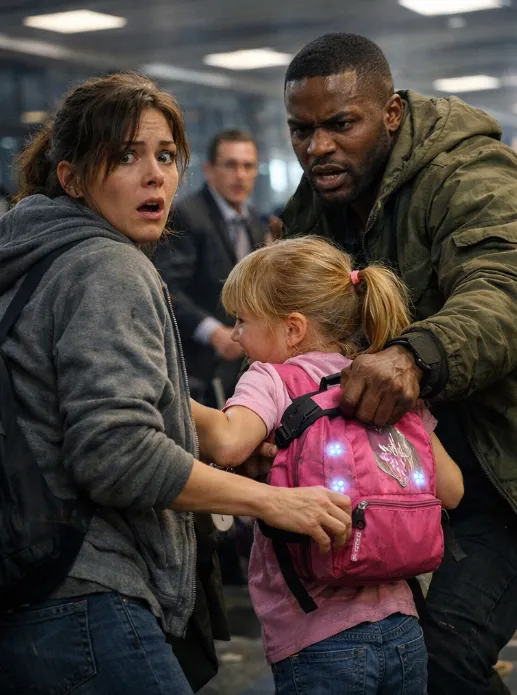
The Market Was Never Safe. The Deadliest Secret Was Wearing a Badge.
By the time the first scream tore across Briarwood’s Saturday market, the bomb had already been there for forty-three minutes.
No one knew it. Not the little boy with strawberry juice on his chin. Not the old woman haggling over heirloom tomatoes. Not the fiddler near the fountain sawing his bow through a crooked rendition of “Shady Grove.” They stood inside the bright, cheerful lie of an ordinary morning while death waited somewhere among baskets of peaches, jars of honey, and hand-painted signs promising local goodness.
And at the center of that lie stood Nathan Cole, wearing another man’s name.
He looked forgettable on purpose. Wire-rim glasses. Corduroy jacket despite the warmth. A canvas satchel weighted with notebooks and photocopied maps. His false identity—Dr. Simon Hale, traveling historian—had been polished for months until it seemed more real than his own reflection. Simon Hale was quiet, scholarly, faintly absent-minded. The kind of man people explained things to. The kind of man angry men underestimated.
That was why The Founders’ Oath had let him in.
They were careful. Ruthless. Clever enough to disguise extremism as nostalgia. At potlucks and veterans’ breakfasts, they spoke about liberty, inheritance, and restoring the republic. In encrypted chats and private basements, they spoke about targets, supply routes, and the cleansing fire they believed would purify the country. Nathan had spent eight months listening to both versions.
Today was supposed to be the breakthrough.
A courier known only as Redbird was scheduled to pass coded instructions to Leon Vickers, a retired mechanic whose grease-stained hands and churchgoing smile concealed a deeper truth: he financed a growing illegal weapons pipeline stretching through three states. Nathan had never been this close to proving it. He had positioned himself near the produce trucks where the handoff was expected. His earpiece was too risky in the open, so he had none. His backup team waited outside the market perimeter, ready to move if he signaled.
All he had to do was watch.
Then Officer Derek Boone saw him.
Boone had the heavy, swaggering build of a man who had never once mistaken fear for respect. His mirrored sunglasses cut the morning into cold silver slices. He moved through the market like he owned the pavement, the stalls, the citizens, and perhaps even the air in their lungs. Briarwood knew him well. Mothers lowered their voices when he passed. Teenagers looked away. Complaints vanished. Apologies were extracted.
When Boone’s gaze fixed on Nathan, something in Nathan’s spine tightened.
“You,” Boone barked, striding toward him. “What’d you take?”
Nathan turned with practiced confusion. “I’m sorry?”
“Don’t make me repeat myself. Vendor says something’s missing.”
It was clumsy. Too clumsy. Boone wasn’t investigating theft. He was selecting prey.
Nathan gave him Simon Hale’s mild, almost apologetic smile. “Then perhaps the vendor can identify me.”
For one second, Boone’s jaw flexed. Then his expression hardened into something ugly and eager.
“So now you’re telling me how to do my job?”
The market’s cheerful noise faltered. Nearby shoppers slowed. A mother pulled her daughter a step behind her leg.
Nathan lifted both hands slowly, palms open. “I’m willing to cooperate, Officer.”
But Boone wasn’t looking for cooperation. He was looking for submission.
He seized Nathan by the shoulder and spun him so violently Nathan’s satchel slammed into the side of the produce truck. Crates jumped. Apples scattered. Nathan hit the metal panel chest-first so hard his teeth clacked together.
A murmur ran through the crowd.
“Hey!” someone shouted. “Take it easy!”
Nathan forced himself not to react like an agent, not to pivot, not to trap the arm, not to drop Boone to the pavement in front of a hundred witnesses. He stayed in character. He let his body fold under the grip.
“Officer,” he said, each syllable measured, “this is unnecessary.”
Boone drew his baton.
The first strike landed across Nathan’s ribs with a crack that turned the market silent.
Pain exploded through him—white, hot, blinding. His breath vanished. The second blow caught his cheekbone and split skin open. He tasted blood. Somewhere a child started crying.
And through watering eyes, Nathan saw exactly what he had feared.
A man in a tan cap—the courier—slipped away through the crowd.
The operation was unraveling in real time.
Boone shoved him harder against the truck. “You people always think you can walk in here and do whatever you want.”
You people.
Nathan heard it. So did everyone else.
A woman near the flower stall lifted her phone with shaking hands. The bluegrass trio had stopped playing entirely. The market held its breath in horror, yet nobody moved close enough to stop it. Boone wore a badge, and that badge turned terror into hesitation.
Nathan dropped to one knee, one arm wrapped around his ribs. He had seconds left to make an impossible choice. Reveal himself and save his life—but destroy eight months of infiltration. Stay undercover—and risk dying in a farmer’s market while the most important lead of the case vanished forever.
Boone lifted the baton again.
Then a voice cut across the square.
“That’s enough, Derek.”
It came from Martha Bell, eighty years old, silver-haired, owner of Bell’s Orchard, seller of the sweetest peaches in Briarwood. She stood behind her stall gripping a paring knife in one hand and a dishtowel in the other, her face pale with fury.
Boone didn’t even look at her. “Stay out of this.”
“No one reported a theft,” she snapped. “I’ve been here since dawn. You made that up.”
The words hit the crowd like a match to dry tinder. Heads turned. Whispers sparked.
Boone’s baton lowered a fraction. “You want to be charged with interference, Martha?”
“I want you to stop beating a man in front of children.”
That one sentence did what law had failed to do. Phones rose higher. Voices joined in. “She’s right!” “Back off!” “We’re recording this!”
Boone’s nostrils flared. For the first time, calculation entered his eyes.
Nathan seized the sliver of opportunity. Through blurred vision, he scanned the square and caught a flash of tan cap disappearing past the fountain. He could not chase. Not like this. But maybe someone else could.
His gaze landed on a teenage boy beside the bluegrass trio, violin case at his feet, phone in hand. Seventeen at most. Nervous eyes. Sharp mind. Nathan had noticed him earlier because he had been watching the crowd instead of the music.
Nathan met the boy’s stare and spoke carefully, still half in character, half in code. “The man by the fountain with the tan cap—he dropped my notes. Please… don’t let him leave.”
The boy’s brows knit. He looked at Boone, then back at Nathan, and something passed across his face. Understanding? Instinct? Courage?
He nodded once and slipped into the crowd.
Boone saw the glance. “Who are you signaling?”
Nathan wiped blood from his mouth and managed a weak laugh. “You think highly of me, Officer.”
But inside, panic rose. If that boy confronted the courier alone, he could die. If he succeeded, he might save dozens.
Boone grabbed Nathan by the collar, yanking him upright. “You got ID?”
Nathan hesitated. His undercover identification was in his inside pocket. So was something else: a micro-transmitter disguised as a fountain pen. One click would alert the perimeter team to immediate danger.
He let his hand drift toward the pocket.
Boone caught the movement and slammed him back against the truck. “Slow.”
Then sirens erupted—not from the street, but from everywhere.
Car alarms. Truck alarms. A delivery van horn blaring continuously.
For a disoriented second, Nathan thought the pain had scrambled his hearing. Then the market erupted into confusion. People clapped hands over ears. Children shrieked. Boone jerked his head around, distracted.
Nathan understood instantly.
The boy had done something.
In chaos, people moved. The crowd split and surged. From beyond the fountain came a shout: “He’s running!”
The tan-capped courier bolted between bread stalls, clutching a paper bag to his chest. Three shoppers tried to grab him; he rammed through them. The teenage violinist was right behind him, not chasing recklessly but keeping him in sight while yelling directions.
Nathan jammed the fountain pen transmitter with his thumb.
Signal sent.
Boone heard none of it. He was too busy staring toward the panic, the alarms, the commotion that had shattered his control. “What the hell—”
The answer came in the form of black SUVs flooding both ends of the square.
“FBI! Nobody move!”
Everything changed at once.
Agents poured into the market in tactical vests, weapons drawn but controlled, voices sharp with command. One team intercepted the courier near the bakery stall. The paper bag burst open in the struggle, spilling folded maps, coded ledgers, and a compact detonator onto the pavement.
A bomb detonator.
The market gasped as one body.
Nathan straightened despite the agony and pulled his badge from inside his jacket. He held it up, blood streaking the gold.
“Special Agent Nathan Cole. Derek Boone, step away from me and put down the baton.”
Boone froze.
His face did not show shock. It showed hatred—and something far more dangerous.
Then he laughed.
It was low at first, then louder, uglier, stripped of all pretense. “You really don’t get it, do you?”
Two agents advanced on him. Boone didn’t surrender. He took one step backward and said, almost conversationally, “Ask him, Agent Cole. Ask your people who signed off on extending your cover after Indianapolis.”
Nathan’s pulse stumbled.
Only a handful of people even knew Indianapolis had nearly blown his operation three months earlier. Boone should not have known.
“What did you say?” Nathan whispered.
Boone smiled through split cruelty. “You were never infiltrating us. We were infiltrating you.”
Before anyone could react, Boone dropped the baton and reached not for his gun—but for the radio at his shoulder.
“Package is compromised,” he said clearly. “Initiate contingency.”
A gunshot cracked.
Boone jerked as a sniper round from an FBI overwatch unit tore through his radio and shoulder simultaneously, spinning him to the ground. The square exploded into fresh screams. Agents swarmed him, cuffing him as he bled and laughed into the pavement.
Nathan barely noticed.
His blood had gone cold.
Contingency.
He spun toward the captured courier. “Get me the bag!”
An agent kicked the spilled items toward him. Nathan knelt, ignoring the fire in his ribs, and tore open the folded maps. Market schematics. Utility access points. Timed routes. One page showed the square from above with colored circles marking stall clusters.
Not a bombing plan.
An evacuation funnel.
Then he saw the final sheet, handwritten, smeared at one edge.
PRIMARY DEVICE: COURTHOUSE.
SECONDARY: MARKET RESERVED FOR RESPONSE CONVERGENCE.
TRIGGER UPON FEDERAL EXTRACTION.
Nathan’s stomach dropped into ice.
The market was never the main target.
It was bait.
Boone had baited the FBI into converging their people here—into pulling law enforcement, EMS, and every available responder away from downtown.
The real bomb was at the Briarwood Courthouse.
And today was arraignment day for six federal witnesses set to testify against an interstate militia network connected to The Founders’ Oath.
“Move!” Nathan roared. “This is a diversion! Courthouse now!”
Agents snapped into motion, shouting into radios. SUVs peeled away. Sirens howled toward downtown.
But Nathan’s eyes had fixed on one last line at the bottom of the page, written smaller than the rest.
Failsafe carried by Bell.
Bell.
Martha Bell.
The peach seller.
Nathan turned slowly toward the orchard stall.
Martha was gone.
For a second, his mind rejected it. The brave old woman. The one who intervened. The one who exposed Boone’s lie. The one who had given the crowd its conscience back.
Then memory rearranged itself with cruel precision.
She had been perfectly positioned to challenge Boone. Perfectly timed. She had steered attention. She had emboldened the witnesses. She had made Nathan trust her instantly.
Not despite the violence.
Because of it.
“Where is Martha Bell?” Nathan shouted.
No one knew.
The teenage violinist pointed with a trembling hand. “She left behind the cider truck—just now.”
Nathan ran.
Every step was a knife under his ribs. He cut behind the market’s rear lane, past stacked pallets and crates of corn, until he reached Bell’s Orchard truck. Its back doors stood open. Inside, beneath baskets of peaches and mason jars, a metal case blinked with a red light.
Martha Bell sat beside it on an overturned crate, hands folded in her lap.
Without the apron and grandmotherly panic, she looked different. Not softer, not harder—just stripped clean. Her blue eyes were steady as winter glass.
“You figured it out faster than expected,” she said.
Nathan stopped dead. “You?”
She gave him the faintest smile. “I founded the Oath before Boone ever put on a badge.”
The world seemed to tilt.
“You’re eighty.”
“I’m patient,” she replied. “People hear ‘grandmother’ and imagine innocence. They never imagine architecture.”
Nathan looked at the blinking case. “What is that?”
“Insurance. The courthouse device will fail. I arranged that myself.”
He stared at her.
She nodded toward the square, where distant shouts and sirens tangled in the air. “The market was the real operation. Not for mass death. For revelation. Boone was unstable. Leon was greedy. Redbird was careless. The Oath had rotted. So I brought all of you here—my traitors, your agents, the local bully in uniform, the federal observer with a conscience he could not suppress.”
Nathan’s voice was raw. “You orchestrated your own network’s collapse?”
“I orchestrated a selection.” Her gaze did not waver. “Movements survive by cutting away diseased flesh.”
He realized then what she meant, and the horror of it made the back of his neck go cold.
The courier. Boone. Leon. The courthouse threat. The diversion. None of it was meant to succeed. It was meant to expose everyone unreliable at once—to law enforcement, to one another, to her.
The blinking case between them wasn’t a bomb.
It was a recorder. A transmitter. A vault of evidence.
“I’ve captured everything,” Martha said softly. “Every financier. Every sheriff. Every judge. Every donor. Names your Bureau hasn’t even dreamed of. Enough to decapitate three generations of this cancer.” She tilted her head. “But only if it reaches the right hands.”
Nathan swallowed. “Give it to me.”
“I can’t.”
“Why?”
“Because your Bureau has already been penetrated.”
The sentence hit harder than Boone’s baton.
She reached into her pocket slowly and removed a small remote, no larger than a car key. “There are only two secure recipients left. One is a journalist in Montréal. The other…” Her eyes met his. “Is you.”
Nathan took one cautious step forward.
She pressed the remote.
Back in the square, every car alarm stopped at once.
Silence crashed down.
Then Martha Bell slumped sideways off the crate.
Nathan lunged and caught her before her head hit the truck floor. A tiny dart protruded from the side of her neck.
He looked up sharply.
A figure stood on the roof of the adjacent shed—black-clad, rifle raised, already retreating.
Nathan fired once, but the shooter vanished.
Martha’s breath fluttered. In her trembling hand, she pushed the remote toward him. “Not a trigger,” she whispered. “A release. It sent everything.”
“To whom?”
Her lips curved faintly. “To the boy.”
Nathan stared.
“The violinist?” he said.
“He’s not a violinist.” Blood touched the corner of her mouth. “He’s my grandson.”
Nathan’s mind fractured around the revelation.
“He hates what I built,” she whispered. “That is why I trusted him.”
Her fingers tightened once around his sleeve. “He’ll publish all of it in twelve minutes. Unless they kill him first.”
Then she died.
Nathan knelt in the truck, covered in blood—his and hers—while the truth detonated inside him.
The brave teenage witness. The clever boy who had tripped the alarms. The one person no one would track in the chaos.
Not an innocent bystander.
Not Oath loyalist.
The executioner of them all.
Nathan burst from the truck and ran back toward the square.
He found the violin case abandoned beside the fountain.
Inside, beneath velvet lining, there was no instrument.
Only a satellite uplink rig, a burner phone, and a folded note addressed in neat handwriting:
Agent Cole—
You were the only honest man in the market.
Try to survive the next hour.
—Eli Bell
A roar rose from phones all across the square.
Notifications.
Messages.
News alerts.
Agents checked screens, then looked up in disbelief. Faces drained. Radios erupted with overlapping panic. Nathan grabbed the burner phone and saw the first headline bloom across the display:
LEAK EXPOSES NATIONAL EXTREMIST NETWORK; LAW ENFORCEMENT, JUDGES, AND FEDERAL OFFICIALS NAMED.
Then a second alert.
ACTING FBI DIRECTOR RESIGNS AFTER RECORDINGS SURFACE.
Nathan stood frozen amid peaches, blood, broken crates, and stunned citizens while the country cracked open in real time.
Boone, cuffed on the pavement, stopped laughing.
For the first time that morning, he looked afraid.
And Nathan understood the final twist with breathtaking clarity:
He had come to Briarwood believing he was the hunter.
He had been the witness.
Not to a bombing.
Not to a beating.
But to the carefully staged execution of an entire hidden empire—brought down not by the FBI, not by the law, but by an old woman everyone trusted and a boy carrying a violin case full of apocalypse.