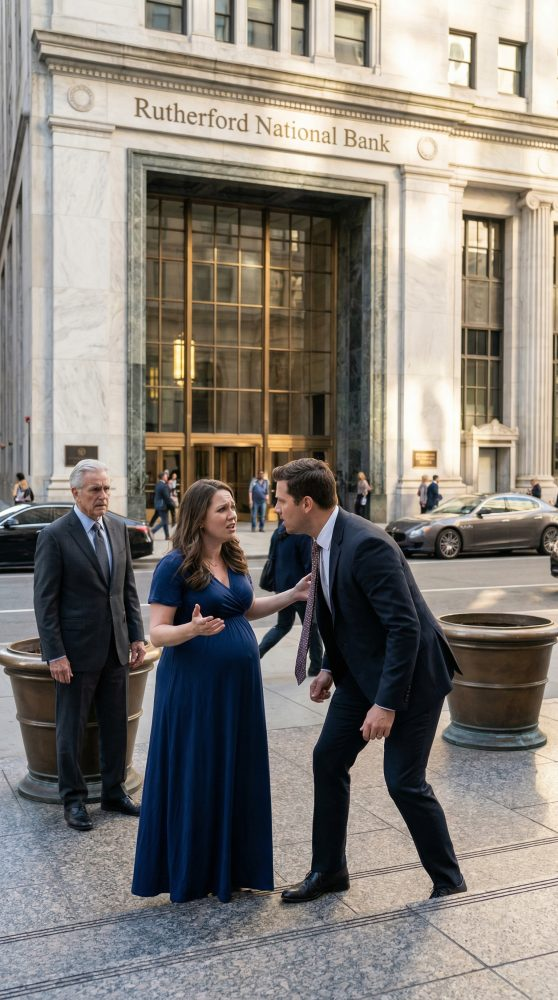
I was seven months pregnant when my husband shoved me onto the cold marble floor of a private bank and hissed, “You should’ve stayed ignorant, Sarah.” The words hit harder than the fall. One hand flew to my stomach before I even felt the pain in my hip. Around us, people froze. A receptionist gasped. Somewhere in the distance, a pen rolled across the polished floor. And in that humiliating, terrifying second, the truth finally landed: Richard Hayes, the man I had loved for eight years, had never been trying to protect our family. He had been stealing from me.
Family legal services
For most of our marriage, Richard had painted the same picture. Business was unstable. Investments were tight. Cash flow was complicated. He was a successful CEO on paper, but at home he played the role of the burdened provider, always stressed, always warning me to be careful, to stop asking questions, to trust him. I did. I trusted him when he sold my late mother’s jewelry, claiming we needed liquidity. I trusted him when he insisted I sign documents without reading every line because “that’s just how these things are done.” I even trusted him when he convinced me to step away from my own consulting career after my pregnancy became difficult.
But that morning, one wrong envelope changed everything.
It had arrived by courier, marked urgent and confidential. Richard was in a meeting, so I opened it. Inside was a banking notice referencing an account I had never seen before, connected to a trust bearing my birth name—Sarah Wellington, not Sarah Hayes. There were balances listed that made no sense. Transfers. Withdrawals. Authorization records. My signature had supposedly approved several large movements of money over the years. I knew immediately I had never signed them.
I drove to the bank myself, my heart hammering the entire way. At first, no one wanted to speak with me. Then Richard arrived, furious, as if he had been alerted the second I walked through the doors. He didn’t deny the account. He didn’t explain the forged signatures. He just grabbed my arm and tried to drag me outside. When I pulled away and demanded answers, he pushed me.
That was when a tall man in a dark suit stepped forward from across the lobby, staring at me with a strange mix of shock and recognition. His voice was low, almost disbelieving, when he said, “My God… you’re a Wellington.”
Richard’s face drained of color.
And for the first time since I married him, I saw real fear in his eyes.
The man introduced himself as James Wellington, head of the bank’s private legacy division. He helped me to my feet, called for water, and insisted I be examined by the on-site medic before anything else happened. Richard tried to interrupt, tried to take control the way he always did, but James shut him down with one sentence: “Mr. Hayes, from this point forward, you will not speak for her.” The authority in his voice was unmistakable. Richard stepped back, but the look he gave me promised this was far from over.
Once I was seated in a private office, James placed an old photograph in front of me. It showed a young woman with my eyes, my cheekbones, even the same small scar above the left eyebrow that I had carried since childhood. “This was my sister, Elizabeth Wellington,” he said. “She disappeared years ago after cutting ties with the family. We searched for her for decades.” My throat tightened before he even said the next words. “Sarah… according to the records we’ve protected all this time, Elizabeth had a daughter. That daughter is you.”
Past life regression
I sat there stunned, trying to process the impossible logic of something completely real. I had grown up in foster care after my mother died in a car accident when I was twelve. I knew almost nothing about my father, and what little my mother ever told me about her family was vague and painful. She never spoke their last name. She never explained why we moved so often. She only repeated one thing: Never trust people who are too interested in what you might inherit.
James then walked me through the trust records. My mother had created a protected financial structure before her death, naming me sole beneficiary. The trust had been designed to release information to me only under strict identity confirmation protocols. Richard had somehow discovered it years earlier through my legal records. He married me knowing exactly who I was before I ever knew it myself.
The “financial struggles” he had described for years had been a lie. He had been forging access requests, manipulating dormant accounts, and siphoning funds through shell entities tied to his companies. Worse, James revealed Richard had a history. Two prior wives. Both wealthy. One dead in what had been ruled an accident. One missing after a bitter divorce overseas. Quiet settlements. Sealed records. Rumors no one could prove—until now.
Family legal services
Then James said the part that made my blood run cold.
“Sarah, Richard is preparing a guardianship strategy for your baby. If anything happens to you before or shortly after delivery, he could attempt to control your daughter’s inheritance through custody.”
I looked at the office door, suddenly aware of how vulnerable I was, how carefully I had been isolated.
And just then, my phone lit up with a text from Richard.
If you don’t leave with me right now, you’ll regret what happens next.
James moved fast after that. Within an hour, I was escorted out through a secure exit, driven to a Wellington family estate outside the city, and connected with attorneys, investigators, and a physician who confirmed that, thankfully, my baby was unharmed. The shock came in waves, but one truth kept me steady: Richard had not just lied to me. He had built an entire marriage around access, control, and eventual ownership. I had never been his partner. I had been his plan.
Father’s Day gifts
Over the next several weeks, everything unraveled.
Forensic accountants traced years of fraudulent transfers from my trust into companies Richard controlled through layered LLCs and offshore accounts. Digital analysts found altered authorization forms, fabricated signatures, and deleted messages recovered from backup servers. My attorneys obtained emergency protective orders and froze multiple assets before Richard could move them again. Publicly, he tried to play the grieving husband, claiming I was emotionally unstable because of pregnancy hormones and family pressure. Privately, he became reckless.
One night, just after midnight, the estate’s security team alerted us to movement near the rear entrance. Cameras showed Richard arriving with two men I did not recognize. They wore gloves, carried zip ties, and had a folder full of forged legal documents. He had come to force me to sign power-of-attorney papers and leave with him before the court could formally block his access. But the Wellington estate wasn’t the kind of place a man like Richard could enter unnoticed. The security system locked down the property in seconds. Police were already en route before he reached the interior hallway.
Legal consultation service
I watched from an upstairs monitor as officers forced him to the ground.
Even then, he was shouting my name like I belonged to him.
Family legal services
He was charged with fraud, attempted kidnapping, assault, coercion, and financial crimes that stretched across state lines. Fifteen months later, he was convicted and sentenced to fifteen years in federal prison. By then, I had already given birth to a healthy baby girl. I named her Elizabeth, after the mother who had tried to protect me even after death.
I inherited more than money. I inherited proof that survival can become purpose.
In the years that followed, I rebuilt my life on my own terms. I returned to financial analytics, expanded the Wellington philanthropic foundation, and launched the Elizabeth Initiative, a nonprofit that helps women escape financial abuse and domestic control. We provide emergency legal support, housing assistance, and education so women can recognize the warning signs I missed for far too long.
People still ask me what hurt the most—being betrayed, being used, or learning that my whole life had been shaped by secrets. The answer is simple: none of that was the worst part. The worst part was how close I came to believing I was powerless.
I wasn’t.
Past life regression
And if this story made you stop, think, or feel something, tell me in the comments: what was the exact moment you knew Richard was never going to change?