Part I: The Boy in the Road
By the time the first scream split across the highway, the storm had already passed—but it had left its breath behind.
The sky sagged low and gray, swollen with the last of the rain. Water still glistened over the cracked asphalt in long silver streaks, and the late afternoon light burned weakly through the clouds, turning the whole road into a dim mirror. Cars had slowed after the weather. People were tired, impatient, eager to get home.
Then the engines came.
Not one. Not two.
A wall of them.
The roar tore through the silence like a living thing, rising from the bend in the road with such force that people on the shoulder turned before they even understood why. Black motorcycles burst into view, their headlights cutting through the damp air, their frames gleaming wet, their riders hunched low in leather and denim, moving as one hard, dark wave.
A biker convoy.
Big enough. Fast enough. Loud enough to make every pedestrian step back instinctively.
A woman loading groceries into her trunk froze with both hands gripping a paper bag. Two teenagers at the bus stop stopped laughing. A delivery driver muttered, “Jesus,” under his breath and pulled out his phone before he even knew what he planned to record.
And then, from the far side of the road, something moved.
At first people thought it was a shopping cart.
Then a stroller.
Then, horrifyingly, they saw the truth.
A boy.
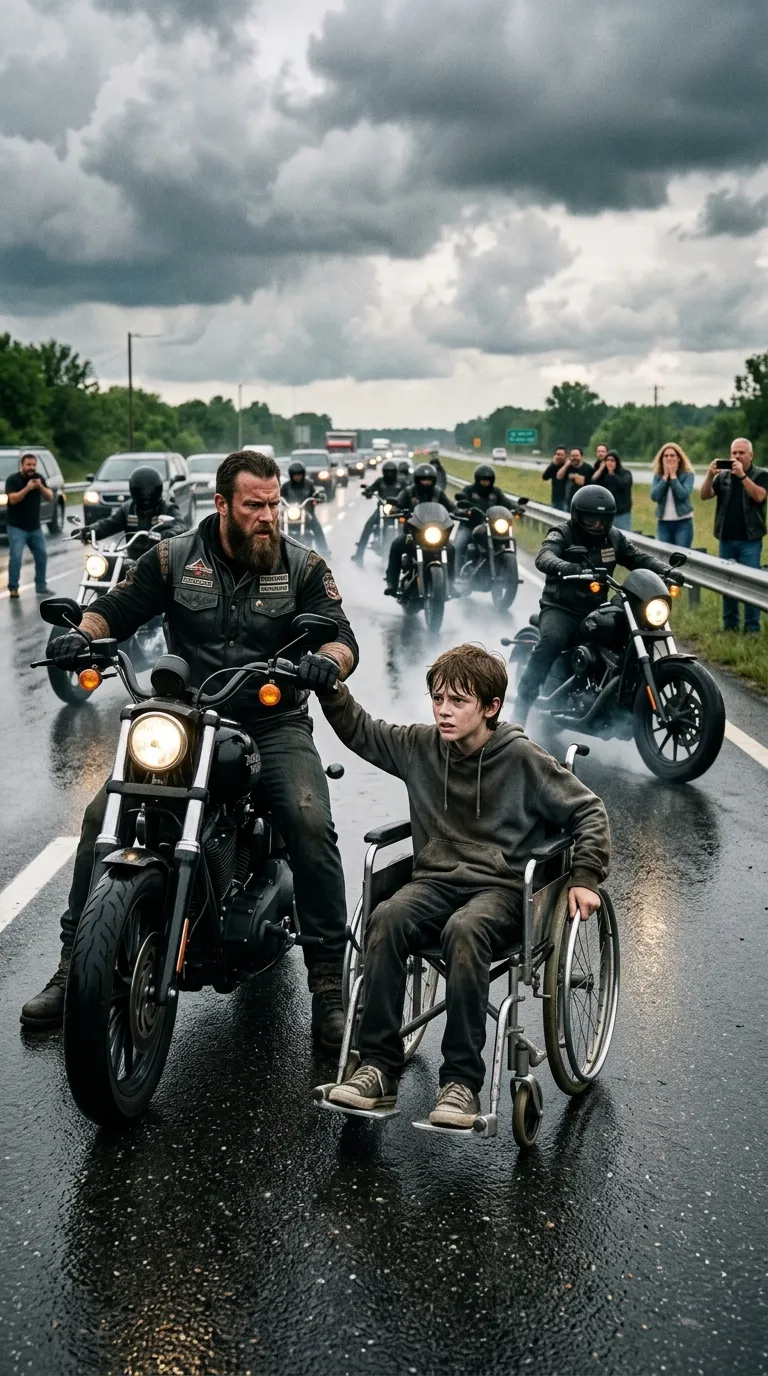
Small. Thin. Wrapped in a faded gray hoodie that looked too light for the cold. His wheelchair rattled violently beneath him as he pushed it off the shoulder and into the middle of the highway. His arms were trembling so badly the wheels jerked in uneven bursts, but he kept going, jaw locked, eyes fixed ahead as if the rest of the world did not exist.
As if nothing mattered except getting there.
“NO!”
The scream came from somewhere near the gas station lot. It was sharp enough to turn heads—but too late to stop what happened next.
The convoy hit their brakes.
The sound was monstrous.
Rubber screamed against wet pavement. One bike fishtailed sideways. Another leaned so hard it nearly fell. Headlights swung wildly. The convoy shattered from perfect formation into chaos as rider after rider fought to avoid plowing into the wheelchair in the center of the road.
A crash didn’t come.
Somehow.
Some miracle of reflex and raw luck kept metal from crushing bone.
When the smoke of burned rubber drifted away and the engines coughed themselves into a furious growl, the boy was still there.
Still in the middle.
Still blocking every bike.
For half a second, the entire highway went quiet in the strangest way—full of noise, full of breath, full of heartbeats—but still quiet, because everyone was waiting for the moment after the moment.
“What is wrong with him?” a man shouted from the shoulder.
“He’s going to get himself killed!”
“Someone get that kid!”
“Call the police!”
A woman in a yellow raincoat already had her phone in the air, filming. Another was fumbling with emergency services, voice breaking as she tried to explain there was a disabled child in the middle of a biker convoy and she didn’t know if there was about to be an accident or an assault or both.
The riders began to dismount.
Boots hit pavement.
Zippers. Leather creaks. The metallic click of kickstands slamming down.
Up close, they looked even more intimidating—broad shoulders, weathered faces, inked arms, chains glinting at belts and wrists. Not criminals, maybe. But not men most people rushed toward. Men built from road and noise and scars.
And from the front of the convoy, the lead biker stepped down.
He was taller than the others, heavily built, with a beard darkened by rain and tattooed forearms exposed beneath rolled sleeves. His vest was black, plain except for a stitched patch on the chest and another across the back. He didn’t storm forward. He didn’t yell.
He just walked.
Slowly.
Steadily.
With the kind of control that looked more dangerous than anger.
The crowd drew in a breath all at once.
The boy stared straight ahead, chest heaving. He looked maybe twelve. Thirteen at most. Too thin. Too pale. Like life had not been gentle with him. Mud had splashed up the wheels of his chair, and one of the footrests was bent inward. His lips were dry and colorless, but his eyes were alive with something that made strangers uneasy.
Urgency.
The biker stopped directly in front of him.
“Move,” he said.
He didn’t raise his voice.
He didn’t need to.
The word landed like a weight.
The boy didn’t move.
He didn’t speak either. Not a single sound came from him. His throat worked, but nothing followed. His hands were white-knuckled from gripping the wheels. Then one of them lifted.
He pointed.
Straight ahead.
The gesture was abrupt, desperate, almost angry.
Nobody understood.
A few people craned their necks, looking down the road. It curved past a low embankment and a line of half-flooded brush, then disappeared behind a cluster of eucalyptus trees. Nothing obvious. Nothing dramatic. Just wet highway, stormlight, and distance.
“He’s in shock,” someone said.
“He doesn’t know what he’s doing.”
“Get him out of there!”
The boy pointed again.
Once.
Twice.
As if he could will meaning into the air.
The lead biker’s face didn’t change, but his eyes narrowed. He glanced down the road, then back at the boy. “Kid,” he said, quieter this time, “you need to get out of the lane.”
The boy lunged forward and grabbed his arm.
It shocked everyone.
One tiny hand locking around a forearm thick with muscle and ink. The grip was fierce—not because the boy was strong, but because he had nothing left except refusal. His other hand came up and pointed again, more violently this time, straight ahead, toward the blind bend.
The biker followed the line of his finger.
And then he froze.
Not paused.
Not hesitated.
Froze.
Every muscle in his body locked.
His eyes sharpened with the kind of recognition that drains blood from the face even when the face does not show it.
Behind him, one of the other bikers called, “Mace?”
No answer.
The boy’s fingers dug deeper into his arm.
And from beyond the bend, almost too faint to catch beneath the ticking engines and scattered shouting, came a sound.
A brittle sound.
A deep, splintering crack.
Like wood under impossible strain.
Then another.
The lead biker spun around so fast his boots slipped on the wet pavement. “Everybody back!” he roared, and now his voice was enormous. “BACK! NOW!”
People recoiled in instinctive terror.
“What is it?” someone shouted.
But Mace was already running toward the shoulder, waving both arms like a man trying to stop death itself. “Get off the road! Move your cars! Move!”
The convoy reacted instantly. Whatever they were to the world, they listened to him. Riders sprinted toward stranded vehicles, pounding on windows, yanking open doors, dragging stunned people out into the ditch when they didn’t move fast enough.
And then the hillside above the bend gave way.
Not all at once.
First the guardrail shuddered.
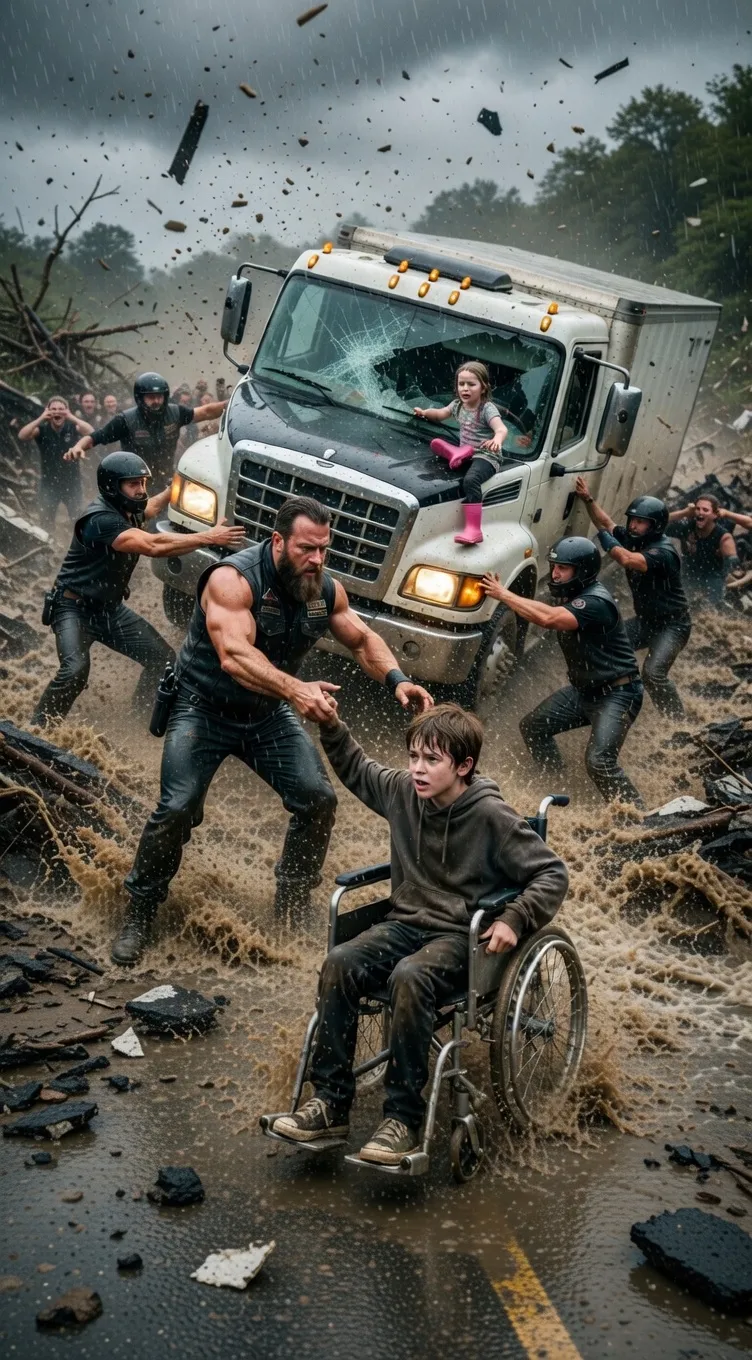
Then the soaked earth beneath it collapsed with a sound like thunder ripping open. A delivery truck appeared around the curve at the exact wrong second, its driver hitting the brakes too late as the road beneath him began to buckle. The front wheels dropped. Metal shrieked. Crates inside the trailer slammed forward.
The whole truck jackknifed sideways.
And behind it came the flood.
A sheet of stormwater, mud, broken branches, and torn asphalt burst across the highway in a violent brown surge, swallowing the curve, hammering the truck broadside, and turning the lane the convoy would have entered seconds later into a wrecked, collapsing river.
The crowd screamed.
Somebody fell to their knees.
A parked sedan near the shoulder was lifted half off the ground and shoved into a ditch. The truck’s horn jammed into one long, terrible blare before cutting out. Debris spun wildly through the water. Concrete cracked. The guardrail vanished.
And in the middle of it all, the boy in the wheelchair stayed absolutely still, rain-mist blowing against his face.
Because he had known.
And every soul on that highway knew it too.
Part II: The Man Who Remembered
For several seconds after the collapse, no one moved like a normal human being.
They staggered.
They stared.
They stood with their mouths open, unable to make sense of the fact that the road they had all been looking at moments ago no longer existed in one piece.
Sirens were still far away.
The world felt stranded between before and after.
Then the screaming started from the truck.
Not loud. Not continuous.
Just one ragged cry from somewhere inside the cab, swallowed quickly by the hiss of runoff and the ticking engines left idling on the road.
Mace was the first to break.
“Rope!” he barked.
One of the bikers was already moving. Another sprinted for saddlebags. A third pulled off his jacket and splashed knee-deep into the runoff without waiting for instruction. The convoy changed in an instant from frightening spectacle to disciplined machine. No panic. No wasted motion.
The people on the shoulder watched in disbelief.
The lead biker dropped to one knee in front of the boy. “You saw it coming?”
The boy nodded once, breathing hard.
“You can talk?”
A pause.
Then the smallest shake of the head.
Mace looked at him for one long moment, something unreadable passing through his eyes. “Stay here,” he said.
The boy grabbed his sleeve again.
Mace glanced down.
The boy pointed, not at the destroyed bend this time—but toward the truck. Then he curled his hand tight and hit it once against his chest.
Me.
Help.
The message was crude, improvised, unmistakable.
Mace’s jaw hardened. “No.”
The boy’s face twisted with fierce frustration. He struck his own chest again, then pointed to the truck, then to the flooded ditch near the shoulder where a thinner stream ran fast but not deep. He mimed low movement with his hand.
Mace stared at him.
The kid had seen more than the collapse. He had seen a path.
And perhaps because time was breaking apart around them, perhaps because none of this made sense anyway, Mace trusted him.
He scooped the chair around and shoved it toward the ditch edge, following where the boy indicated. The wheelchair’s damaged wheel caught, bounced, nearly tipped. Mace steadied it. The boy slapped the armrest and pointed harder to the left.
There—a narrow maintenance strip half hidden beneath brush and runoff, just wide enough to skirt the worst of the collapse and reach the truck from below.
“You’ve got to be kidding me,” one of the bikers muttered.
Mace stood and shouted, “This way! We go low!”
They moved.
Two bikers took the front of the wheelchair, one at each side, while Mace pushed from behind. Mud sprayed their boots. Water soaked through denim and leather. The boy twisted in the chair, directing them with urgent gestures, every few feet throwing a look toward the truck as if time itself were bleeding out.
Inside the cab, the driver screamed again.
When they reached the underside of the slope, the scene became clear in a way that felt almost obscene. The truck was hanging at an angle, front end partly submerged in the collapsed lane, trailer wedged against the broken guard base. The windshield was fractured into a spiderweb. The driver—middle-aged, bleeding from the forehead—was trapped behind the wheel, one leg pinned.
And in the passenger seat sat a little girl.
Maybe seven.
Curly hair plastered to her cheeks. Pink rain boots. Frozen with terror so total she seemed turned to glass.
The crowd above gasped when they finally saw her.
“Oh my God,” the woman in the yellow raincoat whispered.
Mace did not waste breath on shock. He looked once at the cab, once at the water level rising around the front axle, and started issuing orders. “Jax, line to the trailer. Boone, with me. Eli, keep the slope clear. Nobody stands under that cab if the frame shifts.”
The little girl saw them and began to sob. Not loud like before. Worse. Quiet, hiccuping sobs of a child trying not to make things harder.
Mace climbed first.
The truck groaned under his weight.
Boone secured himself to the line and followed. Jax and the others braced from below. Mace reached the broken window, spoke to the driver, assessed the pinning, then looked down at the boy.
The boy was staring so intently it hurt to see.
Rainwater slid off his lashes, but he never blinked.
And suddenly Mace knew why the kid’s face had seemed so disturbingly familiar from the first second.
Not because he had seen him.
Because he had seen someone like him.
Twelve years earlier, on a county road three states away, there had been another storm. Another blind turn. Another vehicle trapped where help arrived thirty seconds too late. His little brother Levi had been fourteen then—funny, stubborn, reckless, forever building toy motorcycles out of scrap metal—and he had died in the passenger seat of a pickup because grown men on the roadside had spent too long arguing about what to do.
Mace had never forgiven the world for that.
He had certainly never forgiven himself.
Now a child sat trapped above him again, and below him in a battered wheelchair was a boy with the same impossible eyes Levi used to get whenever he knew something adults didn’t.
“Boone!” Mace shouted. “Window first. Kid comes out now.”
The rescue happened in fragments.
Glass broken free.
The girl handed carefully through the side.
Boone passing her down to waiting arms.
The crowd above erupting into relieved cries as one of the bikers carried her clear.
Then the driver.
Harder. Slower. The pinned leg had to be forced loose, the dashboard pried back with tools hauled from the bikes. Every movement risked shifting the cab. Water kept rising. Mud kept sliding.
At one point the truck lurched so violently everyone on the slope shouted at once.
The boy in the wheelchair slapped both palms against his armrests, eyes wild, then pointed upward, toward the trailer hitch assembly. Jax followed the line of sight and saw what the rest had missed: a mounting bracket shearing loose.
“Bracket’s going!” he yelled.
That warning saved them.
They got the driver free just before the trailer tore away, wrenching the cab sideways with a horrible metallic scream. Boone half fell, half jumped. Mace shoved the driver into waiting hands below and dropped after him as the front of the truck disappeared deeper into the wash.
When he hit the mud, he stayed there a second, one knee down, breath blasting out of him.
People were cheering.
Actually cheering.
The girl was alive. The driver was alive. The convoy that everyone had feared was suddenly the only reason they were alive.
But Mace didn’t look at the crowd.
He looked at the boy.
The boy sat drenched to the skin, shaking now in full-body waves from cold and adrenaline, his hands still clenched so tight around the chair rims his knuckles had gone bloodless. He was watching the rescued girl fold into her father’s arms with an expression so complicated it barely looked survivable.
Relief.
Pain.
Grief.
Recognition.
Mace walked to him slowly.
Around them, sirens finally began to near.
“What’s your name?” he asked.
The boy looked up.
He tapped two fingers against his chest, then used one trembling hand to trace letters against the wet armrest: N-O-A-H.
“Noah,” Mace said softly.
Noah nodded.
Mace crouched so they were eye level. “How did you know?”
Noah swallowed. His face tightened. He lifted his hand and pointed toward the trees up the slope. Then he tapped his temple. Then he made a falling motion.
He’d seen it.
From somewhere high enough to notice the hillside splitting before anyone below could hear it.
“You came all the way down here alone?” Mace asked.
Noah’s eyes flickered away.
That was when an older woman pushed through the crowd with a hand pressed to her mouth. “Noah!”
She nearly fell getting to him. She was soaked, out of breath, and wild with panic—gray hair escaping its braid, slippers muddy, cardigan hanging half off one shoulder. She dropped beside the wheelchair and clutched his face in both hands as if to prove he was real.
“You promised me you wouldn’t go near the road,” she cried. “You promised—dear God, Noah—”
He grabbed her wrists, urgently, trying to calm her.
“Ma’am,” Mace said, steady but gentle, “he saved people.”
The woman looked up at him with wet, bewildered eyes. “He left the house without me. I was only gone ten minutes. He can’t even get down that slope by himself unless he used the drainage path and if he used the drainage path—” Her voice broke. “He hates that path.”
Noah’s face shuttered.
Mace noticed.
He also noticed the way several people in the crowd were now whispering. Their fear had changed shape. It was no longer fear of bikers. It was something softer and uglier—curiosity edged with guilt.
Why had this child been alone?
Why had he been desperate enough to throw himself in front of roaring machines?
The older woman wiped her cheeks and said, almost apologetically, “He doesn’t speak. Not since the accident.”
Mace did not ask which accident.
He already knew there was one.
Noah’s eyes were locked on the broken road again.
Sirens arrived in a flood—ambulances, police, road crews. Questions crashed down. Statements. Tape. Flashing lights reflected in every puddle. Someone tried to guide Noah away, but he resisted until Mace put a hand lightly on the back of his chair and said, “It’s all right. I’m here.”
The words came out before he could think about them.
And for reasons Mace could not explain, Noah believed him.
Hours later, after paramedics had checked everyone and the sky had darkened completely, Mace found himself outside a small weather-worn house on the hill overlooking the ruined section of highway. The convoy had been cleared to leave. Most of the others had gone for food, fuel, warmth.
Mace had come here instead.
The porch light was weak. The rain had started again, softer now.
Noah’s grandmother opened the door with visible surprise. Behind her, the house smelled faintly of tea and damp books. “You,” she said.
“Mace,” he replied. “I wanted to make sure he was okay.”
She hesitated, then stepped aside.
Noah was in the living room beneath a blanket, wheelchair parked beside the window. He looked pale and exhausted, but awake. On the table beside him sat a spiral notebook and a cheap marker.
When Mace entered, Noah picked up the notebook and wrote with slow, careful strokes.
I HEARD THE HILL CRACK.
He turned the page.
NO ONE WOULD LISTEN IF I JUST WAVED.
Another page.
BUT THEY WOULD STOP FOR YOU.
Mace stared.
“Why us?”
Noah wrote again.
BECAUSE YOU LOOKED LIKE MEN PEOPLE FEAR.
His hand paused. Then continued.
FEAR STOPS FASTER THAN KINDNESS.
The words hit harder than any accusation.
Mace let out a long, stunned breath.
Noah looked at him, then wrote one more line.
I’M SORRY.
Mace frowned. “For what?”
Noah’s marker pressed deeper, carving the letters.
I USED YOU.
For a second the room held nothing but the sound of rain against the window.
Then Mace did something he had not done in a very long time.
He laughed.
Not because it was funny.
Because it was devastatingly true, devastatingly smart, and devastatingly sad that a child had learned the world worked that way.
“You did,” Mace said. “And it worked.”
Noah’s mouth twitched at one corner.
It was the first sign of a smile Mace had seen from him.
And that was when Noah’s grandmother, standing quietly in the doorway, whispered, “He hasn’t smiled since his mother died on that road last year.”
Everything in Mace went still.
He turned toward the window.
Toward the broken bend, barely visible through rain and darkness.
And suddenly the full shape of Noah’s desperation revealed itself.
This had not been only about strangers.
It had been about that road.
That deadly piece of road that had already taken one parent and nearly taken more.
Noah had not rolled into the convoy because he was fearless.
He had done it because he knew exactly what the road could do.
And he would rather be crushed himself than watch it happen again.
Part III: The Silence Breaks
The days after the collapse changed the town in ways no one admitted at first.
Officially, it was a rescue story.
News crews came. They filmed the wrecked hillside, interviewed the truck driver, replayed shaky phone footage of motorcycles skidding to a stop in front of a wheelchair boy in the middle of the road. Headlines bloomed online. BOY IN WHEELCHAIR SAVES FAMILY FROM LANDSLIDE. BIKER CONVOY JOINS HEROIC RESCUE.
But that wasn’t the real change.
The real change was quieter.
People who had once crossed the street to avoid the convoy now nodded when they saw riders at the gas station. The woman in the yellow raincoat deleted the first dramatic caption she had planned to post and replaced it with one simple sentence: I was wrong about what I saw.
Road inspectors arrived and found what residents had been complaining about for months—unstable drainage, ignored repair requests, warning reports buried under signatures and delays. The town meeting overflowed. Anger rose. Questions sharpened. Someone who had once shrugged at “just another dangerous stretch” now said, with tears in her voice, “A child had to risk his life before anyone paid attention.”
Mace stayed longer than he meant to.
At first he told himself it was because his bike needed a part and the weather was bad and the convoy could spare two days. Then two days turned into five. He helped haul sandbags, joined crews clearing brush, and somehow ended up on Noah’s porch each evening with takeout containers and the uncomfortable awareness that he had begun looking forward to the quiet house on the hill.
Noah communicated through notebooks, gestures, and sometimes a small tablet his grandmother charged by the window. He was brilliant in a way that made adults underestimate him only once. He loved maps, weather patterns, and old engines. He hated pity. He had a dry, brutal sense of humor. And though he still did not speak, his silence no longer felt empty. It felt specific. Deliberate. Like a locked room with the light on inside.
Mace learned the rest in fragments.
Noah’s mother, Elena, had died on the same bend the previous spring when a delivery van hydroplaned after another storm and shoved her car through the old guardrail. Noah had survived with spinal injuries and a throat damaged not by impact—but by the scream he had torn out when he watched the river below take her vehicle first.
After that, his voice had never come back.
Doctors had called it trauma. Selective mutism complicated by injury and shock. His grandmother called it grief living in the body.
Noah called it nothing at all.
One evening, as sunset bled copper through the clouds, Mace found Noah on the porch holding a folder full of papers. Complaints. Petitions. Photos of cracks in the road. Maintenance requests his mother had filed before she died. Reports no one had acted on.
Noah handed them over.
Mace flipped through them, slower and slower.
“She knew,” he said quietly.
Noah nodded.
“She tried to warn them.”
Another nod.
Mace looked out toward the road. His chest ached with old fury and new understanding. “And nobody listened.”
Noah’s eyes hardened.
Not until the collapse.
Not until spectacle.
Not until terror.
Not until him.
The public hearing was set for the following week in the high school gym. Residents packed the bleachers. Officials sat behind folding tables with microphones and legal faces. Reporters hovered like gulls. The room buzzed with outrage and anticipation.
Mace had not planned to attend.
Then Noah handed him a note that afternoon.
COME.
So he came.
What happened there would be retold in town for years, and usually people told it wrong.
They said the bikers intimidated the council.
They said the press exposure forced accountability.
They said the truck driver’s testimony changed everything.
Those things mattered.
But they were not the thing.
The thing was Noah.
He rolled himself to the microphone in a pressed shirt and dark jeans, his grandmother walking beside him with one trembling hand on the back of the chair. The gym fell into a hush so complete it felt sacred.
A councilman leaned forward. “Take your time, son.”
Noah placed a tablet on the podium.
People expected a typed statement. A digital voice.
Instead, he lifted his face to the microphone.
And spoke.
The first word came out rough, scraped raw from disuse, barely louder than breath.
But it was a word.
“My.”
His grandmother made a sound behind him like her heart had broken open.
Noah swallowed. Every muscle in his neck strained. He looked terrified. Mace, standing against the back wall with his arms folded, felt his own pulse pounding in his throat.
Again Noah spoke.
“My mother warned you.”
The gym did not move.
No one breathed.
His voice was uneven, cracked, almost painful to hear, but each word landed harder because it clearly cost him something enormous.
“I watched her die there.” He pointed, not at the road—they were indoors now—but at the officials in front of him. “And when I heard the hill breaking, I knew… you would let that road kill again.”
A woman in the bleachers began to cry.
Noah gripped the podium tighter. “I rolled into traffic because I thought fear was the only thing stronger than delay.”
The line struck the room like lightning.
Mace closed his eyes for a second.
He had heard it already in writing. Spoken aloud, it was unbearable.
Noah’s breath shook. “I was right.”
Silence.
Terrible silence.
Then the gym rose.
Not literally all at once, but close enough. People standing. Clapping. Some weeping. Some ashamed. Some furious. The officials looked stunned, then cornered, then suddenly very aware the world had changed beneath them.
Within a month, the road repairs were approved in full. Emergency drainage systems. Retaining walls. New guardrails. Review boards. Investigations into negligence. Two officials resigned before the findings were released. One contractor lost his license. The town called it reform.
Mace called it late.
But late was better than never.
On the day the new memorial marker for Elena was installed near the rebuilt bend, the convoy returned.
This time no one stepped back in fear when the engines rolled in.
Children ran to watch.
Someone from the bakery brought coffee.
The girl from the truck—the one in pink rain boots—arrived holding her father’s hand and carrying a drawing folded in half. She gave it shyly to Noah. It showed a wheelchair, a motorcycle, a mountain, and a giant crooked sun. Above them she had written in childish block letters: THANK YOU FOR STOPPING THE BAD ROAD.
Noah stared at it a long time.
Then, very carefully, he handed it to Mace.
A trust. A gift.
Mace looked at the memorial stone, at the rebuilt guardrail gleaming in sunlight, at the boy beside him whose thin hands had forced an entire town to hear what it had buried.
“You know,” Mace said, voice low, “when I first saw you out there, I thought I was walking toward trouble.”
Noah glanced up.
Mace smiled faintly. “Turns out I was walking toward the bravest person on the road.”
Noah rolled his eyes with theatrical impatience.
Mace laughed.
And then Noah said, quietly but clearly, “You were scary enough to be useful.”
For one stunned heartbeat, Mace simply stared.
Then the convoy behind him exploded with laughter so loud birds lifted from the trees.
Noah’s grandmother covered her face and sobbed openly.
Because it wasn’t just that Noah had spoken.
It was how he had spoken—dry, precise, mischievous, fully himself.
Not a miracle. Not a cure. Not grief erased.
Something better.
A beginning.
Later, when the ceremony ended and the crowd thinned, Mace lingered by his bike while the sun dropped low over the repaired road. Noah wheeled himself beside him, the evening wind tugging at his hoodie.
“Your grandma says you’ve been looking at adaptive hand controls,” Mace said.
Noah nodded.
“For what?”
Noah looked at the convoy.
Then at Mace.
Then he said, with effort but unmistakable intention, “For my bike.”
Mace barked out a startled laugh. “Your what?”
Noah’s expression did not change.
“My bike. One day.”
There it was again—that impossible certainty, that refusal to let the world define the edge of his life.
Mace looked at the repaired bend. The memorial. The town below. The boy who had once rolled into terror because he understood something everyone else refused to see.
And for the first time in years, the memory of his brother did not feel like an open wound.
It felt like a hand on his shoulder.
“All right,” Mace said at last. “One day.”
Noah nodded, satisfied.
The convoy engines started one by one, not violent now, but deep and steady, like thunder that had learned mercy. The sound rolled across the road, over the new guardrails, through the clean evening air.
People would tell the story for a long time.
They would say a wheelchair boy stopped a biker convoy.
They would say a lead biker saved a trapped family.
They would say a town finally woke up.
All true.
But the deepest truth was simpler than any headline.
A silent boy had learned that the world listened to fear faster than kindness, so he used fear to force it to look where kindness had failed.
And in doing so, he broke something far more dangerous than silence.
He broke indifference.
And once that shattered, everything changed.