Part I
The morning the road turned dangerous began so beautifully that no one who looked at it from a distance would have believed evil could find room inside it.
Ridgerest Road unspooled through the Tennessee hills like a ribbon of pale gravel and sun, bordered by oak trees painted in rust, amber, and burnt gold, their leaves whispering whenever the wind moved across them. It was mid-October, warm enough for short sleeves in the sun, cool enough in the shade to raise a shiver across bare skin. The town itself still slept in that lazy Saturday way small towns do, where curtains stayed drawn a little longer and the smell of coffee drifted from porches like prayer.
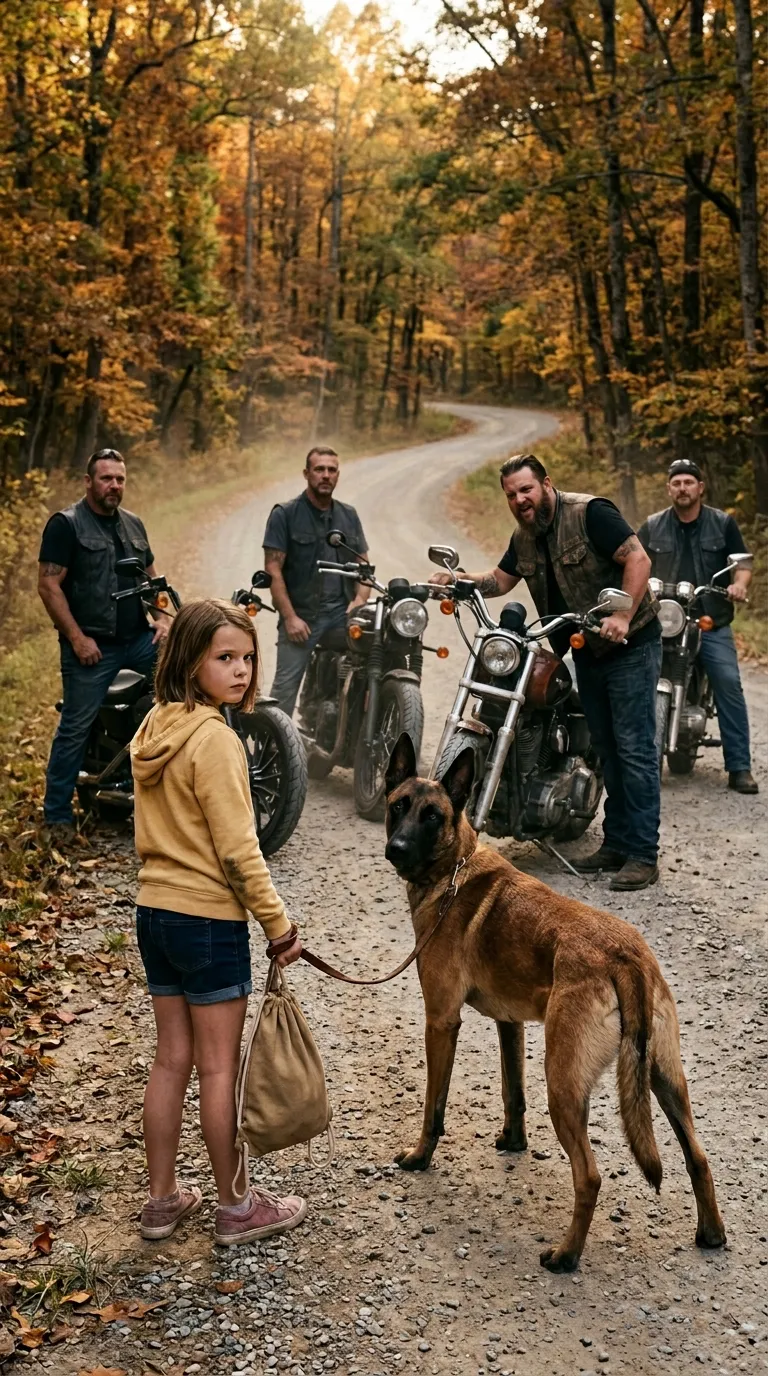
Nine-year-old Lily Harmon liked those hours best.
She walked alone because solitude felt easier than the quiet inside the house. Since her mother died, silence had changed shape. It was no longer gentle. It sat in rooms. It listened. It waited. Her grandmother, Carol, tried to fill it with the ordinary sounds of living—the scrape of pans, the low drone of the television, the steady humming of hymns while folding laundry—but grief was stubborn. It crept between all things.
So on most weekend mornings, while Carol still slept, Lily slipped outside with her canvas drawstring bag, her sketchbook, and the careful determination of a child who had learned too early how to carry her own sadness.
Beside her walked Atlas.
He was not the kind of dog people forgot. Seventy-two pounds of muscle, intelligence, and restraint, Atlas moved with a smooth, watchful precision that made other dogs look clumsy. His coat was burnished tan, his face masked in black, his ears sharply upright. He had once worked with the Harden County Sheriff’s Department as a K9—tracking, suspect apprehension, narcotics detection—until an injury ended the career of the deputy who handled him. After that, Atlas had been retired, adopted out through a placement program, and brought home to Carol’s little weathered farmhouse on the edge of town.
To most people, he was simply a former police dog.
To Lily, he was the one steady soul in a world that had been rearranged by loss.
She talked to him as she walked, sometimes about birds she wanted to draw, sometimes about school, sometimes about her mother in the careful half-whisper children use when they are still uncertain whether naming the dead will make them vanish all over again.
Atlas never answered, of course. But he listened.
That morning, Lily paused beneath the old catalpa tree near the bend and looked up through its thinning branches. “I bet I could draw this one,” she murmured, tugging her sketchbook halfway from her bag. “Not the whole thing. Just the pods.”
Atlas stood quietly at her left side.
Then he froze.
It was subtle at first: a stiffness in the shoulders, a stilling of breath, a shift of attention so total it changed the air around him. Lily looked down, then followed the line of his gaze toward the road behind them.
She heard the motorcycles a moment later.
Not one. Three. Maybe four. Their engines rolled over the hill in a thick metallic growl, too fast at first, then suddenly slower. Much slower. Slowing not because of the curve, but because of her.
Atlas stepped between Lily and the road.
His leash, clipped loosely around her wrist, went taut.
The motorcycles came into view in a spray of dust and low thunder, then pulled to a stop twenty feet ahead. Three bikes. Four men. Two of them broad-shouldered and thick-necked, one lean with a bristling beard, the fourth with a shaved head and dark glasses despite the mild morning sun. Their leather vests bore patches Lily did not recognize, though she knew enough from movies and from the look in Carol’s eyes when certain names came up in local gossip to understand they were not the kind of men a little girl should ever meet alone on an empty road.
For a moment, no one moved.
The engines idled.
A crow called from somewhere in the trees.
Then the biggest of the men swung one leg off his bike and planted his boot in the gravel. “Well now,” he said, his voice dipped in mock friendliness. “Where you headed, sweetheart?”
Lily did not answer.
Her fingers tightened around the leash. Atlas’ body pressed lightly against her shin, grounding her.
Another biker laughed. “Cute dog.”
“Does he bite?” the man asked.
The laughter that followed had something rotten in it.
Lily remembered what Carol always said: When something feels wrong, leave before it has time to get worse.
So she turned without a word and started back the way she had come.
Behind her, the engines cut off.
Boots crunched against gravel.
“Hey,” one of the men called. “We’re talking to you.”
Lily kept walking.
Atlas moved in perfect sync beside her, not pulling, not lunging, not barking. But his head kept turning, eyes fixed over his shoulder. Lily’s breath had begun to flutter fast in her throat. The road, which had always felt familiar, now seemed absurdly long. Too open. Too empty.
Another voice, closer now. “You deaf, girl?”
A hand caught the strap of her bag.
The force jerked her backward so sharply she gasped.
The sketchbook slipped free and hit the road.
Atlas spun.
The sound that came from him was not a bark. It was a low, controlled warning so deep it seemed to vibrate through Lily’s bones.
The man holding her bag lifted both hands in false innocence. “Whoa. Easy there.”
But his grin widened.
Another of the bikers stepped around in front of her, blocking the path back toward home. “No need to run. We just wanna talk.”
Lily’s heart began pounding so hard she could hear it. “Please let me go.”
Something changed at that moment—not in the men, but in Atlas.
Until then, he had been alert. Protective. Measured.
Now he became something else.
He lowered his head, squared his stance, and fixed on the nearest threat with a terrifying, professional calm.
The biggest biker looked down at him and smirked. “What’s this mutt gonna do?”
He reached for Lily’s wrist.
And the world split open.
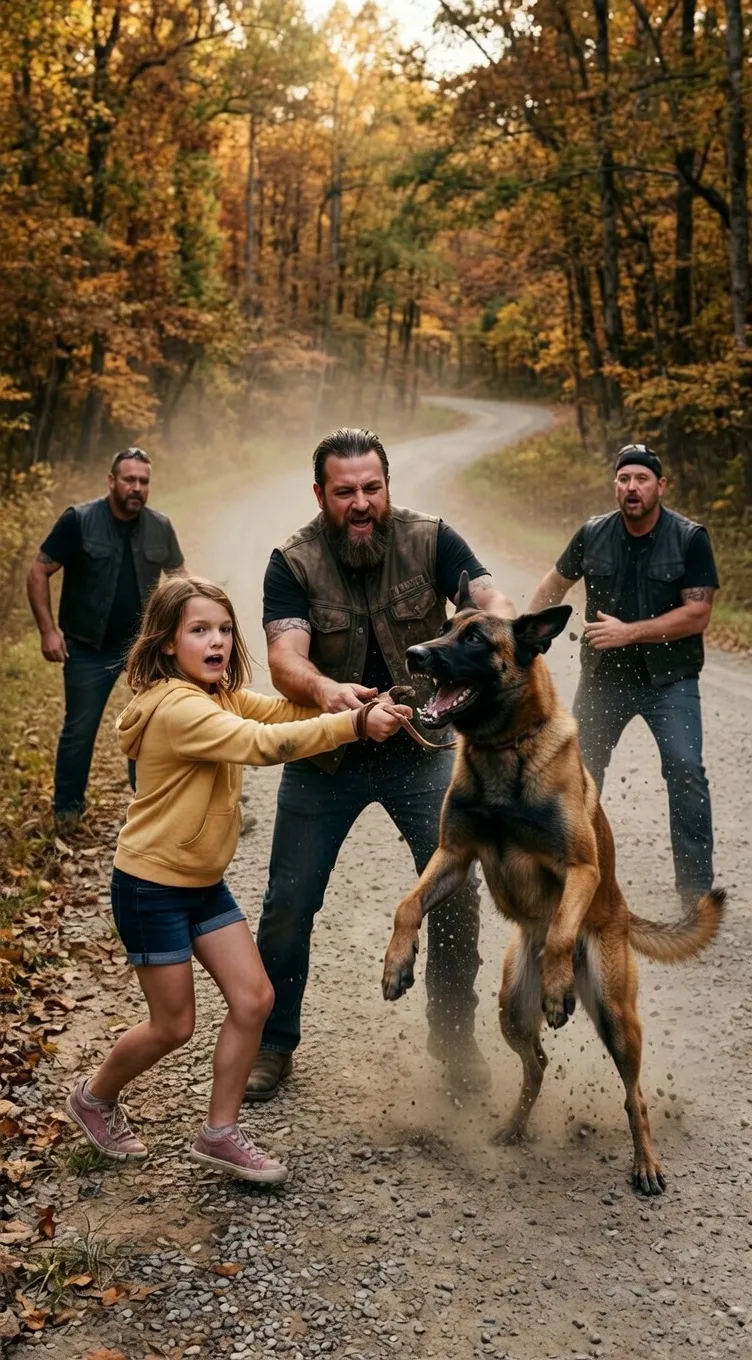
Atlas launched so fast that Lily barely saw him leave the ground.
One instant he was beside her. The next, he was airborne—a blur of tan muscle and black muzzle, every ounce of him driven by training buried so deep it was no longer learned behavior but instinct.
His jaws closed around the man’s forearm.
The scream tore across the quiet road like metal ripping apart.
The biker staggered backward, his boots skidding in gravel as Atlas held with precise, crushing force. Not wild. Not frenzied. Controlled. Lily saw that even through her terror. Atlas was doing exactly what he had been taught to do.
One of the other men lunged forward, shouting. Another reached toward his belt.
Atlas released, pivoted, and planted himself in front of Lily again, snarling now—a sound so fierce that all three bikers stopped as if an invisible fence had risen between them.
The man clutching his arm cursed and dropped to one knee. Blood darkened his sleeve.
“You little—” the shaved-headed biker began, stepping forward.
Then a truck horn blared from around the bend.
Everyone turned.
A battered county utility truck came bouncing down the road, dust flying behind it. The driver, a broad man in a reflective vest, slammed on his brakes when he saw the standoff. He took in the child, the dog, the bleeding man, and the motorcycles in one sweeping glance.
“Lily?” he shouted. “Get over here!”
Lily did not hesitate.
She ran.
Atlas backed with her, never turning his back on the bikers until she reached the truck. The utility worker yanked open the passenger-side door and practically lifted her inside. Atlas sprang in after her, landing half across her lap.
The man leaned out the window. “Sheriff’s on the way!” he yelled, though his hand was already fumbling for his phone.
The bikers glanced at one another. Something silent passed among them. Then, with the speed of men who understood when a moment had turned against them, they kicked their bikes to life. Engines roared. Tires spat gravel. Within seconds they were tearing back the way they had come, leaving only dust, fury, and the fading echo of their noise behind them.
Lily sat shaking so hard her teeth knocked together.
The utility worker kept saying her name. She heard it as if from underwater.
Atlas climbed fully into her lap, impossible as his size should have made that, pressing his weight against her chest until she could breathe.
And when she finally burst into tears, he licked once at the salt on her cheek and went utterly still again, returning to his silent, watchful duty as if nothing extraordinary had happened at all.
But everything had changed.
Because on that road, in the bright stillness of an October morning, a retired K9 had made a decision.
And somewhere beyond the trees, unseen by Lily and everyone else, a phone recording from the back pocket of the injured biker was still running.
Part II
By noon, the whole town knew.
In Ridgerest, news did not travel. It rushed—through diner counters, gas station pumps, church steps, and phone calls made in low urgent voices. By the time Lily sat wrapped in a sheriff’s office blanket with Atlas pressed against her knees, she could feel the weight of everyone’s fear settling around her like another room.
Her grandmother arrived pale and breathless, still wearing one house slipper and one work shoe.
“Lily. Oh, baby.”
Carol dropped to her knees and gathered her so fiercely that Lily almost disappeared in her arms. For a second, Lily let herself be held the way she had wanted to be held since the day her mother died. She buried her face in her grandmother’s shoulder and breathed in laundry soap, old perfume, and the wild salt of panic.
Atlas stayed close, eyes never leaving the doorway.
Sheriff Nolan Mercer stood nearby with one hand on his belt, his expression arranged into something meant to look reassuring. He was broad-faced, silver at the temples, and famous in town for speaking softly enough that people mistook it for kindness.
“Looks like a bunch of drifters got bold,” he said. “We’ll put out an alert.”
But Atlas gave a low growl the moment Mercer stepped closer.
Everyone turned.
Mercer chuckled. “Guess he’s still wound up.”
“No,” Lily said before she even realized she was speaking. Her voice came out thin, but steady. “He didn’t do that with anyone else.”
The room went strangely still.
Mercer’s smile held, but something in his eyes hardened for one flicker of a second. Then he stepped back. “Trauma does funny things to animals.”
And to people, Lily thought.
On the drive home, Carol kept one hand on the wheel and the other tight around Lily’s fingers. Atlas lay in the backseat, but not resting. He was listening. Watching. Waiting.
The autumn light had gone golden by then, spilling across the hills in long slanting bands. Everything outside looked heartbreakingly ordinary. Mailboxes. Split-rail fences. Cows in far fields. A child’s bicycle tossed in a yard. Lily wanted to hate the beauty of it. How dare the world still look soft after what had happened?
At the farmhouse, Carol locked both doors, then the windows, then checked them all again.
Only when the house fell quiet did she kneel in front of Lily and cup her face.
“Tell me exactly what they said.”
Lily tried. The road. The bikes. The hand on her bag. The smell of leather and gasoline and something sour. The way one of them had laughed. The way another had reached toward his belt.
Carol listened without moving.
Then Lily said, “Grandma… they didn’t look surprised to see me.”
Carol’s face changed.
Not with fear.
With recognition.
It was small, but Lily saw it.
“Why did you look like that?” Lily whispered.
Carol stood too fast. “You need food.”
“Grandma.”
Carol turned away, and that was when Atlas rose.
He did not bark. He did not whine. He crossed the kitchen with eerie certainty, went to the narrow hallway by Carol’s bedroom, and stopped at the old cedar chest that had belonged to Lily’s mother. Then he pawed it once.
Carol went white.
“Atlas,” she said sharply.
He pawed it again.
Lily stared. “Why is he doing that?”
Carol’s mouth trembled. “Because I prayed he never would.”
She sank onto the edge of the chest like someone whose bones had suddenly forgotten their purpose. For a long moment, she only looked at Lily. Then she opened the lid.
Inside were quilts, yellowed letters, two framed photographs, and beneath them all, wrapped in a dish towel, a flat metal tin.
Carol lifted it like it was heavy enough to break her wrists.
“There are truths,” she said quietly, “that people tell themselves they’re hiding to protect a child. But sometimes they’re just hiding them because they cannot bear to watch the child suffer twice.”
Her hands shook as she opened the tin.
Inside lay a flash drive, a small spiral notebook, and an envelope with Lily’s name written on it in a hand so achingly familiar that the air left Lily’s lungs.
Her mother’s handwriting.
Lily opened the letter with trembling fingers.
My sweet girl,
If you are reading this, then something has gone wrong, and Atlas has remembered before the law did. Listen to him. Listen to your grandmother. And forgive me for the years I took from you.
Lily could barely see the words through the blur in her eyes, but she kept reading.
Her mother had not died in an ordinary crash.
She had worked as a records clerk at the county annex and had discovered evidence files disappearing—drug seizures logged, then erased; witness statements altered; arrests redirected; names protected. The same names kept circling back to a biker crew out of Knoxville and one man inside Ridgerest who made sure no one looked too closely.
Sheriff Mercer.
The room seemed to tilt.
“He—” Lily couldn’t breathe. “He was there today.”
Carol nodded, tears streaming now. “Your mother found out too much. She copied records. She kept notes. She said if anything happened to her, it would not be an accident.” Her voice cracked. “Then they told us the brakes failed.”
Lily looked down at the letter again, her heart battering itself against her ribs.
I hid enough to ruin him. I could not trust the department. I trusted only your grandmother… and a dog who was trained never to forget a threat. If Atlas ever leads you back, it means they know what I knew.
For several seconds, no one moved.
Only the clock ticked.
Then Atlas turned his head sharply toward the front porch.
A truck engine growled outside.
Carol snatched the notebook. “Upstairs. Now.”
But the knock came before they could move.
Three hard raps.
“Mrs. Harmon?” Sheriff Mercer’s voice floated through the screen door. “Just checking in.”
Atlas’ entire body went rigid.
Carol looked at Lily, and in that look Lily understood something terrible and absolute:
Mercer had not come to protect them. He had come to see whether they knew.
Carol shoved the flash drive into Lily’s sweater pocket. “If I tell you to run, you run.”
The next few moments unfolded in fragments.
Carol opening the door only a crack.
Mercer smiling.
His eyes skimming the room.
Then dropping—to the open cedar chest.
Everything in him changed.
“Where’s the notebook?” he asked.
Not what notebook.
Where.
Carol tried to slam the door.
Mercer drove his shoulder into it so hard the frame splintered.
Lily screamed.
Atlas exploded forward.
The sheriff staggered back as the dog hit him high in the chest, all precision and fury. Mercer fired once, the shot deafening in the small front hall, the bullet shredding a lampshade. Carol grabbed Lily and dragged her toward the kitchen while Atlas and Mercer crashed into the wall, a snarl and a curse and the sickening sound of furniture breaking.
“Back door!” Carol shouted.
They ran.
Cold evening air slapped Lily’s face as they burst onto the porch—and froze.
Another vehicle had just swung into the yard.
The battered county utility truck.
The driver jumped out before it stopped rolling.
It was the same man who had pulled Lily off the road that morning.
But now he was holding a badge.
“Tennessee Bureau of Investigation! Mercer, don’t move!”
Mercer stumbled into the doorway with Atlas still latched to his forearm. Behind the TBI agent, two unmarked SUVs came roaring up the gravel lane in a spray of dust and sirens.
Mercer’s face lost all color.
And for the first time all day, Lily saw genuine fear.
Part III
The arrest lasted less than thirty seconds.
The truth lasted much longer.
Mercer tried to fight. Then to bargain. Then to laugh it off. By the time they dragged him past the hydrangea bushes with his hands zip-tied behind him, his neat sheriff’s calm had split wide open. He shouted that none of it would stick, that records could disappear, that biker trash would never testify, that Carol Harmon was a grieving old woman with stories and a dangerous dog.
Then the TBI agent said, “Funny thing about that.”
He held up a phone sealed in an evidence bag.
Lily stared.
The man gave her a grim nod. “One of the bikers dumped it when we boxed them in outside Cross Hollow an hour ago. It was still recording.”
The whole yard went silent except for Mercer’s ragged breathing.
The agent pressed play.
Static crackled. Engines. Wind.
Then voices.
One biker cursing about his bleeding arm.
Another saying, “Mercer’s gonna lose his mind if the kid still has the sketchbook.”
A third voice, distorted but unmistakable, came over speakerphone:
“Then get the girl before she gets home.”
Mercer closed his eyes.
Even through the tinny speaker, Lily recognized him.
But the recording was not finished.
One of the bikers laughed nervously and said, “Should’ve finished her mama cleaner when we had the chance.”
Carol made a sound Lily had never heard from any human being before—a broken, animal sound, torn straight from the center of a life.
Lily felt her knees weaken.
The TBI agent caught her before she hit the porch rail.
“Easy,” he said quietly.
She looked up at him then, really looked.
He was older than she had first thought. Deep scar along the jaw. Left hand stiff at the knuckles. Sad eyes. Familiar, somehow.
“I’m Ben Rawlins,” he said. “Used to handle Atlas’s transport cases after he retired.” His voice softened. “Your mother brought evidence to me once. I was injured before I could move on it. By the time I got back, she was dead. I’ve been trying to nail Mercer ever since.”
Carol stared at him through tears. “You knew?”
“I knew enough to suspect.” Ben looked at Atlas, who had finally released Mercer and returned to Lily’s side as though the world had simply corrected itself. “I also knew if they ever moved against the child, the dog would tell us the rest.”
Lily dropped to her knees and wrapped both arms around Atlas’s neck.
He smelled like dirt, old leather, and the iron tang of someone else’s blood. He leaned into her with full, solid weight, and she buried her face in his fur and wept until her throat hurt.
Not the thin frightened crying from the truck that morning.
This was deeper.
This was for her mother.
For the lie.
For the years of thinking death had been random when it had been chosen by wicked men who believed they could bury a woman by calling murder an accident.
The investigation ripped open Harden County before the week was over.
Mercer went down first. Then two deputies. Then the biker crew. Then a county judge whose name had appeared three times in Lily’s mother’s notebook. Search warrants uncovered cash, drugs, altered files, and enough buried corruption to make the state news for days.
But what Lily remembered most was not the television vans or the court hearings or the way strangers began stopping Carol at the grocery store to say your daughter was brave.
It was the night after the arrests.
The farmhouse was finally quiet.
Moonlight silvered the fields. Crickets sang. Somewhere far off, a train moaned through the dark.
Lily sat on the back steps with Atlas beside her, his head resting against her shoulder. Carol came out carrying the last page of the letter—one Lily had not noticed before, folded behind the first.
“You should read this now,” she said.
Lily unfolded it carefully.
There were only three lines.
Sweet girl, grief will try to convince you that the world ended when I did. It didn’t.
One day the truth will hurt you. Then it will free you.
And when it does, look at the dog. He will show you where to begin again.
Lily read the words twice.
Then she looked at Atlas.
He stood up immediately.
Carol let out a startled breath. “What in heaven’s name—”
Atlas stepped off the porch, crossed the moonlit yard, and headed toward the old catalpa tree by the bend in the road.
The same tree.
The one where Lily had stopped that morning.
The one she had wanted to draw.
Heart pounding, Lily followed.
Atlas circled the tree once, then dug at the roots with determined, scraping paws.
Ben Rawlins, who had stayed late with the investigators and was just then coming around the side of the house, saw what they were doing and ran for a shovel.
Within minutes, they struck metal.
A small rusted box.
Inside was no evidence this time.
No ledgers. No names.
Just a pressed catalpa flower, a photograph of Lily as a toddler asleep across her mother’s lap, and a sealed note.
Lily opened it under the moon.
I knew you’d come here someday.
This was where you laughed hardest when you were little. You called these trees “umbrella trees,” and you believed nothing bad could happen beneath them. I am sorry that life proved otherwise. But listen to me carefully, Lily: evil does not get the final word simply because it arrives loudly. Love stays. Love waits. Love remembers the way home.
So when you are old enough to decide who you want to be, do not choose your life in answer to fear. Choose it in answer to love.
And if Atlas is still with you when you read this, then kiss that stubborn hero right between the ears for me.
Lily laughed then—a sudden, shattered laugh through tears.
And she did.
She held Atlas’s face in both hands and kissed him between the ears.
He blinked once, solemn and patient, as if he had carried that message all this time and was satisfied, at last, to deliver it.
Ben looked into the box again. “There’s something under the photograph.”
He lifted it carefully.
A key.
Small. Brass. Old.
Carol frowned. “To what?”
No one knew.
Not until the next morning, when Lily was helping put her mother’s things back into the cedar chest and noticed a tiny brass lock built into the frame of an old watercolor hanging in the hallway—one her mother had painted years ago of the farmhouse under autumn leaves.
The key fit.
The backing clicked open.
Hidden inside was a single folded document.
Not a confession.
Not a will.
A scholarship application, half-completed in Lily’s mother’s handwriting, for an art academy in Nashville. At the bottom, in the space marked For Student’s Future Use, her mother had written one sentence:
For Lily—because survival is not the same thing as living.
Lily stood very still.
All this time, everyone had been talking about bravery and justice and what had been taken.
But here, hidden behind a painting, her mother had left behind something else.
A direction.
A future.
Carol put a shaking hand over her mouth. Ben turned away to give them privacy. And Lily, with the morning sun pouring over the old floorboards and Atlas leaning quietly against her leg, understood the final shape of what her mother had done.
She had not only hidden proof to destroy the men who killed her.
She had hidden hope for the daughter they meant to leave broken.
Outside, Ridgerest Road lay bright and harmless-looking again beneath the October sky.
But Lily no longer mistook beauty for safety, or silence for peace, or endings for the end of everything.
Because the most astonishing truth of all was this:
The men who cornered her had believed they were hunting a frightened child and an aging dog.
They had never understood that a mother’s last act of love had been waiting for them in secret, patient as roots beneath a tree, fierce as memory, and impossible to kill.
And in the end, what destroyed them was not the law, or luck, or even fear.
It was a dead woman’s truth, a little girl’s courage, and a retired dog who never stopped working.