For several seconds, Rhett could not hear the sirens anymore.
He could not hear the curses of the men being restrained. He could not hear Boone speaking to dispatch from the doorway, or Emma’s sobbing slowly easing into hiccups against her mother’s neck.
All he could see was Lena.
Not the laughing seventeen-year-old from his memory, but the woman she had become—thinner than she should have been, bruised, terrified, fierce enough to crawl across broken glass for her daughter. Yet beneath the blood and exhaustion, he still saw the shape of the girl who used to sit on the hood of his rusted truck and say she wanted to escape town before it swallowed them alive.
“Rhett,” she said again, like his name hurt.
He stared at Emma.
Emma stared back, confused now, thumb caught between her lips.
Those eyes.
His mother used to call them storm-gray. Said no Maddox man had ever been born without them.
The sheriff’s deputies and paramedics arrived in a rush of noise and authority. Statements were shouted. The two men were cuffed and dragged away, one spitting threats, the other trying to claim there had been a misunderstanding. Boone gave a short laugh at that and had to be physically waved away by a deputy before he educated them further.
The paramedics knelt beside Lena, checking her head wound, her pulse, her pupils.
“I’m not leaving my daughter,” Lena said immediately, clutching Emma tighter.
“You don’t have a choice if you’ve got a concussion,” one medic answered.
“I said I’m not—”
“Then she rides with you,” Rhett cut in.
Everyone looked at him.
The medic hesitated. “Family only.”
Rhett’s jaw flexed. Lena looked up at him, and something old and frightened moved behind her eyes.
Then, very quietly, she said, “He is family.”
No one questioned it after that.
The ride to Mason County Hospital was short and agonizing. Rhett followed the ambulance on his bike with Boone and Jax behind him. The rest of the club stayed back to deal with deputies, tow trucks, and statements. Word would spread fast, of course. By nightfall half the county would be saying the Black Vultures had raided a house. By morning the other half would learn they’d saved a woman and her child.
Rhett didn’t care about either version.
At the hospital, Emma refused to let go of him while Lena was taken for scans.
So he sat in a plastic waiting-room chair, a leather-clad mountain of a man with grease under his nails and a little girl asleep against his chest, one tiny fist wrapped around the chain at his neck.
Boone came back from the vending machine with stale coffee and a stuffed toy bear from the gift shop, looking embarrassed by both. He handed the bear to Rhett, who carefully tucked it under Emma’s arm.
“Well,” Boone muttered, dropping into the seat beside him, “this got complicated.”
Rhett kept staring at the hallway doors. “You knew?”
Boone nearly choked on his coffee. “Knew what?”
“That she had a kid.”
“No.”
“That the kid might be mine.”….
(To be continued)
Since Facebook doesn’t allow longer comments, please understand. If you want to read the
Part I
By the time the little girl came running out onto the highway, the heat had already begun to shimmer above the cracked asphalt, turning the road into a wavering ribbon of light.
The bikers saw her all at once.
One second the Black Vultures Motorcycle Club was idling in a long row outside the Rust Lantern Bar, engines rumbling like a storm held on a leash. The next, a tiny barefoot child in a yellow flowered dress burst from the tree line and stumbled straight into the center of the road, her pale legs streaked with dust, her cheeks soaked with tears.
She lifted both arms as if she could physically stop twenty men and twenty motorcycles with nothing but terror.
And somehow, she did.
Brakes screamed. Boots slammed down. Chrome shivered in the sun.
At the front of the formation, Rhett Maddox, president of the Black Vultures, killed his engine and swung off his bike in one hard motion. He was a broad-shouldered man in his late thirties, all scarred knuckles and watchful eyes, with a beard that made him look meaner than he was and silence that made most people assume the worst.
He crossed the road fast, crouched down in front of the little girl, and removed one glove.
“Hey,” he said, voice low and steady. “Hey, sweetheart. Look at me. You’re okay.”
She was not okay.
Her lower lip trembled so violently it seemed painful. Her small chest hitched for air. When she tried to speak, the words tangled in sobs.
Rhett kept his voice calm. “What’s your name?”
“E-Emma.”
“Emma,” he repeated gently, as if anchoring her to the world with it. “I’m Rhett. Are you hurt?”
She shook her head so hard strands of gold hair stuck to her wet face.
Then she grabbed the front of his leather vest with both fists and cried, “They’re hurting my mommy! Please—please don’t let her die!”
Behind Rhett, every sound seemed to vanish.
Even the men stopped moving.
Rhett felt something cold and immediate slide down his spine. “Who’s hurting her?”
Emma turned and pointed with a shaking arm toward a narrow dirt lane disappearing between overgrown hedges. “At the house. They came in the truck. Mommy told me to run. She said find anybody. But I saw you and—” Her voice broke. “—and everybody says bikers are scary, but you were there and I didn’t know what else to do.”
A rough curse escaped someone behind him.
Rhett rose in a single motion. The softness vanished from his face, replaced by something far older and more dangerous.
“Boone,” he barked.
A massive man with gray in his beard stepped forward instantly. “Yeah.”
“Call 911. Tell them possible home invasion, assault in progress. County Road Nine, somewhere down that dirt cut.” He looked at the girl. “Emma, can you show us?”
She nodded frantically.
Boone already had his phone in hand. Other men were dismounting, expressions darkening one by one. The Black Vultures had been called a lot of things over the years—outlaws, thugs, troublemakers, a stain on the county—but there was one thing they had never been: men who ignored a child begging for help.
Rhett bent and scooped Emma into his arms.
She clung to him instantly, as if he were the only solid thing left in the world.
“Hold on tight,” he told her.
Then he looked at his club and said, with terrible calm, “Move.”
The lane was too narrow for the full line of bikes, so they tore down it in staggered order, engines exploding through the quiet countryside. Dust billowed behind them. Branches whipped past. Emma buried her face in Rhett’s shoulder each time a root jolted them, but she kept pointing with one tiny finger.
“There,” she whispered at last.
The house crouched at the edge of a clearing—small, white once, now faded almost gray, with a front porch sagging on one side and one shutter hanging crooked. A blue pickup truck sat outside at an angle, driver’s door open.
Rhett’s eyes narrowed.
The front window was broken.
The screen door hung off one hinge.
And through the open doorway came the unmistakable crash of something heavy overturning inside.
He was off the bike before it fully stopped.
“Stay with Boone!” he ordered, passing Emma into the older biker’s arms.
“No!” Emma wailed, reaching for him. “Mommy!”
Rhett gripped her shoulder once. “I’m bringing her back.”
Then he turned and charged the house with six of his men behind him.
The front room looked like a tornado had tried to learn cruelty. Lamps smashed. Drawers ripped out. A chair overturned. The air smelled of sweat, fear, and old cigarette smoke.
And on the living room floor, half-curled beside a broken coffee table, lay a woman.
She couldn’t have been more than twenty-six. Dark hair spilled over her face. Blood marked one temple. Her blouse had been torn at the sleeve. She was conscious—barely. Her eyes fluttered open as the men stormed in, wild with pain and confusion.
Then she saw the leather cuts.
For one horrifying second, she thought they were part of it.
“Please,” she gasped, dragging herself backward. “Please don’t—”
“You’re safe,” Rhett said sharply.
A sound came from the kitchen.
A man bolted out the back hallway, carrying a metal cash box. He froze when he saw the room full of bikers.
Then he ran.
Jax Mercer, the youngest Vulture and mean as a snake when he needed to be, launched himself across the room and slammed into the fleeing man hard enough to send both of them crashing into the wall. The cash box flew, hit the floor, burst open, and spilled papers and old photographs like startled birds.
Another figure emerged from the hallway—older, red-faced, thick in the gut, holding a pistol.
Everything happened at once.
“Gun!” Boone roared from the doorway.
The mother screamed.
Rhett moved before thought could catch him. He grabbed the broken lamp base off the floor and hurled it. The heavy brass piece struck the armed man’s wrist. The gun fired into the ceiling. Plaster rained down. Before the weapon could fall twice, two bikers were on him, wrenching his arm behind his back and driving him face-first into the wall.
“Don’t kill him,” Rhett snapped.
The order came out hard, strained, almost reluctant.
Jax had the first man pinned, forearm across his throat. “You sure?”
“For now.”
Rhett dropped to one knee beside the woman. Up close he could see the purple marks blooming on her wrists, the exhaustion in her face, the raw effort it took for her to remain conscious.
“Your daughter’s okay,” he said. “She found us.”
The woman stared at him.
At first there was disbelief.
Then shock.
Then a crack of pure, animal relief so intense it looked like it might kill her.
“Emma?” she whispered.
“She’s outside.” He glanced toward the door. “Boone!”
The older biker carried Emma in.
The moment the child saw her mother, she slipped from Boone’s arms and flew across the wrecked room. “Mommy!”
The woman tried to sit up and failed. Rhett caught her shoulders and eased her back as Emma clung to her neck, sobbing so hard she shook.
The woman wrapped both arms around her daughter and let out a broken sound that did not sound human at all.
Rhett looked away.
Sirens wailed faintly in the distance.
The two intruders cursed and struggled under the weight of men who could have broken them in half.
And then the woman lifted her face to Rhett, saw him clearly, and went perfectly still.
Not with fear.
With recognition.
Her voice came out hoarse, disbelieving, almost inaudible.
“Rhett?”
He frowned.
Then she pushed tangled hair from her face, and the years fell away like shattered glass.
A porch swing in summer.
A county fair lit with paper lanterns.
A teenage girl laughing barefoot in the rain.
His chest locked.
“Lena?”
The room seemed to tilt.
Because the woman bleeding on the floor of that ruined house was Lena Hart, the first girl he had ever loved, the girl who had vanished from his life eighteen years ago without explanation.
And the child in her arms had his eyes.
Part II
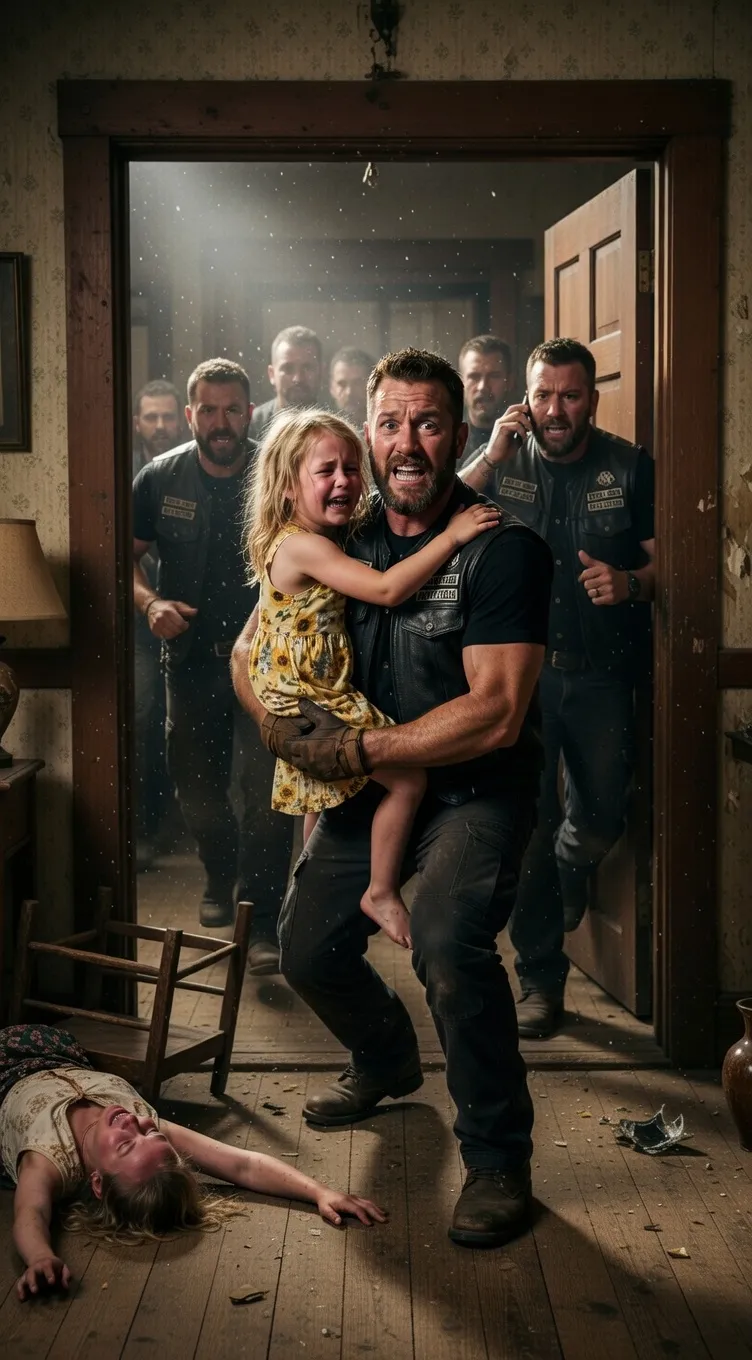
For several seconds, Rhett could not hear the sirens anymore.
He could not hear the curses of the men being restrained. He could not hear Boone speaking to dispatch from the doorway, or Emma’s sobbing slowly easing into hiccups against her mother’s neck.
All he could see was Lena.
Not the laughing seventeen-year-old from his memory, but the woman she had become—thinner than she should have been, bruised, terrified, fierce enough to crawl across broken glass for her daughter. Yet beneath the blood and exhaustion, he still saw the shape of the girl who used to sit on the hood of his rusted truck and say she wanted to escape town before it swallowed them alive.
“Rhett,” she said again, like his name hurt.
He stared at Emma.
Emma stared back, confused now, thumb caught between her lips.
Those eyes.
His mother used to call them storm-gray. Said no Maddox man had ever been born without them.
The sheriff’s deputies and paramedics arrived in a rush of noise and authority. Statements were shouted. The two men were cuffed and dragged away, one spitting threats, the other trying to claim there had been a misunderstanding. Boone gave a short laugh at that and had to be physically waved away by a deputy before he educated them further.
The paramedics knelt beside Lena, checking her head wound, her pulse, her pupils.
“I’m not leaving my daughter,” Lena said immediately, clutching Emma tighter.
“You don’t have a choice if you’ve got a concussion,” one medic answered.
“I said I’m not—”
“Then she rides with you,” Rhett cut in.
Everyone looked at him.
The medic hesitated. “Family only.”
Rhett’s jaw flexed. Lena looked up at him, and something old and frightened moved behind her eyes.
Then, very quietly, she said, “He is family.”
No one questioned it after that.
The ride to Mason County Hospital was short and agonizing. Rhett followed the ambulance on his bike with Boone and Jax behind him. The rest of the club stayed back to deal with deputies, tow trucks, and statements. Word would spread fast, of course. By nightfall half the county would be saying the Black Vultures had raided a house. By morning the other half would learn they’d saved a woman and her child.
Rhett didn’t care about either version.
At the hospital, Emma refused to let go of him while Lena was taken for scans.
So he sat in a plastic waiting-room chair, a leather-clad mountain of a man with grease under his nails and a little girl asleep against his chest, one tiny fist wrapped around the chain at his neck.
Boone came back from the vending machine with stale coffee and a stuffed toy bear from the gift shop, looking embarrassed by both. He handed the bear to Rhett, who carefully tucked it under Emma’s arm.
“Well,” Boone muttered, dropping into the seat beside him, “this got complicated.”
Rhett kept staring at the hallway doors. “You knew?”
Boone nearly choked on his coffee. “Knew what?”
“That she had a kid.”
“No.”
“That the kid might be mine.”
Boone went silent.
When he finally spoke, his voice was stripped clean of humor. “Rhett… no.”
Rhett looked down at Emma’s sleeping face. “Count it.”
The older biker did. Blonde hair. Gray eyes. The stubborn little jaw.
“Hell,” Boone whispered.
Memory opened in Rhett like an old wound.
He and Lena had been inseparable the year they were seventeen—him, the mechanic’s son with a bad reputation he hadn’t fully earned yet; her, the scholarship girl with books in her bag and fire in her blood. The entire town had treated them like a storm forecast: inevitable and unwelcome.
Then one night Lena had shown up at his garage crying.
Said her father had found out she was pregnant.
Said he was sending her away to “fix it.”
Said Rhett couldn’t come, because if he did, her father would destroy him.
Rhett had told her to wait at the old bridge at midnight.
He had gone.
She had never come.
The next morning the Harts were gone.
No address. No forwarding. Nothing.
For years he had believed one of two things: that she had chosen to leave without him, or that she had lost the baby. Both possibilities had gutted him in different ways.
Now here was a child sleeping on his chest.
Alive. Real. Warm.
And Lena had looked at him as though she had been carrying a secret too heavy for one life.
When the doctor finally came out, Rhett stood so fast Emma startled awake.
“Your wife is going to be okay,” the doctor said.
Rhett didn’t correct him.
“Head trauma, bruising, dehydration, mild concussion. No internal bleeding. She’ll need rest and monitoring, but she’s lucky.”
Lucky.
Rhett almost laughed.
They were taken to a private room because the nurses recognized the club and wanted less commotion near the front. Lena was pale against the white pillow, hair brushed back now, bruise darkening along her cheekbone. Emma climbed into the bed beside her instantly and curled against her side.
Lena looked at Rhett standing near the door.
“Can Boone take Emma to the cafeteria for ice cream?” she asked softly.
Emma perked up. Boone, hearing his cue, appeared as if summoned by witchcraft and led the child away with the solemnity of a palace guard escorting royalty.
When the door clicked shut, silence flooded the room.
For a long time neither of them spoke.
Then Rhett said, “You knew.”
Lena closed her eyes.
“Yeah.”
His voice was controlled, and that made it more dangerous. “You knew the whole time.”
“Yes.”
He laughed once, with no humor in it at all. “That’s a hell of a thing.”
Tears filled her eyes immediately, but she didn’t look away. “You think I don’t know that?”
“Then explain it.”
So she did.
After her father found out about the pregnancy, he didn’t just threaten her. He beat Rhett’s name out of every conversation and swore he’d have his brothers cripple him if Lena ever went near him again. That night at the bridge, she had tried to leave anyway.
Her father caught her before she got there.
Locked her in her room.
Three days later he dragged her and her mother across state lines to Tennessee, where his cousin ran an auto salvage yard and nobody asked questions. Lena wrote Rhett letters. Dozens of them. She mailed none, because her father intercepted the first two and burned them in front of her.
When Emma was born, Lena’s mother begged her to run.
But her mother got sick—fast, brutally, terminally. So Lena stayed to care for her until the end. After that, she tried to build something from the wreckage. She worked two jobs. She kept Emma fed. She kept moving town to town when men like the one from today—her landlord’s nephew and his friend—started circling too close, smelling vulnerability the way dogs smell blood.
“Why not find me after your father died?” Rhett asked.
Her face changed. “Who said he died?”
He stared.
Lena swallowed. “He’s one of the men your club handed to the sheriff.”
The room went still.
Rhett thought of the older man with the red face and the pistol. The brute fury in him. The familiarity he hadn’t placed.
No.
No, not possible.
But Lena nodded once, like she saw the realization land.
“He found me two months ago,” she whispered. “He’s been gambling for years. Drinking worse. He heard I got a small insurance payout when Mom died and decided it was his. I refused to give him a dime. Today he came with Dale, the landlord’s nephew, looking for the cash box and the deed papers.” Her voice shook. “When I fought back, he…” She stopped. Started again. “He said I ruined his life when I kept Emma.”
Rhett’s hands curled into fists so tight the knuckles whitened.
“My God,” he said.
“I didn’t tell you because I was ashamed,” Lena said. “Then later because I was scared. And then because too much time had passed and I didn’t know how to walk up to you with a ten-year-old child and say, surprise, she’s yours, I disappeared and let you think whatever hurt least.”
“Least?” he echoed, broken.
A tear slid down her face. “There wasn’t a least.”
He turned away and stared out the narrow hospital window at the darkening sky. The rage in him was volcanic, but it had nowhere clean to go. At her father. At time. At himself for not finding her. At the whole rotten machinery of fear that had chewed through two lives and nearly swallowed a third.
Behind him, Lena said in a voice so small it almost disappeared, “She asked me once why she didn’t have a dad. I told her maybe he was the kind of man who would come running if he knew.”
Rhett shut his eyes.
“And today,” Lena whispered, “you did.”
He stood there so long she may have thought he wouldn’t answer.
Then he turned back, crossed the room, and sank into the chair beside her bed.
“I’m angry,” he said.
“I know.”
“I don’t know what to do with half of what you just told me.”
“I know.”
“But hear me clear, Lena.” He looked at Emma sleeping with one hand on her mother’s arm. “Whatever happened before today, whatever we gotta untangle, nobody touches you or that little girl again. Nobody.”
The tears she had been holding back spilled over all at once.
Rhett took her hand.
She gripped his like a drowning woman grabbing the edge of a boat.
And outside the room, boots approached fast.
Jax shoved the door open without knocking, face grim. “Sheriff’s downstairs. Says there’s a problem.”
Rhett rose at once. “What problem?”
Jax’s expression was hard and baffled in equal measure.
“He says the older guy we brought in?” Jax said. “He’s not Lena’s father.”
Part III
For one impossible second, the words meant nothing.
Then Lena went white beneath the bruises.
“What?” she breathed.
Jax stepped inside and lowered his voice. “Sheriff ran fingerprints. The man gave the name Arthur Hart, but Arthur Hart died six years ago in a warehouse fire outside Knoxville. Dental records confirmed it back then.”
Lena stared at him as if language had deserted her.
“No,” she whispered. “No, that’s not—”
“It gets worse,” Jax said. “The dead man’s prints also don’t match any old licenses under Arthur Hart. Which means whoever raised you under that name wasn’t Arthur Hart either.”
Rhett felt the floor shift under him.
“Then who the hell is he?” Boone asked from the hall, Emma in one arm and two melting ice creams in the other.
Jax looked at Lena. “Sheriff wants to know the same thing.”
Everything that followed happened in fragments.
The sheriff came upstairs, hat in hand, face tight. He was a man who had spent twenty years treating the Black Vultures like an infection, but even he knew when the truth had gotten too strange for pride.
He asked Lena if she had a birth certificate, old family photos, anything official.
She did.
The cash box.
The one the intruder had been carrying when he tried to run.
Rhett called one of his men still at the house. The box had already been logged as evidence, but the sheriff authorized a quick search of its contents.
An hour later he returned with a folder.
Inside were deed papers, her mother’s death certificate, Emma’s birth records—and beneath them, an envelope Lena had never seen.
It was yellowed with age and addressed in a woman’s handwriting she recognized immediately.
For Lena. If he ever comes back.
Her hands shook so badly Rhett had to help open it.
Inside was a letter from her mother.
Lena read the first line and made a sound like her heart had physically torn.
My darling girl, if you are reading this, then the man you knew as your father has finally lost control of the lies.
The room narrowed around the words.
Her mother’s letter revealed everything in clean, devastating strokes. Twenty-eight years earlier, before Lena was old enough to remember, her mother had been married to another man—Gabriel Vale, a local investigative journalist who had been digging into a smuggling route running through county lines, aided by corrupt deputies, business owners, and one violent enforcer named Silas Creed.
Silas was the man Lena knew as Arthur Hart.
He had kidnapped Lena’s mother after Gabriel got too close to exposing the network. Gabriel disappeared. Everyone assumed he’d run off or been murdered. Silas forced her mother to take a new name, a new town, a new life, threatening to kill the child if she resisted. For years she had played obedient wife to keep Lena alive, waiting for a chance to escape that never came.
When Lena became pregnant as a teenager, Silas panicked. Not because of morality.
Because he had recently learned that Gabriel Vale had not died.
He had been living under protection after a failed attempt on his life, still gathering evidence, still hunting the network that had destroyed his family. Silas feared that if Gabriel resurfaced and saw Lena—his daughter grown, with a child of her own—the whole past would come crashing back into daylight.
So Silas moved Lena again. Controlled her. Isolated her.
And when her mother got sick, she finally wrote the truth, hiding the letter where Silas would never think to look: with the money and papers he valued more than people.
At the bottom of the page was a final line:
If Gabriel ever finds you, tell him I never stopped waiting by the window.
Lena was crying so hard she could barely breathe.
Emma, frightened by the adults’ faces, climbed into Rhett’s lap and clung to him.
The sheriff looked shell-shocked. Boone had stopped pretending not to have feelings and was openly wiping his eyes with the back of one rough hand.
Rhett read the letter twice.
Then a terrible thought struck him. “If Gabriel Vale is alive…”
The sheriff nodded grimly. “Then he may already know Silas was in custody.”
As if summoned by the sentence, a deputy burst into the room.
“Sheriff,” he said, breathless. “You need to come now. There’s a man downstairs asking for Lena Hart. Says his name is Gabriel Vale.”
No one moved.
Then Lena stood.
Her knees nearly buckled. Rhett caught her, but she pulled free gently, one hand pressed to her mouth. “No,” she whispered again, but this time it sounded like prayer, not denial.
They found him in the hospital chapel.
He was older, of course. Sixty maybe, weathered and lean, with silver at his temples and a face marked by old scars. But when Lena saw him, something in her broke open with instant recognition no photograph could have manufactured.
He stood slowly as she entered.
For a moment they simply looked at each other.
Then he said, voice shaking, “Lena.”
She began to cry before he reached her.
He folded her into his arms with the careful desperation of a man holding the center of his life after believing it dead for decades. Lena clutched at the back of his shirt like a child.
Rhett stood in the doorway with Emma in his arms and watched three generations of broken history collide in one room.
Gabriel told them the rest.
He had survived the attempt on his life but never managed to locate his wife and daughter. Silas and the men around him had buried every trail. Gabriel spent years feeding evidence to federal investigators under another name, helping dismantle the smuggling ring piece by piece. Only a few low-level remnants were left now—desperate men, scattered, angry, still dangerous. Silas had slipped through every crack until today.
When the sheriff ran the print alert, a dormant watch flag on Gabriel’s old case triggered. He had driven three hours the second he got the call.
Then came the final twist—the one no one in the room saw coming, not even Gabriel.
The sheriff cleared his throat and looked almost embarrassed by the enormity of it.
“There’s more,” he said. “Federal marshals are on their way for Silas. But before they arrive… there’s a witness in protective housing who asked to speak with you, Gabriel.”
Gabriel frowned. “Who?”
The sheriff looked toward the door.
A woman stepped in.
Thin. Gray-haired. Walking with a cane.
Lena gasped.
The letter slipped from her hand.
Because standing in the doorway, alive when she had been buried in Lena’s heart for years, was her mother.
For one vertiginous second, no one understood what they were seeing.
Then her mother smiled through tears and said, “I’m so sorry it took this long.”
Lena made a broken, disbelieving sound and rushed to her.
They collided halfway across the chapel, both sobbing, both laughing, clinging to each other so tightly it seemed impossible either had ever been apart. Emma squirmed wildly from Rhett’s arms and ran to them, and suddenly all three were there together—mother, daughter, granddaughter—held inside one impossible reunion.
Rhett looked at Gabriel, who had gone utterly still.
“Your wife’s dead certificate—” Rhett began.
“Faked,” Gabriel said hoarsely. “The marshals staged it after she finally escaped two years ago. Silas still had reach. They thought if he believed she was dead, he’d stop hunting her.” His eyes never left the woman across the room. “I agreed because it kept her alive. But they couldn’t risk contact until Silas surfaced.”
Rhett exhaled slowly, almost laughing at the audacity of fate.
The county had gossiped for years that the Black Vultures brought trouble wherever they rode.
Today they had brought a child back to her mother, a woman back to her father, a wife back to her husband, and the truth back from the grave.
Later, long after the chapel had emptied and statements had been taken and federal agents had led Silas Creed away in chains, Rhett stood outside the hospital under a sky bruised purple with evening.
Emma sat on the curb swinging her legs, eating contraband pudding from the cafeteria. Boone and Jax argued near the bikes about whether hospital coffee counted as a human rights violation. Gabriel spoke quietly with Lena’s mother by the parking lot lights, their heads bent close like two people relearning a miracle.
Lena stepped beside Rhett.
For a minute neither said anything.
Then she looked at Emma and smiled through exhaustion. “She likes you.”
Rhett glanced over. “I like her too.”
“That’s not what I meant.”
He turned to Lena.
She looked older than the girl in his memories and stronger than she had any right to be. There were bruises on her skin and grief in her history and still, somehow, light in her.
“I stole ten years from you,” she said quietly.
“You survived ten years from hell,” he answered. “That ain’t the same thing.”
Her eyes filled again. “I don’t know what happens now.”
Rhett looked at the people gathered below the parking lot lights—the club brothers who would fight for him without question, the child who had changed everything by running toward the men she was taught to fear, the family brought back from the dead by sheer endurance and one impossible day.
Then he reached for Lena’s hand.
“Now,” he said, “we start telling the truth. And after that, we build whatever they tried to take.”
Emma looked up then, as if she had heard him from across the distance.
“Mr. Rhett?” she called.
He smiled despite himself. “Yeah, baby?”
She frowned in solemn concentration. “Mommy says you come running when it matters.”
His throat tightened.
Lena pressed her fingers to her lips.
Emma grinned, pudding on her chin, innocent and triumphant and entirely unaware that she had just rewritten the ending of four broken lives.
Then she said the words that undid him completely.
“Good. Because I think you’re my dad.”
Rhett laughed once, sharp and helpless, and wiped at his eyes with the heel of his palm.
“Yeah,” he said, voice rough with wonder. “I think so too.”
And under the hospital lights, with engines cooling in the dark and the old lies finally dying, the feared men of chrome and leather stood guard over something far more powerful than reputation.
They stood guard over a family that had found its way back from ruin.
And for the first time in a very long time, the night did not feel like an ending at all.
He Said She Didn’t Look Like a Navy Officer. By Nightfall, the Whole City Knew He Had Picked the Wrong Mother.
Part I
The afternoon bell at Canyon Ridge Elementary rang with the bright, careless joy of childhood, and for one fragile moment, the world looked harmless.
Children flooded through the front doors in chattering streams, sneakers slapping pavement, lunchboxes bumping against little knees. Teachers in fluorescent vests pointed toward pickup lanes. Parents gathered in loose circles with half-finished coffees, exhausted smiles, and the thousand distracted gestures of people trying to survive another weekday.
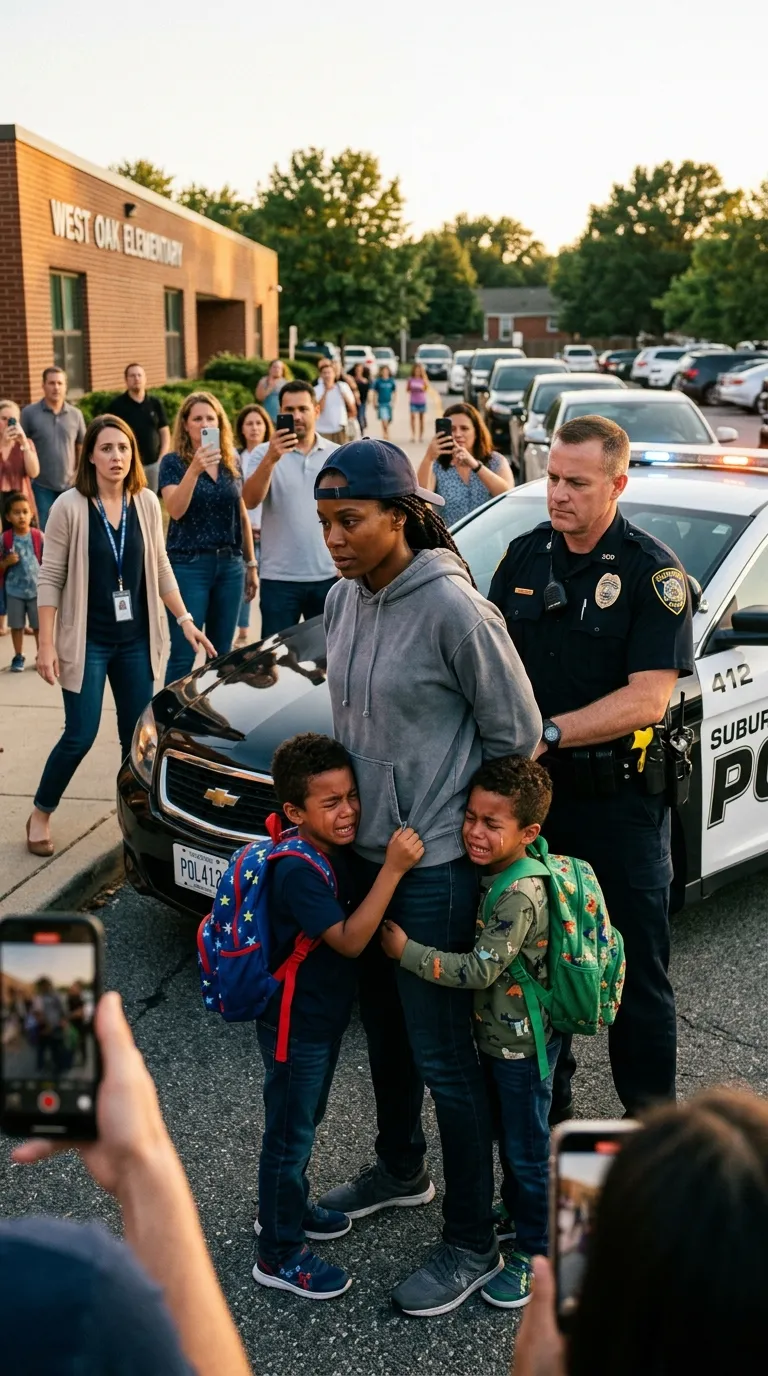
Commander Naomi Pierce stood near the crosswalk in jeans, a faded gray hoodie, and a navy-blue baseball cap, looking exactly like what she wanted to be that afternoon: just a mother waiting for her sons.
She had spent fifteen years in Naval Special Warfare learning how to move without attracting notice, how to study a street without seeming to look at it, how to read danger before danger knew it had been seen. Blending in was not a performance anymore. It was muscle memory.
But nothing about this moment was tactical.
This was sacred.
Then she saw them.
Eli and Owen burst from the school doors like twin rockets, identical grins splitting their faces, backpacks bouncing wildly against their shoulders. Her boys. Her whole heart in duplicate.
“Mom!” they shouted together.
Naomi dropped into a crouch and opened her arms just as they slammed into her, nearly knocking her backward. She laughed—a real laugh, the kind that only existed for them—and wrapped both boys up tightly.
“How were my favorite troublemakers?” she asked.
“We made volcanoes!” Eli yelled.
“Owen spilled baking soda on Mateo!” Owen said, betraying his brother instantly.
“It was science!” Eli protested.
Naomi pressed a kiss to each forehead. For one sweet breath, the world narrowed to warm hair, little shoulders, and the ordinary miracle of everyone being safe.
That was when the patrol car rolled up too fast and stopped too close.
Its tires whispered against the curb. The engine idled. Several parents glanced over, then looked away the way people do when they sense trouble but pray it belongs to someone else.
Officer Jared Kline stepped out.
He was broad-shouldered, sun-reddened, with the kind of face that looked carved from irritation. His hand rested on his belt before he spoke, not because he needed it there, but because he liked what it suggested.
He watched Naomi for one beat too long.
Then he said, “Ma’am, step away from the children.”
Everything inside Naomi went still.
The boys tightened around her legs. Naomi rose slowly, keeping one hand on each small shoulder.
“Is there a problem, officer?” she asked.
Kline’s eyes flicked to her cap as though it offended him personally. “We’ve had reports of stolen valor in this area. Someone claimed military benefits at a gate last week. You match the description.”
Naomi stared at him, sure for a second she had heard wrong.
“I didn’t claim anything,” she said. “I’m here to pick up my children.”
Kline held out a hand. “ID.”
Naomi passed him her driver’s license. He examined it, then looked at her face again with a slow, skeptical tilt of the head. Not confusion. Not procedure. Judgment.
“You’re saying you’re a Navy officer?” he asked.
“Yes,” Naomi replied evenly. “You can verify that through dispatch.”
He did not reach for his radio.
Instead, the corner of his mouth twitched.
“You don’t look like one.”
The words were plain. Casual, almost.
But Naomi knew the weight hidden inside them. She had carried versions of that sentence her entire career.
Too Black. Too female. Too calm. Too ordinary. Too wrong for the picture in his head.
Around them, the school pickup noise seemed to thin out, as if the air itself had turned to glass.
Naomi inhaled carefully. “Officer, call it in. Please verify my identity before you escalate this.”
“Turn around,” Kline said.
Her jaw hardened. “You’re making a mistake.”
“Turn. Around.”
One teacher—a young woman with a braid and a laminated school badge—took a nervous step forward. “Officer, those are her boys, she’s here every—”
Kline lifted a hand without looking at her. “Stay back.”
The teacher froze.
Naomi glanced down at Eli and Owen. Their faces had gone pale with the fast, instinctive fear children feel when adults stop making sense.
She lowered her voice. “Boys, go stand by Ms. Alvarez.”
They didn’t move.
“Now,” she said more softly.
Trembling, they released her.
Naomi turned around.
The metal cuffs snapped shut around her wrists with a sound so final it seemed to split the afternoon in half.
A mother near the curb gasped. Someone else muttered, “Oh my God.” Phones began rising into the air one by one, rectangular witnesses hungry for spectacle.
The cuffs bit hard enough to sting. Kline tugged them tighter anyway.
“I’m arresting you for impersonation and obstruction,” he announced loudly, projecting for the crowd.
Naomi’s shoulders stayed straight. Her face did not crack.
But when she turned toward her sons and saw them crying, something in her chest tore open.
Eli lunged toward her first. “Don’t take my mom!”
Owen was sobbing so hard he could barely breathe.
Naomi took one step toward them before Kline yanked her back toward the cruiser.
“Eyes on me,” she said quickly, voice low and steady despite the steel at her wrists. “Breathe. You’re safe. Look at me, babies. You are safe.”
It was an impossible thing to say while handcuffed in front of them.
And yet she said it because mothers lie for mercy all the time.
Kline moved her another step.
Then three black SUVs came around the corner in a hard, synchronized turn and stopped at the curb in a line so precise it looked rehearsed.
One.
Two.
Three.
Doors opened immediately.
Men and women stepped out in dark suits and plain clothes, movements crisp, eyes scanning, postures alert but controlled. Not local police. Not random officials. Something else.
The lead was a woman in black slacks and a fitted blazer, blond hair pinned back, expression flat with purpose. She crossed the pavement without hesitation, heels striking sharp against concrete.
“Officer,” she said, each syllable precise, “remove those cuffs.”
Kline laughed once. “Back off.”
The woman produced credentials so fast it seemed like a magic trick. She held them inches from his face.
“You have just detained Commander Naomi Pierce, United States Navy.”
The crowd fell silent.
Even the children seemed to stop.
Kline looked at the credentials, then at Naomi, then back again. Color drained from his face, but his ego held the line where his reason had failed.
“She could still be—”
The woman cut him off. “And we have reason to believe you’ve done this before.”
The words landed heavier than the badge.
Naomi’s eyes sharpened.
Because there it was—the thing she had sensed the moment he chose humiliation over verification.
This wasn’t a mistake.
At least, not his first one.
In the distance, sirens began to rise.
And Officer Jared Kline, for the first time that afternoon, looked afraid.
Part II
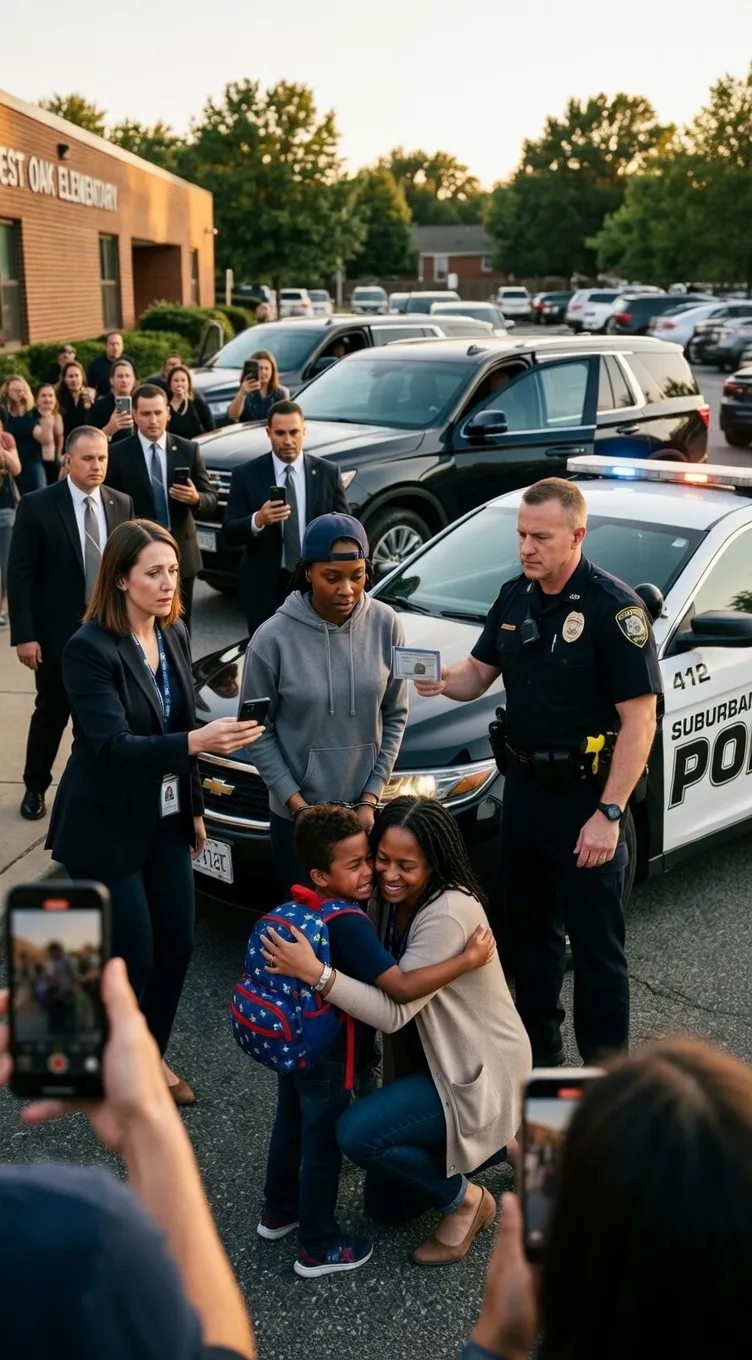
The cuffs came off with none of the force that had put them on.
Officer Kline’s hands trembled slightly as he reached for the key. He didn’t apologize. Men like him rarely did when apology would mean admitting they had not simply erred, but revealed themselves.
Naomi stepped back as soon as the metal fell away. Her wrists were red and already swelling.
Before anyone else could say a word, Eli and Owen crashed into her again, clinging to her sides, shaking with leftover terror. Naomi dropped to her knees on the pavement despite the ache in her arms and gathered them close.
“It’s okay,” she whispered. “I’ve got you.”
“Were they taking you to jail?” Owen cried into her hoodie.
“No,” Naomi said, holding his face between her hands. “No one is taking me anywhere.”
It was another lie. The truth was that for sixty endless seconds, she had not known what would happen next. And that uncertainty scared her far more than pain ever could.
The blond woman crouched beside her. “Commander Pierce, I’m Special Agent Rebecca Vale, Naval Criminal Investigative Service.”
Naomi looked up sharply. “NCIS?”
Vale nodded once. “We need to move fast.”
Kline shifted his stance. “What is this?”
Vale stood and turned toward him. “This is a federal matter now.”
The distant sirens grew louder. Two more vehicles were approaching—not patrol units this time, but unmarked sedans.
Naomi rose slowly, one hand still on each son. “Why is NCIS here?”
Vale met her gaze. “Because Jared Kline has been appearing in three separate complaints involving military families, especially women of color. Harassment. Unlawful detention. Intimidation. But that’s not the real reason.”
Naomi’s instincts flared.
“What’s the real reason?” she asked.
Vale glanced at the crowd of recording parents, then back at her. “Someone in this district has been feeding private information about service members’ dependents to an outside network. Pickup schedules. addresses. travel windows. We thought it was identity theft at first.”
A cold silence opened inside Naomi.
Eli gripped her hand tighter. She squeezed back automatically.
“And now?” she asked.
Vale’s face darkened. “Now we think it’s something much worse.”
The words crawled across Naomi’s skin like ice.
Kline barked out a laugh too brittle to sound human. “You people are insane.”
One of the arriving agents approached with a tablet. “Ma’am, we pulled his traffic body cam stream from dispatch before it got scrubbed.”
“Scrubbed?” Naomi repeated.
The agent turned the screen slightly so she could see. “Someone from inside tried to flag the footage for restricted deletion nine seconds after the black SUVs were spotted on traffic camera.”
Naomi looked straight at Kline.
He avoided her eyes.
That was answer enough.
The crowd, sensing the shift from scandal to something darker, leaned in. Parents who had been filming out of outrage were now filming out of fear.
Ms. Alvarez stepped forward with both twins. “Commander Pierce, I can take the boys inside if you need—”
“No,” Naomi said immediately.
Her voice was soft, but final.
She had spent too many years training herself to evaluate threats in layers, to identify what was visible and what was hidden beneath it. And right now the visible danger was Kline.
Which meant the hidden danger was whoever thought Kline mattered enough to protect.
Naomi rose fully and squared her shoulders. “Talk.”
Agent Vale did not waste time. “Three months ago, the spouse of a Navy cryptologist had her car broken into after school pickup. Nothing valuable taken. Just a folder containing overseas travel paperwork. Six weeks later, a Marine intelligence officer’s son was followed from soccer practice. The suspect vanished before local police arrived. Last week, a Coast Guard lieutenant found someone had filed fraudulent claims using his dependent data.”
Naomi felt her heartbeat slow into the cold, efficient rhythm it used in operational briefings.
A pattern.
Not random.
Selection of targets tied to access, travel, and military families.
Then she understood why Vale was here.
“Someone’s building profiles,” Naomi said.
Vale gave a grim nod. “And someone in local law enforcement has been helping.”
Kline snapped, “That’s a lie.”
But no one was listening to him now.
Naomi looked down at her boys. Their cheeks were still wet. They were staring up at her with the terrible trust children have—the trust that says if you stand, the world can still be held together.
She turned to Ms. Alvarez. “Take them inside. Lock the front office. Call my emergency contact—the number on the school form under Aunt Tessa. Tell her I said Code Harbor.”
Ms. Alvarez blinked but nodded. “Okay.”
Eli resisted. “Mom—”
Naomi knelt again and cupped both little faces. “Listen to me. I need you to be brave for six minutes.”
“Why six?” Owen whispered.
Because that was how long it often took a crisis to become a catastrophe.
Because trained minds break time into usable pieces when panic wants forever.
Because if she said a little while, they would know she was guessing.
“Because I said so,” she answered, kissing each forehead. “And because you are Pierce boys.”
That got the faintest, shakiest smile out of Eli.
As Ms. Alvarez led them back toward the school, Naomi stood and watched until the doors shut behind them.
Only then did she turn back.
“Tell me everything,” she said.
Vale exhaled. “We didn’t identify the leak through data tracing. We identified it through behavior. Every time a military dependent had an issue, Officer Kline was first on scene or first to request access to the report. He always made it seem routine. A stop. A warning. A paperwork delay.”
“Fishing expeditions,” Naomi said.
“Yes.”
Another agent approached with an earpiece pressed tight. “Ma’am, warrant team is at Kline’s house.”
Kline’s head jerked up. “You don’t have probable cause.”
The agent ignored him. “Neighbor’s security footage shows a man dropping sealed packages at his garage twice this month. No plates.”
Vale’s eyes stayed on Naomi. “We were waiting for one more confirmed contact. Then he approached you today before we could take him quietly.”
A chill passed through Naomi. “You were watching the school?”
Vale hesitated.
“Yes.”
Naomi’s face hardened. “And you let him get close to my children?”
“It wasn’t supposed to happen like that.”
Those six words nearly undid more than the handcuffs had.
Naomi stepped forward, her voice dropping into something dangerous. “Nothing involving my sons gets to happen ‘like that.’ Do you understand me?”
Around them, agents went very still.
Vale held her ground. “Yes, ma’am.”
Naomi stared at her another second, then looked toward the school entrance again.
She forced herself to think, not feel.
“If Kline was making contact in daylight, in public, on camera, then he either panicked,” she said, “or he needed to create a disruption.”
Vale nodded slowly. “We thought the same.”
Naomi turned back to the original patrol car. “Search his vehicle. Now.”
Kline laughed again, but this time it cracked in the middle. “You can’t order—”
“Do it,” Vale said.
Two agents moved immediately.
Kline lunged half a step forward. “You have no warrant for that car!”
But one of the agents had already spotted it.
A burner phone duct-taped beneath the dashboard.
Everyone froze.
The agent held it up in a gloved hand. “Found one.”
Kline’s face went blank in the way guilty faces sometimes do—stripped suddenly of performance, revealing only raw calculation.
Then, shockingly, he smiled.
Not smugly.
Not arrogantly.
Knowingly.
And Naomi understood one beat too late that the disruption had never been about her arrest.
It had been about time.
A scream erupted from inside the school.
Every head snapped toward the doors.
Then the fire alarm began to blare.
Children started pouring out in panicked waves.
Naomi’s blood turned to fire.
“Eli! Owen!”
She ran.
No permission. No briefing. No protocol.
Just a mother moving faster than fear.
Agents shouted behind her. Vale barked orders. Kline was slammed to the ground. None of it mattered.
Smoke was curling from a side hallway inside the main office entrance—not thick, not accidental, just enough to trigger chaos. Teachers were trying to guide children out, but panic had split the lines.
And through that noise, Naomi heard it:
A child yelling, “He took them!”
Her body went cold.
Ms. Alvarez stumbled out of the building coughing, eyes wild. “Two boys—someone pulled the twins through the east gate—I tried—”
Naomi didn’t hear the rest.
She was already running toward the far side of campus.
Past the basketball blacktop.
Past the maintenance shed.
Past the narrow gate that opened toward a service alley.
Open.
A black van was idling beyond it.
Its rear doors were closing.
And inside, just for a flashing second, she saw two small faces and matching blue backpacks.
The world narrowed to one savage point.
Naomi did not scream.
She did not think.
She moved.
Part III
The van peeled away from the curb just as Naomi hit the gate.
Any other mother might have frozen for one fatal second at the sight of distance, speed, steel.
Naomi Pierce had once boarded a moving vessel in eight-foot seas with a fractured rib and a knife between her teeth.
She sprinted.
The alley was narrow, littered with bins and cracked asphalt. The van accelerated toward the far street, but children made kidnappers sloppy. Chaos made them greedy. One of the rear doors had not latched fully.
Naomi grabbed a metal recycling bin with both hands and shoved it hard into the alley behind her.
“Block the exit!” she roared.
An agent somewhere behind her shouted for units. Tires screeched at the far intersection.
The van clipped a parked landscaping trailer, fishtailed, then corrected.
That half-second was enough.
Naomi leaped.
Her hands caught the loose rear handle. The impact slammed pain through her shoulders, but she held on as the van dragged her three brutal yards across asphalt before momentum lifted her feet clear.
Inside, one man cursed.
The rear door swung wider.
Naomi saw them then—Eli and Owen zip-tied together, crying, terrified, one masked man reaching for them, another scrambling toward Naomi with a stun baton.
“Mom!” Eli screamed.
The man lunged.
Naomi drove both boots against the doorframe and used the van’s motion to swing inward like a wrecking ball. Her shoulder smashed into his chest. The baton cracked harmlessly against metal walling and skittered away.
The second man grabbed Owen by the arm and hauled him backward as a shield.
Naomi’s voice dropped to a lethal calm. “Let go of my son.”
He laughed shakily through his mask. “Or what?”
Naomi’s answer was not verbal.
She seized the first kidnapper’s wrist, snapped his elbow backward with a sickening pop, then slammed his head into the van’s interior hard enough to drop him unconscious across the floor. The second man recoiled, dragging Owen tighter.
“Stop!” the kidnapper shouted. “I’ll break his neck!”
Eli was sobbing uncontrollably. Owen had gone eerily silent—the silence of a child too frightened to cry.
Naomi lifted both hands slightly.
A surrender posture.
A lie.
“Okay,” she said. “Okay. Don’t hurt him.”
The man’s breathing was ragged. “Back up.”
Naomi took one tiny step.
Then she looked straight at Owen.
“Eyes on me,” she said softly.
It was the same thing she had told them in the handcuffs.
The same anchor.
Owen obeyed instantly.
And because he was Naomi’s son—because somewhere inside his fear there was still trust—he did the one thing she needed.
He dropped his weight.
The kidnapper lost balance for a fraction of a second.
Naomi exploded forward.
Her forearm crushed into his throat. Her knee drove into his thigh. She tore Owen free with one arm and threw her body between both boys and the attacker just as the van swerved violently.
Gunshots cracked outside.
One tire blew.
The van spun.
Metal screamed.
The world flipped sideways and slammed to a halt against a loading barrier in a shower of glass.
For one impossible second there was silence.
Then the boys began crying again, and Naomi almost collapsed from gratitude.
“It’s okay, it’s okay,” she gasped, cutting the zip ties on their wrists with a folding blade she had palmed from her hoodie seam. “Mom’s here. Mom’s here.”
Sirens engulfed the street now. Agents surrounded the van with weapons drawn. The driver was dragged through the front windshield by tactical officers. The surviving kidnapper in the back was pinned face-first against the floor.
Agent Vale appeared at the wrecked door, breathless and pale. “Commander—”
Naomi looked up, fury burning through every syllable. “Who are they?”
Vale stared past her at the two captured men, then at something one of the tactical officers had just pulled from the front seat.
A city-issued evidence envelope.
Not federal. Not military. Local.
Naomi stepped out of the van with one son on each side of her and saw Officer Jared Kline in the middle of the street, handcuffed, bleeding from the mouth where agents had thrown him down earlier.
He was laughing.
Actually laughing.
Vale took the envelope, opened it, and froze.
Naomi could see a photograph inside.
A family photograph.
Her family.
Taken three weeks ago outside a grocery store.
Beneath it was a typed sheet filled with dates, school pickup windows, routes, and one line highlighted in yellow:
TARGET: PIERCE CHILDREN — LEVERAGE EVENT IF MOTHER INTERFERES.
Naomi felt something ancient and terrible rise inside her.
She walked toward Kline.
Agents moved instinctively to intercept her, then stopped when they saw her face.
Kline spat blood onto the pavement and grinned up at her. “You think I picked you because I’m racist?”
Naomi’s voice came out almost gentle. “You tell me.”
His grin widened. “I picked you because someone paid extra for yours.”
Every person on that street went still.
Vale stepped forward. “Who?”
Kline looked delighted by the question. “Wouldn’t you like to know?”
Naomi stared at him, at the smugness returning, at the thrill he took in holding fear over other people’s heads, and realized something terrifying.
Kline wasn’t the mastermind.
He wasn’t even important enough to protect.
He was bait with a badge.
A collector. A courier. A man who enjoyed cruelty and had sold access to families for cash.
But someone else had ordered her sons.
Why?
Before she could speak, one of the agents at the van shouted, “Ma’am, there’s another phone!”
Vale snatched it and glanced at the lock screen.
Then all the color left her face.
“What?” Naomi demanded.
Vale looked up slowly. “It’s not an incoming operation.”
Naomi’s pulse thundered.
“It’s a retrieval.”
“I don’t understand.”
Vale swallowed. “The person funding these kidnappings hasn’t been targeting military families for blackmail or espionage.”
The street seemed to tilt.
“Then what?” Naomi asked.
Vale turned the phone so Naomi could see the last message on the screen.
CONFIRM DNA BEFORE TRANSFER. CLIENT WANTS THE SONS, NOT THE COMMANDER.
For a moment Naomi could not make sense of the words.
Then she did.
And the truth hit so hard she nearly lost her footing.
Because there was only one person on earth who could want DNA-confirmed access to Eli and Owen specifically.
One person who had vanished before they were born.
One person with money, obsession, and a private hatred deep enough to hire criminals to steal children.
Her father.
Admiral Stephen Voss.
The decorated war hero.
The future cabinet favorite.
The man who had publicly mourned his estranged daughter for years while privately pretending her children did not exist.
The man Naomi had testified against seven years earlier when she discovered he had run unauthorized black-site operations through contractors and sacrificed lower-ranking personnel to bury it.
The man who had never forgiven her for choosing truth over blood.
Vale saw the realization on Naomi’s face. “You know who this is.”
Naomi whispered, “No.”
Then louder: “No. He wouldn’t—”
But even as she said it, memory rose up like poison.
Her father telling her at nineteen that legacy mattered more than love.
Her father calling her sons “political liabilities” when she refused to let him near them as infants.
Her father’s final message two years ago after losing his immunity deal:
If I cannot reclaim my name through you, I will reclaim my blood through them.
Naomi had thought it was the bitter fantasy of a ruined man.
Not a promise.
She closed her eyes for one second.
When she opened them, the street, the sirens, the flashing lights all felt very far away.
Kline was still smiling.
“Looks like the city’s realizing who you really are,” he sneered. “But maybe you should ask who your family is.”
Naomi took one slow breath.
Then she smiled back.
It was not a kind smile.
It was the expression of someone who had just solved the last piece of a battlefield she had not known she was standing on.
“You made one mistake,” she told him.
Kline blinked. “What’s that?”
Naomi glanced at Agent Vale. “My father likes leverage. He likes clean chains, plausible deniability, and distance. If he ordered retrieval, he ordered surveillance too.”
Vale’s eyes sharpened instantly. “You think we’re being watched?”
Naomi looked at the nearest news van just pulling up to the police line. Then at the row of parents still filming behind barriers. Then beyond them, to a man in a maintenance uniform standing too still beside a utility pole, one hand pressed to his earpiece.
Their eyes met for half a second.
He turned and ran.
“There!” Naomi shouted.
Agents took off.
The man bolted into the crowd, shoving people aside, but he never made it past the school sign. A father in a business suit—one of the same parents who had recorded Naomi’s arrest—stuck out a leg on pure instinct and sent him crashing face-first onto the sidewalk. Agents piled onto him seconds later.
The maintenance badge tore free in the struggle.
Fake.
Under his jacket was a compact camera rig, a directional mic, and a secure transmitter.
Live feed.
Naomi stared at it, then looked up at the school, at the parents, at the children being led from danger, and finally understood the final horror of the plan.
This had not only been a kidnapping.
It had been a public extraction.
An abduction staged to humiliate her, erase her authority, and turn her into a spectacle before stealing her sons.
Kline had not arrested her because she “didn’t look like a Navy officer.”
He had arrested her because he knew exactly who she was.
And he wanted her on her knees first.
Agent Vale’s radio crackled violently. She listened, then stared at Naomi in open disbelief.
“What?” Naomi said.
Vale’s voice dropped. “Warrant team got into your father’s coastal property.”
Naomi couldn’t breathe.
Vale continued, “There’s no sign of him. But they found children’s rooms prepared for two boys. Clothes in their sizes. School materials. Medical kits. Photos of Eli and Owen on the walls.”
A hush rippled through everyone close enough to hear.
Naomi felt her sons press into her sides.
Then Vale said the one thing no one on that street saw coming.
“And in the basement,” she whispered, “they found Admiral Stephen Voss dead.”
Silence.
Even Kline stopped smiling.
“Dead?” Naomi repeated.
Vale nodded numbly. “Estimated twelve hours ago. Execution-style.”
Kline’s face collapsed from smugness into animal fear.
Because if Voss was dead, then the money trail had ended before the order was carried out.
Which meant there was someone above the client now.
Someone who had taken the children anyway.
Someone cleaning up every loose end.
Naomi’s voice came out cold enough to freeze glass. “Then my father didn’t order today.”
Vale looked sick. “No.”
Naomi turned slowly toward Kline.
He was shaking now.
And at last she understood the real ending to the story he had thought he controlled.
He hadn’t been serving a powerful man.
He had been used by one.
Naomi stepped closer until he had to tilt his head up to meet her gaze.
“What did they know about Officer Jared Kline?” she asked quietly, echoing the question that had begun this nightmare.
Then she answered it herself.
“They knew he was disposable.”
Kline’s mouth opened, but before he could speak, a single shot cracked from somewhere distant.
His body jerked once.
Then dropped.
Chaos exploded again—agents shouting, people screaming, children crying—but Naomi did not move.
She only stared.
Because the bullet had not been meant to silence the man who handcuffed her.
It had been meant to deliver a message to the mother who survived.
This was bigger than revenge. Bigger than scandal. Bigger than one corrupt officer or one monstrous father.
Someone had wanted her sons.
Someone still did.
Naomi slowly pulled Eli and Owen behind her and lifted her head toward the skyline darkening above Canyon Ridge.
The day had begun with a school bell and a mother waiting at a crosswalk.
It ended with a dead admiral, a murdered cop, a shattered conspiracy, and a truth more terrifying than anything the city had imagined.
Because by the time the black SUVs arrived, the city realized who Naomi Pierce really was.
But only Naomi realized, in that final ringing second after the shot, that the war against her family had only just begun.