Part I: Day 172
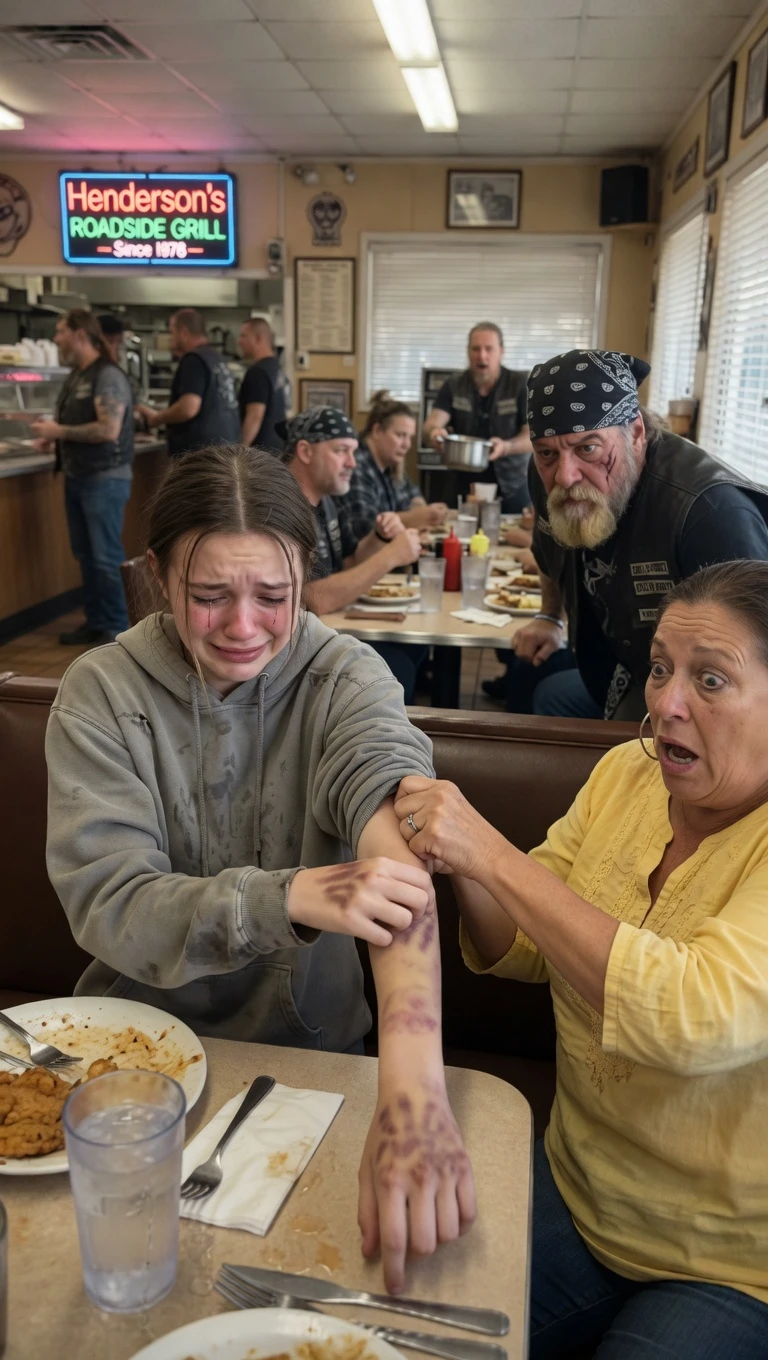
The bell above the door at Henderson’s Roadside Grill gave a bright little jingle that had no business sounding so cheerful.
To Maya, it might as well have been the toll of a funeral bell.
Aunt Martha’s hand clamped around her upper arm as they stepped inside, fingers sharp and merciless even through the thin fabric of Maya’s thrift-store hoodie. The diner was warm with the smell of frying oil, burnt coffee, syrup, and old linoleum. It should have been ordinary. It should have been comforting.
Instead, Maya felt her body stiffen in dread.
“Smile, Maya,” Martha whispered without moving her lips. Her voice was low, polished, and deadly. “Remember what happens if people think I’m not taking care of you.”
Maya stared at the floor and counted the cracked yellow tiles near the hostess stand. One. Two. Three. Four. Counting was safer than crying. Counting was safer than thinking.
She had been counting everything for 172 days.
Days since the sheriff knocked on the front door of her old house, hat in both hands, voice breaking as he told her that her parents’ car had gone over Blackwater Bridge in a storm.
Days since the funeral, where Aunt Martha cried loud enough for everyone to hear and held Maya in front of the church like a grieving saint.
Days since the paperwork, the signatures, the closed-office meetings where adults talked in hushed voices about “stability” and “kinship placement” while Maya sat frozen in a plastic chair.
Days since Martha had taken her home, shown her the basement, and shut the door.
At first, Maya had thought the room downstairs was temporary.
A misunderstanding.
A rough patch.
Aunt Martha had smiled and said, “Just until we get settled, sweetheart.”
By the end of the first week, Maya understood the truth.
The basement had one narrow cot, a bare bulb, a tiny window too high to reach, and walls that sweated when it rained. Martha kept the door locked from the outside at night. Sometimes during the day, too. She called it “protecting a traumatized child from wandering.” She called the bruises “discipline.” She called the hunger “teaching gratitude.”
And in town, she called herself a savior.
Henderson’s was packed for lunch. Truckers in caps. Two waitresses balancing plates. An old couple sharing pie. A baby fussing in a high chair. The jukebox murmured country music under the hum of the refrigerators.
And in the far corner booth sat seven bikers.
They looked like they had thunder in their blood.
Leather vests. Heavy boots. Tattoos curling over forearms and disappearing under sleeves. A woman in a black bandana with silver rings on every finger. A bald man built like a steel beam. A younger guy with a cast on his hand. Another man whose beard fell to the middle of his chest. They were laughing at something, voices booming, sunlight catching on chrome chains and belt buckles.
Martha leaned close. “Don’t stare at those animals.”
Animals.
Maya looked anyway.
Not because they seemed safe.
Because they seemed dangerous enough to interrupt something.
The hostess led them to a booth near the window. Martha slid in first and gave Maya the inside seat, trapping her against the wall. That was how Martha liked it—every exit measured, every movement observed.
A waitress came over, cheerful and tired. “What can I get you folks?”
“Two waters,” Martha said, offering her sad widow smile. “And just a side of dry toast. We’re keeping things simple.”
“Sure thing.”
Maya lowered her eyes. Her stomach knotted so hard it hurt. The last time she’d had a full meal was six days ago, unless a bruised apple and stale crackers counted as dinner.
Martha often did this in public. Ordered almost nothing. Sighed about how hard things had been since “the tragedy.” Let people admire her sacrifice while she wore one of Maya’s mother’s gold bracelets under her sleeve and deposited Maya’s father’s insurance checks into a separate account every month.
“Sit up straight,” Martha muttered.
Maya did.
The lead biker looked up then.
He was older than the others, late fifties maybe, with a thick gray beard, weathered skin, and a scar running across the bridge of his nose. His eyes were pale, sharp, and unreadable. He wasn’t laughing anymore. He was watching.
Not staring.
Watching.
It was different.
Maya felt something dangerous stir in her chest.
Hope.
She looked away quickly, but a second later Martha reached for the sugar dispenser, and Maya flinched before she could stop herself.
The biker saw that too.
His face changed almost imperceptibly. Not pity. Something colder.
The waitress brought the waters and toast. Martha thanked her loudly, sweetly, like a woman in a commercial for casserole dishes and forgiveness.
Then, under the table, she drove her heel into Maya’s ankle.
Maya sucked in a breath.
“Ungrateful girls,” Martha said with a smile fixed on her face, tearing the toast into little pieces and eating them herself. “They don’t know how blessed they are.”
The biker in the corner booth leaned back slightly, still watching.
Maya’s pulse started to pound.
This was it.
Maybe her only chance.
Maybe her last mistake.
She thought of the basement. The mold smell. The click of the lock. Martha’s voice floating down the stairs: No one is coming for you. No one wants damaged girls.
She thought of the hidden phone she had once found in Martha’s laundry room—dead, no charger, gone the next day.
She thought of the social worker who had visited only twice, both times while Martha hovered nearby, smiling, while Maya lied because Martha had shown her the kitchen knife that morning and pressed the tip of it very gently into the wooden table between Maya’s fingers.
She thought of day 173.
And she knew with crystalline certainty that if she got back into that silver SUV, she would not survive this summer.
Her hand moved before her mind could stop it.
She stood up too fast.
Her knee banged the underside of the table. Her water glass tipped, hit the edge, and spilled across the Formica in a glittering sheet. It drenched Martha’s sleeve and dripped onto the floor.
The whole booth jerked.
Martha’s mask shattered.
“You clumsy little brat!”
Heads turned.
Martha lifted her hand.
Not high. Not enough to draw alarm if someone looked away too quickly.
But Maya knew that movement. Knew the angle of it. Knew exactly how the slap would land, how the room would spin, how Martha would later say she had only been trying to calm her hysterical niece.
This time, Maya did not cower.
This time, she slipped out of the booth and stepped backward into the aisle, toward the corner booth where the bikers sat.
“Help me,” she whispered.
The jukebox played on for one more second.
Martha’s expression flipped instantly from rage to embarrassment. “Oh my goodness,” she said to the room, laughing nervously. “I’m so sorry. She’s had such a hard time since the accident. The trauma is—”
Maya reached for her sleeve.
Her fingers shook so violently she could hardly grip the cuff. But then she pulled the hoodie up, and beneath the fluorescent diner lights the bruises bloomed into view—purple, yellow, green, old and new, crossing her forearm and climbing toward her elbow.
A map of cruelty.
The diner went completely silent.
No jukebox.
No silverware.
No murmurs.
Just the hum of the refrigerator and the blood roaring in Maya’s ears.
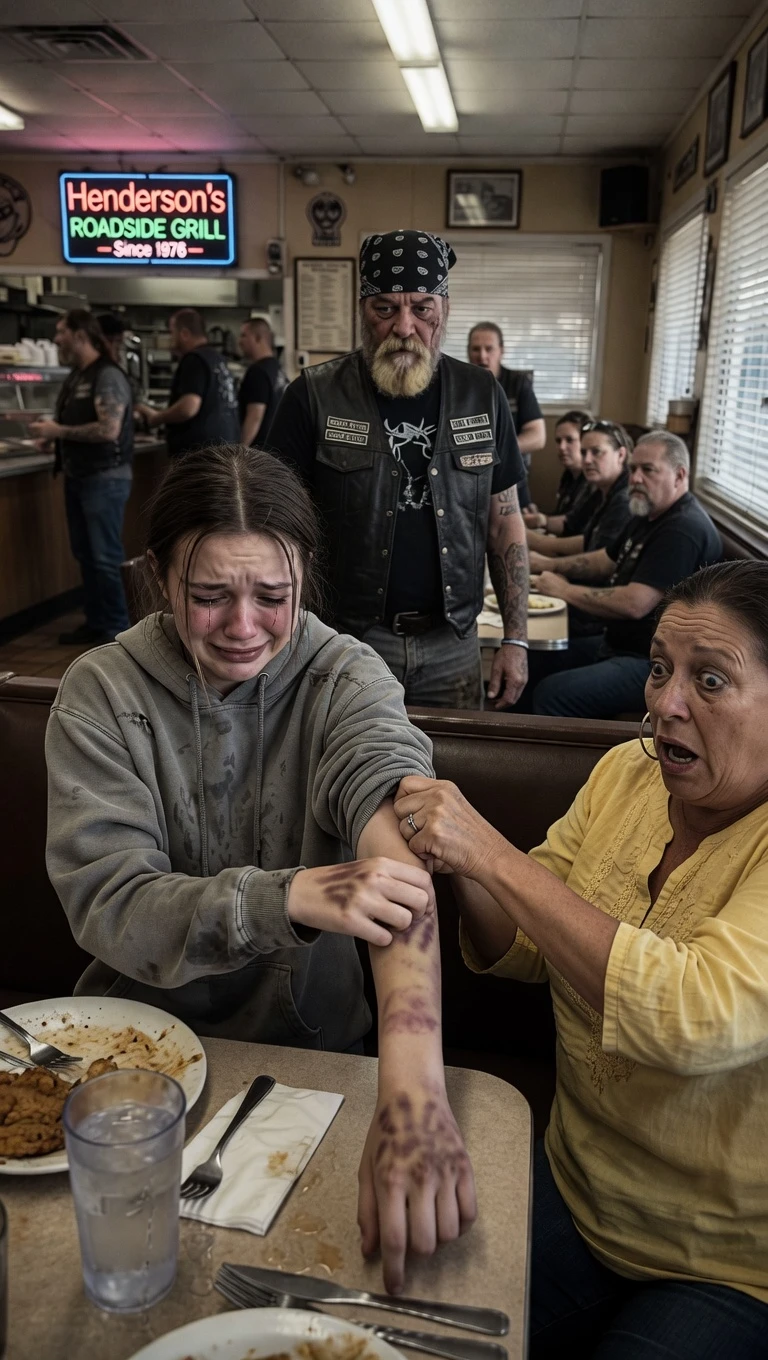
The gray-bearded biker stood up.
His chair scraped across the floor with a sound like a blade being drawn.
And for the first time in 172 days, Martha looked afraid.
Part II: The Men in the Corner Booth
The biker did not speak immediately.
He stood there, broad shoulders filling the aisle, one hand resting on the back of his chair, pale eyes locked on Martha with the stillness of a storm right before impact. One by one, the others at his table fell silent too. Their joking expressions vanished.
Maya was dimly aware of the rest of the diner breathing again.
A fork clinked against a plate.
Someone near the register whispered, “Oh my God.”
Martha found her voice first.
“This is none of your business,” she snapped, then corrected herself with a brittle smile. “My niece is confused. She’s grieving. She has episodes.”
The biker’s gaze shifted to Maya.
“What’s your name, kid?”
The kindness in his tone nearly broke her.
“Maya.”
“Maya,” he said carefully, as if laying something fragile on a table, “did she do that to you?”
Martha barked out a laugh. “This is outrageous. She falls. She bruises easily. She—”
“Yes,” Maya said.
Just one word.
But it detonated in the room.
Martha lunged for her wrist. “You liar—”
The biker moved so fast Maya barely saw it. He stepped between them with effortless force, and Martha had to stop short or collide with his chest.
“You don’t touch her again,” he said.
His voice was low.
Soft, even.
That made it worse.
Behind him, all six of the other bikers had risen. Not aggressively. Not puffed up and theatrical. Just upright and present, forming a rough human wall that changed the entire atmosphere of the diner.
The woman with silver rings folded her tattooed arms.
The bald man turned slightly, cutting off the path to the door.
The younger one with the cast set his jaw.
Nobody shouted.
Nobody needed to.
Martha’s face flushed crimson. “I am her legal guardian. I have every right—”
“No,” said the ringed woman flatly. “You don’t.”
The waitress had backed away and now stood near the counter, hand over her mouth. The cook appeared in the kitchen window, grease-spotted apron tied crookedly, eyes wide.
The gray-bearded biker kept his body angled protectively toward Maya without crowding her. “You got somewhere else hurt?”
Maya hesitated.
Martha hissed, “Don’t you dare.”
The biker did not look at Martha. “Maya. Look at me.”
She did.
And saw, to her shock, that his eyes were not cold at all.
They were furious.
For her.
Maya swallowed hard. Then, very slowly, she nodded.
A murmur rippled through the diner.
Martha straightened to her full height. “You people have no idea what you’re walking into. I know the sheriff. I know the pastor. I have cared for that girl every single day while she spits in my face and wallows in self-pity.”
The younger biker with the cast let out a short, disbelieving laugh. “Lady, that speech ain’t helping you.”
The ringed woman pulled out her phone.
Martha’s head snapped toward her. “What are you doing?”
“Calling 911,” the woman said. “What’s it look like?”
Panic flashed in Martha’s eyes—raw, unguarded, animal panic. It vanished almost instantly under a fresh layer of indignant righteousness.
“Wonderful,” she said. “Please do. I will be delighted to explain how a group of criminals is harassing a grieving family.”
The gray-bearded biker finally smiled, though there was nothing pleasant in it.
“Ma’am,” he said, “you got one thing right. We’re not family.”
He reached into his vest pocket and took out a leather wallet. He flipped it open.
Inside was a shield.
Not a biker club insignia.
A badge.
The entire room seemed to tilt.
Martha blinked. “What—”
“Detective Daniel Voss,” he said. “Retired Chicago PD. Missing Persons, then Special Victims. I volunteer with a national transport network that helps recover at-risk teens and domestic abuse victims.” He tilted his head toward the others. “And these criminals you’re looking at? One paramedic, two veteran outreach coordinators, one family lawyer, one county dispatcher off duty, one mechanic, and one pain-in-the-neck biker who bakes the world’s worst cornbread.”
The bald man muttered, “That cornbread’s won awards.”
The tension in the room cracked just enough for a nervous sound—half-laugh, half-gasp—to escape from somewhere near the pie case.
Martha’s complexion went chalk white.
“You’re lying.”
The ringed woman held up her phone. “Dispatcher’s already tracing child welfare contacts from the county. And the sheriff’s office is on the way.”
Martha whirled toward Maya, and for one terrible instant Maya thought she might still try something reckless—grab her, run, drag her outside. But now every eye in the diner was on her. Every single one.
The old couple with the pie were glaring openly.
The trucker near the window had stood up.
Even the baby had stopped fussing, as if the whole world were listening.
Martha forced a trembling smile. “Maya, honey, tell them you’ve been upset lately. Tell them you’ve been having nightmares.”
Maya’s throat tightened.
The room waited.
The old terror rose up inside her like black water. The terror that had ruled the basement, the stairwell, the car rides, the church pew, the grocery aisle, the nights when Martha unlocked the door and stood smiling in the dark because Maya had “forgotten her manners.”
But terror was no longer alone.
Something else stood beside it now.
Witnesses.
Maya drew a shaky breath. “She locks me in the basement.”
No one moved.
No one even blinked.
“She takes my food away if I speak wrong. She hit me with a belt buckle last week because I asked about school. She told the social worker I was unstable. She said if I ever told anyone, she’d make sure they put me in a psychiatric ward and no one would believe me.”
The words spilled out faster, hotter, unstoppable.
“She cashes my parents’ checks. She sold my mom’s wedding ring. She reads my mail. She said my dad only tolerated me because he had to. She said—” Maya’s voice cracked. “She said the accident should’ve taken me too.”
A collective sound moved through the diner, small but devastating.
Detective Voss closed his eyes for one second.
When he opened them, they looked like steel.
“Don’t say another word to that child,” he told Martha.
Outside, sirens wailed in the distance.
Martha heard them too, and something in her finally snapped.
“Oh, you stupid little fool,” she spat at Maya, all sweetness burned away. “Do you know what happens to girls like you? Do you know where you end up? You think these people will save you? People always leave. Everyone leaves.”
She took one step backward.
Then another.
Then she turned and bolted for the door.
The bald biker moved first, but the trucker by the window was closer. He stuck out one boot, and Martha stumbled hard, slamming into an empty chair. Before she could recover, the mechanic biker was there, not hurting her, just pinning her path with his body and folding his arms.
“Trip hazard,” he said mildly.
The sheriff arrived thirty seconds later with two deputies.
Everything after that came in fragments.
Questions.
Sirens.
Blue lights strobing across the diner windows.
The ringed woman wrapping a blanket around Maya’s shoulders though it was summer and not cold at all.
A deputy taking photographs of her arm with careful, apologetic hands.
Martha in handcuffs, screaming at everyone in sight.
“She’s a liar! She’s manipulative! She’s sick!”
Then louder, shriller, more desperate:
“I SAVED HER!”
Nobody believed her now.
The sheriff, a broad man with tired eyes, knelt in front of Maya. “We’re going to need to search the property.”
“There’s a lock on the outside basement door,” Maya whispered. “And under the workbench there’s a red box with papers. Insurance papers. My dad’s name is on them.”
The sheriff’s face hardened. He stood and gave a short nod to one of the deputies.
Voss stayed nearby but did not crowd her. “You did good.”
Maya looked at him, blanket clutched in both fists. “It doesn’t feel good.”
“No,” he said quietly. “It usually doesn’t at first.”
She watched through the diner window as Martha was led toward the patrol car. For a brief second Martha twisted and looked back.
Not frightened.
Not ashamed.
Furious.
And smiling.
A cold shiver went down Maya’s spine.
Because it was not the smile of a woman who had lost.
It was the smile of a woman who knew something no one else in the room knew yet.
Part III: What Waited in the Basement
By evening, the basement was open.
The sheriff’s office had taken Maya first to the clinic in the next town, where a nurse documented bruises with clinical gentleness and gave her apple juice in a paper cup. Then came interviews with child services, a victim advocate, and a woman in a navy blazer who spoke so softly that Maya distrusted her on principle until she said, “You don’t have to be brave every second. You’ve done enough for one day.”
Maya answered what she could.
She cried once when they asked about the lock.
Twice when they asked whether Martha had ever threatened her with weapons.
Not at all when they asked if she wanted to go back to the house.
“Never,” she said.
And then, just before sunset, Detective Voss appeared at the clinic with the sheriff and asked if she would be willing to identify items from the basement from the driveway—not inside, only if she wanted.
Maya almost said no.
Then she remembered Martha’s smile in the patrol car.
So she went.
The house sat at the end of a gravel road lined with pines, the white paint peeling, porch swing creaking in the wind. It looked exactly the way it always had: harmless from a distance. Respectable, even. The kind of house people pointed to when they said, “Such a nice Christian woman lives there.”
Police vehicles crowded the yard. Yellow evidence lights glowed through the dusk.
Maya stood wrapped in a borrowed sweatshirt beside Voss while deputies moved in and out of the open basement door.
The lock had been cut off.
She felt dizzy just seeing it.
A female deputy approached carrying the red metal box Maya had described. “This the one?”
Maya nodded.
The deputy opened it on the hood of a cruiser. Inside were insurance statements, bank records, school withdrawal forms Martha had never filed correctly, and an envelope stuffed with cash. Beneath that lay a stack of letters with Maya’s name on them—unopened.
Her breath stopped.
The top envelope was from St. Luke’s Youth Services.
The next from County Family Court.
The next from a lawyer’s office in Indianapolis.
“Those came for me?” Maya whispered.
The deputy glanced at the sheriff.
He exhaled grimly. “Looks that way.”
Maya’s hands started shaking. “She said nobody ever wrote.”
Voss’s jaw tightened. “They did.”
The sheriff opened the letter from the lawyer carefully, as if it might explode.
His expression changed.
Then changed again.
“Maya,” he said slowly, “did your parents ever mention a man named Ethan Cole?”
She frowned. The name floated somewhere far away, almost familiar. “No. I don’t think so.”
The sheriff looked at Voss, then back at her. “This letter’s from an attorney representing him. It says he filed for emergency contact review after your parents died. Says he’s your—”
He stopped.
Maya stared at him.
“My what?”
The sheriff swallowed. “Your biological father.”
The world went silent all over again.
Not the silence of the diner this time.
A deeper one.
A silence that seemed to open under Maya’s feet.
“That’s not possible,” she said immediately. “My dad was my dad.”
Voss spoke with extraordinary care. “No one is taking that away from you.”
The sheriff looked down at the letter. “It says your mother’s husband, Thomas Bennett, legally adopted you when you were four. Ethan Cole signed away parental rights after a custody and medical dispute. The record was sealed. According to this, he tried to reach out after the accident when he learned you were placed with Martha.”
Maya felt sick.
A memory surfaced: being very small, on a hospital bed, her mother crying in a chair, her father—Thomas, Dad—holding a stuffed rabbit and promising everything would be okay. Another memory layered beneath it, older and stranger: a man’s voice singing off-key; the smell of motor oil; a hand carving a tiny wooden bird.
“Why didn’t anyone tell me?” she whispered.
No one answered because no one in that yard could answer that.
Martha had intercepted every letter.
Every notice.
Every legal filing.
Every chance.
The deputy returned from the basement carrying a cardboard banker’s box. “Sheriff, you need to see this.”
Inside were photographs.
Dozens of them.
Girls.
Teenage girls, some younger, all photographed candidly in diners, bus stations, church parking lots, county fairs. On the backs of many, Martha had written notes in neat blue ink.
Quiet. No father present. Foster placement disrupted.
Mother uses pills. Easy to isolate.
Good church face.
The sheriff went utterly still.
“What is that?” Maya asked, though some terrible part of her already knew.
The female deputy answered, voice tight. “Looks like your aunt may have been tracking vulnerable kids.”
There were phone numbers too. Names. Donation ledgers from Martha’s church outreach fund. Records of private “placements.” Cash payments without explanations.
Voss’s entire body seemed to harden by degrees. “That’s no guardian scam.”
“No,” the sheriff said. “That’s trafficking prep.”
The word hit like a physical blow.
Maya stumbled backward, and Voss caught her elbow gently.
“No,” she said. “No, she wouldn’t—”
But she remembered the men who sometimes came to the house when Martha made her stay downstairs and silent. The way Martha would say, “Presentation matters.” The time Martha had forced her into a dress she’d never worn before and then canceled something at the last minute because Maya had a visible bruise on her cheek.
The cold dread that had lived in her bones suddenly took shape.
Martha had not only been cruel.
She had been preparing to sell her.
The borrowed sweatshirt seemed too tight. The yard spun. Maya pressed both hands over her mouth.
“Oh God.”
Voss led her carefully to the back bumper of the cruiser and helped her sit. He crouched in front of her, voice low and steady.
“Listen to me. You got out before that happened.”
Maya shook her head violently, tears spilling down her face. “I was there for months. What if there were others? What if—”
“There probably were,” he said, and because he respected her, he did not lie. “And because you spoke today, there’s now a chance to find out who. A real chance.”
The sky over the pines went dark purple. Porch lights flicked on. Deputies moved faster now, urgency replacing routine.
The sheriff came over again, gentler this time.
“There’s more in the attorney letter. This Ethan Cole—he’s here.”
Maya blinked.
“What?”
“He’s been in town for three days,” the sheriff said. “He was the one who tipped off an old colleague when his lawyer’s calls kept disappearing. That old colleague was Detective Voss.”
Maya turned slowly.
Voss gave a tiny shrug. “I was supposed to be passing through for pie.”
“Where is he?” Maya whispered.
The sheriff looked toward the driveway entrance.
A pickup truck sat there, engine off. A man stood beside it in the shadows, not approaching, hands visible, posture rigid with restraint. Mid-forties. Lean. Dark hair gone silver at the temples. Work boots. A denim jacket worn shiny at the cuffs.
He looked like someone bracing for impact.
Maya’s heart pounded.
She searched his face and found nothing she recognized.
Then he took one hesitant step into the light, and she saw it—
In his left hand, held carefully like something sacred, was a tiny wooden bird.
Memory split open.
A workshop full of cedar shavings.
Laughter.
A song sung badly on purpose.
Her own little hands reaching for curls of wood.
Maya made a sound she had never made before—a sound halfway between a sob and a gasp.
The man stopped dead.
He did not say Daddy. He did not say sweetheart. He did not rush her.
He only said, in a voice so rough it seemed scraped raw from years of regret, “Hi, Maya.”
And suddenly the most shocking thing of all was not that he existed.
It was that he looked more frightened of hurting her than anyone ever had.
Maya stood on trembling legs.
Voss rose but stayed back.
The sheriff turned away, granting privacy that was not really privacy at all.
The man—Ethan—held out the wooden bird. “You used to carry one everywhere,” he said. “Your mom said you lost it when you were four. I made another one every year anyway. Just in case.”
Maya stared at the bird.
Then at him.
Then back at the bird.
“So you knew?” she asked. “All this time?”
His face folded under the weight of the question. “I knew where you were after the accident. I didn’t know what she was doing to you. Your mother and I made choices when you were little, and some were for love and some were for fear and some were just… wrong. Thomas was a good man. Better than me in some ways. He gave you a life I couldn’t then. I stayed away because that was the agreement, and because your mother asked me to. But when I heard about the crash, I came. Martha blocked everything. Lawyers, court notices, welfare checks. I didn’t know if you even knew my name.”
Maya’s whole body shook.
She thought she might hate him.
She thought she might collapse into his arms.
She did neither.
Instead, she asked the only question that mattered. “Why didn’t you stop trying?”
His eyes filled. “Because you were my daughter before paperwork, after paperwork, and beyond it. Because some things don’t stop being true just because adults make a mess of them.”
The wooden bird trembled in his hand.
Maya took it.
It fit her palm perfectly.
Behind them, on the porch, evidence technicians carried out another box from the basement. Inside it, visible even from the yard, were more letters. More records. More names.
Lives about to be uncovered.
Crimes about to surface.
A network about to crack open because one girl in a gray hoodie had lifted her sleeve in a diner.
Maya looked back at the house one last time.
At the basement door.
At the broken lock lying in the dirt.
Then she turned away from it forever.
She did not know what came next. Therapy, courtrooms, grief, rage, headlines, maybe even family—new or reclaimed. She did not know whether Ethan Cole would become part of her life or remain a man holding a wooden bird at the edge of the past. She did not know how to rebuild a self after 172 days of being erased.
But for the first time, she understood something Martha had never wanted her to learn.
Being saved was not the same as being weak.
And speaking was not the same as breaking.
Voss walked back toward the cruiser, giving her space, and called over his shoulder, “Kid?”
Maya looked up.
He nodded toward Henderson’s to-go bag sitting on the hood of a police car. “One of the waitresses sent pie.”
For a second Maya just stared.
Then a laugh burst out of her—broken, wet, astonished, but real.
Real enough that everyone nearby smiled without meaning to.
The diner, the sirens, the basement, the letters, the bird, the impossible father in the driveway, the terrible truth under the floorboards—it all blurred together into something too enormous to carry at once.
So Maya did what she had done for 172 days.
She counted.
Only this time, she did not count cracked tiles or bruises or nights locked underground.
She counted living things.
One wooden bird in her hand.
Two tears she let fall and did not hide.
Three deep breaths.
Then the rest of her life, waiting.