Part I — The Day the Road Began to Roar
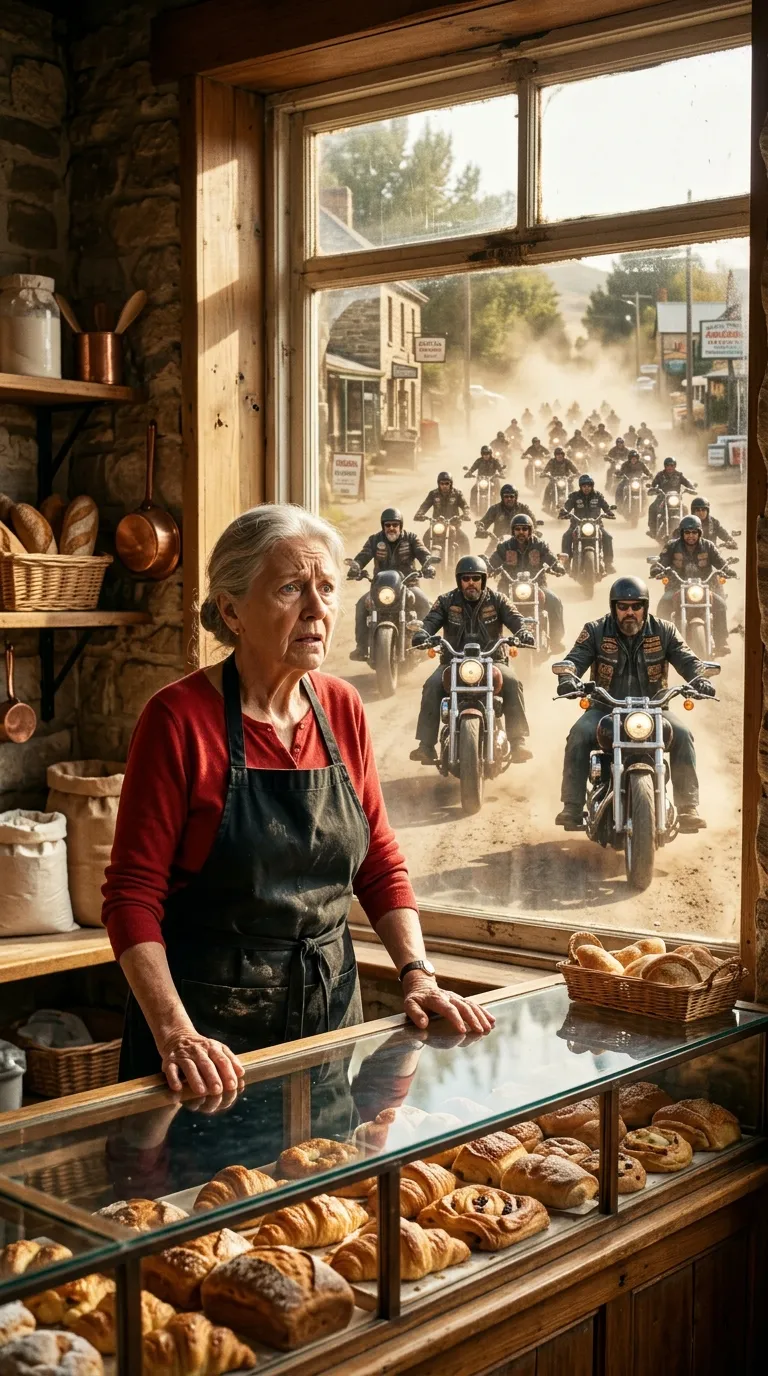
At 6:12 on a pale November morning, Eleanor Wren was pulling the first tray of cinnamon rolls from the oven when the windows of her bakery began to tremble.
Not rattle. Not shake.
Tremble.
It started so faintly she thought it was just the old glass settling in its frame, the way old things did when the cold came in hard from the fields. The bakery had been standing on Maple Street for nearly seventy years—long before the gas station at the corner, long before the chain pharmacy, long before people started locking their doors in the daytime and pretending it was normal. The floorboards had memory. The walls had held generations of laughter, weddings, funerals, whispered gossip, and apologies no one was ever supposed to hear.
And Eleanor, at eighty-one years old, had memory too.
She stood very still in the amber glow of the kitchen, one hand wrapped around a thick oven mitt, the other braced against the metal rack, and listened.
The sound came again.
A low, distant rolling thunder, except the sky outside the rear window was clear.
Then it grew louder.
She set the tray down, peeled off the mitt, and moved slowly through the narrow swinging door that separated the kitchen from the front counter. The bakery was warm and golden, full of the sweet scent of butter, brown sugar, and yeast. The glass cases glowed with pies and honey buns and sugared pastries arranged just so. Outside, the town still wore its sleepy face. The hardware store across the street was dark. The florist’s van hadn’t arrived yet. A pair of crows pecked at something by the curb.
Then she saw the dust.
It rose first at the far end of the road in a thick, pale cloud, unfurling above the asphalt like smoke from a brushfire. Out of it came headlights—one, then five, then twelve, then too many to count.
Motorcycles.
Dozens of them.
No—scores of them.
Eleanor’s breath caught in her throat. Her hand went instinctively to the edge of the counter.
The convoy moved as one body, a dark, roaring river of chrome and leather, engines growling deep enough to vibrate through the glass. The riders wore black jackets, patched vests, helmets, sunglasses. Some had gray in their beards. Some looked young enough to be reckless. All of them rode with the unsettling precision of people who knew exactly where they were going.
And they were coming straight toward Wren’s Bakery.
“Oh, dear God,” Eleanor whispered.
She wasn’t a dramatic woman. She had survived a husband’s long illness, a daughter’s grave, three recessions, and forty-two winters in a drafty building that should have collapsed years ago. She had learned to keep her voice level even when life clawed at her. But this—this was something different. This looked like the beginning of a news story people would later describe in hushed tones.
She checked the lock on the door even though she knew she’d already turned it after opening. Her fingers shook anyway.
The first motorcycle stopped directly outside the window.
Then another.
And another.
And another.
Within seconds, the whole street was lined with them—nearly a hundred bikers, idling in front of her tiny bakery as if they had ridden out of some dark legend and chosen her doorstep for their reckoning.
The engines cut out one by one.
The silence afterward felt even louder.
Eleanor stared at them through the glass, her heart pounding so hard she could hear it in her ears. A few townspeople had emerged onto the sidewalks now. Curtis from the barber shop. Maribel from the flower store, still in her coat with one sleeve half on. Two teenagers filming from across the street, because of course they were. Everyone was frozen, watching.
Then the lead rider took off his helmet.
He was a large man, broad-shouldered, somewhere in his early forties. His hair was dark with threads of silver at the temples. He had a weathered face, a trimmed beard, and eyes that looked startlingly human for someone who had just arrived like an invading force. Not cruel eyes. Not wild ones.
Wounded eyes.
He swung off the motorcycle and looked at the bakery window as if he had been trying to find it for years.
Then he started walking toward the door.
Eleanor’s mouth went dry.
Every foolish warning she’d ever heard raced through her head at once. Don’t open for strangers. Call someone. Hit the alarm. Get to the back. But her legs wouldn’t move. She stood rooted behind the counter, her apron dusted with flour, staring as the man reached for the door.
The bell above it gave its usual cheerful jingle when he stepped inside.
That sound—that absurd, tiny, happy bell—nearly undid her.
The man removed his gloves slowly, as if not to alarm her. He looked around the bakery with such focused intensity it was almost reverent. The others remained outside, waiting. No one followed him in.
“Ma’am,” he said, voice low and rough. “Are you Eleanor Wren?”
She swallowed. “Who’s asking?”
A flicker crossed his face. Pain, maybe. Or disappointment.
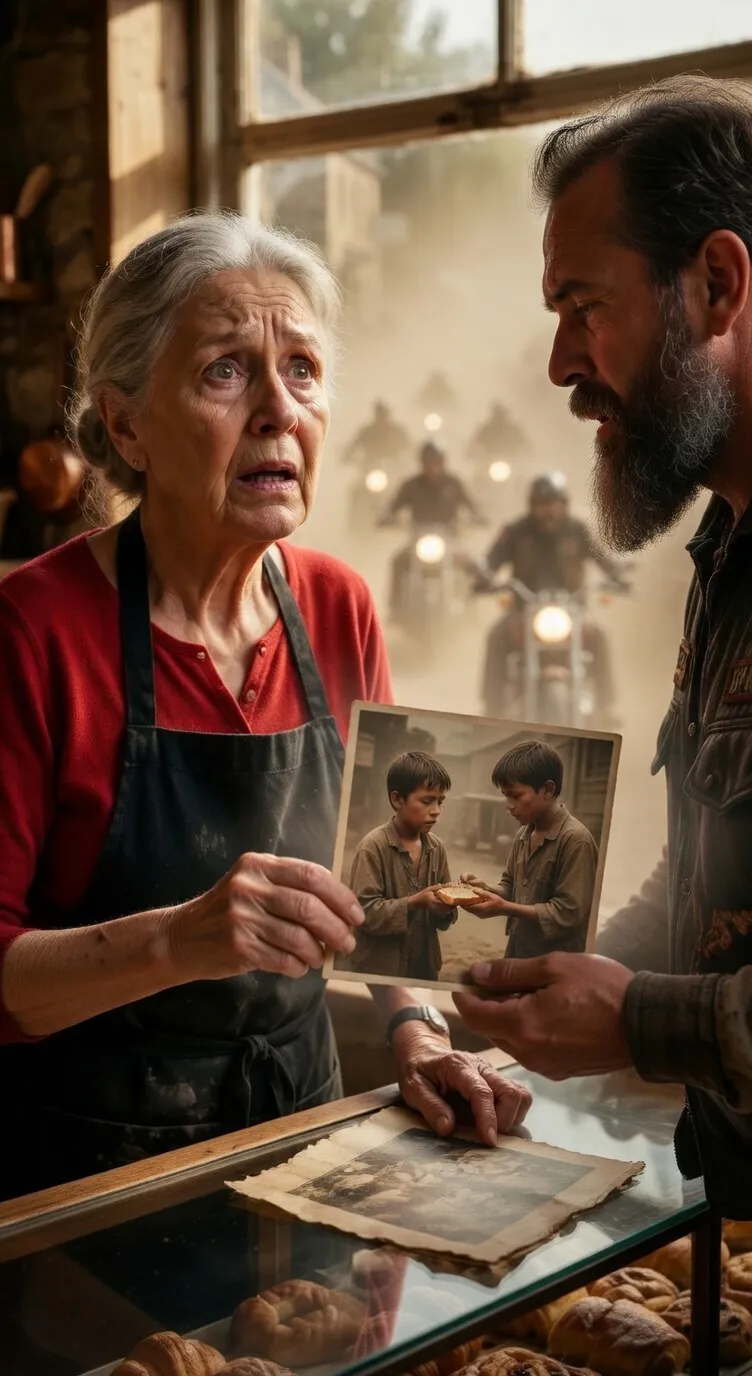
“My name is Gabriel Voss,” he said. “And I’ve been looking for you for a very long time.”
She stared at him. The name meant nothing. But there was something about the way he said it—as if it mattered, as if it was supposed to unlock some hidden drawer in her memory.
“I don’t know you,” she said.
He nodded once, like he had expected that answer and had spent years rehearsing how not to flinch when it came. “No,” he said quietly. “I didn’t think you would.”
He reached into the inside pocket of his vest.
Eleanor’s breath stopped.
But he did not pull out a weapon.
He pulled out an old, creased photograph.
He laid it gently on the glass counter between them.
It was yellowed with age, the edges soft from handling. Eleanor leaned in. At first all she saw was a blur of winter white and a storefront. Then the image sharpened in her mind.
A boy.
Thin as wire. Wrapped in a coat too big for him. Standing in the snow outside this very bakery.
And beside him, younger by decades and harder to recognize but unmistakably herself, was Eleanor—holding out a paper bag with both hands.
Her knees weakened.
“I remember the snow,” Gabriel said softly. “I remember you telling me I looked too proud to beg and too hungry to argue.”
Eleanor’s fingers trembled above the photo.
Twenty-one years vanished.
She saw it all at once—the storm that had hit before Christmas, the wind that knifed through every crack in town, the teenager standing outside her shop at closing time pretending not to stare at the bread. He had been maybe fourteen, maybe fifteen, with blue lips and stubborn eyes. She had offered food, and he had refused at first out of pride so fierce it almost made her smile. Then she had wrapped two loaves, six rolls, a wedge of cheese, and an apple pie still warm from the oven.
And because the cold had been dangerous, because his hands had been shaking, because there had been something in his face that reminded her too much of what loneliness did to young people, she had also given him her late husband’s old wool coat from the storage room upstairs.
“You told me,” Gabriel continued, voice thickening, “that no decent person lets a child freeze just because the world decided to stop looking at him.”
Eleanor’s hand flew to her mouth.
“Oh my Lord,” she whispered. “That was you?”
He smiled then, but it broke in the middle. “Yes, ma’am. That was me.”
Outside, through the window, she could see the riders watching in utter stillness.
Her fear loosened—but only a little. Because people did not bring nearly one hundred bikers to say thank you. Not unless thank you was only the beginning.
Gabriel glanced back at the street, then at her. “We didn’t come here to scare you.”
“You succeeded anyway.”
A faint, regretful laugh escaped him. “I know.”
She looked again at the photograph. “Why now?”
His expression changed. The warmth drained from it, replaced by something colder. More urgent.
“Because gratitude,” he said, “is only half the reason we came.”
The room seemed to tilt.
Behind him, outside on Maple Street, the riders began dismounting in silence.
And Eleanor realized with a stab of rising dread that every single one of them was looking toward her bakery—not like customers, not like tourists, but like witnesses arriving for the moment a long-buried truth was finally going to be dragged into daylight.
Part II — The Debt No One Knew Was Owed
Gabriel did not sit down when Eleanor offered. He remained standing near the counter, shoulders tight, as if he had taught his body to expect bad news even in warm rooms.
Eleanor poured coffee with hands that were only mostly steady and slid a mug toward him. He looked at it for a long moment before taking it, like the gesture itself had struck him somewhere tender.
Outside, the town had gathered in clusters along the sidewalks. The motorcyclists still waited by their bikes, some talking quietly, most scanning the street with the alert patience of men and women used to being unwelcome. The sight should have been absurd in little Bellmere—a one-stoplight town where people still argued over the best peach pie and whether the library roof had ever truly been fixed.
But nothing about the morning felt absurd anymore.
It felt like something old waking up.
Gabriel reached into his pocket again and removed a second item: a folded newspaper clipping inside a plastic sleeve. He laid it beside the photograph.
The headline made Eleanor’s stomach drop.
LOCAL RUNAWAY PRESUMED DEAD AFTER WINTER STORM
The date was twenty-one years old.
Her eyes moved down the article. Male teenager. Approximately fifteen. Last seen near the freight yard outside town. Possible exposure. Search suspended after blizzard conditions. Name unknown.
“I saw that story,” she said faintly. “They said… they said nobody knew who he was.”
Gabriel’s jaw tightened. “Because someone made sure nobody would.”
Eleanor looked up sharply.
He took a breath. “After you fed me, I made it two more days. Then a deputy picked me up outside the rail yard. I thought I was saved.” His laugh held no humor. “Turns out he worked for the kind of men who saw kids like me as profitable.”
A chill slid through her.
Gabriel stared into the coffee but did not drink it. “They moved runaways. Foster kids. Boys from shelters. Girls nobody would look for fast enough. Some they used for labor. Some disappeared altogether. The deputy told everyone I’d been found wandering out toward the county line. Then he reported me dead when the storm came in and the roads closed.”
Eleanor gripped the counter so hard her knuckles whitened.
“No,” she whispered.
“Yes.” His gaze lifted to hers. “I lived because of what you gave me.”
She shook her head, not in denial, but because the room could no longer hold the weight of what she was hearing. “I gave you some bread and a coat.”
“You gave me two more days,” he said. “And those two days changed everything.”
He told her then.
He told her how the food had kept him moving, how the coat had kept him alive long enough to survive the deputy’s first brutal attempt to break him. How he had escaped months later during a transfer outside state lines. How he had hidden under freight tarps, stolen meals where he could, and eventually stumbled into a veteran-run shelter in Missouri where a medic named Walt had taken one look at him and said, “Whoever kept you alive this long wasn’t done with you yet.”
He told her how he had joined the military the moment he could, not because he romanticized violence, but because he needed structure sharp enough to cut through rage. How he had served, been wounded, come home, and then spent years quietly finding other survivors of the same network. Some had scars. Some had records they should never have had. Some had graves. Some had children now, children they tucked in at night with a fierceness born from knowing exactly what monsters existed.
“And the riders outside?” Eleanor asked.
Gabriel finally lifted the mug and took one slow sip. “Some are veterans. Some are survivors. Some are both. A few owe their lives to people who were saved because one person in the chain refused to look away.”
Eleanor’s eyes burned.
He leaned closer. “We call ourselves the Winter Hundred. Not because there were a hundred of us at first. Because that was the number we swore we’d reach before we came back.”
“Came back for what?”
His answer came without hesitation.
“Proof.”
At that moment the bakery door opened again, and another rider entered—this one a woman in her fifties with a silver braid, hard eyes, and a folder tucked under her arm. Gabriel nodded to her.
“This is Mara.”
Mara approached the counter and gave Eleanor a look so respectful it hurt. “Ma’am,” she said, “I’m sorry for bringing a storm to your street. But we think the center of everything started here.”
Eleanor frowned. “Here?”
Mara opened the folder. Inside were copies of land records, old maps, photographs of the rail yard, and names—so many names Eleanor thought she might be sick.
“This bakery used to belong to your husband’s brother before you bought him out,” Mara said carefully.
“Yes. Owen ran it badly and drank worse.”
“Did he ever use the cellar?”
Eleanor blinked. “The root cellar? Of course. Everyone did. It’s older than the building.”
Mara slid forward a grainy black-and-white photograph from years ago. It showed the alley behind the bakery, half obscured by snow. In the image, barely visible, was the outline of a truck backed against the rear loading doors.
“That truck,” Mara said, tapping it, “belongs to a supply company that existed only on paper. It appeared in three towns connected to missing youth reports. Always during storms. Always near older commercial basements with outside access.”
Eleanor stared at the photo, then at Mara, then at Gabriel.
“No,” she said again, but this time the word sounded smaller.
Gabriel’s face was grave. “We think they used hidden routes under the old downtown blocks to move kids unseen before transport.”
A memory struck Eleanor like a hand to the chest.
Not visual. Auditory.
A sound.
Years ago—years and years ago—she had been downstairs during a winter inventory and heard what she thought were pipes banging under the stone. Except it had not sounded like pipes.
It had sounded like someone pounding from far away.
She had mentioned it once to Owen, before buying him out. He had turned white, then angry, then told her not to go poking around in foundations she didn’t understand.
At the time, she’d thought he was drunk.
Now her blood ran cold.
“There’s more,” Mara said.
She removed one last item from the folder: an envelope addressed in shaky handwriting.
To Eleanor Wren.
No stamp. No return address.
“It was found,” Mara said, “inside a sealed evidence box misfiled in an old county archive. Hidden behind property seizure records. We only got access three weeks ago.”
Eleanor hesitated before opening it.
Inside was a single sheet of paper.
The handwriting was young. Hurried. Broken in places by what looked like water damage.
Mrs. Wren,
I think they use the place behind your bakery. I heard one man say “under the bread lady.” I wanted to warn you but I’m scared they’ll catch me. If anything happens, I didn’t run away. My name is Daniel Pike. Please tell my sister Lila I tried to come home.
Eleanor’s vision blurred.
Daniel Pike.
The name hit some far corner of memory. Not from the article. Not from the town gossip.
From a child.
A little girl with tangled hair and scraped knees who had come into the bakery every Thursday one summer, counting pennies for sugar cookies. Lila. Her brother had vanished. Their mother had taken work in another county after that. Eleanor had not seen the girl in years.
“Oh God,” she breathed. “Oh, Daniel…”
Gabriel’s voice was softer now. “We think he got that letter out through another captive. It never reached you.”
Eleanor looked up, horror hardening into something else. Something older and fiercer than fear.
“Who knew?”
Gabriel held her gaze. “We have names. But the highest one still alive is Sheriff Amos Tully.”
The mug nearly slipped from Eleanor’s hand.
Sheriff Tully had been in Bellmere forever. He shook babies at parades, donated canned goods at Thanksgiving, attended every memorial like grief belonged to him personally. He had helped carry Eleanor’s groceries after her hip surgery. He had sent flowers when her husband died.
“No,” she said, but now there was anger in it. “No. Not him.”
Mara slid a photograph across the counter.
It showed a much younger Tully standing beside the deputy Gabriel had mentioned. Both were outside a warehouse, laughing.
On the back, in faded ink, was written: Freight ready before storm.
The bakery seemed to go silent around Eleanor.
For a long moment, she said nothing. Then she folded Daniel’s letter with deliberate care, slipped it back into the envelope, and straightened her shoulders.
“What do you need from me?”
Gabriel looked startled. “You don’t have to do anything.”
She gave him a sharp, wounded look. “A boy was taken under my feet while I sold pies upstairs. Another wrote me for help and never got it. And the man I’ve trusted for twenty years shook my hand while all this sat buried under my town.” Her voice deepened. “Do not insult me by asking for less than everything.”
Something in Gabriel’s face broke open then—not weakness, but relief. The relief of a burden finally shared.
“We need access to your cellar,” he said.
Eleanor reached under the counter, took out the old ring of brass keys she had carried for decades, and set it between them with a sound like a starting gun.
“Then let’s go,” she said.
What none of them knew—not Gabriel, not Mara, not the riders outside, not Eleanor with all her gathered courage—was that the truth waiting below the bakery was not just evidence of a trafficking route.
It was a secret far stranger, far darker, and far more intimate than any of them were prepared to face.
Part III — What the Cellar Had Kept
The cellar door was hidden behind a flour rack in the storage room, a narrow wooden hatch with iron hinges and stone steps worn smooth by a century of feet. Eleanor had gone down there thousands of times. Potatoes once. Jars of preserves. Old ledgers. Extra sacks of sugar when prices were better bought in bulk.
Never for this.
Gabriel went first with a flashlight. Mara followed. Eleanor came after them, one hand on the rail, the other clutching the envelope from Daniel Pike as if it might still deliver him home.
The air below was colder than it should have been.
The cellar was larger than modern code would allow, extending beneath the bakery and part of the alley beyond. Stone walls sweated with age. Wooden shelves lined one side. Dust lay thick over crates untouched for years.
Gabriel moved his flashlight slowly across the far wall.
Then he stopped.
There, almost invisible beneath limewash and age, was a seam in the stone.
Mara exhaled sharply. “There.”
Together they dragged aside two empty flour barrels. Behind them was an iron ring set low into the wall, caked with grime. Gabriel braced himself and pulled.
The section of wall groaned outward.
Behind it lay a narrow passage, just high enough to stoop through.
Eleanor made a sound she would later be unable to describe.
The tunnel went deeper under downtown, lined with rough brick and old utility pipes. The air smelled stale, metallic. Fifty feet in, they found rusted hooks bolted to the wall. Further on, a locked steel door hanging half off its hinges. Further still, the remains of an underground loading platform that connected to an abandoned drainage cut near the rail line.
And in a metal cabinet tucked into the wall, protected from damp by layers of waxed cloth, they found the records.
Names. Dates. Routes. Payments.
Children listed like cargo.
Gabriel stared at the pages without speaking. Mara covered her mouth. Eleanor felt something in herself tear cleanly in two—before and after, ignorance and knowing.
Then she saw one more ledger, smaller than the others.
Different handwriting.
Not accounts.
Birth records.
At first she did not understand what she was looking at. Then her own name appeared.
Eleanor Mae Wren
Female infant
Bellmere County Home, 1944
Mother deceased
Father unlisted
Transferred private placement
Her flashlight beam shook.
“That can’t be right,” she said. “I was adopted. I know I was adopted.”
Mara took the ledger carefully. Her face drained of color as she turned the page.
There were other names. Babies. Private placements. Cash amounts.
And one recurring signature authorizing transfer logistics decades before the trafficking ring formally existed.
Harold Tully.
Sheriff Amos Tully’s father.
Gabriel looked from the ledger to Eleanor in stunned silence. “Ma’am…”
She barely heard him.
All her life, Eleanor had known only the softened version. That her mother had died young. That kind people had arranged for her to be placed with the Wrens when no one else could keep her. That small towns took care of their own back then.
But here, beneath her own bakery, in a tunnel used to move stolen children, lay evidence that the system had older roots. That children had been bought, placed, erased, and traded through Bellmere for generations—not always with chains, not always in trucks, but with paperwork, money, and smiling faces.
And suddenly a hundred old oddities snapped into terrible alignment. The way some people in town had always known too much about everyone else’s past. The hush around certain families. The missing records at the courthouse after a flood that had supposedly ruined only one shelf. The fact that Sheriff Tully had once said to her, years ago at a charity luncheon, “Bellmere made you, Eleanor. Never forget that.”
She had laughed then.
Now she understood.
He hadn’t meant the town.
He had meant the machine beneath it.
Footsteps thundered overhead.
Gabriel’s head snapped up.
A second later, one of the bikers shouted from the cellar stairs, “Sheriff’s here! And he brought county deputies!”
Gabriel swore and moved fast, gathering ledgers. Mara took photographs with her phone. Eleanor remained frozen for one impossible moment, staring at her own infant record in the flashlight beam like it belonged to someone else.
Then something cold and precise settled over her.
“Take the records,” she said.
Gabriel hesitated. “What?”
“Take them and go through the tunnel.”
“We’re not leaving you.”
“You’re not leaving me. You’re saving the evidence. There’s a difference.”
Above them came Amos Tully’s voice, amplified by age and authority and the certainty that people always obeyed him.
“Eleanor! Open up now. I know those bikers are trespassing. Let us handle this.”
She looked at Gabriel. “Where does the tunnel exit?”
“Three blocks east, storm drain near the old feed lot.”
“Good. Go.”
He stared at her as if measuring whether she had any idea what she was asking.
Then, unexpectedly, he reached out and placed the old photograph—the one of her handing food to a freezing boy—back into her palm.
“You saved me once,” he said. “Don’t make me fail you now.”
Eleanor closed her fingers around the photograph. “Then don’t waste time arguing.”
He gave a single sharp nod. Mara gathered the remaining papers. They disappeared into the tunnel with two others who had come down the stairs.
Eleanor climbed up alone.
The bakery had changed while they were below. The street outside was now crowded—townspeople, bikers, deputies, patrol cars. Sheriff Amos Tully stood in the center of it all, broad in his winter coat, silver-haired and solemn, playing the concerned public servant so convincingly Eleanor might once have fallen for it again.
He stepped inside as soon as she emerged.
“Eleanor,” he said, voice warm with practiced care, “thank God. Are you all right?”
She looked at him and saw at last what had always been there: not goodness, not authority, but possession. The confidence of a man who believed this town and everyone in it belonged to him.
“I’m fine,” she said.
His eyes flicked past her toward the back room. “Where are they?”
“Who?”
“The men who came in here stirring trouble.”
She held his gaze. “What if they came looking for truth?”
A thin smile. “Truth gets messy when outsiders bring their own version.”
Outside, phones were up now. People were filming. Good, Eleanor thought. Let them.
Tully lowered his voice. “You’re upset. I understand. Men like that know how to confuse decent people. Let me take control before this gets worse.”
Then he made his mistake.
He touched her elbow.
Gently. Familiar. Reassuring.
And Eleanor, who had spent a lifetime being underestimated because she was small and old and polite, slapped his hand away so hard the crack of it silenced the bakery.
“No,” she said, loud enough for the whole room to hear. “You do not touch me.”
Outside, heads turned.
Tully’s expression hardened for the first time. “Eleanor—”
“No. You will listen.” She stepped toward the open doorway, into full view of the street. Her voice rose, clear and carrying, honed by decades of calling orders over mixers and morning crowds. “This man told Bellmere he protected its children. Meanwhile children vanished under our feet.”
A murmur rippled through the crowd.
Tully laughed—too quickly. “That is an outrageous accusation.”
“Is it?” she shot back. “Then why were sealed records hidden under my cellar? Why is your father’s signature on infant transfers? Why did a missing boy write me that he was being kept ‘under the bread lady’?”
For the first time, real panic flashed across his face.
And then, from somewhere above them, a new sound split the air.
A helicopter.
Everyone looked up.
A news chopper swung low over Maple Street, followed by two state police vehicles forcing through the crowd. Mara’s voice came through a portable speaker from the far end of the block:
“Evidence has already been transmitted to the state bureau, three national outlets, and every device in this town with a signal. Smile, Sheriff. History is finally filming back.”
The crowd erupted.
Deputies backed away from Tully. Someone screamed. Someone cursed. Curtis the barber began shouting that his cousin disappeared in ’98. Maribel burst into tears. Across the street, one of the teenagers nearly dropped his phone from shaking too hard.
Tully lunged for Eleanor—not to help, not to calm, but to silence.
He got one step.
Then Gabriel appeared from the side of the building like judgment itself and caught the sheriff’s arm mid-grab.
The two men locked eyes.
Tully recognized him.
And in that instant, all pretense collapsed.
“You,” the sheriff hissed.
Gabriel’s face was carved from ice. “You should’ve left that boy in the snow,” Tully spat, and the words rang out in the sudden hush.
Gasps tore through the crowd.
Gabriel didn’t hit him.
That was almost the most shocking part.
He just said, in a voice so steady it shook everyone more than shouting would have, “You did. She didn’t.”
State officers surged forward. Tully twisted, cursed, tried to invoke jurisdiction, reputation, politics, old favors, all of it. It didn’t matter. Cameras were on him. Witnesses were screaming names. Mara held up copies of the ledgers. The town’s buried dead had begun, all at once, to speak through paper.
Eleanor stood in the doorway of her bakery, clutching the photograph and the infant ledger page that named her origin, and felt the ground of her whole life rearranging beneath her feet.
But the final shock had not yet come.
Hours later, after the sheriff had been taken away, after reporters swarmed the street and the bikers formed a silent barrier to keep them from crushing her, after statement upon statement and tears upon tears, a woman stepped through the crowd.
She was in her late forties. Thin. Pale. Trembling.
“I’m sorry,” she said before Eleanor could ask who she was. “I know this is impossible timing.”
Eleanor blinked at her. “Do I know you?”
The woman’s eyes filled. “My name is Lila Pike.”
Daniel’s sister.
Eleanor reached for the counter to steady herself. “Lila…”
Lila nodded, crying now. “I came when I heard the sheriff was arrested. I came because of Daniel. But also because…” She swallowed hard. “Because I’ve spent twenty years searching for records about my family.”
Gabriel and Mara turned toward her.
Lila took a shaking breath. “Daniel wasn’t my full brother. He was adopted. And the documents I found last year suggested his birth mother had another child placed privately a few years earlier.” Her voice broke. “Eleanor… I think that child was you.”
The room went still.
Eleanor stared at her, unable to breathe.
Not just a victim of the machine.
Not just a witness standing over its ruins.
Family to one of its lost boys.
Lila stepped closer, tears running freely. “That means Daniel wrote to you without knowing. He asked his own sister for help.”
Eleanor let out a sound that was half sob, half prayer.
For one impossible moment, the years folded together: a hungry boy in snow, a letter delayed by decades, a town built on secrets, and blood calling to blood through all of it.
Gabriel bowed his head.
Outside, the Winter Hundred stood in silence before the bakery, not like an army anymore, but like mourners, guardians, and proof that mercy can travel farther than evil ever expects.
Eleanor looked down at the old photograph in her hand—the younger version of herself offering food to a freezing child—and understood at last the deepest truth of the day:
She had not simply saved a stranger. She had, without knowing it, reached across the machinery that stole children and fed her own lost family back into the world.
And Bellmere, which had hidden its sins underground for generations, would never bury them again.