Part I
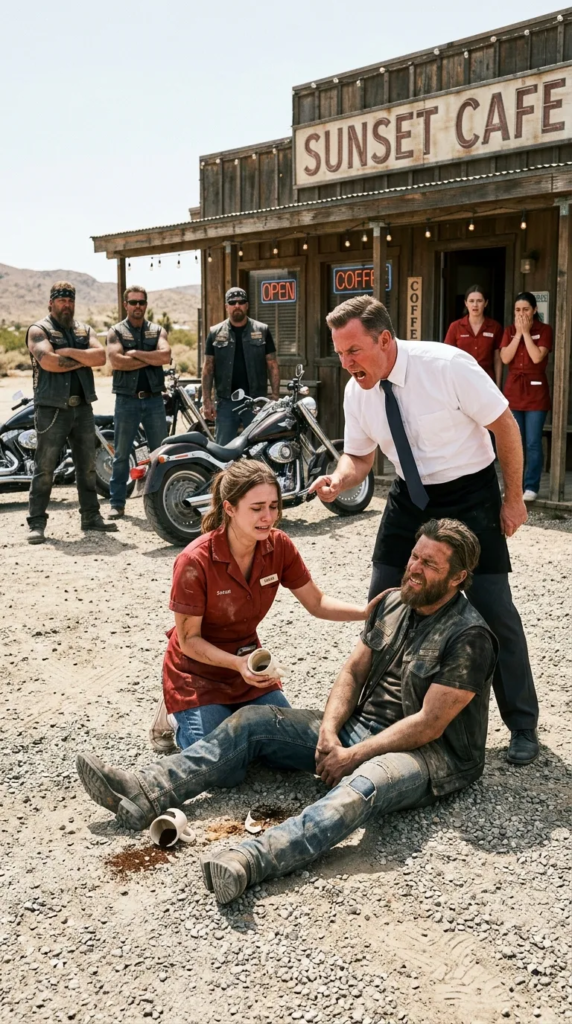
The first thing people noticed about the Sunset Cafe was the sign leaning over the highway like it had been holding on through bad decades and worse men. The second thing they noticed was the smell—burnt coffee, hot oil, desert dust, and the faint metallic tang of truck exhaust rolling in from Route 17. By noon, the heat outside turned the gravel lot into a shimmer. By one, tempers usually started to boil.
That was when Emily Carter stepped out the side door carrying a tray of iced teas and saw a man collapse beside a motorcycle.
For a split second, the whole world seemed to stutter.
One moment he was standing near the line of parked bikes, broad shoulders turned toward the road, one hand pressed low against his ribs. The next, he dropped to one knee, then both, and braced himself against the chrome fender as if the earth had tilted under him.
“Sir—” Emily gasped.
The tray slipped from her fingers. Glasses shattered over the gravel. Tea splashed over her shoes. One of the cooks inside yelled in annoyance, but she was already running.
The man was in his forties, maybe older, with sun-browned skin, a rough beard, and a black leather vest worn soft at the seams. Sweat stood out on his forehead. His jaw was clenched so hard a vein pulsed in his temple.
“Hey. Hey, stay with me,” Emily said, kneeling beside him. “Can you hear me?”
He gave the smallest nod.
Up close she saw the dark stain spreading beneath his hand. Blood.
Her heart slammed against her ribs. “You’re hurt.”
“Been hurt,” he muttered, voice dry as gravel. “Just… got worse.”
Emily tore open the side door with her shoulder and shouted into the diner, “I need the first-aid kit! And water! Now!”
Inside, plates clattered, conversations stopped, and every head turned.
So did Richard Voss’s.
The manager emerged from behind the register like a storm in a pressed white shirt and burgundy tie. He was thirty-five, handsome in the cruel polished way that made people trust him for two minutes too long, and his face darkened the second he saw the shattered drinks.
“What do you think you’re doing?” he snapped.
Emily looked up, stunned. “He collapsed. He’s bleeding.”
Richard marched outside, his dress shoes crunching over spilled ice. “Then call an ambulance and let them handle it. You are on shift. Tables six through ten are waiting, and you just dumped half my lunch service on the ground.”
“He needs help now.”
“He needs to be off my property.”
The words struck harder than a slap.
Behind Richard, two waitresses hovered in the doorway. Maddie covered her mouth. Tasha folded her arms tightly, the way people did when they wanted to disappear from a scene without actually leaving it.
Emily stared at Richard as if she had misheard him. “You can’t be serious.”
“I’m very serious,” he said. “We are not turning this place into a roadside charity ward for every drifter that falls off a bike.”
The injured man slowly lifted his eyes.
They were not the eyes of a drifter.
They were cold, startlingly clear, and terribly awake.
Emily felt it before she understood it: this was a man used to pain, danger, and being underestimated.
Still, he said nothing. He simply watched.
“His name isn’t ‘drifter,’” Emily said, voice shaking now, not with fear but fury. “And even if it was, he’s still a human being.”
Richard’s expression hardened. “One more word like that and you can clean out your locker.”
Emily laughed once—short, breathless, unbelieving. “You’re threatening to fire me because I’m helping a bleeding man?”
“No,” Richard said. “I’m firing you because you disobeyed me in front of customers.”
The silence that followed was enormous.
Even the highway seemed to hush.
“You can’t—” Maddie whispered from the doorway.
“I can,” Richard cut in. Then, looking directly at Emily, he said, “Take off the apron. You’re done.”
Emily’s face drained of color. She was twenty-three, living in a one-bedroom apartment with her younger brother, Noah, after their mother died the previous winter. This job paid the rent. It paid Noah’s school fees. It paid for groceries, gas, the power bill, every fragile piece of the life she was holding together with trembling hands.
And Richard knew it.
That was the ugliest part.
He knew exactly what he was taking from her, and he did it anyway.
Emily swallowed. “I’m not leaving him.”
Richard stepped closer. “Then leave forever.”
Something shifted in the gravel lot.
A boot scraped.
Emily looked past him and realized the other bikers had stopped pretending not to watch. There were three of them, all big men in worn denim and leather, standing beside their Harleys with an eerie stillness. One wore sunglasses. One had a shaved head and scarred knuckles. The third, older and broad as a doorway, folded his arms and said nothing.
They were not casual observers anymore.
Richard noticed them too, but instead of backing off, he puffed himself taller. “This doesn’t concern you.”
The man on the ground finally spoke.
“It concerns me.”
His voice was low. Calm. Dangerous in the quietest possible way.
Richard sneered. “You’re the reason for this circus.”
Emily reached for the biker’s arm. “Don’t. Please. You need pressure on the wound.”
He looked at her then, really looked, as if measuring something in her that nobody else ever bothered to see. When he spoke again, it was softer.
“You should go inside.”
She shook her head. “No.”
That single word hung between them like a vow.
Richard took one furious step forward and pointed at Emily’s face. “You think this is noble? You think anyone here is going to save you when your rent is due? Take off the apron and get off my lot.”
Emily rose slowly to her feet.
Dust clung to her knees. Her red polo was damp with sweat, her hair falling loose from its tie, and there was terror in her chest so sharp she thought it might cut her in half.
But there was something else too.
A line.
A last line.
And Richard had just stepped over it.
She untied the apron, yanked it free, and dropped it at his feet.
“Keep it,” she said. “I’d rather lose my job than lose my soul.”
Maddie gasped. Tasha’s eyes widened. One trucker near the window inside let out a stunned whistle.
Richard’s face went crimson. “Get off this property.”
Emily ignored him completely. She crouched again beside the injured biker and pressed her clean napkin harder against the blood. “What’s your name?”
He hesitated.
Then: “Jack Mercer.”
The name hit the air like a lit match.
Behind them, one of the bikers removed his sunglasses.
Even Richard faltered.
Because in three counties and four towns, everyone had heard of Jack Mercer.
Not the version on paper. Not the sanitized rumors. The real version. Former Marine. Former enforcer. A man with a violent history and an even more violent sense of justice. The kind of man other hard men stepped around.
Richard recovered too late and too poorly. “I don’t care if you’re the governor.”
Jack gave him a faint, humorless smile. “That makes one of us.”
Then Jack’s hand slipped from the wound, and blood darkened the gravel.
Emily’s fear turned to ice. “We need an ambulance now.”
She looked at Maddie.
Maddie looked at Richard.
Richard barked, “Nobody calls anyone until I say so.”
Emily went still.
Jack did too.
One of the bikers muttered, “That was the wrong answer.”
And in that blistering patch of desert sunlight, with the smell of blood and spilled tea rising from the gravel, everything began to tip toward violence.
Part II
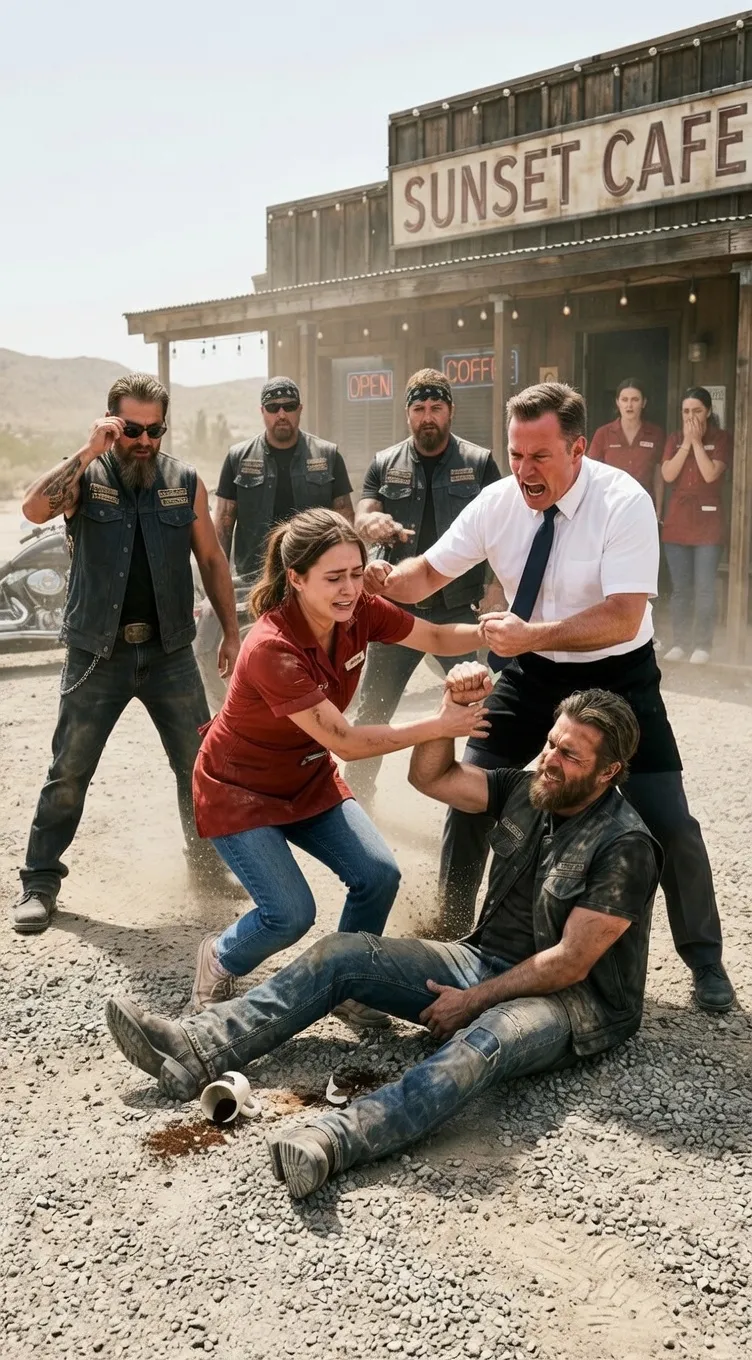
It happened in a blur so fast Emily would later remember it in fragments—Richard’s hand shooting out, fingers clamping around her wrist, Jack rising despite the pain, gravel spraying under boots, Maddie screaming.
Richard grabbed Emily hard enough to wrench her half upright. “I said get out.”
She cried out.
Jack moved.
There was no dramatic warning, no shouted threat, no theatrical pause. One second he was kneeling, pale with blood loss. The next, he had Richard’s arm twisted back at an angle no arm should bend, and the manager was on his knees in the dirt choking on his own scream.
The entire parking lot froze.
Jack’s face had changed. The pain was still there, but it had been shoved behind something colder.
“Take your hand off her again,” he said quietly, “and you’ll eat gravel through a straw.”
Richard whimpered, outraged and terrified in equal measure. “You psycho—”
Jack twisted harder.
“Try that sentence again.”
Emily stumbled back, clutching her wrist. She should have been afraid of Jack. Every rumor she had ever heard told her to run from men like him.
Instead, she felt something stranger.
Relief.
Behind them, the other bikers were moving now, spreading out like a wall. Customers began spilling out of the diner to watch. Phones appeared in hands. Engines on the highway roared past, indifferent witnesses to the collapse of one man’s authority.
Richard saw the phones and panicked. “Put those away! This is assault! This lunatic assaulted me!”
The shaved-head biker barked a laugh. “Funny. Looked more like a public correction.”
Emily dropped to Jack’s side. “You’re bleeding through.”
Jack didn’t look at her. “I know.”
“No, I mean really bleeding through.”
Dark red was running down his side and soaking the waistband of his jeans.
Emily turned toward the diner. “Maddie! Bring towels! Tasha, call 911!”
Tasha stood paralyzed in the doorway.
Richard, still pinned, gasped, “If either of you disobey me, you’re fired too!”
That was when something snapped in Tasha’s face.
Maybe it was seeing Emily’s wrist already bruising. Maybe it was hearing the same threat she had swallowed herself for months. Maybe it was the simple unbearable fact of evil becoming too obvious to ignore.
Whatever it was, she reached into her pocket, pulled out her phone, and said, with shaking hatred, “Fire me.”
Then she dialed.
The diner erupted.
Richard began shouting about lawyers, damages, police, ownership. Jack released him with a shove that sent him sprawling sideways into the gravel. The second he was free, Richard scrambled backward, coughing and pointing.
“You think you can do this on my property? You think you can threaten me and walk away?”
Jack pushed himself to standing.
He was tall enough to cast a shadow over Richard even bent with pain.
“I think,” he said, “you’re about to learn how many people have been waiting to see you on the ground.”
Richard’s bravado flickered.
Then, like a drowning man grabbing at anything, he reached for the one weapon men like him always trusted.
He smiled.
It was a terrible smile.
“Maybe,” he said, brushing dirt from his shirt, “but when Sheriff Dugan gets here, let’s see who he believes.”
The older biker went still.
Jack’s expression flattened into stone.
Emily looked between them. “Sheriff Dugan?”
Richard saw confusion in her face and pounced. “That’s right. Sheriff Dugan. My brother-in-law.”
A murmur passed through the gathered crowd.
Now Emily understood.
Of course.
That was why complaints vanished. Why Richard never got disciplined. Why the health inspector ignored violations. Why two former waitresses had quit in tears and refused to talk about it. Why every threat he made carried the lazy confidence of a man protected from consequences.
The sheriff arrived seven minutes later in a cloud of dust.
By then the lot was packed. A delivery truck had stopped. Two tourists were filming openly. Someone from the gas station across the road had wandered over with a soda in hand. The story had already outrun the scene itself.
Sheriff Dale Dugan stepped out of his cruiser with mirrored sunglasses, a heavy belt, and the swagger of a man accustomed to deciding reality for everyone else. He was thick-necked, broad-bellied, and slow-moving in a way that suggested not caution but contempt.
Richard hurried to him like a child running to a father.
“This man attacked me,” Richard said, jabbing a finger toward Jack. “And this girl caused the whole thing.”
Dugan removed his sunglasses and took in the crowd, the bikes, the blood, the phones.
Then his gaze landed on Jack.
And for one startling second, his face changed.
Not much. Just enough.
A flash of recognition. Then annoyance. Then something deeper and uglier: fear disguised as anger.
“Well,” Dugan said, voice dry, “look what the highway dragged in.”
Emily stared. Jack’s jaw tightened. The bikers behind him shifted.
“You know him,” she whispered.
Jack didn’t answer.
Dugan stepped closer. “Jack Mercer. Haven’t seen you around here since the Hollis warehouse fire.”
The name meant nothing to Emily.
The reaction in the crowd did.
People exchanged glances. One of the truckers muttered, “No way.”
Richard frowned. “What warehouse?”
Jack’s eyes never left the sheriff. “You didn’t tell your wife about that? I’m shocked.”
Dugan’s smile vanished.
Emily felt the temperature in the air drop, though the sun still blazed overhead.
The sheriff turned sharply to her. “Miss, step aside. You’re in the middle of an investigation.”
“She was helping an injured man,” Tasha said before Emily could speak.
Dugan ignored her. “I said step aside.”
Emily’s pulse hammered. “He needs medical attention.”
“He’ll get it,” Dugan said. “After I sort out whether he started this.”
“He didn’t,” Emily snapped. “Richard grabbed me.”
Richard barked, “She’s lying.”
Maddie found her voice at last. “She’s not.”
Dugan swung around. “Did I ask you?”
Maddie flinched.
Emily saw it all then with brutal clarity: the web of intimidation, the habits of silence, the way fear became routine until people mistook it for order.
And maybe that realization gave her courage.
Or maybe she was simply out of things to lose.
She stepped forward and pointed at the sheriff’s chest. “You don’t get to bury this.”
The crowd made a sound—half gasp, half thrill.
Nobody talked to Dugan that way.
The sheriff’s face darkened. “Careful, sweetheart.”
Jack’s voice cut across the lot like a blade. “Call her sweetheart again.”
Dugan looked at him and smiled without warmth. “Or what?”
Jack reached into his vest.
Every deputy hand moved toward a holster.
Emily’s breath caught.
But Jack only pulled out a small object wrapped in a bloodstained bandana.
A flash drive.
Tiny. Ordinary. Deadly.
He held it up between two fingers.
“This,” Jack said, “is why I’m here.”
The sheriff went absolutely still.
Richard looked confused. “What is that?”
Jack’s eyes remained on Dugan. “Your wife’s family business is dirtier than your kitchen, Richard. And your sheriff’s been laundering more than justice.”
Silence crashed down over the parking lot.
Emily felt the world tilt.
Dugan’s hand fell to his gun.
So did the hands of both deputies beside him.
The bikers stepped forward as one.
Then Jack said the words that changed everything.
“I came to hand this to the FBI at three o’clock.”
It was 2:47.
A truck backfired on the highway like a gunshot.
Dugan drew.
What followed lasted less than four seconds.
Jack slammed Emily down behind a motorcycle. One biker tackled a deputy. Another drove his shoulder into Richard and sent him headfirst into a trash can. The third kicked Dugan’s wrist just as the sheriff fired, and the bullet shattered the cafe window instead.
Glass exploded inward.
People screamed.
Emily hit the ground hard, breath blasted from her lungs. When she looked up, Jack was on one knee in the dirt again, not from weakness this time but from force, his fist locked around Dugan’s gun hand, the flash drive clenched in his bloody other hand like the last clean truth in a filthy town.
“Drop it,” Jack growled.
Dugan bared his teeth. “You should’ve stayed gone.”
Jack’s reply was ice.
“You should’ve buried your secrets deeper.”
Sirens wailed in the distance.
Not one cruiser.
Several.
And this time, they weren’t local.
Part III
The black SUVs arrived in a storm of heat and dust, cutting across the lot and stopping hard enough to make gravel spit from under the tires. Doors flew open. Men and women in windbreakers moved fast, armed and efficient, their backs marked with three letters that seemed to suck all the oxygen out of the afternoon.
FBI.
Nobody in the lot moved.
Nobody except Sheriff Dugan, who seemed to shrink without changing size at all.
An agent with silver hair and a desert-flat voice stepped forward. “Sheriff Dale Dugan, drop the weapon and place your hands where I can see them.”
Dugan looked once at Jack.
Just once.
And in that look was an entire buried history—old deals, old betrayals, old crimes dragged bleeding into daylight.
Then he released the gun.
Deputies were disarmed. Richard was hauled sputtering out of the trash can by two agents and forced face-first against the hood of the cruiser while he shouted that this was all a misunderstanding, a setup, a political stunt, anything except what it was.
Emily pushed herself shakily upright.
Jack swayed beside her.
“You’re going to fall over,” she said.
“Probably.”
“That wasn’t a joke.”
“Wasn’t meant to be.”
Despite everything, a broken laugh escaped her. It surprised them both.
The silver-haired agent approached. “Mr. Mercer.”
Jack handed over the flash drive.
The agent took it like it weighed more than metal and plastic had any right to weigh. “You kept your word.”
“Barely.”
Emily looked between them. “What is happening?”
The agent’s gaze softened a fraction. “A long-running investigation.”
Richard twisted his head around from the cruiser hood. “Emily! Tell them he attacked me! Tell them!”
She looked at him for a long moment.
Then at the sheriff.
Then at the shattered cafe window, the spilled blood, her coworkers standing together instead of apart, the customers still filming, the bikers like silent sentries in the sun.
And suddenly she understood something simple and immense:
Fear only worked while everyone pretended to be alone.
“No,” she said.
Richard stared.
Emily lifted her bruised wrist for all of them to see. “I’ll tell them the truth.”
What came next unspooled with brutal speed.
Agents went into the diner office and emerged with ledgers, envelopes, and a locked metal box. One deputy broke within minutes and started talking. Tasha confessed Richard had been skimming wages for months. Maddie admitted he had threatened staff who complained. The cook produced security footage he had secretly saved to a cloud account after Richard made him erase clips from the diner’s cameras twice before.
But none of that was the real bomb.
The real bomb was on the flash drive.
Jack had gotten it from a man named Eli Hollis, an accountant for a construction company that didn’t build much but moved enormous amounts of money. Hollis had died in a warehouse fire six months earlier, officially ruled accidental. Unofficially, Jack had never believed it.
The drive contained records—payoffs, shell companies, land seizures, extortion, forged inspections, insurance fraud, and names. So many names. County officials. Contractors. Deputies. Richard Voss. Sheriff Dugan.
And one more name no one expected.
At 4:12 p.m., while Jack was finally being loaded into an ambulance and Emily sat on the bumper holding a bottle of water with trembling hands, the silver-haired agent got a call. He listened. His face changed. He lowered the phone very slowly.
“What?” Jack asked.
The agent looked at him. “We just matched one of the shell payments to a beneficiary account.”
“Who?”
The agent’s eyes shifted to Emily.
She frowned. “Why are you looking at me?”
He answered carefully. “The account was in your mother’s name.”
The world stopped.
Emily stood so abruptly the water bottle fell and rolled beneath the ambulance. “That’s impossible.”
Jack’s expression sharpened.
The agent took a breath. “It was active for two years. Deposits came through one of Dugan’s development fronts.”
“My mother was a waitress,” Emily said. “She worked at a pharmacy. She—no. No.”
Then memory hit.
Not memory exactly.
Pieces.
Her mother coming home exhausted and distracted the year before she died. Unopened letters hidden in a kitchen drawer. Phone calls taken outside. One night of quiet crying behind a locked bathroom door. And, strangest of all, the warning she’d given Emily three days before her stroke:
If anyone ever asks about Hollis Development, you say nothing and you call nobody in this county. Nobody.
Emily had thought grief made memories noble after the fact. She had turned the words into fear, or illness, or meaningless confusion.
Now they came back sharp enough to cut.
“She knew,” Emily whispered.
Jack was staring at the desert as if reading the past in the heat haze. “Maybe not all of it.”
The agent nodded. “Maybe not. Or maybe she found out too much.”
Emily’s stomach turned over.
“My mother died.”
“Yes,” the agent said. “And we’re reopening that.”
The sentence landed like a blow to the chest.
She couldn’t breathe.
Jack stepped closer despite the pain. “Emily.”
She looked at him helplessly. “I thought she was just scared. I thought she was protecting us from debt collectors or something stupid. I never—”
Her voice broke cleanly in half.
Jack caught her before her knees gave out.
It wasn’t romantic. It wasn’t dramatic. It was steadier than both. His hands were rough and warm and careful, as though he knew exactly how much force a shattered person could survive.
“I know,” he said quietly.
That was when Richard laughed.
Even cuffed, even ruined, even with blood and dust on his face, he laughed.
Everyone turned.
He looked straight at Emily, and malice shone in him like oil catching fire.
“You still don’t get it, do you?” he said. “Your mother wasn’t just scared. She was useful.”
Jack moved before anyone could stop him.
Two agents intercepted him.
Richard kept talking, drunk on his own cruelty. “She cleaned records. Moved papers. Covered dates. Thought she was helping keep your rent paid after your father ran out. Then she wanted out.”
Emily’s vision narrowed.
The lot around her dimmed.
“What did you do?” she whispered.
Richard smiled.
It was the most horrifying thing Emily had ever seen because he smiled not like a man remembering violence, but like a man remembering efficiency.
“We didn’t have to do much,” he said. “Once people realize nobody’s coming to save them, they usually finish themselves.”
Jack roared.
It was not a human sound. It was grief and fury and old war all ripping loose at once.
Agents barely held him.
Emily stared at Richard and, in one crystalline instant, understood the true shape of evil. Not horns. Not monsters. Not cinematic villainy. Just men who turned suffering into a management style and called it normal.
She walked toward him.
The agents tensed, perhaps expecting a slap, a scream, a collapse.
Instead she stopped inches from his face and said, with a calm that terrified even her, “You just confessed in front of federal agents, twenty witnesses, and six active phones.”
Richard blinked.
Then he looked around.
At the cameras.
At the stunned faces.
At the recording lights blinking red.
And for the first time all day, true fear entered him.
By sunset, the video was everywhere.
Not the shooting.
Not the brawl.
The confession.
Richard Voss threatening staff, Sheriff Dugan drawing a gun, Emily lifting her bruised wrist, Jack revealing the flash drive, and then the final clip—the one nobody could stop from spreading—Richard admitting enough to tear open the whole county.
By nine o’clock, reporters were on the highway shoulder outside the cafe.
By midnight, three county officials had resigned.
By morning, the state attorney announced a task force.
And by the next week, people from all over the county were coming into the Sunset Cafe not for spectacle, but for testimony. Former employees. Contractors. Widows. Men who had lost land. Women who had swallowed insults because nobody in uniform ever listened.
Now they talked.
Because one waitress had knelt beside a bleeding stranger and refused to stand down.
Jack survived surgery.
The bullet hadn’t hit him. The wound had come from earlier—an attack on the road when someone tried to stop him from reaching the cafe at all. He spent six days in the hospital and complained through all of them like a man personally offended by blankets.
Emily visited every afternoon.
On the seventh day, he said, “You don’t owe me this.”
She sat in the chair beside the bed, sunlight striping the floor between them. “I know.”
“Then why are you here?”
She thought about the answer before giving it.
“Because before you, I thought courage meant not being afraid. Now I think it means being afraid and doing the right thing anyway.”
Jack looked at her for a long time. “That sounds like something your mother would’ve said.”
Emily smiled sadly. “Yeah. Maybe it does.”
She and Noah moved out of their apartment two months later.
Not because they had to.
Because the county paid restitution after the investigation exploded, and because the owner of the Sunset Cafe—who had conveniently spent years ignoring Richard’s abuses—sold the place under pressure.
Emily bought it.
That part shocked everyone most.
Not the FBI raid. Not the corruption. Not even the arrests.
The waitress buying the diner.
She kept the old sign because it had earned the right to stay crooked. She rehired Maddie and Tasha at better wages. She put a plaque by the register that read:
NO ONE BLEEDS ALONE HERE.
Jack hated the plaque at first.
Then pretended he didn’t.
He took longer to heal than he admitted. He also kept showing up with ridiculous excuses—broken sink, delivery issue, suspiciously underseasoned chili. By the fourth week, Noah called him “the world’s least subtle customer.”
One evening, as the sun burned orange over the highway and motorcycles gleamed outside like patient animals, Emily stood beneath the old sign and watched Jack cross the gravel lot toward her.
“Health inspection?” she asked.
“Nope.”
“Coffee complaint?”
“Nope.”
“Then what?”
He stopped in front of her, hands in his pockets, expression almost uncertain.
It made him look younger. More dangerous, somehow, because vulnerability sat on him like a knife laid bare.
“I came to ask,” he said, “if you wanted to drive out past the ridge and watch the sunset somewhere that doesn’t smell like fryer grease.”
Emily smiled.
“You mean a date?”
Jack considered it. “I mean a date if you say yes. And a humiliating personal setback if you say no.”
She laughed—a full, bright laugh, the kind she had not heard from herself in over a year.
Then she stepped forward, took his hand, and said, “Yes.”
He looked almost startled.
At the road behind him, the desert opened wide and gold and endless.
At the diner behind her, people were eating, talking, healing, telling the truth out loud.
And above them both, the old sign swayed slightly in the evening wind, still standing, still stubborn, still refusing to fall.