For one long second, the entire boardwalk seemed to stop.
Not the waves.
Not the gulls.
Not the restaurant lights.
Just the people.
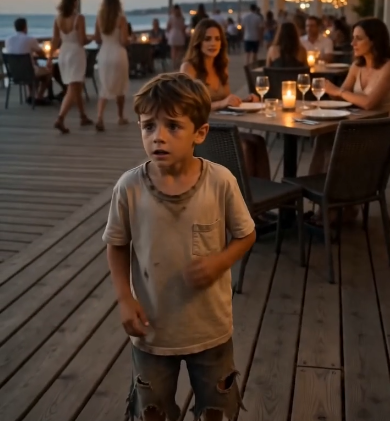
Because suddenly this was no longer a dirty child bothering rich diners at sunset.
It was a life coming back.
The woman stared at the half-shell pendant in the boy’s hand like it had reached straight through the years to expose the one thing she had never really escaped.
Years earlier, before the seaside house, before the money, before the polished life she now wore like armor, she had been young, terrified, and pregnant. The shell necklace had been a gift from the baby’s father — split in two on the beach the night they promised they would keep their child, no matter what. But her family had other plans. They took the baby after birth, told her it had died, and pushed her into silence before she had enough strength to fight.
She believed them.
At least enough to survive.
But the baby had not died.
A nurse took pity. A poor woman working in the hospital laundry carried the child away and raised him as her own. The necklace remained the only proof of where he came from.
And now that woman was dead.
The child she saved had come back with half a shell and one impossible truth.
The rich woman’s voice came out thin.
“She raised you?”
The boy nodded.
“Until yesterday.”
That sentence broke the last piece of distance between them.
Because this wasn’t a scam.
Not a trick.
Not some cruel coincidence dressed up as fate.
It was a son arriving too late for one mother, and just in time for another to face what was stolen from her.
The woman looked at him properly now.
Not the torn sleeves.
Not the bare feet.
His eyes.
His mouth.
The shape of the face she had once imagined a thousand different ways and then forced herself to stop imagining at all.
The boy’s voice shook.
“She said not to trust you fast.”
A pause.
“She said if you looked scared before you smiled… then maybe she was telling the truth.”
That was worse than accusation.
Because she was scared.
And she still hadn’t smiled.
The diners around them had fallen silent.
The waiter lowered his eyes.
No one wanted to pretend this was still just dinner.
The woman slowly stood from her table, not caring that the whole restaurant was watching.
Because suddenly the sunset, the candles, the elegant plates — all of it looked cheap beside what stood in front of her.
The boy clutched the shell tighter and asked the question that finally shattered her composure:
“Did you ever look for me?”
The ocean kept moving behind them.
But at that table, everything had already changed.
Because the barefoot child everyone wanted removed from the restaurant wasn’t begging for fries.
He had come to find out whether the woman with the other half of his necklace was really his mother —
or just the first person who abandoned him.
For one long second, the whole city square forgot how to breathe.
Not the volunteers.
Not the people in line.
Not even the camera phones still pointed in his direction.
Because suddenly the famous charity man no longer looked generous.
He looked cornered.
He stared at the photograph in his hand as if the younger version of himself had stepped out of it to accuse him in public.
Years earlier, before the foundation, before the speeches, before the soft voice he used for interviews and ribbon cuttings, he had spent one winter volunteering at a shelter. There he met a pregnant woman who owned nothing but a stubborn sense of dignity and the habit of pretending she wasn’t colder than she was.
He told her he would help.
Told her he would come back.
Told her she wouldn’t be alone.
Then opportunity arrived.
A wealthy donor took interest in him.
A political circle opened.
A career in visible kindness became possible.
And the homeless woman became an inconvenience he convinced himself he would “fix later.”
Later never came.
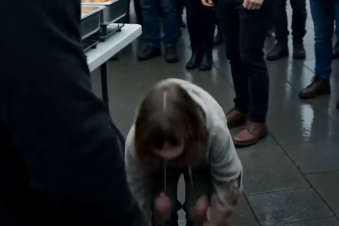
The little girl standing in front of him was what later looked like.
Thin. Wet. Brave because she had no one left to be scared for her.
His voice came out rough.
“Where is your mother?”
The answer was small.
“She died last week.”
That sentence shattered the last layer of performance.
Because this was not a setup.
Not a rumor.
Not a bitter woman seeking revenge from afar.
This was a daughter obeying the final instruction of the mother he abandoned.
The girl looked down at the note, then back at him.
“She said you’d know her eyes in mine.”
And there it was — not just resemblance, but accusation woven into blood.
The line behind her had gone still.
The volunteer stared at the ground.
Even the people filming seemed ashamed now.
The charity man could feel every camera turned toward him, but for the first time in years, he didn’t seem to care about the image.
Only the truth.
He unfolded the note completely.
On the back, written in weaker handwriting, were the final words:
If she comes to you hungry, don’t feed her for the cameras. Feed her because she is yours.
That was when his face finally broke.
Not theatrically.
Not loudly.
Just enough for the whole square to understand this was real.
The little girl clutched the empty bowl tighter and asked the question that turned the cold morning into a courtroom:
“Are strangers still easier to love?”
No speech could save him after that.
Because everyone there suddenly understood what the cameras had accidentally caught:
a man famous for feeding the city
had left his own child waiting in the same line.
And the child did not come for publicity, pity, or revenge.
She came because a dying mother wanted one answer before the world decided what kind of man he was.