The Boy Who Walked In Barefoot. The Lie Beneath the Gold.
No one remembered the first note the orchestra played that night.
They remembered the last.
It snapped in midair like a throat cut short.
The grand ballroom of the Vale Estate had been designed to make ordinary people feel small. Crystal chandeliers blazed above like captive suns. Marble floors shone so perfectly they reflected every jewel, every polished shoe, every smile practiced in mirrors. Silk gowns whispered. Champagne laughed in thin glasses. Men discussed fortunes as if they were weather.
Everything glittered.
Everything lied.
At the center of the room sat Elena Vale, wrapped in a midnight-blue gown threaded with silver stars. Her beauty was the kind that silenced rooms. Her face was serene, almost royal. Her dark hair fell in careful waves over pale shoulders. Around her neck rested a sapphire necklace worth more than some villages.
And beneath the silk of her gown, her legs lay still.
For ten years, Elena had not walked.
Doctors from five countries had tried. Surgeons had promised miracles. Priests had prayed. Specialists had shrugged. Her father, Marcus Vale, one of the richest men in the city, had spent a fortune trying to buy back what fate had taken.
Tonight was her twenty-first birthday.
Tonight was also a performance.
Marcus smiled at guests, kissed hands, thanked investors, accepted condolences disguised as compliments. But every few seconds, his eyes slid back to Elena.
Watching.
Measuring.
Guarding.
Then the ballroom doors opened.
No herald announced him.
No servant stopped him.
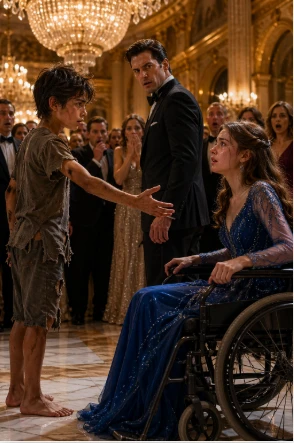
A boy stepped inside.
Barefoot.
Thin as winter. Dust on his ankles. Torn gray clothes hanging from sharp shoulders. Hair tangled. Eyes bright in a face too serious for childhood.
He walked across marble that had never known dirt.
Each footprint he left behind should have disgusted the room.
Instead, it frightened it.
The orchestra faltered.
Then died.
Conversations collapsed one by one until only the sound of the boy’s steps remained.
He did not look left or right.
He walked through wealth as if it were fog.
And he stopped in front of Elena.
Marcus moved instantly, stepping between them.
“Who let you in?” he demanded.
The boy ignored him.
His gaze stayed on Elena, softening in a way no one had seen all evening.
Then he spoke.
“Let me dance with her.”
A ripple of laughter escaped somewhere in the crowd, then died when no one else joined it.
Marcus stared. “Do you know where you are?”
“I know where she is.”
The room chilled.
Marcus lowered his voice. “Leave now before I have you removed.”
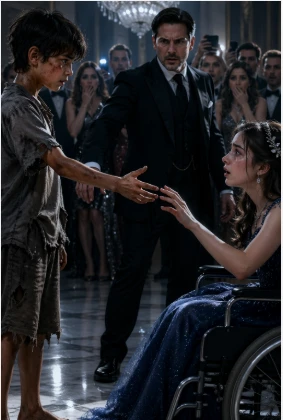
The boy slowly raised one hand toward Elena.
“Because I can make her stand.”
The words struck harder than a gunshot.
A woman gasped. Someone dropped a glass. Crystal shattered across the floor like ice.
Elena’s fingers tightened on her wheelchair arms.
Marcus’s face drained of color, then flushed red with rage.
“What did you say?”
The boy did not blink.
“Dance with me.”
He stepped closer.
Security guards at the edges of the room moved in, but Marcus lifted one hand to stop them. Something had entered his eyes that no one there had ever seen.
Fear.
Elena leaned forward.
The crowd leaned with her.
The boy bent close, voice barely air.
“Stand up.”
And Elena rose.
A scream tore from somewhere in the ballroom.
The wheelchair rolled backward, empty.
Elena stood trembling, both hands locked around the boy’s shoulders. Tears flooded her eyes. Her knees shook like newborn branches in wind.
Then she took one step.
Then another.
The ballroom erupted.
People cried, shouted, prayed, applauded. Some sank to their knees. Phones rose everywhere like candles. Marcus stumbled backward, hand over his mouth.
“Elena…” he whispered.
She turned to him, smiling through tears.
“I can feel them,” she said. “Father… I can feel my legs.”
Then she looked back at the boy.
“Who are you?”
He smiled for the first time.
And Marcus made a sound like a wounded animal.
Because he knew.
The smile belonged to someone dead.
Ten years earlier, Marcus Vale had two children.
Elena was the younger.
The elder was Adrian.
He had the same eyes. The same half-smile. The same strange calmness. At age eleven, Adrian could quiet birds by standing still. He could sense storms before clouds formed. He once touched a dying dog and it rose wagging its tail.
Marcus hated such stories.
He was building an empire from steel, ports, and politics. Miracles did not fit balance sheets.
Then came the accident.
Marcus’s wife died in a cliffside crash while driving both children home from the coast. Adrian vanished into the sea. Elena survived with shattered spine and ruined legs.
The city mourned.
Marcus buried one child and spent millions on the other.
He never spoke Adrian’s name again.
Now the barefoot boy standing in his ballroom wore Adrian’s face at eleven years old.
Impossible.
Marcus staggered forward. “Who sent you?”
The boy’s eyes met his.
“You did.”
The room fell silent again.
Marcus lunged, grabbing the boy’s shoulders.
“You little fraud—!”
The moment his hands touched him, Marcus screamed.
He fell backward clutching his head.
Guests recoiled.
“What happened?” someone cried.
Marcus’s breath came in ragged bursts. “The water…” he whispered. “The car… the door…”
Elena frowned. “Father?”
Marcus looked at her, shattered.
And for the first time in twenty-one years, the great Marcus Vale looked small.
“There was no accident,” he said.
The ballroom froze.
“No…” Elena whispered.
Marcus’s lips trembled. “Your mother discovered what I’d done. The bribes. The disappearances. The men buried to build everything you see.” He gestured wildly at chandeliers, marble, gold. “She was going to leave me. Take both of you.”
He looked at the boy.
“I only meant to scare her on that road. I tampered with the brakes. But Adrian saw me. He knew.”
A murmur of horror moved through the crowd.
“Elena was injured in the crash,” Marcus said, sobbing now. “Your mother died instantly. Adrian survived.”
The barefoot boy stood perfectly still.
Marcus choked on the next words.
“I found him first.”
Elena’s hand flew to her mouth.
“I couldn’t let him speak.”
The silence that followed was monstrous.
“No,” Elena said, backing away. “No.”
Marcus nodded, tears pouring freely.
“I pushed him into the sea.”
Gasps erupted like explosions.
Guests staggered backward from him as if rot had become visible.
Elena stared at the boy.
He was no longer smiling.
“Adrian?” she whispered.
He stepped toward her.
And the chandeliers flickered.
Every candle in the ballroom blew out at once.
Darkness swallowed gold.
Then light returned.
The boy was gone.
Only wet footprints remained across the marble.
Leading nowhere.
Marcus Vale was arrested before dawn.
By sunrise, news helicopters circled the estate. Hidden accounts surfaced. Witnesses emerged. Bodies were found where foundations had been poured. Politicians denied knowing him. Friends vanished. Investors fled.
Empires collapse faster than they rise.
Elena gave no interviews.
She left the estate in simple clothes and never returned.
Doctors confirmed what made headlines worldwide: she could walk. Slowly, shakily, painfully—but she could walk.
No surgery explained it.
No scan predicted it.
Experts called it trauma release, psychosomatic recovery, dormant nerve response, extreme emotional catalyst.
Elena listened politely.
Then ignored them all.
She moved into a small coastal house far from the city.
Every morning she practiced steps across weathered wood floors.
Every evening she walked the shoreline where waves hissed over stone.
And every night, she dreamed of her brother standing in moonlight, barefoot, smiling sadly.
Years passed.
Marcus died in prison, begging guards to keep the water away from his cell.
Elena built charities with the money recovered from his crimes. Hospitals. Shelters. Schools.
People praised her grace.
They did not know grace was simply grief given direction.
One autumn evening, ten years after the ballroom, Elena heard footsteps outside her beach house.
Bare feet on wet sand.
She opened the door.
No one stood there.
Only a small set of footprints leading to the shore.
Her heart hammered.
She followed them across moonlit sand until the sea touched her ankles.
The footprints ended at the waterline.
Then a voice behind her said, “You walk better now.”
She turned so fast she nearly fell.
A man stood there.
Not a boy.
Tall. Broad-shouldered. Mid-thirties. Dark hair silvered by moonlight. Familiar eyes.
Alive.
Elena could not breathe.
“Adrian?”
He smiled.
The same smile.
“I was never dead.”
The world tilted.
He told her everything.
After the crash, Marcus had indeed found him first—but not before fishermen farther down the cliffs had dragged Adrian from the water. Hidden by injury and shock, he heard Marcus confess tampering with the brakes. He fled before Marcus could finish him.
A retired healer on a remote island took him in. Adrian’s strange gifts, always real but unexplained, grew stronger with time—an uncanny ability to sense pain, unlock fear, calm the body into healing.
He had returned as a boy because Elena remembered him only that way.
“I needed Father to confess before witnesses,” Adrian said. “And I needed you to believe enough to stand.”
Elena stared.
“You disguised yourself?”
He laughed softly. “Actors, prosthetics, medicine, timing. Wealth teaches cruelty. But it also buys very useful tools.”
She hit him hard across the chest.
Then again.
Then collapsed into his arms sobbing.
“You let me mourn you for twenty years.”
“I know.”
“I hate you.”
“I know.”
She held him tighter.
The waves moved around their feet like applause.
Far behind them, her abandoned wheelchair—kept all these years in a storage room as a reminder—sat in the doorway of the beach house where she had dragged it earlier to throw away.
A gust of wind nudged it.
It rolled forward alone.
Then tipped into the sand.