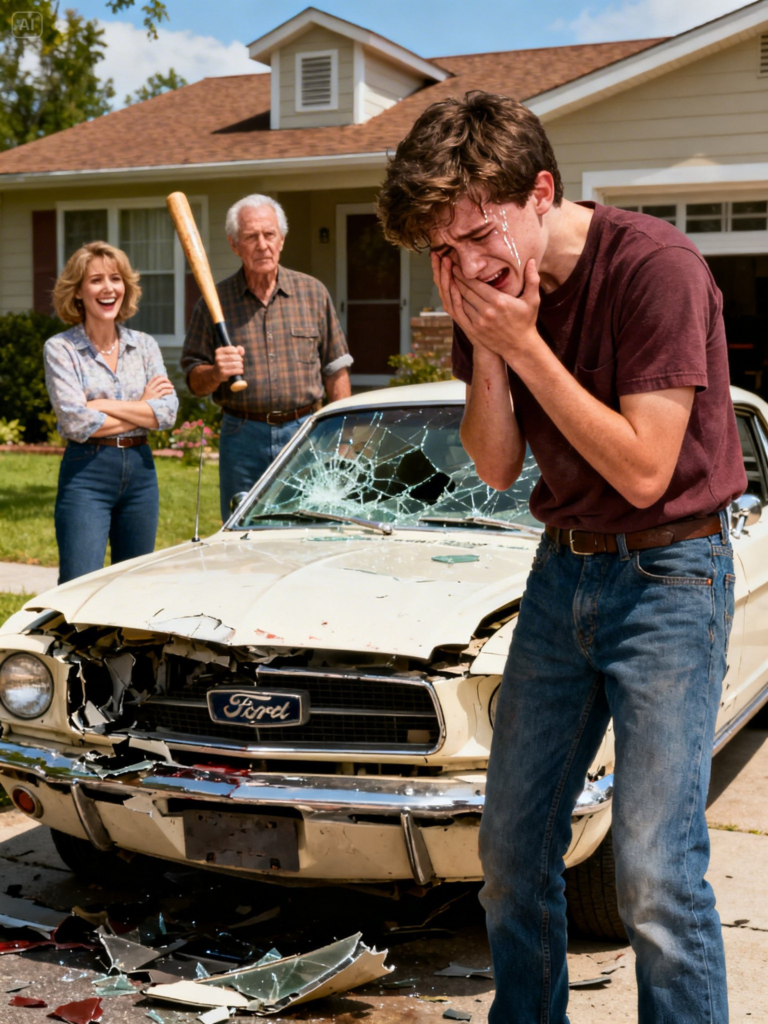
At My Son’s Seventeenth Birthday, My Father Smashed His Mustang With a Baseball Bat
At My Son’s Seventeenth Birthday, My Father Smashed His Mustang With a Baseball Bat
Part 1
The morning my son turned seventeen started with the kind of light that makes you think life might finally be soft with you for a while.
Sun poured across my kitchen floor in long gold bars. The cheap blinds over the sink were tilted crooked, so the light came in striped, bright over the dish rack and dim over the coffee maker. I had chocolate chip pancakes on the griddle, bacon in the oven, and a grocery-store bouquet of orange lilies in a mason jar because Tyler always said flowers made the house look like “someone in a movie lived here.”
I had been up since five.
Not because I’m one of those cheerful sunrise people. I work in a hospital. My body wakes up early even when my soul wants to file a complaint. But that morning, I woke up early because I’d been waiting two full years for it. Two years of double shifts, holiday pay, overtime, aching feet, vending-machine dinners, and saying no to myself in a hundred little ways. No new winter coat. No takeout when I was too tired to cook. No weekend trip with the girls from work. No replacing the dryer until it squealed like an animal every time I used it.
All of that was sitting in my garage.
A metallic blue Ford Mustang.
Used, immaculate, and still the nicest thing I had ever bought in my entire life.
Tyler came downstairs in his old robotics team T-shirt, hair sticking up in the back, still half asleep. He was taller than me by almost a head now, but there were moments when I could still see the little boy who used to carry around broken toaster parts because he thought every machine deserved “one more chance.”
“Happy birthday, baby,” I said.
He gave me the fake-annoyed look teenage boys practice like it’s part of their curriculum, but then he leaned down and let me hug him anyway. “Thanks, Mom.”
He reached for the orange juice. “So… are you messing with me, or is it actually here?”
I tried to play it cool. I failed. “Go look.”
He frowned like he didn’t trust joy unless it came with paperwork. Then he walked toward the mudroom, pushed open the garage door, and just stopped.
He didn’t say anything at first.
That was the part that undid me.
He stood there in the cool gray light of the garage, one hand still on the doorframe, staring at that car like it might vanish if he breathed wrong. The blue paint caught the overhead bulb and shimmered. The hood had a tiny dent near the passenger side that the seller had pointed out three times, apologizing for it, but Tyler looked at it like it was a spaceship.
Then he turned around, eyes already wet.
“Mom.”
Just that one word.
I went to him and he folded into me in that sudden, awkward teenage way where they’re too big to fit but still need you anyway.
“Thank you,” he said into my shoulder. “Thank you, thank you, thank you.”
I laughed and cried at the same time, which I hate doing because it makes my nose run, but there I was, standing in slippers and pancake-smell, crying in front of a garage shelf full of laundry detergent.
“You earned it,” I told him. “Not because you’re perfect. Because you’re good. There’s a difference.”
He pulled back and looked at the car again. “I swear I’m gonna take care of it.”
“I know.”
He ran his hand an inch above the paint without touching it. That was Tyler all over. Careful even with things that belonged to him.
By eight-thirty we were setting up the backyard. Streamers, folding chairs, plastic tablecloths, the cake pickup reminder taped to the fridge, burger patties in the cooler, a Bluetooth speaker charging on the counter. Nothing fancy. We weren’t fancy people. But the backyard looked cheerful, and I knew exactly which kids would crowd around the car first and which ones would pretend not to care but absolutely care.
Tyler’s friends were good kids. Smart, awkward, polite. A couple of football players, mostly robotics club, one drummer with a lip ring who always called me ma’am and brought thank-you notes after every meal. I was looking forward to hearing them all yell over each other and eat me out of house and home.
At noon my mother called.
I knew it was my mother before I looked at the screen because nobody else in my life called like they were knocking on a door they already intended to kick in.
I balanced the phone between my shoulder and ear while I arranged red cups in neat towers. “Hey, Mom.”
“We’re on the way,” she said. No hello. “Your father’s driving.”
“Okay.”
There was a pause. Not the natural kind. The loaded kind. The kind that used to make my stomach knot when I was eight.
Then she said, “Your sister mentioned she could really use a car right now.”
I stopped moving.
There are sentences that walk into a room wearing muddy boots, and that one was one of them.
“What does that have to do with Tyler’s birthday?”
“Well,” she said, drawing the word out, “Vanessa is having a difficult time. She only lost her license temporarily, and honestly the whole thing was blown out of proportion. She needs transportation for work.”
My hand tightened around a plastic cup until it buckled.
Vanessa was thirty-four years old. Vanessa had been “having a difficult time” since middle school. Vanessa had borrowed money from every person with a pulse. Vanessa had wrecked a leased SUV, maxed out two credit cards, and moved back into my parents’ house so many times they may as well have given her a rotating drawer.
“And?”
My mother sighed, irritated that I wasn’t helping her land the plane. “And a Mustang is too much car for a teenager. He doesn’t need it. Vanessa does.”
I actually laughed, one sharp sound, because sometimes your body rejects nonsense before your mind catches up.
“I spent two years saving for that car.”
“I know, and that’s admirable. But family helps family.”
My mother loved that sentence. She used it like a crowbar. Funny how it never seemed to apply in my direction.
“The car is Tyler’s,” I said. “It is not a family resource. It is not available for borrowing, gifting, sharing, teaching a lesson, or whatever wording Vanessa plans to use. It’s his.”
Silence.
Then my mother’s voice went cool and flat. “You have always had a selfish streak.”
I stared through the kitchen window at the backyard, at the streamers moving in the breeze, at my son carrying folding chairs two at a time because he knew my back had been bothering me.
“No,” I said. “I just finally learned what belongs to me.”
She didn’t answer for a second, and in that second I could hear the clink of something in the car on her end. Metal on metal. It meant nothing. It meant everything. I couldn’t place it.
“We’ll talk when we get there,” she said, and hung up.
Tyler came in through the sliding door carrying a tray of burger patties. “Everything okay?”
I smiled too quickly. “Everything’s perfect.”
That was my first mistake of the day.
The second was thinking my family would limit themselves to words.
By two o’clock the yard was full. Laughter, sneaker squeaks on the patio, the smell of charcoal and sunscreen and freshly cut grass. Tyler gave three different friends the grand tour of the Mustang like he was hosting an auto show. He was trying to act calm, but his ears went pink every time someone whistled or said, “Dude, your mom is legendary.”
Watching him grin like that made the whole world narrow down to one clear thought: whatever it cost me had been worth it.
Then my family arrived.
My father climbed out of the truck holding a baseball bat.
“Brought this for a little birthday game,” he said when he saw me looking.
Maybe that should have set off alarm bells loud enough to drown out the music.
Instead, I told myself it was just my father being my father—always too loud, always making a show of entering a place. My mother got out next, mouth set thin. Vanessa stepped down carefully in sandals too expensive for someone always broke, and her eyes went straight past me.
Straight to the car.
Behind them, my brother Keith lit a cigarette he knew better than to light near my guests, and Uncle Larry slapped Tyler on the shoulder hard enough to make him rock forward.
Last out was Grandma Rose, using her cane, moving slower than the rest of them but somehow taking up more space. She wore cream slacks, pearl earrings, and the expression of a woman who had spent eighty-three years watching people reveal themselves.
She hugged Tyler and slipped him an envelope. “For your future,” she whispered.
He smiled at her in a way he didn’t smile at the others. “Thanks, Grandma Rose.”
Her hand lingered on his cheek. “You look happy.”
“I am.”
She looked over his shoulder toward the Mustang. Then she looked at me.
I don’t know what she saw in my face. Whatever it was, her eyes sharpened.
By the time I carried out the cake, my father had positioned himself near the driveway. My mother had Vanessa beside her like a lawyer with a difficult client. Keith was watching Tyler’s friends crowd around the car with a mean little smirk I remembered from childhood, the one he wore before pulling wings off bugs.
I set the cake down and told myself I was imagining things.
Then Vanessa lifted her plastic fork, pointed it toward the driveway, and said, loud enough for every teenager in my yard to hear, “So, Tyler, about that car. We need to talk.”
And the air changed all at once. It turned thin and metallic in my mouth, like the second before lightning hits. I looked at my father, still holding that bat, and realized he hadn’t brought it for a game at all.
Part 2
If you grow up in a family like mine, you learn to hear danger before it arrives in full sentences.
It’s in the pitch of your mother’s voice when she’s pretending to be reasonable. It’s in the way your father plants his feet, like the ground itself owes him backing. It’s in your sister smiling before she asks for something she thinks has already been decided in her favor.
Vanessa had that smile now.
She sat back in her chair, one ankle crossed over the other, sunglasses perched on top of her head, cheap vanilla body spray fighting a losing battle against the smell of grilled burgers. Tyler was still standing beside the picnic table with frosting on his lip from the first bite of cake.
“Talk about what?” he asked.
He sounded polite. Confused, but polite.
That was another thing about my son. Even when someone was reaching into his life with dirty hands, his first instinct was courtesy.
Vanessa waggled the fork toward the driveway. “The car. I need something reliable for work, and honestly it makes more sense for me to have it than you.”
A couple of Tyler’s friends stopped chewing. One girl with purple braids glanced at me, then at Tyler, like she was waiting for an adult to laugh and say this was a weird joke.
Nobody laughed.
Tyler looked at me. “Mom?”
I kept my voice level because I knew if I let the anger into it too early, my family would grab that and use it as the real story. “There’s nothing to discuss. The car belongs to Tyler.”
My mother dabbed her mouth with a napkin she hadn’t used all afternoon. “Don’t be dramatic. Vanessa is only asking for a little support.”
“A Mustang is not ‘a little support,’” I said.
“She means you should let me use it,” Vanessa snapped, dropping the fake sweetness. “You have no idea what it’s like trying to keep a job when nobody helps you.”
That sentence would have landed better if she hadn’t been wearing a bracelet my mother had given her last Christmas after “borrowing” my emergency grocery money to buy it.
Tyler frowned. “I’m sorry you’re having a hard time, Aunt Vanessa, but this is my birthday present.”
He said it softly, almost apologetically.
My father stood up.
The chair legs scraped against the patio, loud enough that a couple of the boys near the speaker turned around.
“That,” he said, pointing the bat toward Tyler, “is exactly the problem right there.”
My skin went cold.
“Dad,” I said. “Sit down.”
He ignored me. “You kids today think everything is yours. You don’t know how to share, how to sacrifice, how to do for family.”
I almost asked him where that philosophy had been when I was seventeen and working weekends to buy my own school clothes while Vanessa got cash slipped into her hand for mall trips. But there are arguments you don’t start because you already know the ending. Facts had never slowed my father down.
My mother turned to Tyler with that sugary tone she used right before saying something poisonous. “Honey, your aunt needs the car more than you do. You’re young. You don’t need something so expensive.”
The injustice of that almost made me dizzy.
Two years of overtime. Two years of seeing Tyler do without things because he knew money was tight and never once complaining. Two years of driving an old sedan with an engine light that came on every time it rained.
“You do not get to decide that,” I said.
Vanessa put her fork down. “You always make everything harder than it needs to be. Why can’t you just think about somebody besides yourself for once?”
It was such a familiar accusation that for half a second, my body reacted before my mind did. I felt that old childhood panic, the one that says maybe if I explain myself better, maybe if I stay calm enough, maybe if I deserve more carefully—
Then I looked at Tyler.
His shoulders were tense. His birthday candles were still smoking in the cake. Fifteen of his friends were watching the adults in his family try to take his present away in broad daylight.
Something inside me locked into place.
“No,” I said. “Everybody stop talking. This party is over for you. You need to leave.”
Keith barked out a laugh. “Listen to her.”
My brother had gotten wider over the years, soft around the middle, mean around the eyes. He always smelled faintly of stale beer and car freshener, and he still wore his baseball cap turned backward like time had forgotten to collect him.
“I’m serious,” I said. “Get off my property.”
My father looked at the Mustang, then back at Tyler. “Last chance. Hand over the keys.”
Tyler blinked. “No.”
It was quiet. Clear. Stronger than I think any of them expected.
Vanessa’s whole face changed. The mask came off so fast it was almost a relief.
“You ungrateful little brat.”
That got Tyler’s friends moving—uneasy shifting, exchanged looks, one of the boys lowering his phone like maybe he should start recording and maybe it would make things worse if he did.
I stepped between Tyler and the table. “Do not call my son that.”
My mother stood too. “He needs to learn that in this family we take care of each other.”
I laughed again, but there was no humor in it this time. “No. In this family, you strip one person down to feed the person who screams loudest.”
Her face hardened. “You’ve always resented your sister.”
I wanted to say no, I resented the system. I resented being the reliable one because reliability meant I could be drained without sympathy. I resented working and saving and showing up while everyone praised Vanessa for surviving messes she made herself.
But Tyler was there. His friends were there. I wasn’t going to spend his birthday explaining old wounds to people who had spent decades digging them.
“You all need to go,” I said again.
My father adjusted his grip on the bat.
That little movement made the back of my neck prickle.
Grandma Rose was standing near the porch rail now. She hadn’t said a word. She was watching my father with an expression I couldn’t read. Not surprise. Not fear. Something more final than that.
Tyler reached into his pocket and held up his keys. Not to hand them over—just reflex, maybe, because the conversation had become about the keys as much as the car. The metal flashed in the sun.
Vanessa saw them and stepped forward.
“Give me those.”
Tyler stepped back.
I moved too, but Keith was faster. He came around the side of the table and grabbed my forearm hard enough to bruise.
“Keith, let go of me.”
“Relax,” he muttered. “You’re making a scene.”
There’s something sick about being told you’re making a scene while somebody is actively creating one on purpose.
Tyler’s friends were definitely filming now. I could hear the tiny digital chirp from someone unlocking their screen. One of the girls said, “Oh my God,” under her breath.
My father looked at Tyler.
Tyler looked back.
And I knew, with that hollow certainty you only get once or twice in your life, that what happened next would split our lives into before and after.
My father lifted the bat.
For one insane heartbeat I still believed he was bluffing. That he’d swing it into the air, into the grass, into a patio chair. Something stupid and theatrical, because that was his style. Loud, humiliating, but not irreversible.
Instead he turned and brought it down full force on the Mustang’s windshield.
The sound was not like in movies.
It wasn’t one clean crash. It was a thick, violent crack that seemed to punch the air out of the yard. Glass spiderwebbed instantly, then collapsed inward in glittering chunks. Somebody screamed. I think it was me. I know Tyler made a sound I had never heard from him before, something ripped straight from the center of him.
“Dad!” I lunged forward, but Keith yanked me back so hard my shoulder burned.
“Family comes first,” he hissed in my ear.
Then my father swung again.
Headlight. Shatter.
Again.
Side mirror. Snap.
Tyler ran toward the driveway and I broke free at the same time, but Uncle Larry stepped in, knife already open like he had been waiting for his cue. The sunlight flashed along the blade.
Somewhere behind me, my mother said, calm as a church bulletin, “Maybe now he’ll learn.”
I couldn’t process all of it at once. My son crying. The metallic smell of broken safety glass. The squeal of sneakers on concrete as teenagers backed away. Vanessa laughing—actually laughing—with one hand over her mouth like this was the funniest thing she had ever seen.
Tyler reached the car just as my father brought the bat down on the hood.
“Please stop!” he shouted. “Please!”
Vanessa tossed her hair back. “You should’ve just given it to me.”
Uncle Larry crouched by the front tire and plunged the knife in. Air hissed out in a long angry sigh. Then the second tire. Then the third. It was methodical. That’s what I remember most. Not rage. Not chaos. Method. Like they were carrying out a plan they’d already discussed.
And suddenly I understood the clink on the phone. The bat. The knife. The way my mother had said we’ll talk when we get there.
This was never a conversation.
This was punishment.
Keith grabbed a set of keys from the patio table—I still don’t know whose—and dragged them down the side of the car, deep enough that the sound made my teeth ache.
Tyler fell to his knees.
One of his friends shouted that they were calling the police. Another was crying openly. A boy from robotics club moved toward Tyler like he wanted to shield him, but froze when my father turned with the bat still in his hands.
I finally got between them and screamed, “Stop it! All of you, stop!”
For one second, no one moved.
Then my father lifted the bat again, and before he could bring it down, a quiet voice behind me said, “That is enough.”
Not loud.
Not theatrical.
But every person in that driveway stopped like a string had been cut.
Grandma Rose stepped off the porch, cane tapping once against the concrete. Her face was pale, but her eyes were sharp as broken glass. She looked at the ruined Mustang, at Tyler on the ground, at my father with the bat in his fist.
Then she reached into her purse and pulled out her phone.
And the look on my mother’s face told me this was the first time that day somebody had truly scared her.
Part 3
My grandmother had never needed volume to make people obey.
That was one of the first things I learned about her as a child. My father could fill a whole house with noise and still somehow never command real respect. Grandma Rose could say four words in a normal tone and people straightened in their seats without knowing why.
She stood there in the driveway, small and upright, white hair pinned back neatly, cane in one hand and phone in the other, while the whole yard seemed to hold its breath around her.
My father still had the bat raised halfway.
“Put it down,” she said.
He did.
Not all at once. Not eagerly. But his arm lowered a little, then a little more, until the bat hung by his side. I watched the shift happen in his face—the ugly adrenaline fading, the first crack of uncertainty getting in.
Tyler was still on the concrete, palms flat, staring at the car like he might wake up if he blinked hard enough. The windshield sagged inward. The hood was caved in. One side looked like it had been attacked by wild dogs instead of people with our last name.
I went to my son and dropped beside him.
His shoulders were shaking. His breathing came in short jerks. Broken glass glittered around his sneakers like ice. I put both hands on his face and forced him to look at me.
“Don’t touch the glass,” I said. “Look at me. Tyler, look at me.”
His eyes were red, stunned, so wide he looked much younger than seventeen. “Mom.”
“I’m here.”
Behind us, my mother found her voice first. “Rose, don’t overreact.”
Grandma Rose turned her head slowly. “Overreact?”
There are ways to say one word that feel like a courtroom door closing. She had that tone.
“They’re emotional,” my mother said, as if that explained a destroyed car and a sobbing teenager. “Things got out of hand.”
“No,” Grandma Rose said. “Things went exactly where you intended.”
My father tried to recover some authority. “Now hold on—”
She cut him off with a look so sharp he actually shut up.
Then she raised her phone. “I recorded enough.”
The silence after that felt different. Not shocked now. Calculating.
My mother’s face lost color first. Vanessa’s mouth parted, and she glanced around like maybe she could find a way to laugh this off. Keith took one step back. Uncle Larry closed his knife with a cheap little click that sounded suddenly pathetic.
“You were recording?” my mother asked.
“Yes.”
“You wouldn’t call the police on your own family,” my father said.
Grandma Rose’s expression didn’t change. “Watch me.”
That was the moment the emotional balance in the yard flipped. One second they were aggressors, righteous and swaggering in their own minds. The next they were people standing in front of evidence.
Several of Tyler’s friends were still holding up phones.
One of the girls with purple braids wiped her face and said, voice trembling, “I got all of it.”
A boy near the fence lifted his hand too. “Me too.”
Another voice from the patio: “Same.”
My father looked around at the teenagers like they had betrayed him personally by seeing what he had done with his own hands.
“You put those away,” he barked.
Nobody moved.
Grandma Rose took one measured step closer. “Do not speak to those children.”
Then she looked at me. “Call the police.”
I had my phone in my hand before she finished the sentence. My fingers were shaking so badly I had to dial twice. When the dispatcher answered, the words came out clipped and flat, like someone else was speaking through me.
“My father destroyed my son’s car with a baseball bat during his birthday party. There are witnesses. He is still here.”
While I gave the address, Tyler’s friend Mason knelt beside him on the other side. “Hey, man,” he said softly. “Hey. Just breathe, okay?”
Tyler nodded once, but tears kept sliding down his face. The worst part wasn’t even the crying. It was how embarrassed he was to be crying in front of everyone. Even shattered, he was trying to apologize with his eyes.
I wanted to burn the whole world down for that alone.
When I hung up, my mother tried a new angle. She always did. If guilt failed, she moved to practicality. If practicality failed, she moved to wounded innocence.
“Let’s not do something permanent because of one bad afternoon,” she said.
I actually stared at her.
One bad afternoon.
Not decades of favoritism. Not an ambush at a child’s birthday. Not property destruction, intimidation, and cruelty performed in front of a yard full of witnesses. Just one bad afternoon, like overcooked chicken.
“You watched them destroy his car,” I said. My voice sounded strange in my own ears. Too calm. “You stood there and watched.”
“He was being selfish.”
Tyler made a broken sound beside me.
That did it. That was the sentence that snapped whatever final thread still connected me to the idea that these people might ever understand what they had done.
I stood.
I felt too steady. That frightened me more than the shaking would have.
“No,” I said. “You don’t get to speak to him again. Not today. Not after this. Maybe not ever.”
Vanessa gave a sharp, incredulous laugh. “You’re being dramatic. It’s a car.”
Tyler flinched like she’d slapped him.
“It was not just a car,” I said. “It was two years of my life. It was the first thing he ever got that was fully his. It was trust.”
“Then he should have shared it,” she shot back.
Grandma Rose turned her full attention to Vanessa then, and I watched my sister shrink by inches without understanding why. Maybe because Grandma Rose looked at her the way people look at mold on expensive wallpaper. Not shocked. Just done.
“You are thirty-four years old,” Grandma Rose said. “If you need a vehicle, buy one.”
Vanessa tossed her hair. “Easy for you to say. You’ve always had money.”
“I had discipline,” Grandma Rose replied. “You confuse the two.”
That landed. Vanessa’s face flushed bright red.
Keith tried to jump in. “Grandma, come on. Nobody got hurt.”
I swung toward him so fast my back cracked. “You held me back while Dad smashed the car.”
He spread his hands. “I was trying to calm things down.”
“By restraining me?”
“You were hysterical.”
There it was. The family favorite. Hysterical. Crazy. Sensitive. Dramatic. Words designed to turn injury into inconvenience for the people causing it.
Grandma Rose took out a small notepad from her purse—I had never noticed before that she still carried one—and wrote something down. Keith watched her do it, suddenly uneasy.
“What are you doing?” he asked.
“Making a list,” she said. “Names. Actions. Time.”
My father rubbed a hand over his mouth. His anger was leaking into something else now. Fear, maybe. Or the dawning realization that there were consequences beyond bullying the nearest vulnerable person.
“Rose,” he said, softer, “there’s no need to make a federal case out of this.”
“You committed a crime with a bat in front of minors,” she said. “I assure you, I am being modest.”
That would have been enough. More than enough. But Grandma Rose wasn’t finished.
She looked at Tyler. “Sweetheart, stand up if you can.”
Mason and I helped him to his feet. He was trembling, face streaked with tears, but he managed.
Then Grandma Rose put one arm around him and faced the rest of them.
“I have watched this family devour its own for years,” she said. “I watched you, Harold”—that was my father—“turn your capable daughter into unpaid labor while you praised the children who failed upward. I watched you, Diane”—my mother—“call exploitation sacrifice and cruelty honesty. I watched these grandchildren grow into exactly the adults you rewarded them for becoming.”
Nobody spoke.
Even the teenagers were quiet now, maybe because they could sense this wasn’t only about the car. This was an old reckoning arriving on schedule.
“I should have ended my tolerance sooner,” Grandma Rose went on. “I am ending it now.”
My mother blinked. “What does that mean?”
“It means,” Grandma Rose said, “that my attorney will be contacted first thing Monday morning. The trust arrangements for my estate will be revised. Vanessa and Keith will receive nothing.”
Vanessa made a strangled noise. “You can’t be serious.”
“I am entirely serious.”
“That money was promised.”
“It was planned,” Grandma Rose corrected. “For family. That was my error in phrasing.”
Keith stepped forward. “Because of one mistake?”
I almost laughed at that. One mistake. Like they had spilled wine on a rug.
“No,” Grandma Rose said. “Because this is who you are when you think there will be no price.”
My father’s voice turned ugly again, desperation dressing up as outrage. “You’d choose them over your own son?”
At that, something in Grandma Rose’s face changed. Not softened. Darkened.
“I am choosing decency over blood,” she said. “I suggest you spend whatever years you have left learning the difference.”
Then she turned to me. “Pack bags for you and Tyler. You’re coming home with me.”
I stared at her. “Rose—”
“That was not a suggestion.” Her gaze shifted back to my parents. “And hear me carefully: do not contact my daughter or great-grandson again. Not by phone, not by mail, not through church friends or cousins or neighbors. If you do, I will support every restraining order available.”
My mother’s mouth opened and closed. She looked, for the first time in my memory, truly at a loss.
From the street came the distant wail of sirens.
My father heard it too. I saw the moment the sound reached him. His shoulders dropped, just a fraction. The bat slipped from his fingers and hit the driveway with a dead, ugly clunk.
Tyler looked up at me, eyes swollen and stunned.
The police were coming. The yard was full of witnesses. My grandmother had just cut my family out at the root.
And as the sirens got closer, one thought pushed through all the noise in my head:
If Rose had been documenting them for years, what else did she know?
Part 4
The police arrived fast enough that the cake was still out on the table, candles half melted into the frosting.
That detail stuck with me. How absurdly ordinary things looked from one angle. Paper plates with streaks of yellow icing. A bowl of potato salad sweating in the heat. Streamers flipping in the wind. And ten feet away, a destroyed Mustang crouched in the driveway like an animal after a hunt.
Two patrol cars rolled up first, then another. Doors opened, radios crackled, and the entire tone of the afternoon changed again. Teenagers straightened. Adults started adjusting expressions. My father picked up his shoulders like maybe he could still wear innocence if he stood in it hard enough.
The first officer out was a woman maybe in her forties with sandy hair pulled back tight. She took in the scene in one sweep—the car, the bat on the ground, my son’s face, the cluster of witnesses holding phones.
“Who called?” she asked.
“I did,” I said.
She nodded once. “Tell me what happened.”
I gave her the short version because if I’d tried to tell the whole truth, I might have dissolved right there on the driveway. My father destroyed the car. My brother restrained me. My uncle slashed the tires. My mother and sister encouraged it. Multiple witnesses recorded the incident.
She glanced toward my father. “Sir, step away from the vehicle.”
“It’s a family matter,” he said.
The officer didn’t even blink. “It became a police matter when you committed vandalism and assault in front of witnesses. Step away.”
That word—assault—seemed to hit him harder than vandalism. Like property destruction could still be framed as passion, but assault made it criminal in a way he could not explain away.
While officers separated everyone, another one came over to Tyler. He crouched a little so he wasn’t towering over him. “Hey, buddy. Any injuries?”
Tyler shook his head. “No.”
I cut in. “He was threatened. He’s in shock.”
The officer nodded like he’d seen enough shocked people to recognize the blankness in Tyler’s face. “We’ll note that.”
Then the interviews started.
I watched my family peel apart into different corners of the yard and driveway, each of them trying on a version of the story that might save them.
My mother kept pressing a hand to her chest and saying things like, “Emotions were high,” and, “We never thought it would go this far,” as if the baseball bat had wandered over by itself. Vanessa cried without tears. Keith talked too much, which he always did when lying. Uncle Larry suddenly found the horizon fascinating.
The teenagers, meanwhile, were rock solid.
Mason showed the officer his video with hands that shook only a little. Purple-braids—her name was Jada, I remembered suddenly—had footage from a better angle. Another kid had the tire slashing. One of the football boys had recorded enough audio to catch my mother saying, “Your sister deserves it more than him.”
Every fresh clip felt like another nail sealing shut the coffin of any future family denial.
Grandma Rose stood near the porch, answering questions with calm precision. She gave names, times, relationships, actions. She spoke the way she probably had in boardrooms for forty years—clear, economical, impossible to push around. The officers listened to her differently. People always did.
At one point the female officer came back to me and said quietly, “Ma’am, based on what we’re seeing, this is very clear-cut.”
Clear-cut.
Such a tidy phrase for a thing that had sliced the center out of my child’s birthday.
I nodded because my mouth wasn’t working right.
Tyler’s friends started drifting toward the gate one by one after giving statements. Not because they wanted to leave him, I think, but because there’s only so long kids can stand inside adult violence before their own bodies start begging for distance.
Mason hugged Tyler hard. “Text me, okay?”
Jada did too, and Tyler actually held on for a second longer than usual. “Thanks for recording.”
“Always,” she said fiercely. “Your family is insane.”
I would have corrected her—some of them, not all of them—but that felt too technical for the day we were having.
By six o’clock the party was gone. The grill was cold. The neighbors had definitely all watched from windows no matter what they later claimed. A tow truck was on its way for the Mustang. I stood in the kitchen putting uneaten burger buns back into the bag because if I stopped moving, I was afraid I might stop functioning.
Tyler came in and leaned against the counter.
His face was puffy from crying, but he was steadier than before. Empty in that dangerous way where the feelings have gone underground but are still very much alive.
“I’m sorry,” he said.
I turned so fast I nearly dropped the buns. “For what?”
“For saying no.” He looked down. “I mean, if I’d just—”
“No.” The word came out sharp enough to cut. Then I gentled it. “Absolutely not. Listen to me.”
He didn’t lift his eyes.
I crossed the kitchen and put my hands on both sides of his face again. “This did not happen because you said no. This happened because they are the kind of people who punish boundaries. Do you understand me?”
A muscle jumped in his jaw. “But if I’d just let her borrow it—”
“She would not have borrowed it. She would have taken it. And next time it would have been something else. Your laptop. Your college money. Your peace. This was never about one car.”
He swallowed and nodded, but I could tell he was only taking in pieces.
That was when Grandma Rose came in.
She had already spoken to the officers, already arranged for copies of the videos, already somehow found out which attorney was on call for civil claims. She moved through crisis the way certain people move through airports: not hurried, exactly, just practiced.
“They’ll be charging Harold, Keith, and Larry,” she said. “Possibly more once the district attorney reviews the footage.”
I stared. “Really?”
She gave me a look. “There are advantages to public humiliation on video.”
Tyler made the tiniest sound that might have been half a laugh, half a sob.
Grandma Rose’s expression softened when she looked at him. “Now. Upstairs hall closet. There are two suitcases. Pack enough for a week.”
I opened my mouth to protest and she lifted one hand.
“No,” she said. “You are not sleeping in this house tonight wondering whether they’ll come back. You and Tyler are staying with me.”
“They won’t—”
“I know exactly what people like your father do when control slips. They escalate, then they grovel, then they rewrite history. Sometimes all three in the same evening.” She tapped her cane once against the tile. “Pack.”
She was right. Of course she was right.
By the time the tow truck took the Mustang away, my phone had already lit up with messages from unknown numbers, extended relatives, and one church lady I hadn’t spoken to in nine years. I didn’t read them. I just turned the device facedown and kept packing.
Tyler moved through his room like somebody underwater. Hoodie. Charger. Toothbrush. One framed photo of him and me at the county fair when he was eleven. He paused over a small model engine on his desk, then tucked that in too.
When we came downstairs, Grandma Rose was in the living room making another phone call. Her voice had dropped into that smooth, expensive calm she used when speaking to professionals she intended to direct.
“Yes, first thing Monday,” she was saying. “I want the estate revisions drafted immediately. And I also want paperwork started for a civil action. Emotional distress, destruction of property, and whatever else fits. If their insurance resists, we push harder.”
She listened a second, then added, “I’m not interested in reconciliation language. I’m interested in consequences.”
Tyler looked at me.
That was when I realized he had never seen an adult in our family use power in defense of us. Not really. He’d seen control. Intimidation. Guilt. Performance. But not clean, competent protection.
I think that frightened him a little too, because it was new.
We loaded the car in near-dark. The driveway looked wrong without the Mustang there, like a smile missing a tooth. Shards of safety glass still glittered in the cracks. One of the streamers had come loose and was stuck against the porch railing, moving in small tired jerks.
As I locked the front door, headlights flashed at the curb.
My chest clenched so hard I tasted metal.
But it wasn’t my parents. It was a black sedan I recognized from the hospital parking lot downtown. A man in a gray suit stepped out and walked up the path carrying a leather briefcase.
He was younger than I expected, maybe late thirties, neat haircut, rain-polished shoes even though it hadn’t rained.
“Mrs. Bennett?” he asked Grandma Rose.
She nodded. “Thank you for coming, Daniel.”
He turned to me. “I’m Daniel Mercer. Rose asked me to come by tonight so nothing gets lost in the confusion. I’ll be coordinating with law enforcement and insurance first thing in the morning.”
I blinked at him. “Tonight?”
He gave a small professional smile. “Rose does not believe in giving bad people a head start.”
I looked at my grandmother.
She stood in the porch light, one hand on her cane, purse over her arm, pearl earrings catching gold.
For the first time all day, I saw not just a kind old woman who had finally stepped in. I saw a strategist. Someone who had been watching for longer than I knew, maybe preparing for exactly this kind of break.
And as Daniel opened his briefcase and pulled out a folder already labeled with our names, I realized the car might not be the only thing my father had destroyed that afternoon.
Because if Rose had been waiting for a line to be crossed, then maybe he had just triggered something far bigger than criminal charges.
Part 5
Grandma Rose’s house sat three neighborhoods over in the historic district, where the streets were wider and the trees older and the porches looked like they had opinions.
I had been there my whole life, of course, but mostly for holidays when I was young and occasional Sunday dinners after Grandpa died. Walking into it that night with suitcases felt completely different. The house smelled like lemon polish, old books, and a faint trace of the rose hand cream she used every winter. The hardwood floors shone. Lamps were already on in the front windows, making everything look warm in a way my own place never quite managed no matter how hard I tried.
Tyler stood in the foyer with his duffel bag at his feet and looked around like he wasn’t sure whether he was visiting or being rescued.
Probably both.
“You’ll take the blue room,” Grandma Rose told him. “Fresh sheets are on the bed. If you need anything in the night, knock on my door or your mother’s.”
Then she turned to me. “You’re across the hall.”
I set my suitcase down and said the only thing my body could manage. “Thank you.”
She shook her head once. “Not now. Later.”
The blue room had once belonged to my aunt who died before I was born. Grandma Rose had turned it into a guest room years ago, but there were still traces of old life in it—a tiny nick in the dresser, a faded watercolor over the bed, a window seat polished smooth where somebody must have sat reading for years.
I helped Tyler unpack enough for one night. He put his toothbrush in the bathroom, his phone charger by the bed, then just stood there holding the framed county fair photo.
“You can put that anywhere,” I said.
He set it on the nightstand and looked at me. “It doesn’t feel real.”
“No.”
“I keep thinking I’m going to wake up and the car will still be in the garage.”
I didn’t know what to do with that. There are no good mother-words for moments when reality is worse than the nightmare version.
So I did the only honest thing. I crossed the room and hugged him again.
He held on hard.
When I finally went downstairs, Daniel Mercer was still there, seated at Grandma Rose’s dining table with a legal pad open and his suit jacket folded neatly over the back of his chair. He had the look some attorneys have when they were either very competent or very expensive. Possibly both.
He asked me to walk him through the day from the beginning.
Not just the attack. The call from my mother. The mention of Vanessa needing a car. The bat. The knife. Who said what. Who touched whom. Whether my father had been drinking. Whether my brother had left marks when he grabbed me. Whether there had been prior incidents of harassment or coercion involving my family.
That last question made me pause.
“Not like this,” I said.
He nodded. “But?”
I stared at the grain of the dining table for a second.
“But they’ve always behaved like what belonged to me was negotiable.”
He wrote that down.
I almost laughed. Such a simple sentence for such a long wound.
By the time Daniel left, it was close to midnight. He stood in the front hall putting on his jacket while Grandma Rose gave him additional instructions in a tone that suggested she had been giving men orders since before he was born.
“Copies of every police report,” she said. “All video backups. And move quickly on the estate revisions.”
“Yes, ma’am.”
“No mediation language.”
“Yes, ma’am.”
When the door shut behind him, the house went quiet in a way that felt expensive.
I found Grandma Rose in the kitchen rinsing out two wine glasses. She had changed into a soft gray robe and still somehow looked more put together than I ever managed on my best day.
“You knew,” I said.
She didn’t ask what I meant. “I suspected.”
I leaned against the counter, suddenly more tired than I had words for. “How long have you been documenting them?”
She dried a glass carefully before answering. “Long enough.”
“That’s not an answer.”
“No,” she agreed. “It isn’t.”
Then she set the towel down and looked at me fully.
“I started keeping notes when you were sixteen.”
I actually went cold.
“Sixteen?”
“That was the year your father made you cancel your debate tournament so Vanessa could use your registration money to fix her transmission.”
I closed my eyes.
I had forgotten that, or told myself I had. But there it was at once: the smell of dust in my high school office, the sound of my coach saying, “I’m sorry,” because he could tell I was lying when I claimed I’d changed my mind. Vanessa crying in the driveway about needing help. My father saying, Family comes first.
I opened my eyes again. “You knew about that?”
“I know about more than you think.”
I sank into a kitchen chair without asking permission.
Grandma Rose sat across from me. The clock over the stove ticked. Somewhere upstairs, a floorboard creaked under Tyler’s steps.
“I kept hoping,” she said, “that what I was seeing was temporary. That your father would mature. That your mother would stop enabling him. That Vanessa would fail enough times to develop humility. That Keith would choose a better model of manhood.” She gave a humorless smile. “Hope is useful in medicine. Less so in character assessment.”
“So you wrote things down.”
“I wrote patterns down.”
The distinction landed hard.
Because a single incident can be excused. A pattern is a verdict.
She told me about envelopes in her study. Dates. Notes. Copies of checks she’d written for my college books after my father claimed he had no money, then bought Keith a dirt bike three months later. The time my mother called me selfish for refusing to babysit Vanessa’s son during my finals week. The year my parents “forgot” Tyler’s birthday but sent Vanessa flowers because she had a rough breakup.
I had lived all of those things.
Hearing them arranged as evidence made them sound like what they were: not random hurts, not misunderstandings, not me being too sensitive.
A system.
I put a hand over my mouth and laughed once, then started crying.
Not loud crying. That would have been easier. This was the shaky, humiliated kind, the kind that leaks out while you’re still sitting upright trying to be a person.
Grandma Rose did not say, don’t cry.
She just got up, came around the table, and put one hand on the back of my neck the way she used to when I was a girl with migraines.
“I’m sorry,” she said quietly. “I should have done more sooner.”
I shook my head because I didn’t trust myself to answer.
After a while the crying passed. It left me hollow and weirdly clear.
“Are you really cutting them out?” I asked.
“Yes.”
“All of them?”
“Yes.”
The certainty in her voice was almost frightening.
“What about Mom?” I whispered. “She didn’t swing the bat.”
Grandma Rose went back to her chair. “She authorized it. Some people commit violence with their hands. Others commit it by deciding who gets protected from consequences.”
That sentence sat between us like a clean blade.
I slept badly. Every time I closed my eyes I heard the windshield cracking. At three in the morning I got up and padded down the hall in bare feet to check on Tyler. His door was partly open. He was asleep on his side with the lamp still on and one arm thrown across the blanket like a little kid. I stood there longer than I meant to, just breathing in the sight of him safe.
The next morning the internet had already done what the internet does.
The videos were everywhere locally.
One clip from Jada’s phone had the clearest view of my father’s first swing and Vanessa laughing in the background. Another caught my mother saying, “Your sister deserves it more than him.” A third showed Keith scratching the side panels while Uncle Larry slashed the tires.
The comments were brutal.
Who destroys a kid’s birthday present?
Arrest every adult in this video.
That poor boy.
Some people do not deserve to call themselves family.
I should not have read them while still in pajamas, but there I was at Grandma Rose’s breakfast nook with cold coffee and a phone full of strangers defending my son with more ferocity than his own relatives ever had.
Tyler came in while I was reading and went still when he saw my face. “Is it bad?”
I turned the screen so he could see.
He scanned a few comments. His expression changed—first dread, then disbelief, then something like relief. “People are on our side.”
“Yes.”
He sank into the chair across from me and kept reading.
One comment had already identified my father by full name. Another named the church my parents attended. Someone else claimed Vanessa had once screamed at a cashier over expired coupons and said, “This tracks.”
I should have felt embarrassed. In a tiny, conditioned part of me, I did. We are taught to keep family mess inside the walls even when the walls are the thing making you sick.
But mostly I felt something else.
Exposure.
Sunlight where there had been mold.
At nine-thirty, Daniel called with updates. The police had recommended charges. Insurance would fight because the act was intentional, but the videos made civil recovery likely. He also said something else, casually, like he was mentioning traffic.
“There may be separate issues worth exploring related to the property your parents currently occupy.”
I straightened in my chair. “What property?”
“Their house.”
“What about it?”
At My Son’s Seventeenth Birthday, My Father Smashed His Mustang With a Baseball Bat – Part 2
A brief pause. Paper rustled on his end.
“It appears the down payment may have come from funds your grandmother advanced under conditions that were never met. Rose has the original documents.”
I looked across the kitchen at Grandma Rose, who was slicing strawberries as if she hadn’t just tipped my world a second time in twelve hours.
She glanced up, met my eyes, and gave the smallest nod.
The house my parents lorded over everyone from. The house where I had been volunteered, corrected, and diminished for most of my life. The house they always treated like proof they had built something solid.
It might not actually be theirs in the way they’d always claimed.
And as Tyler read another comment aloud—“Hope the grandma in this story takes them to the cleaners”—I realized the car had only been the spark.
Grandma Rose had just opened the vault door on everything underneath.
Part 6
By Monday morning, my family had switched from rage to outreach.
That is the cycle with people like them. First they hit. Then they justify. Then, once consequences come into view, they start calling it a misunderstanding and asking for grace.
I woke up in the blue room’s twin next door to twenty-three missed calls.
Not one from anybody I wanted.
My mother had left six voicemails. Vanessa, nine. Keith, three. Two unknown numbers that I later learned belonged to church friends drafted into emotional labor. One from a cousin I hadn’t seen in years but who somehow had urgent opinions about family reconciliation before breakfast.
I didn’t listen to any of them.
I sat on the edge of the bed and watched the phone light up again. Mom. Decline. Vanessa. Decline. Unknown. Decline.
Then a text came through from my mother.
You have made your point. Call me.
Another.
Your father is beside himself.
Then:
If you loved us at all, you would stop this before it goes too far.
That one made me laugh, and I hated the laugh because it had no joy in it. Just recognition. Even now, even with the videos online and police involved and a destroyed car to prove what they’d done, she still framed the real danger as my reaction.
Not the attack.
The accountability.
Downstairs, I found Tyler at the kitchen island in one of Grandma Rose’s too-big waffle-knit robes, eating toast with strawberry jam and scrolling through college robotics forums like his life hadn’t detonated two days before. It was a fragile kind of normal, and I loved him for trying to make it.
“How’d you sleep?” I asked.
He shrugged. “Woke up twice. Better than yesterday.”
That counted as a victory.
Grandma Rose was already dressed for battle in navy slacks and a cream blouse, her reading glasses low on her nose as she reviewed papers spread across the dining table. She had color-coded tabs. My grandmother color-coded vengeance.
We spent three hours sorting reality.
Police recommended criminal charges for my father, Keith, and Uncle Larry. The district attorney’s office would likely add more once they reviewed the witness statements. Civil action against all involved was already underway. The insurance fight would be ugly, but not impossible. Tyler’s emotional distress claim mattered. My bruised arm mattered. The public videos mattered enormously.
Then Daniel opened a different folder.
“Rose asked me to walk you through the housing issue.”
I looked at Grandma Rose. She folded her hands and nodded for him to continue.
When my father and mother bought it, they had nowhere near enough for the down payment. My grandmother had advanced the money under a written agreement. Not a gift. Not loose family help. An advance contingent on regular repayments and certain financial behaviors—things like not taking out additional high-interest debt against the property without consent.
My father had signed. My mother had signed. Then they violated almost every condition within three years.
They refinanced without permission. They stopped making payments to Rose. They claimed temporary hardship while somehow still financing Keith’s truck, Vanessa’s emergencies, and a kitchen remodel my mother insisted was “necessary for resale value,” even though they never intended to sell.
“So what does that mean?” I asked.
Daniel steepled his fingers. “It means Rose has claims she chose not to enforce for a very long time.”
“Until now.”
He gave the smallest nod. “Until now.”
I sat very still.
Tyler looked from me to Grandma Rose. “Are they going to lose the house?”
Grandma Rose answered him directly, which I appreciated. “I don’t know yet. But if they do, it will not be because of you.”
That mattered. She knew exactly where his mind would go.
At noon, while Daniel was still there, my mother showed up.
Of course she did.
You could set your watch by her inability to respect a boundary the first time it was spoken.
The doorbell rang. Then rang again. Then my mother’s knuckles hit the wood in that brisk offended pattern I knew down to my bones.
Grandma Rose didn’t even flinch. She just sipped her tea and said, “Daniel, would you get that?”
He opened the front door only as far as the chain allowed. I was close enough to hear my mother’s voice sharpen instantly when she saw a man in a suit instead of me.
“I’m here to see my daughter.”
“Mrs. Bennett has asked for no contact,” Daniel said. “You need to leave.”
My mother gave the laugh she uses when she thinks charm is a weapon. “I don’t know who you think you are, but this is a private family matter.”
“It stopped being private when your husband committed property destruction on camera.”
I nearly applauded.
“Let me speak to her,” my mother demanded.
“No.”
That was Grandma Rose, from her chair in the dining room. She hadn’t raised her voice at all, but it carried straight through the hallway.
Daniel opened the door a little wider then, enough that we could all see each other.
My mother looked terrible.
Not in any permanent sense. In the temporary, visible sense of a woman who had slept badly and spent the morning losing control of the narrative. Her lipstick was uneven. Her hair wasn’t set. She had on the pale green blouse she wore to church committee meetings when she wanted people to think of her as dignified.
She saw me and immediately changed expressions, like flipping from one mask to another.
“Oh, honey,” she said.
I almost laughed again. Honey. The word she always used right before trying to stuff me back into a role.
“Do not call me that,” I said.
She put a hand over her chest. “I came to make peace.”
“You came because the internet saw you.”
Color rose in her face. “That is unfair.”
“No. Unfair is ruining your grandson’s birthday because your adult daughter wanted his present.”
My mother’s eyes flicked toward Tyler, who had come to stand beside me. He was pale, but he did not hide behind me. That was new.
“Tyler,” she said, softening her voice. “You know Grandma loves you.”
He stared at her. Really stared. Not with teenage embarrassment or confusion. With the stunned clarity of someone seeing a person without costume for the first time.
“No,” he said quietly. “I don’t.”
My mother recoiled like he’d hit her.
It was the first honest thing he had ever said to her face.
She turned to me quickly. “You’ve poisoned him against us.”
I stepped closer to the doorway. “No. You did that in the driveway.”
For a second something vicious flashed across her face. It was gone almost instantly, replaced by sorrow arranged for display.
“Your father feels terrible.”
I thought of the bat. The second swing. The third. The way he kept going after Tyler begged.
“I don’t care.”
That stunned her more than anger would have.
Mothers like mine can work with anger. Anger still means investment. Indifference is the locked door they can’t pick.
She gathered herself. “He only wanted to teach the boy a lesson.”
Tyler inhaled sharply beside me, and I felt my whole body go cold.
There it was. No denial. No misunderstanding. Just justification.
And because it came in that calm church-lady voice, it was somehow even uglier.
Grandma Rose rose from her chair. Slowly. Deliberately.
“If you speak another word on this porch,” she said, “I will call the police and start the paper trail for harassment today instead of tomorrow.”
My mother looked at her, and for one second I saw the old daughter in her too—the one who used to fear being corrected by this woman. But instead of taking the warning, she chose spite.
“You’re blowing up your whole family over a car.”
Grandma Rose’s smile was brief and terrible. “No. I’m removing rot to save what’s left.”
Then she nodded to Daniel.
He shut the door.
My mother pounded once, hard enough to rattle the glass. Then again. Then I heard her heels striking away down the porch steps.
Nobody moved for a moment.
Tyler let out a breath that sounded painful. “I think that’s the first time I’ve ever told her the truth.”
I touched his shoulder. “How did it feel?”
He thought about it. “Like throwing up and breathing at the same time.”
“Accurate,” Grandma Rose said.
That afternoon, Daniel filed paperwork for temporary no-contact orders. By evening, the school counselor from Tyler’s new district—because yes, Grandma Rose was already arranging a transfer—had called to welcome him and explain support options. By dinnertime, my hospital supervisor had seen the video and texted me privately that if I needed schedule flexibility, she would help however she could.
Kindness was coming in from directions I hadn’t even known to look.
Later that night, after Tyler went upstairs, I found a slim leather notebook left at my place setting on the dining table. No label. No note.
I opened it.
Inside, in Grandma Rose’s neat precise handwriting, were dated entries going back years.
Not gossip. Not vague memories. Documentation.
March 14 — Vanessa requested Elena’s tax refund “loan.” Harold pressured Elena to agree. No repayment plan discussed.
September 3 — Tyler’s 10th birthday forgotten by Diane and Harold. Vanessa’s dog’s surgery fundraiser mentioned twice during dinner.
January 22 — Keith mocked Tyler’s interest in engineering. Harold joined in. Boy went quiet for rest of evening.
My hands started shaking by the third page.
This wasn’t just proof.
It was a map of everything I had been trained to minimize.
And tucked halfway through the notebook was an envelope with my name on it.
Inside was a photocopy of a document I had never seen before—a life insurance policy from my late grandfather.
Beneficiary update pending.
My name was highlighted in yellow.
And written in the margin, in Grandma Rose’s careful hand, were five words that made my pulse kick hard:
Your father never told you this.
Part 7
I read the highlighted line three times before the words made sense.
Beneficiary update pending.
My name.
My grandfather’s policy.
My father never told you this.
At first I thought I was misreading it because I wanted to. Trauma does strange things to the eyes. It turns one sentence into ten possibilities and all of them feel like traps.
I carried the papers into the kitchen where Grandma Rose was loading the dishwasher with the serene energy of somebody who had not just upended three generations.
“What is this?” I asked.
She didn’t look surprised that I’d found it. “Sit down.”
I stayed standing. “Rose.”
She closed the dishwasher, dried her hands, and faced me. “Your grandfather changed part of his estate planning six months before he died.”
I frowned. “He left everything to you.”
“Mostly. But there were separate policies and discretionary funds.” She paused. “One of them was supposed to go directly to you when Tyler turned sixteen.”
The kitchen seemed to tilt slightly.
“What?”
“Your grandfather believed in investing in people who built things. He adored you. He admired your work ethic even when you were little. He used to say you were the only person in that house who understood the difference between wanting and earning.”
I sat down because my knees made the choice for me.
“He left something for me?”
“Yes.”
“Then why didn’t I get it?”
Grandma Rose’s mouth flattened. “Because the paperwork was intercepted.”
I stared at her.
“My father?” I whispered.
“Yes.”
The clock over the stove ticked twice, loud as a hammer.
According to Rose, the attorney handling some of Grandpa’s post-death documents had mailed a notice to my parents’ house because that was still my listed address on older paperwork. I was in nursing school then, working nights, sleeping in my childhood room between shifts and classes, too exhausted to track estate mail I didn’t know existed.
My father got the envelope first.
“He told me later that you weren’t ready,” Rose said. “That you were overwhelmed. That he’d handle things until you graduated.”
My skin crawled.
I remembered that year. The way he kept insisting I let him “help” me manage tuition. The way he asked odd questions about my bank account. The time he said Grandpa had left “sentimental items” but not much cash because of medical bills, and I had believed him because why wouldn’t I?
“There were no medical bills like that,” Rose said. “Your grandfather planned carefully.”
“So where did the money go?”
She held my gaze. “Into the house. And into bailing out your siblings.”
For a second I honestly thought I might be sick.
All those years. All those shifts. All those nights I had sat on the edge of my bed calculating whether I could buy both textbooks and groceries. All those times I thought hardship was simply my portion of life, something I had to survive with enough grace to make it mean something.
There had been money.
Not enough to make me rich. But enough to change the shape of those years. Enough to lessen the damage. Enough to tell me my grandfather had seen me and believed I deserved a start.
My father stole that too.
I pressed both hands flat to the table because they were shaking so badly.
“Why didn’t you tell me?”
Rose closed her eyes briefly. “Because I didn’t know the full truth then. Harold told me the transfer had been delayed because of your academic status. Later, when I pressed, he said you’d chosen to fold it into a family property investment.” Her jaw tightened. “I wanted to believe he was merely controlling, not criminal.”
I laughed once. It came out ugly.
“That was stupid of you.”
“Yes,” she said softly. “It was.”
The honesty in that answer kept me from saying something crueler.
Instead I just sat there while the edges of my life rearranged themselves again.
Memory is a treacherous thing. Once one piece moves, a hundred others follow. I remembered my father pushing hard for me to keep living at home after nursing school “to save money.” I remembered him bragging about how they’d managed the down payment on the house after all. I remembered my mother saying, You’ll thank us one day for everything we did to keep this family afloat.
I had.
God help me, I had thanked them.
Tyler came in halfway through this realization carrying a bowl of popcorn and immediately froze when he saw my face. “What happened?”
I looked at him. At my son with his careful heart and his newly broken trust. I did not want to pour old poison into him, but I also knew the age of family lies had to end somewhere.
So I told him.
Not every legal detail. Enough.
His expression changed from confusion to disbelief to a kind of concentrated fury I had only seen in him once before, when he found out a group project partner had plagiarized and expected everyone else to take the hit.
“They stole from you,” he said.
“Yes.”
“Grandpa left it to you and they stole it.”
“Yes.”
He set the popcorn down too hard. Kernels bounced across the counter.
For a second I thought he was going to cry again. Instead he said, very clearly, “Then don’t ever talk to them again.”
The simplicity of it hit me like cold water.
Children—teenagers, I know, but he was still my child—can sometimes see the line cleaner than adults because they haven’t spent decades learning to blur it for survival.
Grandma Rose nodded. “That is the current plan.”
Tyler looked at her. “Can we prove it?”
Ah. There was the engineer. Even heartbroken, he wanted mechanism.
Rose crossed to a sideboard drawer and took out another folder. “Possibly.”
Inside were photocopies of a disbursement ledger, partial bank records, and one yellowed letter from the estate attorney noting failure to reach me directly and temporary communication through “Mr. Harold Bennett as family intermediary.”
My father had signed for the certified mail.
The rage that came over me then was different from the driveway rage. Sharper. Cleaner. Less heat, more blade.
Because this wasn’t impulse. It wasn’t drunkenness or public humiliation or some warped lesson about sharing.
This was deliberate theft from a daughter he had always assumed would endure whatever he handed her and still show up for Thanksgiving.
Daniel came back the next day for signatures and I asked him, point blank, whether we could pursue the stolen inheritance legally.
He read the documents, tapped a pen twice against his lower lip, and said, “Potentially, yes, though statutes and evidentiary issues matter. But even absent a separate action, this materially affects any civil settlement posture.”
Translation: if we couldn’t fully drag them for this old theft, we could absolutely make it hurt now.
“Do it,” I said.
Daniel held my eyes for a second, maybe checking whether he needed to slow me down or protect me from my own anger.
He must have seen something there because he only nodded. “All right.”
News of the policy issue must have reached my parents through some legal channel because the next voicemail from my father sounded nothing like the man in the driveway.
“Elena, call me. This is getting out of hand. There are things you don’t understand.”
I listened to it once. Only once.
Then deleted it.
There are indeed things I hadn’t understood. That was the whole problem.
That evening, Tyler and I took a walk around the block while Grandma Rose had bridge club on speakerphone in the den, informing six elderly women that she would miss Thursday because she was “dismantling several long-standing mistakes.”
The air smelled like cut grass and someone’s laundry vent. Streetlamps were just beginning to glow. Tyler shoved his hands into his hoodie pocket and kicked a pebble all the way to the corner.
“Mom?”
“Yeah?”
“Was it always like this?”
I knew what he meant. Not the money. The family.
“Yes,” I said after a while. “Just usually smaller. Easier to explain away.”
He nodded like that matched something he had been testing inside himself.
“I used to think maybe they just liked Aunt Vanessa more because she needed more help.”
I swallowed. “So did I.”
“But that’s not really what it was, right?”
“No.”
He looked up at the darkening sky. “It’s weird. I’m sad, but I also feel… less crazy.”
There it was. The strange gift at the center of revelation.
Not healing. Not yet. But alignment.
“Me too,” I said.
When we got back to the house, a certified letter had already been attempted at the door and would be available for pickup the next morning.
Sender: Harold Bennett.
Daniel advised not opening it without him present.
So I placed it on the mantel and left it there overnight like a threat in an envelope.
I slept poorly again, but not from fear this time.
From anticipation.
Because whether my father was lying, apologizing, or trying one last time to rewrite history, he had put it in writing now.
And I had a feeling whatever was in that letter was going to tell me exactly how far back the rot really went.
Part 8
The letter sat on the mantel all night like a snake no one wanted to touch.
By morning I had already imagined ten versions of what could be inside. A fake apology crafted by my mother. A threat. A religious tract about forgiveness tucked in around legal jargon. A confession. A lie polished until it reflected his face better than the truth.
Daniel came by after lunch to open it with us present.
That alone told me how far from normal my life had drifted. Most people did not need legal supervision to read mail from their father.
He slit the envelope with a brass opener Rose kept in the desk and unfolded four pages of lined stationery covered in my father’s slanted blue handwriting. He scanned the first paragraph and let out a breath through his nose that could have meant anything.
“Well?” I asked.
He handed it to me. “Read it yourself.”
I wish I could say the letter shocked me.
It didn’t.
What shocked me was how familiar the logic sounded, even arranged in black and white where anyone could see how ugly it was.
He wrote that he was sorry the party “went further than intended.” Not that he was sorry he attacked the car. Sorry things had escalated. Sorry feelings were hurt. Sorry outsiders were now involved.
He wrote that Tyler had “disrespected his elders” and that in our family, disrespect always had consequences. He wrote that I had “encouraged entitlement” in my son and “weaponized a gift” by refusing to help Vanessa.
Then came the part about the inheritance.
He admitted taking control of the funds.
Not stealing, of course. Not in his language. He called it reallocating family resources during a critical period.
He wrote that I was young, emotional, and unlikely to make wise use of the money. He wrote that keeping the house afloat had benefited all of us. He wrote that I “still would have had a home to come back to” if I had needed one, as though that erased everything.
And at the end, in the part that made my skin go cold, he wrote:
Everything I did, I did as the head of this family. You always had trouble respecting that.
I finished reading and set the pages down very carefully.
Tyler, who had been trying to give me privacy while absolutely not giving me privacy, said, “What does it say?”
I looked at him. “It says he thinks he had the right.”
Tyler’s face hardened in a way that made him suddenly look older than seventeen.
Daniel asked if I wanted a copy scanned immediately. I said yes. Rose said make three.
That letter became the cleanest gift my father ever gave me. Proof of motive. Proof of mindset. Proof that there was no hidden wounded man underneath waiting to be understood if only I loved harder.
He understood exactly what he had done. He simply believed his role excused it.
That afternoon, I started therapy.
Not because I had achieved some admirable self-awareness in record time. Because I was unraveling at odd hours and snapping at minor things and hearing glass break every time someone set down a cup too hard.
Grandma Rose had already gotten me the number of a therapist she trusted, Dr. Lisa Friedman. Her office smelled like peppermint tea and old paperbacks. She wore navy sweaters and listened with the unnerving stillness of someone who had no need to interrupt because she knew silence would do the work for her.
By the second session, she said the word scapegoat.
I hated it immediately because I knew it fit.
“Families with chronic dysfunction often assign roles,” she said. “A hero, a golden child, a mascot, a lost child, a scapegoat. The scapegoat is often the most competent member because they can survive what’s projected onto them.”
“I don’t feel competent.”
“That’s because you’ve been carrying everyone else’s failures and calling it your personality.”
Rude. Accurate. I nearly laughed.
She had me walk through my childhood not by big dramatic traumas but by patterns. Who got blamed when dinner ran late. Who got asked to give up things. Who got described as difficult. Who got praised for the bare minimum. Who got treated as though their resources, time, body, and labor were public property.
Once you see it, you cannot unsee it.
Tyler started therapy too, with a family trauma specialist named Dr. Torres who had kind eyes and an office full of model airplanes. Tyler was skeptical right up until he spotted a 3D-printed gear assembly on the bookshelf and realized this adult might actually speak his language.
After the third session, he came home and said, “Apparently making yourself smaller so people won’t get mad at you is not a personality trait.”
I looked up from the sink. “How’d that feel to say?”
He thought about it. “Annoying. Useful. Kind of embarrassing.”
“All excellent therapy words.”
He snorted.
That small sound felt like spring.
School transfer paperwork moved faster than I expected. The viral video had circulated widely enough that the counselor at Brookfield Academy already knew who Tyler was when we came in for orientation. I hated that at first. I wanted to protect him from being “that kid.”
But Brookfield surprised me.
The counselor, Dr. Patterson, didn’t do pity. She did structure. She talked to Tyler about schedule options, robotics club, advanced math placement, and where he could find a quiet room if he got overwhelmed. She never once asked him to retell the party for her emotional entertainment.
“We can’t control what people know,” she told him. “But we can shape what kind of environment they meet you in.”
Tyler liked her immediately.
His first week at the new school was nerve-racking for both of us. I sat in the hospital parking lot on his first day and checked my phone every break like a woman waiting on lab results. When I picked him up, he got into the car, buckled in, and said, “Someone asked if I was the Mustang kid.”
My stomach dropped. “And?”
“I said yes.”
“And?”
“And then he asked if I wanted to join robotics.”
I stared at him.
He shrugged, but there was a small smile under it. “Apparently the video made me seem ‘metal.’”
I laughed so hard I had to wipe my eyes at a red light.
At home, Grandma Rose was in the den on the phone with her estate attorney, using a voice like polished steel. She had not backed off a single inch. Vanessa and Keith were formally removed from trust distributions. New provisions were being set up for Tyler and any future descendants “demonstrating stable character and self-supporting behavior.”
When I asked if that wording was really necessary, Rose said, “Absolutely. Precision is the only respect some people deserve.”
My mother tried other routes. A handwritten note sent through church. A casserole delivered by a neighbor who looked deeply uncomfortable. An email from my cousin Beth claiming Mom was “devastated” and maybe I could meet for coffee because “closure matters.”
I wrote one reply to Beth and only one.
Closure is not a meeting. It is a locked door.
Then I blocked her too.
Two weeks later, criminal charges were filed. My father took a plea negotiation seriously for the first time in his life. Keith called me from a number I didn’t recognize and said, “You’re really going to ruin Dad over a car?”
I listened just long enough to answer.
“No. He ruined himself over a car.”
Then I hung up.
The first time Tyler saw the damaged Mustang’s appraisal and total loss paperwork, he went quiet for a long time. Finally he said, “I thought seeing the number would make me feel better.”
“It didn’t?”
“No.” He ran a thumb over the page. “Because it still doesn’t explain why they wanted to hurt me.”
That question lodged under my ribs.
Not why they wanted the car. Why they wanted the hurt.
Dr. Torres later told him that was the right question. Some people do not merely want access to what you have. They want you trained not to believe it can ever be fully yours.
When Tyler told me that after dinner, the room felt still for a long moment.
Then Grandma Rose said, “That is exactly right.”
I looked at the two of them—my son and my grandmother, one newly learning his worth and the other finally using hers—and had the strange, dizzying sense that the center of my life was being rebuilt by hand.
Not quickly. Not cleanly.
But honestly.
And then, just as things began to feel survivable, Daniel called with an update from the civil side.
“There’s something else,” he said. “A witness we didn’t know about has come forward. Someone who heard your parents planning this before the party.”
My pulse jumped.
Because if that was true, then the attack on the Mustang wasn’t just cruelty.
It was conspiracy.
Part 9
The new witness turned out to be my father’s barber.
That sentence would have sounded ridiculous in any other season of my life, but by then my standards for normal had been sandblasted down to the studs.
According to Daniel, the barber had seen the viral video, recognized my father instantly, and called the number attached to the civil notice after realizing the man in his chair two days before the party had spent twenty minutes ranting about “teaching that boy a lesson.” He remembered the details because my father had brought the bat up more than once and laughed about “scaring some gratitude into him.”
When Daniel told me this over the phone, I had to sit down on the edge of Grandma Rose’s bed.
“So it was planned,” I said.
“It appears so.”
Appears so.
Legal language is careful, but I could hear what it really meant. Bat, knife, timing, my mother’s phone call, Vanessa’s certainty, Keith’s role, Uncle Larry’s contributions. Not chaos. Choreography.
Tyler was in the next room working on calculus homework at Rose’s old secretary desk. I could hear pages turning. Pencil scratching. The low hum of his concentration. He was trying so hard to live as if life still had equations and answers.
How was I supposed to tell him that his family had planned his humiliation ahead of time?
The answer, it turned out, was truthfully.
I waited until after dinner. Grandma Rose made pot roast, the kind with onions cooked down so far they melted into the gravy. The house smelled warm and savory and safe. Tyler had seconds. That mattered. Appetite returning is one of those little signs of healing nobody celebrates enough.
When the plates were cleared, I said, “We need to tell you something.”
He looked from me to Rose and immediately set his fork down. “What now?”
Daniel joined us by speakerphone so he could explain the legal angle without me accidentally editorializing the whole thing into a bonfire.
He told Tyler about the barber. About the statement. About premeditation as it related to both criminal seriousness and civil damages. He was careful. Clear. Not dramatic.
Tyler listened without interrupting.
When Daniel finished, the room stayed quiet for a moment.
Then Tyler said, very softly, “So they decided before they got there.”
“Yes,” I said.
He stared at the grain of the table. “Wow.”
Not dramatic. Not loud. Just wow, like the word itself had fallen short and knew it.
Grandma Rose reached across and laid a hand over his. “I’m sorry.”
Tyler nodded once, still looking down. “I thought maybe Grandpa just snapped.”
That one cut me.
Because even after everything, some part of him had still been trying to preserve a version of the world where maybe it wasn’t fully intentional. Maybe adults were just terrible in the moment, not calculating in advance.
I recognized that instinct. I had lived inside it for decades.
He pulled his hand back finally and asked, “Can I go upstairs?”
“Of course,” I said.
He left without slamming anything. That worried me more than if he had.
I found him an hour later in the blue room, sitting on the floor with the closet open and a shoebox beside him. Inside were old ticket stubs, screws, robot competition wristbands, a snapped keychain, little pieces of his own history. He was sorting them into piles with a concentration that looked almost surgical.
“What are you doing?” I asked.
“Figuring out what I actually care about.”
I sat down beside him.
He picked up a movie ticket from eighth grade and turned it over. “Dr. Torres says when something big gets destroyed, your brain starts trying to save smaller things.”
“Is it helping?”
“A little.”
He glanced at me. “Do you ever feel stupid for not seeing it sooner?”
There it was. The adult question, years early.
“Yes,” I said. “All the time.”
He nodded like he’d expected that answer. “Same.”
I leaned back against the bedframe and looked at the closet ceiling. “But not seeing something isn’t the same as agreeing with it. Sometimes you survive by misunderstanding what would hurt too much to understand all at once.”
He thought about that. Then he held up an old robotics club lanyard. “Keep or trash?”
“Keep. Historical significance.”
He snorted. “That’s not an objective system.”
“None of this is objective.”
We sorted the box together until midnight.
The next weeks moved in overlapping tracks: legal, emotional, practical.
The legal track was brutal and oddly satisfying. My father’s attorney tried the usual tricks—minimizing harm, emphasizing family ties, suggesting private resolution. Daniel cut through it all with the cheerful professionalism of a man billing by the hour and enjoying every minute.
The emotional track was slower. Tyler had nightmares less often, but loud noises still got him. Once, when a landscaper’s leaf blower backfired outside Brookfield, he had a full panic episode in the hallway and ended up in Dr. Patterson’s office with a paper cup of water and shaking hands. He texted me later: bad day but handled it.
I cried in the supply closet at work for three minutes, washed my face, and went back to patients. That became its own kind of survival too.
The practical track surprised me by bringing relief. I got a new position at a hospital closer to Rose’s neighborhood. Better pay. Better hours. A supervisor who knew about the video and didn’t ask invasive questions, just said, “We’ll support you if court dates come up.” I nearly hugged her.
At home, routines settled.
Tyler joined Brookfield robotics and came home talking about servo torque and a girl named Anika who could weld better than half the boys. Rose started teaching him poker, which was less about cards and more about reading people. I cooked on the nights I got home early. Tyler mowed the lawn for Rose and pretended not to notice when she slipped money into the garage drawer “for gas.” Sundays we all ate breakfast in our pajamas and nobody asked anyone to apologize for existing.
Peace, I learned, is loud in its own way. It hums.
Then came Thanksgiving.
My first instinct was dread. Holidays in my family had always been competitions disguised as casseroles. But Rose announced she was hosting “a proper one” and invited exactly the people she liked: two bridge club friends, the widower next door, Tyler’s friend Mason and his mom, and Dr. Patterson for dessert because “school counselors are criminally underfed.”
It should have felt patchwork.
It felt right.
There were no backhanded compliments. No scorekeeping. No one assigning women to invisible labor while men discussed politics they didn’t understand. Tyler laughed so hard during dessert he snorted whipped cream through his nose and the whole table howled.
I stood at the kitchen sink later, rinsing plates, and realized my body was not braced.
Not for criticism. Not for demand. Not for the sudden sting of being reminded who counted more.
Rose came up beside me with the gravy boat. “You’re quieter than usual.”
“I was just thinking this is the first holiday I’ve ever actually enjoyed.”
She set the gravy boat down carefully. “That should shame someone.”
“It does.”
By Christmas, the plea deal was set. My father avoided jail but got community service, restitution, probation, and enough public embarrassment to sour every church potluck for miles. Keith lost his job before New Year’s. Uncle Larry moved to Nevada. Vanessa sent me a message from a new email address that said, We’ve all suffered enough. Please be humane.
I deleted it without replying.
Humane was not the word for what they wanted. They wanted access. Those are different things.
On New Year’s Eve, Tyler and I sat on Rose’s back steps under blankets watching neighbors set off illegal fireworks three streets over. He had a mug of hot chocolate and a face finally starting to belong to a teenager again instead of a witness.
“Mom?”
“Yeah?”
“I think I’m glad it happened.”
I turned to him slowly. “Explain.”
He winced. “Not the car part. Obviously. I mean… if they’d just kept being normal-bad, maybe we would still be trying.”
The honesty of it stole my breath a little.
He looked out into the dark yard. “This made it impossible to pretend.”about:blank
I thought of the notebooks. The policy. The porch. The letter. The way truth had arrived all at once and wrecked the structures built to contain it.
“Yes,” I said. “It did.”
Midnight fireworks began then, loud and messy and bright over the trees.
Tyler flinched at the first boom.
Then he stayed seated.
And somewhere between one crack of light and the next, I realized we weren’t just surviving the worst thing my family had done.
We were building a life that did not require their absence to be explained anymore.
Then, in early February, Tyler got his first college acceptance.
And tucked inside the packet was a handwritten note from an admissions officer who had recognized his name from the viral story and wanted him to know one thing:
Resilience shows.
Part 10
The first acceptance came from a state engineering program with a robotics lab so clean it looked like a spaceship had mated with a machine shop.
Tyler opened the email at the kitchen table while eating cereal and went completely still.
I looked up from my coffee. “What?”
He blinked once. Twice. Then shoved the laptop at me so fast milk sloshed out of his bowl.
“Read it.”
The word congratulations was right there in the first line.
Accepted. Merit scholarship. Invitation to honors engineering weekend.
I made a sound that startled even me. Something between a laugh and a cry and a victory siren. Tyler stood up so abruptly his chair tipped backward. I was around the table before he could breathe, and then we were hugging in that cramped kitchen with the cereal box on the floor and Grandma Rose coming in from the den asking what had exploded.
When we told her, she put one hand over her heart and said, “Of course they did,” like the school had merely behaved sensibly.
That became the rhythm of spring.
Acceptances. One after another.
Not all of them. His reach school in Massachusetts said no, and he took that hard for two days. I let him. Disappointment deserves room when it’s honest. Then another school said yes with partial scholarship. Another with enough aid to make me sit down. Another with a handwritten note from a professor who had read his essay about rebuilding after trust is broken and called it “one of the clearest statements of purpose we’ve seen this year.”
The essay had nearly gutted me when he let me read it.
He didn’t make the destroyed Mustang the center of it. That was the smart part. He used it as the fracture line that revealed everything underneath—how systems fail, how support matters, how engineering appealed to him because machines, unlike families, obeyed principles you could test and improve. It was the kind of essay that makes adults in admissions offices underline things.
By April he had options.
By May he had a decision.
He chose a state program with a full ride, research opportunities, a nationally competitive robotics team, and a campus that felt like possibility instead of performance. He walked us through the reasons over pizza in Rose’s dining room like he was already defending a thesis.
“I can graduate debt-free. The faculty actually talked to students like human beings. And their lab has that modular drone project I told you about.”
Rose nodded. “An excellent choice.”
I smiled into my soda. “I love hearing you sound so sure.”
He looked down, almost shy. “I am sure.”
That might have been the greatest healing of all. Not that he stopped hurting. Not that the past vanished. But that certainty started coming more naturally to him than apology.
Graduation arrived in June wearing heat like a punishment. The bleachers at Brookfield were full of folding programs, sweating relatives, and little bursts of applause that kept rising and falling like weather. Rose wore a wide-brimmed hat and elegant sunglasses and looked more prepared than the school administration. I cried before the processional even started because apparently I had become a woman whose tear ducts responded to ceremonial music.
When Tyler’s name was called, we stood.
Not just me. Not just Rose.
Mason’s mother stood. Dr. Patterson stood. Rose’s bridge friend Lucille stood. The widower next door stood because “that boy helped me reset my router twice and deserves a proper ovation.” Our people stood.
Tyler crossed the stage with that calm long-legged stride that still surprised me sometimes. They announced his honors, his robotics distinction, his scholarship package. He shook hands, took the diploma, and scanned the crowd until he found us.
When he did, he grinned.
That grin repaired things in me I had not known were still cracked.
Afterward, under the big oak near the parking lot, we took photos. Rose insisted on at least six angles. Tyler humored her. I fixed his collar even though it didn’t need fixing. Mason photobombed one picture. We laughed. Somebody handed Tyler flowers. Somebody else handed him a card with cash. It was messy and loving and gloriously free of my parents.
They did try, once.
A week before graduation, my mother sent a letter through an attorney requesting “an opportunity for restorative conversation before this important milestone.” I didn’t read past that phrase. Daniel did, rolled his eyes so hard I worried for his vision, and drafted the refusal.
There would be no restorative conversation. There was nothing restorative about giving abusers one final audience for a ceremonial occasion.
That summer, Tyler got a part-time job at a tech repair shop and came home smelling faintly of solder and machine oil, happy in the bone-deep way that only comes from competence. He paid for his own gas. Bought me flowers from the grocery store one Friday because “you looked tired this week.” Helped Rose reorganize the garage so efficiently she started introducing him to neighbors as “my resident genius.”
And in July, Rose made good on a promise she had made the day of the attack.
We went car shopping.
Tyler had argued for something modest. Rose ignored him with the confidence of the truly solvent and bought him a deep red Dodge Challenger that made the sunlight look jealous. It was more car than the Mustang had ever been and somehow less symbolic too, which mattered. This was not replacement. It was future.
She registered it in her own name with Tyler as designated driver and looked very satisfied signing the papers.
“Layered protection,” she said.
Tyler laughed. “You make me sound like a museum artifact.”
“You are a valuable object in a hostile world,” she replied. “Insurance exists for a reason.”
We celebrated his eighteenth birthday quietly. Just close friends, cake from the bakery downtown, hamburgers, music, and no one whose love needed to be tested by deprivation. Rose gave him access to a safe-deposit box full of bonds she’d been buying in small amounts since the day he was born. I cried. Tyler cried. Rose pretended she had dust in her eye and fooled no one.
Later that night, after the friends left and the paper plates were stacked and the house had settled into that happy post-party quiet, Tyler found me in Rose’s study.
“Can I ask you something?”
“Always.”
He sat on the arm of the chair instead of taking the sofa, which meant it mattered.
“Do you ever think about forgiving them?”
No hesitation. No speech. The answer came clean.
“No.”
He looked relieved.
“I miss the idea of family sometimes,” I said. “But not them. Not the people who did those things and then explained them like they were justified. Forgiveness is not a reward for blood. And access is not the same as love.”
He nodded slowly. “That’s what I hoped you’d say.”
I touched his hand. “What about you?”
He looked toward the hallway where Rose’s laughter drifted faintly from the kitchen. “I think some things you can move past without letting the people back in.”
There it was. Eighteen years old and already wiser than half the adults who raised me.
In late August, we moved him into his dorm.
The room was tiny. The air smelled like new carpet and cinder block. Parents all over the hall were pretending not to be emotional while wrestling mattress toppers and mini fridges. I made his bed too tightly. Rose bribed the resident assistant into helping us get the fan mounted. Tyler arranged his tools before his socks because that’s who he is.
When everything was done, there was nothing left but the moment itself.
The goodbye.
I hugged him first. Hard. Not elegantly. “Call me if you need anything. Or nothing. Call me because you’re bored. Call me because the food sucks. Call me because you found a weird bolt.”
He laughed into my shoulder. “I will.”
Rose hugged him next and whispered something that made his eyes go shiny.
Then we left him there.
At the elevator, I almost turned back. Rose squeezed my arm once, the way she had in the driveway, the way she had in the kitchen, the way she had whenever she knew the exact point at which grief can become retreat if you let it.
“He’s going,” she said. “That means we did our job.”
On the drive home, I looked out at the late-summer light over the highway and thought about the baseball bat. About the shattered windshield. About the sound of Tyler crying in front of all his friends.
I thought about court dates and letters and inheritance records and the quiet dignity of locked doors.
Most of all, I thought about this:
My family had tried to teach my son that good things could always be taken from him by louder, crueler people.
They failed.
And when I pulled into Rose’s driveway and saw the porch light she had left on for us, I knew with a certainty that felt like peace at last that there would be no reunion scene, no softened ending, no late apology granted the dignity of acceptance.
Some losses are not tragedies.
Some are exits.
Part 11
The first semester of Tyler’s college life taught me two things.
One: eighteen-year-old boys will absolutely live on protein bars, cafeteria fries, and optimism if left unsupervised.
Two: a child can leave home and still become more present in your life than he was when fear sat in every room with you.
Tyler called often.
Not every day. Thank God. I did not raise a son just to become his emotional weather app. But often enough. He called to complain about a professor with unreadable handwriting. To ask whether chicken that smelled “kind of weird but not evil” was safe to eat. To describe a robot chassis failure with the same intensity some people reserve for war reports. To tell Rose that he won twenty dollars off two sophomores who underestimated him at poker.
He sounded light.
Not always. Midterms wrung him out. Crowded dorm life sometimes scraped old nerves. Once, after a fire alarm sent two hundred students stumbling outside at 2 a.m., he called from the sidewalk breathing too fast because the sudden noise and pounding feet had thrown him straight back into the driveway.
I stayed on the phone. Rose brought me tea. We both listened while he breathed his way back to the present.
Healing, I learned, is not a straight climb. It is a city map. Some streets circle. Some dead-end. Some you only discover at night.
The legal matters ended slowly, then all at once.
The civil settlement came through before Christmas. Insurance fought, then yielded under the weight of video, witness statements, and my father’s own handwritten letter about “consequences” and “family authority.” Between the car’s full value, additional damages, and negotiated compensation for Tyler’s trauma and my physical restraint, the amount was enough to make my mother call one last time from a number I didn’t recognize and say, voice shaking with rage, “Are you happy now?”
I said, “No. Safe.”
Then I hung up and blocked that number too.
At My Son’s Seventeenth Birthday, My Father Smashed His Mustang With a Baseball Bat – Part 3
My father finished community service wearing a fluorescent vest on the side of county roads. Someone sent me a photo once. I deleted it. I did not need visual proof of his humiliation to feel finished. Keith bounced through two jobs and lost both. Vanessa married a man she’d known for eleven weeks and divorced him before their first anniversary, which surprised absolutely nobody. Uncle Larry stayed in Nevada. My parents sold the house the following spring under pressure from debt, legal costs, and a claim Rose finally enforced on the original down-payment agreement.
When I drove past that house the week before closing, I did not stop.
I looked once through the windshield. Saw the shutters my mother had insisted were “classic.” The front window where I used to wait after school. The driveway where Keith learned to rev engines too hard and Vanessa cried every time another consequence arrived in her life dressed as unfairness.
Then I kept driving.
I felt no triumph. That’s the thing people get wrong about endings like this. They imagine revenge tastes sweet.
It doesn’t.
It tastes clean.
A year after the birthday party, Tyler came home for fall break and stood in Rose’s kitchen—broader now, surer, carrying laundry like a normal college kid and confidence like a newer inheritance.
He had a part-time lab position. A close group of friends. A maybe-something with a mechanical engineering major named Lena who beat him at Mario Kart and had no patience for manipulative people. The first time he mentioned her, casually and then not casually, Rose caught my eye over the soup pot and smiled into the steam.
Later that night I asked, “Do you like her?”
Tyler rolled his eyes in the universal language of sons. “Yes.”
“Does she know about… everything?”
“A version of it.”
“How’d she respond?”
He leaned against the counter, thinking. “She said, ‘That’s awful. Your family sounds feral. Do you want more pasta?’”
I laughed so hard I had to sit down.
“Smart girl,” Rose said.
He looked around the kitchen then. At the yellow light, the stacked cookbooks, Rose’s orchid on the windowsill, me in my hospital sweatshirt, the kind of scene so ordinary it becomes holy when you’ve lived without it.
“This place saved me,” he said.
Rose corrected him immediately. “You saved yourself. We just provided proper conditions.”
Maybe that was true. Maybe both were.
On the anniversary of the attack, I did not hold a memorial for the Mustang. I did not post about resilience. I did not write a noble social media caption about forgiveness and growth.
I took the day off.
Tyler and I drove out with Rose to a diner near the lake where the coffee was terrible and the pie was perfect. We sat in a vinyl booth by the window while gulls picked at the shoreline and somebody fed an old jukebox coins in the corner.
Tyler ordered pancakes. Rose had tuna melt and tea. I had eggs I barely tasted because I kept looking at them and thinking how miraculous it was that we had made it into an entirely different life.
Not perfect.
Real.
After breakfast we walked down by the water. The wind smelled like leaves and cold stone. Tyler shoved his hands in his jacket pockets and looked out across the gray surface, thinking his own private engineer thoughts.
“Do you ever wonder what would’ve happened if Rose hadn’t been there?” he asked.
“Yes,” I said honestly. “And then I stop.”
He nodded. “Me too.”
Because there are roads you do not need to honor by walking them again in your head.
A few weeks later, Rose updated her will one final time and asked me to sit with her afterward in the study. The late afternoon light came in amber through the curtains. Her desk looked exactly as it always had—organized, formidable, impossible to sentimentalize.
“I want you to know,” she said, “that I have no regrets.”
I knew what she meant.
Cutting them off. Rewriting everything. Choosing us openly.
“Neither do I,” I said.
She leaned back in her chair and smiled, tired but satisfied. “Good. People confuse peacekeeping with goodness. They are not the same.”
I carried that sentence home in my chest.
These days, when people who know only the outline of the story say things like, “But they’re still your parents,” I no longer feel the urge to defend myself with details.
I don’t explain the windshield sound.
I don’t explain the inheritance.
I don’t explain what it does to a boy to hear his aunt laugh while his dream gets smashed in front of his friends.
I simply say, “Yes. And?”
Because blood is not an apology.
Because parent is not a magic word.
Because some people should be grieved and left exactly where they earned their place: outside the door.
Tyler is twenty now as I tell this, and taller than ever, with grease under his nails half the time and plans bigger than the town that tried to shrink him. Rose still beats us both at cards when she feels like it and pretends not to notice when we accuse her of counting. I’m a charge nurse now. I bought myself a decent winter coat last year without guilt. We celebrate birthdays with people who clap when the candles are blown out instead of calculating what can be taken next.
And every so often, usually when the light hits a car hood just right in a parking lot, I remember the bat rising in my father’s hands.
I remember the split second before impact.
I remember thinking, This cannot be happening.
But it did happen.
And maybe that was the beginning of everything we needed.
My father smashed a car because my son would not hand over what was his. He thought destruction would teach obedience. My mother thought blood entitled her to access. My siblings thought cruelty was normal if the right people were doing it.
They were wrong.
The car died in my driveway.
What survived was better.
My son learned that love does not demand surrender. I learned that family can be chosen by behavior, not claimed by title. And Grandma Rose—quiet, observant, patient until patience became complicity—made sure the people who confused power with permission paid for every single swing.
That is the ending.
Not reunion. Not forgiveness. Not one final Christmas card proving everyone changed.
Just this:
We left.
We built something cleaner.
And they never got another piece of us again.