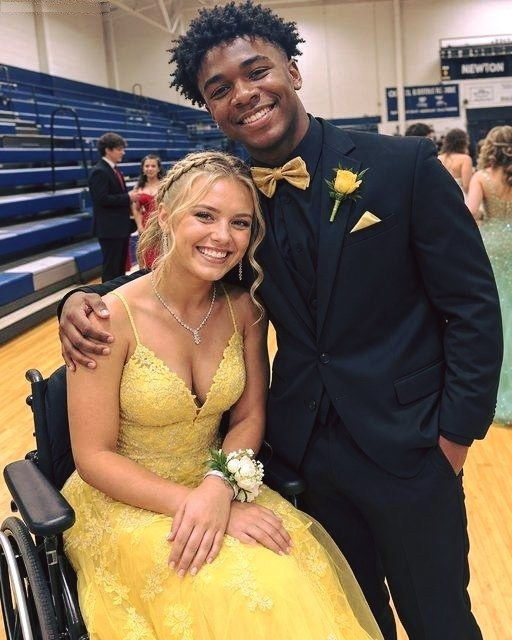
I had spent most of my life learning how to exist quietly in spaces that never fully felt like mine. The fire that took my parents when I was ten also took away the version of me that believed the world was safe. After that night, everything changed in ways I didn’t fully understand at first. I lost not only them, but also the sense that I moved through life like everyone else. People treated me carefully afterward, as if too much emotion or too many questions might break something already fragile.
By the time I reached high school, I had grown used to the pattern of glances and silence. Teachers spoke gently, always a little too slowly when addressing me. Strangers looked at my wheelchair before they looked at my face. Even classmates who meant well never quite knew how to approach me, so they often didn’t. I learned to sit with that distance, telling myself that being overlooked was safer than being pitied too deeply.
Prom night felt like it belonged to a different world entirely. The gym was transformed with lights, music, and decorations that shimmered in ways I could admire but never fully enter. Couples moved across the floor with an ease that made me feel even more still. I positioned myself near the wall, as I always did, where I could observe without intruding. It was familiar. It was safe. And it was lonely in a way I had stopped trying to fight.
Then Daniel Carter walked toward me.
He didn’t move like someone trying to impress a crowd. He moved like someone who had already decided what mattered and didn’t need permission to act on it. We had known each other for years, but only in fragments—shared classrooms, brief exchanges, moments where kindness existed without expectation. He stopped in front of me, and for a second, the noise of the room felt far away.
“Would you dance with me?” he asked.
I remember blinking, unsure if I had misunderstood him. It wasn’t the question itself that confused me—it was the simplicity of it. There was no hesitation in his voice, no careful framing, no glance toward others to see how it would be received. It was as if the rest of the room didn’t exist.
“Dance?” I repeated softly, my hands tightening slightly in my lap. I glanced down at my wheelchair, as if reminding him of something obvious he had somehow missed. But Daniel didn’t follow my gaze. He stayed focused on my face, steady and calm.
“Only if you want to,” he said again.
That was all. No pity. No awkward correction. No forced cheerfulness meant to disguise discomfort. Just an invitation offered without conditions. Something in that moment shifted inside me, subtle but undeniable. I nodded before I could talk myself out of it.
When he moved behind my chair, I expected hesitation or clumsiness or the kind of overthinking people usually showed around me. Instead, he guided me with care that felt practiced, as if he understood the importance of not making me feel like an object being moved rather than a person choosing to be there.
The dance floor opened ahead of us like unfamiliar territory. I felt every gaze that turned in our direction, but for the first time, it didn’t feel sharp or cruel. It felt curious. Maybe even uncertain. Daniel didn’t rush. He simply brought me into the space and let the moment unfold naturally.
The music was slow, soft, almost fragile, like it didn’t want to disturb anything fragile in return. Daniel turned my wheelchair gently in rhythm with it, never forcing movement, never making it feel unnatural. There was something steady about the way he stayed present, as if the entire room had narrowed down to just the two of us and the sound between us.
At first, I could feel the attention. People watching. Whispering. The kind of curiosity that usually made my shoulders tighten. But slowly, something changed. The stares didn’t disappear, but they softened. The laughter faded into silence. Even the energy of the room seemed to shift, like everyone was realizing they were witnessing something they didn’t quite know how to label.
I found myself laughing quietly, surprised by the sound. Daniel smiled in response, but there was something layered behind it—something I couldn’t fully interpret. Not joy alone. Not sadness alone either. Something in between, like memory and emotion tangled together.
When the song ended, he didn’t immediately step away. He crouched slightly beside me so we were at the same level.
“I’ve wanted to do that for a long time,” he said.
I asked him why.
But before he could answer, the doors of the gym opened, and everything changed.
The officer’s presence shifted the entire atmosphere instantly. Conversations slowed, then stopped. The principal moved toward him with a tense expression that told me this was not part of any planned evening. My stomach tightened without knowing why.
Daniel went still beside me.