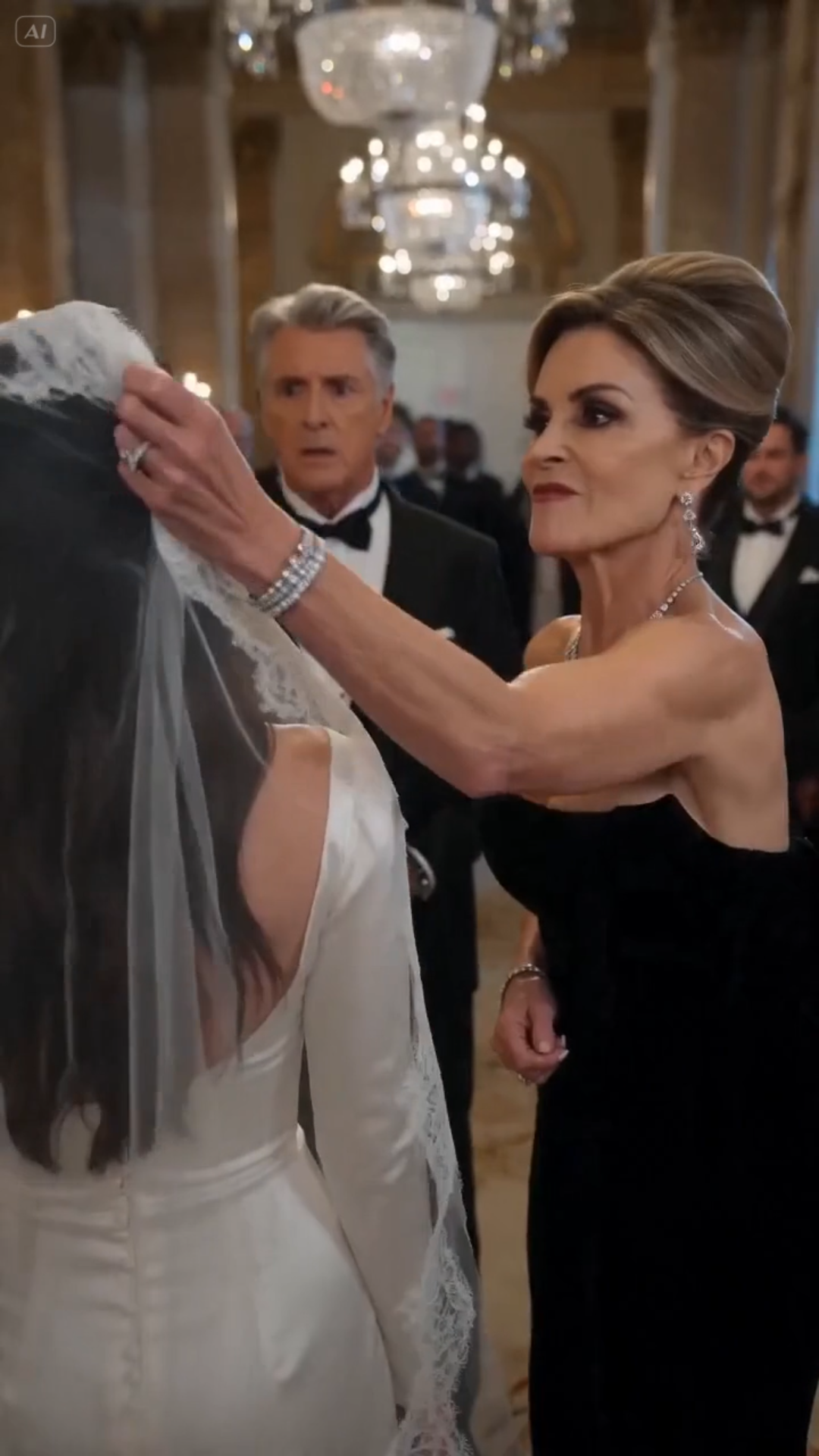
The Hawthorne wedding looked like something built for magazines.
Crystal chandeliers poured warm gold light over the ballroom. Tall decorative columns lined the walls. White roses climbed around the arch near the orchestra, and nearly three hundred guests in tuxedos and evening gowns moved through the room like wealth had taught them how to breathe differently.
At the center of it all stood Amelia Laurent.
She was twenty-four, calm, beautiful, and far too simple for the room she had married into.
Her white silk wedding dress had no diamonds sewn into it. No dramatic train. No imported lace from Paris. Just clean lines, soft fabric, and a classic lace veil pinned carefully into her brown hair.
That veil was the only thing she had refused to replace.
The Hawthorne wedding planner had suggested something “more appropriate.” Margaret Hawthorne had suggested something “less sentimental.” Even Edward Hawthorne had looked at it once and said, “Old lace rarely photographs well.”
Amelia smiled through all of it.
“This was my mother’s,” she said.
No one argued after that.
Not because they respected it.
Because they thought it did not matter.
Margaret Hawthorne stood a few feet behind the bride in a black strapless evening gown, diamonds flashing at her throat and wrists. Her makeup was heavy, her smile sharpened by champagne and resentment. For months, she had smiled beside Amelia at bridal showers, charity lunches, and rehearsal dinners. But every smile had carried the same silent message.
You do not belong here.
Julian Hawthorne stood near the ballroom steps in his groom’s tuxedo, surrounded by old friends and investment partners. He looked nervous, but not unhappy. He loved Amelia. That was the only reason she had agreed to stand under those chandeliers in the first place.
But Julian had been raised in a house where love was often confused with obedience.
And tonight, obedience belonged to Margaret.
She had spent the entire reception watching guests praise Amelia’s grace, her restraint, her quiet beauty. Worse, she had watched Edward watching Amelia. Not with affection. With discomfort. As if there was something about the young bride he could not place.
Margaret saw it too.
The shape of Amelia’s eyes.
The set of her chin.
The veil.
Especially the veil.
When the orchestra began a soft waltz and the photographer turned away to capture the cake, Margaret moved.
She stepped behind Amelia, reached up, and violently pulled the lace veil from her head.
A gasp rippled through the ballroom.
Amelia’s head tilted back from the force, but she did not stumble. She stayed still, eyes closed for one brief moment, as if absorbing the humiliation without letting it enter her bloodstream.
Margaret held the veil in one hand like a trophy.
Several guests turned.
Julian went pale in the background.
Amelia slowly opened her eyes.
Margaret’s voice cut through the golden room.
“She should have known her place.”
The sentence landed harder than the action.
Amelia turned around.
The room expected tears.
A trembling bride.
A dramatic collapse.
A groom rushing forward to defend her.
None of that happened.
Amelia reached into the fold of her dress and lifted a smartphone already connected to a call. Her hand was steady.
She held it in front of Margaret and Edward.
“Yes,” Amelia said into the phone. “Do it now.”
Margaret’s smile faltered.
Edward Hawthorne stepped forward.
He was sixty-one, elegant in a black tuxedo, silver at the temples, a man whose whole life had been built around control. Banks answered his calls. Politicians attended his dinners. Newspapers called him a philanthropist because his lawyers made sure they forgot the rest.
He stared at the phone in Amelia’s hand.
Then at the veil crushed in Margaret’s fist.
“What did you just do?” he asked.
Amelia stepped closer.
The ballroom was silent now.
Every guest, every server, every violinist, every Hawthorne cousin with a champagne glass in hand was watching.
Amelia looked first at Edward.
Then at the veil.
“You should have asked that before touching my mother’s veil.”
Edward froze.
The words struck something buried.
Not memory exactly.
Recognition.
His face drained slowly.
“Who are you?”
Amelia looked at him without blinking.
“My name is Amelia Laurent,” she said. “My mother was Celeste Laurent.”
The name moved through the ballroom like a cold wind.
Most guests did not know it.
Edward did.
Margaret did too.
Her hand tightened around the veil.
Twenty-five years earlier, Celeste Laurent had been the most brilliant designer in New York bridal couture. Not the most famous. Not yet. But women with taste knew her name. She made gowns for daughters of senators, heirs, actresses, and quiet old-money families who never used the word rich out loud.
Celeste was also the woman Edward Hawthorne almost married before Margaret.
At least, that was the version society knew.
The truth was uglier.
Celeste had not been Edward’s fiancée.
She had been his business partner.
She created the first bridal line that made Hawthorne Events profitable. She designed the signature lace veils, negotiated the first celebrity wedding contracts, and built the aesthetic that turned Edward from a hotel heir into a national wedding empire.
Then she got pregnant.
Edward promised marriage.
Margaret promised destruction.
Within six months, Celeste was accused of stealing designs, leaking contracts, and embezzling from the company she helped build. The evidence appeared perfect. Too perfect. She lost everything. Her studio. Her clients. Her name.
She disappeared from New York society.
Years later, she died quietly in a small house outside Providence, raising a daughter who grew up hearing only one instruction.
Never beg cruel people to recognize your worth. Make them answer for what they took.
Amelia had spent years doing exactly that.
She studied contracts before she studied bridal magazines. She read court filings other girls her age would have found boring. She found old invoices, altered partnership agreements, payment trails, and letters Celeste had hidden in a cedar box beneath her bed.
But the real key came from the veil.
Her mother’s veil.
The lace pattern stitched along the edge was not decorative. It was the original Laurent pattern, registered under Celeste’s name before Hawthorne Events ever existed. Edward had used a slightly altered version for twenty-five years, building an empire on stolen work.
Amelia had not come into the Hawthorne family helpless.
She came in prepared.
She met Julian at a legal clinic fundraiser, long before he knew what his family had done. He was the first Hawthorne who listened without trying to manage the truth. He helped her find archived foundation records. He fought with his father quietly, then loudly. He begged Amelia not to turn the wedding into a battlefield.
Amelia had agreed.
Unless they humiliated her mother one more time.
Margaret had just done that in front of everyone.
Edward looked toward Julian.
“You knew?”
Julian stepped forward, pale but steady.
“I knew enough to ask you for the truth,” he said. “You lied.”
Margaret snapped, “Julian, stop talking.”
For the first time in his life, he did not.
“No,” he said. “I should have talked sooner.”
Edward’s phone buzzed.
Then Margaret’s.
Then phones across the room began lighting up.
Board members.
Attorneys.
Investors.
The careful machinery of Hawthorne power began cracking in real time.
Edward looked down at his screen.
The subject line read:
Laurent Estate v. Hawthorne Holdings — Federal Filing and Injunction Notice.
Margaret whispered, “No.”
Amelia spoke calmly.
“My attorneys have filed the civil suit. The injunction freezes the sale of Hawthorne Events to Whitcomb Capital. The evidence package has been delivered to every board member and the state attorney general.”
Edward’s jaw tightened.
“You timed this for our son’s wedding?”
Amelia looked at the veil in Margaret’s hand.
“No. I timed this for the moment your family proved it had not changed.”
Margaret laughed, but fear had entered it.
“You think a dead seamstress’s daughter can take down the Hawthornes?”
Amelia’s eyes hardened.
“My mother was not a seamstress. She was the reason anyone knows your name.”
That sentence did what shouting could not.
It made the room turn.
Not toward Edward.
Toward Amelia.
Guests began whispering now. Some recognized the Laurent pattern. Some remembered the old scandal. Some were already searching on their phones, discovering articles buried beneath decades of carefully managed reputation.
Edward stepped closer, lowering his voice.
“You have no idea what you’re doing.”
Amelia smiled sadly.
“That’s what men like you always say when women understand the documents.”
Margaret threw the veil onto the floor.
“There,” she said. “Take your little rag.”
The room recoiled.
Amelia’s face changed for the first time.
Not rage.
Grief.
Julian crossed the room, bent down, and picked up the veil with both hands. He did not give it to Amelia immediately. First, he turned to his mother.
“You don’t get to touch her again,” he said.
Margaret stared at him.
“I am your mother.”
Julian looked at the veil.
“And somehow you still never learned what that means.”
He placed the veil gently in Amelia’s hands.
That was when Edward tried his last move.
He raised his voice for the room.
“Ladies and gentlemen, I apologize for this unfortunate display. My daughter-in-law is clearly emotional. We will handle this privately.”
Amelia lifted her phone again.
The speaker was still on.
A woman’s voice came through clearly.
“Mrs. Hawthorne, Mr. Hawthorne, this is Deputy Attorney Marla Keene. You have both been served electronically. Any attempt to destroy documents, contact witnesses, or move assets from Hawthorne Holdings will be treated as obstruction.”
A stunned silence followed.
Then a server near the back quietly said, “Oh my God.”
Edward looked at Amelia as if seeing her for the first time.
Not as a bride.
Not as a girl.
As an opponent.
“Who helped you?” he asked.
Amelia looked around the ballroom.
“Your victims.”
That was the deeper twist.
Celeste had not been the only one.
Amelia had found former assistants forced to sign false statements. Designers whose work vanished into Hawthorne collections. Vendors bankrupted after refusing unfair contracts. A bookkeeper who had kept copies of payments from Margaret’s private account to the investigator who framed Celeste.
All of them had been waiting for someone with enough evidence and enough courage.
Tonight, they got both.
Margaret’s diamonds glittered as her throat moved.
“You’ll destroy Julian too.”
Amelia looked at her husband.
The whole room looked with her.
Julian took Amelia’s hand.
“No,” he said quietly. “She’s giving me a chance not to become you.”
Edward closed his eyes for one second.
When he opened them, something cold and defeated had replaced his authority.
Security entered through the side doors.
Not Hawthorne security.
Venue security, following instructions from the independent trustee appointed that afternoon after the emergency injunction.
Edward understood before Margaret did.
They no longer controlled the room.
The reception ended without music.
But it did not end in shame for Amelia.
Guests approached her one by one. Some apologized. Some offered information. Some simply bowed their heads, embarrassed by how easily they had mistaken quietness for weakness.
Margaret and Edward left through a private hall, not escorted in handcuffs, not yet, but stripped of the thing they valued most: the illusion that everyone still believed them.
Three months later, the Hawthorne empire was no longer an empire.
The civil suit uncovered enough fraud to trigger criminal investigation. The sale collapsed. Margaret resigned from every charity board before she could be removed. Edward was charged with financial misconduct, witness intimidation, and conspiracy to falsify evidence in the original Laurent case.
The media rediscovered Celeste Laurent.
Old photographs resurfaced: Celeste in her studio, Celeste adjusting a bride’s sleeve, Celeste smiling beside a lace veil that looked painfully familiar.
The fashion world called her forgotten.
Amelia corrected them every time.
“She was not forgotten,” she said in one interview. “She was erased. There is a difference.”
Julian gave up his role in Hawthorne Holdings and testified voluntarily. It cost him friends, money, and the easy protection of his family name.
But it saved his marriage.
Not because Amelia needed him to choose her publicly.
Because he finally chose truth without being begged.
One year later, Amelia opened the Laurent House for Women in Design.
It offered legal support, contract education, studio grants, and emergency funds for young designers whose work had been stolen by larger companies. In the entrance hall, beneath warm lights, stood a glass case.
Inside was the lace veil.
Repaired.
Not perfect.
A faint tear remained where Margaret had ripped it from Amelia’s hair.
Amelia refused to hide the damage.
At the opening, Julian stood beside her, no tuxedo, no dynasty behind him. Just a husband who had learned that love without courage was only decoration.
A young designer looked at the veil and asked, “Why keep the tear?”
Amelia smiled.
“Because that’s where the truth got in.”
That evening, after the guests left, Amelia stood alone in front of the case.
For years, she had imagined justice as thunder.
A courtroom.
A confession.
A ruined enemy.
But real justice felt quieter.
It felt like her mother’s name spoken clearly.
It felt like young women walking into a building built for them.
It felt like a torn veil no longer being proof of humiliation, but proof that someone had tried to destroy a legacy and failed.
Julian came up beside her.
“Do you ever wish we had a normal wedding?” he asked softly.
Amelia looked at the veil.
Then at him.
“No,” she said. “I wish my mother had lived to see it.”
Julian took her hand.
“She would have been proud.”
Amelia’s eyes filled, but she smiled.
“She would have told me to stand up straighter.”
So she did.
Outside, the city moved on the way cities always do. Cars passed. Lights changed. People rushed toward lives full of secrets, hopes, and quiet battles no one else could see.
Inside Laurent House, Amelia turned off the ballroom lights one by one.
The veil remained behind glass, glowing softly in the dark.