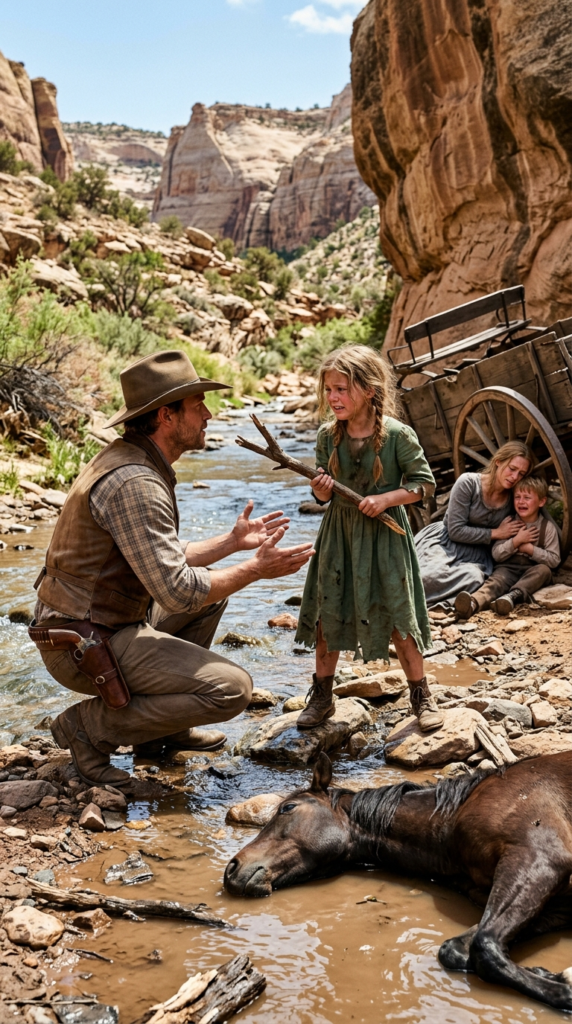
PART 1: THE SCREAM IN THE ARROYO
Julián Mendoza had seen many misfortunes in his forty years of life. He had seen droughts swallow entire ranches, good men lose themselves to a bottle, and families torn apart over a few coins. But the scream that crossed the plains of Chihuahua that summer afternoon was not a problem he could simply leave behind.
It was the scream of a girl watching her mother die.
Julián spurred his horse hard. The sun beat down on the earth like a hot iron, and red dust rose behind him. When he reached the edge of the dry arroyo, he saw an overturned cart, a dead mule tangled in the shafts, and three bodies lying among the rocks.
A woman lay face down, motionless. A small boy breathed with difficulty beside her. And a girl about eight years old gripped a broken branch as if it were a sword.
“Don’t come any closer,” the girl said, her voice hoarse. “Don’t take my brother.”
Julián dismounted slowly, hands raised.
“I’m not here to take anyone, child.”
“Everyone says that.”
The man looked at the boy. His lips were cracked from thirst and his skin burned with fever.
“Your brother is dying.”
The branch trembled in the girl’s hands.
“He’s asleep.”
“No. He’s sick. And your mother needs help too.”
The girl clenched her teeth. Her hair was full of dust, her face burned by the sun, and her eyes were far too old for her age.
“What’s your name?” Julián asked.
“It’s none of your business.”
“It is if I’m going to save your lives.”
She fell silent.
Julián pointed north.
“I have a ranch an hour from here. There’s water, shade, and a healer who comes every week. I’m not the police. I’m not a soldier. I’m just a man who heard a scream and couldn’t keep riding.”
The girl lowered the branch a little.
“My name is Lucía. She is my mom, Elena. And he is Mateo.”
The boy moaned.
“Water…”
Julián knelt beside him. He touched the boy’s neck with two fingers and felt the weak pulse.
“Lucía, I’m going to lift your brother. Then I’ll lift your mother. You can sit behind me with that branch if it makes you feel safe. If I do anything wrong, hit me with all your strength. Deal?”

The girl stared at him for a long time.
“Why would you do this for strangers?”
Julián looked down.
“Because once someone did it for me.”
He said nothing more.
Carefully he lifted Mateo onto the horse. Then he lifted Elena. The woman was pale, with dried blood on her temple and an injured shoulder. Still, she was breathing.
Lucía climbed up behind the boy and held him as if she had carried the weight of the world for years.
The journey back was slow. Julián walked beside the horse, holding the reins.
“Why aren’t you riding?” Lucía asked.
“The horse is already carrying too much weight.”
“It’s strong.”
“Being strong doesn’t mean it doesn’t get tired.”
The girl stayed quiet.
When the ranch appeared in the distance—a low adobe house with a tin roof and a large mesquite tree beside the corral—Lucía murmured:
“Your house looks very lonely.”
Julián did not answer. The house had been lonely for nine years, ever since his father died and he stopped hoping anyone would ever walk through the door.
That afternoon, for the first time in a long time, the house filled once again with the breathing of others.
Julián laid Elena in his bed, placed Mateo on a blanket, and sent Lucía to fetch water from the well. Then he lit the stove, cleaned the wounds, tore up a clean shirt to make bandages, and spent the entire night changing cold cloths on the boy’s forehead.
Lucía did not sleep. She stayed in a corner, hugging the branch.
“Mr. Julián,” she said at last, when the lamp was nearly out. “There’s something you should know.”
She pulled a folded paper from her dress.
“Don’t read it in front of me.”
Julián took the paper and waited until the girl closed her eyes.
The notice offered a reward of five hundred pesos for the delivery of Elena Valdez and her children, Lucía and Mateo, to the care of their “legitimate protector,” Don Victoriano Aranda, landowner from Parral. It claimed that Elena was confused, mentally ill, and had stolen the children.
Julián read the paper twice.
Then he folded it calmly.
And he understood that the cart had not overturned by bad luck. Elena had been running.
PART 2: THE HOUSE THAT DECIDED TO DEFEND THEM
Before dawn, Mateo opened his eyes.
“Where is my mom?” he whispered.
“Right here, champ,” Julián answered. “And you’re safe.”
The boy squeezed his hand.
“Don’t go away.”
Julián felt something crack inside his chest.
“I’m not going.”
Shortly afterward, Doña Remedios arrived—the town healer, alerted by a neighbor. She was a strong woman with white hair and a commanding voice. She examined Elena, cleaned her wound, and managed to get Mateo to drink some broth.
“This family is fleeing from something ugly,” she said quietly to Julián. “And you’re already in it up to your neck.”
“I know.”
“Then don’t be a fool. Ask for help.”
Elena woke at noon. When she saw Julián beside the bed, she tried to sit up.
“Lucía, take your brother. We’re leaving.”
“You can’t even walk a hundred steps,” Julián said calmly. “If you leave now, the boy won’t make it alive to the road.”
Elena looked at him with distrust.
“I have no money.”
“I didn’t ask for any.”
“Everyone asks for something sooner or later.”
Julián held her gaze.
“Tonight I only ask that you drink water.”
Elena cried without making a sound. She had learned to cry that way, the way someone cries when they don’t want to wake danger.
Later she told him the truth.
Her husband, Rafael Valdez, had worked for Don Victoriano Aranda, a powerful landowner and moneylender. He discovered that Aranda was stealing land from peasants, falsifying debts, and ordering cattle to disappear so he could force them to sell cheap. Rafael wanted to report him. A week later he was found dead at the foot of a ravine.
“They said he fell from his horse,” Elena told him. “But Rafael had been riding since he was a child. He didn’t fall. They had him killed.”
Elena had only said it once, out loud, during the wake. Since then Aranda had declared her unstable and tried to take the children from her—especially Mateo, the only male grandchild of his blood.
“I fled with them eleven days ago,” she whispered. “I couldn’t take it anymore. The cart broke. I closed my eyes for just a minute… and I almost killed them.”
“No,” Julián said. “You didn’t kill them. You almost saved them. You just needed to reach here.”
That same afternoon an old friend of Julián’s, Don Eusebio, arrived at the ranch with bad news.
“There are four men in town asking about a widow and two children. One is a lawyer. He has papers. They say they’re coming for them tomorrow.”
Elena went pale.

Lucía clung to Mateo.
Julián stepped out onto the porch with Don Eusebio.
“I need the civil judge and Father Anselmo here tomorrow at noon. Also two witnesses.”
Don Eusebio looked at him as if he had heard pure madness.
“What are you going to do?”
“Marry Elena.”
When she heard it from the bedroom, she stood up furiously.
“I’m not a burden to be passed from one man to another!”
Julián entered slowly.
“You’re right. I said it wrong. I’m not asking you for anything as a woman. I’m offering you a piece of paper. A shield. If you are my wife in the eyes of the law, your children will be under my roof and that man won’t be able to take them without a hearing. When Aranda falls, you can tear up the paper if you want.”
Elena trembled.
“And what do you want in return?”
“Nothing.”
“No one gives something for nothing.”
Julián looked at Mateo sleeping in the bed and at Lucía watching over him like a soldier.
“That boy asked me not to leave. That girl stopped fighting when she believed she could finally rest. They’ve already paid the price. I don’t want to possess them. I want to defend them.”
Elena remained silent for a long time.
“Three conditions,” she said at last. “One: you never touch me unless I allow it. Two: when this is over, I can leave if I want. Three: if you sign for my children, don’t break their hearts. They’ve already lost a father.”
Julián bowed his head.
“I accept.”
At dawn, Aranda’s men arrived earlier than expected. The lawyer, Licenciado Ibarra, climbed onto the porch with papers and a serpent’s smile.
“I’ve come for the minors.”
Julián stepped out with the rifle in his hand.
“You’re early for a legal matter.”
“I have an order.”
“It hasn’t been delivered to the mother in front of independent witnesses. That’s not valid.”
The lawyer’s smile vanished.
“You’re a rancher, not a lawyer.”
“My father was a justice of the peace for twenty years. I learned something copying papers by candlelight.”
The lawyer pressed his lips together.
“I’ll return with the authorities.”
“Come back at noon. There will be a wedding, a judge, witnesses, and a telegram on its way to the federal authorities. If you want to steal children, do it in front of everyone.”
Licenciado Ibarra understood that this rancher would not be easily moved.
He left, but not before issuing a warning:
“Don Victoriano Aranda does not forgive.”
Julián replied:
“Neither do I abandon.”
PART 3: THE MAN WHO DID NOT RIDE PAST
At noon the civil judge arrived in a cart, along with Father Anselmo, Doña Remedios, and Don Eusebio. Elena sat in a chair by the table, pale but upright. Lucía held Mateo’s hand.
Before beginning, the judge looked at Elena.
“Are you doing this of your own free will?”
“Yes,” she answered. “Not for love yet. For my children. And because this man has not asked me for anything I cannot give.”
Julián looked down.
The ceremony was brief. There was no music, no flowers. Only a humble house, a feverish boy, a girl who no longer wanted to let go of her brother’s hand, and a woman who married so she would not lose everything.
When the judge pronounced them “husband and wife before the law,” Julián did not try to kiss her. He simply offered her his hand.
Elena took it.
“Thank you, Mr. Mendoza.”
“Mrs. Mendoza,” he corrected her gently.
She cried for the first time without hiding her tears.
A month later the hearing took place in Chihuahua. Don Victoriano Aranda entered the courtroom in a black suit, silver cane in hand, carrying the confidence of a man who had bought too many silences.
He presented false witnesses. A woman claimed that Elena saw ghosts, talked to herself, and was incapable of caring for her children. But the lawyer defending Julián and Elena—a honest young man named Salvador Reyes—produced a bank receipt showing that Aranda had paid that same woman five hundred pesos three days before her statement.
The judge ordered her detained for false testimony.
Then they called Lucía.
The girl stepped up to the stand with a straight back. Her feet barely reached the floor.
“Who do you want to live with?” the judge asked.
“With my mom, my brother, and Don Julián.”
“Why?”
“Because there no one buys us or sells us. There we are family.”
Don Victoriano leaned toward her.
“You are a confused little girl.”
Lucía looked at him without blinking.
“I heard you the night we fled. You said my dad got what he deserved. You said he didn’t fall from his horse. I heard you.”
The courtroom fell silent.

Aranda’s face changed for the first time.
That single sentence opened an investigation. The men who had served the landowner began to talk to save themselves. Weeks later Don Victoriano Aranda was arrested for fraud, land theft, document forgery, and suspicion of homicide.
The judge permanently denied his claim over the children.
“Go home, Mrs. Mendoza,” he said. “Your children are yours. They always were.”
As they left the courtroom, Mateo raised his arms toward Julián.
“Are we going home, Dad Julián?”
Elena stood motionless.
Julián looked at the boy, then at her.
“If your mom allows it.”
Elena, eyes full of tears, took Julián’s hand.
“Take us home.”
They returned to the ranch at sunset. The dog ran in circles, the wind stirred the mesquite, and the lonely house seemed to breathe differently.
At the door, Elena stopped.
“Could you carry me across the threshold?”
Julián’s eyes widened in surprise.
“Are you sure?”
“I want a man to carry me once not because I’m falling, but because I’m coming home.”
Julián lifted her carefully. He carried her through the doorway and set her down in the center of the kitchen. She placed both hands on his face and rested her forehead against his.
She did not kiss him. That would come later, when fear no longer ruled.
But in that gesture, Julián understood he would never be alone again.
The years were not easy, because the land never gives anything for free. There were hard winters, droughts, and debts. But there were also laughs, hot bread, children running across the yard, and a table where there was always enough food.
Lucía learned to read and years later studied law to defend women and children without a voice. Mateo grew up strong, healthy, and stubborn like Julián. Elena and Julián had two more children, but he never made any difference between them.
To all of them, he was simply Dad.
Many years later, when someone asked how that family had begun, Julián would look toward the distant arroyo where he had once heard a scream.
“It started the day I understood that a man doesn’t always choose his family,” he would say. “Sometimes he finds it lying in the dust, thirsty, afraid… and decides not to ride past.”
And that house, which for nine years had held only silence, was never empty again.