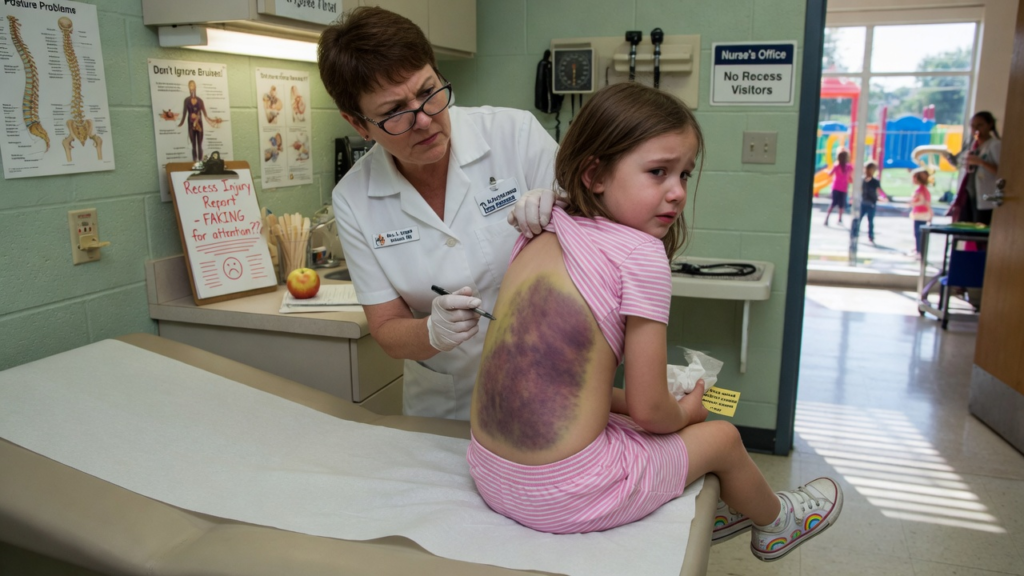
I trusted the school staff to protect my five-year-old daughter when I wasn’t there, but that trust dissolved into pure terror the moment I pulled off her shirt for a bath and saw the jagged, spreading purple shadow creeping up the center of her spine.
For six long, agonizing months, I had been completely gaslit.
My daughter, Chloe, used to be a tornado of energy. She was the kind of five-year-old who never walked anywhere; she ran, skipped, or hopped.
But right around the time the leaves started changing for autumn, something shifted.
It started quietly. A small complaint here, a brief hesitation there.
“My back is tired, Mommy,” she would say, sitting down on the sidewalk halfway through our usual walk to the local park.
I didn’t think much of it at first. Kids get tired. They play hard, they crash hard.
But then the night wakings began.
I would hear her crying through the baby monitor at 2:00 AM. I’d rush into her room to find her clutching her legs, her face buried in her pillow, sobbing that her bones were aching.
Like any concerned mother, I immediately made an appointment with her pediatrician, Dr. Evans.
I sat in that brightly lit, sterile examination room, holding Chloe’s hand, detailing every sleepless night and every complaint of pain.
Dr. Evans, a man who had been practicing medicine for thirty years, barely looked up from his clipboard.
He gave Chloe a cursory pat on the knee, smiled a practiced, condescending smile, and looked at me.
“She’s perfectly fine, Sarah. These are textbook growing pains.”
Growing pains. That phrase became the soundtrack to my life for the next six months.
“It’s just growing pains,” the nurses would say when I called the advice line in tears.
“Give her some children’s Tylenol, use a warm heating pad, and she’ll grow out of it,” they insisted.
I wanted to believe them. They were the experts, right? They went to medical school. I was just a worried mom.
So, I pushed my instincts down. Every time my gut screamed that something was terribly wrong, I suffocated it with their professional reassurances.
I gave her the medication. I rubbed her back. I told her she was just getting taller and stronger.
But she wasn’t getting stronger. She was fading.
The vibrant, energetic girl I knew was slowly being replaced by a child who wanted to sit on the couch all weekend.
Then came the subtle changes in the way she moved.
It wasn’t constant at first. Just a slight stiffness in the morning, or a brief drag of her right foot when she was really tired.
I filmed it on my phone once and showed it to Dr. Evans during a follow-up appointment.
He watched the ten-second clip, chuckled softly, and handed my phone back.
“Kids develop strange habits when they’re dealing with growth spurts. She’s likely just favoring one side because the other is sore. Stop hovering, Mom. You’re going to make her anxious.”
I left that office feeling humiliated. I felt like a neurotic, overbearing mother who was projecting illness onto her perfectly healthy child.
I vowed to stop analyzing her every move. I promised myself I would treat her like a normal, healthy kid.
And that terrible, misguided vow is exactly what led to the most horrifying day of my life.
It was a cold Tuesday morning in early March.
Chloe had been unusually quiet during breakfast. She just pushed her cereal around the bowl, staring blankly at the kitchen table.
When it was time to get dressed, I noticed she was taking an incredibly long time to put on her shoes.
“Come on, sweetie, we’re going to be late for kindergarten,” I called out from the hallway.
She shuffled out of her bedroom. Her right foot scraped against the hardwood floor.
Scrape. Pause. Scrape. Pause.
I bit my tongue. Growing pains, I reminded myself. Don’t hover.
I drove her to school, kissed her forehead, and watched her slowly make her way into the brick building.
I went to work, sitting in my office cubicle, but I couldn’t focus. A heavy, dark pit had formed in my stomach.
At 1:15 PM, my cell phone rang. The caller ID flashed the name of Chloe’s elementary school.
My heart hammered against my ribs as I answered. “Hello?”
“Mrs. Miller? This is Mrs. Gable, the school nurse.”
Her voice was clipped, professional, and dripping with an undeniable undercurrent of irritation.
“Is Chloe okay?” I asked, standing up from my desk immediately.
“Chloe is physically fine,” Mrs. Gable sighed loudly into the receiver. “But we are having some significant behavioral issues today.”
“Behavioral issues? Chloe?” I was stunned. Chloe was shy, sweet, and terrified of getting into trouble.
“Yes. During afternoon recess, she refused to participate in the class activities. When the playground monitor told her to join the others, she threw herself on the dirt.”
I frowned, pressing the phone harder against my ear. “Threw herself? That doesn’t sound like her.”
“She’s currently sitting in my office,” Mrs. Gable continued, her tone growing even more rigid. “She has been dragging her leg across the floor and crying hysterically, making up stories.”
“What stories?” my voice shook.
“She keeps telling the staff that ‘the ground is pulling her’.” Mrs. Gable let out a dry, humorless scoff. “I’ve checked her leg. There are no scrapes, no bruises, no swelling. She has full range of motion when I manipulate it.”
“Then why is she crying?”
“Mrs. Miller, I’ve been a school nurse for fifteen years. I know an attention-seeking performance when I see one. She likely just didn’t want to play the game the other kids chose. I told her to stop seeking attention and sent her back to class, but she refused to stand up. You need to come pick her up. We cannot accommodate tantrums that disrupt the faculty.”
I didn’t even say goodbye. I grabbed my purse, ran to my car, and broke several speed limits getting to the school.
When I burst into the clinic, the sight of my daughter nearly brought me to my knees.
Chloe was sitting on a rigid plastic chair in the corner of the room. She looked tiny.
Her face was splotchy and red from crying, her eyes swollen.
But it was the way she was sitting that made my blood run cold.
She was clutching her right thigh with both of her small hands, her knuckles white, physically lifting her leg slightly off the ground as if the weight of it was unbearable.
“Mommy,” she whimpered when she saw me.
I rushed over, dropping to my knees in front of her. “Baby, what’s wrong? What hurts?”
“The ground,” she sobbed, burying her face into my neck. “The ground keeps pulling my leg down. It’s so heavy, Mommy. Make it let go.”
Mrs. Gable was sitting at her desk, typing on her computer. She didn’t even look up.
“As I said on the phone, Mrs. Miller,” the nurse stated flatly over the sound of her keyboard. “There is nothing medically wrong with her. You might want to have a firm conversation with her about school rules and fake crying.”
I wanted to scream at the woman. I wanted to flip her desk over.
But my priority was my child.
I didn’t argue. I didn’t say a word to Mrs. Gable. I just picked Chloe up.
She felt different in my arms. Heavy. Lopsided. Her right leg dangled limply against my hip, completely dead weight.
I carried her to the car and strapped her into her booster seat. She didn’t say a word the entire drive home. She just stared out the window, her eyes hollow and dark.
By the time evening came, Chloe was completely lethargic. She refused dinner. She didn’t want to watch her favorite cartoons.
“Let’s just get you into a nice, warm bath,” I whispered, brushing the hair out of her sweaty face. “The warm water will help your muscles.”
Growing pains. The doctor’s words echoed in my head, mocking me.
I carried her into the bathroom. The room was cool, lit only by the harsh overhead vanity light.
I turned on the faucet, adjusting the water until it was steaming and warm.
I sat Chloe down on the fuzzy bath mat. She couldn’t hold herself up straight. She slumped forward, bracing herself with her hands on the floor.
“Arms up, sweetie,” I said softly, grabbing the hem of her long-sleeved cotton shirt.
She weakly raised her arms.
I grabbed the fabric and pulled the shirt over her head, tossing it into the hamper.
I turned back to look at my daughter.
And my entire world stopped spinning.
The air vanished from the room. My ears began to ring with a deafening, high-pitched pitch.
Right there, directly over her spinal cord, starting from the base of her neck and stretching brutally down to the middle of her back, was a massive, horrific shadow.
It wasn’t a normal bruise. It wasn’t from a fall.
It was a deep, angry, mottled mixture of black, violent purple, and sickly yellow.
It looked like rot. It looked like the tissue beneath her skin was dying.
And as I traced the edge of the swelling with a trembling finger, feeling the unnatural, feverish heat radiating from her spine, a horrifying realization slammed into me like a freight train.
Chloe didn’t have growing pains.
Her leg wasn’t tired.
The ground wasn’t pulling her.
Advertisement
Her spine was failing.
And for six months, I had been giving Tylenol to a child who was rotting from the inside out.
CHAPTER 2
I hovered my hand over the dark, mottled skin of my daughter’s back. My fingers were trembling so violently I could barely keep them steady.
I didn’t want to touch it. Every instinct in my body screamed at me to pull my hand away, to close my eyes, to pretend this horrifying mass of bruised, swollen flesh wasn’t real.
But I had to know. I had to know what I was looking at.
I gently pressed the very tip of my index finger against the outer edge of the purple shadow, right near her shoulder blade.
Chloe let out a scream that I will never, ever forget.
It wasn’t a normal cry. It wasn’t the sound a child makes when they scrape their knee or pinch their finger in a door.
It was a guttural, primal shriek of absolute agony. The sound tore through her tiny throat, echoing off the bathroom tiles and vibrating right into the center of my chest.
“Don’t touch it! Mommy, don’t! It burns!” she sobbed, throwing her body forward until her forehead hit the fuzzy bath mat.
She curled into a tight ball, but she couldn’t bring her right leg up to her chest. It stayed entirely straight, dragging uselessly behind her on the floor.
My breath caught in my throat. I couldn’t breathe. The air in the bathroom suddenly felt thick and suffocating.
The heat radiating from that massive bruise was unnatural. It felt like I was holding my hand over a hot stove. It was a severe, raging fever trapped entirely beneath her skin, localized right on top of her spinal column.
This wasn’t a bone growing. This wasn’t a strained muscle from playing too hard on the playground.
This was an infection. And it looked massive.
Panic, cold and sharp, flooded my veins.
“Okay, baby. Okay, Mommy’s sorry. I won’t touch it again,” I stammered, my voice cracking.
I didn’t bother with clothes. There was no time to put her pajamas on. The hospital was twelve minutes away if I hit every green light. Waiting for an ambulance would take too long. I couldn’t waste another single second.
I reached up and yanked a large, thick bath towel off the rack.
I knelt down and carefully draped it over her shoulders, wrapping it around her small body. I made sure the fabric was loose over her back, terrified of causing her any more pain.
“We are going for a ride in the car, Chloe,” I said. I tried to sound calm. I tried to keep the sheer terror out of my voice. But I was failing.
“No,” she whimpered, her eyes squeezed shut. “I want to sleep. The ground is pulling me, Mommy. Let me sleep.”
“You can’t sleep right now, sweetie,” I said, sliding one arm under her knees and the other around her upper back, avoiding the swollen area.
I lifted her up.
She was dead weight. Her head lolled back against my shoulder. Her right leg dangled straight down, completely limp, like a broken pendulum.
I ran.
I carried her out of the bathroom, down the hallway, and out the front door. I didn’t grab my purse. I didn’t grab my jacket. I didn’t even lock the front door behind me.
The cold March air hit my face as I sprinted down the driveway. The sun had already set, and the streetlights cast long, creepy shadows across the pavement.
I wrenched the back door of my SUV open and gently laid her across the backseat.
“I’m going to put the seatbelt over you, okay?” I whispered, my hands shaking as I pulled the strap across her waist and clicked it in.
She didn’t answer. Her eyes were half-open, staring blankly at the ceiling of the car. Her lips were pale, almost blue in the dim light.
I slammed the door, ran to the driver’s side, and threw myself behind the wheel.
I pushed the push-to-start button, threw the car into drive, and slammed my foot on the gas pedal. The tires screeched against the concrete driveway as I reversed, threw it into drive, and sped down our quiet residential street.
My heart was hammering against my ribs like a trapped bird. My hands gripped the steering wheel so tight my knuckles were completely white.
I looked in the rearview mirror.
Chloe hadn’t moved. She was lying exactly where I put her, wrapped in the white towel.
“Chloe? Can you hear me?” I yelled over the sound of the engine.
“It’s cold,” she whispered. Her voice was incredibly weak. It sounded like it was coming from miles away.
“I know, baby. I’ll turn the heat up,” I said, aggressively twisting the climate control dial on the dashboard until hot air blasted from the vents.
I blew through the first stop sign. I didn’t even tap the brakes.
I merged onto the main road, pressing the gas pedal closer to the floor. The speed limit was forty-five. I was doing seventy.
Every car in front of me felt like an insurmountable obstacle. I swerved around a slow-moving sedan, honking my horn aggressively. The other driver flashed their brights at me, but I didn’t care. Nothing mattered except getting to Oak Creek Memorial Hospital.
“Chloe, talk to me,” I pleaded, glancing in the rearview mirror again.
“My toes,” she mumbled, her eyes drifting shut.
“What about your toes, sweetie? Are they cold?”
“I can’t find them,” she said.
The words hit me like a physical punch to the stomach.
I can’t find them. She was losing feeling. The paralysis was spreading.
That was what she meant when she told the school nurse “the ground was pulling her.” She wasn’t throwing a tantrum. She wasn’t seeking attention. She was losing the ability to lift her own leg. The nerves in her spine were being crushed, severing the connection between her brain and her muscles.
And that horrible, nasty school nurse had accused her of faking it. She had forced my terrified, partially paralyzed five-year-old daughter to sit in a hard plastic chair while a massive infection attacked her spinal cord.
Hot, blinding rage mixed with my terror.
I wanted to scream. I wanted to hit something. But most of all, I wanted to go back in time.
I wanted to go back to Dr. Evans’ office six months ago. I wanted to grab him by his stiff white collar and demand an X-ray. I wanted to refuse to leave until he took my daughter’s pain seriously.
Growing pains. The phrase tasted like poison in my mouth. I had trusted him. I had trusted his medical degree and his thirty years of experience over my own motherly intuition.
I had spent six months telling my daughter to stop complaining, giving her over-the-counter pain medicine while something lethal was growing inside her.
The guilt was suffocating. It felt like a heavy stone sitting directly on my chest, making it impossible to take a full breath.
I saw the bright red glow of a traffic light ahead. It was a major intersection. Cars were crossing in both directions.
I didn’t stop. I couldn’t stop.
I laid my hand flat on the car horn, letting out a continuous, blaring sound, and flew through the red light. Brakes squealed around me. Someone yelled out their window. I ignored it all.
Up ahead, I finally saw the glowing blue sign: EMERGENCY ROOM.
I whipped the steering wheel to the right, taking the turn so fast the tires squealed in protest. I flew up the ramp and slammed the car into park directly in front of the sliding glass doors, blocking the ambulance bay completely.
I didn’t turn the engine off. I threw the door open, ran around to the back, and pulled Chloe out of the backseat.
She was completely limp now. Her eyes were closed. Her breathing was shallow and rapid.
“Help!” I screamed at the top of my lungs as I sprinted toward the sliding glass doors.
The doors parted slowly, feeling like they took an agonizingly long time to open.
I burst into the waiting room. It was packed. At least thirty people were sitting in uncomfortable plastic chairs, staring at their phones or watching the news on a muted television.
“Help me! Somebody help my daughter!” I yelled, my voice echoing off the high ceilings.
People turned to stare at me. A teenager in the corner lowered his phone. An older woman gasped and covered her mouth.
I ran straight to the triage desk. It was enclosed behind thick, bulletproof glass.
A nurse in blue scrubs was sitting at a computer, slowly typing. She looked up at me with an expression of tired annoyance. It was the exact same look the school nurse had given me earlier that day.
“Ma’am, you need to sign in at the kiosk and take a seat,” the triage nurse said through the small speaker on the glass. Her voice was flat and robotic. “We are currently experiencing a four-hour wait.”
“No!” I slammed my hand against the thick glass. “She’s not waiting! Something is wrong with her spine. She can’t feel her legs!”
The nurse let out a long sigh, clearly assuming I was just another hysterical parent overreacting to a fever.
“Ma’am, I understand you are worried. But we have a protocol. You need to put her down, sign her name, and wait for your number to be called. We have chest pains waiting.”
I lost my mind. The last shred of my polite, rule-following self completely snapped.
“I am not signing a damn computer screen!” I roared.
I stepped back from the glass. I turned Chloe slightly to the side, supporting her limp body with my left arm. With my right hand, I grabbed the top edge of the thick bath towel and yanked it down.
I exposed her bare back to the entire waiting room.
The massive, black-and-purple mass was glaring under the harsh fluorescent lights of the hospital. It looked even worse here than it had in the bathroom. The skin was taut, shiny, and stretched tight over the horrific swelling.
Several people in the waiting room let out audible gasps. Someone dropped a magazine.
I looked back at the triage nurse behind the glass.
Her bored, annoyed expression vanished instantly. The color completely drained from her face, leaving her looking like a ghost. Her eyes went wide, staring at the bruised mass on my daughter’s spine.
She didn’t tell me to sign in anymore.
She didn’t tell me to take a seat.
She slammed her hand down on a large red button on her desk, leaned forward into a microphone, and yelled.
“Code Blue triage! We need a pediatric trauma team to the front desk NOW! Bring a gurney!”
The shift in the room was violent. The bored, sluggish atmosphere of the waiting room shattered in an instant.
The double doors leading to the actual emergency room burst open. Three nurses and a doctor in a long white coat came sprinting out, pushing a metal stretcher in front of them.
“Put her down! Put her on the bed!” a male nurse yelled at me.
I gently laid Chloe down on the thin mattress. The moment her back touched the surface, she let out another weak, horrifying shriek, her eyes rolling back in her head.
“Don’t put her on her back!” the doctor shouted, grabbing her shoulders and quickly rolling her onto her side.
He was a tall man with graying hair and intense, focused eyes. His nametag read ‘Dr. Harris’.
“What happened?” Dr. Harris demanded, pulling a small penlight from his pocket and shining it into Chloe’s unresponsive eyes. “Did she fall? Was she in a car accident?”
“No!” I cried, grabbing the metal rail of the gurney as they started pushing it through the double doors. I ran alongside them. “No trauma. No fall. It just appeared.”
“A bruise that size doesn’t just appear, Mom,” Dr. Harris said, his tone sharp. “Think. Did someone hit her? Did she drop something heavy on herself?”
“I swear to God, no!” I yelled, tears finally spilling down my cheeks. “She’s been complaining of back pain for six months! Her pediatrician said it was growing pains! He told me to give her Tylenol!”
Dr. Harris stopped walking for a fraction of a second. He looked up from Chloe and stared directly at me. His jaw clenched so tight the muscles in his cheek popped.
“Six months?” he repeated, his voice low and dangerous.
“Yes,” I sobbed. “And today the school called. They said she was dragging her right leg. They said she was throwing a tantrum and refused to stand up.”
“She wasn’t throwing a tantrum,” Dr. Harris said grimly, pushing the gurney faster down the brightly lit hallway. “She’s losing motor function.”
We burst into a large trauma bay at the end of the hall. The room was freezing cold and blindingly bright.
Nurses swarmed the bed like ants. One nurse grabbed a pair of heavy medical shears and cut the towel away. Another nurse started slapping sticky heart monitor pads onto Chloe’s chest. The loud, rapid beeping of the heart monitor filled the room.
“Pulse is 140. Respiration is 32 and shallow. She’s running a massive fever. 104.2,” a nurse called out rapidly.
“Get a large-bore IV in her left arm,” Dr. Harris ordered, pulling on a pair of blue latex gloves. “Push broad-spectrum antibiotics right now. Don’t wait for the labs. I want a CBC, a blood culture, and a metabolic panel. And page neurology. Tell Dr. Vance to get down here immediately.”
I stood in the corner of the room, my hands pressed against my mouth, watching the chaotic scene unfold.
It felt like I was watching a movie. It didn’t feel real. This couldn’t be my life. This couldn’t be my little girl.
Just yesterday, we were coloring pictures at the kitchen table. Now, strangers were cutting her clothes off and sticking needles into her tiny arms.
“Ma’am, I need you to step back,” a nurse said gently, placing a hand on my arm and guiding me further toward the wall.
“Is she going to be okay?” I begged, grabbing the nurse’s sleeve. “Please tell me she’s going to be okay.”
The nurse wouldn’t look me in the eye. She just offered a tight, sympathetic smile. “We are doing everything we can.”
That was the worst possible answer. It was the answer they give when they don’t know if a patient is going to survive.
Dr. Harris stepped up to the side of the bed. He reached out and gently ran two fingers down the edge of the swollen, purple mass on Chloe’s back.
He didn’t say a word, but I saw the expression on his face.
It was an expression of pure, unadulterated dread.
He pulled his hand back, stripped off his gloves, and threw them into the trash can.
He walked over to me. His face was stern, his eyes completely serious.
“Mrs. Miller,” he said, keeping his voice low so the rest of the room couldn’t hear. “I need to be very honest with you.”
“Okay,” I whispered, my whole body trembling.
“This is not a bruise,” Dr. Harris said bluntly. “And this is absolutely not growing pains. Based on the heat, the extreme swelling, and the rapid onset of paralysis in her lower extremities, I suspect your daughter has a severe spinal epidural abscess.”
I stared at him blankly. “A what?”
“It’s a massive pocket of severe infection,” he explained, speaking slowly and clearly. “It has formed directly inside her spinal column. The infection is rapidly expanding, and the pus and swelling are currently crushing her spinal cord against the bone.”
The room started to spin. I reached out and grabbed the edge of a supply cart to keep myself from falling over.
“Crushing her spinal cord?” I repeated, the words feeling heavy and foreign on my tongue.
“Yes,” Dr. Harris said. “That is why she cannot feel or move her right leg. The nerves are being choked off.”
“Can you fix it?” I asked, my voice cracking into a pathetic sob. “Can you give her medicine?”
Dr. Harris looked down at the floor for a second, then looked back up at me.
“Mrs. Miller, antibiotics alone will not fix this. If we do not relieve the pressure on her spinal cord immediately, the nerve damage will become permanent. She will be paralyzed from the waist down for the rest of her life.”
I let out a loud gasp, covering my mouth with both hands.
“And,” Dr. Harris continued, his voice dropping even lower. “If this infection breaches the barrier and enters her spinal fluid or her brain… it will be fatal. We are running out of time.”
He didn’t sugarcoat it. He didn’t offer false hope. He laid the terrifying, brutal reality right at my feet.
My daughter was five years old, and she was going to be paralyzed or she was going to die. Because a doctor told me she had growing pains. Because a school nurse told me she was faking.
“What do we do?” I asked, wiping my nose with the back of my hand, trying to force myself to stay strong for her.
“We need an MRI right this second to see exactly how large the abscess is and exactly where it is located,” Dr. Harris said, turning back toward the bed. “Then, she is going straight to the operating room for emergency spinal surgery. We have to cut her back open and drain the infection.”
He didn’t wait for my permission. He didn’t hand me forms to sign. He just started barking orders at the nurses.
“Call MRI. Tell them we are coming down right now. Bump whatever patient is in there. This is a priority one.”
Before I could even process what was happening, the nurses unlocked the wheels of the gurney.
They pushed Chloe out of the trauma bay, the wheels clattering loudly against the hard linoleum floor.
I ran after them, my boots slipping on the slick floor.
We rushed down a long, sterile white hallway, turning corner after corner, until we reached a set of heavy lead double doors with a bright red warning light above them. The sign read: MAGNETIC RESONANCE IMAGING.
“You can’t come in here, Mom,” a male tech said, stepping in front of me and blocking the door. “The magnet is always on. No metal allowed.”
“Please,” I begged, trying to look past his shoulder. “She’s going to wake up and she’s going to be terrified. She’s only five.”
“She’s unconscious, Mrs. Miller,” Dr. Harris said gently from the other side of the door. “She won’t feel anything in there. We will be right here watching her the entire time. Stay right here in the hallway.”
The heavy lead doors swung shut, cutting me off from my daughter.
I was completely alone.
The hallway was deadly quiet, a sharp contrast to the chaotic noise of the emergency room. The only sound was the low, rhythmic thumping of the massive MRI machine vibrating through the walls.
Thump. Thump. Thump. It sounded like a mechanical heartbeat.
I slid down the cold wall until I was sitting on the floor, pulling my knees up to my chest.
I buried my face in my hands and finally let myself completely break down.
I sobbed until my throat was raw. I cried for my little girl. I cried for the pain she had been in for six months while I told her to just go to sleep. I cried out of pure, unadulterated hatred for Dr. Evans.
I sat on that cold floor for what felt like hours. Every minute that ticked by felt like an eternity.
I kept picturing the dark, massive shadow on her back. I kept hearing the school nurse’s arrogant, dismissive voice on the phone. She’s faking it. She’s throwing a tantrum. How could people be so blind? How could professionals entrusted with the care of children be so unbelievably incompetent?
Suddenly, the heavy lead doors clicked and swung open.
I scrambled to my feet, wiping the tears off my face.
Dr. Harris walked out.
He wasn’t rushing anymore. He was walking slowly. His shoulders were slumped, and he looked incredibly tired.
He held a large brown envelope in his right hand.
My heart completely stopped. The look on his face told me everything I needed to know, but I still needed to hear the words.
“Dr. Harris?” I whispered, my legs shaking so badly I had to lean against the wall to stay upright. “Did you find it?”
Dr. Harris stopped in front of me. He looked down at the brown envelope in his hand, then slowly raised his eyes to meet mine.
“We found it, Mrs. Miller,” he said quietly.
“And?” I pushed, desperate for an answer. “Can you operate? Can you drain it?”
He shook his head slowly. The overhead lights reflected off his tired eyes.
“I’ve looked at the scans,” he said, his voice completely hollow. “I’ve sent them to our head neurosurgeon. And I am so, so sorry.”
“Sorry for what?” I demanded, my voice rising to a frantic pitch. “Tell me what is wrong with my daughter!”
Dr. Harris took a deep breath, steeling himself.
“The infection didn’t start in her back,” he said. “The abscess on her spine is just a symptom. It’s the tip of the iceberg. The real problem… the source of the infection… is much, much worse than we thought.”
CHAPTER 3
“Worse than we thought?” I repeated. The words tumbled out of my mouth in a weak, breathless whisper.
I stared at Dr. Harris. The sterile hallway of the hospital suddenly felt incredibly cold. My teeth actually began to chatter.
“What could possibly be worse than my five-year-old daughter being paralyzed?” I demanded, my voice rising. I didn’t care who heard me. I didn’t care about being polite anymore.
Dr. Harris held up his hand, a gesture meant to calm me down. It didn’t work.
“Mrs. Miller, please come with me,” he said softly. “We shouldn’t discuss this in the hallway. Let’s go into the consultation room.”
He placed a gentle hand on my shoulder and guided me away from the heavy lead doors of the MRI room. I let him lead me. I felt completely numb. My legs moved automatically, but my brain was entirely frozen in panic.
We walked into a small, windowless room down the hall. It had a round table, three uncomfortable-looking blue chairs, and a large computer monitor mounted on the wall.
It was the kind of room where doctors deliver terrible news. I knew that the second I walked in. The air in there felt heavy and suffocating.
Dr. Harris closed the door behind us. The click of the latch sounded like a gunshot in the quiet room.
“Sit down, please,” he instructed, pulling out a chair for me.
I sat. I kept my hands tightly clasped in my lap to stop them from shaking. My fingernails dug hard into my own skin, but I barely felt the pain.
Dr. Harris sat in the chair next to me. He didn’t look at me right away. He clicked a button on the keyboard resting on the table, and the large screen on the wall woke up.
A black-and-white image appeared on the screen. It was an x-ray, combined with the detailed slices of an MRI scan.
Even without a medical degree, I could tell I was looking at a human spine. I could see the individual bones stacked on top of each other.
“This is Chloe’s lower back,” Dr. Harris said, his voice grave. He stood up and pointed to the middle of the screen.
He traced his finger along a bright, glowing white cloud that surrounded a large section of the dark spinal bones.
“This bright area right here,” he explained, “is the epidural abscess. It is a massive collection of pus, infected fluid, and inflamed tissue. It is pressing directly against her spinal cord, choking off the nerves that control her lower body.”
I stared at the glowing white cloud on the screen. It looked huge. It looked like an alien parasite wrapped around my daughter’s delicate bones.
“You said the infection didn’t start there,” I managed to say, my throat completely dry. “You said there was a source.”
“There is,” Dr. Harris nodded slowly. He tapped a few keys on the keyboard.
The image on the screen zoomed in closely on the very center of the white cloud. The contrast changed, making the bones look darker and the surrounding tissue look lighter.
“Look right here,” Dr. Harris said. He pointed the tip of a pen at a tiny, solid white shape buried deep inside the mass of infection.
It wasn’t a bone. It wasn’t a fluid pocket. It was a sharp, jagged little sliver, glowing bright white against the dark background. It was wedged right between two of her vertebrae, deeply embedded in the muscle and tissue.
“What is that?” I asked, leaning forward in my chair. My heart started to pound in my ears.
“It’s a foreign body,” Dr. Harris said flatly. “And it is the root cause of this entire nightmare.”
I blinked in confusion. “A foreign body? You mean like a piece of metal? Or glass? How could she get something like that inside her back without a cut or a scar?”
Dr. Harris turned away from the screen and looked me dead in the eye.
“Mrs. Miller, I need you to think back,” he said. His voice was intense and demanding. “Think back over the last six to eight months. Did Chloe have an accident? Specifically, did she have an encounter with an animal? A bite, or a severe scratch?”
The question hit me so hard I physically recoiled in my chair.
My breath caught in my throat. The sterile hospital room vanished, and my mind violently snapped back in time.
It was late September. Six months ago.
The weather had just started to cool down. We were in our front yard. Chloe was helping me rake autumn leaves into large, crunchy piles. She was wearing a thin pink t-shirt and denim overalls.
Our next-door neighbor, Mr. Henderson, was walking his dog down the sidewalk.
It was a massive German Shepherd mix named Duke. Duke was a notoriously poorly trained dog. He was always pulling on his leash, barking at cars, and jumping on fences. I always kept Chloe away from him.
But that day, Mr. Henderson dropped the leash. He was trying to light a cigarette, and the thick nylon strap slipped right out of his hand.
Duke took off like a rocket. He charged straight into our yard, barking wildly at a squirrel near our oak tree.
Chloe was standing right in his path. She was holding a plastic yellow rake, laughing at the squirrel.
Duke didn’t even slow down. The massive dog slammed directly into my five-year-old daughter.
I remembered the exact sound she made when she hit the ground. It was a sharp, terrified gasp, followed instantly by a piercing scream.
Duke had trampled right over her. His heavy paws and thick claws scrambled across her back as he fought to gain traction on the slippery autumn leaves.
I had screamed, dropping my own rake and sprinting across the lawn. I shoved the heavy dog away from her and scooped Chloe up into my arms.
She was crying hysterically, clutching my neck.
Mr. Henderson came jogging over, not even apologizing properly, just grumbling about his dog pulling too hard. He grabbed the leash and dragged Duke back to his house.
I took Chloe inside immediately. I pulled off her overalls and her pink t-shirt to check for injuries.
Her right shoulder blade was red and angry. There were three distinct, long scratch marks from the dog’s claws.
But there was one specific spot, right near the center of her spine, that looked different.
It was a tiny, deep puncture wound. It was barely bleeding. Just a single, small drop of dark red blood welling up from a hole the size of a pinhead.
I panicked. I washed it out with warm water and antibacterial soap in the kitchen sink. Chloe cried the entire time, saying it burned.
I called Dr. Evans, her pediatrician, the very next morning. I drove her into his office, completely terrified about rabies or infection.
I remembered sitting in his exact same brightly lit exam room. I remembered him looking at the tiny puncture mark on her back.
And I remembered exactly what he said.
“It’s just a superficial scratch, Mom,” Dr. Evans had chuckled, pulling off his gloves. “Dogs have rough claws. It barely broke the skin. Keep it clean, put a little Neosporin on it, and put a band-aid over it. She is completely fine. Don’t make a mountain out of a molehill.”
I trusted him. I bought the antibiotic ointment. I put the band-aids on. The tiny scab healed in a week, and the skin closed over perfectly. There was no scar. There was no redness.
It vanished. And a month later, the back pain started. The “growing pains.”
I snapped back to reality. I was sitting in the hospital consultation room. Dr. Harris was staring at me, waiting for an answer.
Tears instantly flooded my eyes, blurring my vision. My chest heaved with a massive, jagged sob.
“A dog,” I choked out, covering my mouth with both hands. “Our neighbor’s dog. Six months ago. He jumped on her and knocked her down.”
Dr. Harris nodded slowly. He didn’t look surprised. He looked grim.
“Did the dog bite her?” he asked quietly.
“No,” I sobbed, shaking my head frantically. “I didn’t think it was a bite. It was just a tiny puncture wound. Like a claw mark. The pediatrician looked at it! He said it was superficial! He told me to put a band-aid on it!”
Dr. Harris looked back at the screen on the wall.
“Your pediatrician made a catastrophic mistake,” Dr. Harris said. His voice was cold and angry. “That wasn’t just a scratch. And it wasn’t superficial.”
He pointed his pen at the tiny white sliver on the screen again.
“When that heavy dog jumped on her, one of his thick claws, or perhaps a broken piece of his tooth, punctured her skin deeply. The force of the dog hitting her snapped the tip of the claw or tooth completely off.”
I felt violently sick to my stomach. I grabbed the edge of the table to keep myself steady.
“It broke off inside her?” I whispered, horrified.
“Yes,” Dr. Harris confirmed. “And because the entry wound was so small, the skin quickly healed over it, trapping the foreign object deep inside the muscle tissue of her back.”
“But… but that was six months ago,” I argued weakly. “How could it cause this now?”
Dr. Harris let out a heavy sigh and sat back down in his chair.
“The human body is designed to fight off foreign objects. When that piece of dog claw was trapped, her body formed a protective wall of tissue around it. But an animal’s claws are covered in massive amounts of dangerous, aggressive bacteria.”
He leaned forward, his face dead serious.
“For six entire months, that microscopic piece of animal bone has been slowly migrating deeper into her back with every movement she made. And for six months, it has been slowly, quietly leaking necrotizing bacteria directly into her spinal column.”
I couldn’t speak. I couldn’t form a single word.
“The bacteria caused a smoldering, slow-burning infection,” Dr. Harris continued. “It ate through the muscle. It ate through the protective casing of her spine. And now, it has exploded into a massive epidural abscess that is actively crushing her spinal cord to death.”
The guilt hit me like a physical blow. It was so heavy and so painful I actually doubled over in my chair, wrapping my arms around my own stomach.
I had washed it. I had put the band-aid on. I had watched her cry from the pain for six months, and I had handed her Tylenol and told her to go to sleep.
My baby was rotting from the inside out because I listened to an arrogant doctor instead of demanding an x-ray.
“We need to go to the operating room,” a new, deep voice said from the doorway.
I snapped my head up.
A tall man in dark blue surgical scrubs had just walked into the room. He was wearing a blue surgical cap, and a mask pulled down around his neck. His face was sharp, serious, and intensely focused.
“Mrs. Miller, I am Dr. Vance,” the man said, stepping into the room. “I am the head pediatric neurosurgeon here at Oak Creek. I have reviewed Chloe’s scans.”
I stood up immediately. My legs felt like jelly, but I forced myself to stand.
“Can you fix it?” I pleaded, grabbing his arm. “Can you get it out? Can you save her legs?”
Dr. Vance didn’t pull away, but he didn’t smile, either.
“I am going to try,” he said plainly. “But I need you to understand exactly what we are dealing with here. This is not a simple surgery. This is a salvage operation.”
The word ‘salvage’ sent a fresh wave of terror crashing through my system. You salvage a wrecked car. You don’t salvage a five-year-old child.
“What do you mean?” I asked, my voice trembling violently.
Dr. Vance walked over to the table and pulled a blank piece of paper and a pen from his pocket. He quickly drew a rough sketch of a spinal column.
“Right now, Chloe is completely anesthetized and intubated,” Dr. Vance explained, drawing a dark circle over the spine. “The infection is under extreme pressure. If we don’t open it up, the pressure will sever her spinal cord completely within the next two hours.”
He looked up at me, his eyes dark and serious.
“I am going to take her into the OR. We are going to cut a large incision down the center of her back. I have to physically cut away portions of her infected vertebrae—her actual bones—just to reach the abscess.”
I gasped, covering my mouth. “You have to cut her bones?”
“Yes,” Dr. Vance said firmly. “The infection has compromised the bone structure. Once I expose the spinal canal, I have to carefully drain the massive pocket of pus. Then, I have to find the piece of animal claw hidden inside the dead tissue and remove it.”
He put his pen down and crossed his arms over his chest.
“Here are the risks, Mrs. Miller. I need you to listen to me very carefully.”
I nodded, tears streaming down my face, terrified of what he was going to say next.
“The infection is sitting directly on the thin membrane that protects her spinal fluid,” Dr. Vance said, his voice lowering. “When I relieve the pressure, there is a very high risk that the membrane could rupture. If that happens, the deadly bacteria will flood directly into her spinal fluid and travel straight to her brain.”
My knees buckled. I grabbed the back of the chair to stop myself from hitting the floor.
“If it hits her brain,” Dr. Vance stated brutally, “it will cause severe bacterial meningitis. She will go into a coma, and it will likely be fatal.”
“No,” I whimpered, shaking my head. “No, please.”
Advertisement
“Secondly,” he continued, refusing to soften the blow, “the nerves in her right leg have been crushed for hours. Even if I successfully remove the infection, the nerve damage may already be permanent. She may wake up from this surgery and never walk again.”
He reached into his pocket and pulled out a clipboard with a thick stack of papers attached to it. He held it out to me.
“I need your signature, Mom. I need your consent to cut her open. And I need it right now. We are losing time.”
My hands were shaking so badly I could barely hold the pen he handed me.
I looked down at the paper. It was covered in dense legal jargon. Words like paralysis, hemorrhage, brain damage, and death jumped out at me from the page.
I felt completely alone. My husband, David, was an interstate truck driver. He was currently on a three-day haul through Ohio. I had called him from the emergency room waiting area and left a frantic, screaming voicemail, but I hadn’t heard back. He was probably asleep in the cab of his truck, completely unaware that our daughter was fighting for her life.
I had to make this decision alone. I had to sign the paper that could potentially kill my child, or potentially save her.
Advertisement
I pressed the pen to the paper and scribbled my signature on the bottom line. The ink was smeared by a drop of my own sweat falling onto the page.
“Done,” I choked out, handing the clipboard back to him.
Dr. Vance took it, gave a sharp nod, and turned toward the door.
“Can I see her?” I begged, running after him. “Before you take her in. Please. I just need to see her.”
Dr. Vance stopped in the doorway. He looked at the clock on the wall, then looked at me.
“You have thirty seconds,” he said. “Follow me.”
I ran behind him down the hallway. We pushed through a set of double doors marked PRE-OP SURGICAL HOLDING.
The room was bright, loud, and full of chaotic movement. Nurses were rushing around, carrying trays of terrifying-looking metal instruments.
In the center of the room, lying face down on a narrow metal operating table, was Chloe.
She looked so incredibly tiny. She was completely naked, save for a small blue surgical drape covering her lower half.
Advertisement
Her beautiful blonde hair was pushed back and covered by a tight blue cap. A thick, clear plastic tube was shoved down her throat, connected to a loud, rhythmic ventilator machine that was forcing her chest to rise and fall.
Wires were taped all over her small back and sides, trailing off to monitors that beeped wildly.
The entire center of her back, from her neck down to her tailbone, was painted a dark, sickly orange color with surgical iodine. The massive, swollen lump in the middle of her spine looked even more grotesque under the bright surgical lights.
“Chloe,” I sobbed, rushing to the side of the table.
A nurse stepped in my way, holding her hands up. “Don’t touch her sterile field, Mom. You can touch her hand.”
I reached out and grabbed Chloe’s left hand. It was freezing cold. Her tiny fingers were completely limp.
“Mommy is here, baby,” I cried, pressing my lips against her small knuckles. “Mommy is right here. You are going to go to sleep, and the doctors are going to fix your back. You are going to be okay. I promise you, you are going to be okay.”
I was lying. I had absolutely no idea if she was going to be okay. I didn’t know if this was the last time I would ever see my daughter alive.
Advertisement
“Time’s up, Mom,” Dr. Vance said firmly from the head of the table. “We need to go. Now.”
Two nurses grabbed the sides of the operating table and began to push it rapidly toward a massive set of metal doors marked OPERATING ROOM 3.
I didn’t want to let go of her hand. I held on tightly as they rolled her away, taking several steps with them until my fingers literally slipped away from hers.
“I love you, Chloe!” I screamed after her.
The heavy metal doors swung open. They pushed her inside. The bright, blinding lights of the actual operating room spilled out into the hallway for a split second before the doors slammed shut, sealing tight with a heavy, magnetic click.
The red light above the door flashed on. SURGERY IN PROGRESS.
A nurse gently grabbed my arm and led me out of the pre-op area and down a long, quiet hallway to the surgical waiting room.
It was a large, depressing room with gray carpet, brown chairs, and a muted television playing a late-night infomercial.
I was the only person in there.
I sat down in a chair in the corner, pulled my knees to my chest, and started to shake. The adrenaline that had been keeping me upright suddenly vanished, leaving me completely hollow and exhausted.
Advertisement
I pulled my cell phone out of my pocket. My hands were still covered in dried blood from the tiny scrape on my own knee when I dropped to the floor earlier.
I dialed David’s number again.
It rang four times and went to voicemail.
“David, please,” I sobbed into the phone, tears running down my face and dripping onto the screen. “Please pick up. They just took Chloe into surgery. Her spine is infected. A dog claw broke off inside her back six months ago, David. It’s crushing her spine. The doctor said she might be paralyzed. He said she might die. Please call me back. I need you. I’m so scared.”
I hung up the phone and dropped it onto the empty chair next to me.
I stared at the large, ticking clock on the wall.
It was 10:15 PM.
The next four hours were the darkest, most agonizing hours of my entire life.
Time didn’t just slow down; it felt like it entirely stopped. Every single minute felt like hours. I paced the room until my feet physically ached. I drank four cups of terrible, bitter hospital coffee just to have something to hold in my freezing hands.
Advertisement
Every time the heavy doors to the waiting room opened, my heart jumped into my throat. But it was always a janitor, or a nurse looking for someone else.
I tortured myself with memories. I replayed the moment the dog knocked her down a thousand times in my head. I remembered Dr. Evans laughing at me. I remembered the school nurse rolling her eyes and telling me Chloe was faking it.
The fury I felt toward those people was blinding. If my daughter died tonight, I knew with absolute certainty that I would destroy them. I would ruin their careers. I would make sure they never forgot the name Chloe Miller.
By 1:30 AM, exhaustion took over. I collapsed into one of the brown chairs and stared blankly at the wall. My eyes were completely swollen shut from crying. I felt like a zombie.
I kept imagining Dr. Vance in that cold room. I kept picturing him cutting into my baby’s spine. I prayed to God, to the universe, to anyone who would listen. I offered trades. Take my legs. Take my life. Just let her wake up.
At exactly 2:45 AM, the heavy wooden doors of the waiting room pushed open slowly.
Advertisement
I snapped my head up.
Dr. Vance walked into the room.
He looked entirely different than he had four hours ago. He looked like he had been through a war.
His dark blue surgical scrubs were stained with large, terrifying splashes of bright red blood. He had pulled his surgical cap off, and his hair was plastered to his forehead with sweat.
He was holding his paper face mask in his hand, crushing it tightly in his fist.
He didn’t walk toward me immediately. He stopped just inside the doorway, leaning his shoulder heavily against the wall as if he couldn’t support his own weight.
I stood up. My legs shook violently. I couldn’t breathe.
I walked slowly across the gray carpet toward him. The room was dead silent. I could hear my own heart pounding in my ears.
“Dr. Vance?” I whispered, stopping three feet away from him.
He slowly lifted his head and looked at me. His eyes were red-rimmed and incredibly dark. He looked completely shattered.
Advertisement
“Did you get it out?” I asked, my voice cracking. “Did you find the piece of dog claw?”
Dr. Vance swallowed hard. The muscles in his neck strained.
“We got the object out, Mrs. Miller,” he said, his voice completely hoarse. “And we drained the infection.”
A massive wave of relief hit me. I let out a loud, shuddering breath and closed my eyes. “Thank God. Thank you. Will she walk again?”
“Mrs. Miller, listen to me,” Dr. Vance interrupted abruptly. His tone was sharp, cutting off my relief instantly.
I opened my eyes. He pushed himself off the wall and took a step closer to me.
“When we removed the foreign object and cleared away the dead bone,” Dr. Vance said, his voice dropping to a terrifying whisper, “the swelling suddenly collapsed inward.”
“What does that mean?” I asked, panic flaring right back up in my chest.
Dr. Vance looked down at the blood covering his scrubs, then looked back up at me with an expression of pure dread.
“It means the infection had already eaten entirely through the protective membrane around her spinal cord before I even made the first cut. The pressure was the only thing holding the barrier together.”
Advertisement
I stared at him, my brain refusing to process the words.
“When the pressure released,” Dr. Vance continued, his eyes locked onto mine, “the barrier completely shattered. The necrotizing bacteria flooded directly into her spinal fluid.”
The room started to spin violently.
“She went into massive neurogenic shock on the table,” Dr. Vance said bluntly. “Her heart stopped.”
CHAPTER 4
“Her heart stopped.”
Those three tiny words didn’t just break my heart; they completely obliterated my reality.
I didn’t faint. I didn’t scream. I just stopped existing for a moment. My vision tunneled until all I could see was the bright red blood splashed across Dr. Vance’s chest.
“What do you mean her heart stopped?” I whispered, my voice completely devoid of any emotion. It sounded like someone else was speaking.
Dr. Vance took a heavy step forward, closing the distance between us. He didn’t try to sugarcoat it. He didn’t try to soften the blow.
Advertisement
“When the abscess ruptured, the shock to her central nervous system was catastrophic,” he explained, his voice low and urgent. “Her blood pressure bottomed out in a matter of seconds. She flatlined on the operating table.”
I stared at him, unable to blink. “Is she dead?”
“No,” he said firmly, grabbing my shoulders to keep me upright. “No, she is not dead. We immediately began chest compressions. We pushed epinephrine directly into her IV. It took four agonizing minutes, but we got her heart beating again.”
Four minutes.
My five-year-old baby girl had been dead for four whole minutes while her chest was cracked open on a cold metal table.
“However,” Dr. Vance continued, his grip on my shoulders tightening, “I need you to brace yourself for what comes next. The surgery to remove the piece of dog claw was successful. The localized infection is drained. But the barrier is broken. The necrotizing bacteria has absolutely entered her cerebrospinal fluid.”
My legs finally gave out.
I collapsed toward the floor, but Dr. Vance caught me. He dragged me over to a nearby chair and gently lowered me into it.
“What does that mean now?” I choked out, wrapping my arms around my stomach as a violent wave of nausea washed over me.
Advertisement
“It means she is currently developing bacterial meningitis at a terrifying speed,” he said grimly. “We have flooded her system with the strongest, most aggressive intravenous antibiotics we have. But the infection is essentially a wildfire racing straight up her spinal cord toward her brain.”
“Can the antibiotics stop it?” I begged.
“We won’t know for at least forty-eight hours,” he answered honestly. “Right now, she is in a medically induced coma. We have her on a ventilator to breathe for her, and she is hooked up to a vasopressor drip to keep her blood pressure high enough to sustain her organs.”
He paused, letting out a long, exhausted sigh.
“Mrs. Miller, the next few days are critical. She might not wake up. If the infection causes too much swelling in her brain, the damage will be irreversible. And even if she does wake up, the four minutes she spent without oxygen to her brain during the cardiac arrest… well, we just don’t know what her cognitive function will look like. Or if she will ever move her legs again.”
He handed me a small, plastic cup of water from a nearby dispenser. My hands were shaking so violently I spilled half of it on my jeans before taking a sip.
Advertisement
“I need to see her,” I said, my voice hardening. I was done crying. Crying wasn’t going to save her. “Take me to her right now.”
Dr. Vance nodded. “She is being transferred to the Pediatric Intensive Care Unit. I will take you there.”
I followed him out of the surgical waiting area, down an elevator, and through a set of heavy, locked double doors marked PICU.
The atmosphere in the PICU was entirely different from the emergency room. It wasn’t chaotic. It was dead quiet. The lights were dimmed low, and the only sounds were the rhythmic, mechanical whooshing of ventilators and the sharp, continuous beeping of heart monitors.
We walked into Room 4.
The sight of my daughter was a physical blow to my chest.
She was lost beneath a mountain of medical equipment. A thick plastic breathing tube was taped securely to her mouth, connected to a machine that loudly forced air into her tiny lungs.
Her face was incredibly swollen, entirely stripped of its normal rosy color. She looked bruised and battered.
There were IV lines snaking into both of her arms, her neck, and even her foot. A tangle of colorful wires ran from her chest to a massive monitor mounted on the wall behind her.
Advertisement
“Oh, Chloe,” I sobbed, rushing to the side of the bed.
“Do not touch her back, and do not move her head,” a PICU nurse warned me softly from the corner of the room. “Her spine is extremely fragile right now.”
I gently reached out and wrapped my hand around her tiny, cold fingers.
“I’m here, baby,” I whispered, pressing my face against her knuckles. “Mommy is right here. You have to fight this. Do you hear me? You have to fight.”
I pulled a chair up to the side of her bed and refused to leave.
Four hours later, the door to the room practically blew open.
My husband, David, rushed in. He looked completely unhinged. He was still wearing his heavy trucker boots and his stained work jacket. He had driven his massive semi-truck straight to the hospital parking lot the second he checked his voicemail, abandoning a load of freight in the middle of his route.
“Sarah!” he gasped, his eyes wild with terror as he took in the scene.
He looked at me, covered in dried tears and sitting in a dark corner, and then he looked at the bed.
David, a massive, broad-shouldered man who never cried, immediately dropped to his knees on the hard linoleum floor.
Advertisement
He buried his face in his large, calloused hands and let out a broken, agonizing wail that shattered the quiet of the room.
I rushed over and dropped to the floor beside him, wrapping my arms tightly around his neck. We sat there in the dark, clutching each other, sobbing over the broken body of our only child.
“I’m so sorry,” I cried into his shoulder. “I should have known. I should have made the doctor do an x-ray. I failed her, David.”
“You didn’t fail her,” he whispered back, his voice thick with tears. “That arrogant doctor failed her. And if she doesn’t pull through this, I swear to God I will tear his life apart.”
The next three days were a living hell.
Time lost all meaning. We didn’t sleep. We barely ate. We just sat in those uncomfortable hospital chairs, staring at the flashing numbers on her heart monitor, praying for a miracle.
By day two, her fever spiked to a terrifying 105 degrees. The meningitis was ripping through her system.
The nurses rushed in, packing her small body in actual bags of ice to try and physically cool her blood down before her brain literally cooked inside her skull.
Advertisement
I watched my daughter violently shiver while in a medically induced coma, her lips turning a terrifying shade of blue.
Dr. Vance came in every six hours to check her pupil response with a tiny flashlight. Every single time, his face remained grim. Her pupils were sluggish. The infection was putting massive pressure on her brain.
On the evening of the third day, the head of pediatric neurology, Dr. Aris, pulled David and me into the hallway.
“I need to be direct with you both,” Dr. Aris said, folding her arms across her chest. “The antibiotic cultures are finally showing that the bacterial growth is slowing down. We are gaining ground on the infection.”
“That’s good, right?” David asked, his voice full of desperate hope.
“It’s good that the infection isn’t spreading,” Dr. Aris cautioned. “But the swelling in her brain is severe. And she has been unresponsive to deep pain stimuli for seventy-two hours.”
“What are you saying?” I asked, my stomach plummeting.
“I’m saying we need to start weaning her off the sedation medication tonight,” she explained softly. “We need to see if she can wake up. And if she does wake up, we need to see what is left of her brain function. If she doesn’t wake up within twenty-four hours of the sedation being turned off… we will need to have a very difficult conversation about life support.”
Advertisement
The world tilted on its axis.
They turned the sedation drip off at 8:00 PM.
David and I sat on either side of her bed. We each held one of her tiny hands.
The entire night passed in agonizing silence.
The sun came up, casting a gray, miserable light through the single window in the PICU room.
It was 9:00 AM. Thirteen hours with no sedation.
Chloe hadn’t moved a single muscle. She hadn’t fluttered an eyelash. The ventilator continued to pump her chest up and down, a cruel imitation of life.
My hope was completely gone. I was physically and emotionally hollowed out.
“Come on, sweetie,” David whispered, resting his forehead against her hospital mattress. “Please come back to us.”
At 11:45 AM, I felt it.
Advertisement
It was so faint I thought I hallucinated it.
I looked down at my hand. My fingers were wrapped tightly around Chloe’s right hand.
I held my breath. I stared at our joined hands, refusing to blink.
Twitch.
Her index finger jerked. Just a fraction of an inch.
My heart slammed against my ribs.
“David,” I gasped, pointing violently at her hand. “Look. Look at her hand.”
David snapped his head up.
Ten seconds passed. Nothing.
“Sarah, I don’t see anything,” he started to say, his voice breaking.
Advertisement
And then, clear as day, her entire hand tightened. She squeezed my fingers. It was a weak, pathetic squeeze, but it was there.
“She squeezed me!” I screamed, jumping out of my chair. “Nurse! Get the doctor in here right now! She moved!”
Three nurses and Dr. Aris came rushing into the room.
“She squeezed my hand,” I sobbed, backing away so the doctor could reach the bed.
Dr. Aris quickly pulled out her penlight. She peeled back Chloe’s swollen eyelids and flashed the bright light directly into her pupils.
“Pupils are reactive,” Dr. Aris noted, her voice tight with concentration.
She reached down and pinched the sensitive skin on the inside of Chloe’s arm, pressing hard.
Chloe’s tiny face scrunched up in a grimace. A low, muffled groan echoed around the plastic breathing tube shoved down her throat.
“She feels pain,” Dr. Aris said, finally looking up at me with a massive, genuine smile. “She’s waking up.”
Tears of pure, unadulterated joy poured down my face. David grabbed me and spun me around, burying his face in my hair, weeping loudly.
Advertisement
Over the next two hours, Chloe slowly clawed her way back to consciousness. Her eyes fluttered open, glassy and confused. She hated the tube in her throat. She started gagging and thrashing her head from side to side.
“Okay, let’s get that tube out,” the respiratory therapist announced.
They deflated the cuff and pulled the massive plastic tube out of her airway.
Chloe coughed violently, taking a massive, ragged breath of real room air.
“Mommy,” she croaked. Her voice was incredibly hoarse, barely louder than a whisper, but it was the most beautiful sound I had ever heard in my entire life.
I leaned over the bed, careful not to touch her back, and kissed her forehead a hundred times. “I’m right here, baby. Mommy and Daddy are right here. You’re so brave.”
But the joy was quickly overshadowed by the terrifying reality we still had to face.
She was awake, and she recognized us. Her brain had survived the cardiac arrest.
But what about her legs?
Dr. Vance walked into the room later that afternoon. He looked relieved to see her awake, but his posture was completely rigid.
Advertisement
“Hi, Chloe,” Dr. Vance said gently, standing at the foot of her bed. “Can you tell me where you are?”
“Hospital,” she whispered, her eyes drooping with exhaustion.
“That’s right,” he smiled. “You had a really bad owie on your back, and we fixed it. But I need you to do something very important for me right now.”
He reached beneath the thin hospital blanket and grabbed her left foot.
“Can you wiggle the toes on this foot for me?” he asked.
Chloe frowned. She looked down at her foot. Slowly, the tiny toes on her left foot curled inward and then spread out.
“Excellent,” Dr. Vance praised her.
He moved to the right side of the bed. He reached under the blanket and wrapped his hand around her right foot—the leg she had been dragging across the school floor just four days ago.
The leg that the school nurse had accused her of faking.
“Okay, Chloe,” Dr. Vance said, his voice lowering with intensity. “This is the tough one. I need you to try really, really hard. Can you wiggle the toes on this foot?”
Advertisement
The entire room held its breath.
I squeezed David’s hand so hard my knuckles popped.
Chloe stared at her right foot. Her tiny face contorted in intense concentration. She bit her bottom lip.
Five seconds passed.
Nothing moved.
“I can’t,” she whimpered, tears instantly welling up in her eyes. “It feels asleep, Mommy. It’s too heavy.”
A sob tore through my throat. I clapped my hand over my mouth to stifle the sound. She was paralyzed. The infection had crushed the nerves for too long. My vibrant, running little girl was going to spend the rest of her life in a wheelchair.
Dr. Vance didn’t look away. He didn’t give up.
“Don’t cry, Chloe. Look at me,” he commanded softly but firmly. “The swelling in your back is still very bad. The nerves are very tired. I want you to close your eyes. Don’t look at the foot. Just think about your big toe. Tell it to move.”
Chloe squeezed her eyes tightly shut. Tears leaked out from beneath her eyelashes.
Advertisement
Ten seconds passed.
Fifteen seconds.
“Come on, baby,” David whispered frantically.
And then, right as I was about to turn away because I couldn’t bear to watch her fail anymore, I saw it.
The big toe on her right foot twitched.
It didn’t move much. It barely moved a millimeter. But it moved.
Dr. Vance let out a loud, breathless laugh. “Did you see that? Do it again, Chloe! Harder!”
She gritted her teeth. This time, the toe moved noticeably upward, followed by a slight curl of the second toe.
“We have motor function,” Dr. Vance announced, dropping her foot and running a hand through his hair. He looked at me, his eyes shining. “The nerves aren’t dead. They are severely traumatized, but they are absolutely not severed. With aggressive physical therapy, she is going to walk again.”
I collapsed against David’s chest, sobbing with a relief so profound it felt like I was floating.
Advertisement
The nightmare wasn’t over, but we had survived the worst of the storm.
Chloe spent a total of four weeks in the hospital.
The first two weeks were purely medical. Pumping her full of IV antibiotics to completely eradicate the meningitis, managing her excruciating pain as her sliced spinal bones tried to heal, and constantly changing the heavy surgical bandages on her back.
The final two weeks were spent in the inpatient pediatric rehabilitation wing.
I watched my five-year-old daughter scream and cry as physical therapists forced her to try and stand on a right leg that felt like it was made of lead.
I watched her fall over and over again. I watched her muscles tremble.
But I also watched her slowly regain her strength. I watched her go from a wheelchair, to a tiny walker, to crutches, and finally, miraculously, to an unsteady, limping walk all on her own.
The day we finally discharged her and drove her home, the sun was shining. She had a massive, angry red scar running exactly six inches down the center of her spine, but she was alive.
The moment we settled her onto the couch at home, David and I went into the kitchen.
Advertisement
We didn’t celebrate immediately. We sat down at the table, opened a fresh legal pad, and went to war.
We hired the most vicious, aggressive medical malpractice lawyer in our entire state.
I handed him all the medical records. I handed him the surgical report detailing the piece of dog claw embedded in her spine. And I handed him the dates of all my visits to Dr. Evans, completely documenting his refusal to do an x-ray and his condescending diagnosis of “growing pains.”
We didn’t just sue Dr. Evans for malpractice. We reported him to the state medical board.
The lawsuit didn’t even make it to trial. His insurance company looked at the photos of my daughter’s ruined back, looked at the surgical notes detailing a near-fatal cardiac arrest and severe meningitis, and settled out of court for an amount that ensured Chloe’s college, medical bills, and future were secured forever.
Dr. Evans’ practice took a massive hit. The state board placed him on strict probation, requiring extensive mandatory retraining on pediatric trauma and diagnostic procedures.
But I didn’t stop there.
I drove straight to Chloe’s elementary school the very next morning.
I marched past the front desk, ignoring the receptionist, and walked directly into the principal’s office.
Advertisement
I slammed a massive, thick envelope down on his desk. It contained high-resolution color photos of the terrifying, massive abscess on Chloe’s spine, taken by the ER nurses right before surgery.
“I want Mrs. Gable fired,” I stated coldly, staring the principal dead in the eye. “And if she isn’t fired by the end of the week, I am going to every local news station in this city with these photos. I will tell them exactly how your school nurse accused my partially paralyzed child of faking an injury, forced her to sit in a hard chair, and allowed a life-threatening spinal infection to go entirely ignored.”
The principal turned a horrific shade of green when he looked at the photos.
Mrs. Gable was quietly let go three days later. She never worked as a nurse in our school district again.
It has been two years since that terrifying day.
Chloe is seven now. She is in second grade.
She runs, she jumps, and she rides her bike without any issues. The only physical reminder of the nightmare is the thick white scar on her back, and a very slight weakness in her right ankle when she gets extremely tired.
Advertisement
But the emotional scars remain.
I don’t trust doctors implicitly anymore. I don’t care how many degrees are framed on their walls, or how many decades they’ve been practicing medicine.
If my child says she is in pain, I will never, ever dismiss it again.
I will demand the x-ray. I will demand the blood test. I will gladly be labeled the crazy, neurotic, overbearing mother in the waiting room.
Because being a “polite” patient almost cost my daughter her life.
Never let anyone gaslight you about your own child. A doctor sees your kid for fifteen minutes a year. You see them every single day.
You know when the light in their eyes goes out. You know when their body is failing them.
Trust your gut. Scream until someone listens. Flip the desks over if you have to.
Because at the end of the day, you are the only absolute line of defense your child has against a world that is too busy, too arrogant, and too dismissive to look close enough to see the truth.