Chapter 1: The Call That Changed Everything
I’ve been a mother for five years, but nothing in my entire life prepared me for the sheer, paralyzing terror that gripped my heart when I stepped inside my neighbor’s living room that Tuesday afternoon.
It was a crisp, overcast October morning in our quiet suburban neighborhood in Oakridge, Pennsylvania, when the nightmare began. I was already running late for my shift at the logistics firm downtown, frantically trying to pack a lunchbox while keeping an eye on my five-year-old daughter, Lily.
Lily was normally a burst of pure, chaotic energy from the moment her feet hit the hardwood floors. She would chase our golden retriever around the kitchen island, begging for blueberry pancakes or demanding to wear her favorite mismatched socks. But that morning, she was completely different.
She sat quietly at the kitchen table, her small chin resting in her hands, staring blankly at a bowl of cereal she hadn’t even touched. Her usual bright, expressive blue eyes looked heavy, surrounded by faint, dark circles that hadn’t been there the night before.
When I knelt down beside her and pressed my palm against her forehead, her skin felt slightly warm, but not alarmingly hot. I grabbed the digital thermometer from the medicine cabinet and checked her temperature. It read 98.6 degrees—completely normal.
“My tummy feels funny, Mommy,” Lily whispered, her voice incredibly small as she pointed toward her belly button.
I sighed, feeling a familiar pang of working-mom guilt twisting in my chest. I had already used three sick days the previous month when Lily had a mild case of the flu, and my supervisor had made it abundantly clear that any more unexcused absences would put my position in serious jeopardy.
“Is it just a little ache, sweetie? Did you have a bad dream?” I asked gently, trying to convince myself that she was just tired.
Lily shrugged her tiny shoulders, curling her legs up tightly against her chest. She didn’t cry, which in hindsight should have been my very first warning sign. Lily was a tough kid, the kind who would scrape her knee on the pavement, laugh it off, and keep running.
Knowing I couldn’t miss work, I called Clara Gable, our next-door neighbor. Clara was a sixty-year-old widow who had lived in our neighborhood for over two decades. She was a structured, traditional woman who prided herself on her immaculate garden and her old-school approach to raising children.
Clara had watched Lily a handful of times before, and while she was always a bit strict, she had always seemed reliable and deeply responsible. When I called her explaining the situation, Clara answered with her usual crisp, authoritative tone.
“Bring her right over, Sarah,” Clara said confidently over the phone. “Children get these little phantom aches all the time when they don’t want their mothers to leave for work. A little bit of structure and some fresh air will clear it right up. Don’t you worry about a thing.”
Advertisement
Relieved, I carried Lily across the damp lawn to Clara’s pristine, white colonial house. The air smelled of fallen leaves and distant rain. As I handed Lily over, she clung to my neck a little tighter than usual, her small hands bunching up the fabric of my sweater.
“I’ll be back by four o’clock, baby. I love you,” I murmured, kissing her pale cheek before gently detaching her fingers and handing her to Clara.
Clara gave me a reassuring nod, smoothing down Lily’s blonde hair with a firm hand. “She’s in good hands, Sarah. Go on to work. Don’t let those corporate folks give you a hard time.”
I spent the next four hours at my desk, completely consumed by an underlying sense of dread that I just couldn’t shake. My eyes kept darting to the clock on the wall, the numbers moving agonizingly slow. I tried to focus on the shipping manifests and inventory spreadsheets, but my mind kept racing back to the quiet, subdued look on Lily’s face.
At exactly 2:15 PM, my desk phone rang. The caller ID displayed Clara Gable’s home number. My heart skipped a violent beat, and I snatched the receiver before the first ring could even finish.
“Clara? Is everything okay?” I asked, my voice pitching higher with immediate anxiety.
On the other end of the line, there was no warmth, no reassurance. Instead, Clara’s voice was incredibly tight, sharp, and dripping with heavy exasperation.
“Sarah, you need to come get your daughter right now,” Clara said, her tone utterly cold. “I have raised three children of my own, and I absolutely refuse to tolerate this kind of manipulative behavior in my home.”
I froze, my hand tightening around the phone until my knuckles turned white. “What are you talking about? What happened?”
“Lily has been throwing a continuous, dramatic tantrum for the last two hours,” Clara snapped, her breath catching with annoyance. “She refused to eat the beautiful chicken soup I made for her. She refused to play with the coloring books I set out. Instead, she has been lying flat on my living room rug, crying softly and complaining about her stomach.”
“Clara, she told me this morning that her stomach hurt—” I started, but Clara cut me off instantly with a harsh, dismissive scoff.
“Sarah, she is completely faking it,” Clara insisted, her voice rising in irritation. “She is faking nausea just because she wants to go home and have you cater to her. It’s a classic attention-seeking tactic. I told her to get up and sit at the table, and she just curled into a ball and ignored me. You have spoiled her, Sarah, and now she thinks she can lie her way out of any situation.”
The word lie echoed in my ears, sending a sudden spike of protective maternal fury through my veins. Lily did not lie. She was five years old, completely innocent, and had absolutely no concept of staging a medical crisis just to manipulate an adult.
Advertisement
“I’m leaving right now,” I said through clenched teeth, slamming the receiver back onto its cradle without waiting for Clara to reply.
I didn’t even bother asking my supervisor for permission. I grabbed my purse, bolted out of the office doors, and sprinted through the parking lot to my car. My hands were shaking so violently that it took me three tries just to insert the key into the ignition.
The twenty-minute drive back to Oakridge felt like an absolute eternity. The sky had grown darker, a heavy blanket of charcoal clouds rolling in, reflecting the suffocating panic building inside my chest. Every single red light felt like a personal attack, every slow driver a barrier keeping me away from my child.
Clara’s words kept repeating in my head. Faking nausea. Manipulative behavior. Spoiled.
A terrible, instinctual gut feeling told me that Clara was horribly, dangerously wrong. Mothers possess a strange, almost supernatural frequency when it comes to their children’s well-being, and every single alarm bell in my soul was screaming at maximum volume.
When I finally tore down our street, I didn’t even park in my own driveway. I pulled my car directly onto Clara’s front lawn, leaving the engine idling as I threw the door open and sprinted up the concrete steps to her porch.
I didn’t knock. I twisted the brass doorknob and pushed the heavy wooden door open, stepping directly into the oppressive, suffocating quiet of Clara’s home. The house smelled faintly of old potpourri, lemon cleaner, and stale chicken broth.
“Clara!” I called out, my voice echoing sharply off the high ceilings.
“In the living room, Sarah,” Clara’s voice floated back, completely devoid of any urgency or empathy.
I hurried down the short hallway and stepped into the living room. The afternoon light filtering through the heavy drapes was dim, casting long, somber shadows across the immaculate room.
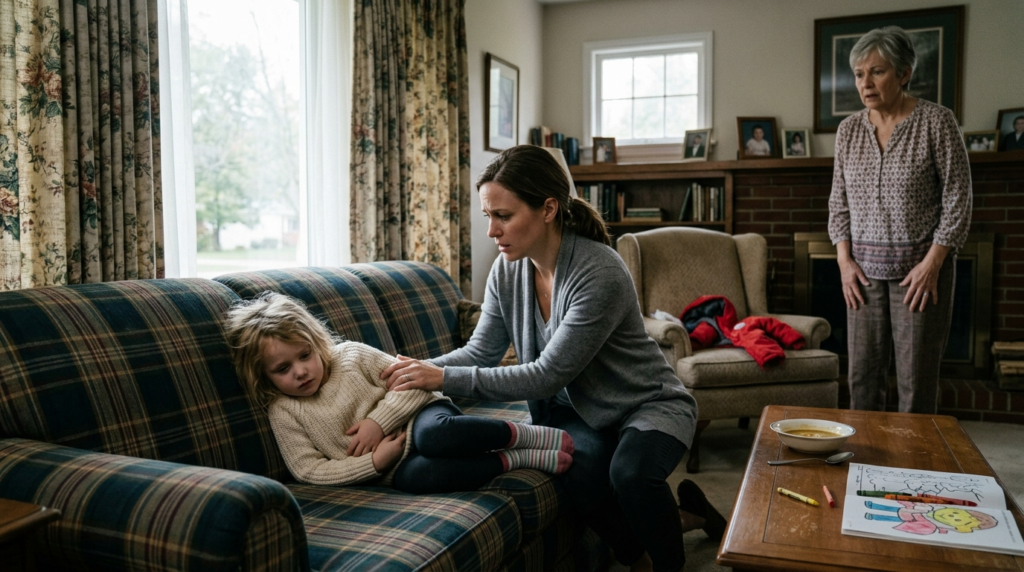
There, curled up on the far end of the stiff plaid sofa, was my little girl.
Lily looked incredibly small, almost swallowed whole by the heavy cushions. Her knees were pulled tightly up to her chin, her little arms wrapped around her legs. Her face was completely devoid of color, a ghostly, chalky white that contrasted terrifyingly with her bright blonde hair. Faint tracks of dried tears stained her cheeks, and her breathing was shallow, rapid, and uneven.
Clara was standing a few feet away from the sofa, her arms tightly crossed over her chest, a mask of pure disapproval hardening her features.
“Thank goodness you’re finally here,” Clara said, let out a heavy, dramatic sigh. “Maybe now you can show her that this little performance isn’t going to grant her a reward. She has been acting like this for hours, completely ignoring my instructions to sit up straight.”
I completely ignored Clara. I dropped my purse onto the floor and rushed over to the sofa, falling to my knees right beside Lily.
“Lily, sweetie, Mommy’s here,” I whispered, my heart breaking into a million pieces as I reached out to touch her arm. “Tell me where it hurts, baby. Look at me.”
Advertisement
Lily slowly turned her head toward me. Her eyes were dull, glassy, and completely unfocused. She didn’t even have the strength to reach out and hold my hand. She just let out a tiny, pathetic whimper that sounded completely hollow.
Clara stepped forward, her sensible loafers clicking sharply against the hardwood floor. She shook her head, a patronizing smile touching the corners of her thin lips.
“Oh, please, Sarah. Don’t indulge her the second you walk through the door,” Clara said, her voice dripping with condescension. “Watch this. She’s completely putting it on for your benefit. Children do this all the time to get pity.”
Before I could even realize what she was doing, Clara leaned over the sofa, reaching her hand out toward Lily.
“Lily, enough of this nonsense. Get up,” Clara said firmly.
To demonstrate her point to me—to prove that Lily was merely pretending to be in pain—Clara extended her fingers and pressed them firmly, deeply, directly into the lower right side of Lily’s tiny abdomen.
The reaction was instantaneous, violent, and completely shattering.
The moment Clara’s hand made contact with that specific spot, Lily’s entire body went completely rigid. Her eyes flew wide open, filled with a sudden, pure, unadulterated agony that no five-year-old child should ever have to experience.
She didn’t just cry. She let out a sharp, blood-curdling gasp—a sound of sheer, primal torture that completely ripped through the quiet house. Her tiny back arched off the sofa, her hands clawing desperately at the air as if she were drowning.
And then, just as quickly as she had gasped, Lily’s head fell back against the cushion, her eyes rolling into the back of her head as her entire body went completely limp, slipping into unconsciousness.
I screamed, a raw, terrifying sound tearing from my own throat as I grabbed Lily’s lifeless shoulders. “Lily! Lily, wake up! Look at Mommy!”
But when I looked up from my daughter’s pale face, I saw Clara Gable.
The older woman was frozen mid-lean, her hand still hovering in the air just inches above Lily’s body. Every single ounce of color had completely drained from Clara’s face, leaving her a ghastly, translucent white. Her jaw was hanging slightly open, her eyes wide with a sudden, paralyzing realization of the catastrophic mistake she had just made.
She stared down at her own hand, then at my unconscious daughter, her entire body beginning to tremble as the true weight of her stubborn ignorance crashed down upon her.
Chapter 2: The Golden Hour
The silence that followed Lily’s collapse was louder than any scream. For a second, the world entirely stopped spinning. The air in Clara’s immaculate living room felt thick, heavy, and impossible to breathe.
I was on my knees, my hands hovering over Lily’s limp, pale body, terrified to touch her, yet desperate to pull her back to reality. Her small chest was rising and falling in short, shallow, erratic hitches. She looked so incredibly fragile, like a porcelain doll dropped onto the stiff cushions of the sofa.
“Lily? Lily, baby, look at Mommy. Please, look at Mommy,” I pleaded, my voice cracking into a raw whisper. I gently patted her cool, damp cheek. Her skin felt entirely different now—clammy, lifeless, and devoid of the warm vitality that usually defined my little girl. There was no response. Her long eyelashes remained still against her ghostly white cheeks.
I spun around to face Clara. The older woman was still standing there, completely paralyzed, her hand still frozen mid-air as if she could somehow undo the physical pressure she had just applied to my daughter’s abdomen. The arrogant, judgmental mask she had worn for hours had completely shattered. Her mouth opened and closed like a fish out of water, but no sound came out.
“What did you do?” I screamed at her, the sheer force of my maternal rage finally breaking the silence. “What did you do to her, Clara?!”
“I… I didn’t,” Clara stammered, her voice trembling violently as she took a small, unsteady step backward. “I just… I was just trying to show you, Sarah. I didn’t press that hard. She was just faking it to get you to come home… children do that… they always do that…”
“Call 911!” I roared, cutting her off completely. I didn’t care about her excuses. I didn’t care about her decades of experience raising children or her rigid, old-school theories on discipline. My daughter was unconscious on her couch. “Call them right now!”
Clara fumbled with her pockets, her fingers shaking so badly that she couldn’t properly grasp her phone. She pulled it out, but it slipped from her grip, clattering loudly against the polished hardwood floor. She dropped to her knees, scrambling for the device like a panicked animal.
Seeing her utter incompetence, I snatched my own phone from my purse on the floor. My fingers were slick with cold sweat, but adrenaline took over. I dialed the three digits that every parent prays they never have to call.
The line rang once. Twice. To me, each ring felt like an entire lifetime passing by.
“911 emergency, what is the address of your emergency?” a calm, measured female voice answered on the other end.
“I need an ambulance at 412 Maple Court,” I gasped out, my voice hitching as I tried to keep my breathing under control. “It’s my five-year-old daughter. She… she was complaining of stomach pain, and then she screamed and passed out. She’s completely unresponsive.”
“Okay, ma’am, take a deep breath. Help is on the way,” the dispatcher said, her voice steady and grounding. “Is she breathing right now?”
“Yes, but it’s very shallow. Her skin is completely white and clammy,” I said, placing my hand gently over Lily’s heart. It was racing, a frantic, rapid tapping against her ribcage that terrified me even more. “Please hurry. Please.”
“The paramedics have been dispatched to your location, ma’am. Stay on the line with me. Do not move her unless absolutely necessary. Can you check if she responds to your voice or a gentle shake?”
“Lily? Lily, sweetie,” I called out, gently shaking her shoulder. Nothing. Her head just lolled slightly to the side. “No, she’s not responding at all. She’s completely out.”
Behind me, Clara had managed to get to her feet. She was clutching her hands together against her chest, pacing back and forth on the expensive Persian rug. “Is she… is she going to be okay? Sarah, you have to believe me, I didn’t mean to hurt her. I was just trying to help. I thought she was just being stubborn.”
I didn’t even look at her. The sheer sight of her face filled me with a level of anger so profound it made my blood run hot. If I looked at her, if I acknowledged her, I felt like I would completely lose my mind. I focused entirely on Lily, tuning out Clara’s frantic, self-serving murmurs.
“Ma’am, I need you to stay calm,” the dispatcher’s voice came through the speaker. “Listen for the sirens. They should be turning onto your street any second now.”
And then, through the heavy silence of the suburban afternoon, I heard it. A faint, distant wail that grew louder and sharper with every passing second. The sirens of the Oakridge Emergency Medical Services. The sound usually brought a sense of anxiety when heard from afar, but right now, it sounded like a literal lifeline.
The high-pitched screech of the tires echoed outside as the massive ambulance pulled directly into Clara’s driveway, its red and blue lights flashing violently against the living room windows, drowning the cold blue-gray afternoon in a chaotic rhythm of color.
The heavy front door burst open, and two paramedics rushed into the house carrying heavy medical bags and a collapsible gurney. The lead paramedic was a tall, burly man named Mark, his face calm but entirely focused. Behind him was a younger paramedic named Dave.
“What do we have here?” Mark asked immediately, dropping to his knees beside me at the sofa, his eyes scanning Lily instantly.
“She’s five. Her name is Lily,” I said rapidly, the words spilling out of my mouth in a desperate torrent. “She complained of a stomach ache this morning. No fever. Then, a few minutes ago, my neighbor pressed on her lower right stomach… Lily screamed in absolute agony and then just went completely limp. She’s been unconscious ever since.”
Mark’s expression shifted instantly. The professional calm remained, but a sharp, intense seriousness settled over his features. He reached out, his large fingers gently checking the pulse on Lily’s neck while Dave began setting up a portable monitor.
“Dave, get a line started and prep her for transport immediately,” Mark commanded quietly. He then turned his attention back to Lily’s abdomen. He gently lifted her small shirt, revealing her tiny belly.
Even under the dim, cold light of the room, I could see it. Her lower right abdomen was distinctly swollen, rigid, and tightly guarded. It didn’t look soft like a child’s stomach should. It looked hard, almost like stone.
Mark touched the area with extreme gentleness, barely applying any pressure at all. Even in her unconscious state, Lily’s face contorted into a brief, painful grimace, a low, subconscious whimper escaping her pale lips.
“Abdomen is extremely rigid, guarding, highly distended,” Mark murmured to Dave, his voice tight. “We’re looking at an acute abdomen. Highly likely a ruptured appendix. She’s showing early signs of septic shock. Her blood pressure is dropping.”
Septic shock. Ruptured appendix.
The words crashed into my chest like physical blows. My little girl. My innocent, beautiful five-year-old girl was in septic shock because I had left her with a woman who thought she was just playing a game for attention.
“We need to move right now,” Dave said, his hands moving with practiced, terrifying speed as he secured an oxygen mask over Lily’s face and slipped a small IV needle into the back of her tiny hand. Lily didn’t even flinch at the needle prick. That was the most terrifying part. She was completely gone to the world.
They lifted her up, her small body looking impossibly light in their arms, and secured her onto the gurney.
“Are you the mom?” Mark asked, looking directly at me.
“Yes, I’m her mother,” I said, my voice shaking.
“Grab your things. You’re riding in the back with us. We need to get her to Oakridge Community Hospital immediately. They have a pediatric trauma team on standby,” he said, already guiding the gurney out the front door.
I grabbed my purse from the floor, my legs feeling like lead as I followed them. As I reached the front door, I caught a glimpse of Clara Gable.
She was standing in the middle of her pristine, perfect living room, looking incredibly old and incredibly small. The heavy, self-righteous authority she had carried for years had completely vanished. She looked like a ghost, her eyes wide with terror, watching the paramedics wheel my child away.
“Sarah…” she whispered, her voice cracking as she reached out a trembling hand toward me. “I… I’ll pray for her.”
I stopped at the threshold. I turned around and looked her dead in the eye. The grief and panic in my soul transformed into a cold, lethal blade of absolute fury.
“If anything happens to my daughter, Clara,” I said, my voice deadly quiet, completely devoid of any emotion. “If she doesn’t wake up… God won’t be able to save you from what I will do to you.”
I didn’t wait for her response. I turned my back on her and ran down the steps, jumping into the rear of the ambulance just as Dave slammed the heavy metal doors shut, locking out the rest of the world.
The ride to the hospital was a blur of noise, flashing lights, and pure, concentrated terror. The ambulance rocked violently as it tore down the suburban streets, the siren wailing a constant, deafening scream above our heads.
Inside the small, sterile cabin, Dave was working frantically. He was adjusting the IV drip, checking the monitors, and calling into the hospital over the radio.
“Oakridge ER, this is Medic 4, we are en route with a five-year-old female, pediatric emergency,” Dave spoke rapidly into the microphone. “Suspected ruptured appendix with onset of sepsis. Patient is unresponsive, GCS of 7. Heart rate is 145, blood pressure is 82 over 40. Skin is cool, pale, and clammy. ETA five minutes.”
I sat on the narrow bench against the wall, clutching Lily’s cold, free hand against my cheek. I was crying silently, the hot tears streaming down my face and dripping onto her knuckles.
“I’m so sorry, baby,” I whispered over and over again, the words a repetitive, desperate mantra in my mind. “I’m so sorry I left you. I’m so sorry I didn’t listen to you this morning. Mommy is right here. Please don’t leave me. Please hold on.”
I looked at the monitor. The green lines were jagged, jumping frantically. The heart rate was way too high for a sleeping child. Her little body was fighting a massive, invisible war inside her, a war against poison that was spreading through her abdomen.
Every single second of that five-minute drive felt like an hour. I watched the paramedic check her pupils, adjust her oxygen, and monitor the IV line. He was entirely professional, but I could see the subtle tension in his jaw. He knew how dangerous this was. He knew that with a ruptured appendix, time was the ultimate enemy. The “golden hour”—the critical window of time to prevent irreversible damage or death—was rapidly closing.
Suddenly, the ambulance swerved sharply to the left, the siren cutting out as the vehicle slowed down. We had arrived.
The doors flew open, exposing the harsh, bright gray afternoon air of the hospital’s emergency bay. A team of medical professionals in blue scrubs was already waiting outside, their faces grim and determined.
“Let’s move, let’s move!” a sharp voice commanded.
The gurney was pulled out of the ambulance in one fluid motion, the wheels hitting the concrete with a loud thud. I jumped out behind them, trying to keep up as they sprinted through the automatic sliding glass doors of the emergency room.
The smell of antiseptic and bleach hit my nose instantly. The bright, buzzing fluorescent lights overhead blurred together as we moved down the hallway at a breakneck pace.
“Five-year-old female, suspected rupture, septic,” Mark shouted to the receiving team as they pushed the gurney into a large trauma bay filled with advanced medical equipment.
Instantly, a dozen hands were on Lily. They cut away her favorite little shirt, attached sensors to her chest, and began setting up a secondary IV line. A middle-aged woman with sharp, intelligent eyes and a calm demeanor stepped up to the bedside. This was Dr. Evans, the attending pediatric emergency physician.
“Lily, can you hear me?” Dr. Evans asked, checking her reflexes. She quickly examined Lily’s abdomen, her fingers palpating the right lower quadrant.
Even in her deep state of unconsciousness, Lily gasped, her small body tensing in a defensive reflex.
“We need a portable ultrasound right now!” Dr. Evans shouted to a nurse. “Call surgery. Tell Dr. Vance we have a pediatric acute appendix, looks like a complete rupture with significant free fluid in the peritoneal cavity. Get the OR ready.”
A nurse gently but firmly grabbed my upper arms, stepping between me and the bed. “Mom, I need you to step back. Let them work. Step back into the hallway, please.”
“No, please! I need to stay with her!” I cried out, trying to push past her. “She’s only five! She’s terrified!”
“She can’t feel anything right now, mom, but we need space to save her life,” the nurse said, her voice filled with a firm, unyielding compassion. “Please, step outside. I will come get you the second we have an update.”
Slowly, inevitably, I was pushed backward out of the trauma bay. The heavy, soundproof double doors swung shut in my face, cutting off my view of my little girl.
I was left standing entirely alone in the long, sterile, gray hallway of the hospital waiting room. The silence of the corridor was a sharp contrast to the chaos inside. The fluorescent lights overhead hummed a low, monotonous tone that vibrated through my skull.
I looked down at my hands. They were trembling. On my right palm, there was a small, smudged print of dirt from Lily’s shoes when I had held her in the ambulance.
I walked over to a row of vinyl chairs, my knees completely giving out. I collapsed into one of them, burying my face in my hands. The heavy, suffocating weight of guilt settled over me, pressing down on my chest until I could barely breathe.
Why didn’t I just stay home? The question repeated in my head like a cruel, mocking chant. Why did I care so much about that stupid job? Why did I listen to Clara?
I had seen the signs. I had seen her sitting quietly at the kitchen table. I had heard her say her tummy felt funny. But I had let myself be convinced by a digital thermometer and the fear of a corporate supervisor. I had handed my most precious possession over to a bitter, arrogant neighbor who treated a medical emergency like a behavioral problem.
Hours passed. Or maybe it was only minutes. Time lost all meaning in that waiting room. Every time the double doors swung open, my heart leaped into my throat, hoping against hope that a doctor would walk out with good news. But each time, it was just another nurse, another orderly, another stranger walking past me without a glance.
The afternoon bled into the early evening. The gray light outside the large windows faded into a dark, oppressive blackness.
Suddenly, the main entrance doors to the waiting room slid open. I raised my head, expecting to see a relative or a friend.
Instead, walking through the doors, clutching her designer leather purse tightly against her winter coat, was Clara Gable.
She looked entirely disheveled. Her usually perfect hair was messy from the wind outside, and her face was completely pale, her eyes rimmed with red. She looked around the waiting room until her gaze landed directly on me.
She took a hesitant, slow step forward, her sensible shoes clicking quietly against the linoleum floor. She looked like a woman walking toward her own execution.
As she drew closer, the pure, unadulterated rage that had been simmering beneath my grief instantly boiled over. I stood up from my chair, my hands curling into tight fists at my sides, watching her approach.
She stopped a few feet away from me, her bottom lip trembling. “Sarah… I… I couldn’t stay home. I had to know. How is she? Is Lily… is she in surgery?”
I stared at her, my breathing growing heavy and loud in the quiet waiting room. “You have a lot of nerve showing your face here, Clara.”
“Sarah, please,” she whispered, a tear finally escaping her eye and rolling down her wrinkled cheek. “I am so, so sorry. I truly thought she was just acting out. You know how children can be when their parents leave… my own son used to pretend to be sick all the time to avoid school… I thought I was doing the right thing. I thought I was helping you stay at work.”
“Helping me?” I hissed, stepping closer to her, forcing her to look directly into my eyes. “My five-year-old daughter is in that room fighting for her life because you wanted to prove a point. You thought you knew better than her own mother. You thought you knew better than a child who was screaming in pain!”
“I didn’t know it was her appendix!” Clara cried out softly, looking around anxiously as a few other people in the waiting room turned to look at us. “I didn’t know! If I had known, I would have called an ambulance immediately!”
“You didn’t know because you didn’t care to look!” I shouted, completely past the point of caring about making a scene. “You were so desperate to be right, so desperate to show me that I spoiled her, that you ignored a dying child for four hours! You let her lie on your floor in agony, Clara! Four hours!”
“I am an old woman, Sarah! I made a mistake!” Clara sobbed, covering her face with her hands.
“A mistake is ruining a batch of cookies, Clara,” I said, my voice dropping to a terrifying, icy whisper that cut through her sobs. “This is criminal negligence. If my daughter dies in that operating room, I am going to make sure the police lock you away for the rest of your miserable life.”
Clara fell silent, her body shaking as she stared at me in horror, realizing that there was absolutely no forgiveness to be found in my heart.
Before she could say another word, the heavy double doors of the pediatric trauma wing swung open with a loud click.
A tall man in green surgical scrubs, a paper cap covering his hair, walked out into the waiting room. His face was deeply lined with exhaustion, and his expression was completely unreadable. He held a medical chart in his hands.
“Is there a family for Lily Davis?” he called out.
I completely forgot about Clara. I turned away from her and ran toward the doctor, my heart slamming against my ribs like a trapped bird.
“I’m her mother,” I gasped out, grabbing his arm. “Doctor, please. How is she? Is she okay?”
The doctor looked down at me, a heavy, somber sigh escaping his lips as he closed the medical chart.
“Mrs. Davis, I’m Dr. Vance, the chief pediatric surgeon,” he said, his voice entirely grave. “We need to talk. Your daughter’s situation is extremely critical.”
Chapter 3: The Price of Ignorance
Dr. Vance’s words hung in the sterile air of the waiting room like a suffocating fog. The ambient hum of the fluorescent lights suddenly sounded deafening, ringing in my ears until I could barely hear my own frantic heartbeat. I stared at him, my hands still gripping the rough fabric of his green surgical scrubs, desperately searching his face for any shred of reassurance.
There was none. His eyes were heavy, shaded by dark circles of profound exhaustion, and his mouth was set in a tight, grim line. He didn’t look away from me, which somehow made the terror inside my chest grow even more violent. When a doctor looks you directly in the eye with that specific brand of solemn pity, you know your world is hovering on the edge of a precipice.
“What do you mean, critical?” I breathed out, the words scraping against my raw throat. “She’s just a little girl. She was fine yesterday. She was laughing yesterday.”
Dr. Vance took a deep, steadying breath and gently placed a hand over mine, easing my frantic grip off his scrubs. He guided me back toward the row of vinyl chairs, but my legs felt entirely hollow, like brittle glass ready to shatter under the slightest weight. I collapsed into the seat, and he knelt down in front of me, bringing himself to my eye level.
Behind us, Clara Gable stood like a frozen statue. She had ceased her sobbing, her hands still clutched tightly over her mouth, her wide, bloodshot eyes fixed entirely on the surgeon. She was listening to every single syllable, her entire body trembling under the weight of an impending verdict.
“Mrs. Davis, I need you to listen to me very carefully,” Dr. Vance began, his voice calm, measured, and entirely direct. “Lily’s appendix did not just rupture. A standard appendiceal rupture is already a severe medical emergency, but it is a condition we handle regularly. What we are dealing with here is a catastrophic escalation.”
He paused, glancing down at the medical chart in his hands before looking back up at me.
“The ultrasound and the initial blood work show that her appendix burst several hours ago. Based on the progression, the toxins had already begun leaking into her peritoneal cavity while she was still at your neighbor’s house. But the real crisis occurred when physical, external pressure was directly applied to her lower right abdomen.”
I felt a cold, physical wave of nausea surge up from my stomach. I turned my head slightly, throwing a lethal, venomous glare at Clara. Clara flinched, taking a small, unsteady step backward, her face draining of what little color she had left.
“When that deep pressure was applied,” Dr. Vance continued, his tone hardening just a fraction as he spoke, “it acted like a mechanical pump. The forced compression caused the localized infection to violently burst outward, scattering highly toxic, bacteria-laden fluid across her entire abdominal cavity. It forced the poison directly into her bloodstream at an accelerated rate.”
“Oh my God,” I whispered, burying my face in my shaking hands. The image of Clara’s hand pressing into Lily’s stomach flashed through my mind, followed by the memory of my daughter’s blood-curdling scream. It hadn’t just been a scream of pain; it had been the sound of her body being flooded with lethal toxins.
“Because of that rapid spread, Lily has gone into severe septic shock,” Dr. Vance explained, his voice stripping away any remaining hope of an easy fix. “Her blood pressure is dangerously low, hovering at a level that is completely unsustainable for a five-year-old child. Her heart is beating at nearly one hundred and fifty beats per minute just to keep her vital organs perfused. Her body is entirely overwhelmed by the infection.”
“Can you fix it?” I cried, grabbing his arm again, my fingers digging into his skin. “You’re the chief surgeon. Please, tell me you can fix it. Just take her into surgery and clean it out. Please.”
“We are taking her into surgery right now. The team is prepping the operating room as we speak,” Dr. Vance said, his voice dropping an octave. “But I need to be entirely honest with you about the risks, Mrs. Davis. Operating on a patient in active septic shock is incredibly dangerous. The anesthesia alone places an immense, life-threatening strain on a cardiovascular system that is already failing. Her blood pressure could drop even further the moment she is put under.”
He reached into the folder on his clipboard and pulled out a thick packet of white papers, handing me a sterile silver pen.
“I need your legal consent to perform this emergency laparotomy. We need to go in, wash out the contamination from her entire abdomen, place drainage tubes, and pump her with maximum doses of intravenous antibiotics and vasopressors to keep her blood pressure up. But you need to understand… there is a very real, very high probability that Lily’s heart may not survive the strain of the procedure.”
The words felt like a physical blow to my skull. May not survive the strain.
I looked down at the paperwork. The text blurred together into a dizzying sea of legal terminology, warnings of mortality, and medical jargon. My hand shook so violently that the pen rattled against the clipboard. I was being asked to sign a paper that acknowledged my five-year-old daughter might die on a cold steel table within the hour.
“Sign it, Sarah,” a shaky, cracked voice whispered from behind me.
I looked up. Clara had moved closer, her eyes staring at the paperwork with a look of unadulterated horror. “Please, Sarah, sign it. Let them save her. Oh sweet Jesus, let them save her.”
“Shut up!” I snapped at her, my voice a jagged weapon of pure malice. “Don’t you dare speak to me. Don’t you dare look at this paperwork. This is your doing, Clara. Your stubborn, arrogant pride put my daughter’s life on this piece of paper.”
I turned back to Dr. Vance. I bit my lower lip so hard I tasted the metallic tang of blood, forcing my hand to steady itself just enough to scribble my signature at the bottom of the form. I handed the clipboard back to him, my soul feeling entirely hollowed out.
“We will do everything humanly possible, Mrs. Davis. I promise you,” Dr. Vance said, his expression softening with a brief flash of genuine empathy. He took the clipboard, turned on his heel, and strode rapidly through the double doors, the heavy access panels clicking shut behind him with a finality that felt like a prison door locking.
The moment he was gone, the waiting room fell into a terrifying, heavy silence. I sat there, my eyes staring blankly at the polished linoleum floor, watching the dim reflection of the emergency exit sign.
Clara took a hesitant step toward the chair next to me. “Sarah, please let me sit with you. We need to pray. We need to—”
“If you sit within five feet of me, Clara, I will entirely lose control of myself,” I said, my voice completely flat, dead, and utterly devoid of inflection. I didn’t even look up at her. “Go sit on the other side of the room. Better yet, leave. Go back to your perfect house and your perfect garden, and leave me alone.”
“I can’t leave,” Clara wept, clutching her designer purse to her chest like a shield. “I can’t go back to that house knowing what’s happening here. I have to stay. I have to know.”
She slunk away, her posture completely broken, and seated herself in the furthest corner of the waiting area, burying her face in her hands as her shoulders shook with quiet, pathetic sobs. I felt absolutely no pity for her. Every tear she shed was a tear of self-pity, a tear shed because her illusion of flawless, old-school wisdom had been utterly shattered by the brutal reality of her criminal negligence.
Before the silence could settle back over us, the heavy main entrance doors of the emergency department slid open with a loud hiss.
Two men in dark blue uniforms stepped into the waiting area. They were police officers from the Oakridge Police Department. The older officer, a man with a thick mustache and a serious demeanor, scanned the room before his eyes locked onto us. He carried a small leather notebook in his left hand.
The hospital had called them. In cases involving severe pediatric trauma resulting from a significant delay in care or potential physical trauma, the medical staff was legally mandated to report the incident to law enforcement.
The older officer walked directly over to me. “Are you Sarah Davis?”
“Yes,” I said, standing up, my voice trembling slightly. “I’m Lily’s mother.”
“I’m Officer Miller, and this is Officer Reynolds,” the man said, his voice respectful but entirely professional. “The hospital administration contacted our precinct regarding the admission of your daughter, Lily. We need to understand exactly what transpired today that led to her current medical state. The trauma team indicated there was a severe delay in seeking medical attention, and an incident involving physical aggravation of her symptoms.”
I didn’t hesitate for a single second. I pointed my finger directly across the room at Clara Gable, who had raised her pale face from her hands, her eyes widening with a new, distinct brand of terror.
“You need to speak to her,” I said, the words coming out cold and sharp. “That is Clara Gable. She is my neighbor. I left my daughter in her care at eight o’clock this morning. Lily told me her stomach hurt before I left, but she had no fever. I had to go to work. By noon, Lily was in agony, lying on the floor, crying for help. Clara ignored her. She told me Lily was faking it. She called me at work, accusing my five-year-old daughter of being manipulative and attention-seeking.”
Officer Miller nodded slowly, his eyes shifting over to Clara, writing down every word in his notebook.
“And then what happened, Mrs. Davis?”
“I rushed home,” I said, my voice cracking as the emotion threatened to overwhelm me again. “When I got there, Lily was white as a ghost, barely breathing on the sofa. Clara wanted to prove a point to me. She wanted to show me that Lily was just pretending to be sick to get attention. So, she took her hand and she pressed it deeply, forcefully, directly into Lily’s lower right stomach. Lily let out a scream that I will never forget for the rest of my life, and then she blacked out. She hasn’t opened her eyes since.”
Officer Miller’s expression hardened. He closed his notebook with a sharp snap and turned toward his partner. “Reynolds, stay with Mrs. Davis. Get a formal, written timeline from her.”
He then turned his full attention toward Clara, his heavy boots clicking loudly against the floor as he walked across the room. Clara looked like she wanted to shrink into the very fabric of the vinyl chair.
“Ma’am, I need you to stand up and step outside into the hallway with me,” Officer Miller commanded, his voice echoing authoritatively through the waiting room.
“Officer, please, it was an accident!” Clara stammered, her voice pitching high with panic as she stood up, her hands shaking uncontrollably. “I am a respected member of this community! I’ve lived here for twenty-five years! I raised three beautiful children! I would never hurt a child!”
“Step outside, ma’am,” Officer Miller repeated, his tone leaving absolutely no room for negotiation or argument. He placed a firm hand on her elbow, guiding her toward the heavy exit doors.
As Clara was led out, she looked back over her shoulder at me, a desperate, pleading look in her eyes. But I just stared back at her with a cold, dead gaze. Her respectability, her twenty-five years in the neighborhood, her flawless reputation—none of it mattered anymore. The law was finally catching up to her arrogance.
Officer Reynolds sat down in the chair next to me, pulling out his own notepad. “I know this is incredibly difficult, Mrs. Davis, but I need you to walk me through the entire day, minute by minute. We need a complete record for the investigation.”
For the next forty-five minutes, I forced myself to relive the worst day of my life. I recounted the morning conversation at the kitchen table, the quiet look in Lily’s eyes, the phone call from Clara, the twenty-minute drive home filled with suffocating panic, and the horrific moment of the physical assault on the sofa. I gave him every detail, every word, every memory, carving the truth into the official record.
By the time we finished, the clock on the waiting room wall read 6:30 PM. The hospital was settling into its nighttime routine. The bright, chaotic energy of the daytime emergency room had shifted into a quiet, tense stillness.
Officer Reynolds thanked me, gave me his card, and stepped outside to join his partner. I was left alone again.
The waiting room became a personal purgatory. Every minute felt like an agonizing hour. I paced the floor, my eyes constantly darting to the red digital clock on the wall. 6:45 PM. 7:02 PM. 7:18 PM.
With every tick of the clock, I knew my daughter was lying on a table down the hall, her stomach cut open, a team of strangers fighting to scrub a lethal poison out of her tiny body. I imagined her small heart, beating frantically against the heavy weight of the anesthesia, trying desperately to survive the toxic storm in her blood.
The guilt came back, heavier and more vicious than before. It wrapped around my throat like a physical hand, choking the air out of my lungs.
I should have stayed home. The thought was a relentless hammer in my brain. I should have let them fire me. What is a stupid corporate logistics job compared to my daughter’s life? I knew she wasn’t feeling well. I felt it in my gut. But I let myself be talked out of it. I trusted an old woman because she had a big house and a clean garden.
I walked over to the large window at the end of the hallway, pressing my forehead against the cold glass. Outside, the night was pitch black, a steady, miserable rain beginning to fall, streaking down the glass like endless tears. The world outside was moving on. Cars were driving past on the distant highway, people were going home to their families, eating dinner, watching television, completely unaware that a mile away, a five-year-old girl was hovering between life and death.
“Please, God,” I whispered into the dark reflection of the glass, my breath fogging the window. “Take me instead. If someone has to pay for this, take me. Don’t punish her for my stupidity. Don’t let her pay the price for Clara’s arrogance. She’s only five. She hasn’t even seen the world yet. Please, just let her wake up.”
Suddenly, the heavy double doors at the end of the hallway clicked loudly.
I spun around, my heart stopping entirely.
A nurse in green scrubs walked out, her face pale, looking around the room frantically. She wasn’t holding a chart. She looked rushed, her breathing heavy as if she had just been running down the corridor.
“Is the mother for Lily Davis here?” she called out, her voice tight with an undeniable sense of panic.
I sprinted toward her, my boots skidding slightly on the polished floor. “Yes! Yes, I’m here! What’s happening? Is she out of surgery?”
The nurse didn’t answer my question. She grabbed my arm, her grip incredibly tight, and began pulling me toward the secure double doors.
“You need to come with me right now, Mrs. Davis,” she said, her voice shaking as she swiped her security badge against the wall scanner. “Lily’s heart just stopped on the table. They are performing CPR right now. Dr. Vance needs you in the room.”
Chapter 4: The Fight for Breath
The heavy double doors flew open with a violent crash, and the sterile world of the hospital operating wing swallowed me whole.
The nurse’s hand was a vice grip on my forearm, pulling me down a brightly lit corridor that smelled of ozone, burning flesh, and cold stainless steel. The fluorescent lights overhead blurred into a single, blinding streak of white.
“Stay behind the yellow line, Mom,” the nurse shouted over her shoulder, her voice cracking with an urgency that turned my blood to absolute ice. “Do not step past the line, no matter what.”
We burst into Operating Room 3. The scene inside was a nightmare rendered in hyper-definition, a chaotic symphony of panic and precision that tore the last remaining shreds of my sanity away.
A dozen medical professionals were crowded around the center table, their bodies moving in a frantic, desperate rhythm. Above them, the massive circular surgical lamps cast a harsh, unforgiving glare on my five-year-old daughter.
Lily looked impossibly small on that massive steel table. She was completely naked, covered only by sterile blue drapes that were pulled back to expose her chest and abdomen. Her skin wasn’t just pale anymore—it was a mottled, bluish-purple, the terrifying hue of a body starved of oxygen and oxygenated blood.
And then, I heard it. The sound that will haunt my dreams until the day I die.
A single, continuous, high-pitched electronic whine. A flatline.
“Charging to fifty!” a technician shouted, his fingers flying across the controls of a crash cart. “Clear!”
“Clear!” the room echoed.
Everyone stepped back for a fraction of a second. I watched Lily’s tiny body jolt off the mattress as the electrical current ripped through her chest. Her back arched, her small arms flying outward in a horrific, artificial reflex.
The monitor beeped once, a cruel tease, before returning to that flat, unyielding whine.
“No response,” a nurse yelled. “Resuming compressions.”
Dr. Vance, the chief surgeon, was standing on a metal step stool beside the table. His surgical gown was splattered with dark red blood and clear fluid. Sweat was pouring down his face, soaking through his paper cap and dripping onto his mask.
He leaned over my daughter, placed the heel of his hand directly over her tiny breastbone, and began pushing down.
One. Two. Three. Four. Five.
The rhythmic, sickening thud of her ribs compressing echoed through the room. It was a brutal, physical assault disguised as a life-saving measure. Every time he pushed down, Lily’s head lolled lifelessly to the side, her blonde hair matted with sweat and hospital fluids.
“Come on, Lily,” Dr. Vance muttered through his teeth, his voice strained with immense physical effort. “Don’t you dare do this. Stay with me, kiddo. One. Two. Three. Four…”
“Lily!” I screamed, the sound tearing from my chest like a physical rupture. I tried to lunged forward, to cross that yellow line, to grab her cold feet, to pull her into my arms and force my own life into her body.
The nurse caught me around the waist, throwing her entire body weight against me to hold me back. “Mom, no! You have to let them work! If you cross that line, they have to stop! Let them save her!”
“She’s five!” I sobbed, my knees buckled completely, leaving me hanging in the nurse’s arms, my boots dragging against the slick linoleum. “She’s only five years old! Please, God, don’t take her! Take me! Take me!”
“Push another milligram of epi down the central line!” Dr. Vance roared, his compressions never slowing down, his shoulders rising and falling in a terrifying cadence. “Get another unit of whole blood ready! We are losing her volume!”
A nurse snatched a syringe, plunging it into the IV manifold near Lily’s neck. The clear liquid disappeared into her bloodstream, a chemical lightning bolt meant to shock her stagnant heart back into motion.
“Charging again! Seventy-five!” the technician yelled. “Clear!”
Dr. Vance stepped back, raising his bloody gloved hands into the air. “Clear.”
Thump.
Another violent jolt. Another horrific, unnatural leap of her tiny frame.
The room held its collective breath. For two seconds, the only sound was the heavy, ragged breathing of the surgical team.
The flatline tone continued. A straight, green line mocked us from the screen.
“Nothing,” the technician whispered, his voice dropping into a hollow, defeated register. “We’ve been down for four minutes, Doctor.”
Four minutes. Four minutes without a heartbeat. Four minutes of her brain being starved of life.
“I don’t care!” Dr. Vance screamed, his voice breaking with a raw, human fury that shattered the professional facade of the operating room. He jumped back onto the step stool, his hands locking back into position over her chest. “We don’t give up on a five-year-old! Not today! Get the internal paddles ready if we have to crack the chest!”
One. Two. Three. Four.
I couldn’t breathe. The air in the room felt toxic, thick with the smell of chemicals and mortality. I watched my daughter’s face. She looked so peaceful, as if she were just taking a nap after a long day of playing in the backyard. But the blue tint around her lips told the real, devastating story.
This was the price of Clara Gable’s pride. This was the cost of a stubborn old woman’s desire to prove a point. My daughter was dying on a steel table because a neighbor couldn’t look past her own arrogant assumptions.
“Doctor, her pressure is completely bottomed out,” the anesthesiologist called out, his voice tight with panic. “If we don’t get a rhythm in the next sixty seconds, her organs are going to start shutting down permanently.”
“I know the clock!” Dr. Vance roared, sweat stinging his eyes. He didn’t slow down. He kept pushing, his arms shaking with fatigue, his chest heaving. “Come on, Lily. Fight. Your mommy is right there. Fight for her.”
I fell to my hands and knees on the cold floor, the yellow line just inches from my fingers. I couldn’t look at the monitors anymore. I closed my eyes, burying my face against the hard tile, and prayed with a desperate, frantic intensity that I had never felt in my entire life.
Please, please, please. Just give her back to me. I’ll do anything. Take my sight, take my legs, take my life. Just let her heart beat. Let her breathe.
“Wait,” a voice whispered.
I snapped my eyes open.
Dr. Vance had stopped compressing. He was leaning forward, his ear close to Lily’s chest, his fingers pressed deeply into the pulse point on her groin.
The flatline tone had stopped. The room was completely silent except for a faint, erratic sound from the speaker.
Beep.
A jagged, ugly mountain formed on the green line of the monitor.
Then, a long pause. Three seconds. Four seconds.
Beep.
Another mountain.
“We have a rhythm!” the technician yelled, his voice cracking with pure emotion. “Sinus tach, it’s irregular, but it’s a rhythm! Heart rate is sixty… seventy… eighty…”
“Get the blood in her now!” Dr. Vance commanded, dropping off the step stool, his legs nearly giving out beneath him. He looked across the room, his eyes finding mine through the sea of blue scrubs. “We got her back, Sarah. We got her back. But we need to finish this surgery right now before she slips away again. Get the mom out of here. Now.”
The nurse didn’t have to pull me this time. I stumbled backward out of the operating room, my body shaking so violently I could barely orient myself. The heavy double doors shut behind me, blocking out the sudden rush of medical activity as they scrambled to stitch her up and stabilize her fragile state.
Advertisement
I collapsed against the corridor wall, sliding down to the floor. I buried my face in my knees and wept, the deep, ugly, rib-shattering sobs of a mother who had just watched her child walk back from the edge of the grave.
The next forty-eight hours were a blur of absolute, exhausting agony.
Lily was transferred to the Pediatric Intensive Care Unit (PICU) at midnight. She was alive, but she was entirely dependent on technology to stay that way.
The PICU room was small, dark, and filled with a terrifying array of machinery. A massive ventilator sat at the head of her bed, its mechanical piston rising and falling with a rhythmic, heavy whoosh-click, whoosh-click that forced air into her damaged lungs. A dozen plastic tubes snaked out from beneath her covers, connected to IV pumps that beeped constantly, delivering a continuous stream of powerful antibiotics, pain medications, and vasopressors to keep her blood pressure from collapsing.
Two drainage tubes protruded from her heavily bandaged abdomen, slowly collecting the dark, cloudy fluid that Dr. Vance had spent hours washing out of her peritoneal cavity.
I never left her side. I refused to move from the uncomfortable vinyl armchair pressed against the right side of her bed. I held her left hand—the only part of her body that wasn’t covered in wires or tape. Her skin was still cool and clammy, her fingers completely limp in mine.
The nurses tried to get me to eat. They brought me styrofoam cups of lukewarm coffee and wrapped sandwiches from the cafeteria, but the food tasted like ash in my mouth. I couldn’t sleep. Every time I closed my eyes, I heard that flatline tone, or I saw Clara Gable’s hand pressing into Lily’s stomach.
On Thursday morning, the heavy wooden door to the PICU room opened with a soft click.
I raised my head, my eyes bloodshot and heavy with exhaustion. I expected it to be Dr. Vance or one of the floor nurses coming to check her vitals.
Instead, Officer Miller walked into the room. He wasn’t wearing his heavy duty belt or his winter jacket; he just wore his crisp blue uniform shirt, his hat held respectfully in his left hand. His face was solemn, but there was a quiet, resolved look in his eyes.
“Mrs. Davis,” he spoke softly, glancing at Lily’s sleeping form before walking over to the side of my chair. “I apologize for disturbing you. The nursing station told me it was alright to step in for a brief moment.”
“It’s okay, Officer,” I whispered, my voice raspy and dry. “Is there… is there news?”
Officer Miller nodded, pulling a small chair over and sitting down beside me. “I wanted to give you a formal update on the investigation. I know your priority is your daughter, but I thought you deserved to know what’s happening outside these walls.”
He took a deep breath, looking down at his hat before continuing.
“We processed Clara Gable at the precinct downtown late last night. After we escorted her out of the waiting room, we executed a search warrant on her residence to establish a timeline, and we conducted interviews with several neighbors, as well as her own adult children who live out of state.”
I tightened my grip on Lily’s cold hand. “What did you find?”
“A pattern,” Officer Miller said, his voice hardening. “It turns out this isn’t the first time Mrs. Gable has exhibited this kind of extreme, dangerous negligence. We contacted her oldest son in Ohio. He informed our detectives that when he was twelve years old, he suffered a broken wrist from a fall. Clara refused to take him to the doctor for three days, claiming he was just trying to get out of doing his household chores. It wasn’t until his school principal noticed the severe swelling and called Child Protective Services that he received treatment.”
A cold shudder ran down my spine. “She’s a monster.”
“She’s a deeply stubborn, controlling woman who values her own authority over the safety of anyone else,” Miller corrected gently. “But she won’t be exerting that authority ever again. Based on your formal statement, the medical reports provided by Dr. Vance, and the recorded delay in care, the District Attorney has officially filed charges against Clara Gable.”
He paused, ensuring I understood the gravity of his words.
“She has been arraigned on felony counts of Aggravated Assault, Reckless Endangerment of a Child, and Criminal Negligence resulting in Grievous Bodily Harm. Because of the severity of Lily’s injuries and the fact that her heart stopped on the table, the judge denied bail. Clara is currently sitting in a cell at the county jail, awaiting trial.”
I looked over at Lily, watching the mechanical ventilator pump air into her chest. Whoosh-click. Whoosh-click.
“Good,” I whispered, a cold, hard satisfaction settling deep into my chest. “Let her rot there.”
“The community has completely turned on her, Sarah,” Miller added softly. “The local news picked up the story this morning. People are outraged. There are reporters outside her house right now. Her pristine reputation is completely gone. She will never step foot back into that neighborhood without a police escort.”
“She doesn’t matter anymore,” I said, turning my eyes back to my daughter’s pale face. “Clara Gable can spend the rest of her life behind bars, and it won’t undo what she did to my baby. It won’t make Lily open her eyes.”
Officer Miller stood up, placing a comforting hand on my shoulder. “She’s a fighter, Mrs. Davis. The whole department is rooting for her. If you need anything at all, my card is at the nursing station. Don’t hesitate to call.”
“Thank you, Officer,” I murmured.
He walked out of the room, leaving me alone once again with the rhythmic sounds of life support.
By Friday afternoon, the atmosphere in the PICU room began to shift.
Dr. Vance came in during his grand rounds, accompanied by a team of residents. He spent a long time studying Lily’s charts, checking the drainage bags, and examining her pupils. For the first time in three days, the grim line of his mouth relaxed into a faint, genuine smile.
“Her white blood cell count is finally dropping, Sarah,” he said, turning to look at me. “The antibiotics are doing their job. The infection in her bloodstream is clearing up, and her blood pressure has been stable for twelve hours without the assistance of the vasopressors.”
Advertisement
I felt a sudden, massive weight lift off my chest, allowing me to take a full, deep breath for the first time in days. “Does that mean… can you take the tube out?”
“We’re going to try to wean her off the ventilator this afternoon,” Dr. Vance said, nodding to a respiratory therapist who had just entered the room with a tray of instruments. “Her lungs are strong enough to do the work now. Let’s see how she does on her own.”
I stood up from my chair, my heart racing with anticipation as the respiratory therapist began the delicate process of suctioning Lily’s throat and deflating the small balloon that held the breathing tube in place.
“Okay, Lily, sweetie,” the therapist said gently, leaning over her. “I’m going to take this big tube out now. I want you to cough for me when I pull, okay? Big cough.”
With a swift, practiced motion, the therapist pulled the long plastic tube from Lily’s airway.
Lily’s eyes flew open, her face contorting as she let out a harsh, raspy cough. She gasped for air, her chest heaving violently for a second before settling into a natural, independent rhythm. The therapist quickly placed a soft oxygen cannula beneath her nose, delivering a gentle stream of fresh air.
Lily lay there, her head rolling slowly against the pillow. Her eyes were glassy, blinking rapidly against the soft light of the room. She looked around, confused, terrified, her tiny brow furrowing as she saw the wires and tubes connected to her body.
Then, her eyes landed on me.
The glassiness faded, replaced by a sudden, profound look of recognition and relief. Her lower lip began to tremble, and a single tear slipped down her pale cheek.
“Mommy…” she whispered.
The voice was incredibly faint, dry as sandpaper, and barely audible over the hum of the monitors. But to me, it was the most beautiful, magnificent sound in the entire universe. It was a symphony, a declaration of life, a miracle delivered on a scrap of breath.
I rushed to the side of the bed, dropping to my knees and burying my face in the mattress beside her shoulder. I grabbed her small hand, kissing her knuckles over and over again as the tears flowed freely down my face.
“I’m here, baby! Mommy’s right here!” I sobbed, my voice cracking with pure joy. “You’re okay, Lily. You’re safe now. The bad thing is over.”
Lily moved her small fingers, weakly curling them around my thumb. “My tummy… doesn’t hurt anymore, Mommy.”
“I know, sweetie. I know. The doctors fixed it,” I said, reaching up to gently smooth her blonde hair away from her damp forehead. Her skin felt normal now—warm, alive, and filled with the beautiful vitality that belonged to a five-year-old girl.
Dr. Vance stepped up to the other side of the bed, checking her pulse one last time. He looked down at Lily, his eyes warm. “You are an incredibly brave little girl, Lily Davis. You fought a very big battle, and you won.”
He looked across the bed at me, nodding filled with profound respect. “She’s going to make a full recovery, Sarah. It’ll be a long road—a few weeks in the hospital for physical therapy and monitoring—but she’s going to be completely fine. No permanent damage.”
“Thank you, Doctor,” I wept, gripping his hand. “Thank you for not giving up on her.”
“It was a team effort,” he said softly, smiling. “Get some rest, Mom. You’ve earned it.”
Six months later.
The crisp autumn air of Oakridge had returned, the leaves turning the same vibrant shades of orange and gold that they had on that horrific Tuesday in October. But the neighborhood felt entirely different now. It felt lighter, cleaner, as if a dark, oppressive shadow had been permanently lifted from our street.
The white colonial house next door stood entirely empty. A large, rusted “FORECLOSURE” sign was hammered into the pristine front lawn where Clara Gable used to spend hours manicuring her roses.
Clara never returned to Oakridge. Three weeks prior, she had accepted a plea deal offered by the District Attorney’s office to avoid a lengthy, highly publicized trial. She pleaded guilty to felony Child Endangerment and Criminal Negligence.
The judge, a no-nonsense woman who had no tolerance for the abuse or neglect of children, sentenced Clara Gable to seven years in a maximum-security state penitentiary, with absolutely no possibility of parole for the first four years. At sixty years old, Clara would spend the twilight of her life sitting in a concrete cell, surrounded by the very elements of society she had spent decades looking down upon with such immense disdain.
She lost her house, her life savings to legal fees, her reputation, and her family. Her adult children never showed up to her sentencing hearing. They left her to face the consequences of her pride entirely alone.
I stood on my front porch, a warm cup of coffee held between my hands, watching the afternoon sun filter through the trees.
Down on the sidewalk, the sound of bright, chaotic laughter echoed through the quiet street.
Lily was running down the pavement, chasing our golden retriever with an unbridled, explosive energy that brought a profound smile to my face. She was wearing her favorite mismatched socks, a bright pink jacket flying open behind her, her blonde hair catching the golden sunlight.
She stopped, turning around to look at me, a wide, gap-toothed smile lighting up her beautiful, healthy face.
“Mommy, watch me! Watch how fast I can run!” she yelled, before sprinting down the grass, the dog barking happily at her heels.
“I see you, baby!” I called back, my voice filled with a deep, unshakeable peace. “I’m watching!”
I took a sip of my coffee, feeling the warmth spread through my chest. I had left that corporate logistics job the day after Lily was admitted to the hospital. I didn’t care about their spreadsheets or their shipping manifests, and when my supervisor tried to call me to complain about my unexcused absence, I told him exactly where he could shove his position.
I found a new job, a remote position with a marketing firm that allowed me to work from my kitchen table, keeping my eyes on my daughter every single day. We didn’t have as much money as we used to, but we had something infinitely more valuable. We had time. We had safety. We had each other.
I learned a terrifying, invaluable lesson on that cold October day. I learned that the world is filled with people who will let their pride, their arrogance, and their desire to be right override the most basic instincts of human decency. They will look at a child’s suffering and see a behavioral problem; they will look at a mother’s worry and see weakness.
But I also learned the true power of a mother’s frequency. I learned that your gut instinct is the most powerful weapon you possess to protect the people you love, and you should never, ever let anyone talk you out of it.
If your instinct tells you that something is wrong—if a small voice in your soul tells you that your child needs you—drop everything. Run. Fight. Break down doors, scream at the top of your lungs, and defy anyone who tells you that you are overreacting.
Because at the end of the day, reputations can be ruined, houses can be lost, and jobs can be replaced.
But your child’s breath is irreplaceable. And it is a mother’s sacred duty to fight for it with every single drop of blood in her veins.