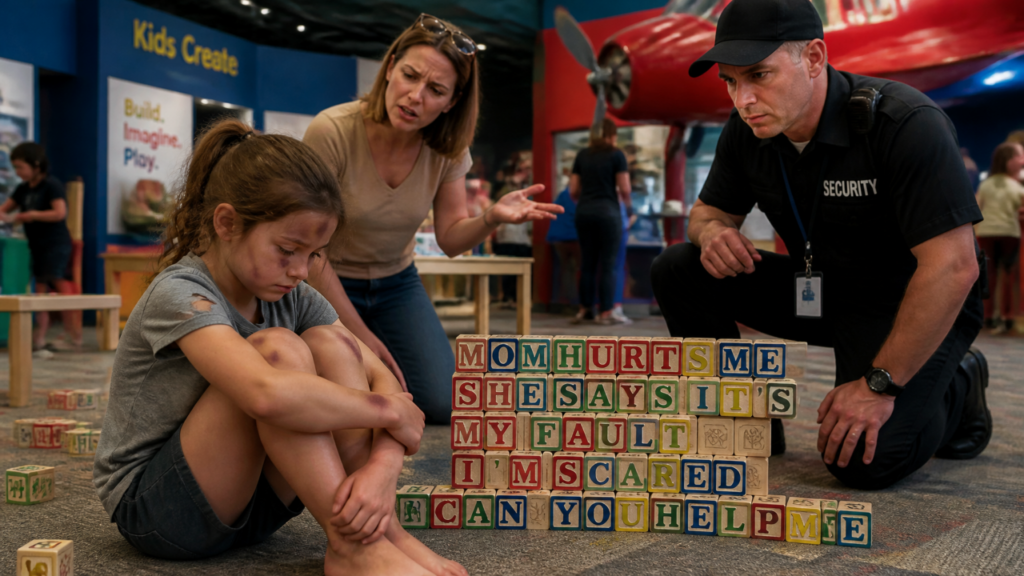
Chapter 1
The sound of a child flinching has a specific, sickening silence to it, even in a room filled with two hundred screaming toddlers.
Marcus Vance knew that silence better than his own name. He had spent twelve years as a deputy sheriff in the state of Ohio, handling the kinds of domestic calls that left a permanent film of grease on your soul. Now, at forty-two, he wore the soft gray polo and navy slacks of a private security guard at the Lakeside Children’s Museum. It was supposed to be a retirement for his nerves. He was supposed to watch kids spill apple juice, break plastic exhibits, and occasionally reunite a panicked mother with a toddler who had wandered off to the water-table exhibit.
But a man’s eyes don’t just forget twelve years of looking for monsters.
It was a blistering Saturday afternoon in June. The museum was at peak capacity. The air inside smelled of ozone, floor wax, and the faint, sweet scent of fruit snacks. Toddlers were shrieking with laughter in the sensory tunnels, and the ambient noise was a steady, deafening roar. Marcus stood near the entrance of the “Imagination Station,” a massive, carpeted room filled with oversized foam gears, wooden trains, and bins of giant plastic alphabet blocks.
That was when he saw her.
She was small, maybe seven or eight years old, but she carried herself like an old woman walking through a minefield. Every step was deliberate, cautious, and completely devoid of the chaotic joy that usually possessed children in this building. She wore a faded denim jacket that was far too heavy for a ninety-degree June day, buttoned tightly all the way to her throat.
Walking three steps ahead of her was a woman Marcus pegged immediately as a polished suburban matrix. Her hair was a flawless blonde blowout, her linen romper was immaculate, and she carried a designer leather tote that probably cost more than Marcus’s monthly mortgage payment. She was on her phone, her thumb flying across the screen, her heels clicking aggressively against the polished concrete border of the carpeted room.
The little girl stumbled.
It wasn’t a dramatic fall. She just caught the toe of her sneaker on the edge of the thick carpet. But as her balance wavered, her arm shot out to steady herself against a plastic partition. The cuff of her heavy denim jacket rode up her forearm.
Marcus, standing twenty feet away, froze.
Beneath the denim, wrapping around her thin wrist like a grotesque bracelet, were three distinct, purple-and-yellow finger marks. It wasn’t the kind of bruise a kid got from falling off a bicycle or roughhousing in the backyard. Those were deep, localized pressure points. Someone had grabbed that little girl’s wrist with enough force to burst the capillaries beneath her skin, and they had done it recently.
Marcus didn’t think. He adjusted his duty belt out of habit and took two long steps forward.
“Whoa there, buddy,” Marcus said, keeping his voice low, warm, and entirely unthreatening. He dropped to one knee, a trick he’d learned long ago to make himself less imposing to a terrified child. “You okay? That carpet edge can be tricky.”
Advertisement
The girl didn’t look at him. She stared straight down at her shoes, her shoulders hunched so high they almost touched her ears. She pulled her hand back into her sleeve so fast it looked like a magic trick.
The woman turned around. Her eyes took in Marcus’s uniform, her expression instantly shifting from annoyance to a practiced, high-society smile that didn’t reach her eyes.
“Oh, she’s perfectly fine,” the woman said. Her voice was loud, melodic, and entirely performance-driven, clearly meant for the other parents sitting on the perimeter benches. “Don’t waste your breath on her, officer. She does this for attention. Every single time we go out, it’s a new performance. Total drama queen.”
Marcus looked up at the woman. Her name tag from the admission desk read Veronica. She had a diamond engagement ring that could have stabilized a small nation’s economy, but her eyes were cold, sharp, and darting around the room to see if anyone else was watching.
“She took a pretty hard bump, ma’am,” Marcus said, keeping his tone entirely professional, though a familiar heat was starting to rise in his chest. “And it’s a little warm today for a denim jacket, don’t you think? Just wanted to make sure she wasn’t overheating.”
Veronica’s smile faltered for a fraction of a second, the skin around her jaw tightening. “It’s her favorite jacket. She refuses to take it off. As I said, attention. If I don’t give in to her tantrums, she acts out. I’m her mother, I think I know my own daughter’s little games.”
She reached down, her manicured fingers wrapping around the girl’s shoulder. Marcus watched the girl flinch—a microscopic, full-body shudder that confirmed every single instinct screaming in his gut.
“Come on, Maya,” Veronica said, her voice dropping an octave, losing its performative sweetness. “Go play with the blocks. Stop embarrassing me.”
She gave the girl a firm shove toward the massive bin of alphabet blocks. Maya didn’t protest. She didn’t cry. She just drifted toward the wooden bins like a leaf caught in a sluggish current.
Veronica immediately turned her back, walking a few yards away to a corner near the emergency exit, her face buried in her phone once more. She was completely checked out, her duty as a mother seemingly fulfilled by delivering her child to an authorized play zone.
Marcus stood up, his knees cracking. He didn’t leave. He walked over to the desk where Clara Higgins, the museum’s shift supervisor, was logging inventory on a tablet. Clara was fifty-five, a retired schoolteacher with silver hair and a zero-tolerance policy for unruly behavior, but she had a heart that leaked empathy.
“Clara,” Marcus murmured, leaning over the counter so his voice wouldn’t carry. “Keep an eye on the woman in the white romper by the fire exit. And the little girl in the denim jacket.”
Clara looked up, her sharp eyes scanning the room until they landed on Maya, who was now sitting alone on the carpeted floor, surrounded by large plastic blocks with bold, black letters printed on each side.
Advertisement
“The one in the jacket?” Clara asked, her brow furrowing. “It’s eighty-five degrees outside, Marcus.”
“I saw her wrist,” Marcus said, his voice dropping to a gravelly whisper. “Grabbing bruises. Finger marks. The mother just dismissed it in front of me. Said the kid is looking for attention.”
Clara’s expression hardened. As an ex-teacher, she knew the phrase ‘she does it for attention’ was often the universal camouflage for parents hiding something dark behind closed doors. “Did you see anything else?”
“Not yet,” Marcus said. “But my skin is crawling. You know me, Clara. I don’t get the shakes for nothing.”
“I know,” Clara said softly. “I’ll keep a lookout from here. Go do your rounds, but stay close to the room.”
Marcus nodded and walked away, but he didn’t go far. He walked a slow, deliberate perimeter around the Imagination Station, pretending to check the locks on the display cases, but his eyes never left the little girl in the denim jacket.
Maya was sitting cross-legged. Other children were around her, screaming, laughing, and building massive towers only to kick them down with explosive delight. Maya didn’t join them. She didn’t build a tower.
Instead, she began gathering specific blocks from the bin.
She was incredibly methodical about it. She would rummage through the chaotic pile of letters, pull one out, and place it face-up on the carpet directly in front of her. Marcus watched her movements. They were slow, almost rhythmic, as if she were executing a plan she had practiced a hundred times in her head.
Ten minutes passed. Veronica remained in the corner, her face illuminated by the blue glow of her smartphone, completely oblivious to her daughter. She was laughing at something on her screen, totally detached from the room.
Marcus looped back around, his heart rate inexplicably accelerating. He walked along the back wall of the Imagination Station, positioning himself directly behind the low wooden shelf where Maya was working. From this angle, he could look over her shoulder without being obtrusive.
Maya had lined up six blocks in a neat, straight row.
Marcus squinted, reading the letters from left to right.
H – E – L – P – M – E
Marcus felt the air leave his lungs as if he’d been struck in the solar plexus. It was a simple, universal cry, but seeing it spelled out in large, primary-colored children’s blocks made it feel like a physical blow.
He took a slow step closer, his boots making no sound on the thick carpet. “Hey there, Maya,” he whispered, keeping his voice beneath the roar of the surrounding children. “That’s some good spelling.”
Maya didn’t look up, but her hands froze over the block bin. Her little fingers were trembling. She didn’t knock the blocks over. She didn’t move them. She just stared at them.
“Is there something you want to tell me, kiddo?” Marcus asked, his voice thick with a sudden, overwhelming protective instinct. He knew he had to be careful. If he scared her, or if the mother noticed him hovering, the window would slam shut.
Before Maya could answer, a loud, obnoxious laugh echoed from the other side of the room. A group of older boys, probably nine or ten, came sprinting through the block area, playing a frantic game of tag. One of them, a heavy-set kid in a red jersey, wasn’t looking where he was going.
He tripped right over Maya’s neatly arranged line of blocks.
The blocks scattered everywhere. The word HELP ME was instantly broken apart, the letters tumbling across the carpet into the general chaos of the room. The boy didn’t even apologize; he just scrambled back to his feet and kept running, yelling to his friends.
Marcus watched Maya’s reaction closely. He expected her to cry, or perhaps to look angry. Instead, she did something infinitely more heartbreaking.
She simply closed her eyes, let out a long, ragged sigh that belonged to a woman four times her age, and reached back into the bin.
She didn’t stop. She didn’t give up.
With the same terrifying, mechanical precision, she began searching for the letters again. But this time, she didn’t place them out in the open on the carpet where a running child could knock them over. Instead, she crawled slightly forward, pushing herself into the narrow, shadowed space beneath the lowest shelf of the wooden block bin. It was a dark, recessed area, barely six inches high—a place where no casual observer would ever think to look.
Marcus watched, his blood turning to ice, as her small hands reached into the shadows.
She found a D. She pushed it deep into the dark space under the shelf.
Then an A.
Then another D.
Marcus felt a cold sweat break out across the back of his neck. He moved closer, dropping to both knees now, completely abandoning any pretense of just doing a routine patrol. He leaned his head down, staring into the dark crevice beneath the bottom shelf.
Maya’s small hand was trembling violently now, but she didn’t stop. She was building a longer sentence. She was digging deeper into the bin, her nails scratching against the plastic as she hunted for the specific characters she needed to tell her story.
The next letters went into the dark, one by one, spaced out with agonizing neatness.
H – U – R – T – S
Marcus’s breathing went shallow. Dad hurts.
He looked over his shoulder nervously. Veronica was still on her phone, but she had turned slightly, her eyes scanning the room as if she were getting ready to leave. Time was running out. Marcus knew the protocol for Child Protective Services, he knew the legal boundaries of his current job, and he knew that if that little girl walked out of this museum today, he might never see her again. And worse, she might not survive whatever was happening to her.
“Maya,” Marcus whispered, his voice cracking. “Who is Dad? Is he at home?”
The girl didn’t answer with words. She just kept moving the blocks. Her face was a mask of pure, concentrated terror, sweat beading along her hairline. She reached into the bin and pulled out an M.
Then an O.
Then an M.
She placed them right next to the previous phrase.
M – O – M – L – I – E – S
Dad hurts. Mom lies.
Marcus felt a wave of nausea wash over him. The pieces were slamming into place with the force of a car crash. The polished mother. The expensive clothes. The casual, public dismissal of her daughter’s trauma as “attention-seeking behavior.” It wasn’t just neglect; it was an active, coordinated cover-up. The mother was framing her own daughter as a liar to protect the monster in their house.
But Maya wasn’t finished.
There was one more sequence of blocks she was assembling in the deep shadows beneath the shelf. She was using smaller, wooden alphabet tiles now, the ones meant for older kids to spell complex words. She had gathered a handful of them, holding them tightly against her chest like a secret treasure.
She reached deep into the back corner of the recess, placing them down in a rapid, frantic motion, as if she could hear her mother’s footsteps approaching before they even started.
Marcus strained his eyes, leaning down until his cheek was almost touching the dirty museum carpet, staring into the darkness beneath the shelf to read the final line of her silent confession.
The blocks spelled out a specific sequence of numbers and letters.
4 – 2 – 4 – L – A – K – E – S – I – D – E
An address.
Marcus’s mind raced. 424 Lakeside Drive. It was a wealthy subdivision just three miles up the road, sitting right on the water. Big, beautiful homes with manicured lawns and high privacy fences. The kind of neighborhood where secrets were buried deep behind triple-pane windows and security systems.
Suddenly, a shadow fell over both of them.
“Maya! What did I tell you about playing in the dirt?”
Veronica’s voice cut through the air like a butcher’s knife. She was standing directly over them, her phone finally slipped into her leather tote, her face twisted in a look of profound disgust. She looked down at Marcus, her eyes narrowing into slits of pure, venomous hostility.
“Is there a reason you are hovering over my daughter, officer?” Veronica asked, her voice laced with an implied threat that could end his employment with one phone call to the museum board. “Because it’s starting to make me very uncomfortable.”
Marcus slowly stood up, smoothing down his gray polo shirt. He forced his face to remain completely neutral, hiding the absolute fury that was pounding in his veins. He looked at Veronica, seeing right through the expensive makeup and the designer clothes to the hollow, terrifying accomplice standing beneath.
“Just ensuring she didn’t get hurt by the older kids running through here, ma’am,” Marcus said, his voice entirely steady. “It gets pretty chaotic on Saturdays.”
Advertisement
“Well, we are leaving,” Veronica said sharply. She reached down and grabbed Maya by the upper arm—the exact spot where Marcus had seen the bruises earlier. She didn’t just pull her up; she yanked her.
Maya didn’t make a sound. She didn’t cry out from the pain of the grip. She just let herself be hauled to her feet like a rag doll, her eyes locked onto the floor, completely disconnected from her own body.
“Let’s go, Maya,” Veronica snapped, turning on her heel and dragging the little girl toward the main exit. “Your father is waiting for us in the car, and he doesn’t like to be kept waiting.”
Those words echoed in Marcus’s ears like a death knell. Your father is waiting in the car.
Marcus stood frozen for a split second, watching the heavy glass doors of the museum begin to close behind them. He looked back down at the dark, narrow crevice beneath the wooden shelf. The blocks were still there, hidden in the shadows, spelling out the map to a little girl’s living hell.
He had to make a choice. If he followed them out to the parking lot to get a license plate, he risked tipping off the mother, who could easily flee or claim harassment. If he called the police through normal channels, by the time a cruiser arrived at 424 Lakeside Drive, the family would be locked inside their beautiful fortress, and the mother would have already spun her web of lies to protect her husband.
Marcus felt the ghost of his past failure slamming into his chest. Five years ago, as a deputy, he had trusted a polished parent’s word. Two days later, he had carried that child out of a house in a body bag. He had promised himself he would never let that happen again.
He turned toward Clara at the front desk, his face pale, his eyes burning with a terrible, dangerous resolve.
“Clara,” Marcus said, his voice a low, hard rumble. “Call Dave Miller over at the precinct right now. Tell him it’s a Code Red domestic. Give him the address 424 Lakeside.”
“Marcus, what are you doing?” Clara asked, her hand trembling as she reached for the landline.
Marcus didn’t answer. He was already moving toward the glass doors, his hand instinctively reaching for the car keys in his pocket. He wasn’t a deputy anymore, but today, the uniform didn’t matter.
The story had just begun, and he wasn’t going to let that little girl fight the monsters alone.
Chapter 2
The heavy glass doors of the Lakeside Children’s Museum didn’t just open; they hissed, releasing a pressurized burst of air-conditioned sanctuary that was instantly swallowed by the oppressive, sweltering reality of an Ohio June.
Marcus Vance stepped out into the blinding glare of the parking lot, and the heat hit him like a physical blow to the chest. It was ninety-two degrees, the air thick with the stagnant humidity rising off the lake, smelling of hot asphalt, melting tire rubber, and the faint, chemically sweet scent of cut grass from the municipal park across the street. His gray museum polo shirt, made of a cheap polyester blend that never quite breathed, instantly began to stick to the small of his back.
But Marcus didn’t care about the heat. He didn’t care about the sweat already pooling beneath the heavy leather of his duty belt. His entire universe had shrunk to a single point of focus: a woman in an immaculate white linen romper and a little girl in a faded denim jacket, walking fifty yards ahead of him through the shimmering waves of heat radiating off the blacktop.
Veronica’s heels clicked aggressively against the gravelly asphalt of the overflow lot. It was a sharp, rhythmic sound—clack, clack, clack—that felt entirely out of place in a parking lot filled with families carrying inflatable beach balls and dragging tired, ice-cream-smeared toddlers. She wasn’t holding Maya’s hand. Instead, her manicured fingers were dug firmly into the fabric of the little girl’s shoulder, steering her forward with the cold, mechanical efficiency of a prison guard transferring an inmate.
Maya’s head was down. Her small sneakers dragged slightly with every step, leaving faint, dusty tracks on the dark asphalt. From this distance, she looked impossibly small, a tiny island of profound, silent misery surrounded by a sea of bright suburban summer.
Up ahead, idling in the shade of a dying maple tree at the edge of the lot, sat the vehicle Marcus had expected. It was a midnight-black Cadillac Escalade, its chrome trim polished to a mirrored shine that caught the noon sun and threw jagged, blinding daggers of light into Marcus’s eyes. The windows were tinted so darkly they looked like solid blocks of obsidian, completely obscuring whoever was sitting behind the wheel. The dual exhaust pipes coughed out pale, trembling plumes of heat into the stagnant air, the low, throaty rumble of the V8 engine vibrating through the soles of Marcus’s boots.
As Veronica and Maya neared the passenger side, the heavy rear door of the Escalade clicked and swung outward.
Marcus slowed his pace, dropping behind the broad tailgate of a parked minivan to keep himself out of their line of sight. He adjusted the brim of his tactical cap, his eyes narrowing as a man stepped out of the driver’s seat.
Richard Sterling was a man built entirely of sharp angles and expensive tailoring. He looked to be in his mid-forties, his silver-flecked hair cut into a precise, military-style crew cut that emphasized a square, unyielding jawline. He wore a crisp, pale blue linen button-down shirt, the sleeves rolled up exactly twice to reveal thick, vascular forearms covered in fine dark hair. A gold Rolex gleamed on his left wrist, catching the sun with an obnoxious, wealthy flash.
His expression wasn’t one of anger or impatience. It was worse. It was a mask of absolute, chilling indifference. He didn’t look down at his daughter. He didn’t ask her how her day was. He simply stood by the open door, his shoulders square, his physical presence dominating the space around the vehicle. He reached out and grabbed Maya by the upper arm—the exact spot where Marcus had seen those deep, purple pressure points earlier—and hoisted her into the leather interior of the backseat with a single, effortless jerk of his arm.
Maya didn’t cry out. She didn’t make a sound. She just disappeared into the dark cavern of the luxury SUV like a ghost slipping back into a crypt.
Veronica muttered something to her husband, her face twisted into a sharp, complaining grimace as she gestured back toward the museum entrance. Richard listened without moving a muscle, his jaw tight, his eyes scanning the parking lot with a cold, predatory alertness. For a terrifying half-second, those eyes swept directly over the minivan Marcus was hiding behind. Marcus held his breath, his old deputy instincts locking his muscles in place, keeping his body perfectly still in the shadow of the vehicle.
Richard didn’t see him. He gave his wife a curt, dismissive nod, stepped back into the driver’s seat, and slammed the heavy door shut. A moment later, Veronica climbed into the passenger side, and the massive black Escalade began to roll forward, its wide tires crunching over the loose gravel as it pulled out onto Lakeside Avenue.
Marcus didn’t waste another breath. He broke into a heavy, limping run toward his own vehicle, parked in the restricted staff lane near the loading dock. His left knee, ruined three years ago during a foot chase through a flooded drainage ditch in his final months with the sheriff’s department, throbbed with a dull, white-hot ache. He ignored it. He threw his weight against the door of his 2008 Ford F-150, a faded dark blue relic with a cracked dashboard and a rusted tailgate that stood in stark contrast to the luxury vehicles filling the museum lot.
He threw himself into the cab, the interior smelling intensely of stale Folgers coffee, old vinyl, and the faint, metallic tang of gun oil. He slammed the key into the ignition and twisted it. The old V8 engine roared to life with a rough, uneven growl, the serpentine belt squealing in protest against the heat.
Before he even shifted into drive, Marcus snatched his personal cell phone from the dashboard mount. His fingers, calloused and thick, were trembling slightly as he scrolled through his contacts until he found the name he had hoped he’d never have to call for a professional favor again.
Dave Miller.
He hit dial, threw the truck into gear, and slammed his foot onto the accelerator. The tires squealed as he pulled out of the staff lane, navigating the tight corners of the parking lot with an aggressive familiarity born of twelve years behind the wheel of a cruiser.
The phone rang once. Twice. Three times. Every second felt like an hour, the rhythmic ring… ring… echoing inside the cramped cab of the truck like the ticking of a countdown timer.
“Miller,” a gravelly, exhausted voice finally answered. It was the sound of a man who had swallowed too much smoke, drunk too much bad coffee, and spent thirty years watching the worst parts of humanity crawl through the doors of the municipal courthouse. Detective Dave Miller was three months away from retirement, his sharp legal mind buried beneath a mountain of cynical exhaustion and a bad hip he’d picked up in a high-speed pursuit back in ’18.
“Dave, it’s Marcus,” Marcus said, his voice a low, urgent rumble as he turned the truck onto Lakeside Avenue, keeping the black Escalade three car lengths ahead of him. “I need you to listen to me, and I need you to not interrupt until I’m finished.”
A long sigh came through the speaker, accompanied by the distinct rustle of paperwork. “Marcus. Buddy. I’m looking at three separate aggravated assault files on my desk, and the air conditioning in Sector 4 just blew a compressor. If this is about the municipal pension board again, I told you, I can’t—”
“It’s not the pension, Dave,” Marcus interrupted, his tone cutting through the detective’s exhaustion like a razor blade. “I’ve got a live one. A little girl, seven or eight years old. Name is Maya. I just watched her mother pull her out of the children’s museum. The kid has grabbing bruises on her wrist—fresh ones, purple and yellow, clear finger marks from a grown man’s grip. She’s wearing a heavy denim jacket in ninety-degree weather to hide them.”
There was a brief pause on the other end of the line. The sound of shuffling papers stopped. “Marcus… you know the drill. Call CPS. If the kid is with her parents, we can’t just roll up on a welfare check because a security guard saw a bruise. You’re a civilian now, Marcus. You don’t have the shield anymore.”
“I know what I am, Dave!” Marcus snapped, his knuckles turning white as he gripped the steering wheel, his eyes tracking the Escalade as it turned left onto the parkway, heading toward the wealthier northern ridge of the city. “But you didn’t see what she did. The mother publicly shamed her in front of a room full of people. Said she does it for attention. Called her a drama queen. Then she forced the kid to go play in the block room. I watched that little girl, Dave. She didn’t build a tower. She didn’t play. She spent fifteen minutes gathering alphabet blocks. She spelled out HELP ME right on the carpet.”
Another pause. Longer this time. Marcus could hear Dave shifting in his squeaky leather office chair. “Kids play games, Marcus. They see stuff on TV. They spell things.”
“She didn’t stop there,” Marcus pressed, his voice cracking with a sudden, overwhelming wave of emotion that caught him completely off guard. “Some older kids ran through and knocked the blocks over. She didn’t cry. She didn’t look angry. She just went completely cold, Dave. She crawled under the lowest shelf of the block bin—a dark, recessed crawlspace where no one would ever look. And she reached back into the shadows and built another line. I got down on my knees and looked under there with my flashlight. You know what it said, Dave? It said DAD HURTS. And then right next to it, MOM LIES.”
The line went completely silent. The ambient noise of the bullpen at the precinct—the ringing phones, the distant chatter of patrol officers—seemed to fade away, replaced by the heavy, collective weight of two men who knew exactly what those words meant.
“Jesus, Marcus,” Dave whispered, his voice losing its cynical edge, replaced by the grim, focused gravity of a veteran cop.
“She wasn’t done,” Marcus said, his breathing shallow as he watched the Escalade switch lanes, its blinker clicking with an arrogant, leisurely rhythm. “She used the small wooden tiles for the last part. She hid them in the deepest corner of the recess. It was an address, Dave. 424 LAKESIDE. I looked it up on the property maps on my phone before I hit the truck. The house belongs to a Richard Sterling. Senior partner at Sterling & Vance Corporate Law. He’s driving a black 2024 Escalade right now. I’m tailing them on the North Parkway. He’s got the kid in the back, and he’s got the mother in the front.”
Dave groaned, a low, pained sound. “Sterling? Marcus, are you kidding me? Richard Sterling sits on the mayor’s advisory council for municipal development. He donated fifty grand to the sheriff’s re-election campaign last fall. He’s got the district attorney on speed dial. If we roll up to 424 Lakeside Drive based on a tip from an ex-cop who got forced out on a psych disability, and we don’t have ironclad probable cause, Sterling will have our badges on a silver platter before the shift ends.”
“I don’t give a damn about his donations, Dave!” Marcus roared, his chest heaving as the memories—the dark, suffocating memories he spent every night trying to drown in cheap bourbon—came rushing back to the surface with the force of a tidal wave.
Five years ago. November 2021.
The image of an eight-year-old boy named Danny Cooper flashed behind Marcus’s eyes. Danny had been a quiet kid who loved drawing comic books. Marcus had responded to a domestic call at a beautiful, two-story colonial in the suburbs. Danny had a fractured collarbone and a split lip. His stepfather, a charming, well-spoken vice principal at the local high school, had smiled warmly, offered Marcus a cup of hot apple cider, and explained that Danny was a clumsy boy who had fallen out of the old oak tree in the backyard trying to be a superhero. The mother had nodded, smiling through her tears, confirming every word.
Marcus had felt something wrong in his gut that night. He had felt the hairs on the back of his neck stand up. But the house was clean, the family was respected, and the paperwork required a 48-hour window for a CPS supervisor to sign off on an emergency removal. Marcus had written the report, filed it in the tray, and went home to his wife.
Two days later, Marcus was the first unit on the scene when the ambulance arrived. Danny Cooper was carried out of that beautiful colonial house in a zippered vinyl bag. The coroner’s report called it blunt force trauma to the abdomen. The vice principal had beaten the boy to death with a golf club because he hadn’t cleaned his room fast enough. The mother had helped clean the blood off the hardwood floors before calling 911.
That was the night Marcus’s life ended. The guilt had turned into a cancer that ate his marriage from the inside out, leading to a bitter divorce from Sarah, a woman who couldn’t bear to look into the hollow, haunted eyes of a man who slept with his service weapon on the nightstand. Six months later, during a routine traffic stop, Marcus had snapped, pulling a driver out of a vehicle with a level of violence that terrified his own partner. The department offered him a choice: an honorable discharge on medical/psychological grounds, or a formal inquiry. He took the discharge. He took the gray polo shirt at the museum. He took the quiet life.
But he had never forgotten the sound of that zipper closing over Danny Cooper’s face.
“Dave,” Marcus said, his voice dropping to a harsh, ragged whisper that trembled with a terrifying intensity. “I am not doing this again. I let Danny Cooper walk back into a house with a monster because I didn’t want to ruffle the feathers of a respectable citizen. I am not letting Maya Sterling go into that house alone. If you don’t dispatch a unit to 424 Lakeside right now, I’m going in myself. And you know exactly what will happen if I go over that threshold without a badge.”
A long, heavy silence stretched over the cellular connection. Marcus could hear the sound of Dave’s heavy breathing, the ticking of the blinker in his own truck, the rumble of the road beneath his tires.
“You’re a stubborn son of a bitch, Vance,” Dave finally muttered, his voice thick with a mixture of fear and profound respect. “Listen to me carefully. Do not—I repeat, do not—approach the vehicle or the property. I am calling patrol supervisor Harris right now. I’ll tell him we have an anonymous tip regarding a high-end domestic in progress at that address. I’ll get a unit dispatched on a priority-two welfare check. But it’s going to take them at least ten or fifteen minutes to clear the downtown traffic and get up to the ridge. Do you hear me, Marcus? Stay in your truck. Do not cross that property line.”
“Just get them there, Dave,” Marcus said, and before the detective could reply, he clicked the end-call button and tossed the phone onto the passenger seat.
The black Escalade turned right, leaving the parkway and entering the grand, wrought-iron gates of Lakeside Heights.
The transition was immediate and stark. The commercial strip, with its auto body shops and discount grocery stores, disappeared, replaced by rolling hills, perfectly manicured lawns of deep emerald Kentucky bluegrass, and ancient weeping willows whose long, graceful branches swept the edges of the pristine asphalt. The houses here didn’t look like homes; they looked like fortresses of privilege. Massive, multi-million-dollar structures of brick, stone, and cedar, tucked neatly behind thick privacy hedges and security gates. It was the kind of neighborhood where the police were called for noise complaints about lawnmowers, where the streets were so quiet you could hear the high-pressure hum of the underground sprinkler systems.
It was a beautiful, sun-drenched paradise built on a foundation of expensive secrets.
Marcus kept his F-150 forty yards back, using a large landscaping truck between them as cover. He watched the Escalade slow down as it approached the four-hundred block of Lakeside Drive. The vehicle activated its turn signal, the amber light flashing with a slow, arrogant rhythm, and pulled into the wide, sweeping circular driveway of number 424.
Marcus pulled his truck over to the curb three houses down, tucking the faded blue Ford beneath the deep shade of a massive white oak tree. He cut the ignition. The engine died with a series of metallic clicks and pings as the heat began to rise from the hood.
He didn’t move. He sat perfectly still, his eyes locked onto the front yard of 424 Lakeside Drive.
The house was a sprawling, two-story colonial constructed of dark, weathered red brick. It featured massive white columns flanking a heavy, solid oak front door that looked thick enough to withstand a battering ram. The windows on the upper floor were large, multi-paned, and glinted like ice in the harsh summer sun. The front lawn was a flawless carpet of green, bordered by neatly trimmed boxwood hedges that ran along the foundation like a green wall. It looked peaceful. It looked perfect. It looked entirely dead.
The doors of the Escalade opened simultaneously.
Richard Sterling stepped out first. He didn’t stretch or stretch his legs after the drive. He walked immediately to the rear door, pulled it open, and reached inside. Marcus watched his upper body tense, his shoulder muscles bunching beneath the pale blue linen shirt as he dragged Maya out of the vehicle.
He didn’t let go of her arm. He kept his fingers locked around her upper bicep, pulling her toward the front porch so fast her small legs had to move in a frantic, stumbling trot just to keep from falling face-first onto the concrete walkway.
Veronica followed close behind. She had her designer leather tote swung over her shoulder, her face fixed in a hard, icy mask of annoyance. She didn’t look at her husband; she didn’t look at her daughter. She was already fishing a set of keys out of her bag, her heels clicking sharply against the concrete—a sound that carried down the quiet suburban street all the way to Marcus’s open window.
Clack. Clack. Clack.
They reached the front porch. Veronica unlocked the heavy oak door and pushed it open, stepping into the cool, dark interior of the house without looking back.
Before Richard followed her over the threshold, he stopped. He turned his head, his sharp, crew-cut silhouette shifting as he scanned the quiet street one last time. He looked directly toward the white oak tree where Marcus’s truck was parked.
Marcus instinctively leaned back into the shadow of the cab, his heart pounding a violent, erratic rhythm against his ribs. His hand slid down to the space between the driver’s seat and the center console, his fingers brushing against the cold, comforting steel of a heavy, three-cell Maglite flashlight—the only weapon he allowed himself to carry these days.
Richard’s gaze lingered on the truck for a fraction of a second, his brow furrowing as if he recognized the faded blue vehicle from the museum parking lot. But then, with a dismissive jerk of his chin, he turned, dragged Maya through the doorway, and pulled the heavy oak door shut behind them.
The sound of the latch clicking into place carried across the yard like the firing of a deadbolt.
Marcus sat in the sweltering heat of his cab, the sweat pouring down his face, soaking through his collar, stinging his eyes. He looked down at his watch.
He looked down at his phone on the passenger seat. No text from Dave. No sound of distant sirens. The silence of Lakeside Heights rushed back in to fill the void, heavier and more suffocating than before. The cicadas in the oak trees above him kept up a high, vibrating drone that sounded like a chorus of screaming voices, rising and falling in the heavy air.
One minute passed. Then two. Then three.
Marcus’s left knee was throbbing violently now, a deep, arthritic ache that seemed to sync with the frantic beating of his heart. His mind was a chaotic storm of images: the purple finger marks on Maya’s tiny wrist; the mechanical precision of her small hands moving the plastic alphabet blocks in the dirt beneath the shelf; the cold, dead eyes of Richard Sterling as he hoisted his daughter into the car like a sack of groceries.
“She does this for attention,” Veronica’s voice echoed in his ears, her performative, melodic laugh twisted into something grotesque and demonic. “Total drama queen. Mom lies. Dad hurts.”
Marcus closed his eyes, his forehead resting against the hard plastic of the steering wheel. He was back in that house in November 2021. He was looking at Danny Cooper’s comic books scattered across a bloody rug. He could smell the hot apple cider. He could hear his wife Sarah screaming at him in the kitchen three months later, telling him that he was a ghost, that he had died in that house with that little boy, and that she couldn’t live with a dead man anymore.
“Not again,” Marcus whispered into the darkness of his closed eyelids. “Dear God, please. Not again.”
He opened his eyes. 12:46 PM. Four minutes since they had gone inside. Still no sirens. The nearest precinct was four miles away, down on the flats, and the Saturday traffic near the river was always a nightmare. Dave had said ten to fifteen minutes.
In ten minutes, a grown man with thick, vascular forearms could do a lifetime of damage to a seven-year-old girl.
Suddenly, a sound tore through the thick, humid afternoon air.
It wasn’t the loud, dramatic crash of an explosion or the screech of tires. It was a sharp, high-pitched crack—the distinctive, unmistakable sound of a heavy glass object shattering against a hard surface, coming from the upper floor of 424 Lakeside Drive.
Marcus’s body reacted before his mind could even process the sound. He threw open the door of the F-150, his boots hitting the pavement with a heavy, hollow thud. He didn’t look down the street for patrol cars. He didn’t care about jurisdiction, he didn’t care about probable cause, and he didn’t care about the corporate lawyers or the mayor’s advisory council.
He grabbed the heavy metal Maglite from the side of the seat, jammed it into the waistband of his trousers, and began a frantic, limping sprint across the pristine green lawn of 424 Lakeside Drive.
As he reached the edge of the circular driveway, another sound followed the shattered glass. It was faint, muffled by the thick brick walls and the double-pane windows of the colonial mansion, but it cut straight through Marcus’s soul like a physical blade.
It was a child’s scream.
It wasn’t a tantrum. It wasn’t the loud, angry cry of a girl looking for attention. It was a high, thin, breathless shriek of pure, unadulterated terror—the sound of a small creature that had been cornered by a predator and knew there was nowhere left to run.
The scream cut off abruptly, replaced by the heavy, terrifying silence of the house once more.
Marcus didn’t hesitate. He took the three concrete steps of the front porch in a single, agonizing leap, his ruined knee screaming in protest as he threw his full weight against the heavy oak front door. He grabbed the polished brass handle and twisted it.
It was locked.
Marcus stepped back, his chest heaving, his face covered in sweat and grease. He looked at the massive white columns, then down at the solid oak door. Through the thin, decorative glass sidelights flanking the entryway, he could see into the grand foyer. The interior was dark, cool, and quiet, a sweeping curved staircase rising up into the shadows of the second floor.
There was no one in the foyer. The house looked completely empty, a stage set for a family that didn’t exist.
Marcus raised his right boot, driving the heel of his shoe directly into the center of the oak door right above the brass handle. The wood groaned, a deep, splintering crack echoing through the porch, but the deadbolt held firm. It was a commercial-grade lock, built to keep the world out.
“Sterling!” Marcus roared, his voice a deep, gravelly bellow that shattered the quiet peace of the neighborhood. He slammed his fists against the heavy wood, the vibration rattling the bones in his forearms. “Police! Open the door!”
It was a lie—he wasn’t police anymore—but he didn’t care. He needed to stop whatever was happening on the other side of that wall.
He didn’t wait for an answer. He turned to his left, his eyes locking onto a large, low-slung bay window that looked into the formal dining room. The window was framed by heavy white trim and sat barely three feet off the porch floor.
Marcus pulled the heavy aluminum Maglite from his waistband. He gripped the textured handle with both hands, raised it over his shoulder, and drove the solid metal butt of the flashlight directly into the center of the plate glass window.
The glass didn’t just break; it exploded.
A loud, thunderous crash shattered the quiet afternoon as thousands of sharp, crystalline shards rained down onto the hardwood floor inside, chiming like a demonic wind bell. Marcus didn’t wait for the dust to settle. He threw his left arm over his face, cleared the jagged remnants of glass from the frame with a violent sweep of his flashlight, and hoisted his heavy frame over the sill.
His trousers caught on a sharp sliver of wood, tearing a jagged hole in the knee, and a piece of glass sliced through his palm, leaving a thin, hot line of crimson blooming across his skin. He didn’t feel it. He dropped onto the interior floor, his boots crunching loudly over the sea of shattered glass scattered across the expensive Persian rug.
The air inside the house was freezing, the air conditioning set so low it made his sweat-soaked shirt feel like a sheet of ice against his skin. The air smelled of expensive lemon polish, expensive leather, and a faint, subtle undercurrent of lavender potpourri.
It smelled like a home where nothing ever went wrong.
Marcus stood in the center of the dark dining room, his chest heaving, his breath coming in ragged, white plumes in the chilled air. He raised his flashlight, the heavy beam of light cutting through the dim interior, painting long, tracking shadows across the polished mahogany table and the silver candelabras.
“Sterling!” Marcus shouted again, his voice echoing off the high ceilings of the house. “I’m inside! Step away from the girl!”
From somewhere deep in the back of the house, near the kitchen, he heard the sharp, frantic click of high heels against tile.
“What are you doing?! Someone call the police! Oh my god, he’s breaking in!”
Veronica appeared in the arched doorway connecting the dining room to the kitchen. Her face was pale, her eyes wide with a mixture of shock and sheer, unadulterated fury. She was holding a cordless phone in her trembling hand, her manicured fingers pressing the buttons with a frantic, uncoordinated speed.
“You!” she shrieked, recognizing Marcus’s gray museum polo shirt. “You’re that crazy security guard from the museum! Are you insane?! You broke my window! Richard! Richard, get down here! He has a weapon!”
Marcus didn’t look at her. He didn’t drop his flashlight. He took two long, heavy steps toward her, his face a mask of absolute, unyielding stone. “Where is she, Veronica?”
“Get out of my house!” she screamed, backing away into the kitchen, her voice rising to a hysterical, piercing register. “I’m on the phone with 911 right now! They’re going to put you in a cage, you lunatic!”
“Where is the girl, Veronica?!” Marcus roared, stepping through the archway. The sheer, violent intensity of his voice seemed to strike her like a physical blow, causing her to drop the cordless phone. It hit the granite countertop with a sharp clack and bounced onto the tile floor, the speaker crackling with the voice of a distant emergency dispatcher.
Before she could answer, another sound came from the top of the curved staircase in the grand foyer.
It was the sound of a heavy, measured footstep.
Marcus turned on his heel, his boots crunching over the rogue shards of glass that had migrated into the hallway. He stepped out of the dining room and into the base of the grand foyer, his flashlight beam tracking up the carpeted steps of the staircase.
Richard Sterling was standing at the landing of the second floor.
He had changed out of his linen button-down shirt. He now wore a clean, white V-neck undershirt that revealed the thick, powerful muscles of his chest and shoulders. His forearms were bare, and on his right knuckle, there was a fresh, bright smear of crimson blood. It wasn’t his own blood.
His face was completely calm. He looked down at Marcus from the top of the stairs with the cold, detached curiosity of a judge looking at a petty criminal from the bench. He held a heavy, wooden police-style baton in his right hand—a souvenir, perhaps, from his days on the municipal advisory council or his connections to the sheriff’s department. He tapped the wood gently against his thigh with a slow, rhythmic thud… thud… thud.
“You’re making a very large mistake, Mr. Vance,” Richard said. His voice was low, smooth, and entirely devoid of fear. He knew Marcus’s name. He had likely checked with the admission desk or recognized the security uniform before they left the museum. “I know who you are. I know what happened to you in the department. I know about the psychological discharge. You’re a trespasser in my home, you’re armed, and you’re currently experiencing a severe mental health crisis.”
He took a slow step down the stairs, the wooden baton catching the light. “If you turn around right now and walk out that broken window, I might not have my lawyers ruin what’s left of your life. But if you take one more step up these stairs, I will protect my family. And the state of Ohio will call it justifiable homicide.”
Marcus looked at the blood on Richard’s knuckle. He looked at the wooden baton. The world around him seemed to slow down, the ambient noise of Veronica’s screaming in the kitchen fading into a distant, insignificant hum.
He didn’t see the wealthy lawyer. He didn’t see the beautiful house. He saw the monster. He saw the vice principal who had put Danny Cooper in a body bag.
Marcus reached down and unbuckled the heavy, clumsy utility belt from his waist, letting it drop to the hardwood floor with a loud, metallic clatter. He kept only the heavy metal Maglite in his right hand.
He looked up at Richard Sterling, his eyes burning with a dark, terrible light that had nothing to do with fear and everything to do with a debt that was five years overdue.
“I died five years ago, Sterling,” Marcus said, his voice dropping to a low, gravelly whisper that carried a terrifying weight through the empty foyer. “You can’t threaten a dead man.”
Marcus took his first step up the stairs.
Chapter 3
The first step Marcus Vance took up the winding, carpeted staircase of 424 Lakeside Drive felt like breaking a covenant with the physical world. His left knee didn’t just ache; it gave a distinct, wet pop, the scarred cartilage grinding against bone like gravel in a blender. A white-hot needle of agony shot straight up his thigh, blooming into a dull, throbbing heat at the base of his spine.
He didn’t flinch. He didn’t slow down. He simply shifted the weight of the three-cell Maglite in his right hand, his calloused fingers finding the familiar, cross-hatched grip of the heavy aluminum cylinder. It was an old tool from an old life, a heavy piece of hardware that had spent a decade rattling in the door pocket of a sheriff’s cruiser. Today, it felt like the only anchor keeping him from floating away into the dark ether of his own memories.
Above him, Richard Sterling didn’t move. He stood on the polished oak landing of the second floor, backlit by a massive arched window that looked out over the pristine, emerald lawns of the neighborhood. The afternoon sun cut through the glass, throwing long, skeletal shadows down the stairs. Richard was still tapping the heavy wooden police baton against his thigh. Thud. Thud. Thud. It was a leisurely, hypnotic rhythm, the sound of a man who owned the air he breathed, the house he stood in, and the people who occupied it.
“Look at you, Marcus,” Richard said, his voice dropping into a smooth, conversational cadence that belonged in a corporate boardroom or a country club locker room. He didn’t shout. He didn’t have to. The house was designed to carry his voice, the high plaster ceilings amplifying every cold, precise syllable. “You’re sweating through that cheap gray shirt. You’re limping. You look like a man who hasn’t had a decent night’s sleep since the Obama administration. Is this really how you want to end it? In a stranger’s house, bleeding out on a wool carpet because you had a psychotic break?”
Marcus took another step. His boot sunk into the plush, cream-colored runner. “The blood on your knuckles, Sterling,” Marcus said, his voice gravelly and low, barely louder than the hum of the central air conditioning. “Whose is it?”
Richard looked down at his right hand. He didn’t look guilty; he looked mildly annoyed, as if he had just noticed a grease stain on a custom-tailored suit. He casually wiped the back of his hand against the fabric of his white undershirt, leaving a faint, rust-colored smear across the cotton.
“My daughter had an accident,” Richard said smoothly. “She’s a clumsy girl, Mr. Vance. As my wife told you at the museum, she craves drama. She threw a tantrum up here, knocked over a heavy crystal vase on her vanity, and cut herself. I had to restrain her for her own safety. In the process, she nipped my finger. It’s a family matter. A private, medical, domestic issue. Do you know what happens to a disgraced, disabled ex-cop who breaks into a prominent attorney’s home under the delusion of being a savior?”
Richard took two slow steps down the stairs, meeting Marcus halfway. The distance between them shrank to less than six feet. Marcus could smell him now—not the smell of a sweat-soaked predator, but the expensive scent of sandalwood cologne, high-end laundry detergent, and the cold, metallic tang of the air conditioning.
“The department threw you away, Marcus,” Richard whispered, his eyes narrowing into cold, gray slits. “They took your shield. They took your pension. They left you to rot in a plastic chair at a children’s museum watching other people’s beautiful lives pass you by. You think Dave Miller is coming to save you? Dave is three months from a retirement package. He’s currently sitting at his desk, calculating his annuity and praying to God he doesn’t have to fill out another incident report. He’s not going to ruin his life for a ghost.”
The mention of the ghost hit Marcus right in the center of his chest. For a split second, the pristine white walls of the Sterling mansion seemed to flicker, replaced by the dark, water-stained wallpaper of the Cooper house from five years ago. He could smell the hot apple cider again. He could see the small, blue-lined notebook where he had written ‘Child appeared clumsy but uninjured’ because he had been too tired, too bureaucratic, too afraid of the paperwork to look closer.
“You’re right,” Marcus murmured, his grip tightening on the Maglite until his knuckles turned the color of old parchment. “Dave isn’t coming to save me. But I’m not here for me.”
Richard’s face didn’t change, but his shoulders bunched. He didn’t give a warning. He was a man who understood power, and power didn’t negotiate when its boundaries were crossed.
The wooden baton came out of the shadows like a strike of lightning.
It was a professional swing, aimed directly at Marcus’s left temple—a killing blow if it connected. But Marcus had spent twelve years in the county’s roughest bars and rural meth houses. He didn’t try to dodge. He knew his ruined knee wouldn’t carry his weight through a sudden lateral movement. Instead, he ducked his head into his right shoulder and brought the heavy aluminum body of the Maglite up in a short, violent parry.
The collision of wood and metal shattered the silence of the foyer with a deafening CRACK.
The force of the blow vibrated through Marcus’s arm, sending a numbing shockwave straight into his elbow. The wooden baton didn’t break, but the impact tore it from Richard’s grip, sending it clattering down the stairs where it bounced off the walls and landed in the foyer below.
Richard didn’t panic. He used his momentum to throw his weight forward, his heavy, leather-soled shoe driving directly into Marcus’s chest.
The kick landed with the thud of a sledgehammer against raw beef. The air left Marcus’s lungs in a short, ragged gasp. His balance went out from under him, his bad knee buckling completely as he tumbled backward down the steps. He hit the landing four steps below, his spine cracking against the wooden edge of the riser, his flashlight slipping from his fingers and rolling into the shadows.
For a long, terrifying five seconds, Marcus couldn’t breathe. The world was a spinning vortex of white plaster, spinning skylights, and the distant, hysterical screaming of Veronica in the kitchen below.
“Richard! Is he dead?! Call the police! Tell them he has a gun!”
Richard stood above him on the stairs, his breathing slightly elevated, his white undershirt rumpled but untorn. He looked down at Marcus with a look of pure, unadulterated disgust. He didn’t rush down to finish the fight. He didn’t need to. He walked over to the banister, reached down, and picked up the wooden baton where it had settled against the wall.
“You’re pathetic, Vance,” Richard said, his voice tight with a sudden, vicious heat that finally broke through his polished exterior. “You’re a broken down, middle-aged loser who thinks he’s in a movie. Get up. Get up so I can legally beat you to a pulp before the units arrive.”
Marcus lay on his side, his cheek pressed against the cream carpet. He could taste copper in his mouth. His left hand was slick with the blood from the glass cut he’d received at the window. He looked through the wooden slats of the banister, down into the dark foyer. His utility belt lay there, useless. His truck was three houses away. He was entirely alone in a house that wanted to bury him.
“Help me,” the blocks had said. “Dad hurts. Mom lies.”
The image of Maya’s face—not her face from the museum, but her eyes as she looked at the floor while her mother called her a liar—rose up in his mind. It was the same look Danny Cooper had given him five years ago when Marcus had turned his back to sign a standard welfare verification form. It was the look of a child who had realized that the adults in the world were either monsters or cowards, and that there was no difference between the two when the door was locked from the inside.
Marcus let out a low, guttural growl that sounded less like a man and more like an old dog being backed into a corner.
He didn’t use his knee. He used his elbows and his right leg, dragging himself up against the wooden banister. He found the cross-hatched grip of the Maglite in the dark corner of the riser. He didn’t stand up—he couldn’t—but he hoisted his torso up, his back against the wall, his chest heaving as he stared up at the man standing two steps above him.
“You think your money protects you, Sterling?” Marcus gasped, a thin line of red saliva trailing down his chin. “You think because you write checks to the sheriff’s department, the world doesn’t see what you are?”
Richard sneered, taking a step down, the baton raised high over his head for a final, crushing strike to Marcus’s shoulder. “The world doesn’t care, Marcus. The world likes a winner. And you’re a—”
Before Richard could finish the word, Marcus didn’t swing the flashlight. He used the only weapon he had left that Richard hadn’t prepared for: his weight.
Marcus threw himself forward, lunging with his upper body, his thick arms wrapping around Richard’s knees like a defensive lineman tackling a quarterback. The sheer, desperate mass of Marcus’s two-hundred-and-twenty-pound frame caught Richard completely off balance.
With a sharp, surprised gasp, Richard went over backward.
The two men became a chaotic, tumbling mass of limbs, wool carpet, and heavy thuds as they rolled down the final four steps of the staircase, crashing into the hard, polished oak floor of the grand foyer with the sound of a falling tree.
The wooden baton flew from Richard’s hand, skittering across the floor and sliding under a heavy mahogany console table. Richard hit the floor hard, his head bouncing off the base of the staircase with a dull, sickening crack. The arrogance instantly drained from his face, replaced by a wide-eyed, dazed look of shock as the air rushed out of his lungs.
Marcus didn’t waste a second. He scrambled over the man’s chest, his heavy knees pinning Richard’s arms to the floor. He raised the heavy aluminum Maglite, his face twisted into a mask of pure, primal rage, the metal butt of the flashlight hovering three inches above Richard’s nose.
“Move,” Marcus hissed, his voice trembling with a violence that terrified even himself. “Give me a reason, Richard. Give me one single reason to do what the state of Ohio should have done to you a long time ago.”
Richard lay perfectly still. The silver-flecked crew cut was matted with a thin line of sweat, and his jaw was slack. For the first time since Marcus had seen him in the parking lot, the lawyer looked small. He looked like the coward he was when he wasn’t hiding behind a child’s heavy denim jacket.
“Marcus! Stop! Oh my god, stop!”
Veronica stood at the edge of the foyer, her hands over her mouth, her phone lying forgotten on the floor behind her. Her flawless blonde blowout was frayed, strands of hair sticking to her cheeks, her face white with a sudden, devastating realization: the fortress had fallen. The world outside had broken through the glass, and it wasn’t leaving until it saw everything.
“Where is she, Veronica?” Marcus asked, not looking at her, his eyes still locked onto Richard’s blinking, dazed face. “Tell me right now, or I swear to God I’ll make sure your husband needs a straw to eat for the rest of his life.”
“Up… upstairs,” Veronica stammered, her voice losing its melodic, suburban performance, dissolving into a thin, ragged squeak. “The second door on the left. The nursery. Marcus, please… he didn’t mean to… she was being difficult…”
“Shut up,” Marcus growled.
He slowly got to his feet, his left knee screaming in a language of pure agony that he chose to ignore. He didn’t drop the flashlight. He left Richard groaning on the floor, his hands clutching his stomach, and began the long, agonizing climb back up the stairs.
Every step was a mountain. The hallway of the second floor was wider than he expected, lined with expensive oil paintings of maritime scenes and high-end sconces that threw a soft, golden light across the white walls. It smelled like fresh paint and expensive wool.
He reached the second door on the left.
The door was made of solid wood, painted a soft, eggshell white. It had a brass knob, but right below the knob, Marcus noticed something that made his stomach turn: a heavy, silver slide-bolt lock had been installed on the outside of the door. It was the kind of lock you put on a tool shed or a cellar, meant to keep something contained. The bolt was slid firmly into the strike plate.
Marcus reached out with his bloody left hand, threw the bolt back with a sharp, metallic clink, and pushed the door open.
The room inside was freezing. The air conditioning vent in the ceiling was wide open, pouring a steady, freezing stream of air into a space that was entirely white and pink. There were white shelves filled with immaculate, untouched stuffed animals—expensive Steiff bears and porcelain dolls that looked like they had never been touched by a child’s sticky fingers. A large, white canopy bed sat against the far wall, its pink silk drapes pulled tight.
The room was completely silent except for the high-pitched hiss of the HVAC vent.
“Maya?” Marcus whispered, stepping into the room. His boots left faint, dark tracks of sweat and street grime on the white carpet. “Maya, it’s Marcus. From the museum. The guy with the bad knee.”
No answer.
Marcus walked slowly toward the bed, his flashlight beam cutting through the dim light of the room. He pulled back the pink silk curtains. The bed was empty. The sheets were pulled tight, pristine and unruffled.
He turned around, his eyes scanning the room. His gaze landed on a narrow gap between the heavy, white wooden wardrobe and the drywall in the far corner of the room. It was a space barely eight inches wide, a dark, dusty recess where the painters hadn’t quite finished the trim.
Marcus dropped to both knees, the pain in his leg causing him to let out a short, sharp grunt. He leaned down, his cheek pressing against the soft white wool of the floor, and shone the heavy beam of his flashlight into the darkness behind the wardrobe.
There she was.
Maya was wedged into the gap, her knees pulled tight against her chest, her chin tucked into her collarbone. She had taken off the heavy denim jacket—or rather, it had been torn off her. She wore only a thin, white cotton tank top. Across her left shoulder blade was a massive, dark red hematoma, the skin already beginning to swell into a jagged, angry ridge. Her bottom lip was split, a thin, slow trickle of dark blood drying down her chin, matching the smear on her father’s knuckle downstairs.
She didn’t move. She didn’t look at the light. Her eyes were wide, vacant, and completely unblinking, fixed on a spot on the baseboard three inches in front of her nose. She was hyperventilating, her small chest heaving in rapid, shallow jerks that made no sound at all.
She had gone into the shadows again. Just like she had under the block bin at the museum. She had found the smallest, darkest place in her world and she had crawled into it, waiting for the storm to pass or for the world to finally end.
Marcus felt something break inside his chest—a dam that had held back five years of accumulated black water and silent grief. He didn’t see a case file. He didn’t see an incident report. He saw a little girl who had given the world her address using children’s toys, and he had almost been too late to answer.
“Hey, kiddo,” Marcus said, his voice dropping into a soft, gravelly warmth that didn’t belong in this cold, terrifying house. He didn’t reach into the gap. He knew that if he grabbed her, her body would mistake him for the other man downstairs. Instead, he set the heavy metal Maglite down on the carpet, turning it so the beam pointed away from her eyes, filling the corner with a soft, ambient glow.
“That was some world-class spelling back there,” Marcus whispered, leaning his head against the wardrobe. “The letter ‘M’ is always hard to find in that bin. Everyone always takes them to build towers. But you found them. You found every single one.”
Maya’s chest hitched. Her eyes didn’t move from the baseboard, but the rapid, shallow breathing slowed down by a fraction of a second.
“My name is Marcus,” he continued, his voice steady, rhythmic, and calm, the sound of an old radio playing in a quiet room. “I used to be a deputy sheriff. That means I used to carry a big shiny star and a heavy belt. But honestly? I wasn’t very good at it. I let a little boy down a long time ago, Maya. His name was Danny. And I spent five years thinking that the world was just full of dark corners where no one could hear you.”
He reached his hand out, leaving it open on the carpet, three inches away from her small, dusty sneakers. “But today, you built a map. And I followed it. I’m right here, Maya. The big man downstairs can’t hurt you anymore. I broke his toy. He’s on the floor down there, and he’s not coming up these stairs ever again. I promise you that on my life.”
For a long, agonizing minute, the only sound in the room was the hiss of the freezer-cold air conditioning.
Then, slowly, with the agonizing hesitation of a wild animal approaching a trap, Maya’s head shifted. Her eyes moved away from the baseboard and landed on Marcus’s face. She looked at his split palm, the blood dripping onto the carpet. She looked at the torn fabric of his gray shirt. She looked into his eyes—the hollow, haunted eyes of a man who had come back from the dead just to sit on the floor of her bedroom.
Her lip trembled. A single, heavy tear broke free from her lower lid, tracing a clean, bright path through the dried blood on her cheek.
She didn’t speak. She didn’t say a word. But she slowly reached her arm out from the narrow gap behind the wardrobe. Her tiny, trembling fingers—covered in the faint, blue ink of the museum stamps—slid into Marcus’s open palm. Her grip was incredibly light, like a sparrow landing on a branch, but to Marcus, it felt like the weight of the entire world shifting back onto its axis.
“I got you, kiddo,” Marcus whispered, his fingers gently closing around hers. “I got you.”
From the street outside, cutting through the heavy brick walls and the shattered glass of the dining room window, a new sound finally arrived.
It started as a distant, high-pitched wail, rising and falling over the hills of Lakeside Heights. Within seconds, it grew louder, more aggressive, the distinct, dual-tone screech of multiple municipal sirens tearing through the quiet, wealthy afternoon. The red and blue strobe lights began to flash against the pink silk curtains of the bedroom, painting the white walls in a frantic, rhythmic dance of authority.
The units had arrived. Dave Miller had kept his word.
Marcus slowly hoisted himself up, keeping his hand wrapped tightly around Maya’s. He reached into the gap and gently, with infinite care, guided her out from behind the wardrobe. When she stood up, her small body was shaking so hard her knees knocked together. Marcus didn’t say anything. He simply reached down, picked up her small, frail frame into his thick arms, and tucked her head against his shoulder.
She felt like nothing. She felt like a bundle of dry twigs. She buried her face into the collar of his cheap gray polo shirt, her small fingers gripping the fabric with a terrifying, desperate strength.
Marcus carried her out of the room and down the long, golden hallway. His knee was a roaring fire of agony with every step, but he didn’t feel it anymore. He was a man carrying a treasure out of a burning building, and the pain was just the price of admission.
As he reached the top of the grand staircase, the scene below had transformed.
The heavy oak front door was wide open, the afternoon heat rushing into the foyer like a furnace. Three uniform patrol officers—young guys with crisp navy shirts, heavy nylon vests, and polished leather duty belts—were standing in the entry, their weapons drawn, their eyes wide with the chaotic adrenaline of a high-priority call.
Behind them, his trench coat thrown over his arm despite the heat, stood Detective Dave Miller. His silver hair was disheveled, his sharp blue eyes scanning the foyer until they landed on Marcus standing at the top of the stairs with the little girl in his arms.
“Vance!” Dave barked, his voice echoing off the high ceiling. “Don’t move! Keep your hands where we can see them!”
On the floor of the foyer, Richard Sterling was already on his feet, though he was leaning heavily against the console table. Veronica was next to him, her hand pressed against his shoulder. The dazed look was gone from Richard’s face, replaced by a cold, calculating mask of pure legal venom. He looked up at the patrol officers, his finger pointing directly at Marcus.
“Officer! Arrest that man immediately!” Richard shouted, his voice regaining its smooth, authoritative resonance. “He’s an intruder! He broke through my dining room window with a metal weapon! He attacked me in my own home! He’s a former deputy who was discharged for psychological instability! He has my daughter! He’s kidnapping her!”
The three patrol officers looked at each other, their boots shifting nervously on the hardwood floor. They knew who Richard Sterling was. They knew his name was on the plaques at the precinct. They also knew Marcus Vance. They knew the legend of the deputy who had snapped five years ago, the guy who had been carried out of a squad car in handcuffs because he couldn’t stop hitting a suspect.
The lead officer, a young kid named Kael with a fresh buzz cut and an anxious twitch in his jaw, took a step toward the base of the stairs, his hand resting on the grip of his Glock.
“Marcus,” Kael said, his voice tight. “You need to put the kid down, man. Right now. Step away from the child and come down with your hands up. Don’t make this worse than it already is.”
Marcus didn’t move. He stood on the landing, his boots planted firmly on the cream runner, his arms wrapped around Maya like a human shield. He looked down at the young officer, then past him, his eyes locking onto Dave Miller’s face.
“Dave,” Marcus said, his voice low, steady, and carrying a terrifying clarity that cut through the lawyer’s shouting. “Look at her shoulder.”
Dave Miller didn’t look at Richard Sterling. He didn’t look at the young officers with their drawn guns. He walked slowly past them, his heavy leather shoes clicking against the oak floor, until he stood at the very base of the staircase. He looked up at Maya, whose small face was still buried in Marcus’s shoulder, her bare shoulder blade visible beneath the white tank top.
Through the soft light of the foyer, the massive, purple-and-black hematoma on the little girl’s back was impossible to mistake. It wasn’t a cut from a crystal vase. It was the distinct, broad bruise left by a heavy, blunt object—the exact width of the wooden baton that was currently sticking out from beneath the console table three feet away.
Dave Miller looked at the bruise. Then he looked at the wooden baton under the table. Then he looked at the fresh smear of red blood on Richard Sterling’s white undershirt.
The old detective let out a long, slow breath through his nose. The cynical exhaustion that had defined his face for thirty years seemed to drop away, replaced by the hard, unyielding steel of a man who had remembered why he had taken the oath in the first place.
“Kael,” Dave said, his voice quiet, but carrying an authority that made the young officer freeze. “Put the weapon away.”
“But Detective,” Kael stammered, his eyes darting toward Richard Sterling. “Mr. Sterling said—”
“I don’t give a damn what Mr. Sterling said,” Dave Miller interrupted, turning around slowly to face the lawyer. He reached into his coat pocket and pulled out a small, leather-bound notebook and a pair of silver Smith & Wesson handcuffs.
“Richard Sterling,” Dave said, his voice flat, professional, and entirely merciless. “You are under arrest for felony child endangerment and domestic assault in the first degree. Veronica Sterling, you are under arrest as an accessory to felony abuse. Officers, cuff them.”
“Are you insane?!” Richard roared, his face turning an ugly, mottled red as he stepped forward, his fists clenched. “Do you know who I am?! I’ll have your badge by five o’clock! I’ll sue this city into the stone age!”
“You can do whatever you want from the county holding cell, Richard,” Dave said, not flinching as the young officers, seeing the tide turn, stepped forward and forced Richard’s arms behind his back. The sharp, metallic click-click-click of the handcuffs locking into place echoed through the grand foyer like a beautiful piece of music.
Veronica began to shriek, a high, panicked sound as the second officer grabbed her wrists, her designer leather tote dropping to the floor, its contents—expensive lipsticks, credit cards, and her smartphone—scattering across the hardwood.
Marcus didn’t watch them being led out. He didn’t look at the lawyers or the wealth or the broken glass. He turned around, his back to the chaos, and carried Maya slowly down the stairs, past the police units, and out into the blinding, sweltering heat of the afternoon sun.
The air was still thick and hot, but as he walked down the driveway, a soft, cool breeze blew in off the lake, rustling the leaves of the old white oak tree where his truck was waiting.
He didn’t stop until he reached the rear bumper of his F-150. He sat down on the lowered tailgate, his bad knee finally giving out, his breath coming in long, slow releases. Maya didn’t let go of his shirt. She sat in his lap, her small fingers still hooked into the gray polyester, her face hidden against his chest as the ambulances and the forensic units began to fill the quiet street of Lakeside Heights.
The story wasn’t over. Marcus knew the legal wall was still coming. A man like Richard Sterling didn’t go down without a fight, and the courtrooms of Ohio were filled with men who knew how to turn a child’s silent blocks into a legal technicality.
But as Marcus looked down at the little girl in his arms, he knew one thing for certain: the silence had been broken. And today, the monsters were the ones who had run out of places to hide.
Chapter 4
The emergency room waiting area at Lakeside Memorial Hospital smelled permanently of burning industrial coffee, stale floor wax, and the sharp, chemical sting of rubbing alcohol. It was 3:15 in the afternoon, but under the harsh, buzzing hum of the flickering fluorescent tubes, time felt entirely irrelevant. The world outside—with its blinding summer sun, its manicured lawns, and its ninety-degree heat—seemed like a distant fiction. Inside these double doors, the only reality was the rhythmic, mechanical click of the triage nurse’s keyboard and the distant, muffled wail of an ambulance backing into the bay.
Marcus Vance sat in a molded orange plastic chair in the far corner of the room, as far away from the intake desk as his legs could carry him. He looked like a man who had been dragged out of a river. His gray museum polo shirt was torn at the collar, soaked through with a mixture of his own sweat, lake-ridge grime, and a faint, dark smudge of grease from the undercarriage of his truck. His left palm was tightly wrapped in a thick, clumsy bundle of white medical gauze, the fabric already showing a small, circular bloom of rusty red where the glass cut from the Sterlings’ dining room window refused to stop leaking.
Every time he shifted his weight, his left knee let out a sickening, grinding throb that vibrated all the way up to his jawline. The emergency room doctor had offered him a shot of Toradol and a prescription for generic painkillers an hour ago, but Marcus had flatly refused. He didn’t want the fog. He didn’t want the soft, fuzzy edges that medication gave to the world. He needed to stay sharp. He needed to feel every single ounce of the pain because, to him, the pain was proof that he was still awake, still standing, and still holding the line.
“You look like hell, Marcus.”
Marcus didn’t turn his head. He didn’t have to. He recognized the heavy, deliberate click of silver-soled loafers against the linoleum. Clara Higgins walked into his field of vision, carrying two oversized styrofoam cups of black coffee. She had changed out of her museum-branded smock into a faded denim button-down shirt, her silver hair pulled back into a tight, no-nonsense bun. Her face, usually bright and maternal, was pale, the skin around her eyes drawn tight with a profound, bone-deep exhaustion.
She handed him one of the cups. Marcus took it with his uninjured right hand, the warmth of the styrofoam offering a strange, grounding comfort against his freezing, air-conditioned skin.
“How is she?” Marcus asked. His voice was a dry, hollow rattle, his throat raw from the shouting and the dust of the broken window.
Clara sat down in the plastic chair next to him, her knees cracking softly in the quiet corner. She took a slow sip of her coffee, staring straight ahead at a framed poster on the wall detailing the signs of childhood stroke.
“They moved her up to the pediatric ICU on the fourth floor,” Clara said softly. “Not because she’s failing, but for security. Dave Miller put a twenty-four-hour guard on her door. A young patrolman named Higgins—no relation to me, thank God, the kid looks like he hasn’t started shaving yet. But he’s got his eyes open.”
She paused, her fingers tracing the rim of her cup. “A forensic pediatrician came down to talk to me since the state hasn’t assigned a formal caseworker yet. Dr. Angela Reed. She’s been doing this for twenty years in the county. She told me she’s rarely seen a child with that level of internal compliance. Marcus… that little girl didn’t cry when they set the IV. She didn’t flinch when they ran the ultrasound over her shoulder. She just… stared at the ceiling ceiling tiles. The doctor said it’s called severe dissociative withdrawal. Maya has spent so long hiding inside her own mind to survive that she doesn’t know how to come back out.”
Marcus felt a cold lump of lead settle in his stomach. He looked down at his bandaged hand, his knuckles tightening until the gauze strained against the skin. “Did they find anything else?”
Clara let out a long, shaky breath. “Old fractures. Two ribs on her right side that healed crookedly, probably from a year ago. A hairline crack in her left clavicle that was never treated by a doctor. They checked the medical databases, Marcus. Richard and Veronica never took her to an in-network hospital. Every time she had an ‘accident,’ they used a series of small, private cash-only clinics out in the rural counties. They paid out of pocket. No insurance trails. No mandatory reporting triggers. They had it all figured out.”
“They’re lawyers,” Marcus muttered, his teeth clicking together. “They know exactly how much blood you can draw before the system notices the stain.”
Before Clara could reply, the heavy double doors of the waiting room hissed open, and Detective Dave Miller walked inside. The old detective looked like he had aged five years in the three hours since they had left Lakeside Heights. His trench coat was gone, his white dress shirt wrinkled and stained with yellow sweat rings under the armpits. His tie was loosened, hanging limply around his neck like an old noose. He carried a thick, manila case folder under his left arm, his hand gripping it so tightly the cardboard was crumpled.
He didn’t say hello. He walked straight over to Marcus, dropped the heavy folder into Marcus’s lap, and fell into the plastic chair opposite them with a heavy, defeated grunt.
“We’ve got a problem,” Dave said, his voice dropping into a harsh, dangerous whisper.
Marcus looked down at the folder but didn’t open it. “What kind of problem, Dave? You caught him with the blood on his hands. You saw the baton. You saw the girl.”
“Richard Sterling’s defense team just filed a writ of habeas corpus and an emergency injunction with the county circuit court,” Dave said, his jaw working as he stared at the floor. “They didn’t use a public defender. Within forty minutes of his booking, three senior partners from his firm showed up at the precinct with a court stenographer and a federal magistrate. They’re not playing defense, Marcus. They’re going on the offensive.”
Dave leaned forward, his elbows resting on his knees, his eyes locking onto Marcus’s with a grim, terrifying intensity. “They filed an official complaint against the department, against me, and specifically against you. They’re claiming that you are an unhinged, armed civilian stalker with a documented history of severe psychological instability and violence. They’re presenting the museum footage from this morning as evidence that you were ‘hovering’ and ‘targeting’ their daughter. They have a signed statement from Veronica claiming that you threatened her at the museum desk, followed them home in an act of premeditated harassment, and then committed an armed home invasion.”
“An armed home invasion?” Clara cut in, her voice rising in a sharp, indignant squeak. “He had a flashlight, Dave! He went in there because that monster was killing his own child!”
“It doesn’t matter what we know, Clara,” Dave snapped, his voice tight with a lifetime of legal frustration. “To the letter of the law, Marcus is a private citizen who broke through a locked window of a prominent attorney’s home. He didn’t have a warrant. He didn’t have active law enforcement status. Sterling’s lawyers are already moving to suppress every single piece of evidence we recovered inside that house. The blood on the undershirt, the wooden baton, the photos of the nursery—they’re claiming it’s all the ‘fruit of a poisonous tree.’ They’re arguing that because the initial entry was an illegal civilian trespass sparked by an unhinged individual, the state cannot use any of it in a criminal prosecution.”
Marcus sat perfectly still, the styrofoam cup frozen in his hand. The room around him seemed to go entirely quiet, the sound of his own breathing loud and rhythmic inside his ears. He had known this was coming. In the back of his mind, from the moment his boot had hit the glass of that dining room window, he had known that the system didn’t automatically favor the truth. The system favored the rules. And the rules were written by men like Richard Sterling.
“What about the district attorney?” Marcus asked quietly. “Will he blink?”
Dave looked away, his eyes scanning the empty waiting room before returning to Marcus. “The DA is Arthur Vance—again, no relation to you, Marcus, but the man is up for re-election in November. Sterling’s firm is his largest campaign contributor. Arthur called me into his office twenty minutes ago. He’s terrified. He told me that if we don’t have ironclad, objective evidence that exists independent of your break-in, he might have to drop the felony assault charges against Richard and reduce Veronica’s status to a misdemeanor failure to report. They’re offering a plea deal behind closed doors right now. Richard agrees to step down from the mayor’s council and enter a private, out-of-state ‘rehabilitation program’ for stress, and the state drops the criminal indictment.”
“And Maya?” Clara asked, her voice trembling, her eyes wide with a sudden, devastating terror. “What happens to the little girl?”
“She goes back to her legal guardians,” Dave said. The words came out of his mouth like a death sentence. “If the criminal charges are dropped, the state has no legal authority to terminate parental rights. CPS can open a monitoring file, but Richard’s lawyers will tie them up in family court for the next three years. She’ll be back in that brick house on Lakeside Drive by the end of the week.”
Marcus stood up.
He didn’t do it quickly—his bad knee wouldn’t allow it—but he stood with a slow, terrifying deliberate force that made both Dave and Clara look up in sudden silence. He set his coffee cup down on the plastic chair. He reached down, picked up the thick manila folder from his lap, and tossed it onto the floor at Dave’s feet.
“No, she won’t,” Marcus said. His voice wasn’t loud, but it possessed a hard, iron-clad certainty that made the hairs on the back of Dave’s neck stand up. “I didn’t let Danny Cooper go back into that house to die just so I could sit in an ER waiting room and watch a bunch of corporate lawyers slide a little girl back across the table like a chip in a poker game.”
“Marcus, listen to me,” Dave said, standing up and placing a heavy, restraining hand on Marcus’s uninjured shoulder. “If you go near that house again, or if you try to intervene with the family, Arthur Vance will personally sign the warrant for your arrest. They’ll put you in the county jail, Marcus. And with your history? They’ll bury you under the floorboards.”
“Then let them build the prison around me, Dave,” Marcus said, pulling his shoulder away from the detective’s grip. “But before they lock the door, you’re going to look at the evidence that doesn’t belong to the house.”
Marcus turned to Clara. “The museum, Clara. The block room. After I left the building to follow the Escalade, what did you do?”
Clara blinked, her sharp eyes suddenly widening as a realization struck her. She reached into her denim button-down pocket and pulled out her personal smartphone—a basic, cracked-screen Android device. Her fingers were shaking as she tapped the screen, unlocking it and scrolling through her recent media files.
“When you told me to call Dave,” Clara said, her voice gaining a sudden, fierce momentum, “I went straight over to the Imagination Station. The room was still chaotic. The older boys who had knocked over Maya’s first sentence were gone, but I remembered what you said about her crawling under the lowest shelf. I got down on my stomach, Marcus. The parents in the room thought I was out of my mind, but I didn’t care. I pulled out my phone, turned on the high-intensity flash, and I took five high-resolution photographs of the blocks hidden in that recess before anyone could touch them.”
She handed the phone to Dave Miller.
The old detective snatched the device, his eyes narrowing as he stared at the small, glowing screen. On the display was a crystal-clear, high-definition photograph taken from floor level. The image showed the deep, dusty shadows beneath the lowest wooden shelf of the block bin. Illuminated by the harsh white glare of the camera flash were six large plastic alphabet blocks and a series of smaller wooden tiles, arranged with agonizing, mechanical neatness.
D – A – D – H – U – R – T – S M – O – M – L – I – E – S 4 – 2 – 4 – L – A – K – E – S – I – D – E
Dave Miller let out a long, low whistle through his teeth. “This was taken at 12:28 PM,” he muttered, reading the timestamp embedded in the file metadata. “That’s fourteen minutes before you arrived at the house, Marcus. And twenty minutes before you broke the window.”
“It’s independent evidence, Dave,” Marcus said, leaning over the detective’s shoulder, his finger pointing at the screen. “It was created by the victim, in a public facility, completely separate from my actions, my trespass, or my psychological file. It proves prior intent, it proves an active cry for help, and most importantly, it links that specific address to a child’s terror before any law enforcement or security personnel ever crossed the property line. That’s your probable cause. That’s your ironclad foundation.”
Dave looked up from the phone, a slow, grim smile finally breaking through the heavy lines of his face. “It’s a start,” he whispered. “It’s enough to make the DA think twice about dropping the indictment. But it’s still a fight, Marcus. Sterling’s team will claim the kid didn’t write it. They’ll claim you or Clara planted the blocks under the shelf to frame them because of your vendetta against wealthy citizens.”
“Then we let them try to say that to a judge,” Marcus said. “Because tomorrow morning, there’s an emergency custody hearing at the county courthouse. And I’m going to be sitting in the front row.”
The county family court building was a depressing, gray concrete monolith constructed during the height of the 1970s brutalist architecture movement. It sat in the shadow of the main municipal jail, its narrow, slit-like windows looking out over a gravel courtyard filled with discouraged-looking smokers and defensive attorneys whispering to their clients.
At 9:00 AM on Monday morning, Hearing Room 3B was packed to capacity. The air inside was warm and stagnant, the building’s old boiler system leaking a faint, metallic hiss into the corner of the room.
Judge Evelyn Thomas sat behind the high, polished walnut bench. She was a woman of sixty-five with sharp, hawk-like features, iron-gray hair cut into an elegant bob, and a reputation for being entirely unimpressed by political titles or corporate balance sheets. She wore her black robes with a natural, unstudied dignity, her half-moon reading glasses sitting low on the bridge of her nose as she reviewed the thick stack of emergency petitions before her.
On the left side of the aisle sat the state’s representation: Arthur Vance, the district attorney, looking distinctly uncomfortable in a custom-pressed charcoal suit, flanked by two young, eager assistant prosecutors and Detective Dave Miller, who sat with his arms crossed, his face a mask of unyielding stone.
On the right side of the aisle sat the defense. Richard Sterling was present, wearing a dark navy Brioni suit that made him look more like a CEO preparing for a merger than a man facing twenty years in a state penitentiary. His right hand was neatly bandaged with a clean, flesh-colored wrap, hiding the knuckles Marcus had pinned to the floor. Next to him sat Veronica, her face completely obscured by a pair of oversized, dark designer sunglasses, her fingers twisting the strap of her leather handbag with a rapid, frantic rhythm. Fronting them was Arthur Pendelton, the senior litigation partner of Sterling’s firm—a man with a mane of white hair, a gold signet ring, and a voice that carried the smooth, theatrical thunder of a classic Southern orator.
Marcus Vance sat alone in the very back row of the public gallery, his heavy frame crammed into the narrow wooden pew. He wore his only good clothes: a charcoal wool sport coat that was tight across his broad shoulders and a pair of dark trousers that hid the torn knee and the white bandage on his palm. His bad knee was stretched out straight into the aisle, throbbing with a dull, rhythmic ache that he welcomed like an old friend.
“Your Honor,” Arthur Pendelton’s voice boomed through the small courtroom, echoing off the wood paneling as he stepped up to the podium. “What we are witnessing today is not a legal proceeding. It is a administrative lynching. The state is attempting to disrupt a prominent, respected American family based entirely on the frantic, illegal actions of a deeply disturbed individual.”
Pendelton turned slightly, his manicured hand gesturing toward the back of the room, his eyes locking onto Marcus with a look of theatrical disgust.
“The entire basis of the state’s emergency custody petition rests upon the testimony of a former deputy sheriff who was drummed out of his department on a psychological discharge due to extreme, unprovoked violence,” Pendelton continued, his voice rising in righteous indignation. “Marcus Vance is a man obsessed with a tragedy that occurred five years ago—a tragedy that had nothing to do with my clients. He has projected his own guilt, his own deep-seated mental illness, onto the Sterling family. He stalked them from a public museum, broke into their private residence with a deadly weapon, and brutally assaulted Mr. Sterling in front of his own wife. And now, the state wants to use the word of this… this vigilante to take a child away from her loving parents.”
Judge Thomas didn’t look up from her paperwork. She turned a page, her fountain pen scratching against the paper with a dry, rhythmic sound. “Mr. Pendelton,” she said, her voice a low, cool alto that instantly cut through the attorney’s thunder. “I have read your brief regarding the suppression of the evidence recovered inside the residence. The arguments regarding civilian trespass are noted, and I will rule on them when the criminal indictment moves to the grand jury.”
She raised her eyes, her sharp gaze cutting through her reading glasses to fix directly onto the defense attorney. “But right now, this is a family court emergency protective hearing. My only concern is the welfare of the minor child, Maya Sterling. The state has entered into evidence a series of five photographs taken by a civilian witness, Clara Higgins, at the Lakeside Children’s Museum at approximately 12:28 PM on Saturday. Can you explain to me, Mr. Pendelton, why your client’s seven-year-old daughter used educational toys to spell out the words ‘Dad hurts, Mom lies’ alongside her own home address?”
Pendelton didn’t blink. He smiled warmly, adjusting his gold signet ring with a practiced ease. “Your Honor, children are highly impressionable creatures. Maya is a young girl with a vivid imagination who has unfortunately been exposed to the modern media landscape. She watches television; she plays video games. More importantly, we have a statement from her school counselor indicating that Maya has shown a history of attention-seeking behavior when her parents are focused on their demanding professional careers. The phrase ‘Dad hurts’ could refer to a minor discipline incident—a timeout, a restriction of privileges—that a child’s mind has exaggerated for dramatic effect. It is a common psychological phenomenon. It is not grounds for the state to dissolve a family.”
“And the address, Mr. Pendelton?” Judge Thomas asked, her brow furrowing. “Did she imagine her own street address for dramatic effect?”
“She knows where she lives, Your Honor,” Pendelton said smoothly. “She was simply spelling words she knew. To suggest that this constitutes an ironclad confession of felony abuse is an extraordinary leap of logic that no responsible court should make.”
Marcus felt the blood starting to hum in his ears. He looked at Richard Sterling, who was leaning back in his chair, a faint, arrogant smirk playing at the corner of his thin lips. The lawyer was winning. He was watching his expensive machinery work, watching the words twist and turn until the bruises on his daughter’s body became nothing more than a ‘vivid imagination’ and a ‘psychological phenomenon.’
Arthur Vance, the DA, stood up slowly from the state’s table. He looked nervous, his eyes darting toward the public gallery before he spoke. “Your Honor… the state believes that the photographs, combined with the medical reports from Lakeside Memorial detailing multiple healed fractures, constitute a clear and present danger to the child. We are asking for a temporary extension of the foster placement until a formal grand jury can be convened.”
“The medical reports are flawed, Your Honor!” Pendelton countered instantly, his voice cutting off the DA before he could gain momentum. “Those healed fractures are the result of a playground fall that occurred during a family vacation in North Carolina two years ago. We have the statements from the local clinic right here. It was an accident. The state is cherry-picking medical data to support a narrative created by an unhinged security guard.”
Judge Thomas sighed, her fingers rubbing her temples. She looked at the papers, then at the defense, then at the nervous district attorney. Marcus could see the hesitation in her eyes. The system was grinding down, the momentum shifting back toward the wealthy and the powerful. If she ruled strictly on the ambiguity of the museum evidence and suppressed the house photos, Maya would be legally returned to her parents within twenty-four hours.
Marcus didn’t plan it. He didn’t think about the rules of court decorum or the fact that he was a spectator in the gallery.
He simply stood up.
The sound of his heavy boots hitting the wooden floor of the gallery was loud in the quiet courtroom. Every head turned. Arthur Vance looked back with a look of pure panic; Pendelton frowned, his mouth opening to object; and Richard Sterling’s smirk vanished, his eyes narrowing into cold, gray slits of venomous anger.
“Mr. Vance,” Judge Thomas said, her voice warning and sharp as she looked over the bench at Marcus. “You are a spectator in this room. You do not have standing to address the court. Sit down, or I will have the bailiff remove you and hold you in contempt.”
Marcus didn’t sit down. He took three long, deliberate steps down the center aisle, his limp pronounced, his heavy frame stopping right at the wooden swinging gate that separated the gallery from the legal tables. He placed his uninjured right hand on the railing, looking straight past the lawyers, straight past the defense, to look directly into Judge Thomas’s eyes.
“Five years ago, Your Honor,” Marcus said. His voice wasn’t loud, but it possessed a raw, vibrating depth that instantly silenced the room. “I stood in a house that looked exactly like the Sterlings’. It belonged to a vice principal of a high school. A man who sat on the church board, a man who donated to the police athletic league, a man who spoke with the same smooth, beautiful English that Mr. Pendelton is using today.”
“Your Honor, object!” Pendelton shouted, slamming his hand onto the podium. “This is entirely inappropriate! This man is a civilian trespasser with a history of mental delusions! He has no right to turn this hearing into a personal therapy session!”
“Quiet, Mr. Pendelton,” Judge Thomas said. She didn’t look at the defense attorney. Her eyes were locked onto Marcus’s face, her expression unreadable behind her half-moon glasses. She raised her hand slightly, staying the bailiff who had begun to step forward from the side wall. “Let him speak. I want to hear what the security guard has to say about the rules of this court.”
Marcus took a deep, ragged breath, his chest expanding beneath his sport coat. “That vice principal told me his stepson was clumsy,” Marcus continued, his eyes never leaving the judge’s face. “He told me the boy fell out of an oak tree trying to be a superhero. The mother stood right next to him, smiling through her tears, telling me the exact same story. They had the paperwork, Your Honor. They had the clinic receipts. And I… I looked at the beautiful house, I looked at the man’s clean shirt, and I chose to believe the rules. I filed a standard welfare report, put it in the tray, and I went home to my family.”
The courtroom went so quiet that the only sound was the faint, rhythmic ticking of the wall clock above the bench.
“Two days later,” Marcus whispered, his voice cracking with an old, jagged pain that made Clara Higgins cover her mouth in the second row. “I carried that eight-year-old boy out of that beautiful house in a zippered bag. His name was Danny Cooper. He didn’t have a vivid imagination, Your Honor. He didn’t have an attention-seeking disorder. He had a stepfather who beat him to death with a golf club because he didn’t clean his room fast enough. And he had a mother who lied to protect the monster because she was too afraid of losing her beautiful life to see the blood on the floor.”
Marcus stepped closer to the gate, his fingers digging into the walnut wood. “Maya Sterling didn’t write those words because she watches too much television, Your Honor. She wrote them because she had reached the absolute end of her rope. She found the darkest, smallest place in that museum—a place where no one could see her—and she used primary-colored alphabet blocks to build a map to her own living hell. She trusted that the world outside wasn’t completely blind. She trusted that if someone found that map, they would follow it.”
Advertisement
He looked down at Richard Sterling, his face turning into a mask of absolute, unyielding stone. “If you send that little girl back to that brick house today because the paperwork is neat and the defense attorney has a gold ring, you’re not enforcing the law, Your Honor. You’re just signing the zipper on another vinyl bag. And I swear to you on everything I’ve lost, I’m not going to stand in the shadows and watch it happen again.”
Marcus stopped speaking. He stood at the railing, his chest heaving, his face covered in a thin sheen of sweat.
Arthur Pendelton opened his mouth to deliver another theatrical objection, but before a single word could leave his lips, Judge Thomas raised her hand. The movement was small, but it carried the absolute weight of the state of Ohio.
She took off her half-moon reading glasses, laid them neatly on top of the case file, and leaned forward over the high bench. She looked at Richard Sterling for a long, agonizing ten seconds, her eyes cold, analytical, and entirely devoid of the respect he had spent his lifetime purchasing. Then she turned her gaze to Veronica, who was staring down at her own manicured nails, her shoulders trembling slightly beneath her designer jacket.
“The defense’s motion to suppress the evidence independent of the residence is denied,” Judge Thomas said. Her voice was no longer cool; it was a hard, striking bell that echoed off the concrete walls. “The state’s emergency petition for the immediate and total suspension of parental rights is granted. Maya Sterling will remain in the temporary legal custody of the Department of Children and Family Services, with a permanent placement order to be determined by a independent guardian ad litem.”
She grabbed her wooden gavel, her knuckles white as she raised it over the block.
“Furthermore,” Judge Thomas added, her eyes cutting back to Richard Sterling with a terrifying, judicial light. “I am referring this file to the county prosecutor with a mandatory recommendation for a full forensic grand jury investigation into the prior medical history of this child. Mr. Sterling, Mrs. Sterling… you will surrender your passports to the bailiff before you leave this building today. This court is adjourned.”
The gavel came down with a thunderous, explosive SLAM that shattered the silence of Room 3B.
Six months later, the early December wind blowing off Lake Erie was sharp and bitter, carrying the smell of oncoming snow and the gray, metallic tang of winter water. The leaves on the massive white oak trees in the municipal park across from the Lakeside Children’s Museum were entirely gone, their long, skeletal branches reaching up into a low, slate-colored sky.
Marcus Vance stood by the tailgate of his 2008 Ford F-150, which was parked in the restricted staff lane near the loading dock. He wore a heavy, dark blue canvas work jacket over a clean flannel shirt, his hands tucked deep into his pockets to keep them from freezing. His left palm was completely healed now, a thick, white crescent-shaped scar running across the meat of his thumb—a permanent souvenir of the glass that had let him into the light. His left knee still ached when the pressure dropped before a snowstorm, but he had learned to walk with it, a steady, deliberate stride that no longer felt like a limitation.
He had left the security job at the museum three months ago. He was now working as a full-time investigator with the County Child Advocacy Center—a small, underfunded non-profit that sat in a brick basement three blocks from the courthouse. He didn’t wear a uniform anymore. He didn’t carry a badge or a heavy utility belt. But he had a desk, a telephone, and a stack of files that he didn’t put in the tray until he knew the names inside were safe.
The heavy glass doors of the museum hissed open.
Clara Higgins walked out onto the concrete apron, her silver hair protected by a knitted wool cap, a thick wool scarf wrapped around her neck. She wasn’t alone. Walking right next to her, her hand tucked securely into Clara’s deep coat pocket, was Maya.
The transformation was subtle, but to Marcus, it looked like a miracle.
Maya wasn’t wearing the heavy denim jacket anymore. She wore a bright pink, oversized winter coat with a faux-fur hood that was flipped back against her shoulders. Her face was clean, the split lip completely healed, leaving only a tiny, faint silver line near the corner of her mouth that looked like a dimple when she smiled. Her hair was pulled back into two messy, chaotic pigtails that bounced with every step she took. She didn’t carry herself like an old woman walking through a minefield anymore. She was walking on her heels, her small boots crunching loudly over the patches of old frost on the pavement.
Richard Sterling’s criminal trial had ended three weeks ago. Faced with the independent museum photographs, Clara’s testimony, and a mountain of forensic medical data compiled by Dr. Angela Reed, his high-priced legal team had finally collapsed. Richard had taken a plea deal: twelve years at the Grafton Correctional Institution for felony child abuse and corrupt activity. Veronica had received a five-year sentence as an accessory, her designer lifestyle replaced by a gray denim jumpsuit in a state facility down in Marysville. The big brick house at 424 Lakeside Drive had been seized by the state to pay for Maya’s long-term medical and psychological trust fund.
Maya was currently living in a quiet, rural farmhouse fifteen miles outside the city with her maternal aunt, Ellen—a quiet, kind-faced woman who had been estranged from Veronica for a decade because she had dared to question the way Richard spoke to his daughter.
“Look who I found hiding in the sensory room,” Clara said as they reached the truck, her face lighting up with a warm, maternal smile.
Maya stopped at the rear bumper of the Ford. She looked up at Marcus through a pair of bright, clear blue eyes that were no longer vacant, no longer fixed on the floorboards. She didn’t flinch when he stepped forward. She didn’t pull her hands into her sleeves.
“Hey there, kiddo,” Marcus said, dropping down to his good right knee so he was at eye level with her. He kept his hands in his pockets, giving her the space she needed to make the choice. “That’s a pretty serious winter coat you’ve got there. Looks like you’re ready for a blizzard.”
Maya didn’t answer with words right away. She reached into the pocket of her pink coat and pulled out a small, square object. It was an old, scratched plastic alphabet block from the museum’s Imagination Station—the letter M, printed in bold, fading black ink on a bright yellow background. Clara had given it to her as a keepsake on the day the custody order became permanent.
She reached out and placed the yellow block gently onto the dark blue metal of Marcus’s truck tailgate.
Then, she looked back into his face, her small lips parting as a tiny, tentative smile broke through the winter cold.
“M is for Marcus,” she said. Her voice was small, high-pitched, and slightly raspy, but it carried through the crisp December air with the beautiful, thunderous clarity of a child who had finally found her voice. “Thank you for finding my blocks.”
Marcus felt a sudden, thick warmth rise up in his throat, a sensation that had nothing to do with the freezing wind or the gray lake. He reached out with his scarred right hand, his thick fingers gently closing around the yellow plastic block, lifting it from the metal.
“I’ll keep it safe, Maya,” Marcus whispered, his voice trembling with an emotion he no longer tried to hide. “I’ll keep it right on the dashboard. So I always know which way is home.”
Maya nodded, her pigtails bouncing as she turned around and grabbed Clara’s hand once more, her small boots crunching over the gravel as they walked toward her aunt’s waiting car at the edge of the lot.
Marcus stood up, his bad knee giving a small, quiet pop that didn’t hurt at all. He climbed into the cab of his truck, placed the yellow alphabet block directly in the center of the cracked vinyl dashboard, and started the engine. As the old V8 roared to life, he looked out through the clean glass of the windshield at the quiet park across the street, knowing that while he couldn’t change the dark corners of the past, he had finally given one little girl the words to build her own dawn.
IMPORTANT NOTES
In a world that often values appearance over substance and privilege over protection, we must never forget that the most devastating cries for help are often the ones that make no sound at all. When a child is trapped in a house of secrets, they do not always have the luxury of a loud voice or a public stage; they use whatever small pieces of the world they can find—a hidden phrase, a drawing, or a row of alphabet blocks—to signal that the foundation is cracking.
As a community, our highest duty is not to be comfortable, but to be vigilant. We must look past the polished blowout hair, the expensive linen rompers, and the respected professional titles to see the bruised wrist hidden beneath the heavy denim jacket. If you see something that makes your skin crawl, do not turn your back to sign the paperwork. Do not assume that someone else will answer the map. Be the person who stops, who looks under the shelf, and who has the courage to break the glass before the silence becomes permanent. If you see a child in danger, or if you suspect that a home is hiding a monster, call the Child Help National Abuse Hotline at 1-800-422-4453. Your voice might be the only anchor keeping a soul from floating away into the dark.