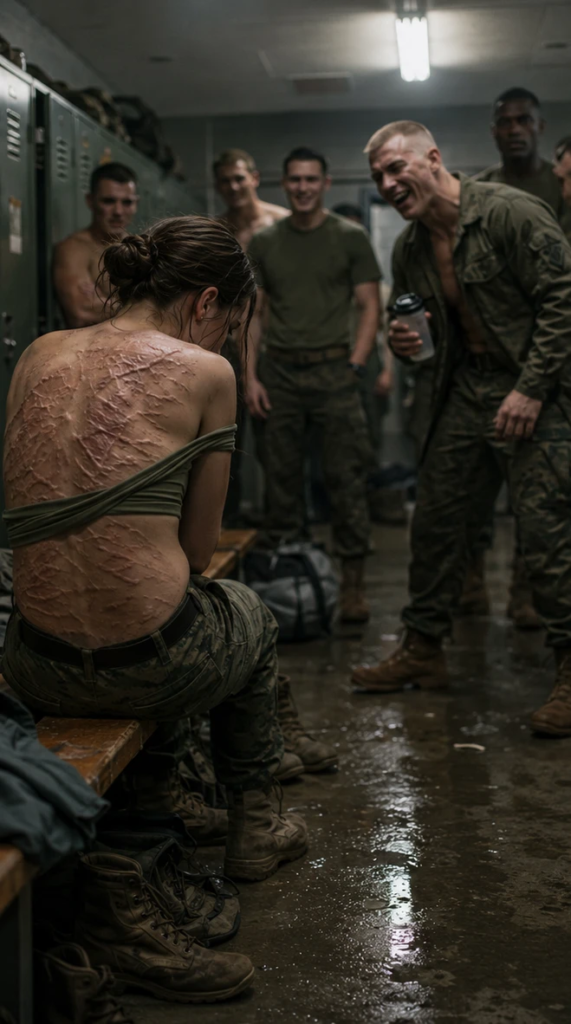
The locker room smelled like exhaustion.The room went dead silent after Sergeant Major Vance spoke. Even Miller’s grin disappeared the second Vance stepped closer to Sarah and stared at the scars on her back like he recognized them.
Sergeant Major Vance slowly removed one glove, revealing burn scars running across his own hand. His jaw tightened for a second before he finally spoke.
Sergeant Major Vance. “I saw what was left of that vehicle after the explosion… and I still don’t understand how anyone walked out alive.”
Sarah’s fingers curled tightly around the edge of the bench. She never looked up, but one Marine near the lockers suddenly noticed something stitched inside her duffel bag an old, smoke-stained military patch with three names written on the back.
Then Vance turned toward the room again.
Sergeant Major Vance. “Do any of you know what burning flesh smells like inside a sealed transport truck?”
Nobody answered.
And Sarah finally closed her eyes like she was hearing the screams all over again.
The continuation of this story is waiting for you.
Sweat soaked into the concrete floor. Mud from the Appalachian training course crusted the bottoms of combat boots. The industrial cleaner the janitors used every night only made the scent worse, mixing bleach with fatigue until the air itself felt heavy enough to choke on. Metal lockers slammed shut in uneven rhythms while Marines stripped off rain-soaked uniforms and complained about the twenty-mile ruck march that had nearly broken half the platoon.
Private Sarah Jenkins sat silently at the far end of the bench.
Her shoulders ached so badly she could barely lift her arms. Every muscle in her back screamed from carrying eighty pounds through mud and cold mountain rain. Usually, she waited until everyone else finished changing before removing her shirt. Usually, she timed everything carefully—head down, movements quick, invisible.
But exhaustion destroyed discipline.
Her fingers trembled while undoing the buttons on her fatigues. She peeled the wet fabric from her body slowly, wincing as sweat dragged against damaged skin beneath the undershirt clinging to her back. Her breathing came shallow and uneven.
Nobody noticed her at first.
Then she pulled the shirt over her head.
The room changed instantly.
Conversation died mid-sentence.
The laughter came a heartbeat later.
“Damn, Jenkins,” Corporal Miller said with a low whistle. He leaned against a locker with a sports drink hanging lazily from his hand. “What the hell happened to your back?”
A few heads turned.
Then more.
Sarah froze.
The scars stretched across her shoulder blades in twisted pale ridges, warped and uneven like melted wax poured over flesh. Some areas looked rope-thick and jagged. Others were smooth and shiny under the fluorescent lights. Together, they spread across her back like the cracked surface of burned earth after a wildfire.
Simmons barked out a laugh.
“Jesus Christ,” he muttered. “Looks like somebody dragged her through a damn engine turbine.”
A few others chuckled nervously.
Miller smirked wider after hearing them join in. “No, no—wait. I got it. Jenkins lost a fight with a lawnmower.”
The room erupted again.
Sarah stared at the floor.
The laughter always felt physical to her. Like fingers pressing into old wounds.
The scars suddenly burned hot beneath the cold locker room air.
Not real heat.
Memory.
Orange flames swallowing steel.
The smell of diesel.
Screaming.
Someone pounding desperately against metal from the inside.
She swallowed hard and forced herself to stay still.
If she reacted, it would only get worse.
Miller mistook her silence for weakness.
He pushed himself off the lockers and walked closer, grinning like a predator circling something injured. “C’mon, Scar-face. Tell us the story.”
Sarah didn’t answer.
“Civilian accident?” he continued. “Or were you just born ugly?”
A couple Marines laughed again, quieter this time.
Miller crouched slightly, trying to force eye contact. “You embarrassed or something?”
Sarah’s jaw tightened.
Her hands curled slowly into fists against her knees.
The hardest part wasn’t the pain. It was pretending the pain meant nothing.
Miller noticed the movement and smirked even harder.
“There it is,” he said softly. “Knew you’d crack eventually.”
Then the locker room door exploded open.
The steel slammed against the concrete wall with a sound like a rifle shot.
Every Marine in the room snapped toward the entrance.
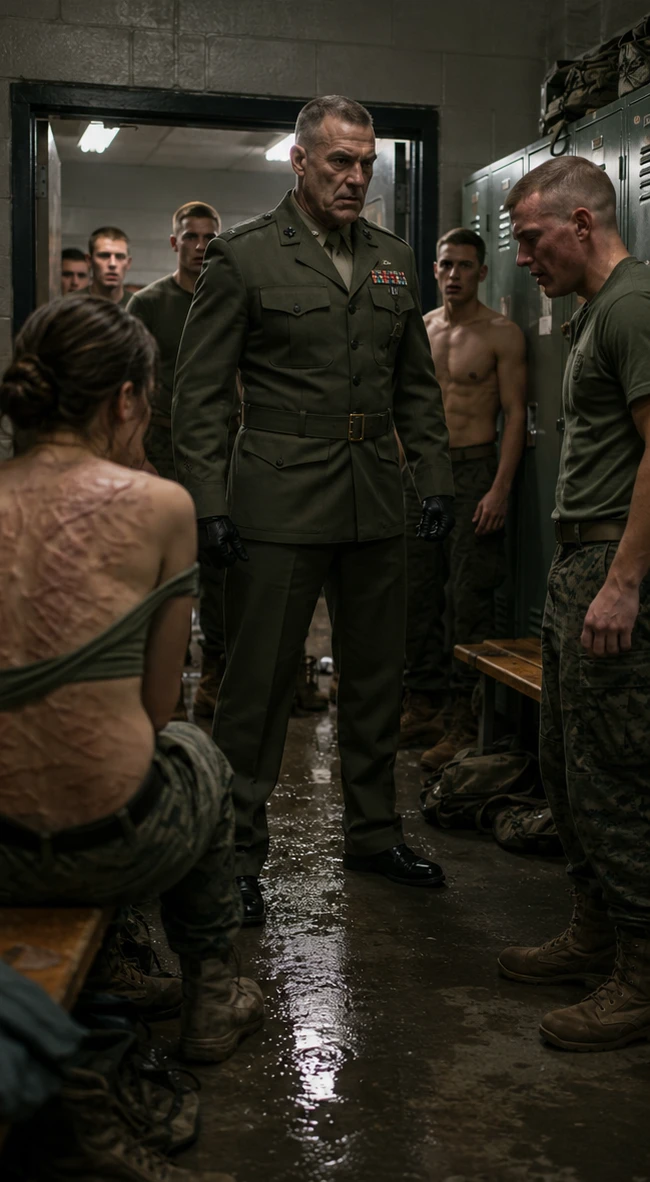
Sergeant Major Vance stood in the doorway.
Silence swallowed the room whole.
Vance wasn’t just respected on base—he was feared. A combat veteran with nearly three decades in uniform, he carried himself like a man carved from old battlefield stone. His face looked permanently etched with exhaustion and fury. Rumors followed him everywhere: firefights overseas, black operations nobody spoke about openly, entire platoons reduced to silence with a single look from him.
And right now, he looked furious.
“Miller.”
The word wasn’t loud.
It didn’t need to be.
Corporal Miller immediately straightened. “Sergeant Major.”
Vance stepped into the room slowly, boots striking the floor with terrifying calm. “What exactly is happening here?”
Nobody answered.
Nobody even breathed.
Miller tried anyway. “We were just joking around, Sergeant Major.”
Vance stared at him.
The silence stretched.
Then stretched longer.
The kind of silence that makes grown men wish someone would just start screaming instead.
“Joking,” Vance repeated quietly.
“Yes, Sergeant Major.”
Vance’s gaze shifted toward Sarah sitting motionless on the bench.
He saw the scars.
And something in his face changed.
Not pity.
Not discomfort.
Recognition.
A long, terrible recognition.
When he looked back at Miller, the temperature in the room seemed to drop ten degrees.
“You think those scars are funny, Corporal?”
Miller swallowed. “No, Sergeant Major, I—”
“You think they’re ugly?”
“No, Sergeant Major.”
Vance took another step closer.
Now Miller looked small.
Very small.
“Because I want you to understand something before you say another word.” Vance’s voice became almost conversational. “Those scars are worth more than every medal most Marines will ever wear.”
Nobody moved.
Sarah slowly lifted her eyes.
For the first time since entering the room, she looked directly at Vance.
And Vance looked at her the way soldiers look at gravesites.
With reverence.
“Two years ago,” Vance said quietly, “Fallujah.”
Several Marines shifted immediately.
The name alone carried weight.
“Humanitarian convoy moving through the city at dawn. Civilian aid workers. Medical supplies. Three Marine escorts assigned to transport security.”
Vance’s eyes never left Miller.
“Then the convoy hit an IED.”
The room stayed dead silent.
“The blast flipped the lead transport vehicle onto its side. Fuel line ruptured instantly. Ammunition inside started cooking off from the heat. Entire vehicle became a furnace in under thirty seconds.”
Sarah’s breathing slowed.
The locker room disappeared around her.
She could hear it again.
Metal screaming.
Glass exploding outward.
A man inside yelling for help until the smoke filled his lungs.
Vance continued.
“Enemy sniper fire pinned down the Marines nearby. Nobody could approach the transport safely. The doors had fused shut from the heat.”
Miller’s face slowly lost color.
“One of the aid workers ignored the gunfire and ran straight into the kill zone.”
Sarah closed her eyes.
She remembered the heat first.
Always the heat.
Not warm.
Not fire.
Something alive.
Something monstrous clawing across skin and muscle while smoke swallowed the sky.
“You know what burning flesh smells like, Corporal?” Vance asked softly.
Miller couldn’t answer.
Vance pointed toward Sarah’s back.
“That young woman wrapped her hands around a metal door handle glowing orange from the flames.” His voice hardened. “Then she ripped the damn thing open anyway.”
A stunned silence settled deeper across the room.
“She pulled one Marine out.”
Sarah remembered his face.
Barely conscious.
Half his face covered in blood.
Begging her not to leave the others behind.
“Then she went back in.”
Vance’s jaw flexed.
“Pulled out a second.”
Sarah remembered collapsing to her knees after dragging him through shattered glass.
Remembered thinking she couldn’t breathe anymore.
Remembered hearing ammunition exploding inside the truck.
Then hearing someone screaming for help.
Still trapped.
Still alive.
“Then she went back a third time.”
Several Marines stared openly at Sarah now.
Not at her scars.
At her.
“By that point,” Vance continued, “her own clothing had caught fire. Skin was literally peeling off her back while she dragged the last Marine through burning fuel.”
Sarah’s throat tightened.
She remembered the last Marine crying.
Not from pain.
From terror.
She remembered promising him he wasn’t going to die.
Even though she had been certain both of them were about to burn alive.
“The vehicle exploded less than a minute later,” Vance said.
Nobody moved.
Nobody dared.
Every man in that room suddenly understood how close death had stood beside her.
Miller looked physically sick now.
Vance finally turned toward Sarah fully.
“That civilian aid worker spent eight months recovering in military hospitals.”
Sarah lowered her eyes again.
Eight months.
Skin grafts.
Nightmares.
Morphine.
Learning how to sleep without screaming.
Learning how to move again when every inch of her back felt flayed open.
People staring.
Children asking what happened to her.
Doctors telling her she’d never fully regain mobility.
Vance’s voice softened slightly.
“After she recovered, she enlisted.”
Several Marines blinked in shock.
“Because saving three Marines wasn’t enough for her.”
The words hit the room harder than shouting ever could.
Miller looked at Sarah again.
But now he wasn’t seeing deformity.
He was seeing fire.
A woman who had walked willingly into hell while trained soldiers couldn’t move.
A woman who carried the memory of burning alive beneath her uniform every single day and still chose to wear it.
Vance stepped beside Sarah’s bench.
“Those scars aren’t shame, Private Jenkins.”
Sarah’s eyes lifted slowly toward him.
“They’re proof.”
Her chest tightened unexpectedly.
Because nobody had ever said that before.
Not doctors.
Not strangers.
Not even herself.
Proof.
Not damage.
Not ugliness.
Proof.
Miller’s voice cracked when he finally spoke.
“Private Jenkins… I didn’t know.”
Sarah stared at him quietly.
Part of her wanted to hate him.
Part of her was too tired to.
Another part understood something painful: most people only respected sacrifice after hearing the story behind it.
Without context, pain just looked ugly.
One by one, Marines around the locker room slowly stood straighter.
Simmons lowered his gaze first.
Then another Marine.
Then another.
Finally Miller snapped to attention.
Not because regulations demanded it.
Because guilt did.
The others followed.
An entire row of Marines stood silently facing Sarah Jenkins.
Not laughing.
Not mocking.
Honoring her.
The room felt completely different now.
Heavy.
Sacred.
Sarah looked around slowly, stunned by the sudden silence wrapping around her like something warm.
For years, she had hidden the scars like evidence of weakness.
For years, she had rushed to cover them before anyone could stare too long.
For years, every glance felt like judgment.
But now—
Now nobody looked disgusted.
They looked humbled.
And somehow that hurt worse.
Because she realized how badly she had wanted this all along.
Not admiration.
Not praise.
Just understanding.
Vance gave a small nod toward her clean uniform folded beside the bench.
“Carry on, Marine.”
Sarah stood slowly.
The scars across her back shifted beneath the fluorescent lights like pale rivers of fire carved into flesh.
For the first time since joining the Corps, she didn’t rush to cover them.
She reached calmly for her shirt.
And nobody looked away.
Because those weren’t scars anymore.
They were survival written directly onto skin.
They were courage burned permanently into bone.
They were the reason three Marines had made it home alive.
And as Sarah pulled on her uniform, the heat that once haunted her back no longer felt like flames.
It felt like armor.