The admiral’s hand hovered over the classified folder while the entire beach stood frozen. Vanessa’s smile was gone. Her drink trembled in her hand.
Then the admiral looked past Commander Reed and fixed his eyes on her father.
“Colonel Reed… are you sure you want this opened here?”
For the first time that afternoon, her father looked afraid.
The folder opened.
Commander Reed glanced at the first page—and all the color drained from her face.
PART 1
My father stood motionless while strangers stared at me like I was damaged beyond repair. For five years, my family let people believe I was a disgraced former officer who had quietly vanished after some shameful failure. Then an admiral crossed the sand, looked at my scars, and said seven words that stopped the whole shoreline cold: “I’ve been searching for you for five years.”
The California sun had no mercy that afternoon. Heat shimmered over La Jolla Shores, gulls screamed above the water, and the air smelled like salt, sunscreen, and catered shrimp left too long under silver lids. I stood near the edge of the private beachfront gathering with my sleeves buttoned tight, sweat dampening the cotton against my arms.
I had learned to live with discomfort. After enough years, pain stops announcing itself and becomes furniture in the room.
My younger sister, Vanessa, never understood that. Or maybe she did and enjoyed pretending not to.
She moved across the sand in a designer swimsuit, laughing with a circle of friends and junior Navy officers who looked at her like the sun had personally picked her out. Vanessa had always been good at that: making attention feel like weather around her. When we were kids, she cried if I got praised for a report card, and when I came home from deployment with a body nobody wanted to discuss, she discovered that pity could be turned into mockery if she aimed it carefully enough.
“Seriously?” she called, loud enough for nearby tables to hear. “Are you hiding from the sun now?”
A few people laughed because laughing was easier than deciding whether she was being cruel.
I lifted my plastic cup of water and said nothing.
Nothing frustrated Vanessa more than not being fed a reaction.
“You do realize this is a beach, right?” she went on. “Not some secret witness protection program.”
My father stood twenty feet away with two young officers and a paper coffee cup in his hand. Colonel Harrison Reed, retired Marine. A man who taught both his daughters that discipline mattered, then confused silence with honor whenever feelings entered the room. He glanced at me once, saw the sleeves, saw Vanessa circling, and looked away.
That hurt more than her words.
Strangers can misunderstand you. Family has to choose it.
Vanessa stepped closer until I could smell her perfume under the sunscreen. “You could at least pretend to enjoy yourself.”
“I’m fine,” I said.
She smiled. “That’s exactly the problem.”
At 2:18 p.m., according to the timestamp on the event photographer’s camera later, her hand hooked into the collar of my shirt.
She yanked hard.
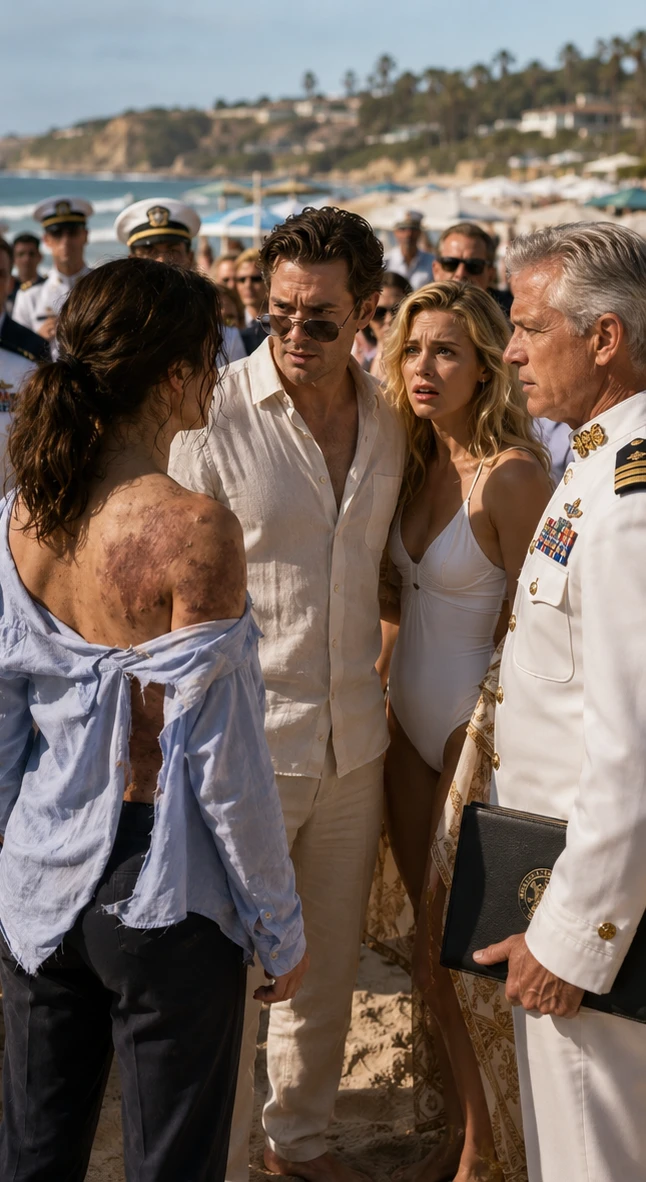
Fabric tore at the seam with a dry rip that cut through the music and surf noise. My shoulder came bare before I could twist away, and sunlight landed on skin I had spent five years keeping covered.
The beach went silent.
Not respectful silence. Not the kind given to a flag ceremony or a prayer before dinner. This was the silence people make when something private is thrown open in public and nobody knows whether looking away would be kinder or more insulting.
A serving tray froze halfway between two guests. A champagne flute hung near a woman’s mouth. One lieutenant stared at the sand like the answer might be written there. My father’s coffee cup stopped inches from his lips, and the little American flag on the beach club pole kept snapping in the wind like it was the only thing allowed to move.
Nobody moved.
Burn scars crossed my back and shoulder. Surgical lines ran along my ribs. Small metal-fragment wounds marked places where surgeons had opened, cleaned, repaired, and closed what was left after Operation Nightfall. They were not pretty. They were not supposed to be.
Vanessa stared openly, then laughed.
“Oh my God,” she said. “I forgot how awful it looks.”
I pulled the torn shirt back into place. Slowly. Carefully. My hands did not shake, and that seemed to disappoint her most.
“She’s always been mysterious about why she left the Navy,” Vanessa announced, turning toward the officers as if she were entertaining them. “Everyone assumed it was some heroic classified story.”
Then she pointed at my shoulder.
“Turns out she’s just a walking disaster.”
A few uncomfortable chuckles slipped out and died fast.
For five years, my family had let the rumors breathe. They never corrected the whisper that I had washed out, failed, broken under pressure, or disappeared because I could not face whatever I had done. No one in that family ever asked why a Navy commander came home with classified discharge notes, medical evacuation summaries, and a service record sealed behind more locked doors than sympathy.
Truth is heavy when it ruins the family picture. Shame is lighter. People pass it around at parties and call it concern.
My father looked at me then. Really looked. But still, he said nothing.
I swallowed once and took one slow breath through my nose. For one ugly second, I imagined throwing my water in Vanessa’s face. I imagined my father finally having to choose a side in public. Then I let the thought pass, because rage had already taken enough from me.
That was when the black government SUV rolled onto the private beach access road.
Every officer near us straightened.
The SUV stopped beside the rope line. The driver stepped out first. Then the rear door opened, and an older man in spotless Navy dress whites stepped onto the sand like the heat did not exist.
Admiral Thomas Hale.
I had not seen him since the medevac corridor outside the forward operating hospital, five years earlier, when alarms were still ringing and someone kept yelling my name like repetition could keep me alive.
He saw me and stopped.
Completely.
The conversations died in rings around us. Vanessa’s smile dropped. My father’s face tightened into something I had not seen on him in years. Confusion. Fear. Recognition arriving too late.
The admiral walked straight toward me. Two officers followed with a black classified folder pressed between them, edges taped and marked with process labels that made every uniform on that beach go still: AFTER-ACTION REVIEW, WITNESS MATERIAL, OPERATION NIGHTFALL.
Then Admiral Hale stopped in front of me.
And saluted.
A full formal salute.
On that beach, in front of my sister, my father, and every person who had mistaken my silence for disgrace, the admiral held that salute long enough for shame to change hands.
“I’ve been searching for you for five years, Commander Reed,” he said.
Vanessa’s drink slipped in her fingers.
My father looked like someone had pulled the air out of his chest.
The admiral lowered his hand, but his eyes had already moved to the torn collar and the scars still visible near my shoulder. His expression hardened.
“We finally identified the person responsible for the unauthorized strike during Operation Nightfall.”
Every muscle in my body locked.
Because this was no longer about Vanessa’s cruelty. It was no longer about my father’s silence or the beach full of people staring at old wounds like they were entertainment. It was about the mission that nearly killed me, the report that had vanished, and the powerful hand that had spent five years turning the truth into fog.
The admiral opened the black folder.
Inside was a single page on top, clipped with a red evidence tab.
Then he looked at me and said quietly, “Commander…”
PART 2
“Commander…” Admiral Hale said again, but this time his voice carried something heavier than rank. It carried grief.
He turned the page toward me.
For five years, I had imagined that folder in my nightmares. Not the black cover. Not the red evidence tab. The truth inside. The truth people had buried so deeply that even my own father had accepted the easier story: that I had failed, vanished, and come home broken because I deserved it.
The paper on top was a flight authorization log.
My eyes found the signature before my mind was ready to understand it.
HARRISON REED.
My father’s name.
The beach tilted under my feet.
For one second, the ocean vanished. The laughter, the gulls, the officers, Vanessa’s frozen mouth—everything collapsed into a single line of black ink at the bottom of a page.
My father whispered, “No.”
But he did not sound innocent.
He sounded old.
Vanessa blinked between us, her hand still tangled in the torn fabric of my shirt like she had forgotten she was touching me. “Dad?” she said, suddenly small. “What is this?”
Admiral Hale did not look at her.
He looked at Colonel Harrison Reed, retired Marine, the man who had taught me how to shine boots, how to stand straight, how to swallow pain without showing it, how to believe duty mattered more than hunger, sleep, fear, or blood.
“Colonel Reed,” the admiral said, “would you like to explain why your authorization code appears on the strike order that hit your daughter’s extraction team?”
A sound moved through the beach like wind through dry grass.
Officers straightened. Guests stepped backward. Someone dropped a fork into the sand. The tiny metallic sound rang out like a bell at a funeral.
My father’s hand shook around his coffee cup.
“I didn’t know she was there,” he said.
Those six words entered my body more violently than Vanessa’s hands ever had.
I stared at him. “You knew Nightfall was active.”
His eyes lifted to mine. For the first time in five years, he looked at my scars without flinching away from them.
“I knew an operation was compromised,” he said. “I was told insurgents had overrun the extraction corridor.”
“You authorized a strike without confirming friendly positions,” Admiral Hale said.
My father swallowed. “The request came through proper channels.”
“The request was forged,” Hale said.
My father closed his eyes.
The admiral’s voice sharpened. “But the authorization was not.”
Vanessa let go of my shirt as if it had burned her. She took one step away from me. Then another. Her face had lost all its practiced beauty. Without cruelty, she looked almost like a child wearing someone else’s confidence.
“Dad,” she breathed, “you said she washed out.”
My father did not answer.
He only stared at me.
And in that silence, I understood the second betrayal.
Not the strike. Not the explosion. Not the months of surgeries or the screams behind morphine. The second betrayal had happened afterward. When he learned I survived. When he had the chance to tell the truth. When his daughter came home with half her back carved into evidence, and he chose his name over mine.
I felt something inside me go very still.
“Why?” I asked.
My voice was quiet enough that people leaned in to hear it.
My father’s mouth trembled once. “Because I thought I had killed you.”
The words emptied the beach.
He looked no longer like a colonel, no longer like a father, no longer like the granite statue of discipline I had feared and loved my whole life. He looked like a man who had been rotting in his own uniform for five years.
“When I found out you were alive,” he said, “the investigation had already begun. My authorization code was in the chain. I told myself the system would clear it up. Then your records were sealed, and Hale was reassigned, and people stopped asking questions.”
Admiral Hale’s jaw tightened.
My father looked at Vanessa, then back to me. “I was a coward.”
Vanessa gave a soft, broken laugh. “No. No, this is insane. You let me make fun of her.”
“Yes,” my father said.
My sister’s face crumpled.
For years, Vanessa had wielded my supposed disgrace like a jeweled knife. She had called me dramatic, damaged, bitter, unstable. She had laughed at long sleeves in summer and stiff posture in family photos. But now the weapon had turned in her palm, and she was seeing, perhaps for the first time, that cruelty does not become harmless just because someone hands it to you.
“You let me believe she was nothing,” Vanessa whispered.
My father said, “I let everyone believe that.”
The admiral opened the folder wider. Beneath the flight log lay photographs, witness summaries, satellite stills, and a sealed medical report. I saw names I had not allowed myself to remember. Lieutenant Aaron Price. Petty Officer Malia Chen. Corpsman David Voss. Men and women who had run toward smoke because I told them we could make it out.
Some of them did not.
A hot pressure rose behind my eyes, but I refused to let the beach have my tears.
Admiral Hale turned to me. “Commander Reed, there is more.”
Of course there was.
Truth, once dug from the grave, never rises alone.
He lowered his voice. “The unauthorized strike was not simply an error. Someone used your father’s code because they knew it would be accepted quickly. That person disappeared from the chain of command three hours later.”
“Who?” I asked.
The admiral’s eyes flicked, almost unwillingly, toward the gathering behind Vanessa.
My sister followed his gaze.
So did I.
Near the catering table, half hidden behind a white umbrella, stood a man in a pale linen shirt and sunglasses. He had been laughing with Vanessa’s friends earlier. Handsome, clean, forgettable in the expensive way powerful people pay to be forgettable.
Vanessa’s fiancé.
Ethan Vale.
His face had gone completely blank.
The folder in Admiral Hale’s hand suddenly felt less like a record of the past and more like a loaded weapon.
Vanessa turned toward Ethan. “What is he talking about?”
Ethan gave her a tight smile. “Vanessa, don’t.”
That was all.
Not confusion.
Not outrage.
A warning.
My skin went cold despite the sun.
Admiral Hale said, “Ethan Vale was a civilian intelligence contractor attached to Nightfall logistics. Five years ago, he transmitted false ground coordinates from a secure relay station, then routed the strike request through Colonel Reed’s authorization chain.”
Vanessa shook her head. “No. Ethan was in Geneva then.”
“No,” I said.
Everyone looked at me.
For five years, there had been one memory I had never trusted because trauma makes liars of pain. A voice over static. Smooth. Calm. American. Telling air command the corridor was clear.
I looked at Ethan, and the world narrowed.
“You said,” I whispered, “‘Confirm clean corridor. No friendlies in grid.’”
Ethan’s jaw moved once.
My body remembered before my mind did.
The blast. The white flash. The heat. The smell of metal. My own voice screaming into comms that we were still there, still there, still there.
I took one step toward him.
Ethan stepped back.
Two Navy officers moved with me.
The whole beach seemed to inhale.
Vanessa stared at the man she was going to marry. “Ethan?”
He looked at her then, and the mask cracked. Not with guilt. With irritation.
“You have no idea what that operation was worth,” he said.
Admiral Hale’s face hardened to stone.
Ethan’s voice lowered. “Nightfall wasn’t supposed to have survivors.”
The words struck harder than the explosion ever had.
Vanessa covered her mouth.
My father made a sound I had never heard from him before—half gasp, half animal grief.
I realized then that Ethan had not merely hidden inside our family by accident. He had chosen us. Chosen Vanessa. Chosen access to my father, to old guilt, to silence. He had slept under our roof at holidays, toasted with my family, kissed my sister in front of me, and watched my scars from across dinner tables.
He had not been afraid of being found.
He had been checking whether I remembered.
PART 3
Ethan turned and ran.
For half a second, no one moved—not because they could not, but because the moment was too monstrous to fit inside ordinary reflexes.
Then Admiral Hale barked, “Stop him!”
Two officers lunged across the sand. Ethan shoved past a waiter, sending a tray of shrimp and glassware crashing onto the beach. Vanessa screamed his name. Guests stumbled backward. A white umbrella tipped over, its pole carving a frantic line through the sand.
Ethan reached into his linen jacket.
My body moved before thought.
Five years of pain disappeared under training.
I grabbed Vanessa by the wrist and yanked her down just as Ethan spun back with a compact black pistol in his hand.
The first shot cracked across the beach.
People screamed.
The bullet struck the metal pole of the catering tent behind us with a violent clang. Vanessa hit the sand beside me, breath punched from her lungs, eyes huge with terror.
I pinned her behind the overturned table and looked into her face.
For the first time in my life, my sister looked at me not with envy, not with contempt, not with performance, but with the raw bewilderment of someone realizing the person she tried to destroy had just saved her life.
“Stay down,” I said.
She nodded, shaking.
Ethan backed toward the access road, pistol sweeping wildly. “Nobody follows me!”
The Navy officers froze behind cover. Guests sobbed into the sand. My father stood exposed, motionless, staring at Ethan like the devil had finally taken human form at a family party.
“Dad!” I shouted.
He did not move.
Ethan saw him.
A terrible smile formed on his face.
“You,” Ethan called. “You made this easy, Colonel. All that pride. All that fear. All I had to do was let you think your daughter’s silence protected you.”
My father’s face collapsed.
Ethan raised the gun toward him.
I ran.
Not gracefully. Not like heroes do in movies. My damaged ribs screamed, my old injuries tore lightning through my back, and sand dragged at my feet. But I ran because a daughter can hate a father and still know the shape of him in a gun sight.
The second shot fired.
I hit my father hard enough to knock both of us sideways.
The bullet passed where his chest had been and smashed into a champagne bucket behind him.
Ice exploded across the sand.
We crashed down together.
My father stared up at me, eyes wet, stunned beyond words.
For five years, he had looked at my scars as proof of his shame. Now he saw them as the reason he was still breathing.
“Don’t,” he whispered.
I did not know whether he meant don’t save me, don’t forgive me, or don’t die.
Admiral Hale moved with impossible speed for a man his age. He came around the table from Ethan’s blind side as the younger officers closed in. Ethan swung the pistol toward him.
And Vanessa rose from the sand.
“Ethan!”
Her scream tore through the beach.
He looked at her for one fatal instant.
Vanessa threw the only thing in her hand—her glass.
It struck Ethan across the temple. Not hard enough to knock him out, but hard enough to turn his aim. The gun fired into the air. A Navy officer tackled him from the side. Another drove his knee into the sand beside Ethan’s wrist. The pistol flew free and skidded to a stop near the rope line.
Then it was over.
Not quiet. Not clean. Not heroic.
Just over.
Ethan lay face-down in the sand, cuffed, cursing through blood on his lip. Vanessa collapsed to her knees, sobbing so hard she could not make sound. My father sat beside me with one hand pressed to his chest as if searching for a wound that was not there.
Admiral Hale retrieved the pistol with a handkerchief and gave it to an officer. Then he came to me.
“Commander,” he said, “are you hit?”
I looked down at myself.
Blood marked my torn sleeve, but it was not from a bullet. It was from the old scar tissue on my shoulder, reopened when I had hit the ground.
“I’m fine,” I said.
The admiral gave me a look that said he had heard that lie from too many soldiers, sailors, and survivors.
Vanessa crawled toward me on shaking hands.
“Don’t,” I said.
She stopped as if the word had struck her.
Her face crumpled. “I didn’t know.”
“No,” I said, my voice flat. “You didn’t care enough to know.”
That hurt her more than shouting would have.
She bowed her head, hair falling over her face. “You saved me.”
I looked at Ethan being dragged toward the black SUV. “He was aiming at everyone.”
“But you pulled me down first.”
I had no answer for that.
Maybe instinct is cruel that way. It saves people before the heart has time to vote.
My father reached for me, then stopped, his hand hovering uselessly in the space between us.
“I killed your team,” he said.
Admiral Hale turned sharply. “No. Ethan Vale did.”
My father shook his head. “I signed.”
“Yes,” I said.
The word was not loud, but he flinched.
I pushed myself upright. The torn shirt slipped again, exposing the scars Vanessa had tried to use as a spectacle. This time, I did not cover them.
Let them look.
Let all of them look.
These were not shame. These were testimony.
Admiral Hale stood beside me and faced the gathered officers. “Commander Reed led twelve personnel out of an unauthorized strike zone under fire after sustaining critical injuries. Her actions saved seven lives and preserved evidence that exposed a criminal network embedded inside military logistics.”
A murmur moved across the beach.
He continued, louder now. “Her record was sealed not because she was disgraced, but because she was the surviving witness in an active counterintelligence investigation.”
My father covered his face.
Vanessa whispered, “Oh God.”
Admiral Hale turned back to me. “And there is one final matter.”
A strange exhaustion passed through me. “More?”
His expression softened.
From inside the folder, he removed a small velvet case.
My breath caught.
“No,” I said.
“Yes,” he replied. “It should have been presented five years ago.”
He opened it.
Inside lay the Navy Cross.
The beach blurred.
For years, I had wanted only one thing: not medals, not apologies, not ceremonies, not revenge. I wanted the dead to matter. I wanted someone to say their names without lowering their voice like they were part of a family embarrassment.
Admiral Hale did.
He read them aloud.
Aaron Price. Malia Chen. David Voss. Samuel Ortiz. Lena Brooks.
Each name entered the air like a bell.
Then he pinned the medal to what was left of my torn shirt.
The applause began slowly. One officer first. Then another. Then the whole beach rose into a thunder that felt nothing like celebration and everything like a debt finally being paid.
Vanessa sobbed openly.
My father stood, trembling. He faced me with the posture of a man reporting for judgment.
“I don’t deserve forgiveness,” he said.
“No,” I answered. “You don’t.”
His eyes closed.
“But you can tell the truth,” I said.
He opened them again.
“All of it,” I said. “Every hearing. Every name. Every lie you allowed. That is not forgiveness. That is the beginning of repair.”
He nodded once, broken but listening.
Two federal vehicles arrived fifteen minutes later.
That was when the final shock came.
As agents searched Ethan’s abandoned beach bag, they found a second folder sealed in waterproof plastic. Inside were photographs of me from the past six months. Grocery store. Apartment window. VA hospital parking lot. Even this beach, taken from a distance that morning.
Vanessa saw them and went white.
At the bottom of the folder was a printed seating chart for her wedding.
My name was circled.
Beside it, in Ethan’s handwriting, were two words:
FINAL WITNESS.
Vanessa sank into the sand as if her bones had dissolved.
The truth was suddenly complete.
Ethan had not planned to marry my sister.
He had planned to kill me at the wedding and frame it as a family tragedy born from old resentment. Vanessa’s cruelty, my father’s guilt, my isolation—he had arranged them all like furniture in a room where murder would look inevitable.
For once, nobody spoke.
Not even the ocean seemed loud enough.
Six months later, I stood in a federal courtroom wearing a dark blue suit that did not hide my scars. I testified for nine hours. My father testified for eleven. Vanessa testified through tears, and for the first time in her life, she did not try to make herself beautiful while doing it.
Ethan Vale was convicted on charges that filled three pages.
My father surrendered his retirement honors.
Vanessa called me every Sunday for a year before I answered.
And me?
I went back to La Jolla once.
Alone.
The beach club had repaired the tent pole. The umbrellas were new. The sand held no memory of blood, glass, or applause. That is the strange mercy of places. They survive us without keeping score.
I stood near the rope line where my sister had torn my shirt open and lifted my face to the sun.
For five years, I had believed survival was the same as living quietly enough not to be noticed.
But scars are not secrets.
They are maps.
And mine had led the truth home.