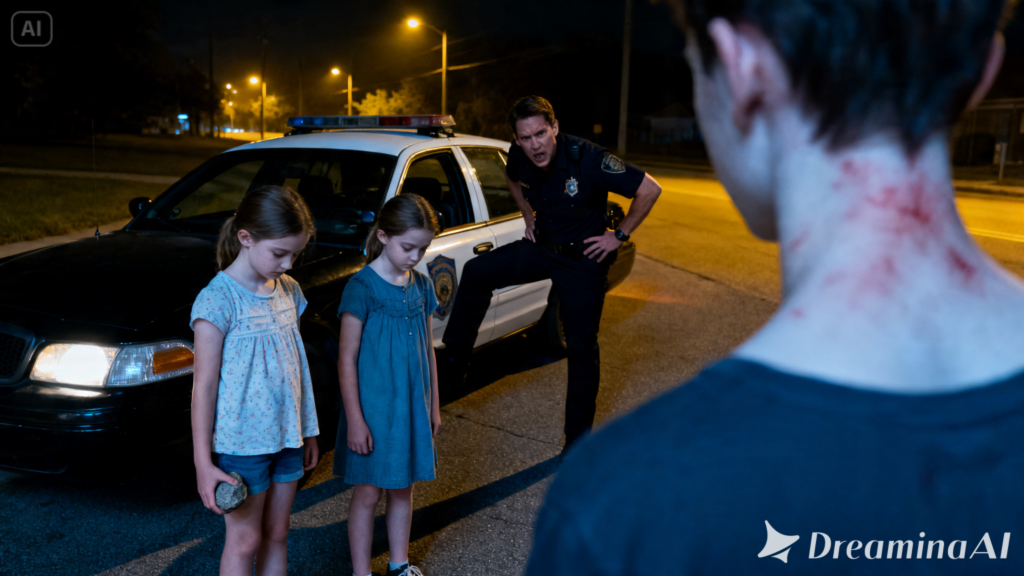
CHAPTER 1: The Midnight Vandals On Interstate Route 85
I’ve been a patrol officer working the graveyard shift for twelve brutal years, but absolutely nothing could have prepared me for the terrifying truth waiting for me at the edge of the highway.
It was 2:00 AM on a blistering Tuesday in July.
My cruiser was idling near the exit ramp of Interstate 85. The radio crackled with the tired, annoyed voice of our night dispatcher.
“We’ve got a 10-59 in progress. Malicious mischief. A couple of kids throwing rocks at passing patrol cars near the old industrial park.”
I sighed, rubbing my burning eyes. Vandalism. At two in the morning.
I flipped on my sirens, just a quick flash of the lights to scare them off, and rolled toward the scene.
Under the glaring, sickly orange glow of the highway streetlights, I spotted them.
Two little girls.
They couldn’t have been more than seven years old.
They were standing shoulder-to-shoulder on the dusty gravel shoulder of the road. Their clothes were little more than rags, hanging loosely from their tiny, shivering frames despite the suffocating summer heat.
And they were doing exactly what dispatch had said.
As I slowly pulled up, one of the girls picked up a jagged chunk of asphalt and threw it weakly at my cruiser’s tire.
It bounced harmlessly off the rubber.
They weren’t trying to cause damage. They were trying to get caught.
I threw the car into park and stepped out, adjusting my heavy duty belt.
“Hey!” I shouted, keeping my voice firm but not overly aggressive. “Where are your parents? It’s way too late for you to be out here.”
The girls didn’t run. They didn’t cry.
Instead, they just stared at me with wide, hollow eyes. Eyes that had seen things no child should ever see.
As I approached them, my flashlight beam cut through the darkness and swept over their dirt-smudged faces.
That’s when I noticed it.
They were identical twins.
And they were trembling violently.
“It’s okay,” I said, softening my tone and kneeling down in the dirt to be at their eye level. “I’m Officer Miller. I’m not going to hurt you.”
The girl on the left reached out a tiny, shaking hand and grabbed my uniform sleeve.
She didn’t say a word. She just turned her head, looking back into the pitch-black shadows of the abandoned warehouse district behind them.
When she turned, her matted hair fell away from her neck.
My breath caught in my throat.
There was a deep, dark purple bruise stretching across her collarbone.
But that wasn’t what made my blood run instantly cold.
Right at the base of her skull, freshly inked into her pale skin, was a black barcode.
My mind struggled to process what I was looking at. A tattoo? On a seven-year-old child?
I gently reached out and brushed the hair away from the second girl’s neck.
Another bruise. Another set of numbers. Another barcode.
Matching marks. Like inventory. Like property.
My heart began to hammer violently against my ribs. I reached for my radio, suddenly painfully aware of the deafening silence surrounding us.
The first little girl tugged on my sleeve again.
She pointed a trembling, dirt-caked finger toward the massive, rotting structure of an abandoned shipping warehouse just beyond the highway guardrail.
“They’re… they’re taking the others,” she whispered, her voice barely a rasp.
Advertisement
I stared into the black, gaping doors of the warehouse, my hand frozen on my radio.
This wasn’t a vandalism call.
This was a rescue.
CHAPTER 2: A Desperate Whisper And The Blacked-Out Truck
My hand hovered over the heavy black plastic of my radio mic, frozen in mid-air.
For a few agonizing seconds, the rest of the world completely ceased to exist.
There was no humid July wind blowing off the highway. There were no headlights cutting through the darkness from the distant northbound lanes. There was only the sickening, undeniable reality of what I was looking at.
A barcode.
Inked into the delicate, bruised skin of a seven-year-old child.
I had been wearing a police badge for twelve years. I had worked the worst neighborhoods, broken up violent domestic disputes, pulled bodies from horrific highway wrecks, and chased armed suspects through pitch-black alleyways.
I thought my capacity to be shocked had died a long time ago. I thought I had seen the absolute lowest depths of human depravity.
I was wrong. So entirely, devastatingly wrong.
My mind raced, trying to find a rational explanation. Maybe it was a temporary tattoo. Maybe it was some sort of sick, twisted prank pulled by a terrible parent.
But as I leaned closer, my flashlight beam illuminating the base of the little girl’s neck, the illusion of a prank vanished.
The ink was slightly raised. The skin around the edges of the thick black lines was inflamed, carrying a faint reddish hue that told me exactly what I was looking at.
It was a real tattoo. It was relatively fresh. And it had been done with absolute, terrifying precision.
Beneath the vertical black bars, there was a string of tiny numbers.
044.
I turned my flashlight slightly to the left, illuminating the back of her twin sister’s neck.
045.
Advertisement
They weren’t just marked. They were numbered. Sequenced. Stamped into a system like boxes of freight on a loading dock.
A wave of pure, unfiltered nausea hit me so hard I actually had to swallow back bile. My knees felt weak, pressing into the sharp gravel of the highway shoulder.
“Hey,” I managed to whisper, my voice cracking in a way it never had on duty. “Hey, sweetie. Look at me.”
The girl with 044 on her neck turned back to face me. Her eyes were enormous, taking up half of her dirt-smudged, hollow face.
She didn’t cry. That was the most terrifying part. Children in danger cry. They scream for their mothers. They panic.
These girls were entirely silent. Their emotional responses had been systematically crushed, leaving behind nothing but a hollow, survival-driven emptiness.
“I need to get you both into my car,” I said, forcing my voice to stay level, calm, and projecting a safety I didn’t currently feel. “You’re going to be safe now. I promise you. I am going to keep you safe.”
I slowly stood up, keeping my hands visible, treating them with the same extreme caution I would use with a wounded animal.
I opened the heavy rear door of my patrol cruiser. The thick, blast-proof glass and reinforced steel suddenly felt like a sanctuary.
“Come on. Climb in. The air conditioning is on.”
They hesitated. 045 grabbed her sister’s hand, her tiny fingers digging into the older twin’s palm.
“They… they won’t hear us?” 044 asked, her voice sounding like dry leaves scraping across pavement.
“No one is going to hurt you,” I said, stepping back to give them space. “Get inside.”
They scrambled into the back of the cruiser, their bare, cut-up feet leaving dusty footprints on the heavy rubber floor mats.
I slammed the door shut. The heavy click of the locking mechanism echoed in the quiet night.
For a brief second, I leaned against the roof of the car, closing my eyes, taking a deep, shuddering breath of the thick summer air.
My heart was beating a frantic rhythm against my ribs.
What the hell is happening? I thought. What did I just stumble into?
I walked around to the driver’s side, opened the door, and reached for the mounted radio.
Standard protocol was clear. Call it in. Request immediate backup, EMS, and child protective services. Establish a perimeter. Wait for the brass.
Advertisement
I unclipped the mic. I pressed the transmission button.
“Dispatch, this is Unit 4-Bravo.”
“Go ahead, 4-Bravo,” the dispatcher’s voice crackled back, sounding bored and exhausted. “You got those kids rounded up?”
I opened my mouth to speak, but the words died in my throat.
I looked through the reinforced steel mesh separating the front and rear seats. The two little girls were huddled together in the corner, staring at me with expressions of pure terror.
But they weren’t looking at me. They were looking at my radio.
044 shook her head violently, her hands coming up to cover her ears. She mouthed the word, No.
Something cold and heavy settled in the pit of my stomach.
A memory flashed into my mind. A raid we conducted three years ago on a suspected stash house on the south side. We had an airtight warrant, the element of surprise, and a ten-man tactical entry team.
But when we kicked the door down, the house was completely empty. A pot of coffee was still brewing in the kitchen. They had vanished minutes before we arrived.
Someone had tipped them off. Someone who had access to our frequencies. Someone with a badge.
If this was a human trafficking ring—and the barcodes left absolutely no doubt in my mind that it was—this wasn’t a couple of street-level thugs operating out of a basement.
Tattooing children with inventory numbers required a system. It required a facility. It required money, logistics, and total secrecy.
Rings like that didn’t exist without paying off the right people. Rings like that had eyes and ears everywhere.
If I put this out over the main unencrypted dispatch channel, every scanner in a fifty-mile radius would pick it up. If there was a dirty cop on shift, or if the people in that warehouse were monitoring emergency frequencies, I would be signing these girls’ death warrants.
And worse, I would be signing the death warrants of whoever was still trapped inside that building.
“4-Bravo, do you copy?” the dispatcher asked, annoyance creeping into her tone. “What’s your status?”
I took a deep breath and released the transmit button.
“Cancel the 10-59, dispatch,” I lied, my voice steady despite the adrenaline surging through my veins. “Area is clear. Kids must have scattered into the woods when they saw my lights. I’m going to do a quick foot patrol of the perimeter and then return to sector.”
“Copy that, 4-Bravo. Show you out on foot patrol. Keep it brief.”
Advertisement
I clicked the radio off.
The silence in the cruiser felt suffocating.
I turned around to face the back seat. I reached into my duty bag and pulled out two sealed bottles of water, slipping them through the narrow gap in the security partition.
“Here,” I said softly. “Drink this slowly.”
They practically tore the plastic caps off, downing the water with a desperate, terrifying thirst.
“What are your names?” I asked, keeping my tone incredibly gentle.
044 lowered her water bottle, wiping her mouth with the back of her dirty hand.
“I’m Maya,” she whispered. She pointed to her sister. “This is Mia.”
“Maya and Mia. Those are beautiful names,” I said. “Maya, I need you to be very brave for me right now. Can you do that?”
She nodded slowly.
“You said… you said they were taking the others. What does that mean?”
Maya swallowed hard. Her tiny shoulders began to shake.
“The trucks are here,” she said, her voice dropping to a terrified whisper. “The big dark trucks. When the trucks come, the men in the masks wake us up. They scan the marks on our necks with a red light. Then they put the others in the boxes.”
My blood ran ice cold.
“Boxes?”
“Wooden boxes,” Mia chimed in, speaking for the first time. Her voice was higher, weaker. “Like the ones they put the heavy tools in. They put them in the boxes and put them in the truck.”
I felt physically sick. Shipping crates. They were moving children in shipping crates.
“How did you get out?” I asked.
“There was a hole behind the big metal shelf,” Maya explained, her eyes darting toward the dark windows of the cruiser as if expecting a monster to smash through the glass at any moment. “Where the rats live. We squeezed through. We followed the pipe to the ditch. The man with the big boots didn’t see us.”
“How many others are still inside?” I asked, dreading the answer.
Advertisement
Maya looked down at her hands.
“A lot,” she whispered. “Twenty. Maybe more. The man with the red flashlight said the truck leaves in an hour. He said it goes far away. Across the water.”
Across the water. International shipping.
If that truck left the warehouse, those children would be gone forever. They would vanish into the dark, endless void of the global black market, never to be seen again.
I looked at the digital clock on my dashboard.
2:14 AM.
I didn’t have time to wait for a specialized task force. I didn’t have time to wake up a judge for a warrant. I didn’t even have time to call my sergeant on his personal cell phone and wait for him to drive across town.
By the time backup arrived, the warehouse would be empty, and the truck would be halfway to the nearest shipping port.
There was no choice.
“Listen to me, Maya. Mia. You are going to stay right here in this car,” I said, locking my eyes on theirs. “The doors are locked from the outside. The glass is bulletproof. Nobody can get in here. Do you understand?”
They nodded in unison.
“I am going to leave the air conditioning running. I am going to go over to that warehouse, and I am going to stop those trucks. I will be back. I promise.”
I turned around, opened my center console, and pulled out my heavy steel key ring. I separated the primary cruiser key, keeping it in the ignition to run the engine, and pocketed my spare tactical fob.
Then, I reached into the passenger side footwell and unlatched my patrol rifle lock.
The heavy, metallic clack of the locking mechanism releasing seemed deafening.
I pulled out my department-issued AR-15. I checked the chamber, ensuring a round was seated properly, and slapped a full magazine into the well.
I wasn’t an elite SWAT operator. I was just a highway patrolman. I was trained for traffic stops, domestic disputes, and the occasional armed robbery.
I had never breached a hostile stronghold alone.
But as I looked back at the terrified faces of those two marked little girls, I knew I was the only thing standing between two dozen children and a lifetime of unimaginable hell.
I stepped out of the cruiser and quietly closed the door.
Advertisement
The oppressive heat of the summer night instantly wrapped around me like a wet blanket. The hum of the highway felt a million miles away.
I stood at the edge of the guardrail, staring out across the expanse of overgrown weeds and shattered concrete that separated the interstate from the abandoned industrial park.
The warehouse loomed in the distance against the dark sky. It was massive, a sprawling complex of corrugated steel and rotting concrete that had been shut down since the early 2000s.
To the naked eye, it looked completely dead. No exterior lights. No signs of life. Just a decaying monument to a forgotten manufacturing era.
But now, staring into the shadows, I could feel the malevolence radiating from the structure.
I clicked my Maglite on, keeping the beam aimed low at the ground, and stepped over the metal guardrail.
My boots crunched softly against the dry brush as I began the descent down the grassy embankment.
The terrain was treacherous. Broken bottles, rusted hubcaps, and twisted pieces of scrap metal were hidden in the tall, unkempt weeds. Every step I took had to be calculated, slow, and deliberate.
The air smelled strongly of diesel fumes, decaying garbage, and something metallic—like old, rusted iron.
As I approached the outer perimeter of the industrial park, a massive, twelve-foot-high chain-link fence blocked my path. At the top, three strands of rusty barbed wire coiled outward, designed to keep scavengers and trespassers out.
I followed the fence line to the right, staying in the deepest shadows, my rifle slung across my chest, my right hand resting on the grip of my Glock 19.
A hundred yards down, I found it.
The girls hadn’t climbed this fence. Someone had cut a hole in it.
The heavy steel links had been cleanly severed by professional-grade bolt cutters, creating an opening just large enough for a grown man to slip through. The edges of the cut metal were shiny, free of the thick orange rust that coated the rest of the fence.
This breach was recent. And it was maintained.
I crouched low, checking my surroundings, before slipping through the gap.
I was now officially off the public right-of-way. I was operating outside my jurisdiction, without a warrant, without backup, entirely off the grid. If I made a mistake now, I wouldn’t just lose my badge. I would lose my life.
The ground inside the perimeter shifted from dirt to cracked asphalt. Potholes the size of craters dotted the old loading paths.
I moved from the cover of one rusted-out shipping container to another, keeping the massive warehouse in my sights.
That’s when I heard it.
Advertisement
It was faint at first, almost completely masked by the distant drone of passing semi-trucks on the highway behind me.
A low, steady, mechanical rumble.
I crept around the edge of a stack of rotting wooden pallets and peered into the loading dock area at the rear of the warehouse.
My heart skipped a beat.
Backed directly into loading bay number four, hidden completely from the street, was a massive, eighteen-wheel transport truck.
It was painted entirely matte black. There were no company logos, no DOT numbers, no identifying marks of any kind.
I pulled a pair of small binoculars from my tactical vest and focused on the rear of the trailer.
There was no license plate.
The rumbling sound I heard wasn’t the truck’s main engine. It was the heavy-duty refrigeration unit mounted to the front of the trailer. They were pumping cold air into the back.
My stomach churned as Maya’s words echoed in my head.
They put them in the boxes and put them in the truck.
A sudden clatter of metal broke the silence.
I dropped to one knee, raising my rifle and sighting in on the loading dock.
A heavy steel door next to the truck swung open, spilling a sharp wedge of harsh, blinding yellow light into the dark alleyway.
Two men stepped out onto the concrete platform.
They were built like linebackers, dressed in dark tactical clothing, wearing heavy boots and black gloves. Slung across their chests were compact, high-powered submachine guns.
These weren’t street gang bangers. These were private military contractors. Highly trained, heavily armed, and completely ruthless.
One of the men reached into his pocket, pulled out a pack of cigarettes, and lit one, the bright orange cherry flaring in the darkness.
“How many left?” the smoking man asked, his voice rough and impatient.
“Three more crates to load,” the second man replied, checking something on a digital tablet. “The handler is prepping the final batch now. We roll out in twenty minutes. The boat is waiting at the docks in Savannah.”
Advertisement
“Good. This place gives me the creeps,” the smoker muttered, taking a long drag. “Did they find the two runners yet?”
“Boss has a sweeping team in the woods out back,” the second man said dismissively. “They couldn’t have gone far. They’re just kids. Even if they make it to the highway, who’s going to believe them? The boss owns the cops in this sector anyway.”
The words hit me like a physical blow to the chest.
The boss owns the cops in this sector.
My instincts had been right. If I had called this in, the dispatcher or the shift sergeant would have tipped them off. I would have been driving directly into an ambush, and the kids would have been executed to destroy the evidence.
I was entirely, absolutely on my own.
I watched as the two men finished their conversation, turned around, and walked back inside the warehouse, letting the heavy steel door slam shut behind them. The distinct, metallic clank of a deadbolt sliding into place echoed across the asphalt.
I looked at my watch.
2:22 AM.
Twenty minutes. That’s all the time I had before the truck was loaded, sealed, and driven away, taking two dozen innocent children into the abyss of the black market.
I couldn’t attack the loading dock directly. Two heavily armed guards with a fortified high ground would tear me to pieces before I even made it up the stairs.
I needed another way in.
I slowly backed away from the pallets and began to circle the massive structure, sticking close to the exterior corrugated steel walls, feeling for any weakness, any rusted panel, any broken window.
The building was a fortress. The ground-floor windows had been bricked over years ago. The secondary doors were padlocked from the outside with heavy industrial chains.
I moved past the eastern wall, the smell of mildew and stagnant water growing stronger.
Suddenly, I felt a faint draft of cold, artificially chilled air hitting the side of my face.
I stopped.
I raised my flashlight, keeping the beam tight and low.
Just a few feet ahead of me, hidden behind a massive overgrown oak tree that pressed dangerously close to the building, was a small utility door.
It was painted the same dull gray as the surrounding concrete, making it nearly invisible in the dark.
Advertisement
And it was propped open.
Just a crack. Barely two inches. A small, wedge-shaped rock had been kicked against the base to keep it from latching shut.
Someone was careless. Or someone inside was planning to step out for a smoke break and didn’t want to get locked out.
I approached the door silently, my boots making absolutely no sound on the damp earth.
I pressed my back against the rough concrete wall, my heart hammering a frantic, terrifying rhythm against my ribs.
I raised my left hand and gently pushed against the heavy steel door.
It creaked, a terrifyingly loud groan of rusted hinges that seemed to echo through the entire industrial park.
I froze, holding my breath, waiting for a shout, an alarm, or the deafening crack of gunfire.
Nothing happened. The ambient hum of the truck’s refrigeration unit masked the sound.
I slipped through the narrow opening, stepping out of the oppressive summer heat and into the freezing, sterile air of the warehouse.
The smell hit me immediately.
It was a sickening, chemical combination of industrial bleach, raw sewage, and unwashed human bodies. It was the smell of fear. The smell of captivity.
I was standing in a narrow, pitch-black utility corridor. A single, flickering fluorescent bulb cast long, distorted shadows at the far end of the hallway.
To my right, there was a massive set of double doors with dirty, reinforced glass windows.
I crept down the hallway, the rubber soles of my boots completely silent on the polished concrete floor.
I reached the double doors. I pressed my cheek against the cold glass and looked through a small, clear patch in the grime.
What I saw on the other side of that glass made my blood run entirely cold, instantly validating every single horrifying fear I had harbored since I found those two little girls on the highway.
The main warehouse floor wasn’t an abandoned ruin.
It was a fully operational, high-tech sorting facility.
Massive floodlights illuminated the center of the room, casting a blinding, sterile glare over rows of pristine, stainless-steel medical tables. Computer monitors glowed with streams of green and red data.
Advertisement
But it was what was lined up against the far wall that made my finger instinctively wrap tighter around the trigger of my rifle.
Cages.
Dozens of heavy steel, dog-run style cages, stacked two high.
And inside every single one of them, huddled in the corners, shivering in the freezing air, were children.
Boys and girls of all ages. Ranging from toddlers to young teenagers. They were all wearing the same filthy rags as the twins.
And standing in the center of the room, holding an electronic tablet and a heavy-duty barcode scanner that emitted a harsh, terrifying red laser, was a man in a white medical coat.
Surrounding him were four more heavily armed tactical guards.
“Bring out the next three,” the man in the white coat shouted, his voice echoing coldly off the steel walls. “The buyer in Europe is impatient. Scan them, sedate them, and box them up.”
I watched in pure horror as two guards unlocked one of the lower cages and dragged out a young boy, no older than ten. The boy was completely silent, his eyes wide and vacant, completely broken by terror.
The man in the white coat stepped forward, raised the red laser, and aimed it at the back of the boy’s neck.
A sharp electronic BEEP echoed through the room.
My breath caught in my throat.
I was vastly outnumbered. I was outgunned. I was completely cut off from the outside world.
But as I watched one of the guards pull a syringe filled with a thick, cloudy liquid from his tactical vest, I knew I couldn’t just stand there and watch.
I shifted my stance, raising my rifle, and kicked the heavy double doors open.
CHAPTER 3: The Slaughterhouse Firefight And The Manifest
The heavy steel double doors exploded inward, the sheer force of my kick tearing the rusted deadbolt straight through the doorframe. The metallic shriek of the tearing metal echoed across the massive, cavernous warehouse like a bomb detonating.
For a fraction of a second, time simply stopped.
Adrenaline dumped into my bloodstream, cold and electric, slowing the world around me into a terrifying, frame-by-frame nightmare.
I stepped through the shattered threshold, bringing the stock of my AR-15 tight against my shoulder, the holographic red dot sight floating perfectly into my field of vision.
Advertisement
The bright, sterile halogen lights of the sorting room burned my retinas, but my focus was entirely locked onto the men in the center of the room.
They were completely caught off guard.
They had assumed their operation was invisible. They had assumed their payroll covered every cop in the county. They never, in a million years, expected a lone highway patrolman to kick down their door in the dead of night.
The man in the white lab coat—the one holding the barcode scanner—dropped his electronic tablet. It hit the concrete floor with a sharp plastic crack, the screen splintering into a spiderweb of glowing green lines. His mouth opened in a silent scream of shock.
Next to him, the guard holding the syringe of sedative turned toward the noise. His eyes widened behind his black tactical mask.
He didn’t drop the needle. Instead, his right hand instantly dropped toward the heavy Glock holstered on his thigh.
He was fast. Terrifyingly fast. The muscle memory of a professional killer.
But I already had my finger on the trigger. I was already looking down the sight.
I exhaled a sharp breath and squeezed.
CRACK. CRACK.
Two deafening, thunderous roars of 5.56 caliber gunfire shattered the freezing air of the warehouse. In the enclosed, high-ceilinged space, the sound was absolutely physical. It punched me in the chest and instantly left a high-pitched ringing in my ears.
The guard with the syringe jerked backward as if he had been kicked in the chest by a horse. The thick ballistic plating of his tactical vest stopped the rounds from penetrating his heart, but the sheer kinetic energy of the bullets knocked him flat off his feet.
He hit the sterile stainless-steel medical table behind him, sending a tray of surgical instruments crashing to the floor in a chaotic clatter of silver tools, before collapsing into a motionless heap on the concrete.
“Contact!” one of the other guards screamed, a raw, guttural roar that broke the momentary spell of shock. “Front door! Light him up!”
The element of surprise was gone. Now, it was just a slaughterhouse.
I didn’t wait to admire my work. I instantly dropped my center of gravity, diving diagonally to my left, desperately throwing my body behind a massive stack of heavy, wooden shipping crates labeled with international freight symbols.
The very second my shoulder slammed into the concrete floor, the warehouse erupted into an absolute hurricane of automatic weapons fire.
The three remaining tactical guards unleashed hell.
The deafening, overlapping roar of their submachine guns tore through the room. A hailstorm of 9mm bullets chewed through the air where I had been standing a fraction of a second prior.
They shredded the shattered double doors behind me, blowing out the reinforced glass in a cascading shower of glittering, razor-sharp shards that rained down on my back.
Advertisement
I scrambled behind the thickest part of the wooden crates, pressing my back against the rough pine, curling myself into the smallest possible target.
Splinters and sawdust exploded directly over my head as a sustained burst of automatic fire ripped through the top edges of my cover. The wood splintered and cracked, showering my face with sharp debris.
I closed my eyes tight, gasping for breath, the terrifying reality of my situation crashing down on me.
I was pinned. I was completely outgunned.
These men were using fully automatic weapons with high-capacity magazines. They were laying down coordinated suppressing fire, communicating with each other through tactical headsets, shifting their angles to trap me in a fatal crossfire.
I was just a patrol cop with a semi-automatic rifle and two spare magazines on my belt.
What the hell did you do? my inner voice screamed at me, panic threatening to freeze my limbs. You’re going to die here. You’re going to die on this dirty floor, and then they’re going to take those kids anyway.
I thought of Maya and Mia, huddled together in the back of my sweltering patrol car out on the highway shoulder. Waiting for me. Trusting me.
If I died here, nobody would know where they were. They would be trapped in that locked cruiser until the morning sun turned it into an oven, or until these mercenaries swept the perimeter and found them.
A sudden, sharp sting brought me back to reality.
A piece of hot, jagged shrapnel from a ricocheting bullet had sliced across my left cheek, drawing a warm line of blood that dripped down to my jaw.
The pain was exactly what I needed. It burned away the panic and replaced it with a white-hot, singular focus.
Survival.
The deafening roar of the submachine guns suddenly paused.
“Reloading! Moving left!” one of the guards shouted.
“I got you covered! Push the flank!” another voice replied.
They were using bounding overwatch. One man laid down fire to keep my head down while the other moved to a new angle to shoot around my cover. It was textbook military tactics.
I had exactly two seconds before the guy moving to my left got a clear line of sight on my position.
I rolled onto my stomach, ignoring the broken glass cutting into my forearms, and peeked around the bottom right corner of the wooden crates, keeping myself barely an inch off the floor.
Through the drifting smoke and falling dust, I saw him.
Advertisement
A guard in heavy black gear, sprinting across the open floor, trying to reach the cover of a massive, stainless-steel industrial sink on the left side of the room.
He wasn’t looking at the floor. He was aiming his weapon at the top of my crates, expecting me to pop up over the top.
I wedged my rifle barrel against the concrete, lined up the red dot on his heavy black boots, and pulled the trigger three times.
CRACK. CRACK. CRACK.
One round missed, sparking violently against the floor. But the other two tore directly into his left knee and shin, completely bypassing the heavy ceramic armor plates on his torso.
The guard let out a bloodcurdling scream, his leg buckling completely backward in a sickening display of broken bone and torn ligaments. He pitched forward, his momentum sending him crashing face-first onto the hard concrete, his submachine gun skittering out of his hands and sliding across the floor.
“Man down! Man down!” the third guard roared from behind the medical tables. “Suppressing!”
A fresh torrent of bullets slammed into my wooden cover. I pulled myself back into a tight ball, listening to the heavy thuds of lead embedding into pine.
The wood was giving way. The crates were thick, but they couldn’t withstand concentrated automatic fire forever. I needed to move, and I needed to do it immediately.
I looked frantically around my immediate area.
Above me, running along the ceiling and dropping down the cinderblock wall about ten feet away, was a massive, thick steel pipe wrapped in industrial thermal insulation. It was a primary coolant line for the heavy refrigeration units.
It was a desperate, incredibly stupid idea. But it was the only one I had.
I waited for the guard to pause his firing for a fraction of a second to adjust his aim.
The exact moment the gunfire stopped, I lunged from behind the crates.
I didn’t aim at the guard. I didn’t even look at him. I raised my rifle toward the ceiling, pointed it directly at the thickest joint of the overhead coolant pipe, and emptied half my magazine into the steel casing.
The metal ruptured with a catastrophic, earsplitting shriek.
Instantly, a massive, explosive geyser of highly pressurized, freezing white Freon gas blasted into the room.
It sounded like a jet engine roaring to life inside the warehouse. The freezing gas billowed downward in a thick, blinding, impenetrable white cloud, instantly dropping the temperature in the room by thirty degrees.
Within seconds, the entire center of the sorting floor was swallowed in a dense, blinding fog. Visibility dropped to absolutely zero.
“I can’t see him! Where did he go?” the guard yelled, his voice muffled by the roaring hiss of the ruptured pipe.
Advertisement
I didn’t answer. I dropped flat onto my stomach and crawled, dragging myself across the freezing, wet concrete, moving away from my original cover and flanking wide to the right.
The cold was intense, biting through my uniform pants and numbing my fingers. The air tasted metallic and bitter, burning the back of my throat with every panicked breath I took.
Through the dense white fog, I could barely make out the shapes of the heavy steel cages stacked against the far wall.
And then, I heard something that completely shattered my heart.
Through the roaring hiss of the gas, through the ringing in my ears, I heard the children.
They weren’t screaming. They weren’t crying for help.
They were simply whimpering. A low, collective, terrified hum of absolute despair. They were huddled together in the darkness of those cages, completely trapped in the middle of a warzone, waiting to die.
The sheer psychological conditioning it must have taken to keep two dozen children from screaming during a gunfight was a level of evil I could not begin to comprehend.
A shadow moved in the fog about twenty feet to my left.
It was the man in the white lab coat. The doctor.
He wasn’t trying to fight. He was using the chaos to escape.
He was crawling on his hands and knees, desperately dragging a heavy, reinforced metal briefcase toward the heavy rolling steel doors that led to the loading dock. He was abandoning his men, abandoning the merchandise, and trying to save the data.
I raised my rifle, but I couldn’t get a clear shot. The fog was too thick, and the risk of a bullet passing through him and striking one of the cages behind him was entirely too high.
“Hey!” I shouted, my voice booming through the misty room.
The doctor froze, his head snapping in my direction.
“Drop the case and put your hands on your head!” I ordered, stepping slowly out of the thickest part of the fog, keeping my weapon leveled at his chest.
He looked at me, his eyes wide with a mixture of terror and absolute, arrogant disgust. He didn’t see a cop. He saw an insect that had ruined his multi-million dollar shipment.
He didn’t raise his hands. Instead, he reached into his coat pocket and pulled out a small, encrypted radio.
He pressed the side button.
“Dock team, breach the main floor! Now! We have a hostile—”
Advertisement
Before he could finish the sentence, a dark shape lunged out of the fog directly behind him.
It was the final tactical guard. The one who had been providing suppressing fire. He had used the doctor’s voice to pinpoint my location.
The guard didn’t bother raising his rifle. We were too close.
He tackled me at full speed.
Two hundred and fifty pounds of muscle and ceramic body armor slammed into my chest like a freight train.
The impact knocked the breath completely out of my lungs. My rifle was ripped from my hands, clattering uselessly across the concrete floor and disappearing into the freezing white mist.
We crashed to the ground in a violently tangled heap.
The guard was a trained killer. He didn’t hesitate. He immediately swung a massive, heavy-gloved fist downward, aiming directly for my face.
I barely managed to turn my head. His fist slammed into the concrete floor right next to my ear, the impact cracking the floor tiles and sending a shockwave of pain through the side of my head.
I bucked my hips, desperately trying to throw his weight off me, but he was too heavy, too entrenched.
He reached down to his tactical belt and pulled a six-inch combat knife from its sheath. The polished steel blade glinted menacingly in the harsh, flickering halogen lights cutting through the fog.
“You’re dead, pig,” he snarled, raising the knife high above his head, aiming for the gap in my ballistic vest right below my collarbone.
Pure, unadulterated survival instinct took over.
I didn’t try to block the knife. I let go of his arms entirely.
Instead, I dropped my right hand to my hip.
The thumb break on my Level III duty holster snapped open.
My hand closed around the familiar, textured grip of my Glock 19. I drew the weapon, keeping it tight against my own ribs to prevent him from grabbing the slide, angled the barrel upward into his heavy ballistic vest, and pulled the trigger.
BANG. BANG. BANG. BANG.
I emptied four rounds directly into his center mass at point-blank range.
The heavy ceramic plates in his armor caught the bullets, preventing them from piercing his flesh, but the sheer, devastating blunt force trauma of four 9mm rounds striking him from an inch away was like hitting him in the chest with a sledgehammer.
The breath exploded from his lungs in a wet, violent gasp. His eyes rolled back in his head.
The knife dropped from his paralyzed fingers, clattering harmlessly against my shoulder.
He collapsed completely, his massive dead weight pinning me to the freezing floor.
I lay there for a moment, trapped beneath the unconscious mercenary, gasping for air. My chest burned with every inhalation. My cheek was bleeding freely, and my head throbbed with a sickening, concussive rhythm.
The room was suddenly terrifyingly quiet.
The only sounds were the deafening, continuous hiss of the ruptured Freon pipe, and the low, terrified whimpering of the children in the cages.
I shoved the heavy guard off me, rolling his unconscious body to the side.
I scrambled to my feet, my legs shaking violently, the adrenaline crash beginning to set in.
I kept my Glock raised, sweeping the room through the thinning white fog.
The first guard was dead behind the medical table. The second guard was bleeding out on the floor, groaning in agony holding his shattered knee. The third guard was unconscious at my feet.
But the doctor was gone.
The metal briefcase was gone.
And the heavy steel door leading to the loading dock was slightly ajar, letting the thick, humid summer air bleed into the freezing warehouse.
He had escaped. He had called his dock team, and he had run.
I didn’t have time to chase him. The men outside would be heavily armed, and they were expecting me.
I holstered my pistol and immediately ran toward the cages.
As I approached the massive steel enclosures, the sheer horror of the operation hit me like a physical blow.
There were at least thirty children.
They were packed into the cages like shelter animals. They were filthy, emaciated, and trembling violently in the freezing air caused by the ruptured pipe. Some of them had fresh, bloody bandages on their arms where blood had recently been drawn.
But the worst part was their necks.
Every single one of them had a freshly inked, raw black barcode stamped onto the base of their skull.
I dropped to my knees in front of the largest cage.
Inside, a young girl, maybe ten years old, was clutching a toddler to her chest, trying desperately to shield him from the cold.
“It’s okay,” I whispered, my voice cracking, tears stinging the corners of my eyes. “I’m a police officer. You’re safe. Nobody is going to hurt you anymore.”
They didn’t move. They just stared at me with those same hollow, broken eyes the twins had out on the highway.
They had been promised safety before. They had been lied to. They had been treated like cargo for so long that they no longer believed rescue was a concept that applied to them.
I reached out and grabbed the heavy padlock securing the cage door. It was a solid steel industrial lock. I couldn’t shoot it off without risking a ricochet hitting one of the kids.
I needed the keys.
I stood up, my eyes scanning the chaotic, blood-stained room.
The doctor had dropped his electronic tablet when I kicked the doors in. It was lying on the concrete near the shattered medical table.
I walked over and picked it up. The glass screen was cracked in a massive spiderweb pattern, but the LCD beneath was still glowing.
I wiped a smear of blood off the screen with my thumb.
What I saw on that display made the blood freeze in my veins.
It wasn’t just a list of names. It was a digital storefront.
It was an active, live-updating database.
There were high-resolution photos of every single child in the room. Next to their photos were complete medical profiles. Blood type. Genetic markers. Allergy information. Psychological evaluations.
And below all of that… were the buyers.
There were names. Addresses. Bank routing numbers routing through offshore accounts in the Cayman Islands and Switzerland.
Some of the children had a status labeled: PRIVATE LABOR. Others were labeled: DOMESTIC COMPANION. But it was the third label that made me physically gag.
A significant portion of the files, mostly the youngest children, had a bold, red status tag that simply read: ORGAN HARVEST – MATCH CONFIRMED. RUSH DELIVERY.
This wasn’t just human trafficking. This was a fully integrated, multi-national black-market supply chain. They were butchering kids for parts.
And the scope of it was unimaginable.
I clicked a tab at the top of the screen labeled “SHIPPING MANIFEST.”
A list of dates and locations populated the cracked screen.
Facility 1: Route 85, Atlanta – Outbound. Facility 2: Port of Savannah – Active. Facility 3: Baltimore Warehouse District – Processing. Facility 4: Dallas Underground – Receiving.
This warehouse wasn’t the entire operation. It was just a single loading dock. A tiny, insignificant node in a massive, sprawling network of horror that spanned the entire country.
The people running this weren’t street thugs. They were billionaires. They were politicians. They were people with the money and power to build an empire of human misery right under the noses of the entire world.
And I had just kicked over their beehive.
I looked down at the bottom of the screen. There was a flashing green notification box.
SHIPMENT 044 & 045 REPORTED MISSING. Maya and Mia.
The system was actively tracking them. The doctor had known they were gone, and he had ordered his men to sweep the woods to find them before the truck left.
Suddenly, a loud, heavy mechanical grinding noise echoed through the warehouse.
It wasn’t coming from the room I was in. It was coming from the massive, twenty-foot-tall corrugated steel bay doors on the far side of the building. The doors that led directly to the loading dock.
The grinding sound was the heavy industrial motors pulling the steel chains.
The dock doors were opening.
The doctor hadn’t just run away. He had gone to the truck. He had told the heavily armed transport guards exactly what was happening inside.
And now, they were coming in.
Through the widening gap beneath the rising steel door, I could see the bright, glaring headlights of the blacked-out transport truck.
But I also saw the shadows of the men walking in front of it.
There weren’t two guards anymore.
Advertisement
There were at least a dozen of them.
They were wearing full tactical riot gear, carrying heavy assault rifles, and they were moving with terrifying, silent precision. A professional kill squad.
I looked back at the cages. The thirty children huddled inside, freezing, waiting for a savior who was completely out of options.
I looked at my Glock. I had ten rounds left in the magazine. My AR-15 was somewhere in the freezing fog on the other side of the room.
I was one man, bleeding, exhausted, and trapped in a steel box with a dozen heavily armed mercenaries closing in.
I closed my eyes, took a deep, shuddering breath, and gripped my pistol tight.
If this was where I died, I wasn’t going to die hiding.
I turned toward the rising metal door, raised my weapon, and waited for the nightmare to step into the light.
CHAPTER 4: The Cavalry, The Dawn, And The Healing
The massive, corrugated steel bay doors groaned in agonizing protest as the heavy industrial chains pulled them upward into the ceiling. The grinding metal sounded like the screams of a dying beast, echoing off the blood-stained concrete walls of the warehouse.
With every inch the door rose, the harsh, blinding white glare of the transport truck’s halogen headlights bled further into the freezing, Freon-filled room. The light cut through the dense white fog like a physical blade, illuminating the terrifying silhouettes of the men marching methodically in front of the massive black grille.
Twelve of them.
They moved with the synchronized, predatory grace of a professional death squad. They were clad in heavy, matte-black ballistic armor that swallowed the light. Their faces were hidden behind reinforced Kevlar helmets and mirrored tactical visors. Slung tightly across their chests were highly customized, short-barreled assault rifles equipped with laser designators. Red dots began to dance through the mist, sweeping the room in a precise, overlapping grid.
I stood there, a solitary, battered highway patrolman with a bleeding cheek, bruised ribs, and ten rounds left in a standard-issue Glock 19. I was an ant standing in the path of a mechanized steamroller.
My chest heaved. Every breath I took of the freezing, metallic air burned my lungs, but my hands were dead steady. I raised my pistol, aligning the tritium night sights with the center mass of the lead mercenary. I knew the 9mm rounds would bounce off his Level IV ceramic plates. I knew I couldn’t stop them.
But I also knew I wasn’t going to let them take another step toward those cages without walking through me first.
“Put the weapon down!” a synthesized, electronically amplified voice boomed from the lead guard’s helmet. “Drop the weapon and step away from the merchandise! You have exactly three seconds!”
I didn’t lower my gun. I didn’t speak. I just planted my feet wider, feeling the cracked concrete beneath my boots, and prepared to pull the trigger. I prayed, in that fleeting microsecond, that whoever found my body would find the shattered tablet on the floor and realize what had happened here.
Advertisement
One.
The red laser sights converged, snapping onto my chest, my throat, my forehead.
Two.
I took a final, deep breath. I thought of Maya and Mia, huddled in my cruiser. I hoped they would keep the doors locked. I hoped they would close their eyes.
Three.
The lead mercenary’s finger tightened on his trigger.
And then, the entire world exploded in a blinding flash of red and blue light.
It didn’t come from inside the warehouse. It came from outside, erupting from the darkness of the abandoned industrial park behind the transport truck.
A sound wave hit us a fraction of a second later—a deafening, chaotic, overlapping symphony of wailing sirens. It wasn’t just one or two cruisers. It was a massive, mechanized armada. The sheer volume of the noise rattled the corrugated steel walls of the building and vibrated in my teeth.
The twelve mercenaries froze, their disciplined formation shattering for a single, fatal second as they instinctively whipped their heads around toward the loading dock alleyway.
Through the opening beneath the rising bay doors, beyond the idling black transport truck, I saw a tidal wave of law enforcement vehicles cresting the overgrown embankment.
Dozens of state trooper interceptors, county sheriff SUVs, and heavy, armored SWAT BearCats were tearing through the perimeter fence like it was made of tissue paper. They were moving at breakneck speeds, kicking up massive clouds of dust and debris, their high beams and emergency strobes cutting through the pitch-black night in a blinding display of absolute authority.
“Contact rear! Contact rear!” the lead mercenary screamed, his synthesized voice cracking with sudden, unadulterated panic. “Break formation! Suppress the dock!”
They completely forgot about me. Survival instinct overrode their contract. They spun around, raising their rifles toward the open bay doors, and opened fire into the darkness.
But they were too late. And they were vastly outgunned.
“This is the Georgia State Patrol! Drop your weapons! Drop your weapons immediately!” an amplified voice roared over a PA system from the darkness outside, completely drowning out the gunfire.
The mercenaries didn’t comply. They fired blindly into the glare of the approaching cruisers.
The response was immediate, overwhelming, and devastatingly precise.
A barrage of return fire erupted from the armored BearCats. The sheer volume of incoming rounds tore through the heavy black transport truck, shattering its windshield, blowing out its massive tires, and turning its engine block into Swiss cheese. The truck hissed violently as its radiator exploded, sending a geyser of boiling coolant into the air.
The tactical squad on the loading dock was caught in a lethal crossfire. They scrambled for cover behind the shredded remains of the truck, their discipline dissolving into total chaos.
Advertisement
I didn’t wait to watch the rest. I instantly dropped to my knees, spinning around to face the cages.
The children were screaming now. The deafening roar of the firefight outside had finally broken through their conditioned silence. They were terrified, covering their ears, huddling together in the freezing mist.
“It’s okay! It’s okay!” I roared over the noise, holstering my weapon and sprinting toward the heavy steel enclosures.
I grabbed the thick iron bars of the first cage. I frantically searched the unconscious guard I had neutralized earlier, tearing through his tactical vest and belt pouches until my fingers closed around a heavy ring of brass keys.
My hands were shaking so violently I could barely fit the key into the heavy industrial padlock.
Click.
The heavy lock snapped open. I ripped it off the latch and threw the heavy steel door open.
“Come here! Come to me!” I shouted, dropping to my knees and opening my arms.
For a second, they hesitated, their wide, terrified eyes darting between me and the roaring gun battle raging just fifty feet away at the loading dock.
Then, the oldest girl—the one who had been holding the toddler—stepped forward. She grabbed my uniform sleeve, exactly like Maya had done on the highway, and buried her face into my chest.
I wrapped my arms around her and the toddler, pulling them tight. “I’ve got you. I promised I would keep you safe. I’ve got you.”
Suddenly, the warehouse was flooded with men in heavy tactical gear, but this time, they had bold yellow ‘POLICE’ and ‘SWAT’ stenciled across their backs. They poured through the side utility door and the shattered front entrance, sweeping the room with military precision.
“Clear! Clear! Suspects neutralized outside! Secure the perimeter!”
A massive, broad-shouldered state trooper wearing a sergeant’s stripes rushed over to me, his assault rifle lowered. He looked at the cages, looked at the children, and then looked at me, covered in blood, sweat, and freezing condensation.
“Miller?” the sergeant asked, his voice thick with disbelief. “Are you out of your damn mind, son? We thought you were dead.”
“The kids,” I gasped, my voice completely failing me. I pointed a trembling finger at the back of the girl’s neck, exposing the dark, fresh barcode tattoo. “You have to get them out. You have to get medics. Now.”
The sergeant stared at the barcode. The color completely drained from his hardened face. He keyed his shoulder mic.
“Dispatch, this is Alpha-One. I need every available EMS unit in a fifty-mile radius routed to this location immediately. Level One Mass Casualty protocols. And get me the FBI on an encrypted line right the hell now.”
Within twenty minutes, the abandoned industrial park had been transformed into a massive, heavily fortified staging area.
Over thirty ambulances lined the highway off-ramp, their red lights painting the night sky. The entire area was cordoned off with yellow tape, floodlights, and heavily armed state troopers holding back the perimeter.
Advertisement
I was sitting on the open back bumper of an ambulance, a thick foil thermal blanket draped over my shaking shoulders. A paramedic was carefully cleaning and suturing the deep shrapnel wound on my cheek, but I barely felt the needle piercing my skin. I was entirely numb. The adrenaline had completely left my system, leaving behind a profound, bone-deep exhaustion.
I watched as the children were carefully brought out of the warehouse.
They were carried in the arms of SWAT operators, state troopers, and federal agents. Hardened men and women, veterans who had seen the worst of humanity, were openly weeping as they wrapped the shivering kids in blankets and loaded them into the ambulances.
A black SUV with government plates skidded to a halt near the loading dock. Two men in crisp suits stepped out, flashing FBI credentials. They were immediately escorted to the shattered electronic tablet I had found on the floor.
I knew the moment they read the manifest, the scope of this night would change the world.
Suddenly, the crowd of officers near the perimeter parted.
Walking toward me, holding the hands of a female county sheriff, were Maya and Mia.
They were wrapped in heavy wool blankets. They looked terrified by the flashing lights and the chaos, but the moment Maya saw me sitting on the back of the ambulance, she let go of the sheriff’s hand and ran.
I pushed the paramedic away, sliding off the bumper, and dropped to my knees on the cracked asphalt.
Maya slammed into my chest, wrapping her tiny, frail arms around my neck, burying her face into my shoulder. Mia was right behind her, hugging my waist.
“You came back,” Maya sobbed, her voice breaking completely. It was the first time I had heard her cry. It was the sound of the dam finally breaking, the sound of a child finally allowing herself to feel safe. “You promised, and you came back.”
“I told you I would,” I whispered, tears freely streaming down my own face, mixing with the blood and iodine on my cheek. I held them incredibly tight, refusing to let them go. “It’s over. The trucks are gone. The bad men are gone. It’s completely over.”
The doctor who had run the facility didn’t make it far. He was apprehended two miles down the highway, his vehicle having been spun out into a ditch by a state trooper pursuit unit. The heavy reinforced metal briefcase he had tried to escape with was recovered intact.
Inside that briefcase, the FBI found the holy grail.
It wasn’t just a ledger. It was the complete, unencrypted financial records of the entire syndicate.
The aftermath of that night sent shockwaves that shattered the foundations of power across the entire globe.
Because of the tablet and the briefcase, simultaneous, coordinated raids were executed at 6:00 AM in Baltimore, Dallas, Savannah, and Seattle. Over three hundred children were rescued from identical underground sorting facilities before the syndicate even knew their network had been breached.
Advertisement
The names on the buyer list were leaked to the federal grand jury. The subsequent indictments decimated circles of untouchable elite. Politicians, billionaire tech executives, international shipping magnates, and pharmaceutical CEOs were dragged out of their mansions in handcuffs.
The dirty cops in my precinct—the ones who had been paid to turn a blind eye and monitor the radio frequencies—were arrested before the sun even came up. That was why my radio call had almost been a death sentence, and that was why Maya and Mia had saved the day.
While I was fighting for my life inside the warehouse, Maya had crawled into the front seat of my locked cruiser. She didn’t use the radio. She had pressed the emergency panic button on the cruiser’s dashboard—a silent, encrypted distress signal that bypassed the local dispatch entirely and beamed directly to the state police headquarters, broadcasting a ‘Code 99: Officer Down’ with my exact GPS coordinates.
A seven-year-old girl, terrified and traumatized, had triggered the massive response that saved all of our lives.
The weeks that followed were a blur of federal debriefings, psychological evaluations, and internal affairs investigations. I was cleared of any wrongdoing regarding the use of lethal force. In fact, the governor pinned a Medal of Valor to my dress uniform in a highly publicized ceremony.
But the medals, the commendations, the handshakes from politicians—none of it meant anything to me.
Every time I closed my eyes, I heard the deafening roar of the Freon gas. I saw the red laser of the barcode scanner. I smelled the sterile, terrifying scent of that warehouse.
The department mandated six months of paid psychiatric leave. I spent the first two months staring at the walls of my apartment, trying to reconcile the absolute evil I had witnessed with the world I was supposed to protect.
But the darkness didn’t win.
Because of Maya and Mia.
The state took custody of the children, placing them in highly specialized trauma recovery centers. Due to the barcodes tattooed on their necks, standard foster care was deemed too dangerous. The syndicate was crippled, but there were still remnants out there, and the girls were material witnesses.
I visited them every single day.
I sat with them in the sterile hospital rooms. I read them stories. I brought them crayons and coloring books. I watched as the hollow, haunted look in their eyes slowly, agonizingly, began to fade, replaced by tiny flickers of actual childhood.
The physical scars healed. The bruises faded. The barcodes on the backs of their necks were carefully and meticulously removed by a top-tier plastic surgeon who donated his time, replacing the black ink of inventory numbers with a faint, thin scar of survival.
But as the months passed, the question of their long-term placement loomed heavy over all of us. They had no parents. No records of their birth. They had simply been stolen from somewhere, scrubbed from the system, and turned into ghosts.
One afternoon, sitting in the facility’s sunroom, Maya looked up from a drawing she was making.
Advertisement
“Officer Miller?” she asked, her voice quiet but steady.
“Just Miller is fine, Maya. Or Uncle Miller. Whatever you want,” I smiled gently.
“Where do we go when we have to leave here?” she asked, looking down at her bare feet. “Are they going to put us in another box?”
The question shattered my heart all over again. I looked at Mia, who was leaning against her sister, staring at me with those same wide, trusting eyes.
I realized then that my life had completely changed the moment I pulled my cruiser over on Interstate 85. I was no longer just a cop. I was the man who had promised to keep them safe. And a promise doesn’t end just because the bad guys are in jail.
“No,” I said, my voice thick with emotion, sliding off my chair to kneel in front of them. “You are never, ever going in a box again. Do you understand me?”
“Where will we go?” Mia whispered.
I reached out and gently took both of their small hands in mine.
“I have a house. It’s not a very big house. It has a yard, and a big oak tree in the front, and there’s a bedroom that’s completely empty right now. It gets lots of sunlight.” I swallowed hard, trying to keep my voice from breaking. “If you guys want… you can come live with me. Forever. And I promise you, every single night, the doors will be locked, and nobody will ever, ever take you away.”
Maya stared at me for a long time. Then, tears welled up in her eyes, and she threw her arms around my neck, holding on with a strength that defied her tiny frame. Mia joined the hug a second later.
The adoption process was incredibly complex, given their status as federal witnesses and Jane Does, but the governor, the FBI director, and every judge in the state pushed it through with unprecedented speed.
Three years have passed since that terrifying July night.
I am no longer working the midnight patrol shift. I took a position as a detective in the Special Victims Unit, focusing entirely on human trafficking task forces. I use the knowledge I gained, the horrors I witnessed, to hunt down the monsters who operate in the shadows, ensuring that no other child is ever stamped with a barcode.
My home is no longer quiet. It is filled with laughter, the sound of running footsteps, and the chaotic, beautiful mess of raising two incredibly smart, resilient ten-year-old girls.
They still have nightmares sometimes. Sometimes, the sound of a heavy truck driving by the house makes them freeze. Sometimes, I wake up in a cold sweat, my heart hammering, feeling the ghost of a combat knife pressing against my chest.
Healing is not a straight line. It is a daily, exhausting, and beautiful battle.
But tonight, as I walk down the hallway of my home and peek into their bedroom, I don’t feel fear.
The moonlight filters through the window, illuminating Maya and Mia sleeping soundly in their twin beds. They are safe. They are loved. They are free.
The darkness of this world is incredibly vast. It is terrifying, and it is real.
But sometimes, all it takes to break that darkness is a single flashlight cutting through the night, a stubborn refusal to look away, and the courage to step into the shadows and fight back.
FINAL THANK-YOU NOTE
From the absolute bottom of my heart, thank you.
Thank you for staying with me, for reading every word of this journey, and for walking through the darkest shadows of this story by my side. I know it wasn’t easy. I know the reality of what happened in that warehouse is terrifying, uncomfortable, and deeply heavy to process.
But you didn’t look away.
By reading this, by sharing in the fear, the anger, and ultimately the triumph of Maya and Mia’s rescue, you help shine a light on a darkness that relies entirely on our silence to survive. There are real heroes out there right now—law enforcement, social workers, and everyday people—fighting these battles in the real world every single day, trying to bring lost children back into the light.
Your empathy matters. Your willingness to listen to hard stories matters.
Thank you for giving Maya and Mia a place in your thoughts today. Hug your loved ones a little tighter tonight, keep your eyes open to the world around you, and never underestimate the massive, life-altering power of simply caring enough to stop and ask if someone is okay.
Stay safe, stay vigilant, and thank you again for reading.