The bride’s assistant stared at the tablet like it had just caught fire.
One red warning became three.
Then ten.
Then a whole screen full of them.
Across the garden, the bride’s smile cracked for the first time.
“What did you do?” she whispered.
I didn’t answer right away.
Because for the first time that afternoon, nobody was laughing.
The crushed orchid was still under the wedding manager’s heel.
The red wine was still dripping down the front of my shirt.
And three hundred rich guests at a Santa Barbara botanical garden were suddenly watching an old “flower farmer” like he might not be what they thought he was.
The bride, Caroline Whitaker, had built her name on perfect weddings.
Not good weddings.
Perfect ones.
She owned Rosebridge Events, a luxury wedding company that charged more for a weekend ceremony than most people paid for a house down payment.
Her clients were tech founders, vineyard heirs, old-money families, and people who believed “rustic” meant hiring someone else to carry dirt in decorative baskets.
To them, I looked like part of the scenery.
A pair of rough hands.
A bent back.
A man who smelled like soil.
That was all Caroline saw when I arrived with the orchids.
And that was all she thought she needed to know.
Her wedding manager, Lydia Marsh, had been the first one to make it ugly.
Lydia was thirty-five, sharp-jawed, polished, and permanently annoyed by anyone not wearing designer shoes.
She stood near the floral arch with a clipboard and a headset, barking at staff as if every waiter, florist, and violinist had personally disappointed her.
When I walked up carrying the crate, she didn’t look at the flowers first.
She looked at my boots.
Then my hands.
Then my shirt.
“Absolutely not,” she said.
I set the crate down carefully.
“These are for the bridal arch. Moon-vein orchids. Temperature-controlled since dawn.”
She laughed through her nose.
“They look small.”
“They open in filtered afternoon light,” I said. “That’s why I asked that the west panel stay uncovered until four.”
Lydia stared at me like I had spoken a language beneath her.
“Don’t tell me how to stage my bride’s wedding.”
I looked past her at the arch.
Someone had already removed the shade panel.
The direct sun was hitting the floral frame too hard.
Some of the white roses were already curling at the edges.
I said, “Those gardenias need misting. The heat will bruise them before the ceremony.”
Lydia took one slow step closer.
“You people always have an excuse.”
I didn’t move.
“What people?”
Her eyes flicked toward my hands again.
“Farm people.”
A server nearby looked down at the ground.
A young violinist stopped tuning.
Two bridesmaids glanced over, then quickly pretended not to hear.
That is how public humiliation works.
It starts small.
A tone.
A look.
A sentence everyone hears and no one challenges.
Then Lydia reached into my crate, pulled out one orchid, and held it between two fingers like it was a dirty napkin.
“This is what you brought for a seven-figure wedding?”
“That bloom is not decorative filler,” I said. “It’s a controlled hybrid. There are only a few hundred stems available this season.”
She smiled.
Then she dropped it.
The orchid landed on the stone path.
Before I could bend down, Lydia stepped on it.
Slowly.
The petals flattened under her heel.
A soft crack came from the stem.
The violinist whispered, “Oh my God.”
Lydia looked at me.
“There. Now it looks like your invoice.”
I felt something hot rise in my chest.
Not rage.
Not yet.
Something older.
A memory of my father standing barefoot in wet soil at five in the morning, telling me, “A flower is not weak just because it can be crushed.”
So I did what he taught me.
I stayed still.
I picked up the broken stem.
I inspected the damage.
And I remembered every witness.
Every camera.
Every staff member within earshot.
Because I had not come to that garden unprepared.
Caroline Whitaker had no idea, but I knew exactly who she was before I ever stepped onto that path.
I knew her company.
I knew her contracts.
I knew her suppliers.
And I knew the dirty middleman she had been using for years to squeeze small growers until they had nothing left.
His name was Martin Vale.
To the wedding industry, Martin was a charming broker with a silver watch and a warm laugh.
To farmers, he was a locked gate.
He bought from struggling growers at the last possible second, forced them into brutal discounts, then sold their flowers to luxury planners at five times the price.
If a farmer complained, Martin told them they would never get another wedding order in California.
If they missed one impossible deadline, he buried them.
If weather ruined a crop, he charged penalties so vicious that families lost greenhouses.
For years, people like Caroline never asked where the flowers came from.
They only cared that Martin delivered.
And Martin delivered because he scared the life out of the people below him.
Three months before Caroline’s wedding, one of those growers called me crying.
Her name was Alma Reyes.
She owned a small greenhouse outside Carpinteria with her two sons.
Martin had taken her entire orchid allotment, delayed payment, then claimed the stems were “below luxury grade” after his own truck left them sitting too long in heat.
He offered her twelve cents on the dollar.
Twelve cents.
For flowers that took years of patience and weeks of precision.
That was the day I decided Martin Vale was done.
Most people in the industry knew me as Henry Cole, a quiet old grower from the coast.
A man who still walked fields at sunrise.
A man who hated boardrooms.
A man who carried crates himself when the flowers mattered.
But fewer people knew what my late wife and I built over forty years.
We started with six acres and one cold room.
By the time she passed, Cole Meridian Floral owned or controlled the largest premium wedding flower supply network in the United States.
California.
Oregon.
Florida.
North Carolina.
Colorado.
Greenhouses.
Cold-chain transport.
Brokerage rights.
Exclusive hybrids.
The kind of boring, invisible infrastructure rich people never notice until it stops.
And three years earlier, after one too many stories like Alma’s, I had quietly begun buying out Martin Vale’s back-end contracts.
Not his brand.
Not his office.
The roots.
The source farms.
The cooling facilities.
The transport lanes.
The breeders.
The auction priority rights.
Martin still thought he was the king of wedding flowers.
He was standing on a rug I already owned.
Caroline’s company, Rosebridge Events, had signed a three-year national procurement agreement that month.
She thought she had locked in guaranteed access to the most exclusive floral inventory in the country.
She didn’t read the controlling supplier clause carefully.
People like Caroline rarely read clauses that require them to respect people they consider beneath them.
That clause was simple.
Any client company or agent who damaged controlled inventory, abused source staff, falsified quality claims, or publicly misrepresented supplier material could be placed on immediate fulfillment hold pending review.
Legal.
Clean.
Signed.
Initialed.
And sitting in the folder on my phone.
Still, I did not come to Caroline’s wedding looking for a fight.
I came because the Moon-vein orchids mattered.
My wife, Ruth, had loved them.
She used to say they looked like blue veins under porcelain skin.
Delicate, stubborn, and almost impossible to make bloom on command.
Caroline wanted them because a magazine had called them “the new status flower.”
I brought them myself because they deserved better than a rushed delivery van.
And within minutes, Lydia crushed one under her shoe.
Then the groom’s mother joined in.
Eleanor Bellamy was one of those women who could insult you without raising her voice.
Gray silk dress.
Pearl necklace.
Perfect posture.
She walked over holding champagne and wearing the kind of smile that never reached her eyes.
“What is that smell?” she asked.
Lydia shrugged.
“Probably the flowers.”
Eleanor leaned closer to me.
Then she wrinkled her nose.
“No. Fertilizer.”
Several guests turned.
Eleanor lifted her voice just enough.
“He smells like fertilizer. Who let him near the bride?”
A few people laughed.
One man at the champagne table covered his mouth with his napkin.
A bridesmaid looked embarrassed but said nothing.
I looked at Eleanor.
“My apologies, ma’am. I came from the greenhouse.”
“How charming,” she said. “Do they not have soap there?”
That got a bigger laugh.
I heard someone record it on a phone.
I saw the tiny red light.
Good.
Let them record.
Then Caroline appeared.
She was radiant, I will give her that.
A white couture gown.
A veil that probably cost more than my first pickup truck.
A diamond bracelet bright enough to catch sunlight from across the garden.
She came down the path like the whole property had been built to flatter her.
But when she saw the crushed orchid in my hand, her face changed.
“What is that?”
Lydia immediately pointed at me.
“He brought damaged product.”
I said, “That is not true.”
Lydia’s voice sharpened.
“I watched him mishandle the crate.”
The violinist looked up.
The server froze.
The assistant with the tablet swallowed hard.
Caroline stepped closer.
“Do you have any idea what today costs?”
I said, “Yes.”
She blinked.
That surprised her.
I continued, “And I know exactly what those flowers cost too.”
She looked at my shirt, my boots, my hands.
Then she smiled with pure contempt.
“You people always know the price of things you could never afford.”
I heard the guests murmur.
Caroline turned to the crowd as if performing.
“My company built this wedding from nothing but taste and discipline. And now some dirty little farm delivery man thinks he can show up with damaged flowers and lecture me?”
I said quietly, “I’m asking you not to lie about the product.”
Her eyes flashed.
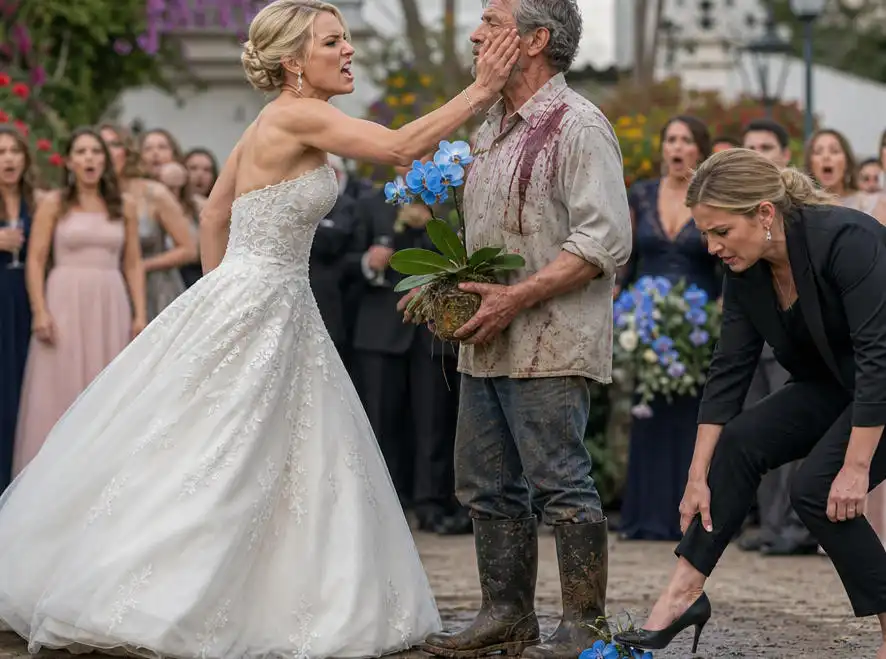
Then she slapped me.
The sound cracked across the garden.
A few women gasped.
Someone said, “Caroline.”
But nobody stepped in.
My cheek burned.
The old me, the man I had been before Ruth got sick, might have raised his voice.
Ruth would have touched my sleeve and said, “Henry, don’t give them your dignity. Make them show theirs.”
So I stood there.
Caroline grabbed red wine from a passing tray.
She threw it across my chest.
The wine soaked into my shirt, dark and cold.
“There,” she said. “Now you look like the kind of vendor you are.”
Lydia stepped forward quickly.
“He tried to sabotage the wedding.”
Caroline pointed at me.
“Remove him.”
I looked at the crushed orchid.
Then at the cameras.
Then at the crowd.
Then at Caroline.
And finally, I took out my phone.
The bride laughed.
“Who are you calling? Your little farm?”
I dialed my operations director, Marcy.
She had worked beside me for twenty-two years and had once made a trucking executive cry without using a single rude word.
She answered on the second ring.
“Henry?”
“Put Rosebridge Events on hold nationwide.”
There was a tiny pause.
Marcy knew what that meant.
“All entities?”
“All entities. Parent company. Subsidiaries. Alias accounts. Pending fulfillment. Priority release. Everything.”
“Reason code?”
I looked at Lydia’s shoe.
“Inventory destruction. Source-staff abuse. Public false quality claim. Possible procurement fraud through Vale Distribution.”
Marcy’s voice went cold.
“Understood.”
Caroline’s assistant, a nervous young man named Tyler, was already staring at his tablet.
His face changed first.
That was the moment B picked up.
One red warning became three.
Then ten.
Then a whole screen full of them.
Across the garden, Caroline’s smile cracked.
“What did you do?” she whispered.
I put my phone back in my pocket.
“I followed the contract.”
Lydia laughed too loudly.
“What contract? You’re a delivery man.”
I bent down and picked up the crushed orchid.
Then I turned to Tyler.
“You have the Rosebridge supplier portal open?”
He nodded before Caroline could stop him.
“Show her the fulfillment status.”
Caroline snapped, “Do not show him anything.”
But Tyler’s hand was shaking.
“He doesn’t need me to show him,” Tyler said. “He already changed it.”
That made the crowd go quiet in a different way.
Not shocked.
Interested.
People love cruelty until the power shifts.
Then they love the reveal.
Caroline snatched the tablet from Tyler.
“What is this?”
The first line read:
FULFILLMENT HOLD — COLE MERIDIAN FLORAL NETWORK.
The second line read:
ALL PREMIUM STEM ACCESS SUSPENDED PENDING SUPPLIER REVIEW.
The third line read:
AUTHORIZED BY H. COLE.
Caroline stared at the screen.
Then she looked at me.
“Who are you?”
Before I could answer, Martin Vale came jogging across the lawn.
He had been hiding near the catering tent, probably waiting to take credit once the ceremony photos were published.
His silver watch flashed in the sun.
His face was pale.
“Henry,” he said quickly. “Let’s not make this dramatic.”
Caroline turned on him.
“You know this man?”
Martin swallowed.
“Yes.”
Lydia’s mouth opened.
Eleanor’s champagne glass lowered.
I looked at Martin.
“Tell her.”
He tried to smile.
“Caroline, there’s clearly been a misunderstanding.”
“Tell her,” I repeated.
Martin’s smile died.
The cameras were still recording.
Guests leaned closer.
Even the string quartet had stopped pretending to tune.
Martin rubbed his forehead.
“This is Henry Cole.”
Caroline said, “And?”
Martin looked like a man being asked to dig his own grave with a dessert spoon.
“He owns Cole Meridian.”
Nobody spoke for three full seconds.
Then Tyler whispered, “Oh no.”
Caroline looked at the tablet again.
Her thumb moved fast.
Dashboard.
Orders.
Vendor list.
Premium floral commitments.
Every line carried the same warning.
Hold.
Hold.
Hold.
Seattle wedding.
Hold.
Dallas wedding.
Hold.
Charleston wedding.
Hold.
Aspen wedding.
Hold.
Napa wedding.
Hold.
New York wedding.
Hold.
Her future was turning red in front of her.
The first cancellation call came before she finished scrolling.
Tyler’s phone rang.
Then Lydia’s.
Then Caroline’s.
At first, they ignored them.
Then Tyler checked his caller ID and went whiter.
“It’s the Parker account.”
Caroline hissed, “Don’t answer.”
His phone kept ringing.
Lydia’s headset buzzed.
A voice came through loud enough for people nearby to hear.
“Lydia, why are the July peonies locked? I’m seeing national hold. Did we lose Cole Meridian access?”
Lydia ripped the headset off.
But the damage was done.
One of the groomsmen said, “Cole Meridian? Isn’t that the company that supplies half the weddings in the country?”
His wife whispered, “More than half of the luxury ones.”
Caroline heard.
Her face flushed.
“This is extortion.”
“No,” I said. “This is enforcement.”
She pointed at me.
“You cannot ruin my business because of one flower.”
I held up the broken orchid.
“One flower?”
Then I turned slightly so the guests could hear.
“Your manager destroyed controlled inventory in public. Your mother-in-law insulted a source worker in public. You accused me of sabotage in public. You threw wine on me in public. Your agent made a false quality claim in public. And your company’s procurement contract gives my network the right to suspend fulfillment when staff or inventory are abused.”
Caroline’s mouth tightened.
“That clause is never enforced.”
“It is today.”
Lydia stepped forward.
“You have no proof.”
That was when the violinist raised her hand.
“I recorded it.”
Lydia turned.
The violinist looked terrified but kept her hand up.
“I recorded the part where she stepped on the flower.”
A server said, “I saw it too.”
A bridesmaid whispered, “So did I.”
Then a man near the champagne table lifted his phone.
“I have the slap.”
Another guest said, “I got the wine.”
Public cruelty had become public evidence.
That is the thing about humiliating someone in front of a crowd.
You don’t just gather witnesses.
You give them a reason to remember.
Caroline tried to recover.
She looked around at her guests, then softened her voice.
“Mr. Cole, I apologize if emotions ran high. Weddings are stressful.”
I studied her.
There was no apology in her eyes.
Only math.
“I accept that weddings are stressful,” I said. “I do not accept false accusations.”
Her jaw flexed.
“What do you want?”
That question told everyone who she was.
Not “Are you okay?”
Not “I’m sorry.”
Not “How do we make this right?”
Just: What do you want?
Martin stepped between us.
“Henry, let’s settle this privately.”
I looked at him.
“You had years to settle privately.”
His face hardened.
“Careful.”
That word did it.
Not because it frightened me.
Because it confirmed the pattern.
I nodded to Tyler.
“Open the attached supplier review file.”
Tyler hesitated.
Caroline snapped, “Do not.”
But Tyler had already seen enough red on that tablet to understand who could still save his job and who could not.
He tapped the attachment.
A folder opened.
Emails.
Invoices.
Temperature logs.
Photos.
Statements from growers.
Alma Reyes’ unpaid invoice.
Martin Vale’s penalty letters.
A transport record showing orchids left unrefrigerated for forty-seven minutes before he blamed the farm.
A chain of messages where Lydia asked Martin to “keep the little growers desperate enough to stay cheap.”
Lydia made a small sound.
Caroline looked at her.
“What is that?”
Lydia said nothing.
Martin lunged for the tablet, but Tyler stepped back.
“Don’t touch it,” Tyler said.
That young man found his spine right there in the garden.
Good for him.
Caroline scrolled.
Her eyes moved faster and faster.
Then she stopped on one email.
It was from Martin to Lydia, copied to Caroline’s procurement director.
The subject line read:
RE: SOURCE PRICE PRESSURE — Q3 EVENTS.
The sentence that killed them was simple.
“Let the farms panic another week. Rosebridge likes the margins.”
Caroline looked at Martin.
He looked away.
The crowd had gone silent again.
This time, not because of drama.
Because everyone understood.
This wasn’t about one old man.
This wasn’t about one crushed flower.
This was about an entire luxury business built on squeezing invisible people until their hands cracked.
I said, “Alma Reyes almost lost her greenhouse because of that margin.”
Caroline snapped, “I don’t know who that is.”
“I know,” I said. “That is the problem.”
Her face twisted.
“I didn’t write that email.”
“No. But your company benefited from it. Your manager coordinated with it. Your contracts rewarded it. And when the flowers arrived, you treated the person carrying them like garbage.”
Eleanor finally spoke.
“This is my son’s wedding.”
I looked at her.
“Yes, ma’am. And you chose to spend part of it telling a working man he smelled too much like work.”
Her mouth opened.
Then closed.
For the first time all day, Eleanor Bellamy had nothing polished to say.
The groom appeared at the edge of the crowd.
His name was Daniel.
He had been inside taking photos with his father when the slap happened.
He walked toward Caroline slowly.
“What is going on?”
Caroline rushed to him.
“Daniel, this man is trying to destroy my company.”
Daniel looked at my wine-soaked shirt.
Then at my red cheek.
Then at the crushed orchid.
Then at his mother.
“Did you hit him?”
Caroline said, “He sabotaged the flowers.”
Daniel looked at the guests.
Nobody backed her.
That was the loudest answer.
He turned to Lydia.
“Did he?”
Lydia’s eyes darted toward Martin.
Martin stared at the ground.
The violinist stepped forward with her phone.
“I have the video.”
Daniel watched it.
Everyone watched his face while he watched the truth.
Lydia dropping the orchid.
Lydia stepping down.
Caroline slapping me.
Eleanor laughing.
The wine.
The accusation.
Daniel’s jaw tightened.
When the video ended, he looked at Caroline like he was seeing the woman behind the wedding.
“Why would you do that?”
Caroline whispered, “It was one moment.”
I said nothing.
Daniel looked at me.
“Mr. Cole, I’m sorry.”
That was the first real apology of the day.
It did not fix the damage.
But it landed differently because it cost him something.
He turned to his mother.
“You owe him one too.”
Eleanor’s face went stiff.
“Daniel—”
“You said it,” he said. “I heard enough.”
Eleanor looked around.
Phones were still up.
Guests were still watching.
Her pride fought her fear.
Fear won.
“I apologize,” she said tightly.
I nodded.
But I did not thank her.
An apology squeezed out by witnesses is not a gift.
It is a receipt.
Caroline grabbed Daniel’s arm.
“We need to go inside.”
He gently removed her hand.
“No. We need to hear what this means.”
Caroline looked at me.
Her voice lowered.
“You can’t hold every order. There are innocent clients.”
That was the first smart thing she had said.
And she was right.
There were innocent clients.
Brides who had paid deposits.
Families who had saved for years.
Venues that had done nothing wrong.
That was why the contract had a review process instead of automatic cancellation.
I said, “Your clients will not be punished for your behavior. My office will contact each account directly. Any event already paid by the client can be transferred to a clean planner or fulfilled through an alternate approved channel.”
Caroline’s face drained.
“You’re taking my clients?”
“No,” I said. “I’m giving them a choice.”
Martin whispered, “Henry, don’t.”
I looked at him.
“You taught the industry that whoever controls the source controls the deal.”
His shoulders sagged.
“I was just doing business.”
“No,” I said. “You were using distance as a weapon. You made sure the people with money never had to look at the people they were hurting.”
Marcy called back.
I answered on speaker.
“Go ahead.”
Her voice came through clear.
“National hold is active. Legal has preserved portal logs. Compliance is notifying affected accounts. Vale Distribution access is suspended pending audit. Grower protection notices are going out now.”
Caroline closed her eyes.
Lydia sat down on the edge of a stone planter.
Martin looked like he might be sick.
Marcy continued.
“Also, Henry, Alma Reyes is on line two. She says if this is about the Moon-veins, she told you not to let anyone make you mad at a wedding.”
I almost smiled.
“Tell Alma I failed.”
For the first time, a few people in the crowd laughed softly.
Not at me.
With me.
It broke the tension just enough for humanity to come back into the garden.
Then Caroline’s phone rang again.
This time she answered.
“Not now,” she said.
The voice on the other end was loud.
A woman yelling.
“You lost Cole Meridian? My daughter’s wedding is in six weeks. Do you understand what we paid you?”
Caroline turned away.
Another call hit Lydia’s phone.
Then another.
Tyler’s tablet kept flashing.
The empire was not exploding because I screamed.
It was collapsing because the rules Caroline signed finally applied to her.
That is a different kind of justice.
Quieter.
Cleaner.
Harder to dodge.
Within twenty minutes, Rosebridge Events had twelve accounts requesting emergency review.
By sunset, thirty-four.
By Monday morning, one hundred and nineteen.
Their three-year national wedding pipeline had depended on guaranteed premium floral access.
Without it, their contracts turned into traps.
Peonies for June.
Ranunculus for Napa.
Garden roses for Charleston.
Orchids for Miami.
Winter whites for Aspen.
Every promise Caroline had sold as “exclusive” was tied to a supply chain she had treated like dirt.
Her lawyers called mine that evening.
They argued.
They threatened.
They claimed emotional distress, reputational damage, interference, and everything else lawyers say when the facts are bad.
My lawyers sent back the contract.
The videos.
The inventory destruction clause.
The staff abuse clause.
The false claim clause.
The procurement fraud audit notice.
Then silence.
By Wednesday, Martin Vale’s distribution license with our network was terminated.
By Friday, three grower associations opened claims against him.
By the next month, his company was under investigation by state regulators for delayed payments and deceptive grading practices.
Several farms recovered money they thought they would never see again.
Alma Reyes got paid in full.
Not twelve cents on the dollar.
All of it.
With penalties.
When she called me, she cried so hard I had to pretend the line was bad so she wouldn’t hear me doing the same.
As for Lydia, Rosebridge fired her two days after the wedding.
Not because they suddenly found a conscience.
Because the video of her crushing the orchid had been shared by guests until vendors across California knew her face.
No luxury planner wanted her near their staff.
No grower wanted her near their product.
No venue wanted a manager who could turn a floral delivery into a public relations disaster.
Caroline tried to save herself.
Of course she did.
She posted a statement about “a deeply unfortunate misunderstanding during a high-stress private family event.”
That lasted about nine minutes.
Then the violinist posted her video.
Then the server posted his.
Then the guest with the wine video posted his.
By lunch, the internet had stitched together the whole scene.
Caroline hitting me.
Eleanor mocking me.
Lydia crushing the orchid.
Me making the call.
Tyler’s tablet turning red.
The caption most people shared was simple:
“Never insult the man who owns the roots.”
I did not share it.
I did not need to.
The truth had enough legs.
Daniel postponed the wedding.
Not because I told him to.
Not because anyone pressured him.
He called me three days later.
His voice sounded exhausted.
“I don’t know how I missed it,” he said.
I was standing in Greenhouse 4, checking humidity levels.
“People show us what they think we’ll accept,” I told him.
He was quiet for a while.
Then he said, “She treated you like you weren’t a person.”
“Yes.”
“And my mother joined in.”
“Yes.”
“I’m sorry.”
“I believe you.”
He exhaled.
“I don’t know what happens now.”
“That part is yours,” I said.
Two months later, I heard through a venue owner that Daniel had ended the engagement.
Caroline kept the ring for a week.
Then returned it after Daniel’s family lawyer reminded her of the prenuptial gift conditions.
Eleanor Bellamy, I am told, started volunteering at a community garden after Daniel refused to speak to her for nearly a month.
Whether that changed her heart or just her public image, I cannot say.
But sometimes behavior improves before character does.
I will take what I can get.
Rosebridge Events did not vanish overnight.
Companies rarely do.
But the luxury market runs on confidence.
And hers was gone.
Several clients transferred out.
A few sued.
Two venues removed Rosebridge from their preferred planner lists.
Their insurance carrier opened a review.
Their lenders got nervous.
Six months later, Caroline sold what remained of the company to a larger events group at a brutal discount.
The woman who once told guests I was “the bottom” lost control of the business she had built on standing above everyone else.
But the part people ask me about most is not Caroline.
It is the flowers.
“What happened to the wedding flowers?”
That day, after the ceremony fell apart, the garden staff asked what to do with the arrangements.
There were thousands of dollars of roses, orchids, lilies, hydrangeas, and greenery sitting in the heat.
Some had been damaged.
Most had not.
Caroline wanted them thrown out.
I said no.
The botanical garden had a service entrance near the east path.
Beside it, waiting in the shade, was an old shuttle bus from a nearby retirement home.
A group of residents had come for a weekly garden walk, but the staff had kept them away from the wedding area because it was “private.”
I saw them through the gate.
Women in sun hats.
Men with walkers.
A nurse helping one elderly gentleman adjust his cardigan.
They were watching from a distance, curious but careful not to intrude.
I walked over to the garden director.
“Can we bring them in?”
She looked startled.
“To the wedding lawn?”
“To the flowers.”
Within fifteen minutes, the same floral arch Caroline said was too good for “farm people” was surrounded by people who actually appreciated it.
An eighty-seven-year-old woman named June touched a garden rose with two fingers and whispered, “My husband used to bring me these.”
A man in a wheelchair asked if the orchids were real.
I placed one in his lap.
He said, “My wife would’ve fussed over this.”
Another woman asked if she could take a small bouquet back to her room.
I said, “Take two.”
We loaded the retirement home shuttle with flowers.
Not leftovers.
Gifts.
Centerpieces.
Garlands.
Buckets of roses.
Orchids that had survived the heat.
Lilies for the dining hall.
Hydrangeas for bedside tables.
The residents clapped when we finished.
Not loudly.
Not like a crowd at a performance.
Softly.
Like people who still knew how to receive beauty without owning it.
That applause did more for my heart than Caroline’s downfall ever could.
Before the shuttle left, June asked me why my shirt was stained red.
I looked down.
The wine had dried dark.
I said, “Someone had a bad day.”
June narrowed her eyes like she didn’t believe me.
Then she patted my hand.
“Well, you gave us a good one.”
I had to turn away for a second.
Ruth would have loved that.
That evening, I went home and washed the shirt.
The stain did not come out.
I kept it anyway.
It hangs now in the mudroom at the old house, beside my field jacket and Ruth’s straw hat.
Not as a trophy.
As a reminder.
A person’s dignity should never depend on whether someone else recognizes their power.
I was not worth respect because I owned a company.
I was worth respect before Caroline knew my name.
So was Alma.
So was Tyler.
So was the server.
So was every grower with cracked hands and early mornings and bills waiting on someone richer to decide their work had value.
That is the part I wish more people understood.
The revenge felt good.
I will not lie.
Watching Caroline’s fake smile disappear when the tablet turned red was satisfying.
Watching Martin Vale realize the farmers he bullied now had protection was even better.
But the healing came later.
It came when Alma paid off her greenhouse loan.
It came when Tyler sent me a note saying he had quit Rosebridge and taken a job with an ethical event company.
It came when the retirement home mailed us a photo of their dining room filled with Caroline’s “ruined” flowers.
On the back, someone had written:
“Beauty belongs to everyone.”
I framed that.
Not the article.
Not the viral post.
That photo.
Because the best ending was not that Caroline lost.
The best ending was that the flowers went where they were loved.
Still, people argue about what I did.
Some say I went too far.
They say one slap, one insult, one crushed flower should not cost a woman her company.
But it was never one slap.
It was never one insult.
It was never one flower.
It was a pattern that finally met a boundary.
Caroline did not lose her business because an old man got his feelings hurt.
She lost it because she signed rules she thought only smaller people had to follow.
And that day, in front of everyone, the rules followed her back.
So pick a side:
Was I wrong to put her company on nationwide hold during her own wedding — or did she finally get the public lesson she earned? Share this if you believe rough hands deserve respect too. 🌹