Chapter 1:
The human body is an orchestra of predictable rhythms. As a physician, you learn to read the sheet music of anatomy long before you ever touch a living, breathing patient. You learn the steady, thumping baseline of a healthy heart, the soft, whispering crescendo of lungs filling with air, the firm, resilient resistance of healthy muscle tissue, and the hard, unyielding truth of bone. You learn that when something goes wrong, it usually follows a pattern. A cyst feels like a contained, rubbery grape. An abscess feels hot, angry, and fluctuant. A lipoma feels doughy and slips easily beneath the skin.
You learn the rules of the human body so well that they become second nature. But nothing in my ten years of medical training, nothing in my residency at Mass Gen, and certainly nothing in my three years as an attending physician at the bustling, rain-swept St. Jude’s Community Clinic in Seattle, prepared me for the moment the “tumor” in my pregnant patient’s shoulder decided to move out of the way of my fingers.
It was a Tuesday afternoon in late November. The kind of Seattle day where the sky presses down on the city like a wet, gray wool blanket, and the rain doesn’t fall so much as it hangs in the air, soaking you to the bone the second you step outside. The clinic was slammed. Flu season was ramping up, mixing aggressively with the usual parade of sprained ankles, mysterious rashes, and chronic pain complaints.
I was exhausted. The kind of bone-deep, soul-leaching exhaustion that makes your eyes burn and your coffee taste like battery acid. My name is Dr. Sarah Evans, and lately, I had been running on fumes and a lingering, suffocating sense of guilt. Six months ago, I missed a subtle sign—a faint, almost imperceptible irregularity in a patient’s gait that turned out to be early-stage ALS. By the time it was caught by a specialist, valuable time had been lost. The patient, a vibrant middle school teacher, was now in a wheelchair. The hospital cleared me of any malpractice—it was an incredibly rare presentation—but the tribunal in my own head had found me guilty, sentenced me to a lifetime of second-guessing every single diagnosis I made. It made me a more thorough doctor, but it also made me a paranoid one. I double-checked labs. I lingered in exam rooms. I looked for monsters hiding in the shadows of routine symptoms.
“Dr. Evans?”
The voice belonged to Jenna, my seasoned Nurse Practitioner. Jenna was a fifty-something force of nature with a no-nonsense Boston accent she hadn’t lost despite living on the West Coast for a decade. She popped her head into my tiny, windowless office, waving a manila chart.
“I’ve got a walk-in in Room 3. Chloe Vance. Twenty-eight years old, twenty-eight weeks pregnant. Complaining of severe shoulder pain and a localized swelling.”
I rubbed my temples, trying to massage away a burgeoning headache. “Pregnancy-induced joint laxity? Did she pull a muscle carrying something?”
“Maybe,” Jenna said, her brow furrowing slightly. It was a micro-expression, but after working with her for three years, I knew it meant something wasn’t sitting right with her. “But the swelling is… odd. It’s on the superior aspect of the left trapezius, extending toward the acromioclavicular joint. It looks almost necrotic, but there’s no heat. And the husband…” Jenna paused, her lips thinning into a hard line.
“What about the husband?” I asked, sitting up straighter.
“He does all the talking. She looks like a stiff breeze would knock her over, and he acts like he’s presenting a minor inconvenience to a customer service rep. Just… keep your eyes open, Sarah.”
“Always,” I murmured, taking the chart from her.
I walked down the sterile, linoleum-tiled hallway, the fluorescent lights buzzing overhead like angry wasps. When I pushed open the door to Room 3, the atmosphere hit me instantly. It was heavy. Stifling.
Sitting on the edge of the examination table was Chloe Vance. She was tiny, her pregnant belly looking almost disproportionately large against her frail frame. She was wearing a faded hospital gown, clutching the edges together over her chest with white-knuckled intensity. Her blonde hair hung in lank curtains around a pale face devoid of makeup, her eyes fixed firmly on the scuffed floor tiles.
Standing beside her, occupying entirely too much space in the small room, was her husband.
“Dr. Evans, I presume?” he said smoothly, stepping forward to offer a hand. He was dressed in a tailored, expensive-looking charcoal suit that looked wildly out of place in our sliding-scale community clinic. His grip was firm, aggressive. “Mark Vance. Thank you for fitting us in. My wife is just having a bit of an overreaction to a localized infection.”
“Nice to meet you, Mr. Vance,” I said, offering a polite but professional smile as I pulled my hand back. I turned my attention entirely to the woman on the table. “Chloe? I’m Dr. Evans. Can you tell me a little bit about what’s going on today?”
Chloe’s breath hitched. She opened her mouth to speak, her eyes darting nervously toward Mark for a fraction of a second.
“It started a few days ago,” Mark interrupted smoothly, slipping his hands into his pockets. “We went camping out near the Cascades last weekend. She must have gotten bitten by a spider or a large tick. It swelled up. I told her we should just put some hydrocortisone on it and ice it down, but you know how women get when they’re expecting. Every little bump is a catastrophe.” He chuckled, a dry, humorless sound.
I didn’t laugh. I kept my eyes on Chloe. “Chloe, is that right? Did you feel a bite?”
She swallowed hard, her throat bobbing. “I… I don’t remember feeling a bite. It just started hurting. A deep ache. And then the lump appeared.”
Her voice was barely above a whisper, trembling with an undercurrent of something that felt dangerously close to absolute terror.
“Alright, let’s take a look,” I said, grabbing a pair of purple nitrile gloves from the dispenser on the wall. “I’m just going to lower the gown on your left side to examine the shoulder, okay?”
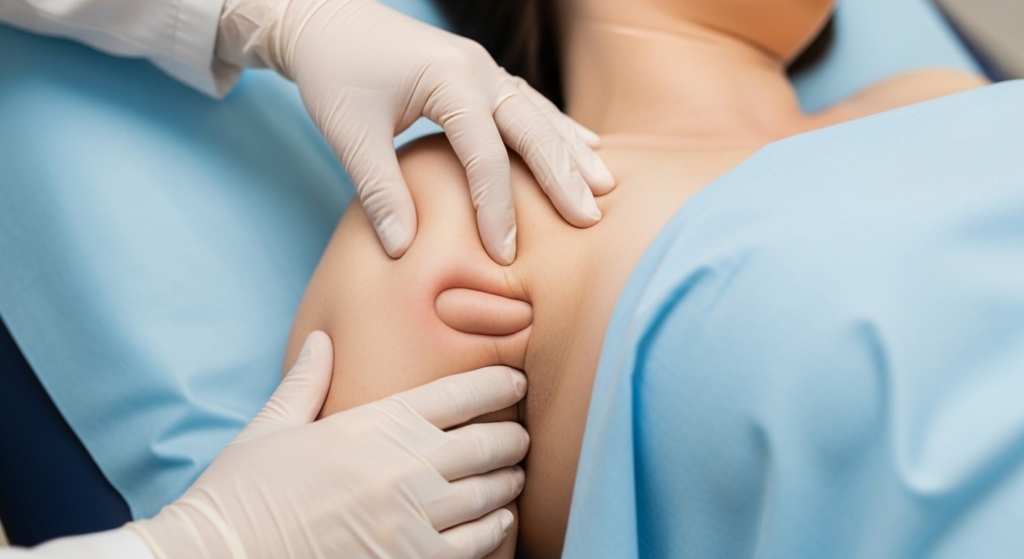
Chloe nodded stiffly. As I gently pulled the fabric down, exposing her left shoulder, I had to physically stop myself from gasping.
Jenna was right; the swelling was bizarre. It was a mass roughly the size of a tennis ball, situated right where the neck meets the shoulder. But it wasn’t the size that was alarming—it was the appearance. The skin stretched tightly over the mound was a sickly, mottled canvas of deep purple, bruised yellow, and a pale, waxy gray. Spidery, angry red veins branched out from the center of the mass like cracks in ice.
It looked traumatic. It looked like someone had taken a baseball bat to her clavicle.
“How long did you say this has been here?” I asked, keeping my voice carefully neutral.
“Three days,” Mark said instantly.
I frowned, leaning in closer. “Three days? Bruising of this stage—the yellowing at the margins—usually takes at least a week to ten days to develop. Has there been any blunt force trauma to this area? A fall? A car accident?”
“None,” Mark said, his voice dropping a fraction of an octave, losing some of its corporate polish. “It’s a spider bite, Doctor. The venom causes tissue necrosis and rapid discoloration. I read about it online. The Brown Recluse.”
“A Brown Recluse bite typically presents with a central blister that ulcerates, Mr. Vance. It doesn’t present as a massive, closed subcutaneous hematoma,” I corrected him gently, but firmly. I turned back to Chloe. “Chloe, are you experiencing any fever? Chills? Numbness running down your arm into your fingers?”
“It… it burns,” she whispered, her eyes welling with tears. “Deep inside. And it feels heavy. So heavy.”
“Okay. I need to palpate the area—that means I’m going to press on it to feel the texture of the mass, see if it’s fluid-filled or solid,” I explained, holding up my gloved hands. “Tell me if the pain becomes too sharp.”
I stepped closer. As I reached my hand out, Chloe suddenly jerked her entire body to the right, pulling the shoulder away from me.
“Sorry,” she gasped, her breathing accelerating. “Sorry, I just… I’m scared.”
“It’s okay to be scared,” I said softly, lowering my hands. “I’ll be very gentle. I just need to feel the borders.”
Mark sighed loudly, a sharp hiss of air through his teeth. He stepped up to the opposite side of the table and placed his large hand heavily on Chloe’s right shoulder, effectively pinning her in place. “Stop squirming, Chloe. Let the doctor do her job so we can get our antibiotics and go home.”
His grip on her was visibly tight. I could see the tension in his knuckles. Chloe’s eyes squeezed shut, and a single tear slipped down her cheek.
“Mr. Vance, I’d ask that you give us a little space,” I said, my tone hardening.
“I’m comforting my wife,” he replied, his eyes meeting mine. They were dead, flat, and completely devoid of warmth. A warning.
My heart rate ticked up. Domestic abuse was a tragic reality in the ER and the clinic. The controlling behavior, the speaking for the patient, the bizarre injury that didn’t match the timeline—all the red flags were waving furiously. I made a mental note to ask Jenna to pull Mark out of the room under the guise of filling out insurance paperwork so I could speak to Chloe alone.
But first, I needed to assess the medical emergency in front of me.
“Okay, Chloe. First touch,” I murmured.
I laid two fingers gently against the outermost edge of the swollen mass. The skin was shockingly cold. Not just room temperature, but unnaturally chilled, as if ice water was circulating directly beneath the dermis instead of blood. The texture was strange, too. It wasn’t the tight, bouncy resistance of a fluid-filled cyst. It felt dense. Hard.
Chloe let out a muffled whimper, shifting her torso slightly backward, arching her spine to alter the angle of her shoulder.
“Does that hurt?” I asked.
“No, it’s just… uncomfortable,” she breathed, her eyes darting to the mass, then quickly away.
“I’m going to press a little deeper now to feel the center,” I said.
On the second palpation, I moved my fingers to the apex of the mound. I applied a steady, downward pressure.
Usually, when you press on a localized swelling, it either compresses slightly, or the patient yelps in pain. This time, neither happened. Instead, as my fingers pressed down, I felt a distinct, solid ridge. It felt like bone, but it was in the wrong place. It was resting above the clavicle, not attached to it.
I frowned, pressing slightly harder, trying to trace the edge of the hard ridge.
Suddenly, Chloe shifted again. It wasn’t a flinch of pain. She actively rotated her shoulder forward, almost as if she were trying to hide the specific spot I was pressing.
“Chloe, please try to stay still,” I said gently.
“I can’t,” she sobbed quietly, her voice cracking. “It… it doesn’t like it.”
I froze. “What doesn’t like it?”
“She means the infection,” Mark snapped, his voice sharp like a cracking whip. His hand tightened further on her good shoulder. “It’s making her delirious. The pain is radiating. Look, Doctor, do we need an ultrasound or can you just prescribe a broad-spectrum antibiotic?”
I ignored him. My instincts—the same instincts that had screamed at me a year ago, the ones I had ignored to my own detriment—were now roaring in my ears. Something was deeply, fundamentally wrong here.
“I’m going to do one more exam,” I said, my voice dropping to a low, authoritative register. “And then we will get an ultrasound.”
I raised my right hand again. I spread my index and middle fingers, planning to anchor the sides of the mass to prevent it from sliding while I pressed the center with my thumb.
I placed my fingers on the cold, bruised skin. I took a breath. And then, for the third time, I pressed down, firmly, into the apex of the dark purple mound.
What happened next broke every law of medicine, anatomy, and reality I had ever known.
I pushed down. And the tissue inside her shoulder pushed back.
It wasn’t a reflex. It wasn’t a muscle spasm. It was a deliberate, kinetic response. Beneath the thin layer of Chloe’s cold skin, I felt something hard and cylindrical. It felt like a thick, ribbed cable, or a heavily calcified joint.
As my thumb maintained pressure, the hard thing beneath the skin shifted. It rolled out from under my thumb with a sickening pop that I felt through my gloves.
I gasped, my hand freezing in place.
Beneath the bruised, discolored flesh, a distinct shape formed. The skin stretched agonizingly tight as the entity inside reoriented itself. I could clearly see the outline of a long, jointed appendage—like a massive, multi-knuckled finger, or the leg of an impossibly large crustacean—sliding under the dermis, pushing outward against the boundaries of her shoulder.
It moved slowly, almost lazily, gliding under the skin from her clavicle toward her neck.
Chloe squeezed her eyes shut and let out a soft, agonized moan, her jaw trembling violently.
“What… what is that?” I stammered, all my professional composure instantly vaporizing. I yanked my hand back as if I had been burned, stumbling backward until my hips hit the metal counter behind me. The stainless steel tray of tongue depressors and otoscope tips rattled loudly against the silence of the room.
The lump on her shoulder was no longer just a static mound. It was shifting. Pulsing. The bruised skin rippled as something inside coiled and uncoiled.
I stared at it, my chest heaving, the blood roaring in my ears. I looked from the undulating mass to Chloe’s face. She was weeping silently, her expression a mix of absolute terror and a profound, exhausted resignation.
Then, I looked at Mark.
He wasn’t looking at the alien movement under his wife’s skin. He was looking directly at me. His pristine, corporate mask had completely dissolved. The plastic smile was gone, replaced by an expression of cold, predatory calculation.
He didn’t look surprised. He looked annoyed.
“I told you,” Mark said, his voice dropping into a terrifyingly calm, deadpan whisper that sent a shard of ice straight through my heart. “She just needs a little rest.”
He took a step away from Chloe, moving slowly toward me, placing himself deliberately between me and the only door out of the examination room.
chapter 2
Time in a trauma situation doesn’t flow; it fractures. It breaks apart into microscopic shards of sensory input that your brain frantically tries to stitch back together. The hum of the fluorescent lights above Room 3 suddenly sounded like the roar of an airplane engine. The smell of isopropyl alcohol and stale cotton seemed thick enough to choke on.
And then there was Mark Vance.
He stood between me and the closed wooden door, his tailored charcoal suit soaking up the harsh clinic lighting. He hadn’t raised his voice. He hadn’t drawn a weapon. But the shift in his posture—the subtle drop of his shoulders, the deadening of his eyes, the absolute, terrifying stillness of his hands—screamed of a violence so deeply ingrained it didn’t need to be loud.
“She just needs a little rest,” he repeated, the words hanging in the stagnant air.
My spine was pressed hard against the stainless-steel counter. My fingers, still gloved in purple nitrile, curled into fists behind my back. My knuckles brushed against the cool metal of a suture tray. A pair of medical shears. A heavy, metal otoscope handle. My mind, trained to save lives, instantly betrayed me by calculating which instrument would make the most effective weapon if he lunged.
I looked past him to Chloe. She was curled in on herself on the exam table, her knees pulled up as close to her swollen belly as they could go. She was shaking so violently the crinkling of the paper beneath her sounded like static electricity. Her left hand was clamped over her right shoulder, her fingers desperately trying to shield the bruised, undulating mass from view.
She knows, I thought, a cold dread pooling in my stomach. She knows exactly what is inside her.
I forced myself to take a slow, shallow breath. I needed to de-escalate. The ghost of Mr. Henderson—the ALS patient I had failed a year ago—flashed in my mind’s eye. I remembered his wife’s face when the final, terminal diagnosis was delivered. The look of absolute, shattering abandonment. I had promised myself, on that day, that I would never be the reason a patient felt that kind of helpless terror again. I was the doctor. This was my clinic. I was not going to let this man walk this woman out of here.
“Mr. Vance,” I said. My voice trembled on the first syllable, but I forced my diaphragm down, anchoring my tone into something resembling professional authority. “Your wife’s condition is highly irregular. As her physician, I cannot, in good conscience, discharge her without imaging. That mass is actively shifting. It is not an infection.”
Mark tilted his head, a gesture so devoid of humanity it reminded me of a bird of prey studying a struggling mouse.
“Dr. Evans,” he said smoothly, taking a slow half-step toward me. “I understand you have protocols. But we are private people. We have our own specialists at Swedish Medical Center. We just stopped in here because it was on the way back to Mercer Island and Chloe was complaining. I’ll take her to our personal physician.”
Mercer Island. The wealthiest zip code in the state. He was reminding me of his power, his status, his ability to crush a community clinic doctor like a bug.
“Then I’ll call an ambulance to transport her to Swedish,” I countered, keeping my chin high. “She is twenty-eight weeks pregnant, and whatever is in her shoulder is exerting pressure on her vascular system. If it ruptures a major artery, she will bleed out in your passenger seat before you cross the I-90 bridge.”
A shadow crossed his perfectly manicured face. It wasn’t concern for his wife; it was annoyance at the logistical complication.
Before he could respond, three sharp, rhythmic knocks hammered against the door behind him.
“Dr. Evans?” It was Jenna. Her Boston accent had never sounded sweeter. “Dr. Evans, I need you out here right now. Dr. Thorne needs a consult on a severe laceration in Bay 2. It’s arterial.”
It was a lie. We didn’t have a Bay 2, and Dr. Thorne, the clinic’s exhausted medical director, was off on Tuesdays. Jenna had sensed the wrongness in the room the moment she handed me the chart, and she was throwing me a lifeline.
Mark hesitated. He looked at the door, then back at me, his jaw clenching. He was a man used to absolute control, and the intrusion of the outside world was fracturing his grip on the situation.
“I have to take that,” I said, my voice steadying. I stepped away from the counter, forcing myself to walk directly toward him. It was the hardest physical movement I had ever made. Every instinct screamed at me to run, to hide, but I kept my eyes locked onto his collarbone, projecting an air of clinical detachment. “Excuse me.”
For a terrible, agonizing second, I thought he wasn’t going to move. We stood chest to chest, the sterile smell of my scrubs mixing with the overwhelming, expensive scent of his sandalwood cologne.
Slowly, deliberately, he took a half-step to the side.
“We’ll be waiting, Doctor,” he whispered as I passed, his breath hot against my ear.
I grabbed the door handle, pushed it open, and stepped into the hallway.
The moment the door clicked shut behind me, my knees buckled. I caught myself against the wall, dragging in a ragged, gasping breath. Jenna was standing two feet away, her arms crossed, her eyes wide behind her reading glasses.
“Jesus, Sarah, you look like a corpse,” Jenna hissed, stepping forward to grip my forearm. “What happened in there? I knocked because he locked the damn door from the inside.”
“Jenna, listen to me carefully,” I whispered, my voice frantic, pulling her further down the hallway, away from Room 3. “Get Marcus. Get him right now.”
Marcus was our head of security. He was a fifty-five-year-old retired Chicago PD detective who had moved to Seattle after a massive heart attack forced him off the force. He had terrible knees, a permanent scowl, and a heart the size of a minivan. After losing his own daughter, Lily, to a violently abusive boyfriend a decade ago, Marcus had adopted the clinic staff as his surrogate family. He was fiercely protective, endlessly patient with our homeless patients, and utterly unforgiving of predators.
“He’s on his smoke break out back,” Jenna said, already pulling her radio from her hip. “What’s the code, Sarah? Are we calling Seattle PD?”
“Not yet,” I said, running a shaking hand through my hair. “If we call the cops, Mark will lawyer up, and he’ll force Chloe out of here before a cruiser even arrives. I have no legal grounds to detain him. She hasn’t claimed abuse. But Jenna… there is something inside her shoulder. And it moved.”
Jenna stopped dead, her thumb hovering over the radio button. “Moved? Like… a muscle spasm?”
“Like an organism,” I said, the words tasting like ash in my mouth. “It had joints. I felt it push back against my hand. We need to get her away from him. We need her in Ultrasound, alone.”
Jenna didn’t ask another question. She keyed her radio. “Marcus. We have a Code Yellow in the main hall. Need a distraction and a separation on a hostile male. Room 3.”
Less than a minute later, the heavy fire doors at the end of the hall banged open. Marcus limped through, moving with surprising speed for a man with a bad left knee. He was wearing his standard uniform: black tactical pants, a tight gray polo that highlighted his thick, tattooed arms, and a utility belt that held a heavy flashlight and pepper spray. His face, etched with deep lines of grief and stress, was locked into a mask of pure business.
“Talk to me, Doc,” Marcus grumbled in his deep, gravelly baritone as he reached us.
I quickly explained the situation. The bizarre mass, the terrifying husband, the need to separate them.
“Charcoal suit? Smells like money and arrogance?” Marcus asked, his dark eyes narrowing. “I saw them walk in. The guy had his hand on the back of her neck the whole time. A guiding grip. It’s a classic control tactic. Makes the victim feel like a puppet.”
“I need five minutes with her alone,” I pleaded, looking up at him. “Just enough time to get a sonogram of that shoulder and get her to tell me the truth.”
“You got it,” Marcus said, rolling his massive shoulders. He reached into his pocket and pulled out his personal cell phone. He tapped the screen a few times, then looked at Jenna. “Go to the front desk. Find out what kind of car he drives from the intake forms. Plate number too, if they asked for parking validation.”
Jenna scurried off. Marcus looked at me, his expression softening just a fraction. “Breathe, Sarah. You’re shaking like a leaf. You did good getting out of that room. Now let me handle the suit.”
Two minutes later, Jenna returned with a slip of paper. “Black Porsche Cayenne. Parked in the reserved spot out front.”
Marcus grinned, a terrifying, wolfish expression. “Perfect.”
We walked back to Room 3. I took a deep breath, plastered my professional mask back onto my face, and opened the door.
Mark was standing by the examination table, holding Chloe’s coat. Chloe was weeping silently, her face buried in her hands.
“Alright, Mr. Vance,” I said briskly, stepping into the room. “I’ve consulted with my director. We are going to do a rapid ultrasound just to rule out deep vein thrombosis, and then you are free to go.”
Mark sneered. “I told you, we are leaving.” He grabbed Chloe’s good arm and hauled her roughly to her feet.
Suddenly, Marcus stepped into the doorway, his massive frame blocking out the hallway light. He held his phone up to his ear.
“Yeah, dispatch, this is St. Jude’s Security,” Marcus said loudly into his phone, his eyes locked dead onto Mark. “We got a hit-and-run in the front lot. A delivery truck just side-swiped a black Porsche Cayenne. Ripped the whole front bumper off. Yeah, plate number…” Marcus read the plate from Jenna’s paper.
Mark froze. His head snapped toward Marcus. “What did you say?”
Marcus slowly lowered the phone, feigning surprise. “Oh, is that your vehicle, sir? Damn shame. The delivery driver took off. I’ve got it on the exterior cameras, but you need to come out to the front desk right now to fill out the police report and check the damage before the tow truck gets here.”
For a split second, I saw the war raging in Mark’s eyes. The obsessive, controlling need to keep his wife in his sight, violently clashing with the narcissistic, materialistic rage of his prized luxury car being destroyed.
The car won.
“Don’t move,” Mark hissed at Chloe, pointing a sharp finger at her face. He turned to me. “If you touch her with a needle, I will sue you into oblivion.”
He pushed past Marcus, his heavy footsteps echoing down the hallway toward the lobby.
The moment he rounded the corner, Marcus turned to me. “You have exactly four minutes before he realizes his precious car doesn’t have a scratch on it. Move.”
I rushed to Chloe. She was swaying on her feet, her eyes vacant and glazed over.
“Chloe,” I said softly, grabbing her good hand. It was ice cold. “We have to go. Now.”
“He’ll be so angry,” she whimpered, tears spilling over her pale cheeks. “You don’t understand what he does when he’s angry.”
“I don’t care,” I said fiercely, channeling every ounce of my pent-up guilt and terror into a single, undeniable command. “I am not letting you leave. Walk with me.”
I threw my arm around her waist, supporting her heavy frame, and practically dragged her out of the room. We hurried down the back corridor, past the breakroom, and shoved open the heavy oak door of the Ultrasound Suite.
I locked the door behind us and flipped the deadbolt. The room was dark, lit only by the soft blue glow of the ultrasound machine’s monitor. The air was cool and smelled of conductive gel and clean linens.
I helped Chloe onto the padded bed. She curled into a fetal position immediately, clutching her pregnant belly, her entire body trembling with a mixture of physical pain and profound psychological terror.
“It’s okay. You’re safe here,” I lied. The lock on the door suddenly felt very flimsy.
I booted up the machine, my hands flying over the keyboard to enter her patient ID as a generic emergency scan. I grabbed a bottle of warm ultrasound gel and a high-frequency linear transducer wand.
“Chloe, I need you to lie on your back,” I said, keeping my voice soft but insistent. “I need to see what’s in your shoulder.”
She shook her head violently. “No. No, if you see it, it will know. It feels everything.”
I stopped. The transducer wand felt heavy in my hand. “What do you mean, it feels everything?”
Chloe let out a sob that seemed to tear from the very bottom of her soul. It was the sound of a woman who had been utterly broken, isolated, and pushed past the boundaries of human endurance.
“Mark… Mark works in biotech,” she choked out, her words tumbling over each other in a desperate, frantic rush. “He owns a private research firm. He’s obsessed with perfection. When we got pregnant, he said the world was too toxic. He said my immune system wasn’t strong enough to protect his son.”
She reached up with a trembling hand and weakly tugged down the collar of her hospital gown, fully exposing the monstrous, bruised, purple mound on her neck.
“Three weeks ago, he brought home a syringe,” she whispered, her eyes wide and haunted, staring blankly at the ceiling. “He told me it was a proprietary stem cell graft. A new type of bio-armor for the fetus. He held me down on our kitchen floor. He injected it right into my trapezius muscle.”
I felt the blood drain from my face. My medical training was screaming at me. A localized injection of foreign biological material. Sepsis. Necrosis. Massive immune rejection.
But none of those things explained what I had felt under her skin.
“For the first week, it was just a red bump,” Chloe continued, her voice dropping to a hollow, ghostly register. “But then it started to grow. And then… then I started to feel it. Not just pain. I felt it twitching. I felt it taking nutrients. I tried to go to a hospital, but Mark locked me in the apartment. He took my phone. He feeds me IV fluids filled with god knows what. He says it’s ‘gestating’.”
“Gestating?” I repeated, the word tasting like bile. “Chloe, what is it?”
“I don’t know,” she sobbed, finally looking at me. Her eyes were bloodshot, the capillaries bursting from strain and terror. “But at night, when the house is quiet… I can hear it clicking against my collarbone. And it’s moving, Dr. Evans. It used to be higher up. It’s moving down.”
She placed her hand protectively over her swollen abdomen. “It’s trying to get to the baby.”
My breath caught in my throat. I didn’t want to believe her. My rational, scientifically trained mind desperately wanted to categorize this as severe pregnancy-induced psychosis brought on by domestic abuse.
But I remembered the hard, multi-knuckled appendage rolling beneath my thumb. I remembered the distinct, deliberate push against my hand.
“Let me look,” I said, my voice barely a whisper.
I stepped up to the bed. I squeezed a thick mound of clear gel onto the bruised, purple skin of her shoulder. The mass immediately twitched beneath the gel, rippling the surface.
I swallowed hard, placed the transducer wand against the skin, and looked at the monitor.
Ultrasound imaging relies on sound waves bouncing off tissues to create a picture. Fluid appears black. Soft tissue appears gray. Bone and dense material appear bright, blinding white.
When the image stabilized on the screen, my heart stopped beating.
I forgot how to breathe.
In the center of the dark gray sea of her muscle tissue, there was no fluid-filled cyst. There was no shapeless mass of necrotic infection.
There was a skeleton.
But it wasn’t human. The screen was illuminated with blinding white lines, outlining a structure that belonged in the deepest, darkest trenches of the ocean, or perhaps on another planet entirely.
It was roughly eight inches long. It had a segmented, heavily armored central carapace, much like a centipede, but incredibly thick and dense. Branching off from the central body were dozens of articulated, multi-jointed legs, terminating in sharp, hook-like points.
And as I watched the screen in paralyzed, suffocating horror, the entity moved.
One of the long, hooked legs slowly extended, reaching deep into the darker gray tissue of her vascular system. I could clearly see the black, pulsing tube of her subclavian artery. The creature’s hooked leg wrapped carefully around the artery, not puncturing it, but rhythmically squeezing it, pulsing in time with her heartbeat.
It was feeding.
“Oh my god,” I breathed, stumbling back a step, the wand slipping on the gel.
“Do you see it?” Chloe cried, her voice rising in panic. “Is it close to the baby?”
I couldn’t speak. I panned the ultrasound wand further down her chest, following the trailing tail of the creature.
The tail didn’t end in her shoulder. It was an incredibly long, thin, fibrous tether that snaked its way down through her chest cavity, weaving behind her ribs, bypassing her lungs, and heading straight down into her abdomen.
I moved the wand to her pregnant belly.
The screen shifted. The familiar, beautiful image of a twenty-eight-week-old fetus appeared. The baby’s spine, its tiny curled fists, its beating heart.
But wrapping around the amniotic sac, glowing bright white against the darkness, was a web of those same thin, fibrous tethers. They were slowly, methodically encasing the womb in a cage of alien tissue.
Suddenly, a loud, violent crash shattered the silence of the room.
Someone was throwing their entire body weight against the heavy oak door of the Ultrasound Suite.
BANG.
The deadbolt rattled loudly.
“Dr. Evans!” Mark’s voice roared from the hallway. It wasn’t the smooth, corporate tone anymore. It was the guttural, feral scream of a predator that had been backed into a corner. “Open this door! You are interfering with proprietary property!”
BANG.
The wood around the lock splintered.
Chloe screamed, a pure, unadulterated sound of absolute terror, and pulled her knees to her chest.
On the ultrasound monitor, the creature in her shoulder reacted to the noise. The segmented carapace arched violently. Dozens of hooked legs dug deep into her muscle tissue, glowing blindingly white on the screen, as it violently hauled its massive body further down her chest, moving aggressively toward the womb.
BANG.
The door hinges groaned.
I looked from the splintering door, to the terrified woman on the bed, to the monstrous reality playing out on the glowing screen.
The oath I took was to do no harm.
But right now, the only way to save the mother and the child was to go to war.
chapter 3
The sound of a heavy oak door breaking apart from its hinges is not a clean noise. It is a violent, jagged tearing, like the cracking of giant bones. With the third, monumental impact, the metal deadbolt sheared straight through the wooden frame. The door burst inward, slamming against the drywall with a concussive force that shook the sterile glass cabinets of the Ultrasound Suite.
I threw myself over Chloe, my body instinctively acting as a physical shield over her pregnant abdomen.
Mark Vance stood in the shattered doorway. The impeccably tailored charcoal suit jacket was gone, his tie ripped away, the top buttons of his crisp white shirt torn open to reveal a neck corded with straining, purple veins. He was breathing heavily, his chest heaving, his fists clenched so tightly his knuckles were bloodless. He looked past me, his eyes wide, feral, and utterly devoid of anything resembling human empathy.
He didn’t look at his weeping wife. He didn’t look at the terrified doctor cowering over her.
His eyes locked instantly onto the glowing blue screen of the ultrasound monitor.
For a profound, terrifying moment, the room was dead silent, save for the ragged sound of Chloe’s sobbing and the high-pitched hum of the medical machinery. I watched, paralyzed, as the expression on Mark’s face shifted. The murderous rage melted away. The psychotic, cornered-animal panic vanished.
In its place bloomed a terrifying, reverent awe.
“Look at it,” Mark whispered, his voice cracking with a horrifying tenderness. He took a slow, deliberate step into the room, his eyes drinking in the blinding white skeleton of the parasite on the screen. “Look at what it’s doing, Doctor. Do you understand what you are witnessing?”
“Stay back,” I screamed, my voice tearing at my throat. I fumbled blindly behind me on the counter, my fingers closing around the heavy, plastic base of a bottle of conductive gel. It was a pathetic weapon, but it was all I had. “I swear to God, Mark, I will scream. I will bring every person in this clinic down this hallway.”
“Scream all you want,” he breathed, stepping closer, completely ignoring my threat. His eyes were glazed, hypnotized by the monitor. On the screen, the monstrous entity was still moving, its hooked legs digging deeper into Chloe’s muscle tissue, fighting its way downward. “You’re a woman of science, Dr. Evans. You should be on your knees thanking me for letting you see this. You are looking at the obsolescence of human frailty.”
“It’s a parasite!” I yelled, my grip tightening on the bottle until my hand cramped. “It is killing her! It’s strangling her vascular system!”
“It is a symbiote!” Mark roared, his voice suddenly rebounding into a deafening boom that rattled the instruments on the trays. He pointed a shaking, accusatory finger at the screen. “Do you know what kind of world my son is going to inherit? Microplastics in the rain. Superbugs immune to every antibiotic you peddle in this pathetic clinic. Prions. Viral mutations. The human immune system is a prehistoric joke! It is too slow, too weak, too easily compromised.”
He took another step, closing the distance between us. I could smell his sweat now, sharp and sour beneath the expensive cologne.
“I spent eight years and ninety million dollars developing the Aegis Graft,” he continued, his tone shifting into the polished cadence of a Silicon Valley tech pitch, making the absolute insanity of his words even more chilling. “It is a synthetic, bio-engineered macromonitor. It taps directly into the host’s vascular and nervous systems. It filters heavy metals. It hunts and destroys malignant cells with ruthless efficiency. And right now, it is building an impenetrable, biological faraday cage around my son. It is doing exactly what it was programmed to do.”
“By consuming the mother!” I countered, my voice shaking with a potent mixture of terror and medical outrage. “Her body can’t sustain it! Look at her, Mark! Her resting heart rate is soaring, her blood pressure is collapsing, and the tissue necrosis in her shoulder is spreading by the hour. When her heart stops, your son dies too!”
Mark’s face hardened, his lips thinning into a cruel, bloodless line. He looked down at Chloe, who was trembling violently beneath me, her face buried in my scrubs, her hands clutching my arms with a desperate, bruising grip.
“She was always meant to be the incubator,” Mark said, his voice dropping to a register so cold it made my breath hitch in my chest. “A temporary vessel. The graft takes what it needs. If she fails before the third trimester is complete, then she was biologically unworthy of the legacy.”
The sheer, breathtaking sociopathy of his statement hung in the air, a physical weight that seemed to suck the oxygen from the room. He wasn’t a worried husband. He wasn’t even a mad scientist. He was a monster who viewed human life as expendable raw material for his own ego.
“You’re insane,” I whispered.
“I’m visionary,” Mark corrected smoothly. “Now, step away from my property.”
He lunged forward.
His hand shot out, grabbing the shoulder of my scrubs with a grip like a hydraulic vise. He ripped me backward with a terrifying, casual strength. I flew across the small space, my hip slamming brutally into the edge of the metal sink. Pain exploded up my side, stealing the breath from my lungs. I crumpled to the linoleum floor, gasping for air, the world spinning in nauseating circles.
“No! Leave her alone!” Chloe screamed, her voice a ragged, tearing sound. She tried to sit up, reaching for me.
“Lie down, Chloe,” Mark snapped, not even looking at her as he reached for the ultrasound machine’s power cord. “We are leaving. The stress of this environment is overstimulating the graft.”
Before his hand could close around the thick black cable, a shadow eclipsed the doorway.
“Hey, asshole.”
Mark barely had time to turn his head before Marcus hit him.
It wasn’t a cinematic punch. It was the raw, unpolished violence of a man who had spent thirty years surviving the streets of Chicago. Marcus didn’t slow down. He charged through the splintered door frame like a runaway freight train, dropping his shoulder and driving his massive body weight directly into Mark’s chest.
The impact sounded like two cars colliding at an intersection.
Mark let out a choked gasp as the air was violently expelled from his lungs. The two men crashed backward, slamming into the heavy, wheeled cart that held the ultrasound machine. The expensive equipment tipped, the monitor smashing into the wall before the entire rig went crashing to the floor in a shower of sparks, shattered plastic, and tearing cables.
The room plunged into semi-darkness, lit only by the flickering fluorescent tube in the hallway and the sparking wires of the destroyed machine.
“Get her out!” Marcus roared over the deafening crash. He was on top of Mark, his thick knees pinning the younger man’s hips to the floor. He brought a heavy, scarred fist down in a brutal arc, burying it into Mark’s jaw with a sickening crack.
But Mark Vance was not a normal man. Fueled by the psychotic adrenaline of his derailed god-complex, he didn’t go unconscious. Instead, he let out a feral, inhuman shriek. His hands shot up, his fingers curling into claws, and he gouged wildly at Marcus’s face, his nails tearing deep, bloody tracks down the older man’s cheek.
“Sarah! Move!” Marcus bellowed, throwing an elbow into Mark’s throat to break the assault, fighting to keep the younger man pinned amidst the wreckage of the medical equipment.
I didn’t need to be told twice. I scrambled to my feet, ignoring the searing pain radiating from my bruised hip. I lunged toward the examination bed.
Chloe was curled into a tight ball, screaming, a continuous, high-pitched wail of pure agony.
“Chloe, look at me! Look at me!” I yelled, grabbing her face with both hands. Her skin was freezing, slick with a terrifying amount of cold, clammy sweat. Her lips were taking on a bluish tint—cyanosis. She wasn’t getting enough oxygen.
“It burns!” she shrieked, her back arching off the table so violently her spine popped. “Dr. Evans, it’s tearing me apart! Make it stop!”
I looked down at her shoulder. Without the ultrasound, I could only rely on what my eyes and hands could tell me. But what I saw was a nightmare manifesting in real-time.
The bruised, purple mound on her shoulder was writhing.
The adrenaline spike in Chloe’s system—the terror, the screaming, the violence happening two feet away—had triggered a massive physiological response in the parasite. It wasn’t just migrating anymore; it was panicking.
The skin over her collarbone stretched so tight it became translucent. I could visibly see the sharp, articulated points of the creature’s legs pushing against the underside of her dermis, threatening to tear right through the flesh. The dark, spidery veins branching out from the mass were no longer red; they were turning a sickly, necrotic black as the creature siphoned massive amounts of oxygenated blood directly from her subclavian artery.
“Oh my god,” I breathed.
“Sarah!”
I spun around. Jenna was standing in the doorway, her eyes wide with absolute horror as she looked at the bloody brawl on the floor, and then at the undulating horror on the patient’s shoulder.
“Jenna, get a crash cart to Trauma Bay 1 right now!” I barked, the physician inside me forcefully overriding the terrified human. “Page Dr. Thorne at home. Tell him it’s a massive localized trauma, possible internal hemorrhage. And call 911! Tell them we need an armed police response and advanced life support transport! Go!”
Jenna didn’t hesitate. She spun on her heel and sprinted down the hallway, screaming for the front desk to initiate a lockdown.
I turned back to Chloe. She had stopped screaming. That was infinitely worse.
Her head lolled back against the thin paper of the exam table. Her eyes were rolled up, showing only the whites. Her breathing had become shallow, rapid, and wet—the terrifying sound of fluid building in the lungs.
“Chloe, stay with me,” I pleaded, pressing my fingers to the carotid artery on the right side of her neck. Her pulse was a frantic, fluttering hummingbird wing against my fingertips. Tachycardia. Over one hundred and sixty beats per minute. Her heart was working itself to death trying to supply blood to her organs while the parasite stole the lion’s share.
“Marcus, I have to move her!” I yelled over my shoulder.
Marcus was currently locked in a desperate grappling match. Mark had managed to slip a knee up, catching Marcus in the ribs. The older man grunted in pain, but his hands remained clamped around Mark’s throat, slamming his head back against the linoleum.
“Take her!” Marcus strained, his face purple with exertion. “I got… I got this son of a bitch!”
I grabbed the heavy, metal rails on the sides of the exam table and pulled them up, locking them into place. I unlocked the wheels at the base of the bed.
“Hold on, Chloe. I’ve got you,” I whispered, though I doubt she could hear me through the shock.
I put my entire body weight behind the bed and shoved. The heavy table rolled forward, the wheels grinding over shattered plastic and torn wires. I steered it around the grappling men on the floor, dragging it out into the brightly lit hallway.
The clinic was in absolute chaos. The fire alarm had been pulled, a shrieking, pulsing siren that echoed off the tile walls. The strobe lights flashed blindingly, painting the hallway in disjointed, nightmarish flashes of white. Patients from the waiting room were being herded out the front doors by the nursing staff.
I pushed the bed down the corridor, my muscles screaming in protest. The heavy double doors of Trauma Bay 1 loomed at the end of the hall. It wasn’t a full operating room—we were just a community clinic—but it had better lighting, a sterile field, surgical instruments, and oxygen.
I slammed the bed through the doors. Jenna was already there, tearing open the plastic wrap on a sterile tray of trauma shears, hemostats, and scalpels. She had an oxygen mask ready and a bag of saline spiked with an IV line hanging from the metal pole.
“Lock the doors!” I ordered as I shoved the bed into the center of the room.
Jenna ran to the double doors, slamming the heavy deadbolts into place and drawing the metal blinds over the small glass windows. We were sealed in.
“What is happening to her, Sarah?” Jenna asked, her voice trembling as she rushed over with the oxygen mask. She strapped it over Chloe’s pale face, cranking the flow meter on the wall to ten liters per minute. “Her pressure is tanking. 80 over 50 and dropping. She’s going into hypovolemic shock, but she isn’t bleeding!”
“She’s bleeding internally,” I said, my hands flying over the drawers of the crash cart. I ripped open a package containing a large-bore, 14-gauge IV needle. “Not freely. That thing… that parasite inside her is stealing her blood volume. It’s shunting it away from her vital organs to feed itself.”
I grabbed Chloe’s right arm, slapped a tourniquet around her bicep, and swabbed the crook of her elbow with an iodine wipe. My hands were shaking so badly I almost dropped the needle, but years of muscle memory took over. I found the vein, slid the needle in, and connected the saline line, opening the valve wide to push fluids into her rapidly collapsing circulatory system.
“Parasite?” Jenna repeated, her eyes dropping to Chloe’s left shoulder.
Under the bright, unforgiving surgical lights of the trauma bay, the situation looked even worse. The bruised mass had moved. It was no longer resting solely on the trapezius. It had shifted a full three inches downward, resting directly over the clavicle.
The skin was so distended it looked ready to burst. The purple and black bruising had spread down her chest, mapping the path of the creature’s fibrous tethers.
And then, as Jenna and I watched in horrified silence, the entity pulsed.
It wasn’t a twitch. It was a massive, full-body contraction.
Chloe’s body instantly reacted. The heart monitor Jenna had hastily attached to her chest began to scream. The jagged green line of her heartbeat on the screen became erratic, spiking wildly before plunging into a terrifying, disorganized wave.
BEEP-BEEP-BEEP-BEEEEEEEEEP.
“She’s going into V-Fib!” Jenna yelled, reaching for the defibrillator paddles on the top of the crash cart. “Ventricular fibrillation! Her heart is quivering, it’s not pumping!”
“No! Don’t shock her!” I screamed, grabbing Jenna’s wrists, stopping her from pulling the heavy paddles.
Jenna stared at me, completely stunned. “Sarah, she’s coding! We have to shock her!”
“You can’t!” I shouted, pointing a shaking finger at the undulating mass on Chloe’s shoulder. “That thing is wrapped directly around her subclavian artery and her vagus nerve. The electrical current from the defibrillator won’t just hit her heart, it will hit the parasite. If you shock it, it will spasm. If it spasms with those hooked legs inside her artery, it will rip her blood vessels to shreds! She will bleed to death inside her own chest in ten seconds!”
Jenna slowly lowered the paddles, her hands shaking violently. “Then what do we do? We have to do CPR! We have to do chest compressions!”
“We can’t do that either!” I said, my mind racing, fighting through the sheer, suffocating panic. “If we push on her chest, we crush the parasite into her organs. We’ll rupture her lungs. We can’t shock her. We can’t pump her chest.”
“Then she is going to die!” Jenna cried, tears streaming down her face. “Sarah, she’s dying right now! Look at the monitor!”
The green line was flattening out. The chaotic waves of V-Fib were degrading into the straight, terminal line of asystole.
BEEEEEEEEEEEEEEEEEEEEEP.
Complete cardiac arrest.
Time stopped. The shrieking fire alarm in the hallway faded into a dull, distant roar. The bright lights of the trauma bay seemed to narrow, focusing entirely on the pale, lifeless face of the young woman on the table.
This was it. This was the moment that had broken me a year ago. The moment a life slipped through my fingers because I didn’t know what to do. Because I was too afraid to act. Because the medical textbooks hadn’t prepared me for the monstrous reality in front of me.
But as I looked at Chloe’s swollen belly, at the tiny, fragile life trapped inside a failing incubator, a cold, hard clarity washed over me. It was a clarity born of absolute desperation and blinding, righteous fury.
Mark Vance had played god with this woman’s body. He had engineered a nightmare and locked her inside it.
I was not going to let him win. I was not going to let this mother and this child die on my table.
“Push one milligram of Epinephrine right now,” I ordered, my voice suddenly deadly calm. It was a terrifying, hollow sound, devoid of panic.
Jenna hesitated for a fraction of a second, then lunged for the medication drawer. She snapped the top off a glass vial, drew up the clear liquid into a syringe, and slammed it into the IV port in Chloe’s arm.
“Epi is in,” Jenna breathed, staring at the flatline on the monitor. “It’s not doing anything, Sarah. Her heart needs a physical or electrical restart. The drugs can’t circulate if there’s no pump.”
“I know,” I said.
I turned to the sterile surgical tray. I didn’t reach for a stethoscope. I didn’t reach for another syringe.
I reached for the #10 surgical scalpel.
The heavy metal handle felt cold and absolute in my gloved hand. The curved, razor-sharp steel blade gleamed under the overhead lights.
“Sarah, what are you doing?” Jenna asked, her voice dropping to an absolute whisper. She backed away from the table, her eyes fixed on the knife in my hand. “You’re a physician, not a trauma surgeon. This is a clinic. We don’t have blood for transfusions. We don’t have bypass machines. If you cut into that… whatever that is… you are operating completely blind.”
“I’m not blind,” I said, stepping up to the left side of the table, directly over the shifting, bruised mass of the parasite. “I saw the ultrasound. I know where its central carapace is. I know where the tethers are.”
“It’s a suicide mission, Sarah!” Jenna pleaded, grabbing my forearm. “If you nick that artery, she bleeds out instantly. If you sever the vagus nerve, her heart never restarts. If you fail, the police won’t see a doctor trying to save a patient. They’ll see a clinic doctor who butchered a pregnant woman in a locked room while her husband was fighting security in the hall. You will go to prison for the rest of your life.”
I looked Jenna dead in the eye. “I failed a patient once because I played it safe. I stayed within the lines. I trusted the protocol.” I gently but firmly pulled my arm out of her grip. “Protocol is dead, Jenna. That thing is killing her. And I am going to cut it out.”
I turned my attention entirely to the horrific mound on Chloe’s shoulder.
I couldn’t just slice it open. The parasite was heavily armored. And worse, it was alive. If it felt the blade, it would react violently. It would dig deeper. It would kill her.
I needed to paralyze it.
“Jenna, the freezer in the breakroom,” I snapped, never taking my eyes off the mass. “Do we still have those heavy-duty, liquid nitrogen cryo-sprays we use for extreme wart removals?”
Jenna blinked, struggling to follow my logic. “Yes. Two cans. Why?”
“Get them,” I ordered. “That thing is an invertebrate. It thrives on her core body heat. When I touched it earlier, the skin above it was freezing cold. It acts as a heat sink. If we hit its central nervous system—right below the skin—with liquid nitrogen, we might be able to put it into temporary thermal shock. It might paralyze the legs long enough for me to cut the main tethers without it ripping her arteries apart.”
“I’ll be right back,” Jenna said, sprinting for the door. She unlocked the deadbolt and slipped out into the chaotic hallway, locking it instantly behind her.
I was left alone with the flatlining monitor, the unconscious pregnant woman, and the alien monster shifting beneath her skin.
“Hang on, Chloe,” I whispered, resting my left hand gently on her forehead. It was cold as marble. “Just give me three minutes. Do not leave me.”
I positioned the scalpel directly over the center of the dark purple mass, right above her clavicle. I could feel the heat radiating from my own hand, and I swear, as I hovered there, the creature shifted slightly, drawn toward the warmth.
A heavy, wet thud slammed against the metal blinds of the door.
I flinched, the scalpel wavering in my hand.
“Dr. Evans!”
It was Mark’s voice. But it didn’t sound human anymore. It was ragged, breathless, and soaked in a terrifying, victorious malice.
Through the slats of the metal blinds, I saw his shadow. He was pressing his face against the glass.
“You think a rent-a-cop could stop me?” he wheezed through the heavy door. “He’s bleeding out on the floor by the front desk.”
My heart plummeted into my stomach. Marcus.
“Open the door, Doctor,” Mark said, his voice dropping to a terrifyingly calm, conversational volume. “If you cut into her, the Aegis Graft’s secondary defense protocol will trigger. It is loaded with a neurotoxin designed to neutralize threats to the host. If you puncture its carapace, it will flood her system. She will die in agony, and the baby will go brain dead in seconds.”
My hand began to shake uncontrollably.
A neurotoxin.
If he was lying, it was a desperate bluff to save his sick experiment. If he was telling the truth, the moment my scalpel pierced that armored shell, I would instantly execute both my patient and her unborn child.
The flatline of the heart monitor screamed in my ear. Chloe’s lips were turning violently blue. The window for reviving her was closing rapidly. Brain damage from lack of oxygen would begin in less than two minutes.
The sound of the deadbolt clicking echoed like a gunshot in the small room.
Jenna burst back in, holding two silver, pressurized cans of liquid nitrogen cryo-spray. She slammed the door shut and locked it just as the handle began to violently rattle from the outside.
“He’s out there,” Jenna gasped, her eyes wide with terror, tossing one of the cans to me. “He… he had a knife, Sarah. A folding knife. Marcus is down.”
The heavy oak door began to shake as Mark Vance threw his weight against it.
BANG.
“Last warning, Doctor!” Mark roared from the hallway.
I looked at the cryo-spray in my left hand. I looked at the scalpel in my right. I looked at the flatlining monitor. I looked at the massive, undulating lump that was slowly strangling the life out of a mother to build a cage around her child.
“Jenna,” I said, my voice eerily calm as I popped the cap off the cryo-spray. “When I say go, you put the defibrillator paddles on her chest. Charge to 200 joules. You shock her exactly three seconds after I make the cut. Do you understand me?”
Jenna gripped the heavy paddles, tears streaming down her face, and nodded. “Three seconds.”
“Doctor!” Mark screamed, the door hinges groaning.
I took a deep breath, raising the canister of liquid nitrogen directly over the center of the dark, bruised skin. I pressed the nozzle.
A heavy, hissing cloud of sub-zero, freezing vapor blasted downward, coating the necrotic tissue in a thick layer of instantaneous, white frost.
Beneath the frozen skin, the monster shrieked.
chapter 4
The hiss of the liquid nitrogen was the only sound in the room, a sharp, clinical whistle that seemed to slice through the rhythmic, soul-crushing drone of the flatline. Under the intense, focused cone of the surgical lamp, the necrotic skin of Chloe’s shoulder transformed instantly. The angry purples and bruised yellows were swallowed by a brittle, crystalline white.
The response from the entity inside was immediate and horrific.
A muffled, high-pitched vibration—not a sound from Chloe’s throat, but a literal mechanical hum—radiated from the frozen mass. I could feel it through the soles of my shoes. The parasite didn’t just twitch; it bucked. Its armored segments ground against her clavicle with a sound like wet gravel being crushed in a silk bag.
“One second,” I whispered, my thumb finding the edge of the frozen ridge.
“Sarah, the door!” Jenna screamed.
The metal hinges of the Trauma Bay door shrieked as they were wrenched from the frame. A heavy, jagged piece of the oak paneling flew inward, skidding across the floor. Mark Vance didn’t wait for the door to fall. He squeezed his body through the opening, his charcoal suit shredded, his face a mask of dried blood and absolute, terrifying clarity.
He saw the scalpel in my hand. He saw the white frost on the “property” he had spent a decade and a fortune to create.
“Don’t!” he roared, lunging toward the table.
“Now, Jenna!” I yelled.
I didn’t slice. I drove the point of the #10 scalpel straight into the center of the frozen carapace.
The resistance was unlike anything I had ever felt in surgery. It wasn’t the yielding softness of flesh or even the hard, porous density of bone. It felt like cutting into a pressurized tire reinforced with steel cables. The blade groaned.
Then, the “Aegis Graft” broke.
A thick, viscous fluid—blacker than any blood I had ever seen, shimmering with a metallic, oily sheen—sprayed out from the incision, coating my gloves and the front of my scrubs. It smelled like burnt ozone and rotted copper.
At that exact moment, Jenna slammed the defibrillator paddles against Chloe’s chest.
“Clear!”
Chloe’s body jolted, her spine arching so violently that for a second, she was suspended in the air by only her heels and her head. The electrical current surged through her heart, but it also cascaded through the metallic fluid leaking from her shoulder.
The parasite reacted to the shock with a final, cataclysmic spasm. I felt the hooked legs retract, a sickening, multi-stage thwip-thwip-thwip as they pulled out of her muscle tissue, seeking the safety of the dark, un-frozen depths of her chest.
I didn’t let it.
I dropped the scalpel, reached into the black, freezing wound with my bare, gloved fingers, and grabbed the central ridge. It was slick, vibrating with a high-frequency pulse that made the bones in my hand ache. I planted my feet, braced my hip against the table, and pulled.
I wasn’t just a doctor anymore. I was a fisherman pulling a monster from the abyss. I was a mother fighting for a child.
With a wet, sucking sound that I will hear in my nightmares until the day I die, the entity came free. It was longer than I had imagined—a foot-long, segmented spine of silver-gray fibers and black, synthetic muscle, trailing a web of hundreds of hair-thin, pulsing tethers that looked like the roots of a poisonous tree.
As it cleared the wound, a fine, amber mist began to spray from the severed tethers.
“The neurotoxin!” I gasped, realizing Mark hadn’t been bluffing.
“Sarah, her heart!” Jenna yelled, ignoring the mist. She was staring at the monitor.
The flatline flickered. A single, jagged mountain climbed up the screen. Then another.
Thump. Thump. Thump-thump.
“She’s back,” I breathed, my lungs burning as I inhaled the amber mist. I turned and hurled the writhing, black-and-silver mass across the room. It landed in the stainless steel sink with a heavy clack, its legs still scratching feebly against the metal.
“You bitch!”
Mark’s weight hit me from behind before I could draw another breath. He didn’t use a knife. He used his hands, his fingers wrapping around my throat, pinning me against the edge of the trauma table. His eyes were wide, the pupils blown out, reflecting the harsh surgical lights.
“You killed it!” he wheezed, his grip tightening until my vision began to spark with white stars. “You destroyed a decade of evolution! You’re nothing! You’re a biological error!”
I clawed at his wrists, but he was possessed by a strength that shouldn’t have been possible. My lungs screamed for air. The amber mist from the parasite was everywhere now, making my head swim, making my muscles feel like they were turning to lead.
“Mark… stop…” Chloe’s voice was a ghost, a tiny, broken rasp from the bed.
Mark froze. He didn’t let go of my throat, but he turned his head slowly toward his wife.
Chloe was awake. Her eyes were unfocused, her face still blue-tinged and deathly pale, but she was looking at him. She moved her right hand—the one that wasn’t paralyzed by the trauma—and placed it firmly over her pregnant belly.
“It’s gone, Mark,” she whispered, a single, clear tear tracking through the blood on her cheek. “I can feel him now. I can feel my son. Not yours. Not your machine. Just him.”
The mention of the baby—the “property” he had failed to “protect”—seemed to break something deep inside Mark Vance’s fractured psyche. His grip on my throat loosened. His shoulders slumped. The terrifying, visionary fire in his eyes went out, leaving only a hollow, pathetic man in a ruined suit.
He looked at Chloe, then at the sink where his multi-million dollar “Aegis Graft” was slowly dissolving into a puddle of black sludge and cooling liquid nitrogen.
“It was supposed to be perfect,” he whispered, his voice cracking. “The world is so dirty, Chloe. I just wanted him to be safe.”
“Then you should have let him be human,” I gasped, sliding down the wall as he finally released me. I coughed, the air rushing back into my lungs like fire.
The sound of heavy boots thundered in the hallway. The door was kicked the rest of the way open.
“Police! Hands in the air! Get on the ground now!”
Four officers from the Seattle PD swarmed the room, their weapons drawn. Behind them, I saw Marcus. He was leaning heavily on a young patrol officer, a thick white bandage wrapped around his shoulder, his face pale but his eyes burning with a grim satisfaction.
“Take him,” Marcus growled, pointing a shaking finger at Mark.
Mark didn’t resist. He didn’t even look at the officers as they shoved him to the floor and clicked the handcuffs into place. He just stared at the sink, at the wreckage of his godhood.
As they led him out, I crawled back to the table.
“Jenna, the wound,” I croaked.
We worked in a feverish, silent blur. We packed the massive hole in Chloe’s shoulder with hemostatic gauze. We sewed the severed muscles as best we could, our hands shaking from the lingering effects of the neurotoxin. We pumped her full of broad-spectrum antibiotics and every liter of O-negative blood the clinic had in storage.
Ten minutes later, the Advanced Life Support ambulance arrived.
As they loaded Chloe onto the gurney, she reached out and grabbed my hand. Her grip was weak, but the connection was absolute.
“Dr. Evans,” she whispered through the oxygen mask. “Thank you for seeing me. Everyone else… they only saw the project. They only saw the belly. You saw me.”
“You did the hard part, Chloe,” I said, leaning down to kiss her forehead. “You survived.”
Advertisement
I watched the ambulance lights disappear into the gray Seattle rain, the sirens fading until they were just a ghost of a sound against the hum of the city.
SIX MONTHS LATER
The air in the park was crisp, the scent of turning leaves and damp earth filling my lungs. It was a good smell. A human smell.
I sat on a wooden bench, a lukewarm cup of coffee in my hand, watching the toddlers chase pigeons near the fountain. My hip still ached when the weather changed, and the faint, thin scar on my throat was a permanent reminder of the night the rules of medicine were rewritten.
A woman pushed a stroller toward me. She was wearing a thick wool sweater, her blonde hair pulled back in a neat ponytail. She walked with a slight limp, her left shoulder sitting a fraction lower than her right, a jagged, silver scar peeking out from the neckline of her shirt.
Chloe.
She sat down next to me, and for a long moment, we just watched the world go by.
“How is he?” I asked, looking at the stroller.
Chloe smiled, a real, radiant expression that reached all the way to her eyes. She reached down and lifted a bundled, chubby-cheeked six-month-old boy into her arms. He had Chloe’s eyes and a tuft of unruly brown hair. He was reaching for a falling leaf, his tiny fingers grasping at the air with a clumsy, beautiful determination.
“He’s perfect,” Chloe said. She paused, her smile softening. “And I don’t mean ‘biotech’ perfect. I mean he gets diaper rashes. He cries when he’s hungry. He had a fever last week that scared me to death. He’s fragile. He’s messy. He’s human.”
We sat in silence, the sound of the baby’s happy babbles the most beautiful music I had ever heard.
Mark Vance was in a federal psychiatric facility awaiting trial for a list of charges that was still being written. The “Aegis Graft” had been confiscated by the Department of Defense, though they officially denied its existence. The St. Jude’s Community Clinic had been renovated, thanks to a massive, anonymous donation that everyone suspected came from the Vance estate’s liquidators.
Marcus was back at the front desk, his knee a little stiffer, his scowl a little softer. And I… I was still a doctor. But I no longer looked for monsters in the shadows of routine symptoms. I looked for the people hiding behind the pain.
“You saved two lives that night, Sarah,” Chloe said, looking at her son.
“No,” I replied, taking a sip of my coffee. “I just reminded the world that life doesn’t need to be engineered to be a miracle. It just needs to be loved.”
The baby finally caught the leaf. He held it up, his eyes wide with wonder, and let out a triumphant shriek.
It was the most natural thing in the world.
Philosophy & Advice:
In a world obsessed with optimization, we often forget that our “flaws”—our vulnerability, our pain, our susceptibility to the elements—are exactly what make us human. We try to build armors of technology, money, and control to protect ourselves from the chaos of living, but in doing so, we risk becoming the very monsters we fear.
True protection doesn’t come from a syringe or a line of code; it comes from the messy, un-optimizable bonds of empathy and the courage to see the human being standing in front of us, even when they are buried under the weight of a nightmare. Never sacrifice the soul of a person for the “perfection” of a project.
The most powerful bio-armor in existence isn’t synthetic. It’s the will to survive for the ones we love.