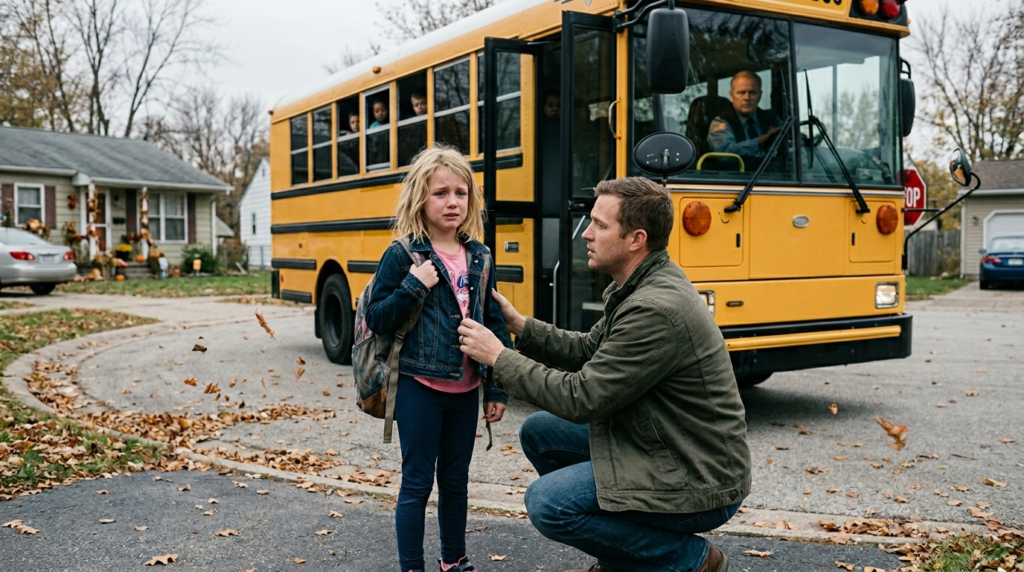
I’ve spent the last five years raising my daughter alone in this quiet Ohio suburb, but nothing prepared me for the sheer terror of what I saw when she stepped off the school bus this afternoon.
It was a Tuesday, just like any other, wrapped in the crisp, grey chill of late October.
The autumn wind was kicking up dry leaves, sending them scratching across the asphalt of our cul-de-sac as I stood at the end of the driveway, checking my watch.
3:15 PM.
Right on time, the heavy, familiar rumble of the diesel engine echoed from around the corner.
My seven-year-old daughter, Emma, usually loved the bus ride. She was a bright, talkative girl who usually spent the trip home drawing pictures or whispering secrets with her friends.
Every single day, she would be the first one to bounce down those high rubber-lined steps, flashing a gap-toothed smile and waving a crinkled piece of construction paper in the air.
But today, the rhythm was entirely wrong.
The heavy yellow bus rolled to a stop, its brakes screeching a bit louder than usual.
The pneumatic doors hissed open, but no one came out immediately.
Instead, a sound drifted from inside the stairwell that made my stomach instantly drop into a cold, hollow pit.
It was crying. Not a soft whimper, and not the kind of tantrum a child throws when they don’t get their way.
It was a deep, chest-heaving, breathless sob of pure terror.
Before I could even take a step forward, Emma appeared in the doorway. She wasn’t walking; she was practically stumbling, her small body shaking so violently that she missed the first step and had to catch herself on the handrail.
Her backpack was dangling loosely from one shoulder, dragging on the dirty floor. Her face was bright red, soaked in tears, and her chest was heaving as she struggled to draw breath.
Right behind her stood Mr. Henderson, the veteran bus driver. He was a heavy-set man in his late fifties who had driven this neighborhood route for nearly a decade. Usually indifferent, his face right now was flushed a deep, angry crimson. His knuckles were white as he gripped the massive lever to operate the door.
He didn’t look down at Emma with pity or concern. Instead, he leaned over his steering wheel, his voice booming out across the quiet neighborhood street, harsh and completely devoid of empathy.
“I told you to stop that crying!” he snapped, his voice cutting through her sobs. “Just get home and stop making a scene! I can’t drive with that racket!”
The sheer hostility in his tone snapped something inside me. A protective instinct I didn’t even know I possessed flared to life.
I rushed to the base of the steps, shielding Emma as she practically fell into my arms.
“Hey! What is wrong with you?” I shouted up at him, my voice trembling with a mixture of confusion and boiling rage. “Why are you yelling at a seven-year-old child like that? What happened on this bus?”
Mr. Henderson looked startled for a split second, his eyes widening as he realized I was standing right there. But just as quickly, his expression hardened into defensive defiance. He refused to look me in the eye, staring straight ahead through the windshield instead.
“She’s been hysterical since we pulled out of the elementary school parking lot, mister,” he mumbled tightly, his jaw clenched. “I have forty other kids to worry about. I can’t have distractions. Just take her.”
Before I could demand another word, he slammed the lever forward. The doors folded shut with a loud slap, and the bus pulled away from the curb, leaving behind a thick cloud of dark exhaust and a deafening silence.
I didn’t care about him anymore. My entire universe was the sobbing little girl clutching desperately at my jacket.
I knelt on the damp concrete of the sidewalk, pulling Emma tightly against my chest. She was hyperventilating, her tiny fingers digging into my shoulders as if she were drowning and I was the only thing keeping her afloat.
“Ssh, it’s okay, Emmy. Daddy’s here. You’re safe,” I whispered into her hair, rubbing her back in slow, circular motions, trying to ground her. “What happened, sweetie? Did someone hurt you at school? Did someone say something on the bus?”
She couldn’t answer. Every time she tried to form a word, a fresh wave of violent sobs choked her off. She just buried her face deeper into my neck, her tears soaking right through my shirt.
I decided to get her inside the house where it was warm, away from the biting wind and the curious glances of a neighbor who had just opened their front door down the street.
I scooped her up into my arms. She felt lighter than usual, completely limp with exhaustion from whatever trauma she had just endured.
As I carried her up the driveway and into the living room, I kept murmuring comforting words, setting her down gently on the edge of the fabric sofa.
The house was quiet, the afternoon light casting long, somber shadows across the room.
“Let’s get this jacket off, okay? You’re burning up,” I said softly, reaching for the zipper of her oversized denim jacket.
She didn’t fight me, but as I gently pulled the sleeves down her arms, she let out a sharp, ragged gasp and winced, pulling away slightly.
“Did you fall on the playground, Emmy?” I asked, my heart hammering against my ribs. “Show me where it hurts.”
She didn’t speak. She slowly turned her back to me, her head bowed, her small shoulders still trembling with residual hitches of breath.
As she shifted, her light pink cotton t-shirt pulled taut across her upper back. Because the jacket had dragged it down, the collar of the shirt slipped sideways, exposing the skin over her right shoulder blade.
I froze. The breath completely left my lungs.
Staring back at me, stark and horrifying against her pale, delicate skin, was a massive, fresh bruise.
It wasn’t a scrape from a playground fall. It wasn’t a mark from a rough game of tag.
It was a perfectly defined, dark purple and blue handprint.
The fingers were long and thick, wrapping viciously around the curve of her upper back, and the deep indentation of a thumb was pressed heavily right over her shoulder blade, where the skin was already beginning to swell.
It was the unmistakable mark of an adult’s hand, squeezed with enough violent force to burst the capillaries beneath her skin.
A sickening realization washed over me as I looked from the bruise to the front window, where the ghost of the school bus had just disappeared down the road.
Mr. Henderson’s furious face flashed in my mind. His defensive anger. The way he had yelled at her to stop crying the moment the doors opened.
My hands began to shake, a toxic mixture of cold horror and blinding fury flooding my veins.
Who had done this to my little girl?
Chapter 2
The silence that followed inside our small living room was deafening. It was the kind of heavy, suffocating quiet that presses against your eardrums right before a massive storm hits. I stared at my daughter’s back, my mind completely refusing to process the image before my eyes.
The bruise was a horrific, violent violet against her pale skin. The indentation of the thumb was pressed deeply near the base of her neck, while four long, thick finger marks wrapped downward across her right shoulder blade, squeezing the delicate tissue until the skin had swollen into angry, raised ridges. It wasn’t just a casual grip; it was a desperate, malicious clamp. Someone had laid their hands on my seven-year-old girl with enough raw force to leave a permanent map of their violence on her body.
My phone felt like a block of ice in my pocket as I pulled it out. My hands were shaking so violently that the first three pictures I took were nothing but a blurry smear of pink cotton and distorted flesh. I had to close my eyes, take a deep, ragged breath, and steady my forearms against my knees to get a clear, sharp shot. Click. Click. The artificial camera noise sounded like a gunshot in the quiet room. Each flash felt like a betrayal of her innocence, but I knew I needed evidence. I needed proof of the monster who had done this.
“Emmy,” I whispered, my voice cracking, sounding entirely foreign to my own ears. I carefully pulled her pink t-shirt back over her shoulder, my fingertips barely brushing the skin, terrified that even the slightest touch would cause her more pain. “Emmy, baby, look at me.”
She slowly turned around on the edge of the sofa. Her eyes were wide, rimmed in a deep, exhausted red, and her lower lip was still trembling. She looked so incredibly small sitting beneath the large framed landscape painting her mother had bought years ago. She pulled her knees up to her chest, wrapping her small arms around them, trying to make herself as invisible as possible.
“I need you to breathe with me, okay? Just look at Daddy and breathe,” I murmured, kneeling on the hardwood floor directly in front of her. I took her tiny, ice-cold hands in mine. “You are safe in this house. Nobody can get to you here. I promise you, on my life, nobody is ever going to hurt you again. But I need you to tell me what happened on that bus. Did Mr. Henderson do that to your shoulder?”
Emma swallowed hard, a tiny, hitching sob escaping her throat. She shook her head rapidly, her blonde hair flying across her face. “No,” she whispered, her voice barely audible over the hum of the old refrigerator in the kitchen. “Not Mr. Henderson.”
The blood in my veins, which had been boiling with a singular focus on the angry bus driver, suddenly turned to ice. “If it wasn’t him, Emmy, then who was it? Did one of the older kids from the middle school grab you?”
She shook her head again, burying her chin deeper into her knees. “It wasn’t a kid, Daddy. It was the bad man.”
“What bad man, sweetie? Tell me.”
It took nearly twenty agonizing minutes to piece the story together through her stuttering, fragmented sentences and sudden bursts of tears.
Because of the heavy road construction on Route 4—the main artery that connects the elementary school to our suburban development—the school buses had been forced to take a lengthy detour for the past two weeks. The detour routed them down Old Mill Road, a narrow, winding two-lane blacktop that cuts directly through the dense, unlit state forest area on the eastern edge of town. It was an isolated stretch of road, bordered by thick patches of oak and pine trees, with barely any cell service and miles between houses.
According to Emma, about midway through the forest stretch, the bus had groaned to an unexpected halt near the old, rusted iron bridge over Sugar Creek. Mr. Henderson had muttered something angry under his breath, engaged the air brakes, and stepped out of the driver’s seat to inspect a loud, rhythmic rattling noise coming from the exterior side mirror on the passenger side.
“He left the front door open,” Emma whispered, her eyes staring blankly at the floorboards as she relived the memory. “The big noisy lever was pushed forward. He was outside, tapping on the glass. I was sitting in the very back row because Lily wasn’t at school today, and I wanted to look out the big back window at the trees.”
She paused, her breathing hitching again. I squeezed her hands gently, encouraging her to keep going, though every fiber of my being wanted to scream at the sheer negligence of a driver leaving a bus full of children with open doors on an isolated country road.
“I dropped my green crayon,” Emma continued, a tear slipping down her cheek. “It rolled under the long bench seat at the very back. I leaned down on the floor to look for it. It was really dark down there, Daddy. And then… then I heard the back emergency door make a loud click.”
My heart stopped. The emergency exit door at the rear of every standard yellow school bus had a heavy red handle. If pushed, it would swing wide open.
“I thought it was just the wind,” she said, her voice dropping to a terrified whisper. “But then I smelled something really bad. It smelled like old grease and wet dirt, like the mud down by the river after a big rain. I stood up to look, and there was a man standing right inside the back door. He had a big black hood over his head, and his face was all dirty.”
“Did he say anything to you, Emmy?” I asked, my grip on her hands tightening unconsciously.
“No,” she sobbed, the memory finally breaking her fragile composure. “He didn’t say a word. He just reached out really fast and grabbed my shoulder. He squeezed it so, so hard, Daddy. It felt like his fingers were digging all the way into my bones. He started pulling me backward toward the open door. He was trying to take me off the bus into the woods.”
A wave of cold nausea washed over me. A predatory stranger had boarded a school bus full of children in broad daylight and had physically attempted to abduct my daughter from the rear exit.
“What happened next? How did you get away?” I asked, my voice trembling with raw horror.
“I screamed as loud as I could, but the older kids in the front rows were playing music on their phones and laughing, and Mr. Henderson was outside hitting the metal mirror,” Emma cried, her small body shaking. “The man kept pulling me, so I turned around and I bit his hand. I bit him right on the thumb, as hard as I could. He made a scary, angry grunting sound and let go of my shirt. Then I heard Mr. Henderson’s heavy boots coming up the front steps of the bus, and the bad man jumped out the back door and ran into the trees.”
Everything made sense now. The puzzle pieces clicked together with a horrifying, sickening precision.
When Mr. Henderson had climbed back into his seat and closed the doors, he had looked in his rearview mirror and seen Emma standing in the aisle at the back of the bus, screaming, sobbing, and completely hysterical with terror. He hadn’t seen the man. He hadn’t heard the emergency door click shut. In his mind, an overworked, stressed-out driver dealing with forty loud children on a delayed route, Emma was just a misbehaving, disruptive seven-year-old throwing an unprovoked tantrum that threatened his concentration on a dangerous road. He had assumed she was just making a scene, which was why he had spent the rest of the drive yelling at her to shut up, completely oblivious to the fact that she had just fought off a kidnapper feet away from his seat.
“Oh god, Emma,” I breathed, pulling her into a fierce, desperate hug. I held her so tightly against my chest, feeling the rapid, terrified thumping of her little heart. “You were so brave. You did exactly the right thing. You’re safe now. Daddy’s got you.”
But as I held her, my eyes drifted back to the front window. The sun was dipping below the horizon now, casting long, bloody streaks of orange and deep purple across the grey suburban sky. The woods where that man had fled were only a ten-minute drive from our house. If he was desperate enough to board a school bus, he was desperate enough for anything.
I stood up, my survival instincts taking complete control of my limbs. I walked over to the front door, turned the heavy deadbolt until it clicked firmly into place, and slid the security chain across the frame. I moved through the downstairs area like a man possessed, locking every single window, pulling down the blinds, and securing the back sliding glass door with a thick wooden security bar I kept in the track.
Then, I picked up my phone and dialed 911.
The line rang twice before a calm, professional female voice answered. “911, what is the address of your emergency?”
“I need the police at my house immediately,” I said, my voice forced into a tight, flat monotone to keep from breaking. “My seven-year-old daughter was just assaulted and nearly abducted from her school bus on Old Mill Road. The suspect is a male, adult, wearing a black hoodie. He fled into the state forest about thirty minutes ago.”
The dispatcher’s tone shifted instantly from routine efficiency to sharp alert. “Sir, is your daughter safe and with you right now?”
“Yes, she’s with me. She has a severe bruise on her shoulder where he grabbed her. Please send someone right away.”
“I am dispatching units to your location immediately, sir. I am also notifying the county sheriff’s department regarding the location on Old Mill Road. Please stay on the line with me until an officer arrives at your home.”
For the next fifteen minutes, I stood in the center of my living room, the phone pressed to my ear, watching the street through a tiny slit in the window blinds. Emma sat huddled on the couch, wrapped tightly in a thick wool blanket I had pulled from the closet, her eyes locked onto me like I was her only anchor to reality. The world outside looked completely normal—a neighbor’s cat strolling across a manicured lawn, a stray leaf blowing across the blacktop—but inside our walls, our entire reality had been shattered into a thousand jagged pieces.
Finally, the distant, rising wail of a siren broke the evening quiet. Within moments, a white-and-blue local township police cruiser rounded the corner of the cul-de-sac, its red and blue emergency lights flashing brilliantly against the darkening neighborhood houses. It pulled up into my driveway, followed immediately by a second unmarked SUV.
I thanked the dispatcher and hung up, quickly unlocking the front door to let them in.
Two officers stepped onto the porch. The first was a tall, broad-shouldered man in his late thirties with a stern, weathered face and a heavy utility belt that clinked with every step. His badge read Officer Davis. Behind him was a younger female officer with her hair pulled back tightly in a bun, her expression filled with genuine concern.
“Sir, are you the one who called?” Officer Davis asked, stepping into the foyer and immediately scanning the room with practiced, tactical eyes.
“Yes. I’m Mark. This is my daughter, Emma,” I said, gesturing toward the sofa.
The female officer immediately bypassed us and knelt down next to Emma, speaking to her in a soft, low, comforting voice that only a trained professional or a mother could master. “Hi Emma, I’m Officer Ramirez. You’re in a lot of safety right now, okay? Can you tell me what happened?”
While Ramirez engaged Emma, I pulled Officer Davis slightly to the side, near the kitchen doorway. I pulled out my phone and handed it to him, showing him the high-resolution photographs of the massive handprint on Emma’s shoulder blade.
Davis took the phone, his eyes narrowing to slits as he looked at the screen. He let out a low, grim whistle through his teeth. “Jesus Christ,” he muttered under his breath, looking up at me. “That’s a deliberate grab. Look at the spacing of the fingers. That’s a grown man’s hand, and he wasn’t trying to scare her. He was trying to haul her out of there.”
“She said he came through the back emergency door while the driver was outside checking a mirror on Old Mill Road,” I explained, the anger rising in my chest again. “The driver didn’t see him. He just thought Emma was throwing a tantrum when he got back inside and started screaming at her to shut up.”
Davis frowned, pulling a small notebook from his shirt pocket. “Old Mill Road near the Sugar Creek bridge? That area is a complete dead zone for cellular service. The woods back there stretch for nearly five thousand acres into the state park. If a guy knows those trails, he could vanish into thin air before we even get a canine unit out there.”
He stepped toward his shoulder radio, pressing the button. “Dispatch, this is Unit 212. Confirming a physical assault and attempted abduction of a juvenile on Bus Route 14. Suspect is an unknown male, adult, large build, wearing a black hooded sweatshirt, potentially injured with a bite mark on his right thumb or hand. We need a secondary unit to head over to the transit depot immediately to intercept Bus 14 and the driver, identified as a Mr. Henderson. We need to secure the on-board camera footage immediately.”
I stood there, watching Davis speak into his radio, a small glimmer of hope rising in my chest that the bus cameras would have captured the monster’s face when he pushed the back door open. Even if Emma was in the back row, those wide-angle security lenses mounted near the driver’s seat usually covered the entire aisle.
The radio crackled with heavy static for a long, agonizing moment before the dispatcher’s voice returned. But she didn’t sound calm anymore. Her voice had a strange, sharp tremor to it that made Officer Davis freeze mid-sentence.
“Unit 212, hold your position at the residence,” the dispatcher’s voice blared through the small speaker, filled with a sudden, suffocating urgency. “Be advised, we just contacted the central school district transportation depot to locate Bus 14. The dispatcher at the depot reports that Bus 14 failed to check in at its final destination fifteen minutes ago. They attempted to contact the driver via radio and digital dispatch, but there has been zero response.”
Officer Davis gripped his radio tighter, his face hardening. “Dispatch, does Bus 14 have an active GPS tracking unit onboard?”
The static cut out for a second, and when the dispatcher spoke again, my heart dropped straight into a frozen abyss.
“Unit 212… the depot reports that the bus’s internal GPS transponder suddenly went completely dark ten minutes ago. The last ping we received from Bus 14 was located precisely at the intersection of Old Mill Road and the Sugar Creek ridge. The bus is missing, and we have thirty-five elementary school children still unaccounted for inside that vehicle.”
Chapter 3
The words hanging in the air of our living room didn’t feel real. They felt like a line stripped from a twisted evening broadcast, something happening thousands of miles away to people I would never meet. But the cold, unyielding look on Officer Davis’s face told me otherwise.
Thirty-five children.
Thirty-five elementary school kids who had been sitting on that exact same yellow vinyl bus seats just minutes before Emma escaped. Kids from our neighborhood. Kids Emma ate lunch with, played tag with, and shared crayons with. They were gone. The entire vehicle had simply dissolved into the damp, shadowed expanse of the Blackwood State Forest.
“Repeat that, dispatch,” Officer Davis barked into his shoulder mic, his knuckles turning white as he gripped the small black device. “Confirm last known coordinates of Bus 14.”
The radio crackled, the underlying static sounding like dry leaves scraping across a grave. “Unit 212, central dispatch confirms the final automated GPS ping occurred at 3:38 PM near the Sugar Creek ridge markers on Old Mill Road. All subsequent telemetry is dead. We are receiving multiple frantic calls from parents at the downstream stops. Stage three mobilization is authorized. All available units converge on the forest perimeter.“
The room transformed in an instant. The professional, measured calm that the two officers had brought into my home evaporated, replaced by the raw, high-stakes adrenaline of a worst-case scenario.
Officer Davis turned to his partner, his eyes hard and focused. “Ramirez, you stay here. Lock this place down. If the suspect Emma encountered is part of a coordinated grab, this house might not be an accidental stop. He knows she got away. He knows she can identify him.”
Officer Ramirez didn’t hesitate. She nodded sharply, her hand instinctively dropping to rest on the butt of her holstered duty weapon. “Understood. I’ll secure the perimeter. Go.”
Davis gave me a brief, heavy look—the look of one father recognizing the absolute terror in another—before turning on his heel and sprinting out the front door. The heavy oak door slammed shut behind him, and a second later, the gravel in my driveway sprayed wildly as his cruiser tore out into the street, its sirens rising into a deafening, frantic wail that echoed through the cul-de-sac.
Inside, the silence rushed back in to fill the void, heavier and more terrifying than before.
“Mark,” Officer Ramirez said, her voice dropping into a low, authoritative register that demanded my focus. “I need you to pull down every single blind in this room right now. Do not stand directly in front of the glass while you do it. Keep low.”
My body moved on pure instinct, the fog of shock momentarily cleared by the immediate need to protect my daughter. I dropped to my knees, crawling along the baseboards of the living room, reaching up to yank the plastic cords of the blinds. One by one, the windows went dark, cutting off our view of the twilight-soaked street and sealing us into a dim, claustrophobic box.
Emma hadn’t moved an inch from the sofa. She had pulled the wool blanket all the way up to her chin, her eyes darting between me and the female officer. She wasn’t crying anymore; she had surpassed tears, entering that hollow, silent space of pure psychological shock.
Then, it happened.
A sound so sharp and violent it made all three of us jump simultaneously.
It wasn’t a noise from outside. It was our cell phones.
My iPhone on the coffee table and Officer Ramirez’s department-issued device on her belt exploded at the exact same millisecond. It was the shrill, discordant, dual-tone screech of an emergency broadcast. The sound that ice-watered your veins before you even read the text.
I snatched my phone. The screen was a bright, glaring orange block of text.
AMBER ALERT: CHILD ABDUCTION TOXIC ALERT AREA. A mass abduction event has been reported in the area of Blackwood State Forest. Vehicle involved: Ohio School District Bus #14. Thirty-five juveniles missing. Suspect or suspects unknown. Extreme danger. Lock all doors and shelter in place.
Seeing it written out in the cold, institutional font of an emergency alert made the horror absolute. My hands shook so violently the phone slipped from my grip, clattering onto the hardwood floor.
“They issued a county-wide block,” Ramirez muttered, her eyes scanning her own screen. She walked over to the front entryway, checking the deadbolt herself, ensuring the heavy security chain was taut. “Mark, do you have any weapons in this house? A hunting rifle? A shotgun? Anything?”
“No,” I choked out, my throat dry as sandpaper. “I… I never thought I’d need one. We moved here because it was supposed to be safe. The crime rate here is practically zero.”
“Nowhere is zero,” she said grimly, pulling her glock from its holster with a metallic click that sounded incredibly loud in the small room. She held it low at her side, her thumb flicking the safety off. “We keep the lights low. We stay away from the doors.”
Outside, the autumn weather took a turn for the worse. The wind, which had been kicking up dry leaves earlier, turned into a violent, howling gale. Heavy sheets of rain began to slam against the siding of the house, a rhythmic, drumming assault that masked the natural sounds of the neighborhood. Lightning flashed through the cracks of the closed blinds, illuminating the living room in brief, skeletal jerks of blue-white light, followed by the deep, window-rattling rumble of thunder.
Ramirez adjusted the volume knob on her shoulder radio, turning up the squelch so we could hear the tactical channel. The audio was a chaotic mess of overlapping voices, shouting officers, and the heavy roar of wind and rain from the search teams out on Old Mill Road.
“Vanguard 1 to Dispatch, we’ve established a roadblock at the northern entrance of the state park. Visual conditions are near zero. The rain is washing out the dirt shoulders.“
“Unit 305, I’m at the Sugar Creek bridge. I’ve got visual on heavy skid marks leading off the blacktop. They look like commercial tire treads. It looks like the bus took a hard right into the old logging trail. I’m moving in on foot.“
I crept over to the sofa, sliding onto the cushions next to Emma. I wrapped my arm around her tiny shoulders, pulling her against my side. She was ice cold, shivering despite the thick wool blanket. I kissed the top of her head, smelling the faint scent of her strawberry shampoo mixed with the lingering, sour smell of the rain and mud she had brought in from outside.
“Daddy’s here, Emmy,” I whispered, my voice trembling. “The police are outside. Whole town is looking for your friends. They’re going to find them.”
She didn’t look at me. She just stared at the blank television screen across the room, her tiny fingers clutching the edge of the blanket. “The man in the black hood… he had friends, Daddy.”
I froze. I looked down at her, my heart skipping a beat. “What do you mean, sweetie? You told me there was only one man at the back door.”
“There was only one man who grabbed me,” she whispered, her voice cracking. “But when I bit him and he jumped off the back steps… I looked out the big window. There were two other men standing in the trees. They had long black sticks in their hands. They were watching the bus.”
My gaze snapped up to Officer Ramirez. She had heard it too. Her face had gone completely pale under the dim living room light.
Long black sticks. Rifles.
This wasn’t a crime of opportunity. It wasn’t a lone predator wandering the woods who saw an open bus door. It was a tactical interception. A synchronized ambush. They had deliberately selected a blind spot on a detour route with zero cellular reception, waited for the driver to step out, and moved in. But Emma’s violent resistance and her scream had disrupted their timeline, forcing the first man to retreat before they could secure the vehicle from the rear.
But they hadn’t given up. They had just waited until the bus drove further into their trap.
The radio on Ramirez’s shoulder erupted into a chaotic frenzy of static and screaming.
“Officer down! Officer down at the logging trail!” a voice shrieked through the speaker, nearly drowned out by the sound of rapid, popping noises in the background. It took my brain three seconds to realize those popping sounds were gunfire. “We’re taking fire from the tree line! High-caliber rounds! They’re targeting the engines—“
The transmission cut off into a sharp, piercing whine of feedback.
Dispatch came back on immediately, her voice breaking her professional facade for the first time. “All units be advised, ambush reported at the old logging trail. Heavy weapons involved. Air support is grounded due to weather. Do not engage without armored support—“
“Oh my God,” Ramirez whispered, her breath catching in her throat. She took a step back from the window, her back pressing against the wall.
The scope of what we were dealing with was mutating into something far larger and more terrifying than a local kidnapping. This was an insurgent action on American soil, a heavily armed group taking an entire busload of children hostage and executing a military-style defense against the local police force.
And then, the house went completely dark.
The hum of the refrigerator died. The digital clock on the microwave blinked out. The faint warmth from the baseboard heaters ceased. The entire neighborhood outside seemed to plunge into an abyss of absolute, unlit blackness.
Emma let out a tiny, stifled shriek, burying her face into my chest.
“Stay down!” Ramirez commanded, her voice a sharp, desperate hiss. “Mark, get her on the floor behind the couch right now!”
I grabbed Emma, rolling off the sofa and pulling her down into the narrow space between the fabric furniture and the heavy oak coffee table. I covered her body with my own, using my back as a shield, my eyes staring wildly into the darkness of the room.
The only light came from the small, glowing screen of Ramirez’s department radio and the occasional, blinding flash of lightning from outside.
Beep. Beep. Beep.
The backup battery on our home security system began to emit a rhythmic, high-pitched warning chime from the hallway closet, signaling that the main power line had been severed. The sound was agonizingly loud, a beacon in the dark.
“Officer Ramirez,” I whispered, my voice shaking so badly I could barely form the words. “Did the storm take out the power grid?”
She didn’t answer immediately. I could hear her soft, deliberate footsteps moving across the hardwood floor toward the front hallway. “The transformer on the main road usually handles heavy wind. This feels too clean. The whole block went down at once.”
A sudden flash of lightning illuminated the front foyer for a fraction of a second. In that split moment of brilliant white light, I saw Ramirez standing near the door, her gun raised, her eyes locked onto the frosted glass panel of the front door.
And then, through the heavy drumming of the rain outside, we heard a sound that made my soul shrivel.
It wasn’t thunder. It wasn’t the wind.
It was the heavy, deliberate thud of combat boots stepping onto the wooden planks of our front porch.
Thud. Thud. Thud.
The floorboards creaked under a massive weight. Whoever was out there wasn’t trying to be quiet. They were moving with the heavy, unhurried confidence of someone who knew exactly who was inside and knew we had nowhere left to run.
“Police!” Ramirez shouted toward the door, her voice echoing with a fierce, trembling bravery. “Identify yourself immediately! I am armed!”
No response. Only the steady, relentless sound of the rain slamming against the porch roof.
Then, a low, mechanical grinding noise echoed from the backyard.
My heart hammered against my ribs like a trapped bird. The backyard sliding glass door was separated from the living room by a single drywall partition. I had locked it, yes, and I had put the wooden security bar in the track. But against someone with heavy tools, a sheet of glass was nothing but a fragile illusion of safety.
A bright, blinding beam of white light suddenly sliced through the cracks of the backyard blinds. It wasn’t natural lighting. It was a high-intensity tactical flashlight, sweeping across the interior of our kitchen, casting long, monstrous shadows across the living room ceiling.
They were flanking us. One at the front door. One at the back.
“Mark,” Ramirez whispered, her voice tight and urgent as she moved back toward the sofa. “Take Emma and get into the hallway bathroom. There are no windows in there. Lock the door and stay on the floor. No matter what you hear out here—no matter what—do not open that door until I tell you it’s safe.”
“I can’t leave you out here alone,” I argued, tears of terror and rage finally blurring my vision. “There are two of them.”
“I am a sworn officer of the law, Mark! Now move your daughter!” she ordered, her tone leaving zero room for debate.
I scooped Emma up into my arms, keeping my head low as I scrambled down the dark hallway. The security system battery was still chirping its mocking warning. Beep. Beep. I reached the small, windowless bathroom at the end of the hall, stepped inside, and pulled the heavy hollow-core door shut. I turned the small thumb-lock until it clicked.
The darkness inside the bathroom was absolute. It was a suffocating, velvety blackness where you couldn’t see your own hand an inch from your face. I sat down on the cold tile floor, pulling Emma into my lap, pressing my back against the porcelain base of the bathtub.
We sat there in the dark, holding each other, listening to the symphony of terror unfolding in our own home.
Through the bathroom door, the sounds were muffled but distinct.
First came the sharp, explosive shatter of glass from the kitchen—the sliding door had been breached.
Then, Ramirez’s voice, screaming a final, desperate command: “Drop the weapon! Drop it—”
Her voice was instantly cut off by the thunderous, deafening roar of three rapid gunshots. The concussive force of the blasts rattled the drywall of the bathroom, the sound vibrating through the floor tiles beneath my thighs.
A sharp, agonizing scream echoed through the hallway—a woman’s voice. Ramirez.
Then, the heavy sound of a body collapsing onto the hardwood floor of the living room, followed by the clatter of a metallic object rolling across the wood. Her gun.
My breath caught in my throat. I clamped my hand tightly over Emma’s mouth, terrified that she would scream, terrified that her tiny voice would give away our final hiding spot. She was shaking violently in my arms, her hot tears soaking into the palm of my hand.
The house fell into a sickening silence, save for the steady dripping of rain from the broken kitchen door and the relentless beep, beep of the security system.
Then, the heavy, wet crunch of boots began to move down our hallway.
They were checking the rooms. One by one.
Thud. Thud. Thud.
The footsteps stopped directly outside the bathroom door.
I held my breath, my entire existence shrinking down to the space of that tiny bathroom. I squeezed my eyes shut, praying to a God I hadn’t spoken to in years, begging for the door to hold, begging for them to turn around.
The brass doorknob began to rattle.
Slowly, deliberately, someone was turning it from the outside, testing the lock. The metal mechanism ground tightly against the wooden frame as they applied pressure.
The lock held for a second.
Then, a sudden, violent concussive blow slammed against the exterior of the door. The wood splinters groaned. They were kicking it down.
A second kick struck the center of the frame. The wood around the latch split with a loud, sickening crack, and the door swung wide open, slamming against the interior wall.
The bright, blinding beam of a tactical flashlight sliced through the darkness, pinning Emma and me against the bathtub like deer in a high-beam headlight.
I raised my arm to shield my eyes, looking through the glare at the monstrous silhouette standing in the ruined doorway.
It was a massive man, over six feet tall, dressed entirely in mud-splattered tactical gear and a heavy black hooded jacket. His face was completely obscured by a dark, ballistic mesh mask, leaving only two cold, emotionless eyes visible through the slits.
He didn’t raise a gun. He didn’t say a word.
Instead, he slowly reached up to his shoulder, clicked a button on his tactical vest, and a pre-recorded audio file began to play from a small, high-output speaker mounted on his chest.
The voice that emerged from the speaker wasn’t his. It was a voice I recognized instantly. It was the tired, gravelly, indifferent voice of Mr. Henderson, the missing school bus driver.
“Mark,” the speaker rasped, the recording distorted by a strange, low-frequency hum. “If you ever want to see the rest of those thirty-five children alive again, you will hand over your daughter. Right now.“
Chapter 4
The mechanical voice vibrating from the speaker on the man’s chest didn’t sound human. It was Mr. Henderson’s voice, yes, but it had been chopped, stretched, and layered over a low-frequency digital hum that made it sound like an execution order broadcast from a concrete bunker.
“Mark… If you ever want to see the rest of those thirty-five children alive again, you will hand over your daughter. Right now.”
The words bounced off the white subway tiles of our small bathroom, suffocating the air. The blinding beam of the tactical flashlight remained locked on Emma’s face. She didn’t scream. She didn’t even blink. Her tiny body had gone completely rigid in my lap, her fingers clawing into the fabric of my shirt with a grip so tight her knuckles looked like polished ivory.
The giant in the doorway didn’t move. He stood perfectly still, a mountain of black ballistic nylon, mud-splattered tactical gear, and that horrific woven mesh mask that completely swallowed his features. The only sign of life was the slow, rhythmic rise and fall of his massive chest and the faint scent of wet earth, iron, and burnt gunpowder radiating off him.
My mind cleared of all peripheral thought, narrowing down to a single, cold realization.
If I handed Emma over, she was dead. If I stayed in this corner, we were both dead. There was no negotiation here. There was no mercy behind that mesh mask. This wasn’t a kidnapping anymore; it was a cleanup operation. Emma was the loose thread that had unraveled their perfect, military-grade ambush on Old Mill Road, and they were here to cut it.
“Okay,” I whispered, my voice sounding incredibly thin, barely carrying over the steady drumming of the rain outside. “Okay. Just… don’t hurt her. Let me lift her up.”
I lowered my left hand, keeping my right arm raised to shield my eyes from the blinding glare of his flashlight. My fingers slid across the cold, damp tile floor behind my lower back, sweeping through the darkness until they struck the solid, heavy porcelain base of the toilet.
Slowly, millimeter by millimeter, I reached upward, my fingertips brushing against the underside of the heavy ceramic toilet tank lid.
“She’s terrified,” I muttered, intentionally letting my voice crack to feed his sense of absolute control. “Please. Move the light out of her eyes. She can’t see where she’s stepping.”
The intruder didn’t lower the flashlight. But he took a single, heavy step forward into the narrow bathroom, the wet rubber soles of his combat boots squeaking against the tile. That step was his mistake. It brought him within arm’s reach of the bathtub.
In one explosive motion, driven by a raw, feral surge of adrenaline I didn’t know the human body could generate, I shoved Emma sideways into the porcelain basin of the tub. At the exact same instant, my right hand gripped the edge of the ceramic tank lid, hoisted the heavy, twelve-pound block of solid porcelain over my shoulder, and swung it forward with every ounce of leverage I had.
The impact was deafening.
The ceramic lid shattered into a dozen jagged shards directly across the side of the man’s ballistic mask. The tactical flashlight flew from his grip, spinning wildly across the floor before slamming into the base of the sink, its beam pointing upward at the ceiling in a skewed, frantic angle.
The giant groaned—a deep, guttural, animalistic sound—and stumbled backward against the doorframe, his hands flying up to his fractured mask.
I didn’t give him a chance to recover. I threw my entire body weight into his midsection, tackling him out of the narrow bathroom and into the pitch-black hallway. We went down together in a chaotic tangle of limbs and nylon. He felt like steel and concrete beneath me, his hands instantly clawing at my throat with terrifying strength.
The darkness in the hallway was total, illuminated only by the rhythmic, mocking orange flash of the home security system’s backup battery.
Beep. Beep. Beep.
With every orange flash, I saw a snapshot of our struggle. A gloved hand tearing at my face. The glint of a heavy tactical knife being pulled from his utility belt. The spray of my own blood as his knuckles caught the bridge of my nose.
He was significantly stronger than me, trained to kill, but I was a father fighting for the survival of my only child on the blood-slicked floor of my own home. There were no rules. There was no technique. I bit, I gouged, I scratched at the eye slits of his mask, desperate to keep that heavy blade away from my chest.
My hand frantically swept across the floorboards as he pinned my shoulders down, his knee driving into my ribs, crushing the breath from my lungs. My fingers brushed against something cold, heavy, and metallic.
Officer Ramirez’s service weapon.
My fingers locked around the checkered polymer grip of the Glock. I didn’t try to aim. I didn’t try to pull back. I simply jammed the muzzle of the weapon upward into the bulk of his chest tactical vest and pulled the trigger.
The enclosed hallway exploded in a blinding flash of orange fire and a concussive roar that shattered my eardrums. The gun kicked violently against my palm.
Bang! Bang! Bang!
The giant went instantly limp, his massive weight collapsing directly on top of me like a felled oak tree. The heavy tactical knife dropped from his hand, clattering harmlessly against the baseboards. The metallic, bitter smell of cordite filled the narrow corridor, mixing with the sudden, metallic stench of fresh blood.
I lay beneath him for three agonizing seconds, my chest heaving, listening to the agonizingly slow wheeze of his final breaths escaping through the mesh mask before he went completely still.
I pushed his massive body off me, scrambling backward on my hands and knees into the living room. The tactical flashlight from the bathroom was still casting its pale beam across the floorboards, illuminating a scene of absolute devastation.
Officer Ramirez was slumped against the base of the fabric sofa, her uniform soaked in dark blood near her shoulder. Her eyes were fluttered open, her breathing shallow and ragged, but she was alive.
“Mark…” she gasped, her hand weakly reaching toward her belt. “The… the radio…”
I crawled over to her, my hands slick with blood, and snatched the department radio from her shoulder. The tactical channel was an absolute nightmare of screaming voices, broken transmissions, and the continuous roar of automatic gunfire over the howling wind.
I pressed the talk button, my voice screaming over the static. “Dispatch! Dispatch! This is Mark at the residence! The intruder is down! Officer Ramirez is hit, she needs an ambulance immediately! Do you copy me? She is bleeding out!”
The line crackled violently before a voice broke through—not the dispatcher, but the hard, gravelly voice of Officer Davis, his background filled with the terrifying sound of high-caliber rounds tearing through metal.
“Mark! Stay in the house! Do not leave the residence! We’ve located the bus at the old Sugar Creek quarry, but we’re pinned down! They’ve got heavy weapons… they’re setting up a defensive perimeter around the tunnels—“
The transmission was cut off by a massive explosion that rattled the small speaker of the radio, followed by a wall of continuous static.
I dropped the radio, my heart stopping.
The old Sugar Creek quarry. It was an abandoned limestone mine deep within the Blackwood State Forest, a labyrinth of flooded pits, crumbling concrete crushing mills, and miles of dark, subterranean tunnels that ran beneath the state park. If they got those thirty-five children deep inside those tunnels, the local police would never find them. It would take a military division days to clear those shafts, and by then, the children would be gone—transported out through one of the dozens of forgotten drainage exits that led to the state highway.
I turned around to see Emma standing in the hallway doorway, holding the wool blanket tightly around her shoulders. Her face was completely pale, but her eyes were locked onto mine with an unyielding intensity.
“Daddy,” she said, her voice completely steady now, the shock transforming into a strange, premature maturity. “They’re going to take them into the dark place. The man on the bus… he said they were going to put them in the ground.”
“I know, baby,” I said, walking over to her and kneeling down, grabbing her arms. “Listen to me. I need you to stay right here with Officer Ramirez. Hold this cloth against her shoulder as hard as you can. Can you do that for me?”
She looked at the bleeding officer, then back at me. She nodded once, sharply. “Are you going to save them?”
“I’m going to bring them home,” I said.
I moved through the dark house like a ghost, grabbing Ramirez’s spare magazines from her utility belt and a heavy tactical flashlight from the kitchen counter. I didn’t have a plan. I didn’t have backup. But I knew the Blackwood State Forest better than any tactical unit in the county. I had spent the last five years hiking those abandoned logging trails with Emma, mapping every rusted iron bridge, every old mining path, and every forgotten shortcut that the county maps had wiped clean decades ago.
I stepped out onto the front porch, plunging directly into the freezing, torrential downpour. The autumn wind slammed into my chest, but I didn’t feel the cold. The fury running through my veins was a white-hot furnace.
I climbed into my old four-wheel-drive pickup truck, threw the gear shift into reverse, and tore out of the cul-de-sac, the tires screaming against the wet asphalt.
The drive down Old Mill Road was a descent into a black abyss. The storm had completely knocked out the power to the entire eastern side of the county, leaving the dense forest road in total, suffocating darkness. Tree branches, ripped away by the gale-force winds, littered the blacktop, forcing me to weave the truck wildly across the center line.
As I approached the Sugar Creek bridge, the blue and red emergency lights of the police roadblock came into view, casting a frantic, strobing glare against the rain-soaked trees. Two county cruiser vehicles were parked crosswise across the road, their engines idling, but there were no officers in sight. They had already advanced into the tree line on foot.
I slammed the brakes, sliding the truck to a halt on the gravel shoulder just before the roadblock. I grabbed the Glock from the passenger seat, jammed it into my waistband, and clicked the tactical flashlight on, stepping out into the storm.
The air smelled of ozone, crushed pine needles, and the distinct, sulfurous tang of heavy discharge.
I didn’t take the main logging trail where the tire treads of the school bus had torn into the mud. Officer Davis had said they were pinned down there. The kidnappers had set up a choke point, using the narrow, steep-sided dirt road as a killing zone against anyone trying to approach the quarry from the front.
Instead, I turned toward a narrow, overgrown foot trail that branched off to the left of the bridge—the old Hunter’s Ridge path. It was a steep, treacherous climb over jagged limestone ledges and thick briar patches, but it topped out directly on the high eastern rim of the Sugar Creek quarry, looking straight down into the main operations pit from above.
The climb was brutal. The mud was like wet cement, tearing at my boots with every step, and the heavy rain turned the steep limestone incline into a treacherous sheet of ice. I slipped repeatedly, my knees slamming against the sharp rock, my hands torn to shreds by brambles as I hauled myself upward through the dark. But every time my muscles screamed for me to stop, I saw the massive purple handprint on Emma’s shoulder blade. I saw the faces of the thirty-five kids who trusted their town to keep them safe.
After twenty minutes of agonizing climbing, the thick canopy of oak trees suddenly broke away. I crawled on my stomach through the wet brush, reaching the jagged edge of the quarry rim.
The scene below was a vision from hell.
The vast, hollowed-out crater of the limestone quarry was illuminated by several high-intensity halogen work lights powered by a portable generator hummed deep in the pit. In the center of the gravel floor sat School Bus #14, its yellow paint glaringly bright under the artificial lights. The front windshield was completely shattered, and the heavy pneumatic door was torn off its hinges.
Surrounding the bus were four large, black unmarked transport vans, their rear doors wide open.
A group of six heavily armed men, dressed in the exact same tactical gear and ballistic mesh masks as the intruder who had breached my home, were actively herding the children out of the back emergency exit of the bus. The kids were tied together in a single, terrifying line by a thick yellow nylon rope wrapped around their waists. They were crying, shivering in the freezing rain, their small faces filled with a level of despair that no child should ever experience.
At the front of the line, holding the lead rope with a cold, unhurried precision, was Mr. Henderson.
He wasn’t wearing a mask. He didn’t need to. He wore his standard brown district uniform jacket, but he had a heavy submachine gun slung across his chest. His face wasn’t the face of the angry, stressed-out driver I had seen this afternoon; it was cold, calculating, and completely devoid of humanity. He was directing the men, pointing toward the massive, black concrete opening of the Main Shaft tunnel at the base of the quarry wall.
Across the other side of the pit, near the main entrance road, three local police cruisers were completely riddled with bullets, their engines smoking, their tires shredded. I could see Officer Davis and two other deputies pinned behind a collapsed concrete retaining wall, pinned down by a massive, tripod-mounted heavy machine gun being operated by one of the masked men from the top of an old gravel hopper. Every time Davis tried to look over the wall, a stream of high-caliber tracers would rip through the air, chewing the concrete into dust.
They were minutes away from moving the children into the tunnels. Once they crossed that threshold, the darkness would swallow them forever.
I looked down at the Glock in my hand. It had nine rounds left in the magazine. Against seven heavily armed men with automatic weapons and a defensive position, I was a dead man walking.
But then, my flashlight beam caught something else—something the tactical units below couldn’t see from their position in the pit.
Directly above the gravel hopper where the heavy machine gunner was positioned sat an old, rusted-out fuel reservoir tank from the mining days. It was a massive steel cylinder, easily holding two thousand gallons, sitting on four crumbling concrete stilts right on the edge of the upper terrace, about thirty feet above the gunner’s head. A heavy, rusted iron drainage pipe ran from the base of the tank directly down the slope.
The storm’s torrential rain had been pooling behind that ancient tank all night, and the mud around the crumbling concrete stilts was already beginning to liquefy, sliding down the steep slope in small, continuous sheets of grey sludge. The entire structure was balanced on a razor’s edge.
I didn’t hesitate. I slid backward into the brush, sprinting along the rim until I reached the upper terrace directly behind the ancient fuel tank.
The smell of old diesel and rust was overwhelming. I approached the base of the concrete stilts. The rear two pillars were completely exposed, the earth beneath them washed away by the heavy runoff from the ridge. The only thing keeping the massive steel cylinder from tipping forward into the quarry pit was a single, rusted steel support cable anchored to a deep iron stake in the limestone bedrock.
I pulled the Glock from my waistband. I didn’t shoot at the men. I didn’t shoot at the gunner.
I aimed the weapon directly at the tension clamp holding the rusted steel cable to the iron stake.
“Please,” I whispered into the howling wind, my hands steadying against a wet rock. “Please hold true.”
I pulled the trigger.
Bang!
The first round struck the iron stake, sending a brilliant shower of sparks into the dark. The cable groaned, the tension singing like a broken guitar string.
Bang! Bang!
The third round hit the center of the rusted clamp. The steel braided cable snapped with a sound like a small explosive charge, whipping backward through the air and tearing through the brush.
Without the rear anchor, the massive weight of the water-logged fuel tank shifted instantly. The two front concrete stilts buckled with a deafening, grinding roar, snapping like toothpicks under the immense pressure.
The two-thousand-gallon steel cylinder tipped forward, sliding down the steep, muddy incline of the quarry wall like an avalanche of iron and rock. It gathered momentum in an instant, tearing through trees, boulders, and loose gravel as it hurtled directly toward the gravel hopper below.
The impact was cataclysmic.
The massive tank slammed into the gravel hopper, completely crushing the structure into a twisted mass of corrugated iron and steel beams. The heavy machine gunner didn’t even have time to turn around before the entire platform collapsed beneath him, burying the weapon and the operator under twenty tons of rushing stone and debris.
The sudden, catastrophic explosion of noise echoed through the quarry pit like a thunderclap, completely halting the gunfire.
“Now!” I screamed into the radio, my voice tearing through my throat as I stood on the edge of the rim, illuminating the valley below with my tactical light. “Davis! Move now! They’ve lost the heavy gun!”
Officer Davis didn’t need to be told twice. Realizing the suppression fire had ceased, he and the two remaining deputies surged over the concrete wall, their weapons firing in tight, disciplined bursts as they advanced into the center of the pit.
The masked kidnappers, suddenly caught in a crossfire and stripped of their heavy tactical advantage, panicked. Two of them were dropped instantly by Davis’s fire near the rear of the transport vans. The remaining three turned toward the Main Shaft tunnel, attempting to drag the line of children with them into the dark.
But Mr. Henderson didn’t run.
He stood in the center of the gravel pit, his face twisted into an expression of pure, unadulterated rage. He raised his submachine gun, aiming it directly at the line of terrified children tied to the rope, determined to eliminate the evidence before the police could secure them.
“No!” I roared.
I didn’t think about the distance. I didn’t think about the wind or the rain. I dropped to one knee on the muddy rim, forty feet above him, locked both hands around the grip of the Glock, and pulled the trigger until the slide locked back on an empty chamber.
The final round struck Mr. Henderson directly through his shoulder blade, the impact spinning him completely around. His weapon discharged harmlessly into the gravel floor before he collapsed backward into the mud, his screaming cut short as Officer Davis tackled him into the dirt, slamming heavy steel cuffs around his wrists.
The remaining three masked men inside the tunnel entrance threw their weapons onto the concrete floor, raising their gloved hands into the air as the sirens of thirty secondary police units finally broke through the forest edge, their headlights flooding the entire quarry in a brilliant, blinding wall of white light.
The nightmare was over.
The sun rose the next morning over a very different Ohio suburb. The rain had finally stopped, leaving behind a cold, crisp blue sky and a neighborhood draped in a quiet, fragile peace.
Our front living room was still a crime scene, taped off by yellow plastic barriers, but Emma and I were sitting on the front porch of our neighbor’s house, wrapped in warm blankets, watching the morning light catch the golden autumn leaves.
The news on the television inside was a whirlwind of international headlines. The investigation had already revealed that Mr. Henderson and his coordinated cell were part of a highly sophisticated, deep-web trafficking network that targeted isolated rural school routes across three different states. They had spent months planning the Blackwood forest ambush, but they hadn’t accounted for a seven-year-old girl who refused to be a victim. They hadn’t accounted for Emma.
Officer Ramirez had been stabilized at the local county hospital; the rounds had missed her vital organs by less than an inch. She was expected to make a full recovery.
Emma sat close to me, her head resting gently against my shoulder. The physical bruise on her back would take weeks to fade, and the psychological scars would take much longer, but as I looked down at her talkative, bright face as she pointed at a blue jay landing on the fence line, I knew she was going to be okay.
She had fought off a monster in the dark, and together, we had brought thirty-five children back into the light.
I pulled her tightly against my chest, feeling the steady, peaceful rhythm of her breath against my ribs. For the first time in twenty-four hours, the cold pit in my stomach was completely gone, replaced by the warm, unyielding certainty that no matter what darkness the world tried to bring to our door, we would always be ready to fight our way back.