Chapter 1
If you work in a suburban Emergency Room long enough, your nose develops a horrifyingly precise memory.
You learn to distinguish the metallic tang of fresh trauma from the sour, yeasty scent of a three-day bender.
But there is one smell that overrides them all.
Sweet. Cloying. Like rotting fruit left baking in a hot car.
It’s the smell of necrotic tissue. The smell of living flesh dying.
It was a damp Friday evening at Mercy General, the kind of shift where the waiting room was a sea of coughing toddlers and exhausted parents holding ice packs to sports injuries.
I was ten hours into a twelve-hour shift, running on stale coffee and adrenaline, when Chloe, our new triage nurse, grabbed my arm.
Her face was paper-white.
“Sarah,” she whispered, her voice trembling. “Room 2. You need to get Dr. Vance. Now.”
“What is it?” I asked, already moving toward the trauma bays.
“A kid. Seven years old. Broken arm,” Chloe stammered, swallowing hard. “But Sarah… the smell. I’ve never smelled anything like it. I think he’s losing the arm.”
I didn’t wait for another word. I signaled for Dr. Marcus Vance, our veteran attending physician who had seen two tours in Afghanistan and thought he was immune to surprises.
When we pushed open the heavy glass door to Room 2, the stench hit us like a physical brick wall.
It was so overpowering, so foul, that Dr. Vance actually stopped in his tracks, his hand instinctively going to his surgical mask to pinch the metal bridge tighter over his nose.
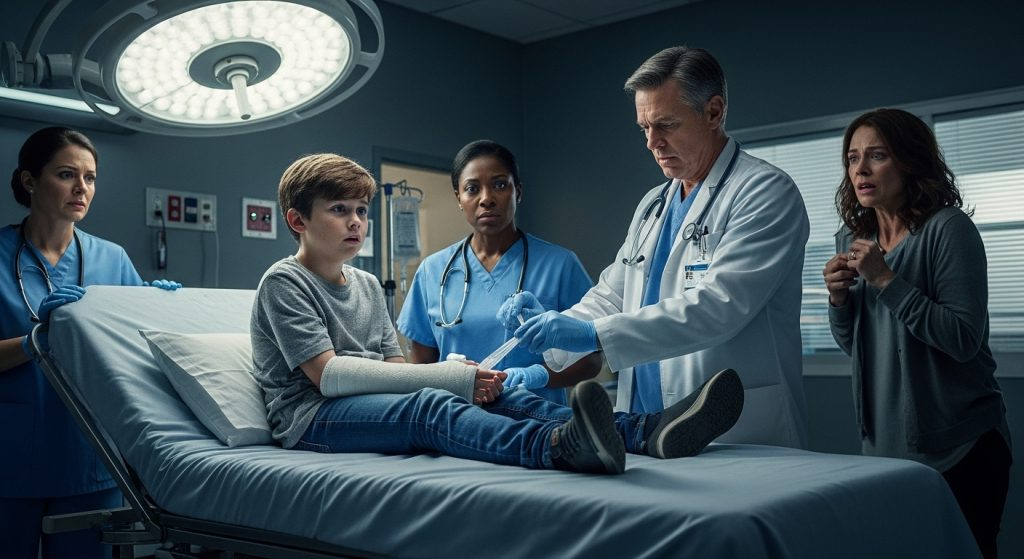
Sitting on the exam table was a little boy. The chart said his name was Leo.
He was incredibly small for seven, wearing a faded Spider-Man t-shirt that hung loosely off his frail shoulders. He was shivering violently, sweat beading on his forehead, his skin a terrifying shade of ashen grey.
His eyes were wide, glassy with fever, and completely devoid of the light a child that age should have.
But it was his left arm that drew all the attention.
It was encased in a fiberglass cast that went from his knuckles to just below his shoulder. Or, at least, it used to be a standard cast.
Advertisement
Now, it was black with grime, frayed at the edges, and visibly soaked through with a dark, foul-smelling discharge that was dripping slowly onto the pristine white paper of the exam table.
Sitting in the corner chair, entirely unbothered by the catastrophic medical emergency unfolding inches away from her, was a woman.
Brenda. The stepmother.
She was in her late thirties, wearing a pristine floral blouse, actively scrolling through Instagram on her phone. She looked up with an expression of mild annoyance, her manicured nails tapping against her phone case.
“Finally,” Brenda sighed, rolling her eyes. “Look, he fell off the monkey bars a few weeks ago. The doctor put this stupid thing on him, and now he won’t stop crying about it itching. He’s being a total drama queen. Just take it off so we can go home. My husband is working the night shift at the plant, and I don’t have time for this.”
Dr. Vance and I exchanged a look. A chilling, silent communication.
A cast shouldn’t look like that after a “few weeks.” It shouldn’t smell like a morgue.
“Ma’am,” Dr. Vance said, his voice dangerously low and steady. “When exactly was this cast put on?”
“I don’t know, a month ago? Two?” Brenda snapped back defensively. “Kids are gross. He probably got mud in it. Just cut it off.”
I stepped closer to Leo. My heart fractured against my ribs.
Ten years ago, I lost my little brother because his complaints of “tummy aches” were ignored by our overwhelmed school nurse until his appendix burst. I became an ER nurse to make sure no child ever slipped through the cracks again.
I gently placed my gloved hand on Leo’s uninjured shoulder. He flinched violently.
“Hey, buddy,” I whispered. “I’m Sarah. We’re going to get this yucky thing off you, okay? It’s going to make a loud buzzing noise, but it won’t cut your skin.”
Leo didn’t look at me. He just stared at his lap, tears streaming silently down his burning cheeks.
Then, barely audible, he mumbled, “Don’t let her take it.”
“Take what, sweetheart?” I asked, leaning in closer.
“Leo, shut your mouth!” Brenda barked from the corner, suddenly standing up, her phone dropping into her oversized designer knock-off bag. “He talks nonsense. He has behavioral issues. Just do your job, nurse.”
Dr. Vance stepped between the bed and Brenda. “Mrs. Miller, please sit down. Sarah, get the cast saw. We need to expose this tissue immediately. Prepare IV antibiotics, broad-spectrum. We might be looking at sepsis.”
I grabbed the cast saw. The metallic whine of the blade filled the small room, drowning out the ambient noise of the hospital.
As I carefully pressed the oscillating blade against the filthy fiberglass, the heat from the friction caused the trapped stench to bloom outward. It was suffocating. I had to blink away tears just to see the line I was cutting.
Advertisement
Bzzzzzz.
I cut down the lateral side. Then the medial.
Leo squeezed his eyes shut, his little chest heaving. He wasn’t crying because of the saw. He was crying out of sheer terror.
“Almost done, Leo,” I promised.
I grabbed the metal cast spreaders, inserting them into the groove I had just made.
Dr. Vance stood ready with trauma shears to cut the cotton padding underneath.
“On three,” I said. “One. Two. Three.”
I squeezed the handles. The hardened fiberglass cracked open with a sickening pop.
As the shell separated, the rotting cotton under-layer gave way.
We expected to see an infected, swollen arm. We expected to see necrotic skin, perhaps an untreated laceration that had festered under the cast.
We were prepared for a medical nightmare.
We were not prepared for what actually tumbled out of the rotting cast and clattered onto the metal tray beneath his arm.
Clink. Dr. Vance froze, his trauma shears suspended in mid-air.
I stopped breathing.
Brenda let out a sharp gasp, the color draining from her perfectly bronzed face. She lunged forward. “Give me that!”
But Dr. Vance blocked her with his body, his eyes glued to the metal tray.
Lying there, coated in dried blood, foul-smelling pus, and necrotic tissue, were two things.
The first was a heavy, antique silver locket—the kind that costs thousands of dollars, deeply tarnished by the infection it had caused by being jammed tightly against the boy’s swelling skin for weeks.
The second was a small, torn piece of lined school paper.
It had been folded so many times it was barely a square inch.
Advertisement
Using his forceps, Dr. Vance carefully picked up the blood-soaked paper and gently unfolded it.
His face, normally a mask of stoic professionalism, twisted into an expression of absolute horror.
Chapter 2
The silence in Trauma Room 2 was heavier than the sickening stench of rotting flesh that clung to the air. It was a thick, suffocating quiet, the kind that only exists in the fraction of a second between a lightning strike and the deafening roar of thunder. The ambient sounds of the Mercy General Emergency Room—the rhythmic beeping of cardiac monitors down the hall, the muffled announcements over the PA system, the frantic squeak of rubber soles on linoleum—all seemed to fade into a vacuum.
Dr. Marcus Vance stood frozen, his broad shoulders rigid beneath his white coat. The harsh fluorescent lights of the trauma bay caught the silver in his hair and the sheer, unadulterated shock dilating his pupils. In his twenty years of practicing medicine, which included two harrowing tours as a combat surgeon in Kandahar, I had never seen him look like this. I had seen him calmly pack gunshot wounds while the ER descended into chaos. I had seen him deliver a stillborn baby with a quiet, heartbreaking grace. But right now, looking at the blood-soaked, pus-stained scrap of lined school paper held delicately in his forceps, he looked completely unmoored.
The paper was no bigger than a matchbook, folded over and over into a tight, obsessive little square. It was stained with the dark, brownish-red hue of old blood and the yellow-green sickness of the severe infection that was currently ravaging seven-year-old Leo’s arm.
Clink.
My eyes darted to the metal surgical tray. The antique silver locket, heavy and ornate, sat amidst the discarded shards of fiberglass and rotting cotton padding. The intricate floral engravings on the silver were caked in necrotic discharge. It had been wedged deep inside the cast, pressed ruthlessly against the boy’s fragile skin for God knows how many weeks. The friction and pressure had worn away the epidermis, creating a deep, festering ulcer that had burrowed straight down to the muscle fascia. That was the source of the smell. That was the source of the lethal fever baking the little boy’s brain.
“Give me that!”
The shrill, panicked shriek shattered the silence. Brenda, the stepmother, abandoned her bored, phone-scrolling facade in an instant. Her face, previously a mask of suburban, Botox-smoothed indifference, twisted into something feral and ugly. She lunged forward, her manicured hands clawing desperately toward the metal tray and the note in Dr. Vance’s forceps.
She didn’t reach for Leo. She didn’t look at his mutilated arm. She went straight for the evidence.
Dr. Vance didn’t even flinch. With the reflexes of a man who had survived war zones, he simply pivoted his hip, using his large frame as an impenetrable wall between the frantic woman and the sterile field. His left hand shot out, catching Brenda firmly by the shoulder and shoving her backward with a calculated, immovable force.
Advertisement
“Do not take another step toward this bed, Mrs. Miller,” Dr. Vance commanded. His voice wasn’t loud, but it possessed a dark, rumbling authority that made the hair on the back of my neck stand up. It was the voice of a man giving a final warning.
Brenda stumbled back, her high heels clicking erratically against the linoleum. She caught her balance against the wall, her chest heaving, her eyes darting frantically from Dr. Vance to me, and finally to the frail, trembling boy sitting on the edge of the bed.
“That… that’s mine!” Brenda stammered, pointing a shaking, acrylic-nailed finger at the silver locket. The confident, condescending tone was completely gone, replaced by a raw, breathless panic. “The boy is a thief! He stole my jewelry! He’s a disturbed, delinquent little brat. My husband and I have been looking for that necklace for a month. He hid it in his cast! You see? You see what I have to deal with?”
I looked down at Leo. The seven-year-old boy was curled in on himself, his uninjured right hand gripping the fabric of his faded Spider-Man t-shirt so tightly his knuckles were white. His fever-glazed eyes were wide with a terror so profound it made my own chest ache. He wasn’t looking at the locket. He was looking at the small, blood-soaked piece of paper in Dr. Vance’s tweezers.
Ten years ago, my little brother Toby had looked at me with that exact same expression of helpless terror right before his appendix ruptured. I had promised myself I would never, ever ignore a child’s silent plea again.
“Sarah,” Dr. Vance said, his voice dropping to a low, tight whisper that only I could hear. He didn’t take his eyes off the note. “Press the silent alarm under the desk. Code Blue for security. And call dispatch. I want PD here right now.”
My blood ran cold. “Marcus?” I whispered back. “What does it say?”
Dr. Vance slowly turned his head to look at me. The veteran doctor, who had stitched up gang members and comforted grieving mothers without shedding a tear, had moisture pooling in the corners of his eyes.
“Press the button, Sarah. Now.”
I didn’t hesitate. I backed away from the bed, moving swiftly to the computer workstation in the corner of the room. I reached under the counter and slammed my palm against the red panic button. Immediately, a silent alert flashed across every security terminal in Mercy General. Within seconds, the heavy, imposing figures of our hospital security team would be sprinting down the hallway.
Brenda, sensing the shift in the room’s dynamic, began to hyperventilate. The realization that she was losing control of the narrative was dawning on her.
“What are you doing?” she demanded, her voice rising an octave. She grabbed her oversized designer bag, clutching it to her chest like a shield. “We are leaving. This is ridiculous. You cut the cast off, we’re done here. I am taking my stepson to a private clinic where the doctors actually know how to treat a worried mother with respect!”
Advertisement
She stepped toward the bed, reaching out to grab Leo’s good arm.
Leo let out a horrific, guttural scream. It wasn’t a child’s cry; it was the raw, primal sound of a trapped animal. He scrambled backward on the exam paper, his bare feet kicking wildly, trying to press himself through the drywall to get away from her. His sudden movement jolted his infected, necrotic arm.
“Don’t let her touch me! Don’t let her touch me!” Leo shrieked, his voice cracking, tears streaming down his flushed face. “She’s going to make Daddy drink it! She’s going to make Daddy drink the bad water!”
Brenda’s face drained of all color. The heavy layer of foundation on her skin suddenly looked like a death mask. “Shut up, you lying little freak!” she screamed, dropping her purse and lunging at the child with both hands outstretched.
She never made it to the bed.
Before I could even intercept her, the heavy glass doors of Room 2 burst open. Two massive hospital security guards, Mike and Lewis, piled into the room, their radios squawking.
“Restrain her,” Dr. Vance barked, pointing a rigid finger at Brenda. “Do not let her leave this room. Do not let her touch her phone. She is a danger to this patient.”
“Get your hands off me!” Brenda thrashed wildly as Mike and Lewis each grabbed an arm, pulling her away from the bed and forcing her into the corner chair. “I’ll sue this hospital! I’ll sue all of you! I’m his mother!”
“You’re his stepmother,” I snapped, the words flying out of my mouth before I could filter them. I stepped between the struggling woman and the sobbing child, my maternal instincts overriding my professional training. I turned my back to her and focused entirely on Leo.
“Hey, hey, look at me, Leo,” I said softly, crouching down so I was at eye level with him. I kept my voice steady, projecting a calm I absolutely did not feel. “Look at Nurse Sarah. You are safe. Do you hear me? The big men are here. Dr. Vance is here. Nobody is going to touch you. Nobody is going to hurt you.”
Leo was hyperventilating, his little chest heaving violently. His core temperature was radiating off him in waves. The smell of the necrotic tissue on his left arm was blooming in the warm room, an oppressive reminder of the medical clock ticking down.
“My dad,” Leo gasped, choking on his own tears. “You have to call my dad. She put the powder in his thermos. He took it to work. He drives the big truck. She said if I told, she would break my other arm and tell the police I fell again.”
The words hung in the air, heavy and poisonous.
I looked up at Dr. Vance. He had finally placed the blood-soaked note into a sterile plastic evidence bag. He held it up slightly so I could read the childish, trembling handwriting scrawled in blue crayon across the torn paper.
Advertisement
Brenda pushed Mommy. Now she puts white powder in Daddy’s coffee. She said he will go to sleep like Mommy. She was going to sell Mommy’s locket for money. I took it back. If she finds it she will kill me too. Please save my Daddy.
The room spun. A wave of profound nausea washed over me, so intense I had to grip the metal railing of the hospital bed to keep my knees from buckling.
This wasn’t just medical neglect. This was a hostage situation. This was attempted murder.
The locket wasn’t just stolen jewelry. It was a dying mother’s heirloom, stolen by the woman who replaced her, and rescued by a terrified seven-year-old boy who decided to use his own broken body as a hiding place to protect the last piece of his mother he had left. He had endured weeks of agonizing, rotting pain, letting his own flesh decay around the silver metal, just to keep it out of her hands.
And the “bad water”? The powder in the thermos?
“What time does your dad’s shift start, Leo?” Dr. Vance asked, his voice suddenly urgent. He abandoned the evidence bag and moved to the computer, pulling up Leo’s emergency contact file.
“He… he left at six o’clock,” Leo whimpered, his eyes drooping. The adrenaline crash was hitting him hard, and the sepsis was taking over. “He drives the big gas truck. He drinks his coffee at nine when he takes his break.”
I glanced at the digital clock on the wall. It was 8:42 PM.
Eighteen minutes.
“Sarah, start a wide-bore IV, right AC, now. Hang a liter of normal saline, wide open. Draw a rainbow of tubes, stat blood cultures, and get a gram of Rocephin and Vancomycin ready to push,” Dr. Vance ordered, instantly slipping back into trauma-surgeon mode. He picked up the wall phone and dialed a nine for an outside line. “I need local PD, highway patrol, and a hazmat intercept. We have a commercial gas truck driver potentially consuming a lethal toxin on the road.”
I sprang into action. I grabbed a tourniquet, tying it tightly around Leo’s uninjured right bicep. His veins were flat, completely depleted by dehydration and the raging fever.
“Squeeze my hand, buddy,” I whispered, tapping his fragile skin, praying for a vein to pop up. “You are incredibly brave, Leo. You did so good. We are going to find your dad.”
“Will he be mad?” Leo slurred, his eyelids fluttering closed. “I broke the cast. She said I was a bad boy.”
“You’re a hero, Leo,” I choked out, sliding the 18-gauge needle into a small vein. A flash of dark, sluggish blood appeared in the chamber. Thank God. “You are the bravest boy I have ever met.”
As I secured the IV with Tegaderm and hooked up the IV tubing, the doors to the ER bay slid open again.
Officer Mike Davis, a twenty-year veteran of the local suburban force, walked in. He was a tall, imposing man with a thick mustache and eyes that had seen far too much domestic tragedy. He had two kids of his own, both around Leo’s age. He took one step into the room, inhaled the scent of the necrotic arm, and his jaw locked tightly.
Advertisement
“Marcus,” Officer Davis said, nodding to Dr. Vance. “Dispatch said you had a Code Blue with an assault and potential poisoning.”
Dr. Vance slammed the phone on the receiver. “Mike. Get highway patrol on the horn immediately. The father is David Miller. He drives a commercial tanker for Sunoco Logistics. He left for his shift at 6 PM. He’s carrying a thermos of coffee that the boy claims his stepmother laced with an unknown white powder.”
Officer Davis didn’t ask questions. He unclipped his shoulder mic. “Dispatch, this is Unit 4. I need an immediate trace and intercept on a commercial vehicle…”
While Davis coordinated the manhunt for Leo’s father, a new figure slipped quietly into the room.
Elena Rostova, the hospital’s senior clinical social worker. Elena was a force of nature. A Ukrainian immigrant who had spent her career advocating for abused children, she had a terrifyingly sharp mind and zero tolerance for bullshit. She wore her signature thick-rimmed glasses and carried a worn leather notepad.
She took in the scene in three seconds. The terrified, septic child. The blood-stained locket. The frantic stepmother being restrained in the corner.
Elena walked straight past Brenda without even looking at her and stopped beside me at the bed. She looked down at the horrifying crater in Leo’s arm. The skin around the deep gouge was black and leathery, surrounded by an angry, spreading ring of fiery red cellulitis that was tracking up toward his shoulder.
“How long?” Elena asked me quietly.
“Given the level of necrosis and bone exposure, weeks. Maybe a month,” I replied, hanging the heavy bag of antibiotics on the IV pole and setting the drip rate. “It’s a miracle the infection hasn’t reached his heart yet.”
Elena finally turned her head and looked at Brenda.
Brenda, sensing an opportunity to manipulate a new player, immediately started crying. It was a pathetic, forced performance. No tears, just dramatic sobbing sounds.
“Please, you have to help me,” Brenda wailed, looking at Elena with wide, pleading eyes. “They are holding me against my will! I brought my stepson in because he was complaining about his cast. He’s a deeply disturbed child. His biological mother died last year, and he’s been acting out, stealing things, lying. I’ve been trying so hard to be a good mother to him!”
Elena slowly walked over to Brenda. She didn’t say a word. She just stared down at the woman, her dark eyes completely devoid of sympathy.
“You brought him in tonight,” Elena said, her voice thick with a heavy Eastern European accent. It wasn’t a question.
“Yes! Because the cast smelled!” Brenda cried out indignantly.
“The cast has smelled for weeks,” Elena stated coldly. “Necrosis does not happen overnight. A child does not hide a heavy silver heirloom inside a fiberglass shell for fun. A child does not endure agonizing pain unless the alternative—you—is far more terrifying.”
“He’s a liar!” Brenda shrieked, her facade cracking again. “He blames me for his mother falling down those stairs! It was an accident! The police cleared me!”
Advertisement
The room went dead silent again.
Officer Davis lowered his radio. He looked at Brenda, his eyes narrowing. “Ma’am, nobody in this room mentioned his mother falling down the stairs.”
Brenda froze. Her mouth opened, but no sound came out. She realized, entirely too late, the massive, gaping hole she had just blown in her own defense.
“Well,” Brenda stammered, her eyes darting around like a trapped rat. “The… the note. He always writes notes about it. He’s obsessed.”
Elena pulled out a pair of latex gloves from her pocket, snapped them on, and walked over to the sterile tray. She picked up the heavy silver locket. It was covered in dried blood and pus, but the intricate latch on the side was still visible.
“Let us see what is so valuable that a seven-year-old boy would risk losing his arm to protect it,” Elena murmured.
With her thumb, she pressed the small silver clasp.
The locket popped open.
Inside the left panel was a miniature photograph of a beautiful woman with bright, kind eyes, holding a much younger, smiling Leo. It was clearly his biological mother.
But it was the right panel that made Elena’s breath hitch.
Tucked behind a thin piece of clear plastic wasn’t another photo. It was a tiny, folded micro-SD memory card.
“Officer Davis,” Elena said, her voice trembling slightly. She held the open locket out to him. “I believe you will want to take this to your cyber division immediately.”
Brenda let out a wail of absolute despair. Her legs gave out, and if the security guards hadn’t been holding her, she would have collapsed onto the floor. “No! Give it to me! You don’t know what’s on there!”
“I have a pretty good guess,” Officer Davis said grimly, pulling out an evidence bag of his own and carefully taking the locket from Elena. “An insurance payout? A staged accident? We’ll find out soon enough.”
“Sarah!” Dr. Vance barked, pulling my attention away from the drama.
I spun around.
Leo was seizing.
His small body was arching off the bed, his eyes rolled back into his head, his teeth clenched tightly together. The monitors above the bed began to shriek, red alarms flashing wildly.
Heart rate: 180. Blood pressure: 70 over 40. Oxygen saturation: 84% and dropping.
“Sepsis is advancing. He’s going into septic shock,” Dr. Vance yelled, grabbing a pediatric oxygen mask and pressing it over Leo’s face. “Push two milligrams of Ativan! Get the crash cart in here now! I need a pediatric intubation tray ready!”
Advertisement
Panic, cold and sharp, flooded my veins. I sprinted to the medication Pyxis, my fingers flying over the keyboard, authenticating my fingerprint, and grabbing the vial of Ativan.
“Stay with us, Leo,” I prayed aloud, drawing up the medication into a syringe. “Don’t let her win. You have to stay with us.”
I pushed the medication into his IV port, flushing it rapidly with saline.
The seizures slowly subsided, leaving Leo’s body limp and utterly exhausted. His breathing was shallow, his lips turning a terrifying shade of blue.
“He’s not maintaining his airway,” Dr. Vance said grimly, tilting Leo’s head back and inserting a laryngoscope into his small mouth. “Sarah, hand me a 5.0 endotracheal tube. I’m taking over his breathing.”
As I handed him the plastic tube, the double doors of the trauma bay flew open once more.
A man stood in the doorway.
He was wearing a high-visibility yellow vest over a grease-stained flannel shirt. His face was pale, slick with sweat, his eyes wide and wild with terror. He was holding a heavy, steel thermos in his left hand.
It was David Miller. Leo’s father.
He looked from the unconscious, intubated body of his little boy on the bed, to the bloody cast on the tray, and finally, his gaze slowly turned to Brenda, who was cowering in the corner between the two security guards.
David slowly unscrewed the lid of the thermos. He looked inside, then looked back at his wife.
“What did you do to my son, Brenda?” he whispered. The raw, guttural heartbreak in his voice made the entire room freeze. “And what did you put in my coffee?”
Chapter 3
The heavy steel thermos in David Miller’s hand shook violently, the dark coffee inside sloshing against the rim. He stood frozen in the doorway of Trauma Room 2, a man whose entire reality had just been atomized in the span of thirty seconds. His eyes, rimmed red from exhaustion and the adrenaline of a police intercept, darted around the chaotic scene before him.
He saw me, my hands slick with medical lubricant as I secured the breathing tube down his son’s throat. He saw Dr. Vance barking orders to the respiratory therapist who had just sprinted into the room. He saw the horrific, black, rotting crater in his little boy’s left arm, surrounded by the discarded, filthy shards of the fiberglass cast.
And then, his gaze locked onto his wife.
Brenda was pinned to the plastic chair in the corner, a hulking security guard holding each of her arms. The fake tears she had tried to summon for the social worker, Elena, had vanished completely. Now, she just looked like a trapped predator—cornered, exposed, and desperate.
“David!” Brenda shrieked, her voice cracking in a high-pitched, hysterical wail. She thrashed against the guards, her designer heels kicking at the linoleum. “David, honey, thank God you’re here! These people are crazy! They attacked me! Leo was acting out again, he broke his cast, and now they’re trying to say I did something to him! Tell them to let me go!”
Advertisement
David didn’t move. He didn’t blink. He just stared at the woman he had married exactly eleven months after his first wife, Emma, had died in a tragic fall down their basement stairs.
“The highway patrol pulled my rig over on Interstate 95,” David said. His voice wasn’t a yell. It was a hollow, deadened rasp that somehow cut through the deafening noise of the emergency room. “Five squad cars. They boxed in my eighteen-wheeler, pulled me out at gunpoint, and told me not to take a sip from my thermos.”
Brenda’s mouth clamped shut. The color drained from her face, leaving her heavy foundation looking like a pale, cracking mask.
“I opened it, Brenda,” David took a slow, heavy step into the room. The smell of the necrotic tissue from his son’s arm hit him, and a violent shudder wrecked his broad shoulders, but he kept his eyes locked on her. “I opened it while I was sitting in the back of the cruiser. There was an inch of thick, dissolving white sludge sitting at the bottom of my black coffee. What was it?”
“It… it was sugar!” Brenda stammered, her eyes darting frantically toward the door, searching for an escape route that didn’t exist. “You know I put your Splenda in there! It just didn’t dissolve right! You know I’m terrible at making coffee!”
“I drink my coffee black, Brenda,” David whispered, a tear finally escaping and cutting a clean line down his grease-smudged cheek. “I have drank it black since the day we met. You’ve never made my coffee in your life until tonight.”
Officer Mike Davis stepped forward, gently but firmly placing a hand on David’s chest, stopping his advance. “Mr. Miller, I need you to hand me the thermos, sir. We have a Hazmat team waiting outside to test the contents.”
David blindly handed the steel container to the officer, his eyes never leaving the bed where I was manually squeezing the Ambu bag, forcing oxygen into Leo’s failing lungs.
“She crushed up her Amitriptyline,” a weak, raspy voice suddenly broke through the chaos.
Everyone turned. Elena Rostova, the clinical social worker, was standing near the medical tray. She was holding Brenda’s oversized designer bag. She had unzipped the main compartment and pulled out an orange prescription bottle. It was completely empty.
“She has a prescription for severe nerve pain,” Elena continued, adjusting her thick glasses, her cold gaze fixed on Brenda. “Amitriptyline. A heavy tricyclic antidepressant. Highly toxic in large doses. An overdose causes severe cardiac arrhythmias, seizures, and deep coma. It is practically untraceable if a man were to suddenly crash an eighteen-wheeler gas tanker into a concrete divider at seventy miles an hour.”
David’s knees buckled. He grabbed the metal railing of Leo’s hospital bed to catch himself. A guttural sob ripped from his throat, the sound of a father realizing he had invited a monster into his home, and his son had paid the price.
“No! That’s a lie!” Brenda screamed, spittle flying from her lips as she violently twisted against the security guards. “You have no proof! You can’t just look through my purse! That’s illegal! I know my rights!”
Advertisement
Officer Davis turned to her, pulling a pair of heavy steel handcuffs from his utility belt. The click of the metal sounded louder than a gunshot in the tense room.
“Brenda Miller,” Officer Davis said, his voice dropping an octave into his official, unyielding cadence as he marched toward her. “You are under arrest for the attempted murder of David Miller, and the felony child abuse of Leo Miller. You have the right to remain silent—and I strongly suggest you use it.”
“You can’t do this!” she wailed as Davis roughly pulled her hands behind her back, the metal cuffs biting into her wrists. “He’s a lying brat! He stole my jewelry! He hid it in that disgusting cast to frame me!”
“He hid it,” Dr. Vance interrupted, his voice laced with pure, unfiltered disgust as he pointed to the bloody silver locket resting in the evidence bag, “because you were going to pawn his dead mother’s necklace. And he hid it inside a cast that you intentionally let rot for over a month because he knew if you found it, you would kill him.”
“That’s not true! It was an accident! Emma fell! The police said it was an accident!” Brenda shrieked, practically foaming at the mouth as Officer Davis hauled her to her feet.
“We’ll see about that,” Davis growled, patting his vest pocket where he had secured the tiny micro-SD card found inside the locket. “Because this memory card your stepson hid in his own rotting flesh is going straight to my cyber division. My guess? A smart kid like Leo wouldn’t endure sepsis to protect a memory card unless it showed exactly how his mother ended up at the bottom of those basement stairs.”
Brenda’s legs completely gave out. She went limp, a dead weight in the officers’ arms, her eyes wide with absolute, world-ending terror. The manicured facade was gone. She was caught.
“Get her out of my trauma bay,” Dr. Vance ordered, turning his back on her in disgust. “Now.”
As they dragged a sobbing, hyperventilating Brenda through the heavy double doors, the momentary sense of justice was instantly shattered by the most terrifying sound in any hospital.
A high-pitched, continuous, unyielding tone.
Beeeeeeeeeeeeeep.
I whipped my head up to the cardiac monitor. The jagged green line of Leo’s heartbeat had vanished, replaced by a flat, endless horizon.
“He’s crashing! V-fib!” I screamed, dropping the Ambu bag and instantly jumping onto the step stool beside the bed. I placed the heel of my hand in the center of Leo’s tiny, frail chest and locked my elbows.
One, two, three, four… I pushed down hard, feeling the horrifying crunch of pediatric ribs under my weight. The smell of necrotic flesh wafted up into my face with every compression, mixing with the sharp scent of sterile alcohol and my own terrified sweat.
“Code Blue! Room 2!” Chloe, the triage nurse, screamed into the hallway.
“Leo!” David roared, lunging toward the bed, his hands clawing at his hair. “No! Oh my God, no! Please, not my boy! You can’t take him! You can’t take him too!”
Advertisement
“Get him back against the wall!” Dr. Vance yelled to Elena, grabbing the defibrillator paddles from the crash cart that had just been rolled in. He smeared conductive gel on the metal plates. “Sarah, stop compressions! Let me see the rhythm!”
I pulled my hands away. The line on the monitor fluttered wildly—ventricular fibrillation. His heart was quivering, failing to pump blood.
“He’s in V-fib! Charge to 50 joules!” Dr. Vance barked.
The machine whined, a high-pitched mechanical squeal that climbed in intensity.
“Clear!” Dr. Vance shouted, pressing the heavy paddles to Leo’s chest and side.
He pressed the shock buttons. Leo’s small body jerked violently off the mattress, arching upward before slamming back down onto the bloody sheets.
We stared at the monitor. The line stayed flat for one agonizing second, two seconds…
Then, it fluttered. A weak, jagged spike appeared. Then another.
Beep… beep… beep.
“We have a pulse,” I gasped, my knees shaking so badly I almost fell off the stool. “It’s weak. Rate is 140, pressure is barely registering, 60 over 40.”
“He’s in profound septic shock,” Dr. Vance said, his face pale, sweat dripping from his forehead onto his scrubs. “The infection has entered his bloodstream. It’s shutting down his organs.”
David pushed past Elena and collapsed to his knees right beside the bed. He reached out with a trembling, grease-stained hand and gently touched his son’s pale, sweaty forehead. “Leo. Buddy. Daddy’s here. I’m so sorry. I’m so sorry I worked nights. I’m so sorry I left you with her. Please, buddy. Don’t leave me.”
I watched this giant, broken man sob over his dying child, and my heart shattered. Ten years ago, my parents had stood over my brother’s bed doing the exact same thing.
“Dr. Vance,” I whispered, looking at the black, weeping wound on Leo’s left arm. The redness, the angry cellulitis, was no longer just around the ulcer. It was visibly crawling up his bicep, tracking thick, red streaks straight toward his shoulder joint and the major arteries of his chest. “The broad-spectrum antibiotics. They aren’t working fast enough.”
Dr. Vance stepped closer, grabbing a penlight and shining it directly onto the necrotic tissue. He pressed his gloved finger against the skin just below the shoulder. It didn’t blanch. It was cold.
The veteran trauma surgeon slowly turned to David. The look in his eyes was one I had only seen a handful of times in my career. It was the look of a doctor who had run out of miracles, and was about to ask a parent to make the most impossible choice in the world.
“David,” Dr. Vance said softly, his voice trembling for the first time that night. He knelt down so he was eye-level with the sobbing father.
David looked up, his eyes wide and desperate. “He’s going to be okay, right? You got his heart started. You can give him medicine.”
“David, listen to me very carefully,” Dr. Vance placed a heavy, comforting hand on the father’s shoulder. “The infection in his arm has gone completely gangrenous. It’s necrotizing fasciitis—flesh-eating bacteria. It has saturated his blood, and the toxins are currently destroying his kidneys and his heart.”
Advertisement
“So give him stronger medicine!” David begged, his voice cracking. “Do surgery! Clean it out!”
Dr. Vance shook his head slowly, the grief evident in the tight lines around his mouth. “It’s too late for that. The tissue is dead. The infection is moving up his arm toward his heart at an aggressive rate. If those red streaks reach his chest cavity, his heart will stop again, and this time, we will not be able to shock him back.”
The room was deathly quiet, save for the mechanical hiss of the ventilator breathing for the little boy.
“I have an OR prepped upstairs. The surgical team is scrubbing in right now,” Dr. Vance said, his voice dropping to a harsh, devastating whisper. “But I need your consent, David. And I need it in the next sixty seconds.”
David wiped his mouth with the back of his hand, his eyes darting frantically between Dr. Vance and the rotting arm of his sleeping son. “Consent for what? What are you going to do?”
Dr. Vance didn’t blink. He delivered the final, crushing blow with clinical, heartbreaking precision.
“To save his life, David, I have to amputate your son’s left arm at the shoulder.”
Chapter 4
The word hung in the sterile air of Trauma Room 2 like a physical executioner’s blade.
Amputate.
David Miller, a man who hauled thousands of gallons of combustible fuel across state lines without breaking a sweat, crumbled. He fell forward, his grease-stained forehead resting against the pristine white sheets of his son’s hospital bed, his massive shoulders shaking with silent, catastrophic sobs.
“His arm?” David choked out, the words muffled by the fabric. “He’s right-handed… he loves baseball, Doc. He… he throws the best curveball in his little league.”
“David,” Dr. Vance said, his voice dropping to a low, steady timber that anchored the chaotic room. He placed his hands firmly on David’s back. “If I don’t take the arm right now, he won’t be playing baseball. He won’t be doing anything. The sepsis will reach his heart in less than twenty minutes. I need you to sign the consent form. I need you to let me save your little boy.”
Elena, the social worker, silently stepped forward. She placed a clipboard with a single sheet of paper and a blue pen onto the metal railing of the bed, right next to David’s trembling hand.
David looked at the pen. To him, it wasn’t plastic and ink. It was a bone saw. It was the instrument that would permanently alter his son’s life.
He slowly lifted his head, his face a portrait of absolute devastation. He looked down at Leo. The little boy’s chest was rising and falling mechanically with the hiss of the ventilator. The foul, sickly-sweet scent of the rotting flesh was a visceral reminder of the ticking clock. David reached out with his rough, calloused thumb and gently wiped a stray tear from Leo’s fever-hot cheek.
“I’m so sorry, buddy,” David whispered, his voice cracking into a million pieces. “I’m so sorry I didn’t see it. I’ll make it up to you. I swear on my life, I will make it up to you.”
Advertisement
He picked up the pen. His hand was shaking so violently he could barely form the letters, but he dragged the ink across the dotted line.
Before the pen even dropped from David’s fingers, the room exploded into a hyper-coordinated frenzy of motion.
“Consent obtained!” Dr. Vance roared, instantly spinning toward the door. “Sarah, transport team is go! Bag him and let’s move! We bypass pre-op, straight to OR 4!”
I grabbed the Ambu bag attached to Leo’s endotracheal tube, squeezing it in a steady rhythm to keep his lungs filled with oxygen as two transport orderlies unlocked the wheels of the bed. We sprinted down the linoleum hallway, the heavy bed crashing through the double swinging doors. David ran alongside us until we hit the red line painted on the floor outside the surgical wing.
“You have to stay here, Mr. Miller,” a surgical nurse said gently, blocking his path.
David pressed his hands against the glass doors as they closed, watching his frail, unconscious son being wheeled into the harsh, blinding lights of the operating theater. He slid slowly down the glass, burying his face in his hands on the cold floor.
The next four hours were an agonizing purgatory.
I was relieved of my shift, but there was absolutely no way I was going home. I changed out of my blood-stained scrubs, put on my street clothes, and walked into the sterile, quiet family waiting room.
David was sitting in the corner, staring blankly at a muted television screen. He looked like a ghost. I walked over, placing a styrofoam cup of black coffee on the table in front of him.
“I didn’t put anything in it,” I said softly, attempting a weak, reassuring smile.
David looked at the coffee, then up at me. His eyes were completely hollowed out. “Thank you, Sarah. For everything.”
I sat down in the chair across from him. “You know, when I was sixteen, my little brother Toby kept complaining about his stomach hurting. My parents thought he was just trying to get out of a math test. By the time they believed him and brought him here… his appendix had ruptured. He went into septic shock.”
David looked up, his attention finally snapping into focus. “Did he…”
“He didn’t make it,” I said, the familiar, ten-year-old ache tightening my throat. “I became an ER nurse because I couldn’t stand the thought of another kid trying to tell the adults that something was terribly wrong, and no one listening.”
David squeezed his eyes shut, a fresh wave of tears spilling over his lashes. “I didn’t listen. She… Brenda… she was so perfect at first. After Emma died, the house was a tomb. Leo wasn’t speaking. I was working double shifts to pay off Emma’s medical bills. Brenda was the nanny we hired. She was so kind. But after the wedding… everything changed. She fired the housekeeper, isolated us from Emma’s family. I thought she was just being protective. But she was building a cage.”
Advertisement
Before I could answer, the heavy wooden door of the waiting room creaked open.
Officer Mike Davis walked in. The twenty-year veteran cop looked physically ill. His face was gray, and the heavy duty belt around his waist seemed to drag him down. He walked over to our corner and sat heavily in the chair next to David.
“Is he out of surgery?” Officer Davis asked quietly.
“Not yet,” David replied, his voice raspy. “What is it, Mike? Did you check the memory card?”
Officer Davis took a deep, shuddering breath. He pulled a small, sealed evidence bag from his jacket pocket and placed it on the table next to the coffee. Inside was the tiny micro-SD card Elena had pulled from the bloody silver locket.
“David,” Officer Davis started, his voice thick with an emotion he was desperately trying to suppress. “I’ve worked homicide for fifteen years. I have seen the absolute worst of human nature. But what your son was carrying around… what he endured to protect this…” He stopped, swallowing hard.
“Tell me,” David demanded, his voice hardening into steel.
“The card contains a single video file,” Officer Davis said. “It’s from a hidden nanny cam. A cheap, motion-activated one. Emma must have bought it and hidden it on the bookshelf at the top of the basement stairs. We think she suspected Brenda was stealing from her purse when she came over to babysit.”
David stopped breathing. “The basement stairs.”
“The video shows Emma standing at the top of the landing, looking at her phone,” Davis continued, his voice dropping to a grim whisper. “Brenda walks up behind her. There is no argument. No warning. Brenda simply places both hands squarely on the center of Emma’s back… and shoves her with everything she has.”
I gasped, my hand flying to my mouth.
“Emma never stood a chance,” Davis said quietly. “She fell backward. The camera caught the whole thing. But the worst part, David… the part that is going to put Brenda away for life without parole… is that after Emma landed at the bottom, her neck visibly broken… Brenda calmly walked down the stairs, checked Emma’s pulse, stepped over her body, and walked to the laundry machine to put a load of towels in.”
A terrifying, suffocating silence filled the room.
David didn’t scream. He didn’t cry. He just stared at the plastic evidence bag with a look of pure, unadulterated hatred.
“How did Leo get it?” I whispered, my mind racing.
“We found Brenda’s old laptop in the squad car when we arrested her,” Davis explained. “We think Brenda found the camera a few days after the funeral, realized what was on it, and kept the SD card as some sick, twisted trophy. Leo is a smart kid. He must have found the card in her things, recognized it from the camera his mom used to have, and watched it.”
My stomach violently turned over. Oh, God. He saw it. A seven-year-old boy watched a video of his mother being brutally murdered by the woman who was sleeping down the hall.
Advertisement
“When Brenda realized the card was missing, and the silver locket was gone, she panicked,” Davis said. “That’s why the abuse escalated. She knew Leo had it. She was waiting for him to break. She let his arm rot to torture it out of him. And when she realized Leo wasn’t going to break… she decided to poison you, David. With you dead from a ‘heart attack’ behind the wheel of your truck, she inherits everything, and Leo is sent into the foster system, his claims dismissed as the ramblings of a traumatized orphan.”
“She’s dead,” David whispered, his voice vibrating with a lethal, terrifying calm. “If she ever gets out, I will kill her with my bare hands.”
“She is never getting out, David,” Officer Davis assured him, his jaw set. “The DA is already drafting capital murder charges. She will never see the sun again.”
Suddenly, the waiting room door opened again.
Dr. Vance stood in the doorway. He was still wearing his surgical cap, his green scrubs dark with sweat, his surgical mask hanging loosely around his neck. He looked utterly exhausted, aged ten years in a few hours.
David shot up from his chair, his fists clenched, bracing for the impact of the worst news a father could hear.
Dr. Vance looked at David, and a slow, infinitely tired, but genuine smile broke across his face.
“He’s alive, David,” Dr. Vance breathed out. “We got it all. The necrotic tissue is gone. His blood pressure is stabilizing, and his fever is already dropping. He is going to make it.”
David collapsed. He literally fell to his knees on the waiting room floor, sobbing uncontrollably, his hands pressed to his face in pure, overwhelming relief. I dropped to the floor beside him, wrapping my arms around his massive shoulders, crying tears of my own.
Three days later.
The Pediatric Intensive Care Unit was quiet, filled only with the soft, rhythmic beeping of healthy vital monitors.
I stood by the door of Room 412, watching the scene unfold.
Leo was awake. He looked incredibly small in the center of the large hospital bed. The horrific grey pallor was gone from his skin, replaced by a soft, bruised pink. The heavy ventilator tube was gone.
His left shoulder was heavily bandaged, a stark, flat emptiness where his arm used to be.
David was sitting on the edge of the bed, holding Leo’s right hand in both of his. He hadn’t left the hospital once. He had shaved, showered in the family wing, and put on a clean shirt, but his eyes never left his son.
Leo blinked slowly, groggy from the pain medication. He shifted slightly, and his brow furrowed in confusion. He looked down at his left side. He tried to move the arm that was no longer there.
A flash of panic crossed his small face. “Daddy?” he rasped, his voice raw and scratchy from the breathing tube. “My arm. It’s… I can’t feel my fingers.”
David leaned in, pressing his forehead against Leo’s. Tears silently streamed down the father’s face. “I know, buddy. I know. The doctors had to take it away. The bad sickness from the cast… it was going to hurt your heart. They had to take it to save you.”
Advertisement
Leo stared at the empty space for a long moment. Then, his eyes widened, panic flooding his heart monitor, making it beep faster.
“The locket!” Leo gasped, trying to sit up, his right hand frantically clutching David’s shirt. “Daddy, the necklace! I hid it! She can’t get it! Mommy’s picture is in it!”
“Hey, hey, look at me,” David said firmly, gently pushing his son back against the pillows. “I have it, Leo. The police have the memory card. The police saw the video.”
Leo froze. The terror in his eyes slowly melted away, replaced by an exhaustion so profound it made my heart ache.
“She’s gone, Leo,” David whispered, kissing his son’s forehead. “Brenda is in jail. She is never, ever coming back. You are safe. I am right here, and I am never leaving you again.”
Leo looked up at his father, his bottom lip trembling. The incredible, unbearable weight of the secret he had carried for months—the secret that had cost him his own flesh and bone—finally lifted from his tiny shoulders.
He didn’t cry for his lost arm. He didn’t cry for the pain.
He just reached up with his remaining hand, wrapped it tightly around his father’s neck, and buried his face in David’s chest.
“I saved you, Daddy,” Leo whispered into the fabric of the shirt, finally letting the tears fall. “I didn’t let her make you drink the bad water.”
“You did, my brave boy,” David sobbed, burying his face in his son’s hair, holding him tighter than he ever had before. “You saved me. You saved us both.”
I stepped back out into the hallway, letting the heavy door click shut behind me, giving them the privacy they deserved.
I leaned against the cool wall of the corridor and let out a long, shaky breath.
In the ER, you see the darkest, most twisted corners of humanity. You see the monsters that wear floral blouses and designer bags, hiding in plain sight in the quiet suburbs.
But sometimes, if you look closely enough, you also witness miracles.
You see a father’s unconditional love pulling his child back from the brink of death. And you see a seven-year-old boy with the heart of a lion, who decided that losing his own arm was a small price to pay to expose a monster, avenge his mother, and save his father’s life.
Leo Miller walked out of Mercy General three weeks later. He was a little lighter, missing his left arm, but as he held his father’s hand walking through the automatic sliding doors into the bright afternoon sun, he had never looked stronger.
Some scars are permanent reminders of the pain we’ve endured. But others are proof that we survived the monster in the dark, and walked back out into the light.
Thank you for reading this story! If you enjoyed this emotional thriller, please react with a  and share it with your friends. Follow my page for more stories that will keep you up at night!