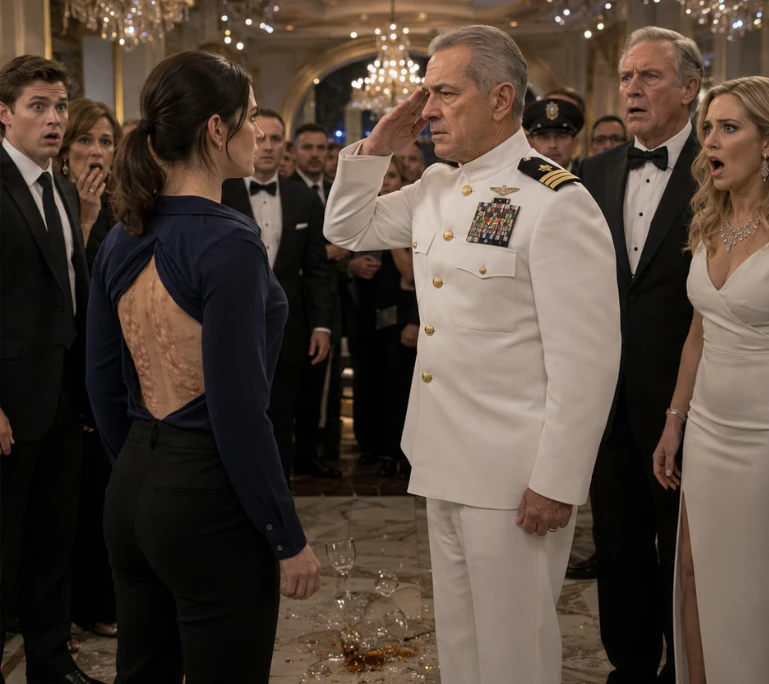
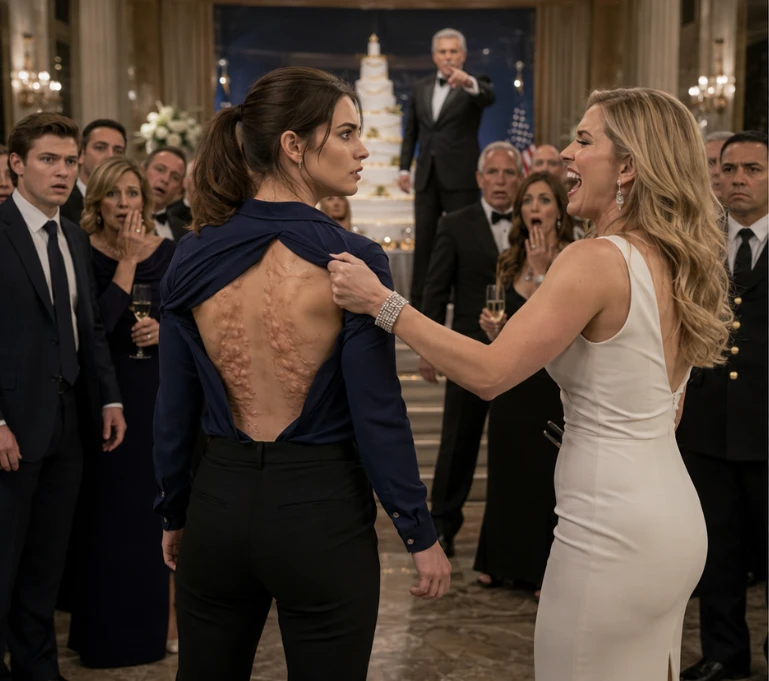
My sister tore my shirt open in front of two hundred people and laughed at the scars on my back.
For one frozen second, even the champagne stopped moving.
The sound was small at first.
A sharp rip.
A cruel little tear of silk and thread that should have been swallowed by the string quartet, the polite applause, the crystal chatter of glasses, the warm roar of wealthy people congratulating themselves beneath chandeliers.
But somehow, everyone heard it.
Every head turned.
Every smile stiffened.
Every conversation died halfway through a word.
I stood in the center of the Vanguard Naval Club ballroom with my blouse split down the back, the cold air touching skin that had not been seen by anyone outside a hospital room in five years.
My sister Harper still had one hand twisted in my collar.
The torn fabric hung from her fingers like a trophy.
Her diamond bracelet flashed under the chandelier light.
“Look at her,” she said, loud enough for the entire room to hear. “Five years gone, and this is what crawls back.”
Someone gasped.
Someone else whispered, “Is that Evelyn?”
I kept my eyes on the stage.
On my father.
Arthur Sterling stood beside a seven-tier retirement cake shaped like a white naval tower, one hand around a glass of bourbon, his silver hair combed perfectly back, his black tuxedo smooth across his shoulders.
Behind him stretched a twenty-foot banner in navy and gold:
CONGRATULATIONS, ARTHUR STERLING
FORTY YEARS OF SERVICE TO AMERICA’S FLEET
He had never worn a uniform.
Not once.
But he had built his fortune selling equipment to men who did.
Tonight, senators shook his hand. Admirals toasted him. Contractors smiled too widely near the bar.
Old family friends leaned close to one another in pearls and cufflinks, hungry for scandal but careful not to look hungry.
And now they had me.
Evelyn Sterling.
The missing daughter.
The disgrace.
The ghost in black trousers and a navy blouse who had walked through the front doors without an invitation and ruined the clean, glittering story my father had spent five years telling.
Harper stepped closer to me, her perfume sweet and expensive, her breath warm against my cheek.
“Tell them,” she whispered, smiling. “Tell them where you’ve been hiding.”
I felt the room looking at my back.
At the scars.
They were not pretty scars. Not delicate silver lines that could be romanticized into survival.
They were thick and raised and uneven, stretched from one shoulder blade to the other, spilling down my spine in puckered ropes of burned skin.
They looked like something had tried to claw me open from the inside.
They looked like fire had learned my name.
Harper laughed.
“Look at the freak!” she shouted. “Where have you been hiding for five years?”
The word landed.
Freak.
It rolled across the polished marble and settled at my feet like something dead.
My mother, seated near the stage in a pale blue gown, lifted one trembling hand to her mouth.
But she did not stand.
She did not speak.
She never did when it mattered.
My brother Carter leaned against the bar with a champagne flute in his hand and that familiar, lazy smirk pulling at the corner of his mouth.
Security began moving from the side doors.
Two men in black suits.
Professional faces.
Hands low.
My father finally looked at me as though I were a stain on a white tablecloth.
“Evelyn,” he said, his voice smooth, cold, and controlled. “Leave before you embarrass this family further.”
The old wound inside me did not open.
That surprised me.
For years, I had imagined hearing his voice again and falling apart. I had imagined rage, tears, shaking hands, some childish part of me still begging him to look at me and see his daughter instead of a problem.
But standing there, with my scars exposed and my sister’s fingers still tangled in my torn blouse, I felt only a strange and quiet clarity.
Like the moment after an explosion.
When the world goes white.
And you realize you are still alive.
I lowered my wrist slightly and looked at my watch.
Thirty-seven seconds.
Harper followed my gaze and laughed again.
“Oh, are we boring you?”
My father’s jaw tightened.
“You were never good at drama,” he said. “Security will escort you out.”
I looked up at him.
I did not cover my back.
I did not fold.
I did not cry.
“Are you sure you want me to leave, Arthur?”
The first time I had called him Arthur instead of Dad, I was sixteen and bleeding from a cut over my eyebrow after he threw a crystal paperweight past my head and blamed me for moving too slowly.
He had slapped me so hard my ear rang for two days.
Now he smiled.
A small, cruel smile.
“You were never good at threats either.”
The watch reached zero.
For one heartbeat, nothing happened.
Then Admiral Thomas Reed stepped forward from the crowd.
The room changed before he said a word.
It was subtle, but immediate.
Officers straightened.
A senator stopped whispering.
A defense executive who had been pretending not to stare at my scars lowered his glass.
Reed was in his white dress uniform, medals bright against his chest, his face weathered and still.
He moved like a man who did not need permission to cross any room in the world.
My father saw him coming.
For the first time that night, Arthur Sterling looked uncertain.
“Tom,” he said, forcing warmth into his voice. “This is a family matter.”
Admiral Reed did not even glance at him.
He stopped directly in front of me.
Close enough that I could see the faint tremor in his jaw.
Close enough that I could hear the breath he pulled in when he saw my scars.
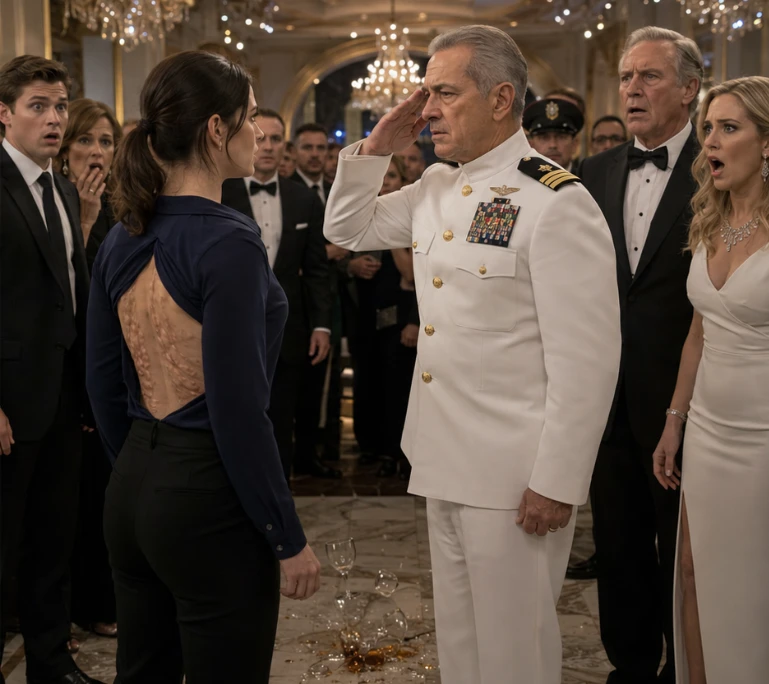
Then, before my father, my sister, my mother, my brother, and every person who had laughed at me, Admiral Thomas Reed raised his right hand and snapped a flawless, knife-edge salute.
“Captain Sterling,” he said, his voice rough with feeling. “Welcome home.”
The entire room went dead silent.
Harper’s hand fell from my blouse.
My father’s glass slipped from his fingers and shattered at his feet.
For five years, my family had told people I had run away.
That I had become unstable after a failed engagement.
That I had been ashamed of my own life and disappeared rather than face the consequences of my failures.
They had never told anyone I had joined the Navy under a sealed intelligence track.
They had never told anyone I had commanded a recovery unit aboard the USS Meridian on the night its forward systems failed in the North Atlantic.
They had never told anyone I had walked into a burning corridor because forty-seven sailors were trapped behind a door my father’s company had manufactured.
They had never told anyone the equipment that failed had Arthur Sterling’s signature on the compliance certificate.
And they had certainly never told anyone I had come home tonight with the man who could prove it.
I returned Admiral Reed’s salute.
My arm lifted slowly because old scar tissue pulled across my shoulder whenever I moved too fast.
The motion hurt.
I made myself finish it anyway.
“Admiral,” I said.
His eyes shone.
Not with pity.
Never pity.
With grief.
With pride.
With something that had carried both of us through five years of silence.
My father recovered first.
He always did.
He stepped away from the broken glass, expression tightening into that corporate mask he wore in boardrooms and depositions.
“What exactly is this?” Arthur asked. “Some kind of performance?”
Admiral Reed lowered his hand.
“No,” he said. “The performance is over.”
A ripple passed through the room.
My father looked around at the guests, recalculating. I watched him search for allies in real time.
Senator Vale near the stage.
Three board members from Sterling Defense.
Two retired captains who had accepted consulting contracts from him.
A deputy secretary whose wife wore diamonds my father had paid for at an auction charity gala.
Arthur had not built a company.
He had built a net.
For decades, it had caught everyone.
Tonight, for the first time, it tightened around him.
“Evelyn has been unwell for years,” he said carefully. “Admiral, with respect, whatever she has told you—”
“She told me nothing I did not already know,” Reed cut in.
Arthur’s face hardened.
Carter set his glass down at the bar.
Harper took a step backward.
My mother still had her hand over her mouth.
But now she was looking at me.
Really looking.
At my torn blouse.
At my ruined back.
At the daughter she had let become a rumor.
My father pointed at the security men.
“Remove her.”
Neither man moved.
Admiral Reed turned his head slightly.
“Stand down.”
It was not loud.
It did not need to be.
The guards froze.
Arthur stared at them as if betrayal had suddenly learned to wear an earpiece.
“They work for me,” he snapped.
“Not tonight,” Reed said.
The ballroom doors opened.
Not violently.
Not with the drama my father deserved.
They opened with a quiet, official precision that was somehow worse.
Four naval investigators entered first.
Then two federal agents in dark suits.
Then a woman with gray hair, sharp eyes, and a leather folder pressed against her chest.
I recognized her immediately.
Margaret Cho.
Inspector General’s office.
The last time I had seen her, I had been lying in a burn unit in Norfolk, my back wrapped in gauze, refusing morphine because I was terrified I would say my father’s name out loud before we had proof.
Harper’s mouth went slack.
“What is happening?” she whispered.
No one answered her.
The quartet stopped playing.
All that remained was the soft hiss of candles, the distant clink of melting ice, and the little broken sounds people make when money realizes it is not God.
Margaret Cho crossed the room and stood beside Admiral Reed.
“Arthur Sterling,” she said, “by order of the Department of Justice and the Naval Inspector General, you are being served with a federal warrant for conspiracy, obstruction, falsification of military safety certifications, witness intimidation, and negligent homicide related to the USS Meridian incident.”
A woman near the back cried out.
Someone dropped a fork.
My father did not look at the warrant.
He looked at me.
And in his eyes, beneath the shock, beneath the calculation, beneath the rage, I saw the thing I had once mistaken for strength.
Fear.
“You did this?” he said.
I wanted my voice to be sharp.
I wanted it to be triumphant.
But when I answered, it came out almost gentle.
“No, Arthur. You did.”
His nostrils flared.
“You ungrateful little—”
“Careful,” Admiral Reed said.
Arthur stopped.
It would have been satisfying if it had not been so sad.
There are moments when a person becomes smaller in front of you.
Not because they shrink, but because the story they used to fill the room finally collapses.
My father had been a giant in my childhood.
His footsteps on the stairs could stop my breathing.
His disappointment could ruin a day before breakfast.
His approval, rare and sharp-edged, had once felt like sunlight.
Now he stood among broken glass, surrounded by people he had bought, and looked at me as though I had stolen something from him.
As though justice were theft.
Margaret opened the folder.
“The Meridian report was sealed due to ongoing investigation,” she said to the room. “At twenty-one hundred hours tonight, the classification hold expired on select findings.”
My watch buzzed once against my wrist.
She continued.
“Five years ago, a fire suppression failure and bulkhead lock malfunction trapped forty-seven naval personnel in the forward corridor of the USS Meridian.
The equipment involved had been certified safe by Sterling Defense Systems despite internal tests showing catastrophic failure under heat exposure.”
The words moved through the ballroom like cold water.
People turned slowly toward my father.
He laughed once.
A short, ugly sound.
“This is absurd.”
Margaret did not blink.
“Internal communications show you were informed of the defect eight months before the Meridian deployment.”
“That equipment passed inspection.”
“Because your company altered the results.”
“I never authorized that.”
A voice came from the bar.
“Yes, you did.”
Carter.
My brother’s smirk was gone.
His face had drained of color.
My father turned toward him so sharply I heard his shoes scrape glass.
“Shut your mouth.”
Carter swallowed.
For the first time in my life, my brother looked younger than me.
Not charming.
Not untouchable.
Just frightened.
“I can’t,” he whispered.
Arthur’s eyes narrowed.
“What have you done?”
Carter looked at me, then away.
“I gave them the server copy.”
Harper made a sound like she had been slapped.
“You what?”
Carter’s hands shook.
“I thought it was just money,” he said, voice cracking. “I thought it was contracts and fake dates and Dad paying inspectors to look away. I didn’t know people died.”
The ballroom breathed in.
All at once.
Arthur stepped toward him.
“You stupid boy.”
Admiral Reed moved between them before anyone else could.
My father stopped.
Carter laughed weakly, almost hysterically.
“You always said Evelyn was the weak one,” he said. “But she went into fire for strangers.
I couldn’t even look at a spreadsheet without wanting to throw up.”
I looked at my brother.
For five years, I had hated him in a lazy, familiar way.
Hated the smirk.
The silence.
The way he had repeated our father’s lies because it was easier than questioning the source of his money.
But now, seeing him stand there shaking in his tailored tuxedo, I realized something that hurt more than hatred.
My father had not raised children.
He had raised accomplices.
Some of us had escaped.
Some of us had not.
Harper pointed at Carter.
“You betrayed us?”
Carter looked at her.
“She’s our sister.”
Harper’s face twisted.
“She left.”
“She was burned alive.”
“I didn’t know that!”
The words burst out of her, raw and defensive.
Then she looked at my back.
Really looked.
The first true look she had given me all night.
Her eyes moved over the scars, and something in her expression flickered. Not guilt exactly. Not yet.
Guilt requires accepting that someone else’s pain is real.
Harper had spent her whole life treating other people’s pain like furniture.
Something to decorate a room.
Something to move around when inconvenient.
My father’s voice cut through the silence.
“Enough.”
He turned to the crowd.
“My daughter has always been disturbed. She resented this family.
She enlisted to humiliate me, failed spectacularly, and now she has returned with a fantasy cooked up by bureaucrats who hate private industry.”
Admiral Reed’s face went cold.
“You are speaking about an officer who saved forty-seven sailors.”
Arthur sneered.
“Saved? She abandoned her family and hid for five years while we carried the shame.”
I felt that.
Not because it was true.
Because a small part of me still remembered wanting him to miss me.
When I was in the burn unit, I woke every morning expecting my mother.
Then expecting Carter.
Then even Harper.
By the third week, I expected no one.
By the fifth, Admiral Reed was sitting beside my bed reading casualty reports aloud because I could not yet turn my head.
By the seventh, he brought me a cup of hospital coffee and said, “Your father’s attorneys have petitioned to restrict access to you.”
I had laughed because I thought pain medication had made me misunderstand.
“What?”
“He claims you are mentally unstable and vulnerable to coercion.”
“My father?”
Reed did not answer.
He did not need to.
That was the day I stopped waiting.
Now, standing under chandeliers with my back exposed, I looked at Arthur Sterling and felt the old hospital sheets against my skin again.
Felt gauze peel away. Felt the nurses tell me not to scream because it would tear my grafts.
“You did not carry shame,” I said. “You carried a lie.”
He smiled.
“You carried my name.”
“No,” I said. “I survived it.”
Something in the room shifted.
A murmur rose and died.
Admiral Reed turned slightly toward me.
The question was silent.
Are you ready?
I nodded.
Margaret Cho withdrew a small recorder from her folder and pressed a button.
My father’s voice filled the ballroom.
Not the polished version.
Not the charity gala voice.
His real voice.
The one from closed doors.
The one from my childhood.
“I don’t care what the heat tests show. The contract goes through Monday.”
Another voice, male, nervous.
“Mr. Sterling, if the corridor locks fail under fire load, those compartments become ovens.”
My father again.
“Then make sure there is no fire.”
A few people gasped.
The recording continued.
“Your daughter is attached to Meridian recovery command, sir. If anything happens—”
Arthur laughed.
“My daughter made her choice when she put on a uniform. Do not bring her into this.”
The ballroom seemed to tilt.
I had heard the recording before.
Once.
In a windowless office with Margaret and Admiral Reed sitting across from me, both silent as my father’s voice confirmed what my body already knew.
Still, hearing it here hurt differently.
Here, beneath chandeliers.
Here, in front of my mother.
Here, while Harper stood beside me holding the ripped fabric of my blouse.
The nervous voice on the recording returned.
“And if the defect is discovered?”
My father said, “Then we blame operator error. That is what young officers are for.”
The tape clicked off.
No one spoke.
My mother made a broken sound.
Arthur looked at her.
“Vivian.”
She flinched at her own name.
I had never seen that before.
Not once.
My mother had always seemed fragile by choice, a woman who floated through the wreckage of our family in silk and silence.
She had taught us early that silence was a kind of manners.
But now her hands were shaking so violently the diamonds at her wrist clicked together.
“Arthur,” she whispered. “Tell me that isn’t real.”
He stared at her as if she had failed him by asking.
“Do not embarrass me.”
And there it was.
The family scripture.
The Sterling commandment.
Do not embarrass me.
Not: are you hurt?
Not: what have I done?
Not even: forgive me.
Just the old altar of image and obedience.
My mother rose slowly from her chair.
Her pale blue gown shimmered as she stepped down from the dais.
Every eye followed her.
She walked toward me as if crossing an ocean.
I did not move.
I did not trust hope.
Hope was the cruelest thing my childhood had ever given me.
It came dressed as an apology and left wearing my skin.
When my mother reached me, she stopped a few inches away.
Her eyes filled with tears as she looked at the scars across my shoulders.
“Evelyn,” she said.
My name broke in her mouth.
I waited.
For an excuse.
For an explanation.
For the sentence that would begin with I wanted to call but…
Instead, she reached for the torn edges of my blouse.
I almost stepped back.
Admiral Reed noticed.
So did she.
Her hands stopped midair.
“May I?” she whispered.
That small permission nearly undid me.
I nodded once.
My mother took the torn fabric and gently lifted it over my shoulders, not to hide the scars from the room, but to cover me from the cold.
The gesture was clumsy.
Too late.
Not enough.
But it was the first kind thing she had done for me in five years.
Maybe longer.
“I believed him,” she whispered. “God help me, I believed him.”
I closed my eyes.
For one second, I let myself be someone’s daughter again.
Then my father laughed.
The sound cracked across the room.
“Oh, Vivian. Spare us.”
My mother turned.
He looked at her with contempt so practiced it felt domestic.
“You knew exactly what kind of man kept you in this life.”
She staggered as if he had struck her.
“You told me she refused our calls.”
“She did.”
“I was in a burn unit,” I said.
“You refused the family attorney.”
“He tried to make me sign a competency transfer while I was still on morphine.”
Arthur shrugged.
“You were not thinking clearly.”
Admiral Reed stepped forward.
“She was thinking clearly enough to identify the defect, locate trapped personnel, override a failed door manually, and drag six sailors out before she collapsed.”
Harper whispered, “Six?”
I looked at her.
“Yes.”
Her eyes filled with confusion.
Not compassion.
Confusion.
As though the version of me she had hated had suddenly become difficult to hate, and she resented the inconvenience.
“One of them was Daniel Price,” Admiral Reed said.
Harper’s face changed.
The name struck her harder than the warrant.
Daniel Price.
Her almost-fiancé.
The naval engineer she had dated for eleven months before his death notice arrived.
The man she had mourned for exactly six weeks before telling everyone grief made her skin break out.
Harper stared at me.
“No,” she said.
I did not answer.
Admiral Reed did.
“Lieutenant Daniel Price was pulled from Corridor F by Captain Sterling at 0231 hours. He died later from smoke inhalation.
Before he lost consciousness, he gave her his badge and told her to find out why the doors failed.”
Harper’s lips parted.
Her eyes moved to my back again.
To the scars.
To the place where her laughter had landed only minutes before.
I remembered Daniel.
Not as Harper’s boyfriend.
Not as a photograph in our family’s holiday cards.
As a man coughing blood into my sleeve in a corridor so hot my boots softened against the floor.
He had gripped my wrist with blistered fingers and whispered, “Tell Harper I was trying to come home.”
I had tried.
After the hospital.
After the grafts.
After I could hold a phone without shaking.
I called her.
She answered, heard my breathing, and said, “If you’re calling for money, Dad already told us not to engage.”
Then she hung up.
I never called again.
Now Harper covered her mouth.
“You knew Daniel?” she whispered.
“I carried him,” I said.
Her knees seemed to weaken.
The torn fabric slipped from her hand and fell onto the marble between us.
She stared at it as if it had turned into a body.
“I didn’t know,” she said.
It was the weakest sentence in the world.
It was also true.
That was the worst part.
She had not known because not knowing had been comfortable.
My father clapped once.
Hard.
“Touching,” he said. “Are we done with the theater?”
Margaret Cho closed the folder.
“No, Mr. Sterling. We are just beginning.”
One of the agents approached Arthur.
“Arthur Sterling, you are under arrest.”
The words should have been satisfying.
I had imagined them in hospital beds, safe houses, rented rooms under fake names, military offices with no windows, and nights when my skin burned so badly I slept sitting up with ice packs across my shoulders.
I had imagined my father’s face.
His hands cuffed.
His empire cracking open.
I thought justice would feel like warmth.
But when the agent reached for him, my father looked at me and smiled.
Not wide.
Not panicked.
Just enough.
And suddenly, every nerve in my body went cold.
Because I knew that smile.
It was the smile he wore when he had one more card under the table.
“You think you won?” he asked softly.
Admiral Reed moved closer to me.
Arthur lifted his chin.
“Ask your admiral why he really hid you for five years.”
The room tightened.
Reed’s expression changed.
Only slightly.
But I saw it.
So did my father.
Arthur’s smile deepened.
“Oh,” he said. “She doesn’t know.”
I looked at Admiral Reed.
“Know what?”
He did not answer quickly enough.
The silence was small.
A fraction.
But after five years of classified rooms, coded files, redacted names, and men telling me certain truths were delayed for operational reasons, I knew what hidden information sounded like.
“Admiral,” I said.
Reed’s eyes closed briefly.
My father laughed under his breath.
“There it is,” he said. “The noble old sailor with his secrets.”
Margaret Cho’s face tightened.
“Mr. Sterling, stop talking.”
“No,” I said.
Everyone looked at me.
My voice sounded far away.
“No. Let him.”
Arthur turned his full attention on me.
For the first time all night, he looked almost happy.
“You want the truth, Evelyn? The Meridian defect would have destroyed my company, yes. It would have sent me to prison, yes. But you were never the reason I buried the report.”
I felt my mother go still beside me.
Arthur’s eyes flicked to her.
Then back to me.
“I buried it because of him.”
Admiral Reed’s jaw hardened.
My mother whispered, “Arthur, don’t.”
But he did.
Of course he did.
Cruel men cannot resist a blade once they find soft flesh.
“The night you were born,” Arthur said, “your mother begged me not to leave her. She cried. She swore it meant nothing.
A stupid, lonely mistake with a rising naval officer who sailed away before the consequences showed.”
The ballroom blurred.
I heard Harper inhale sharply.
Carter said, “What?”
Arthur pointed at Admiral Reed.
“Ask him why he protected you. Ask him why he was so invested in the burned little hero from the Meridian. Ask him why he kept you out of public view until he could build a case against me.”
My heartbeat became a sound outside my body.
Admiral Reed did not deny it.
That was the answer.
My mother turned toward me, tears spilling now.
“Evelyn—”
I stepped back.
Not far.
Just enough that her hand fell away from my shoulder.
The movement hurt my scars.
Good.
Pain was simple.
Pain told the truth.
I looked at Admiral Reed.
“Is he lying?”
Reed’s face had endured storms, wars, hearings, funerals, and command rooms where young people died because older people made decisions too late.
But now, under the chandeliers, he looked broken.
“No,” he said.
The word was gentle.
It destroyed me anyway.
A strange sound moved through the crowd.
Not gossip now.
Something softer.
Something almost ashamed.
I laughed once.
It did not sound like me.
“So when you saluted me,” I said, “was that for an officer or for your daughter?”
His eyes filled.
“For both.”
The happiness came first.
That was the cruel part.
For one impossible heartbeat, something inside me rose toward him.
A child I thought had died years ago.
A child who had wondered why Arthur’s love always felt like a locked door.
A child who had looked in the mirror at her darker hair, her gray-blue eyes, the stubborn set of her jaw, and felt like a stranger among golden Sterlings.
A child who had joined the Navy not to shame her father, but because the sea had always felt more honest than home.
For one heartbeat, the missing piece clicked into place.
Then the wreckage followed.
“You knew?” I asked.
Reed swallowed.
“I suspected after the Meridian. I did not know before.”
“But you found out.”
“Yes.”
“When?”
He looked at me with unbearable tenderness.
“The week you woke up.”
Five years.
I stared at him.
The man who had sat beside my hospital bed.
The man who taught me how to hold a fork again when grafts locked my shoulders.
The man who brought casualty reports because I could not attend funerals.
The man who called me Captain before anyone else dared.
The man who had been my father and did not tell me.
“Why?” I whispered.
“Because you were fighting to survive,” he said. “Because the investigation needed distance.
Because if Arthur knew I knew, he would have used you against both of us.”
I wanted to understand.
Part of me did.
That was worse.
Understanding does not make betrayal painless.
It only removes the comfort of hating cleanly.
Arthur smiled.
“You see? Every father you have lies.”
Admiral Reed turned on him, and for the first time that night, his voice cracked like thunder.
“I lied to keep her alive. You lied to leave her burning.”
Arthur’s smile vanished.
The agents cuffed him then.
He struggled once, not enough to look guilty, just enough to look offended.
“You will regret this,” he said to me as they turned him toward the doors.
I believed him.
Men like Arthur do not stop being dangerous because metal touches their wrists.
But I was no longer sixteen.
I was no longer lying in a hospital bed waiting for a mother who would not come.
I was no longer a daughter measuring her worth by the temperature of one man’s voice.
“Maybe,” I said. “But you will regret it first.”
They led him away through the same ballroom doors I had walked through alone.
No one applauded.
Real justice is not applause.
It is too heavy for that.
It leaves people staring at their hands.
At their drinks.
At the floor where glass has broken and cannot be made whole.
When Arthur disappeared into the hall, the room remained silent.
Then, one by one, the naval officers turned toward me.
Admiral Reed raised his hand again.
This time, every officer in the ballroom followed.
White uniforms.
Black dress blues.
Retired commanders with bent backs.
Young lieutenants with wet eyes.
A roomful of sailors saluting the woman my family had called a freak.
My throat closed.
I tried to return it.
My arm shook.
Not from weakness.
From the unbearable weight of being seen.
Harper was crying now.
Quietly.
Ugly tears, the kind she would have mocked in someone else.
She stepped toward me.
“Evelyn,” she said. “I’m sorry.”
I looked at her.
There were a hundred things I could have said.
You laughed.
You tore my clothes.
You called me a freak.
You mourned the man I carried out of fire and then helped erase the woman who tried to bring you his last words.
But the room was tired.
I was tired.
And some apologies are too small to answer in the moment they are born.
So I said the only true thing.
“You should be.”
She folded.
Not dramatically.
Not beautifully.
She simply bent at the waist as if something inside her had finally lost its structure.
Carter crossed to her and put a hand on her back.
She did not push him away.
My mother stood between them and me, trembling.
“Evelyn,” she said again.
This time, her voice was not asking for forgiveness.
It was offering grief.
“I should have come.”
“Yes,” I said.
She nodded as if I had struck her, and maybe I had.
“I should have chosen you.”
“Yes.”
Her lips pressed together.
“I was afraid of him.”
“I know.”
That was the sentence that hurt her most.
Because it gave no comfort.
It did not absolve her.
It did not condemn her.
It only told the truth.
She reached into the small silver clutch at her wrist and pulled out an envelope, folded so many times the edges had softened.
“I wrote to you,” she said. “Every week for the first year. He told me the letters were returned unopened.”
My breath caught.
She held it out.
“I kept one.”
I did not take it at first.
Then I did.
The envelope had my name on it.
Evelyn.
Not Evie, the name she used when she wanted me to be soft.
Not Miss Sterling, the name my father used when he wanted distance.
Just Evelyn.
Her handwriting shook across the paper.
I slid it into my pocket without opening it.
Not here.
Some wounds deserved privacy.
Admiral Reed stood a few feet away, waiting.
For orders, maybe.
From me.
The thought nearly broke me.
Five years ago, he had stood over me in a hospital room and said, “Captain, you do not have to be brave with me.”
I had replied, “Then who will I be?”
Now I looked at him and saw both men.
The admiral who saved my life.
The father who had hidden his name.
The stranger whose blood had somehow been mine all along.
“I don’t know how to forgive you tonight,” I said.
He nodded.
“You don’t have to.”
“I don’t know how to be your daughter.”
His face crumpled for one second before command restored it.
“I know,” he said. “But if you ever want to learn slowly, I will be there.”
The simplicity of it undid something in me.
Not a healing.
Healing is too clean a word.
It was more like a locked room inside my chest opening just enough for air.
Margaret Cho approached quietly.
“Captain Sterling,” she said. “We’ll need your formal statement tomorrow.”
I nodded.
“Tomorrow.”
Her eyes softened.
“For what it’s worth, the Meridian families asked me to tell you something if this night went well.”
“If?”
She almost smiled.
“Investigations rarely respect ceremony.”
I waited.
She said, “They said welcome home.”
That was when I almost cried.
Not when my sister tore my blouse.
Not when my father ordered me thrown out.
Not when the admiral saluted.
Not even when I learned the truth about my blood.
But then.
Because somewhere beyond this ballroom were families who had buried sons and daughters, husbands and wives, brothers and friends, and they had still made room in their grief to welcome me back to the land of the living.
I pressed my fingers to my mouth.
For a moment, I was back in the corridor.
Smoke so thick it had weight.
Alarms screaming.
Metal glowing orange.
Daniel Price coughing, “Tell Harper…”
A young machinist crying for his mother.
My own skin burning.
My hand finding a manual release that should never have jammed.
The door opening inch by inch while fire reached for me like an animal.
I had not saved everyone.
That was the truth behind every medal, every salute, every whispered thank you.
I had saved forty-seven.
Nineteen died.
Heroism is not the opposite of grief.
Sometimes it is only the shape grief takes when there is no time to break.
I turned toward the stage.
The retirement cake still stood untouched beneath the banner.
Arthur Sterling’s name gleamed above it in gold.
Forty years of service.
I walked toward it.
The crowd parted.
No one stopped me.
At the stage, I picked up the small silver cake knife.
My mother whispered, “Evelyn?”
I looked at the banner.
At my father’s name.
At the lie hanging over the room.
Then I cut one clean line through the cake, from top to bottom.
White icing split beneath the blade.
Gold sugar letters cracked.
It was childish.
It was ceremonial.
It was nothing.
It was everything.
I set the knife down.
Then I turned back to the room.
“My name is Evelyn Sterling,” I said. “I am a captain in the United States Navy. I am the daughter of Vivian Sterling.”
I looked at Admiral Reed.
“And Thomas Reed.”
His eyes filled again.
I looked toward the doors where my father had vanished.
“I survived Arthur Sterling.”
The room held its breath.
I reached behind me and gathered the torn edges of my blouse in one hand.
The scars still showed.
Let them.
For five years, I had hidden them because people looked too long.
Because children stared.
Because lovers flinched.
Because mirrors were sometimes crueler than strangers.
But tonight, under chandeliers paid for by lies, my scars were the only honest thing in the room.
“They are not shame,” I said.
My voice did not shake.
“They are evidence.”
No one spoke after that.
There was nothing left to say.
Outside the ballroom, rain had begun to fall against the tall windows, soft and steady, washing the dark glass clean.
I walked toward the exit.
Admiral Reed did not follow.
Neither did my mother.
Neither did Harper or Carter.
For once, no one tried to pull me back into the shape they needed.
At the doorway, I stopped.
Not because I doubted myself.
Because the hall beyond smelled faintly of salt from the harbor, and for a moment I could hear the sea.
I took the envelope from my pocket.
My mother’s letter.
The paper was warm from my hand.
I did not open it.
Not yet.
Instead, I pressed it against my chest and stepped into the corridor.
Behind me, in the ballroom of the Vanguard Naval Club, every chandelier still burned, every rose still bloomed, every powerful person still stood among broken glass and ruined icing, but the daughter they had tried to erase walked out with her scars uncovered and the sound of a hundred salutes following her into the rain.