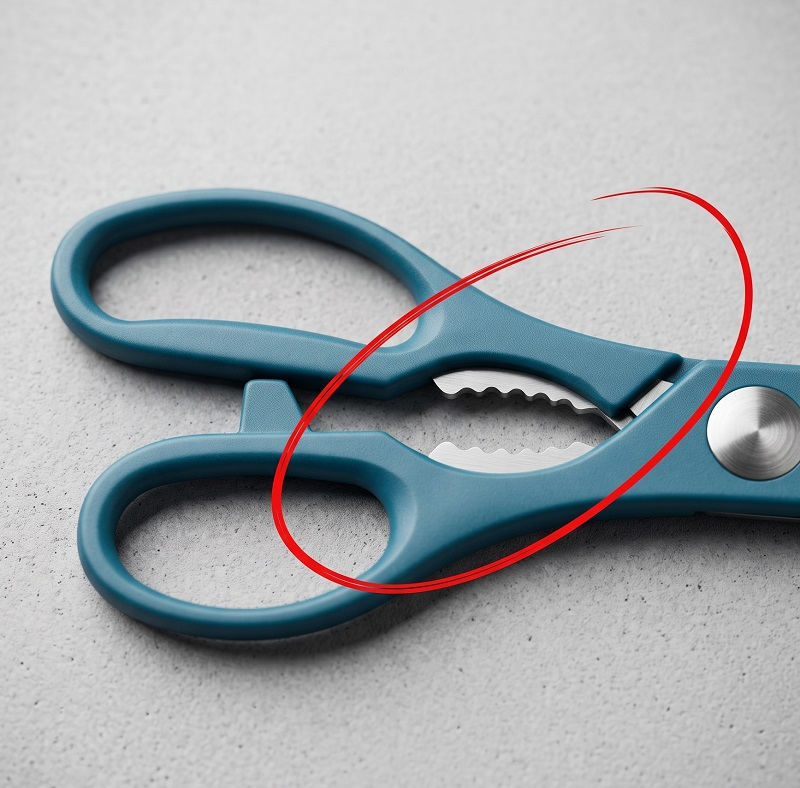
Have you ever noticed the strange jagged section tucked between the handles of your kitchen scissors? It usually sits right behind where your fingers rest, looking like a random little row of teeth. Many people own kitchen scissors for years without ever knowing what that part is actually meant to do.
At first glance, it might seem like a design mistake or just a decorative notch. But that toothy section is not there by accident. It is a clever built-in tool designed to help with several common kitchen tasks.
In fact, once you understand what it does, you may never look at your kitchen scissors the same way again.
So, What Is It?
That ridged part is usually called a gripper, though some brands describe it as a jar opener, nutcracker, or bone gripper. Its main job is simple: it helps you hold, twist, crack, or grip things that are too slippery or tough to handle with your fingers alone.
When you close the scissors slightly, the teeth come together and create a strong gripping surface. This gives you extra traction and pressure, making certain kitchen jobs much easier.
Think of it as the quiet little helper hiding inside your scissors.

It Can Help Open Stubborn Jars and Bottles
One of the most useful jobs for that toothed section is opening tight lids.
Almost everyone has struggled with a jar that refuses to open. You twist, tap the lid, wrap it in a towel, and still nothing happens. That is where the gripper comes in.
Place the lid between the ridged teeth, close the scissors gently around it, and twist. The teeth help hold the lid firmly so your hand does not slip. This can work especially well on smaller caps, such as soda bottles, sauce bottles, tonic water caps, or other containers with stubborn lids.
For people who have limited hand strength, this small feature can be surprisingly helpful.
It Can Crack Nuts
Another common use for the toothed part is cracking nuts.
No nutcracker nearby? Your kitchen scissors may be able to help. Place a walnut, pecan, or hazelnut between the ridges and squeeze the handles gently until the shell cracks.
The key is to use steady pressure, not brute force. You only want to crack the shell, not crush the nut inside into crumbs. Rotate the nut and repeat until the shell loosens enough to remove.
It may not replace a proper nutcracker, but it works well when you need a quick solution.
It Can Grip Small Poultry Bones
On heavy-duty kitchen shears, the ridged section can also help grip small bones, especially when preparing poultry.
For example, it can be useful when working with chicken wings, thighs, or drumsticks. The teeth hold the bone steady so it does not slip while you apply pressure.
However, this depends on the quality of your scissors. Heavy-duty poultry shears are made for tougher jobs, but thin or lightweight scissors may bend, break, or become damaged if used on bones.
So before trying this, make sure your scissors are strong enough for the task.

It Has Other Handy Uses Too
That little gripper can do more than most people realize. It can help crack crab legs or lobster shells, open tight plastic caps on juice bottles, hold twist ties steady, or grip slippery packaging while you cut it.
Some people even use it to help twist out synthetic corks in a pinch, though it is not a perfect replacement for a corkscrew.
Basically, whenever something is slippery, small, tight, or difficult to hold, that hidden section may give you the extra grip you need.
Why Do Kitchen Scissors Have This Feature?
Manufacturers include it because kitchen tools are more useful when they can do more than one job.
A good pair of kitchen scissors is not just for cutting herbs, trimming meat, or opening food packaging. With this built-in gripper, the scissors can also act as a jar opener, nutcracker, shell cracker, and poultry helper.
That means fewer tools cluttering your kitchen drawer.
For anyone with a small kitchen, limited storage space, or a drawer full of gadgets, this kind of multi-purpose design is a big advantage.
Do All Scissors Have It?
No, not all scissors include this feature.
You are most likely to find it on kitchen shears, poultry shears, or heavy-duty multipurpose scissors. Regular office scissors usually do not have it because they are made for paper, not food or tougher kitchen tasks.
To check your own pair, look between the handles. If you see two notched or ridged sections that line up when the scissors close, then your scissors have a built-in gripper.

A Few Safety Tips
Before using it, keep a few things in mind.
Do not force it on anything too hard. Thick bones, rock-hard nuts, or heavy-duty objects can damage your scissors or hurt your hands.
Keep your fingers away from the toothed area while squeezing. Those ridges can pinch.
Always clean the gripper thoroughly after using it, especially if it touches raw meat, seafood, sticky sauces, or oily lids. Food residue can easily hide in the grooves.
And finally, use it for kitchen tasks only. It might seem strong enough for wires, paint cans, or household repairs, but using it that way can ruin the scissors.
The Hidden Power of a Small Kitchen Detail
That weird toothed part on kitchen scissors may look like a strange little design detail, but it is actually one of the most useful hidden features in your kitchen drawer.
It can help open stubborn lids, crack nuts, grip bones, break seafood shells, and hold slippery items in place. In other words, it turns an ordinary pair of scissors into a small multi-purpose kitchen tool.
So the next time you reach for your kitchen scissors, do not ignore that jagged notch between the handles. It may be small, but it can save you time, effort, and frustration.
Once you start using it, you may wonder how you ever overlooked it.