A Little Girl Saved Him. Years Later, Her Secret Would Break Him.
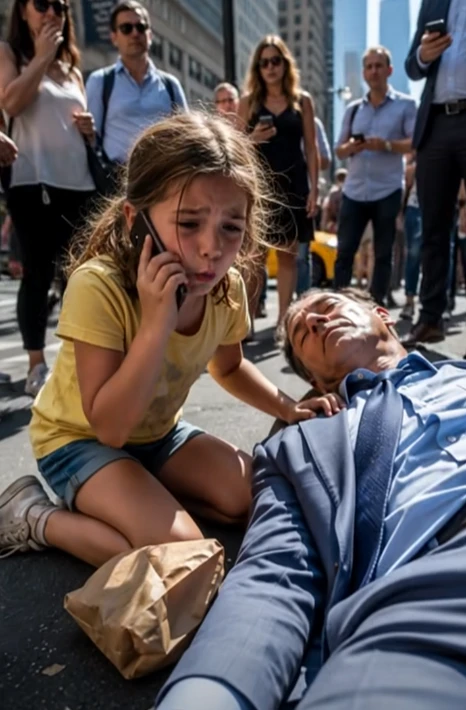
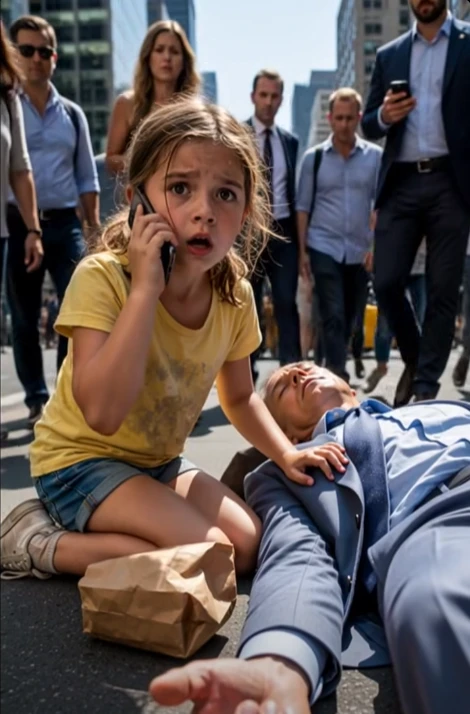
Owen Blake was dying on Fifth Avenue, and everyone around him was too afraid to touch him.
A circle had formed around his body almost instantly.
Phones came out. Whispers rose. Someone said, “Is he drunk?” Someone else murmured, “Don’t move him.” A woman in heels stepped backward as if misfortune were contagious.
But six-year-old Lilly Garrison did not step back.
She stood at the edge of the crowd with a brown pharmacy bag crushed against her chest, her small face pale beneath the burning Manhattan sun.
The man on the sidewalk was not moving.
His lips had turned faintly blue.
Lilly had seen that color before.
She had seen it on her mother’s mouth during the bad nights.
Her heart began to beat so hard it hurt.
“Move,” Lilly said.
No one listened.
She slipped between two adults, dropped to her knees beside the stranger, and set the pharmacy bag carefully beside her sneaker.
“Sir?” she whispered.
The man did not answer.
His chest moved once.
Then stopped.
A sound came from Lilly’s throat—not a scream, not a sob, but something frightened and determined.
She grabbed the phone from the pharmacy bag. It was an old prepaid cell phone with a cracked corner and only three saved numbers: Mom, Pharmacy, and Emergency.
Her fingers shook as she pressed the screen.
“911. What is your emergency?”
Lilly swallowed.
“There’s a man,” she said, forcing her voice not to break. “He fell down on Fifth Avenue. He’s not breathing right.”
The dispatcher’s voice sharpened. “How old are you, sweetheart?”
“Six.”
There was the smallest pause.
Then, calmer: “Okay. You’re doing very well. Is there an adult with you?”
Lilly looked around at the crowd.
At the frozen faces.
At the people recording.
“No,” she said. “Only grown-ups.”
The dispatcher stayed gentle. “Can you tell me exactly where you are?”
Lilly looked up at the street sign.
“Fifth Avenue and 53rd Street.”
“Good. Help is coming. Do not hang up.”
The man made a horrible choking sound.
Lilly flinched, but she did not move away.
“My mommy gets sick,” she whispered into the phone. “Sometimes I have to turn her head so she can breathe.”
“Can you do that for him?”
Lilly looked at the stranger’s expensive suit, his silver watch, his powerful hands lying useless on the concrete.
Then she nodded, though the dispatcher could not see.
“Yes.”
Carefully, with both hands, Lilly turned Owen Blake’s head to the side.
A breath rattled out of him.
The crowd gasped.
Lilly leaned closer, her little ponytail falling over one shoulder.
“Sir,” she said softly, “you have to breathe. My mommy says breathing is the first thing. You can do everything else after.”
His eyelids fluttered.
For one impossible second, Owen saw her.
Not clearly.
Just a blur of sunlight.
A tiny face.
Dark worried eyes.
A child’s voice pulling him back from the edge.
Then everything went black.
Sirens screamed two minutes later.
Paramedics pushed through the crowd, and one of them stopped short when he saw Lilly still kneeling beside the man.
“Was she with him?” he asked.
“No,” someone said. “She just—she just helped him.”
Lilly stood quickly, grabbing the pharmacy bag.
“Is he going to die?”
The paramedic glanced at her. His expression softened.
“Not if we can help it.”
They lifted Owen onto a stretcher. His hand slipped over the side for a moment, limp and heavy.
Lilly stared at it.
There was a gold ring on his finger, not a wedding ring, but something engraved with a symbol she did not understand.
Before the stretcher rolled away, Owen’s hand twitched.
His fingers brushed the edge of her pharmacy bag.
Then the ambulance doors slammed shut.
And just like that, the man was gone.
The crowd began to dissolve.
The city swallowed the moment.
People returned to phone calls, taxis, lunch reservations, meetings.
But Lilly remained standing there, small and still, holding the bag that had nearly been crushed beneath a billionaire’s dying body.
She looked at the sky.
Then at the street.
Then she remembered.
Mommy’s medicine.
Panic shot through her.
She ran.
By the time Lilly reached the narrow apartment building on East 49th, sweat had glued her hair to her forehead. The elevator was broken again, so she climbed four flights, one hand on the railing, the other wrapped around the pharmacy bag.
The apartment door was unlocked.
That frightened her more than anything.
“Mommy?”
The apartment was dim, the curtains drawn against the heat. A fan turned slowly in the corner, clicking every third rotation. The place smelled of soup, medicine, and lavender soap.
Carol Garrison lay on the sofa, one arm across her stomach, her face gray with pain.
Lilly rushed to her.
“I got it,” she said, holding up the bag. “I got your medicine.”
Carol opened her eyes.
Even sick, she was beautiful in the softest way—thin face, tired smile, hair tied loosely behind her neck. But today, her smile came too slowly.
“You went alone?” Carol whispered.
“You couldn’t stand.”
Carol closed her eyes, guilt crossing her face.
“Oh, baby.”
“I was careful,” Lilly said quickly. “I crossed at the lights. I held the bag tight. I didn’t talk to strangers.”
Carol tried to laugh, but it turned into a cough.
Lilly hurried to pour water.
Only after Carol swallowed the pills did Lilly finally sit on the floor beside her.
Her mother brushed weak fingers over Lilly’s cheek.
“You’re shaking.”
Lilly looked down at her hands.
They were trembling.
“A man fell down,” she said.
Carol’s eyes opened wider.
“What man?”
“I don’t know. On Fifth Avenue. He stopped breathing right. I called 911.”
Carol stared at her daughter as if she had just spoken a language no child should know.
“You called 911?”
Lilly nodded.
“And I turned his head like I do for you.”
Carol’s face crumpled.
She reached for Lilly, pulling her close with what little strength she had.
“Oh, Lilly.”
“I didn’t cry,” Lilly said, though tears had begun to form.
Carol held her tighter.
“You should have been allowed to cry.”
For a long moment, the apartment was quiet except for the fan.
Then Carol whispered something Lilly almost missed.
“Please don’t let the world see you too soon.”
Lilly pulled back.
“What?”
Carol forced a smile.
“Nothing, sweetheart. I’m just tired.”
But that night, after Lilly fell asleep on the mattress beside the sofa, Carol stayed awake.
She stared at the ceiling for hours.
At 2:13 in the morning, she reached beneath the loose floorboard under the sofa and pulled out a sealed envelope.
On the front, in careful handwriting, were three words:
For Lilly. Later.
Carol touched the envelope to her lips.
Then she cried silently until dawn.
Across Manhattan, Owen Blake woke up in a private hospital room with five doctors, two assistants, and one very angry younger sister standing around his bed.
“Don’t you dare die,” Amelia Blake snapped, though her eyes were red. “I will personally drag you back and make you attend every board meeting you’ve ever skipped emotionally.”
Owen tried to speak.
His throat burned.
“What happened?”
His doctor leaned over him.
“Cardiac event. Severe arrhythmia. You collapsed on Fifth Avenue. You were lucky.”
Owen blinked slowly.
Lucky.
That did not sound right.
He remembered pain.
Heat.
Concrete.
And a child’s voice.
“My mommy says breathing is the first thing.”
Owen turned his head.
“There was a girl.”
The room quieted.
Amelia frowned. “What girl?”
“A little girl.” His voice was rough. “She helped me.”
One assistant exchanged a look with another.
“We’re trying to get statements from witnesses,” the assistant said. “There were videos online, but security is having them removed.”
Owen’s eyes sharpened despite the weakness in his body.
“Find her.”
“Owen, you almost died,” Amelia said.
He looked at her.
“I know.”
That was exactly why he needed to find the child.
Because in Owen Blake’s world, people helped for money, access, advantage, leverage.
Nobody knelt beside a dying stranger for nothing.
Nobody except, apparently, a little girl with frightened eyes and a paper pharmacy bag.
“Find her,” Owen repeated.
His assistant nodded.
“Yes, sir.”
But finding Lilly Garrison was not easy.
No one had her name.
No one knew where she had gone.
The pharmacy bag in the videos was plain brown, no logo visible. The crowd had filmed Owen, not the child. Every clip showed only pieces of her: a small hand, a ponytail, pink sneakers, a serious little face half-hidden by sunlight.
Three days passed.
Owen was discharged under protest.
By the fourth day, he was back in his penthouse, surrounded by glass walls, expensive silence, and people telling him to rest.
He did not rest.
He watched the footage again and again.
There she was.
Kneeling beside him.
Turning his head.
Holding the phone.
Not panicking.
Not running.
A six-year-old child had done what fifty adults had failed to do.
Owen paused the video at the moment her face turned toward the street sign.
Something twisted in his chest.
Not medical pain.
Something older.
Something he had buried under companies, money, control, and cold decisions.
“Who taught you to be that brave?” he whispered.
On the fifth day, the answer arrived.
His investigator entered the office just after sunset.
“We found her.”
Owen stood too quickly and had to grab the desk.
His sister, sitting nearby, rose in alarm.
“Owen.”
He ignored her.
“Name.”
“Lilly Garrison. Six years old. Lives with her mother, Carol Garrison, in a rent-controlled apartment on East 49th.”
“Father?”
The investigator hesitated.
“None listed.”
Owen noticed the pause.
“What else?”
The man looked down at the file.
“The mother is seriously ill. Medical debt. Late rent. No close relatives we could confirm. The child appears to be picking up prescriptions and groceries alone.”
Amelia’s face changed.
“Owen…”
But Owen was already reaching for his coat.
His doctor had ordered bed rest.
His board expected him on a call.
His company was waiting for decisions worth billions.
For the first time in years, Owen Blake did not care.
He had spent his life building towers high enough to keep the world out.
But somewhere across the city, in a tiny apartment with a broken elevator, a little girl was carrying more than medicine in a brown paper bag.
She was carrying a secret.
And Owen had the terrible feeling that if he did not reach her soon, he would be too late.
Owen Blake arrived at Lilly Garrison’s building in a car worth more than every apartment on the block combined, and for the first time in years, he felt ashamed of it.
The building leaned between two taller structures like something the city had forgotten. Paint peeled around the entrance. A rusted buzzer panel hung crooked by the door. Somewhere above, a baby cried. Somewhere below, a pipe groaned.
Owen stood on the sidewalk with his hand against his ribs, still weak from the hospital, staring at the fourth-floor windows.
Amelia touched his arm.
“You don’t have to do this tonight.”
“Yes,” Owen said quietly. “I do.”
They climbed because the elevator was broken.
By the second floor, Owen was pale.
By the third, sweat had gathered at his temples.
By the fourth, Amelia was furious.
“You nearly died five days ago.”
Owen gripped the railing and looked at her.
“So did someone upstairs.”
That silenced her.
Apartment 4B had a brass number hanging by one nail.
Owen knocked.
For several seconds, nothing happened.
Then a small voice called, “Who is it?”
Owen’s throat tightened.
“My name is Owen Blake.”
Silence.
Then the door opened only as far as the chain allowed.
One dark eye appeared in the gap.
Lilly.
She looked smaller than she had on the sidewalk.
Her hair was tied in a loose ponytail. Her shirt was faded yellow. Her face held the same serious watchfulness, but now Owen saw what the crowd had missed.
She looked exhausted.
“You’re the man who fell down,” she said.
Owen bent slightly so he would not tower over her.
“Yes. And you’re the girl who saved me.”
Lilly blinked.
“I just called 911.”
“You did more than that.”
She looked behind him at Amelia.
“Is she a doctor?”
Amelia’s expression softened.
“No, sweetheart. I’m his sister.”
Lilly considered this.
Then she closed the door.
The chain slid free.
When she opened it again, she whispered, “You have to be quiet. Mommy is sleeping.”
The apartment was dim and hot. The fan clicked in the corner. A bowl of soup sat untouched on the table. Medical bills lay stacked beneath a chipped mug. There were drawings taped to the wall—flowers, clouds, a little house, a woman and girl holding hands.
And on the sofa lay Carol Garrison.
Owen stopped breathing.
Not because she was ill, though she was painfully thin.
Not because the room smelled of medicine and fear.
But because the woman on the sofa opened her eyes and looked at him as if she had been expecting him.
For one second, something flashed across her face.
Recognition.
Then panic.
“Owen,” she whispered.
Amelia turned sharply.
Owen froze.
“You know me?”
Carol tried to sit up, but pain folded her back down.
Lilly rushed to her side.
“Mommy, don’t.”
Carol kept staring at Owen.
“No,” she said too quickly. “I mean—I saw you on the news.”
Owen had spent his whole life reading lies across boardroom tables.
Carol Garrison was lying.
But she was dying while doing it.
So he let the lie stand.
“I wanted to thank your daughter,” he said.
Carol’s hand tightened around Lilly’s.
“She did what anyone should have done.”
“No,” Owen replied. “She did what no one else did.”
Lilly looked down.
Carol’s eyes filled with tears, but she blinked them away.
“We don’t need charity, Mr. Blake.”
“I didn’t offer charity.”
“Men like you don’t climb four flights of stairs just to say thank you.”
Owen glanced at the bills.
“At least let me help with medical care.”
Carol’s face hardened with a strength her body no longer had.
“No.”
“Mommy,” Lilly whispered.
“No, baby.”
Owen studied Carol carefully.
Fear. Pride. Pain.
And something else.
Protection.
She was not protecting herself.
She was protecting Lilly.
“Why?” Owen asked quietly.
Carol looked at him for a long moment.
Then she said, “Because help from powerful men always comes with a price.”
The words landed harder than they should have.
Owen stepped back.
Amelia, sensing the tension, knelt beside Lilly.
“Lilly, do you like hot chocolate?”
Lilly glanced at her mother for permission.
Carol gave the smallest nod.
Amelia smiled. “There’s a café downstairs. Maybe we can get one and bring it back?”
Lilly hesitated. “Mommy needs me.”
Carol brushed her cheek.
“Ten minutes, darling.”
After they left, the apartment felt suddenly too small.
Owen stood near the window.
Carol lay on the sofa, breathing shallowly.
“You’re afraid of me,” he said.
Carol gave a weak laugh.
“I’m afraid of everyone.”
“Why did you say my name like that?”
She turned her face away.
“Because everyone knows your name.”
“Not like that.”
Carol closed her eyes.
For a moment, Owen thought she would refuse again.
Then she whispered, “There are things Lilly doesn’t know.”
“What things?”
“That the world can be cruel.”
“She knows that already.”
Carol’s face broke.
“I know.”
Owen sat carefully in the chair beside the sofa.
“I can help her.”
“No,” Carol said, almost violently. “You cannot take her.”
“I didn’t say take.”
“But people like you do. You see a child in a poor apartment and decide you know better. You’ll give her a room bigger than this whole place. Tutors. Schools. Clean clothes. Doctors. And one day she’ll look back and see me as the sick woman who couldn’t protect her.”
Owen’s voice softened.
“She worships you.”
Carol turned to him then.
“She shouldn’t have to.”
The silence after that was unbearable.
Carol reached beneath the sofa cushion and pulled out a worn envelope.
Her hands trembled.
“I wrote this for her,” she said. “For later.”
Owen looked at the envelope.
For Lilly. Later.
“She’s six,” Carol whispered. “She still thinks medicine makes everyone better. She still thinks if she is good enough, careful enough, brave enough, I’ll stay.”
Owen’s chest tightened.
“What is your diagnosis?”
Carol smiled sadly.
“The kind poor women get too late.”
He understood.
He hated that he understood.
“I can get specialists.”
“I had specialists,” she said. “Before the insurance ended. Before the job ended. Before the bills became bigger than hope.”
“Then let me restart it.”
Carol stared at him.
“You really don’t remember me, do you?”
Owen went still.
The room changed.
The fan clicked once.
Twice.
“Should I?”
Carol’s lips trembled.
“No. Maybe not.”
Before Owen could speak, Lilly returned carrying two hot chocolates with Amelia. She walked carefully, as though the cups were made of glass and gold.
“I got extra marshmallows,” Lilly announced.
For the first time since Owen entered, Carol smiled for real.
“There’s my brave girl.”
Lilly sat on the floor beside her mother and handed her a cup.
Owen watched them together.
The way Lilly adjusted Carol’s blanket without being asked.
The way Carol pretended not to need it.
The way both of them were trying to protect the other from fear.
Something inside Owen shifted painfully.
That night, he left without forcing help on Carol.
But before he stepped into the hall, Lilly followed him.
“Mister Owen?”
He turned.
“Yes?”
She held out something small.
A button from his suit jacket.
“It fell off when the ambulance people took you.”
Owen looked at the button in her palm.
She had kept it safe.
“Thank you.”
“You should sew it back,” she said seriously. “My mommy says broken things last longer if someone fixes them right away.”
Owen closed his hand around the button.
“I’ll remember that.”
Lilly looked up at him.
“Are you better now?”
He thought of his heart.
His empty penthouse.
His years of believing survival was the same as living.
“No,” he said softly. “But I think I might be starting.”
Over the next three weeks, Owen came back again and again.
At first, Carol objected.
Then she tolerated him.
Then, slowly, she trusted him enough to accept small things.
A nurse who “happened” to be available.
A repaired elevator arranged through “building code pressure.”
Meals delivered anonymously until Lilly caught him and said, “Anonymous means you’re lying politely.”
Owen laughed for the first time in months.
Lilly became the strange center of his days.
She showed him her drawings.
She asked why rich people looked sad in magazines.
She told him that clouds were just “sky thoughts.”
She beat him at checkers twice and accused him of “thinking too loudly.”
And Carol watched it all with an expression Owen could not understand.
Gratitude.
Fear.
Grief.
Recognition.
One afternoon, Owen arrived to find Lilly asleep beside her mother, one hand still holding a crayon.
Carol was awake.
Weaker now.
Much weaker.
“Owen,” she whispered.
He sat down immediately.
“I’m here.”
Carol stared at Lilly.
“She likes you.”
“I like her.”
“That’s what frightens me.”
Owen swallowed.
“I won’t hurt her.”
Carol looked at him then, and her eyes were full of tears.
“You already did.”
The words struck him like a blow.
“What?”
Carol’s breathing grew uneven.
“Years ago.”
Owen’s pulse began to pound.
“I don’t understand.”
Carol reached for the envelope.
Not the one marked for Lilly.
Another one.
Older.
Yellowed.
Hidden beneath the blanket.
“I worked for Blake Horizons,” she whispered.
Owen’s company.
His first company.
The one he had built before the empire.
“I was in the medical logistics division. Accounting. No one important.”
Owen’s mind searched backward through years of mergers, acquisitions, lawsuits, signatures.
Carol’s voice trembled.
“There was a whistleblower report. Missing safety funds. A clinic program in Queens. I found the documents. I sent them up the chain.”
Owen went cold.
Blake Horizons had buried a scandal eight years earlier.
He had been told it was false.
He had signed the termination orders for several employees involved in “financial misconduct.”
Carol watched his face.
“You don’t remember because I was just a name on a page.”
Owen could not speak.
“I lost my job,” she whispered. “Then my insurance. Then the treatment I needed.”
Lilly stirred in her sleep.
Carol touched her daughter’s hair.
“I was pregnant when it happened.”
Owen stood so fast the chair scraped the floor.
“No.”
Carol’s eyes closed.
“Yes.”
“I didn’t know.”
“I know.”
The forgiveness in her voice hurt worse than accusation.
“I thought I was cutting out corruption,” Owen said, barely audible.
“You signed what they put in front of you.”
He turned away, horrified.
Every empire he had built.
Every deal.
Every victory.
And beneath it, this apartment.
This woman.
This child.