Part One: Before the River
Her name was Mara Voss, and she had been walking for eleven hours.
Not hiking — walking. The kind of walking that has no pleasure in it, only direction, only the need to be somewhere other than where you started. Her backpack weighed twenty-three kilograms. Her boots had been wet since the second hour. The mountain had given her nothing easy — not the trail, not the weather, not the silence, which was the kind of silence that presses rather than comforts.
Rex walked beside her.
He had been beside her for four years — since the day her mother had driven her to the shelter outside Innsbruck and said you need something to come home to, which had felt, at sixteen, like the saddest sentence she had ever heard, and which felt now, at eighteen, like the wisest. Rex was a German Shepherd with one slightly bent ear and the particular gravity of a dog who has decided that one person is his entire world and organised his existence accordingly. He did not run ahead. He did not lag behind. He walked beside her, matching her pace, checking her face every few minutes with the quiet consistency of someone keeping watch.
She had left the research station at dawn.
She had not told anyone she was leaving.
This was, she understood, the part of the decision that could not be explained in a way that would satisfy the people she would have had to explain it to. That her father had called the night before and said something that made her need to be moving. That the walls of the station had become the particular kind of close that only movement could fix. That there was a village on the other side of the mountain, twelve hours on foot, where her grandmother lived, and that her grandmother was the only person in the world who had never asked her to explain herself.
She had twelve kilometers left.
Between her and those twelve kilometers was the Weiß River.
Part Two: The Log
She had known about the bridge.
She had not known that the bridge would be gone.
She stood at the bank for a long time, looking at the place where it had been — the concrete footings still there on both sides, the gap between them thirty meters of white water and violence and cold that came off the surface like something alive. The river was running high. Spring melt plus three days of rain meant the Weiß was doing what the Weiß did when it was given too much — taking everything and giving nothing back.
The log was her only option.
It was not a good option. She knew this. It was a fallen pine, thick enough to walk on, stretching almost the full width of the crossing with its far end wedged between two boulders. It was wet. It was approximately one meter above the surface at its lowest point. Below it, the water moved the way water moves when it wants to remind you that it does not care about you at all.
She tested it with her foot.
It held.
She looked at Rex.
He looked at the log. Looked at the water. Looked at her.
— Okay, — she said. It was the word she always used when things were not okay and she was choosing to proceed anyway.
She stepped onto the log.
The first eight steps were fine.
She found a rhythm — arms slightly out, eyes on the far bank, feet moving with the particular care of someone who has decided that speed is less important than precision. The sound was immense. The Weiß in full spring flood was not a river sound, it was a geological event, a white noise so complete it filled the inside of her skull and made thought difficult.
Rex followed.
She could hear him behind her — the careful click of his claws, the slight adjustment of his weight as the log swayed imperceptibly. She did not look back. Looking back on a log above a river is the mistake you make once.
She was six steps from the far bank when she heard it.
Not a slip. Not a sound. Just the absence of the clicking behind her.
She turned.
Part Three: The Harness
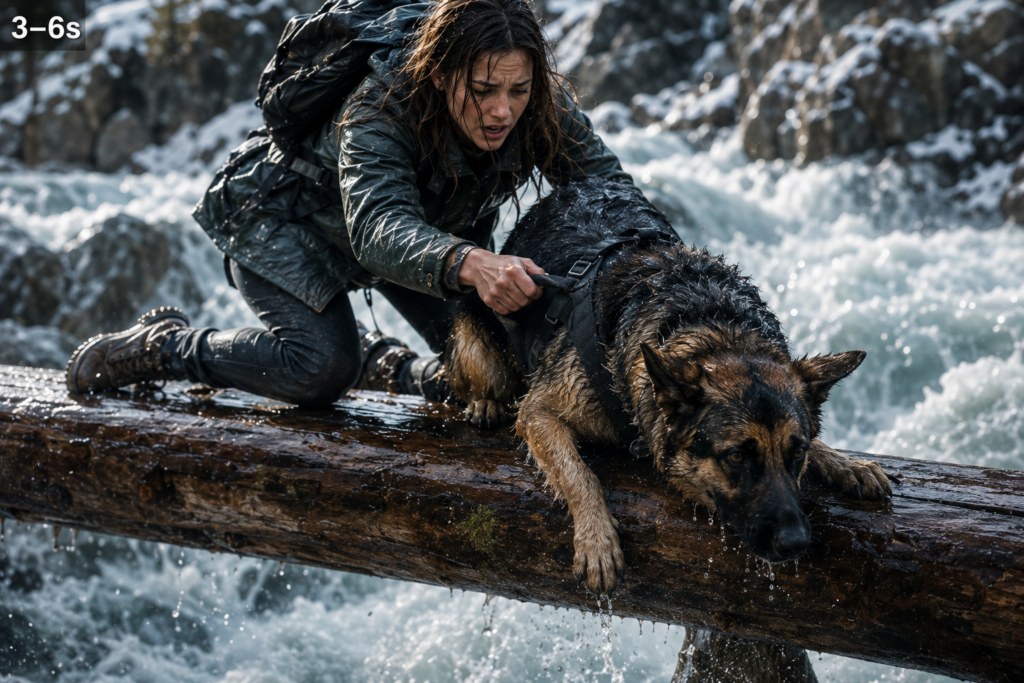
He was on his side.
Not off — not yet — but his back legs had gone off the edge and he was hanging, his front paws scrabbling against the wet bark, his harness the only thing between him and thirty meters of white water and the rocks below it. His eyes found hers with an expression she had seen once before, when he was a puppy and had fallen from a low wall — the expression of an animal that trusts completely and is waiting to be saved.
She dropped to one knee before the thought completed itself.
Her hand found the harness.
The harness was soaked through. The wet nylon was the texture of something that did not want to be held, and her gloves — the thin ones, the ones she had grabbed in the dark that morning — gave her nothing. She could feel him sliding. Not fast. Just the slow inevitable physics of weight and gravity and a surface that had never been designed for this.
— Hold on! — she heard herself say. — Don’t let go!
The words made no sense. He was a dog. He was not choosing to let go. But she said them anyway, the way you say things in the moments when language becomes pure instinct rather than communication.
She pulled.
The harness slipped another centimeter.
She pulled harder.
Her knees were on the bark and the bark was wet and the river below was so loud it had become a physical pressure against her eardrums. She could feel the log moving slightly under her — the micro-vibrations of a thing that was not designed to hold still forever. Her shoulder burned. Her hands were numb from cold and effort and the particular grip of someone who has decided they are not letting go regardless of the cost.
Rex’s back legs found the log.
Not all at once. One paw first, then the other, then the scramble of a large dog getting his body back onto a surface, the artless desperate recovery of an animal that has been genuinely frightened. He made a sound — low and involuntary — when he was back on the log. She made a sound she would not have been able to describe.
She pressed her face against his head for one second.
One second.
Then she heard the crack.
Part Four: The Crack
It was not a small sound.
It was the sound of something structural failing — the deep tonal shift of wood under stress finding its breaking point. The log lurched. Not far. Maybe ten centimeters. But ten centimeters above a river that would kill you in thirty seconds was the difference between nothing and everything, and she felt it through her entire body with the particular clarity of a moment that has become very simple.
The birds went first.
From somewhere in the trees on the far bank — a tree she had not noticed, had not thought about — a dozen of them burst upward with the panicked collective movement of things that know the difference between safe and not safe, and watching them go was, she would remember later, the moment she understood that the situation had crossed a line.
She moved.
Not running — you don’t run on a wet cracked log — but fast, the controlled urgency of someone who has done the calculation and arrived at a number. Rex moved with her. He did not need to be told. He had felt the crack too, and he was already in motion, ahead of her now, his paws finding the far bank as she made the last two steps and then she was off the log and on the rock and she was pulling Rex against her and breathing.
She let herself breathe for three seconds.
Three seconds.
Then she looked upstream.
Part Five: What Was Coming
It was red.
That was the first thing — the colour, entirely wrong for this landscape of white and grey and pine-green. Red, industrial, the red of something built by human hands for human purposes that had no business being here, in this valley, on this river, in this moment.
It was a cargo container.
She knew what it was. She had seen them on trains, on trucks, the anonymous rectangular units that moved things across the world in their millions. But she had never seen one like this — half-submerged, tilted at an angle that should have sunk it but somehow hadn’t, moving with the current at a speed that the river’s character made terrifying. It was not drifting. It was being carried — thrown forward by the Weiß with the casual violence of a river that has decided this thing is its problem now and is in the process of solving it.
It would reach the log in approximately forty-five seconds.
She watched it come.
The broken ice around it moved like a frame, white pieces catching the light and spinning and disappearing. The metallic sound it made — the scraping of steel against submerged rock, the deep percussion of something enormous meeting resistance — was a sound that did not belong in any landscape she had known.
Rex was barking.
Not at her. At the container. At the thing coming down the river that he understood was wrong before he understood what it was — the ancient animal knowledge of a creature that has survived by recognising the things that should not be where they are.
She took one step back.
Then another.
Her hand found Rex’s harness.
The container hit the log at forty-eight seconds.
The sound was not what she expected. She had expected an impact — one definitive moment of collision and consequence. What she got instead was a sequence: the groan of the log taking the weight, the snap of the far-bank foothold releasing, the secondary sound of wood and water and metal rearranging themselves in real time, the birds that had already fled being joined by others, and under all of it the river, which had not changed its voice at all, which was doing what it had always been doing and would continue to do long after every human sound in this valley had stopped.
She was twenty meters back from the bank now.
She did not remember moving those twenty meters.
Rex pressed against her leg. His breathing was fast. His ears were flat. But he was there — solidly, entirely there, against her leg, the weight of him the most real thing in the landscape.
The container moved on.
It did not stop. It never stopped. It rounded the bend below them with the indifference of something that has no opinion about what it has passed through, and then it was gone — the red disappearing behind the white curve of the river, the metallic sound fading into the general roar, and then there was only the Weiß and the broken remnants of the log turning slowly in the current below where it had been.
She stood there for a long time.
Part Six: The Other Side
She reached her grandmother’s village at dusk.
Not at the time she had planned. Later — much later — because after the river she had sat on a rock for a while and let Rex lean against her and had not tried to do anything except be present in the aftermath of what had just happened. This was something she had learned from her mother, who had learned it from her own mother, who was waiting now in a small yellow house at the edge of a village that smelled of woodsmoke and early spring.
Her grandmother opened the door before she knocked.
This was something she always did — appeared at the door in the moment before you reached it, as if she had a particular sense for the arrival of the people she loved.
She looked at Mara.
She looked at Rex.
She looked at Mara again — at the wet clothes, the exhausted face, the particular expression of someone who has been through something and has not yet decided what to call it.
She stepped aside to let them in.
She did not ask what happened.
She put the kettle on.
She found Rex’s old bowl from the last visit and filled it without being asked.
And then she sat down across from Mara at the kitchen table, and she looked at her granddaughter with the patient attention of someone who has lived long enough to know that some things arrive on their own time, and she waited.
Mara looked at her hands.
They were still slightly trembling — not from cold, not anymore. From the particular aftermath of adrenaline, the body taking its time to understand that the emergency is over.
— There was a container, — she said finally. — In the river. It came down while we were crossing.
Her grandmother nodded.
As if this was not surprising. As if the world presenting itself in unexpected and dangerous ways was simply something that happened, something to be noted and moved through.
— But you crossed, — she said.
— We crossed.
Her grandmother looked at Rex, who was eating with the focused efficiency of a dog who has decided that food is currently the most important thing.
— He stayed with you.
— He always stays with me.
Her grandmother nodded again. She wrapped both hands around her tea, the way she always did — the gesture of someone settling into something, making themselves comfortable inside a moment.
— Then you had everything you needed, — she said.
Epilogue
She stayed four days.
She called the research station on the second day and was told, with more relief than she had expected, that they had been looking for her. She explained where she was. She said she was coming back. She said she was fine.
She was, she realised while saying it, not exactly lying.
On the last morning she walked to the river — a different river, a smaller one, that ran peacefully through the lower meadow below the village. Rex walked beside her. The day was clear and cold, the kind of mountain morning that seems to have been made specifically to remind you that the world is large and you are small and this is not necessarily a bad thing.
She stood at the bank for a while.
She thought about the container — where it had come from, where it had gone, what it carried. She thought about the log, which was somewhere downriver now in pieces, doing whatever logs do after they’ve finished being useful. She thought about the forty-eight seconds between the crack and the impact, the forty-eight seconds in which she had moved without thinking, which was maybe the only honest description of survival: you move without thinking, and then later you think about how you moved.
Rex pressed his nose against her hand.
She looked down at him.
He looked up at her.
Between them was the particular understanding of two creatures who have been through something together and have no need to discuss it — who know each other’s fear and each other’s limits and who have been, each to the other, the reason to keep moving.
She scratched behind his good ear.
He leaned into it.
The river went on doing what rivers do.
And she turned, eventually, and walked back up toward the village and the yellow house and the grandmother who would have breakfast ready, who would not ask questions that didn’t need asking, who understood — as the best people understand — that sometimes the most important thing you can offer someone who has just come back from something is simply a table and a warm room and the quiet confirmation that they are here.
That they made it.
That they are still here.