Part I — The Man in the Grey Suit
His name was Daniel Mercer.
Forty-seven years old. Former high school history teacher. Coached the junior soccer team on Thursdays. Made the best chili in the neighborhood according to everyone on Birchwood Lane who had ever been invited to try it, which was everyone on Birchwood Lane, because Daniel Mercer was the kind of man who invited people.
He had been sitting in courtrooms for eleven months.
Not by choice.
The charges were serious. The evidence, the prosecution said, was overwhelming. The timeline placed him at the scene. His fingerprints were on the door. His car had been seen on the street.
What the evidence could not explain — what the evidence seemed entirely uninterested in — was that Daniel Mercer had not done what they said he had done.
He knew this.
His lawyer knew this, or said she did, though lately her voice had taken on the particular quality of someone who has begun to privately revise their assessment of a situation they cannot publicly change.
The jury did not know this yet.
The jury was watching him with the careful, composed expressions of people who have been told to reserve judgment and who are, in the privacy of their own minds, not entirely managing to do so.
Daniel sat in the defendant’s chair in his grey suit and his blue button-down shirt and looked at the large wooden doors at the back of the courtroom.
He did not know why he kept looking at the doors.
He had been looking at them all morning.
Something in him — some part that operated below reason, below language, below the careful architecture of hope he had been constructing and reconstructing for eleven months — was waiting for something.
He didn’t know what.
Part II — What Had Been Lost
Eighteen months ago, Daniel Mercer had a life.
Not a perfect life. Not a spectacular life. But a real one — the kind that is built slowly, out of ordinary things, and that has the particular solidity of something assembled by hand over time.
He had a house on Birchwood Lane with a porch that needed painting every few years and a garden that was more enthusiastic than controlled.
He had former students who still emailed him sometimes to tell him what they were doing, which he considered the highest form of professional compliment.
He had Charlie.
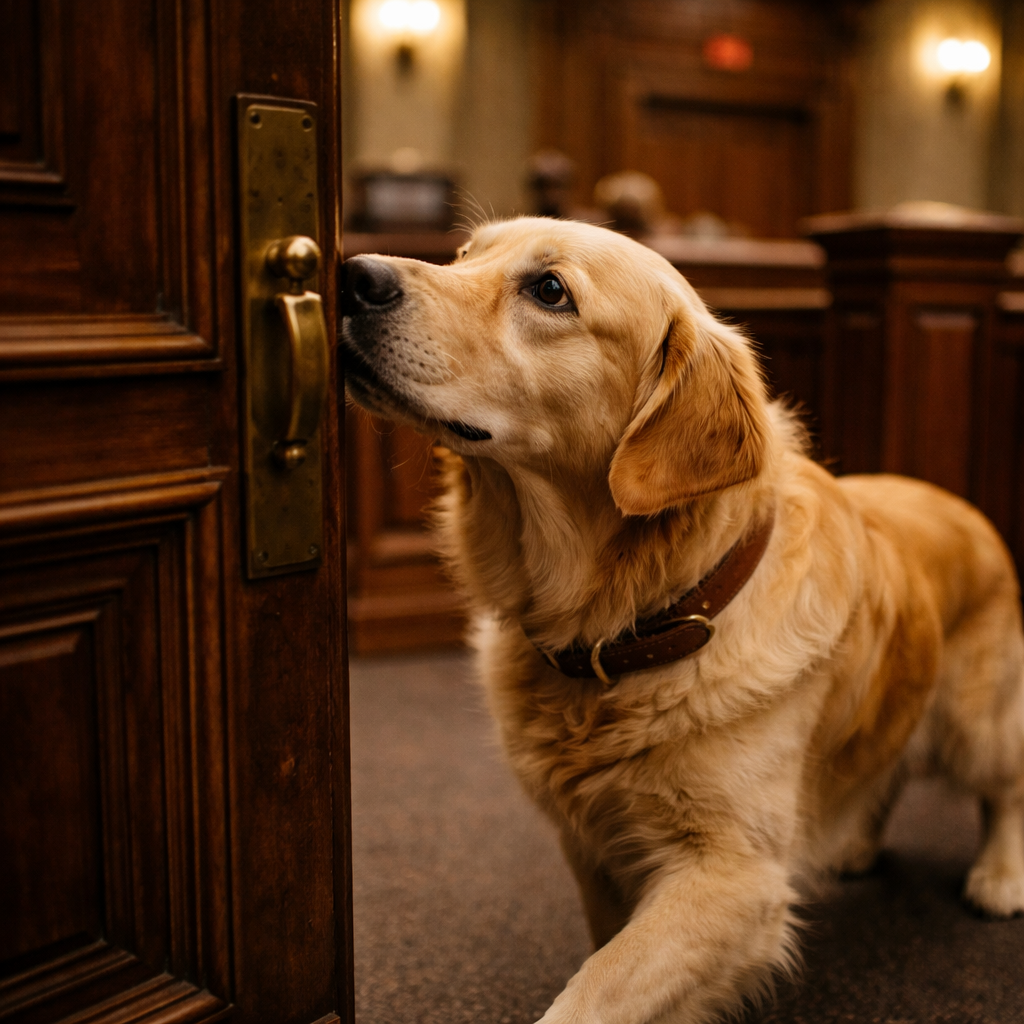
Charlie was a golden retriever, four years old at the time of the arrest, with a brown leather collar and the particular emotional intelligence of a dog who has lived with someone long enough to understand them at a frequency below words.
Charlie had been with Daniel since he was eight weeks old.
He had been there through the divorce — the quiet, undramatic kind that hurts more than the loud dramatic kind because there’s nothing to be angry at, just two people who have grown into different shapes and can no longer fit in the same space. Charlie had slept pressed against Daniel’s legs every night for three months afterward, with the dedicated constancy of something that has decided that presence is the most important thing it can offer.
He had been there through the diagnosis — the one that turned out to be manageable but that had required six months of managing, six months during which Charlie had learned to detect certain things before Daniel did and would press his head into Daniel’s hand in a way that meant sit down, I need you to sit down now.
Charlie knew Daniel.
Not the version of Daniel that wore a grey suit and sat in a defendant’s chair and was described in prosecution documents as a man who had done something he had not done.
The real Daniel. The one who existed before language got involved.
When the police had come and taken Daniel away, Charlie had pressed himself against the front door and stayed there for four hours, according to the neighbor who came to collect him.
He had not barked.
He had simply pressed against the door.
Waiting.
Part III — The Eleven Months
The eleven months had done things to Daniel that he was only partially aware of.
He was thinner. His hair had more gray in it than it had before, which his lawyer said made him look distinguished and which Daniel suspected was her way of finding something useful to say about something that was simply the visible cost of eleven months of fear.
He slept badly. He ate without tasting. He had learned the specific, numbing geography of his own thoughts the way you learn the layout of a room you’ve been locked in — not with interest, not with discovery, but with the flat familiarity of someone who has run out of new places to look.
His lawyer, Margaret Chen, was good. He believed that. She had found inconsistencies in the prosecution’s timeline that she believed were significant and that the prosecution’s team clearly believed were not, and the gap between those two beliefs was where Daniel Mercer currently lived.
Margaret had told him, the night before the final day of testimony, that she was cautiously optimistic.
She had said it in the tone of someone who has learned to attach enough qualifiers to hope that they cannot be held responsible for it if it fails.
Daniel had thanked her.
He had gone back to the small apartment where he was staying on bail conditions and sat on the bed and looked at the empty corner where Charlie’s bed used to be and thought about the particular silence that exists in a space where a living thing used to be.
Charlie was staying with Daniel’s sister, Rebecca.
She had sent a photograph that morning, as she sent one every morning — Charlie sitting at the window, looking out toward the street.
Daniel had looked at the photograph for a long time.
Then he had put on his grey suit.
And come to court.
Part IV — The Door
It happened at 10:47 in the morning.
The prosecution had just finished a line of questioning that Margaret had stood up to object to three times, been overruled twice, and sustained once — a ratio she had described in a whisper to Daniel as about as good as we can expect today.
The judge was making a note.
The jury was sitting in the particular way juries sit when they are composing themselves against something they have just heard.
Daniel was looking at the large wooden doors at the back of the courtroom.
They moved.
Not dramatically. Not with the burst-open urgency of movie moments. They moved the way doors move when something is pushing at them from the other side with steady, patient, utterly committed pressure.
Then a nose appeared in the gap.
Golden. Broad. Unmistakable.
Then the rest of him — the brown leather collar, the familiar slope of the shoulders, the tail already moving before the rest of him had fully committed to being in the room.
Charlie walked through the doors of the courtroom.
He paused.
He looked around.
His eyes found Daniel in exactly the way they had always found him — without searching, without scanning, with the direct, calm certainty of something that has never needed to look very hard because it has always known exactly where it was going.
Part V — The Man’s Face
Daniel Mercer had not cried in eleven months.
Not once.
Not in the police station, not in the holding cell, not in the first courtroom appearance when the charges were read aloud and his name and the words that followed it existed in the same sentence and he had sat there and felt something inside him go very quiet and very still.
Not in the long nights in the small apartment.
Not when his sister sent the photographs.
Not this morning, when he had put on the grey suit and looked at himself in the mirror and understood with a certainty that he could not explain rationally that today was the day that would determine the rest of his life.
He had not cried.
He was crying now.
His eyes widened as Charlie crossed the threshold — not with surprise, exactly, but with the particular wideness of recognition, the way eyes widen when something you have been trying to hold as a memory suddenly becomes real again, suddenly has weight and warmth and breath and is standing thirty feet away from you.
His breath came in sharp. Shallow. The involuntary breath of someone whose body has just received news that the mind is still processing.
The tears came without decision.
They simply arrived, the way certain things arrive when the structures you have built to contain them — the careful architecture of endurance, of getting through one day and then the next, of not allowing yourself to feel the full weight of what you are carrying because feeling it fully would make it impossible to continue carrying it — suddenly and completely stop being necessary.
Part VI — Across the Floor
Charlie ran.
Not the dignified trot of a well-trained dog in an unfamiliar public space.
He ran the way he had always run when Daniel came home — with the full commitment of a living thing for whom the distance between where it is and where it needs to be is the only thing that exists in the world.
His paws hit the polished courtroom floor and found no traction and slid and recovered and kept going, tail moving so fast it was almost invisible, a low sound escaping him that was not a bark and not a whine but something between the two that meant — in the language that existed only between them — I found you I found you I found you.
The courtroom made a sound.
Not words. Not the organized sounds of an institution functioning. A human sound — the involuntary, collective exhale of twenty-seven people watching something they did not expect to feel as much as they were feeling it.
A juror in the second row pressed her hand to her mouth.
The court reporter stopped typing.
The prosecuting attorney, who had spent eleven months assembling a case against Daniel Mercer with the thoroughness and conviction of someone who genuinely believed in it, sat completely still with an expression that had moved past professional composure into something unguarded and unprepared.
Charlie reached the defendant’s chair.
He did not pause at the railing.
He did not hesitate.
He simply gathered himself — four years of muscle and loyalty and eleven months of waiting compressed into a single instant — and leapt.
Part VII — The Embrace
Daniel caught him.
His hands were restrained — the handcuffs allowed limited movement, enough to bring both arms up and wrap them around the dog who had landed in his lap with the full confident weight of something that has arrived exactly where it belongs.
Charlie pressed his head into Daniel’s neck.
Licked his face — his cheek, his jaw, the corner of his eye where the tears were still falling.
Daniel made a sound that was not words and not crying and not laughing and was somehow all three at once.
He pulled Charlie closer.
As close as the handcuffs allowed.
His face went into the fur — that familiar smell, warm and real and entirely unchanged, the smell of everything that had existed before the grey suit and the defendant’s chair and the eleven months, the smell of the house on Birchwood Lane and the garden and the ordinary real life that had been interrupted but not — not yet, not permanently — taken.
He sobbed.
Not the controlled, private kind.
The kind that comes from somewhere below intention, below dignity, below the careful management of how you present yourself to rooms full of strangers who are deciding your fate.
The kind that is simply true.
Part VIII — The Courtroom
The gallery rose.
Not all at once.
One woman first — in the fourth row, a stranger who had come to observe a public trial and who found herself standing without having decided to stand, in the way you stand for something that demands it.
Then the man beside her.
Then a row forward.
Then another.
One by one, the way trees move in wind — each one responding not to a command but to the same thing moving through them — the gallery of the courtroom stood up.
The judge did not call order.
He was a man of sixty-one years with a reputation for complete impartiality and an absolute commitment to the dignity of his court, and he sat behind his bench and watched Daniel Mercer hold his dog in handcuffed arms and did not call order, because there are moments that exist outside of order, moments that belong to a different jurisdiction entirely.
The jury watched.
A juror in the front row — a retired electrician named Harold, who had sat through eleven days of testimony with the methodical attention of someone who takes the responsibility of judgment seriously — looked at Daniel’s face, and at the dog’s face pressed against it, and felt something shift inside him with the physical certainty of something heavy moving into a different position.
He had been uncertain.
He was not uncertain anymore.
Not because of the evidence.
Not because of anything that could be written in a legal document or cited in a closing argument.
But because there are things that cannot be faked, and a dog running across a courtroom floor to a man it loves is one of them, and Harold had lived long enough to understand the difference between what looks like truth and what is truth, and what he was looking at was truth.
Part IX — After
The verdict came three hours later.
Not guilty.
On all counts.
Daniel sat in the same chair and heard the words and felt them arrive in a way that was different from how he had imagined they would arrive — not with relief, not with triumph, but with a kind of vast, quiet settling, like something that has been held at an angle for a long time being finally, gently, set down.
Margaret Chen was crying.
This surprised him.
In eleven months he had never seen her cry.
She was very professional about it — she pressed her fingers briefly against her eyes and then composed herself and shook his hand and said I told you, and he said you did, and they both understood that she had not, not really, not with the certainty that the outcome had required, but that she had done something more valuable than certainty — she had stayed.
Outside the courtroom, in the corridor, his sister Rebecca was waiting.
She had Charlie on a leash.
Charlie, who had been gently retrieved from the courtroom by a bailiff who could not quite bring himself to be stern about it and who had allowed Daniel several minutes before using the word eventually.
Daniel walked out.
Charlie saw him.
And ran.
And this time there were no handcuffs.
Epilogue — Six Months Later
The house on Birchwood Lane needed painting again.
Daniel had started on the left side in October and gotten distracted by the garden, which had grown considerably during the eleven months of his absence and which he was approaching less as a problem to be solved and more as a conversation to be resumed.
Charlie lay on the porch in the afternoon light.
The particular light of late autumn — gold and low, the kind that makes ordinary things look like they mean something.
Daniel sat beside him.
He had gone back to teaching in September. A different school, different students, but the same subject — history, the study of what people did and why and what it cost them and what it built. His new students were seventeen years old and largely unimpressed by him, which he found enormously reassuring.
He had not spoken publicly about what had happened.
He had been asked. Several times. In ways that suggested it would be easy and profitable and that people were genuinely interested.
He had declined.
Because what had happened was not a story about the system or justice or wrongful prosecution, although it was also all of those things.
It was a story about a dog who pushed through a heavy wooden door and ran across a polished floor and arrived, with complete and total certainty, in the exact right place.
And what do you say about that?
What words do you use for the thing that kept you — kept the real version of you, the version that existed before the grey suit and the defendant’s chair — alive through eleven months of not knowing?
Daniel put his hand on Charlie’s back.
Charlie sighed — the deep, satisfied sigh of a dog in afternoon light with the person it belongs to in the exact place that person is supposed to be.
You waited, Daniel said. Not aloud. The words were too quiet for sound.
Charlie’s ear moved toward him.
I know, Daniel said. I know you did.
The light moved across the porch.
The garden grew in its unruly, unconcerned way.
And the house on Birchwood Lane, which had been many things in the past eighteen months — empty, waited-in, longed-for — was, on this ordinary afternoon in late autumn, exactly what it had always been.
Home.
Some witnesses cannot be sworn in.
They cannot be cross-examined.
They cannot be asked to state their name for the record.
But they can push through a heavy door.
And run across a polished floor.
And arrive.
And sometimes —