CHAPTER 1
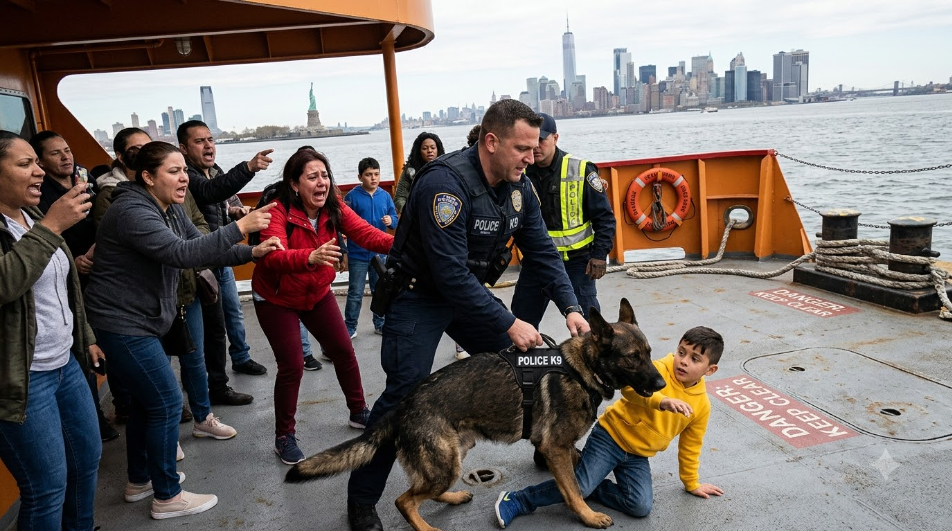
“Get that animal off my son right now!”
The scream ripped out of my throat, tearing through the frigid morning wind of the New York Harbor. It didn’t even sound like my own voice. It was a raw, primal sound, the kind of noise a human being only makes when the center of their entire universe is violently dragged to the ground.
My coffee cup slipped from my fingers, the hot liquid exploding across the freezing concrete, but I didn’t feel the splash on my ankles. I was already moving. I dropped my heavy leather purse and lunged forward, my knees slamming hard against the textured black rubber of the ferry terminal’s non-slip matting.
Right in front of me, no more than three feet from the edge of the churning, black harbor water, a massive port police German Shepherd had my seven-year-old son, Liam, pinned completely flat to the deck.
“Liam!” I shrieked, clawing at the dog’s thick tactical harness.
Liam was weeping hysterically, his small face pressed sideways into the cold rubber mat. His little hands were batting uselessly at the heavy black chest of the K9. The dog wasn’t growling. It wasn’t biting his skin. But its massive jaws were locked with terrifying, immovable force onto the thick, reinforced shoulder of Liam’s bright orange winter jacket. The dog’s sheer weight—easily seventy or eighty pounds of pure muscle—held my boy flush against the ground, refusing to let him move an inch.
“Hey! Back off the kid, man!”
A tall man in a tailored gray overcoat shoved past me, his leather briefcase hitting the deck. He reached out and grabbed the thick leather leash attached to the dog’s collar, wrapping it around his fist and yanking backward with all his strength. “Get this thing off him! Are you crazy?”
Around us, the Tuesday morning commuter crowd had instantly stopped, the dull murmur of harbor traffic instantly replaced by a wave of sharp, escalating panic.
Within seconds, a dozen people had formed a tight, hostile ring around us. Cell phones shot up into the air, their lenses staring down like dozens of unblinking eyes. I could hear the digital clicks of recording starting, the red lights flashing.
“Someone call real cops!” a woman near the back shouted, her phone held high.
“That dog just attacked a kid for no reason!” another man yelled, stepping closer, his boots heavy on the metal decking. “I got it all on video! I got the whole thing!”
But the absolute most terrifying part of the nightmare wasn’t the size of the dog, or the fact that my son was crying. It was the handler.
The port police officer—a broad-shouldered man in a dark blue windbreaker, a radio mic clipped to his shoulder—wasn’t trying to pull his animal back. He hadn’t drawn his weapon. He hadn’t pulled his taser. Instead, he had thrown himself onto the freezing deck right beside his dog. He had one arm wrapped tightly around the K9’s neck, and his other arm was stretched entirely across Liam’s small body, shielding my son with his own heavy torso.
The officer wasn’t looking at me. He wasn’t looking at the angry businessman yanking on the leash. He wasn’t looking at the wall of cameras surrounding him.
He was staring over my shoulder, out toward the edge of the concrete pier, his eyes wide and dilated with a kind of sheer, absolute terror that made my blood freeze in my veins.
“Stay down!” the officer roared, his voice cracking with a desperate panic that cut through the wind. “Everybody get on the ground right now! Get down!”
No one moved.
The businessman yanked the leash harder. “I said call your dog off, you psychopath!”
I grabbed the thick canvas fabric of the officer’s windbreaker, my cold fingers digging in. “Let my baby go! Please, let him go!” I sobbed, trying to wedge myself between the heavy dog and my boy’s trembling body.
I was so consumed by the sight of my child on the ground, so blinded by a mother’s sheer terror, that the entire world had shrunk to a three-foot radius. I couldn’t hear the deep, unnatural sound echoing right behind my head. I couldn’t see what the officer was staring at.
I didn’t know that exactly twenty-two minutes earlier, the invisible fuse to this exact moment had already been lit.
Twenty-two minutes before the screaming started, the ferry terminal had been nothing more than a chilly, boring start to our Tuesday morning.
Liam and I had arrived early for the 9:00 AM commuter ferry across the harbor. We were heading into the city for a doctor’s appointment—nothing serious, just a routine checkup—but I always built in extra time. It was a freezing, bitter morning. The wind whipping off the Hudson River carried the sharp, metallic smell of diesel fuel and deep, cold saltwater.
“Stay close, buddy,” I had murmured, adjusting the collar of Liam’s bright orange coat.
I always made him wear the bright colors near the water. It was a joke between my husband and me—that I dressed our son like a human traffic cone whenever we were within a mile of the ocean. But the harbor was chaotic, filled with hurrying crowds, rushing delivery carts, and the endless, confusing churn of a busy transit hub. I needed to know I could spot him instantly.
We had walked toward boarding zone three, right at the edge of the heavy concrete pier. The terminal was packed. A large group of college-aged tourists—maybe forty of them—had arrived just before us. They were disorganized, chatting loudly, dragging a mountain of oversized canvas duffel bags, rigid Samsonite suitcases, and heavy backpacks.
When the terminal security guard had briefly looked away to answer a radio call, the students had carelessly shoved their massive pile of luggage right up against the heavy iron railings at the front of the line.
They stacked the bags four feet high. By doing so, they completely covered a wide, arched semi-circle painted on the gray concrete. The paint was industrial hazard yellow, lined with thick black diagonals.
Hidden entirely beneath their heavy backpacks were the bold, stenciled letters: SNAP-BACK ZONE. CLEAR AT ALL TIMES.
I hadn’t seen the sign. I had just seen a pile of bags.
We stood a few feet away from the luggage pile, waiting. Liam was bouncing on his heels. He loved boats. He loved the mechanical noises, the heavy chains, the men in orange vests throwing ropes.
“Here she comes, mom!” he had cheered, pointing out at the gray water.
The massive, three-hundred-ton commuter vessel was angling toward the dock. It was a beast of steel and glass, its massive diesel engines rumbling so deeply I could feel the vibration shooting up through the soles of my winter boots. The black water churned into thick, angry white foam as the captain threw the engines into reverse to slow their momentum.
At the edge of the pier, just a few feet from where the students’ bags were piled, stood a massive iron bollard—a heavy, rusted metal cylinder bolted deeply into the concrete base of the dock.
As the ferry drifted closer, a deckhand on the front of the boat hurled a thin messenger line across the gap. A dockworker on the pier caught it and immediately began hauling it in, pulling a massive, three-inch-thick synthetic mooring hawser behind it.
The hawser looked like a giant snake, thick, braided, and heavy. The dockworker threw the loop of the massive line over the iron bollard.
“Mom, can I see how they tie it?” Liam asked, tugging my hand.
“Watch from right here, sweetie,” I said, fishing in my purse to make sure I had our boarding passes ready.
Behind us, Officer Thomas and his K9, Bruno, had been walking their routine morning patrol. They were a familiar sight at the terminal. Thomas was a seasoned handler, and Bruno was a highly decorated dog, trained to sniff out explosives and contraband.
But Bruno, like all working dogs, was deeply attuned to his environment. He didn’t just smell the world; he heard it in a way human beings couldn’t.
As I looked down into my purse, a heavy gust of wind slammed into the side of the incoming ferry. The massive wall of steel acted like a sail. The ferry didn’t stop moving forward—it caught the wind and surged slightly back out toward the harbor, fighting the pull of the dock.
The massive synthetic mooring rope, looped over the iron bollard, instantly pulled taut.
The line lifted out of the dirty water, dripping saltwater, and snapped perfectly straight in the air. Sixty thousand pounds of mechanical pressure transferred directly into the braided fibers of the line.
I didn’t hear it. The business commuters on their phones didn’t hear it. The students laughing by their bags didn’t hear it.
But twenty feet away, Bruno stopped dead in his tracks.
The dog’s large, triangular ears swiveled sharply forward. His muscles locked.
Synthetic mooring hawsers are incredibly strong, but when they are pulled past their breaking limit, they don’t just snap silently. They scream. Deep inside the thick braid, microscopic fibers begin to part under the unbearable tension. It creates a high-pitched, agonizing acoustic squeal—a vibration that travels through the air like a dog whistle.
Bruno heard the fibers dying.
At that exact same second, I let go of Liam’s hand.
Just for three seconds. My fingers were numb from the cold, and I needed both hands to pry my frozen zipper open to check for the tickets.
“Just stay right there, Liam,” I mumbled, looking down into the dark lining of my purse.
But Liam didn’t stay. The massive rope pulling out of the water was fascinating to him. He took two steps forward, slipping around the pile of tourist luggage to get a better view of the heavy iron bollard.
He stepped directly into the center of the hidden, yellow-painted circle.
He stood right in the invisible line of fire.
If a mooring hawser snaps under maximum tension, the backlash is catastrophic. The line doesn’t just fall into the water. It recoils at over five hundred miles an hour, carrying the physical force of a speeding truck. It is known in maritime terms as a snap-back. Anything standing in the geometric arc of that broken line is obliterated instantly.
Officer Thomas, a veteran of the harbor docks, recognized the dog’s rigid posture instantly. He followed Bruno’s ears, his eyes landing on the impossibly rigid line, the wrong angle of the ferry, and the little boy in the bright orange jacket standing right beside the bollard.
Thomas didn’t have time to shout a warning. He didn’t have time to run the distance himself. He had fractions of a second.
He unclipped his leash lock. “Bruno, takedown!”
The dog launched off his back legs like a missile.
Now, back on the freezing concrete, with my coffee pooling around my knees, none of that mattered to me. I didn’t know about the snap-back zone. I didn’t understand the physics of the dock.
All I knew was that an animal was hurting my child, and the police officer was doing nothing to stop it.
“Let him go!” I screamed again, finally shoving my hand against Officer Thomas’s chest, trying to physically pry him away from my son.
The man in the gray overcoat gave the leather leash another violent, jerking pull. “I said let go!”
The sudden jerk on the leash pulled at Bruno’s heavy leather collar, dragging the dog backward an inch. The dog grunted, his jaws slipping slightly on the thick nylon shoulder of Liam’s coat.
“No! Leave him! Leave him on the boy!” Thomas screamed, panic breaking his professional composure. He threw his free hand out, physically shoving the businessman backward. “Get down!”
The crowd gasped at the officer shoving a civilian.
“Did you get that?” a woman behind me yelled, her phone aimed right at Thomas’s face. “He just assaulted him! Send that to the news!”
“Get your dog off my son or I swear to God I’ll kill him myself!” I shrieked, reaching my frozen fingers out to pry at the dog’s jaw.
Thomas looked at me. His face was pale, his jaw locked tight. He wasn’t looking at me with the authority of a cop. He was looking at me with the helpless, desperate eyes of a man who knew a tragedy was already in motion.
“Ma’am, please,” Thomas begged, his voice dropping to a harsh, trembling whisper that only I could hear beneath the shouting crowd. “Please, just keep your head down.”
Behind his terrified eyes, the high-pitched, screaming tension of the boat line finally hit its peak.
It didn’t sound like a rope breaking.
It sounded like a cannon going off.
A deafening, explosive CRACK shattered the air, so loud it vibrated in my teeth. The heavy iron bollard shrieked against its bolts.
The crowd’s angry shouting was instantly sucked into a vacuum of absolute silence.
I looked up, following the officer’s horrified gaze, just in time to see the air itself blur with lethal speed as a shadow the size of a tree trunk whipped backward from the water.
This started long before this morning.
CHAPTER 2
It took me a long time to piece together the truth of what happened that freezing Tuesday. At the time, blinded by a mother’s sheer panic on the dock, I thought the violence had simply fallen out of the sky. I thought a police dog had gone rogue and targeted my boy.
But months later, sitting in a quiet, wood-paneled conference room reviewing hundreds of pages of subpoenaed Port Authority emails and internal safety logs, I finally understood. The trap hadn’t been set by accident. It had been meticulously built out of arrogance and corporate greed, starting exactly eight months before my son ever stepped onto Pier 4.
Eight months earlier, Officer Marcus Thomas had stood in the center of the Terminal Director’s office, holding a glossy, time-stamped photograph.
Advertisement
Richard Vance, the newly appointed Director of Terminal Operations, sat behind a massive mahogany desk, tapping a silver pen against his coffee mug. Vance was thirty-two years old, armed with a freshly minted MBA, and obsessed with what he called “passenger flow metrics.” To him, the harbor wasn’t a living, breathing industrial dock. It was a retail space.
Officer Thomas, fifty-four years old with two decades on the water, placed the photograph on the polished wood.
“The hazard paint is gone, Mr. Vance,” Thomas said, his voice calm but firm. Beside him, his eight-year-old German Shepherd, Bruno, sat perfectly still, his intelligent brown eyes tracking the director.
Vance sighed, not even looking at the photo. “Officer, I have a budget meeting in ten minutes. What am I looking at?”
“You’re looking at Boarding Zone 3,” Thomas explained. “The yellow hazard semi-circle around the primary mooring bollard is seventy percent faded. The salt and the foot traffic have completely eaten through the paint. Passengers are standing right on top of the drop zone. It needs to be repainted with high-visibility marine polymer, and we need to install permanent steel stanchions to keep the crowds back.”
Vance picked up the photo, glanced at it for two seconds, and tossed it back. “I looked at the maintenance request you filed. It’s a four-thousand-dollar work order, and putting up steel barricades reduces our queue space by twenty square feet. We move four thousand commuters an hour during the morning rush. I am not backing up the lines into the street for a coat of paint. Request denied.”
“Sir, you don’t understand the physics of a mooring hawser,” Thomas pressed, leaning forward slightly. “We use three-inch braided synthetic lines to tie off those commuter ferries. When the wind catches a three-hundred-ton vessel, that rope takes up to sixty thousand pounds of tension. It stretches. It stores kinetic energy. If a defect in the fibers causes it to part under that much strain, it doesn’t just snap and drop into the water.”
Vance checked his stainless-steel watch. “Fascinating.”
“It recoils,” Thomas continued, refusing to be dismissed. “It whips back into the dock at over five hundred miles an hour. We call it a snap-back. Anything standing inside that invisible semi-circle will be instantly pulverized. A man. A child. It will cut them in half.”
“It hasn’t happened in twenty years, Marcus.”
“It hasn’t happened because our deckhands are careful,” Thomas corrected. “But the crowds are getting bigger, and they are distracted. They are staring at their cell phones. They don’t know they’re standing in a kill zone.”
Vance stopped tapping his pen. The corporate smile vanished from his face, replaced by a cold, bureaucratic irritation. He looked down at the large K9 sitting loyally by the officer’s leg.
“Your dog is eight years old, Officer,” Vance said quietly.
Thomas stiffened. “Bruno’s age has nothing to do with terminal safety.”
“It has everything to do with the budget,” Vance replied, leaning back in his leather chair. “The department comptroller sent me an email yesterday. He asked if it was time to forcefully retire our older K9 units to save on the specialized veterinary insurance premiums. Now, you have a highly decorated partner there. I’d hate to have to sign off on a mandatory medical retirement just because his handler keeps disrupting commercial operations with hypothetical safety complaints.”
The threat hung in the air, heavy and undeniable. If Thomas went over Vance’s head to OSHA or the Coast Guard, Vance would take his dog.
Thomas looked down at Bruno. He reached out, his knuckles brushing the dog’s thick neck. He slowly pulled the photograph off the desk and slid it back into his manila folder.
“Stick to smelling backpacks, Marcus,” Vance said, opening his laptop. “Let me worry about the boats.”
While Officer Thomas was fighting a quiet, losing battle against the terminal’s management, I was fighting a loud, exhausting battle of my own inside my house.
The true root of my panic on the pier didn’t start with the sight of a police dog. It started three years earlier, on a sunny Tuesday afternoon, when a company representative knocked on my front porch door.
My husband, David, had been a warehouse foreman for a massive logistics company. He was a meticulous, hardworking man who carried a thermos of black coffee to work every morning and always came home with grease on his hands. But he didn’t come home that Tuesday.
A high-pressure hydraulic line on an industrial forklift had blown on the loading dock. The heavy cargo pallet it was lifting had fallen.
The company men in their dark suits sat on my living room sofa and called it a “tragic, unforeseeable accident.” They offered their condolences. They offered a small check.
But later, during the wrongful death settlement, the terrible truth came out. The forklift’s warning gauges had been reporting dangerous pressure faults for weeks. The maintenance had been deliberately delayed by a middle manager who wanted to keep the supply chain moving and save on repair costs. A man in a comfortable office had decided that safety protocols were too expensive, and because of that choice, I became a widow at thirty-four, and my four-year-old son lost his father.
That grief didn’t just break my heart. It rewired my brain.
It morphed into a fierce, suffocating, almost paranoid need to protect Liam. I developed an absolute terror of industrial spaces—construction sites, train platforms, harbor docks. I saw hidden negligence everywhere. I saw the ghost of David’s preventable death in every heavy machine and uninspected cable.
That was why Liam was wearing that bulky, heavily reinforced orange jacket on a simple morning commuter ferry.
I hadn’t bought it at a local department store. I had ordered it from a commercial marine supply catalog out of Maine. It was a Class III heavy-duty flotation coat, specifically designed for deep-sea crab fishermen working on icy, dangerous decks.
The outer shell was made of rigid, tear-resistant ballistic nylon. But more importantly, the shoulders were heavily reinforced with thick, double-stitched industrial webbing. It was engineered so that if a grown man was thrown overboard in freezing water, another crewman could hook the shoulder of the jacket with a heavy steel boat gaff and haul his entire body weight out of the ocean without the fabric tearing.
I made Liam wear it whenever we went anywhere near the harbor. He hated it. He complained that it was stiff, hot, and made him look like a traffic cone.
But I didn’t care. It was my armor for him. It was my desperate attempt to control a world that had already proven it didn’t care about our safety.
I just never imagined the deep, tragic irony of my choice. I never imagined that the very industrial reinforcement I bought to protect my son from the water would be the exact thing a seventy-pound police dog would lock its jaws onto, allowing the animal to drag Liam away from the edge of death without a single tooth puncturing his fragile skin.
One week before the ferry incident, the final piece of the trap clicked into place.
Director Vance landed a massive, highly lucrative contract with the state university system. Hundreds of students on agricultural and historical field trips would now pass through the terminal every morning.
To speed up the boarding process and keep the terminal’s retail concession areas clear, Vance issued a terminal-wide directive: All oversized field-trip luggage was to be staged directly against the heavy iron railings at Boarding Zone 3.
Officer Thomas read the printed memo in the breakroom and felt a cold stone of dread drop into his stomach.
He immediately walked out to Zone 3. The yellow paint of the snap-back zone was virtually invisible now, scrubbed into nothing but a pale smudge by salt, snow, and commuter boots.
He stood near the railing and watched a trial run of the new policy. A massive group of teenagers dropped their heavy canvas duffel bags and rigid suitcases exactly over the spot where the hazard paint used to be. The mountain of bags created a solid visual wall, completely hiding the heavy iron mooring bollard from the waiting passengers.
No one could see the mooring zone. No one could see where the ropes went.
Thomas went straight to the maintenance closet. He bypassed management completely, grabbed a heavy roll of bright yellow, industrial hazard tape, and walked back out to the dock. Kneeling on the freezing concrete, he began taping a new, highly visible semi-circle on the floor, wrapping it wide around the luggage area to physically force the waiting crowds back.
He had barely finished half the arc when Vance strode out onto the dock, holding a cup of artisan coffee.
“What exactly are you doing, Officer?” Vance demanded.
“I’m marking a safety perimeter,” Thomas replied, not looking up, his gloved hands smoothing the bright tape against the cold concrete.
Vance turned to a passing janitor. “Rip that tape up. Right now.”
Thomas stood up, his jaw tight. “Sir, the luggage is completely blind-siding the bollard. If a line parts under tension—”
“If a line parts, the company’s liability insurance will cover the property damage,” Vance snapped, stepping closer, his voice dropping to a harsh hiss. “You are making the terminal look like a disorganized crime scene, Thomas. The university coordinator is doing a walk-through in exactly ten minutes. I will not have you alarming our clients with neon tape. You are officially reprimanded for insubordination.”
Vance pulled a folded pink slip of paper from his coat pocket and shoved it into Thomas’s chest.
“Go walk the perimeter,” Vance ordered. “And keep that dog out of the way.”
Thomas took the written reprimand. He looked at the janitor, who was already nervously peeling the yellow tape off the concrete, throwing it into a garbage bag.
Thomas didn’t argue. He knew it wouldn’t matter. The bureaucracy had already won. He folded the pink slip carefully and slipped it deep into his uniform pocket, intending to keep it.
He looked down at Bruno. The K9 looked back up, his ears swiveled forward, his posture calm but intensely alert.
“We’re on our own, buddy,” Thomas whispered, clipping the heavy leather leash securely to Bruno’s tactical harness. “We just have to watch the ropes ourselves.”
The snare was perfectly set.
Three distinct lives were now on an unavoidable collision course, completely blind to the roles they were about to play. Richard Vance’s corporate greed had successfully erased the only warning sign keeping the public alive. My own deep-seated trauma had left me hyper-vigilant, ready to see any sudden aggression as a deadly threat to my child. And Officer Marcus Thomas had been forced into silence, standing lonely watch over a disaster he was forbidden to prevent.
We were all just waiting for the wind to blow.
And on that freezing Tuesday morning, when the massive commuter ferry caught the harbor draft and the mooring line pulled tight behind my back, the invisible fuse finally burned down to the powder.
CHAPTER 3
Back on the freezing concrete of Pier 4, the deafening crack of the mooring hawser seemed to stop time completely.
It didn’t sound like a rope breaking. It sounded like a massive artillery shell detonating right against the side of the terminal. The angry, overlapping shouts of the commuters, the wailing of the ferry’s horn, my own terrified screaming—every single noise was instantly sucked into a vacuum of absolute, ringing silence.
I was still on my knees, my hand gripping Officer Thomas’s dark blue windbreaker, my other hand outstretched toward my crying son.
I didn’t have time to blink before the air itself exploded.
The heavy synthetic line, stretched to its absolute breaking point by the surging three-hundred-ton ferry, had snapped exactly in the center. Sixty thousand pounds of stored kinetic energy unleashed itself in a violent, invisible arc. The three-inch-thick braided rope whipped backward from the water at over five hundred miles an hour.
It struck the massive iron bollard first. The impact sheared the heavy iron cap right off its rusted bolts with a screech of tearing metal that vibrated through my jaw.
The line didn’t stop. It continued its lethal sweep across the deck, moving faster than the human eye could track. It smashed into a heavy aluminum terminal sign that read NO SMOKING BEYOND THIS POINT, snapping the thick metal post perfectly in half like a dry winter twig.
Then, the massive, frayed end of the hawser slammed directly into the mountain of canvas luggage the college students had piled up.
Duffel bags, heavy plastic suitcases, and thick nylon backpacks were launched into the air as if they had been struck by a speeding freight train. Zippers blew open. Clothes, books, and toiletries rained down across the freezing concrete.
And then, just as violently as it had started, it was over.
The massive, severed length of the hawser fell to the deck, hissing and smoking slightly in the cold morning air, the friction of the breaking fibers having actually melted the synthetic core.
The thick, heavy tail of the rope lay dead on the concrete, exactly across the spot where Liam had been standing just four seconds earlier.
The silence that followed was suffocating.
Slowly, the man in the tailored gray overcoat—the businessman who had been furiously yanking on the dog’s leather leash—let the leather strap slip from his fingers. His face had gone completely gray. His mouth was open, his chest heaving. He looked at the smoking rope, then down at his own hands, realizing with a wave of sickening horror that he had been actively trying to pull the dog and the boy back into the exact center of a lethal kill zone.
“Oh my god,” the businessman whispered, stumbling backward, his polished leather shoes slipping on the spilled coffee. “Oh my dear god.”
Officer Thomas let out a long, ragged breath. He slowly uncurled his body, lifting his heavy torso off my son.
Beneath him, Bruno released his grip. The massive German Shepherd opened his jaws, letting go of the thick ballistic nylon shoulder of Liam’s orange Class III coat. The dog didn’t bark. He didn’t growl. He simply backed up two steps, sat down on the cold concrete, and looked up at his handler, his chest panting heavily.
“Liam!” I gasped, the paralysis finally breaking.
I scrambled forward on my hands and knees, grabbing my boy and pulling him fiercely into my chest. I ran my trembling hands frantically over his arms, his neck, his legs.
“Are you hurt? Baby, look at me, did he bite you? Did he hurt you?” I was sobbing now, the tears hot against the freezing wind.
Liam was crying, but he shook his head. “I’m okay, Mom. The jacket… the jacket is just wet.”
I looked down. The thick, reinforced webbing on the shoulder of the commercial fisherman’s coat was deeply indented with the pressure of the K9’s teeth, completely covered in dog saliva, but the fabric hadn’t torn. Not even a single thread was broken. The heavy-duty design that I had bought out of my own paranoid grief had held strong. The dog’s teeth had never even come close to touching Liam’s fragile skin.
I looked up from the orange coat, my eyes locking onto the smoking, three-inch-thick hawser lying dead on the concrete. The concrete itself was gouged, a deep, dusty trench carved into the surface by the sheer force of the rope’s impact.
The realization hit me with the physical force of a swung bat.
The dog hadn’t attacked my son.
The dog had tackled him out of the path of a guillotine.
If Officer Thomas hadn’t ordered that takedown, if Bruno hadn’t pinned Liam to the deck with seventy pounds of immovable muscle, my seven-year-old son would have been standing exactly where that rope struck. He would have been cut in half.
I looked up at Officer Thomas. The older cop was still on his knees, his hands shaking slightly as he clipped the leash back onto Bruno’s tactical harness. He looked exhausted, his face pale, but he reached out and gently patted the dog’s broad head.
“You saved him,” I whispered, the words barely making it out of my tight throat. “You saved my boy.”
Thomas looked at me, a deep, quiet sadness in his eyes. He opened his mouth to speak, but before he could say a word, the heavy double doors of the terminal building burst open.
“What the hell is going on out here?!”
A loud, furious voice cut through the stunned silence of the crowd.
Richard Vance, the Terminal Director, came storming out onto the pier, flanked by two private terminal security guards in bright yellow vests. Vance was wearing a sharp, custom-fitted wool suit, his face flushed with panicked rage. He took one look at the destroyed iron bollard, the scattered luggage, and the police dog sitting next to the crying child, and his corporate survival instincts immediately went into overdrive.
He didn’t check to see if anyone was injured. He didn’t look at the lethal rope. He looked directly at the dozens of cell phones still held in the hands of the stunned commuters.
He saw a PR disaster. And he immediately needed a scapegoat.
“Officer Thomas!” Vance shouted, pointing a manicured finger at the kneeling cop. “I warned you about that animal! I told you that dog was a liability! Did it attack a passenger? Did your dog just attack this child?!”
The sheer, blind arrogance of the accusation acted like a bucket of ice water down my spine.
I recognized the tone immediately. I knew that voice. It was the exact same voice, the exact same practiced, defensive cadence used by the corporate lawyers who had sat on my living room sofa three years ago, trying to explain why my husband’s death on a loading dock was an “unforeseeable tragedy” and not the result of their own delayed maintenance.
My panic instantly evaporated, replaced by a cold, searing, and fiercely protective anger.
Thomas slowly stood up, dusting the concrete grit off his uniform pants. “Mr. Vance, a mooring line parted under maximum tension. We had a snap-back. My K9 unit engaged to remove a civilian from the hazard zone.”
“Don’t give me that technical garbage, Thomas!” Vance snapped, waving his hand dismissively. He turned to the security guards. “Confiscate that animal immediately! I want that dog locked in a transport cage. He’s going to animal control, and you are suspended pending a full psychological review!”
The two security guards took a hesitant step forward, reaching for Bruno’s leash.
The German Shepherd stood his ground, his ears swiveling, but he didn’t bare his teeth. He just looked at Thomas for the command.
“Don’t you dare touch that dog.”
The words left my mouth before I even realized I had spoken.
I stood up, pulling Liam behind my legs. I wiped the tears off my cheeks with the back of my freezing hand. I stepped directly between Richard Vance and Officer Thomas, planting my boots firmly on the cold concrete.
Vance blinked, clearly thrown off by my interference. He tried to put on a mask of deep, manufactured empathy. “Ma’am, please step back. I am the Director of Terminal Operations. I am so deeply sorry for the trauma you and your son have just experienced. This officer lost control of his K9, but I assure you, Port Authority management will be taking full responsibility for removing this dangerous animal from—”
“The only dangerous thing on this dock is you,” I said, my voice cutting loud and clear over the harsh wind.
The crowd of commuters, still holding their phones, silently shifted their angles. The blinking red recording lights were no longer pointed at the dog. They were pointed directly at Richard Vance.
“Excuse me?” Vance said, his fake smile faltering.
I pointed a shaking finger at the heavy, severed rope lying on the deck. “My son was standing right there. He stepped away from me for three seconds to look at the water. If that dog hadn’t pinned him to the ground, my son would be dead. That officer used his own body as a shield. They saved his life.”
“Ma’am, you’re in shock,” Vance said smoothly, lowering his voice, trying to control the narrative. “A snapped line is a freak accident. It’s an act of God. It’s completely unpredictable.”
“It’s not unpredictable if you know anything about the water,” the businessman in the gray overcoat suddenly interrupted.
He stepped out of the crowd, his face still pale but his jaw set with a sudden, rigid determination. He walked over to stand right beside me. He looked at Vance with absolute disgust. “I run a maritime insurance firm downtown. A snap-back is the most predictable, lethal hazard on a commercial dock. That’s why maritime law requires high-visibility safety perimeters around every active bollard.”
The businessman pointed down at the concrete.
When the snapped line had acted like a giant whip, it had violently blasted the massive pile of college luggage completely out of the way. With the canvas bags and rigid suitcases blown across the pier, the concrete floor was fully exposed.
“Where is your warning zone, Director?” the businessman demanded, his voice echoing off the side of the ferry.
Vance swallowed hard, his eyes darting nervously toward the cameras. “The… the warning zone is right there. It’s painted on the deck. The passengers must have ignored it.”
I looked down at the concrete where the bags used to be.
There was no bright yellow semi-circle. There were no thick black diagonal stripes. There was only a faint, ghostly gray smudge completely worn down to the bare, salted concrete. It was entirely invisible to anyone walking by.
“There’s no paint there,” a woman in the crowd yelled, zooming in with her phone.
“You can’t even see the letters!” a college student added, pointing at the faded mess.
Vance’s face began to sweat despite the freezing wind. “The maintenance schedule for terminal paint is rotated quarterly. We can’t control the weather eroding the surface. It’s unfortunate, but the passengers still shouldn’t have piled their bags there. Terminal policy clearly states—”
“Terminal policy dictated by you states that all oversized luggage must be staged at Zone 3,” Officer Thomas said.
His voice was terrifyingly calm. It was the voice of a man who had waited entirely too long to speak the truth.
Thomas stepped around me. He didn’t yell. He didn’t posture. He simply reached his thick, gloved hand into the breast pocket of his dark blue windbreaker. He pulled out a folded pink slip of paper.
He unfolded it slowly, the harsh winter wind fluttering the thin pink carbon copy.
“What is that?” Vance demanded, his voice suddenly pitching an octave higher, a raw edge of panic bleeding through his corporate armor. “Officer, put that away. This is an internal terminal matter!”
“This,” Thomas said, turning the paper so the businessman, myself, and the ring of recording cell phones could clearly see it, “is an official disciplinary reprimand. Signed by you, Director Vance. Dated exactly seven days ago.”
The crowd went dead silent again. The only sound was the churning water of the harbor.
“Seven days ago,” Thomas continued, his voice projecting clearly across the dock, “I walked out to this exact spot. I recognized that the hazard paint was completely gone. I saw that your new luggage policy was creating a blind spot around a lethal snap-back zone. So, I went to the supply closet. I got a roll of industrial yellow hazard tape, and I tried to manually mark a temporary safety perimeter so no one would get killed.”
Thomas took a step closer to Vance. The Terminal Director actually shrank backward.
“And you,” Thomas said, his voice dropping to a hard, unforgiving gravel, “ordered a janitor to rip my tape up. You said it made the terminal look ‘disorganized’ for your university clients. And you wrote me up for insubordination.”
The collective gasp from the crowd was audible.
The phones pushed closer. The anger that had been directed at the dog just minutes ago had fully metamorphosed, aimed now with laser-focused fury at the man in the custom wool suit.
“That… that document is out of context,” Vance stammered, holding his hands up, taking another step backward. He looked wildly at his two security guards, but the guards had stepped away from him, refusing to be associated with what was happening. “This is an ambush! You are trying to shift liability because your dog is a menace! I want this dock cleared! Everyone, shut your phones off right now!”
“Nobody is shutting anything off,” the businessman snarled, pulling out his own phone and dialing a number. “I’m calling the Coast Guard inspector’s office. You’re going to need a hell of a lot more than an MBA to explain why you intentionally removed safety barriers on an active commercial pier.”
Vance’s eyes darted wildly. The realization that he had just been caught in a catastrophic, deeply negligent cover-up on two dozen high-definition cameras was finally sinking in. He looked at the severed rope, he looked at the pink slip in Thomas’s hand, and then he looked down at Liam, who was still safely tucked behind my legs.
But instead of apologizing, instead of showing a single ounce of human remorse, Vance’s survival instinct doubled down into pure, spiteful malice.
He pointed a shaking finger at Bruno.
“Fine,” Vance hissed, his face twisted in desperate rage. “You want to play whistle-blower, Thomas? Port Authority regulations clearly state that any K9 unit that places its jaws on a civilian, regardless of context, is an automatic liability risk. You might get me fired, Marcus. But I’m still the acting director of this terminal right now. And I am officially ordering that dog to be surrendered to the county warden for immediate euthanasia.”
My blood turned to ice.
Vance pulled a walkie-talkie from his belt, his thumb hovering over the emergency dispatch button. “I have the authority to call the county animal control van right now. They’ll take him away in chains. The dog dies, Thomas. Unless you hand me that piece of paper right now and we call this a freak accident.”
He was holding the hero’s life hostage for his own salvation.
I looked at the older police officer. I saw the absolute devastation hit Thomas’s eyes. He had fought the bureaucracy for years, but looking down at his loyal, gray-muzzled partner, I could see the agonizing choice tearing him apart. He was going to hand over the evidence. He was going to let Vance get away with it, just to save his dog.
“Don’t you dare give him that paper,” I said quietly.
I stepped fully in front of Officer Thomas and Bruno. I reached into my coat pocket.
“You want to talk about liability, Mr. Vance?” I said, pulling out my phone. “Let’s talk about the exact brand of heavy-duty commercial webbing your dock just failed to destroy.”
CHAPTER 4
The freezing wind whipping off the New York Harbor suddenly felt entirely irrelevant. The crowd of commuters, previously a chaotic chorus of shouting and panic, had gone dead silent. Dozens of cell phone cameras were focused directly on me as I stood between Richard Vance and the Port Authority police officer kneeling on the concrete.
I didn’t care about the cameras. I only cared about the arrogant, terrified man in the custom wool suit trying to execute a heroic animal to save his own career.
“What are you talking about?” Vance stammered, taking a hesitant step back as I held my phone up. “This doesn’t concern you, ma’am. That animal assaulted your child.”
“He didn’t assault anyone,” I said, my voice steady and loud enough to bounce off the steel hull of the idling commuter ferry. I tapped the screen of my phone, pulling up the digital receipt I had kept archived in my email for three years. “You want to talk about port authority regulations? Let’s talk about the exact definition of a bite.”
I turned the screen around so the maritime insurance businessman standing next to me could see it.
“That coat my son is wearing,” I said, pointing down at Liam, who was still clinging to the fabric of my jeans, “is a commercially graded Class III deep-sea float coat. It was manufactured for offshore crab fishermen working in the Bering Sea. The outer shell is constructed from double-layered, puncture-resistant ballistic nylon.”
I stepped closer to Vance, forcing him to look at the bright orange material.
“The shoulder webbing, right where that dog grabbed him, is reinforced with industrial stitching,” I continued, the words pouring out of me with the absolute clarity of a mother who had spent years agonizing over safety specs. “It is designed so that a two-hundred-pound man can be hauled out of freezing water by a heavy steel boat gaff hooked directly into that fabric. It is engineered to withstand over six hundred pounds of sheer mechanical force without tearing. It is basically soft armor.”
Vance blinked, his face flushing a deep, mottled red. “I don’t see what—”
“It means the dog’s teeth never touched my son’s skin,” I interrupted, my voice cracking like a whip. “It means the dog didn’t bite a civilian. He clamped onto a piece of industrial rigging and pulled a piece of cargo out of a kill zone. Not a single drop of blood was drawn. Not a single scratch was made. Therefore, under your own liability protocols, there was no civilian injury caused by this K9 unit. You have absolutely zero grounds to call animal control.”
The businessman in the gray overcoat let out a sharp, booming laugh of pure disbelief and triumph. He turned to the crowd, raising his voice so every single cell phone microphone could pick it up.
“She’s absolutely right!” he announced, pointing at Vance. “There’s no puncture wound! It’s a clean rescue! And this empty suit is trying to have a police dog put down just to cover up the fact that he deliberately hid a fatal maritime hazard!”
The reaction was instantaneous. The same commuters who had been screaming at Officer Thomas to get his dog off my son just fifteen minutes ago completely flipped.
“Don’t you touch that dog!” a woman near the front yelled, shoving her way past a piece of destroyed luggage.
“Try calling the pound, you corporate hack! See what happens!” a college student shouted.
Before Vance’s two private terminal security guards could even think about moving forward, the crowd collapsed inward. Thirty ordinary New Yorkers—businessmen with briefcases, students with backpacks, and dockworkers in heavy boots—formed a tight, impenetrable, literal human wall around Officer Thomas, Bruno, Liam, and myself.
Vance was physically blocked out. He stood on the outside of the circle, his mouth opening and closing like a suffocating fish, the pink disciplinary slip in Thomas’s hand safely protected behind a wall of angry citizens.
“You can’t do this!” Vance shrieked, his voice cracking into a high-pitched whine. “I am the Director of Terminal Operations! I am ordering this pier cleared!”
“You’re not ordering anybody to do a damn thing, son.”
The deep, gravelly voice came from the open terminal doors.
We all turned. Striding out onto the freezing concrete pier were four men in heavy, dark blue winter jackets bearing the bright gold lettering of the United States Coast Guard Investigative Service, flanked by two senior Port Authority Police captains. The businessman had evidently made a very fast, very effective phone call.
The crowd parted instantly, allowing the federal investigators and the senior police brass to walk directly to the center of the blast zone.
The lead Coast Guard inspector, a tall, gray-haired man with weathered skin and a face that looked like carved granite, stopped and looked at the sheer destruction. He looked at the massive iron bollard that had been ripped clean off its heavy steel bolts. He looked at the shattered aluminum sign. He looked at the mountain of destroyed luggage blown across the pier. Finally, he looked at the thick, smoking, severed end of the three-inch synthetic hawser lying dead on the concrete.
Then, he looked down at his feet. He used the toe of his heavy black boot to scrape at the concrete where the students’ bags had been piled.
Nothing but pale gray dust. No hazard paint. No warning lines.
The inspector slowly looked up and locked his eyes on Richard Vance.
“Who is the acting authority of this terminal?” the inspector asked. It wasn’t a question. It was a trap snapping shut.
Vance swallowed hard, his Adam’s apple bobbing in his throat. He tried to straighten his custom suit jacket. “I am. Richard Vance. Director of Operations. Lieutenant, we just experienced a freak mechanical failure. A mooring line parted under tension. It was an unforeseeable act of God.”
“An act of God,” the Coast Guard inspector repeated flatly. He walked over to the severed rope, kneeling to inspect the violently frayed, melted synthetic fibers. “A snap-back of a sixty-thousand-pound test hawser is an act of physics, Mr. Vance. That is why federal maritime law dictates a heavily maintained, highly visible drop-zone perimeter around every active iron bollard on a commercial passenger dock.”
The inspector stood up, towering over the younger director. “Where is your safety perimeter, Mr. Vance?”
Vance’s eyes darted frantically. “The paint… the winter salt eroded the polymer. We were scheduled to have maintenance repaint it next quarter. And the passengers illegally staged their bags—”
“That’s a lie.”
Officer Thomas stood up. He left Bruno sitting in a perfect, disciplined heel command and walked straight up to his own Port Authority Police Captain.
Thomas didn’t say another word. He simply handed the pink carbon-copy slip to his commanding officer.
The police captain unfolded the paper. He read it in silence. As his eyes tracked down the lines of ink, his face hardened into a mask of absolute, furious disgust. He handed the slip to the Coast Guard inspector.
The inspector read the write-up aloud. “‘Officer M. Thomas officially reprimanded for insubordination. Officer Thomas attempted to manually deploy unauthorized yellow hazard tape around the Zone 3 mooring bollard, citing faded paint and obscured sightlines. Officer ordered to cease and desist immediately, as temporary tape negatively impacted the aesthetic flow of the commercial terminal.’”
The inspector lowered the paper. He stared at Vance as if he were looking at a cockroach.
“You ordered a police officer to remove safety warnings from a lethal hazard zone because it ruined your aesthetic?” the inspector asked, his voice deathly quiet.
“It… it was a temporary measure!” Vance stammered, stepping backward, his hands shaking. “The risk assessment algorithms showed a practically zero percent chance of a line parting on a clear weather day! I have an MBA in logistics! I understand the metrics of this terminal better than a dog handler!”
“Your metrics almost cut a seven-year-old boy in half,” the businessman in the gray overcoat spat, pointing fiercely at Liam.
The Coast Guard inspector didn’t yell. He didn’t have to. He simply turned to the Port Authority Captain.
“Captain,” the inspector said calmly, “as of this exact moment, the United States Coast Guard is officially revoking Pier 4’s commercial operating license pending a full federal investigation into criminal negligence and reckless endangerment.”
He turned back to Vance. “Mr. Vance, you are stripped of your terminal credentials. You are no longer permitted to access any administrative office or digital network on this property. I strongly suggest you find a very expensive defense attorney, because when the Department of Transportation gets through with this audit, you are going to federal prison.”
Two Port Authority police officers immediately stepped forward. They didn’t draw handcuffs, but they physically flanked Vance, grabbing him firmly by the elbows.
“You’re making a mistake!” Vance shouted as they began marching him toward the terminal doors, his polished leather shoes slipping on the icy concrete. “I increased revenue by twenty percent this quarter! You can’t do this to me!”
Nobody answered him. The heavy glass doors slid shut behind him, cutting off his pathetic, cowardly whining once and for all.
As the federal agents began securing the dock and ordering the ferry to cut its engines, I finally let out a breath I felt like I had been holding for three years.
My knees gave out. I sank down onto the cold, textured rubber matting of the pier, pulling Liam into my lap. I buried my face in his thick, orange nylon shoulder, the heavy smell of salt water, diesel fuel, and dog saliva filling my nose. It was the best smell in the entire world. It was the smell of my son, alive and breathing.
A shadow fell over us.
I looked up. Officer Thomas was standing there. And sitting perfectly beside his left leg was Bruno.
The massive German Shepherd looked at me. His deep brown eyes were calm, intelligent, and completely devoid of malice. He was panting slightly, his thick tongue hanging out, looking more like a giant, overgrown puppy than a lethal tactical weapon.
I felt a hot, heavy wave of absolute shame wash over me.
I slowly let go of Liam. I pushed myself up so I was kneeling directly in front of the officer and his dog.
I looked at my hands. They were the hands that had clawed at this officer’s jacket. They were the hands that had tried to rip this beautiful animal off my child. In my blind, traumatized panic, I had become the very thing I hated. I had assumed the worst. I had attacked the people trying to save us.
I reached out and gently laid my fingers on the thick leather leash attached to Bruno’s harness. I slowly slid my hand away, completely letting go of any hostility, any defense, any fear.
“Officer Thomas,” I whispered, my voice breaking. Tears were streaming freely down my freezing cheeks now. “I am so deeply, profoundly sorry.”
I looked up into his tired, weathered eyes.
“You threw your body over my son,” I said, the gravity of his sacrifice finally settling into my bones. “You didn’t know if that rope was going to hit you. You didn’t know if you were going to go home to your own family tonight. And your dog… your dog held him down when he wanted to run. You saved my entire world today. And I screamed at you. I called him a monster. I am so sorry.”
Thomas looked at me, his hard professional exterior finally cracking. A soft, incredibly kind smile touched the corners of his mouth.
He didn’t lecture me. He didn’t demand an apology. He understood exactly what he was looking at—a mother who had been terrified out of her mind.
Thomas slowly dropped to one knee, bringing himself down to my level, down to Liam’s level.
“Ma’am,” Thomas said gently, his deep voice rumbling with quiet warmth. “When a mother thinks her child is in danger, she fights. That’s what you’re supposed to do. You don’t ever have to apologize to me for fighting for your boy. I’m just glad we were here to help.”
He looked at Liam, who was peeking out from behind my arm, staring at the massive dog with wide, awe-struck eyes.
“Hey, Liam,” Thomas said softly. “You know, Bruno here gets a little stressed out after a big jump. He really likes it when brave kids give him a scratch right behind his ears. Do you think you could help him out?”
Liam looked up at me, silently asking for permission.
For three years, ever since the men in suits came to my house to tell me David was dead, I had taught Liam to fear the world. I had taught him that heavy machinery, industrial spaces, and unexpected variables were all out to hurt him. I had tried to shield him from everything, putting him in heavy armor to survive a world I believed was entirely cruel and negligent.
But looking at this good man, and this loyal, heroic dog, the heavy, suffocating wall of ice inside my chest finally cracked. The world had negligence in it, yes. There were selfish men like Richard Vance. But there were also men like Marcus Thomas. There were protectors.
I smiled, nodding through my tears. “Go ahead, baby. It’s okay.”
Liam stepped forward. He reached his small, bare hand out. Bruno leaned forward, letting out a soft, happy huff of air, and pressed his massive, furry head directly into Liam’s palms. My son giggled, burying his fingers deep into the thick, warm fur of the dog’s neck.
I watched them, the harbor wind blowing my hair across my face, and for the first time in thirty-six months, I didn’t feel afraid.
It took three weeks for the Port Authority to completely overhaul Pier 4.
The investigations were swift and merciless. Richard Vance was formally indicted on federal charges of reckless endangerment and falsifying safety records. He would never hold a corporate management position again, and he was currently awaiting trial, stripped of his arrogance and his custom suits.
The terminal itself was transformed. The mountain of field-trip luggage was permanently relocated to a secure indoor staging room. The heavy iron bollards were completely replaced.
The maintenance crews didn’t just paint a simple yellow line. They laid down a massive, heavily textured, high-visibility perimeter of industrial neon polymer that arched twenty feet around the drop zone. And right in the center of the painted circle, the ferry operator’s maintenance chief had used a custom stencil to paint a massive, black K9 paw print. It was a permanent, undeniable reminder of exactly who had kept the dock safe.
On a bright, unusually warm Tuesday morning one month later, Liam and I walked back onto that pier.
Liam wasn’t wearing his heavy orange commercial fishing coat. He was just wearing his regular blue winter jacket. He held my hand, skipping lightly over the new yellow paint, completely unafraid.
We were waiting near the railing when Officer Thomas and Bruno walked out for their morning patrol.
Bruno was wearing a brand-new, top-of-the-line tactical harness. It was custom-fitted, heavily reinforced with Kevlar slash-resistant paneling, and paid for entirely by a massive private donation from a very grateful maritime insurance executive.
When Bruno saw Liam, his tail immediately started thumping heavily against the concrete.
“Officer Thomas!” Liam cheered, running up to the cop and wrapping his arms around the dog’s thick neck.
Thomas smiled broadly, tipping his uniform cap to me. “Morning, ma’am. Glad you guys could make it.”
“We wouldn’t miss it,” I said, smiling back.
Behind us, the massive, three-hundred-ton commuter ferry slowly drifted toward the dock. The deckhands threw the heavy synthetic lines, looping them securely over the new bollards.
The captain of the ferry stepped out of the elevated wheelhouse. He looked down at the dock, spotting Thomas, the dog, and my son. The captain smiled, reached back inside the cabin, and grabbed the heavy brass pull-cord for the ship’s horn.
He leaned over the railing and pointed directly at my boy.
“Go ahead, kid!” the captain yelled down. “Give the signal!”
Liam beamed. He looked at Thomas, then looked at me. I nodded.
Liam pumped his fist down through the air, just like a train conductor.
High above us, the massive air horns of the ferry blasted out a deep, echoing, triumphant sound that rolled across the dark water of the New York Harbor. The sound vibrated in my chest, loud and powerful, but this time, there was no terror in it. There was only life, and the beautiful, undeniable truth that some debts of gratitude can never be fully repaid.