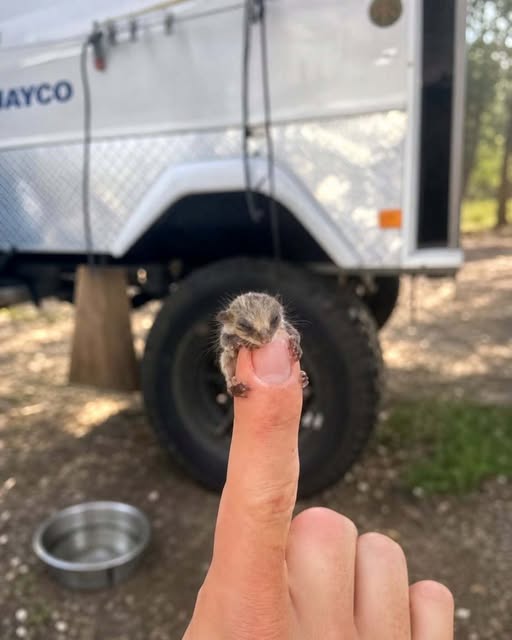
Couple Finds a Tiny Creature at Their Campsite and Gives Him a Chance to Return to the Wild
A Shape That Looked Like a Leaf
The couple nearly overlooked the tiny shape curled against the ground at their campsite. From a distance, it looked like a dry leaf resting in the vast Australian landscape.
It was almost small enough to be one.
Only the faintest movement suggested that the object was alive. A person walking quickly through the area could easily have passed without seeing anything unusual.
The couple stopped and moved closer. What they discovered was not a leaf but an astonishingly small animal with delicate ears, enormous dark eyes and a body that appeared almost too fragile to touch.
He was lying exposed on the ground during daylight. His movements were weak, and everything about his condition suggested that something was wrong.
Concern Without Careless Intervention
The couple’s first instinct was to help, but they understood that affection alone would not provide what the animal needed.
A vulnerable wild creature may be injured, dehydrated, cold, stressed or sick in ways that are not immediately visible. Excessive handling can increase that stress, while unsuitable food or water can create additional problems.
Taking the animal home and treating him like a pet would not offer a responsible solution. He required someone who understood the needs of his species and could assess his condition properly.
The couple contacted wildlife rescuers instead of attempting to improvise treatment. Their decision gave the little animal access to experienced care without exposing him to unnecessary handling.
While waiting for help, they protected him from immediate danger and watched his faint movements closely.
A Different Kind of Love
By the time rescuers arrived, the couple had already developed a powerful emotional connection to the tiny visitor.
The feeling was not based on possession. They did not believe that finding the animal gave them the right to keep him.
Their concern produced the opposite response. Because they cared about his survival, they were prepared to hand him to people better equipped to provide what he needed.
That decision can be difficult. Holding a fragile animal may create an immediate desire to continue protecting it personally.
Responsible wildlife care sometimes requires recognizing that concern is not the same as expertise. The couple’s most important contribution was knowing when to step aside.
The Tiny Visitor Is Identified
The rescuers identified the animal as a feathertail glider, one of Australia’s smallest gliding marsupi
His distinctive tail helped explain the name. It was flattened and bordered by stiff hairs, giving it the appearance of a feather.
A membrane extending between the animal’s limbs allowed him to glide from one tree to another. Although his body appeared impossibly delicate, it was beautifully adapted for movement high above the ground.
Feathertail gliders are nocturnal animals that belong among trees. Finding one weak, exposed and nearly motionless on the ground during daylight was therefore concerning.
The circumstances did not reveal exactly what had happened, but they provided enough reason for an experienced assessment.
No Need to Invent an Explanation
The little glider may have fallen from a tree or become separated from the place where he belonged. A disturbance could also have brought him to the ground.
Without evidence, there was no responsible way to determine the precise cause. Creating a dramatic explanation would not improve his condition or guide his treatment.
The immediate fact was much simpler: he had been found in poor condition and needed help.
The rescuers concentrated on what they could observe. His weakness, exposure and inability to behave normally mattered more than speculation about how he arrived at the campsite.
That focus allowed treatment to begin without forcing the animal’s story into an explanation no one could confirm.
The First Priority Is St
The glider’s body required warmth and stabilization. Before rehabilitation could progress, he needed support through the most vulnerable stage of his recovery.
At the wildlife facility, care occurred through small and carefully controlled steps. Those actions might have appeared uneventful to someone expecting a dramatic rescue.
Warmth helped his tiny body recover from exposure. Appropriate fluids supported him without creating the risks associated with untrained feeding.
Rest allowed his body to conserve energy, while careful observation helped caregivers monitor changes in his condition.
Each step was guided by the animal’s needs rather than by a desire for emotional interaction.
Wildlife Rehabilitation Is Often Quiet
Animal rescues are frequently imagined as dramatic moments followed by an immediate recovery. In practice, rehabilitation may be slow and deliberately uneventful.
An exhausted wild animal does not understand that the people around it are trying to help. Human voices, hands and unfamiliar surroundings can become additional sources of stress.
Caregivers therefore work to reduce unnecessary disturbance. They support the animal’s body while allowing natural recovery to occur whenever possible.
The purpose is not to make the animal comfortable with constant human attention. It is to provide essential assistance without creating avoidable dependence.
For the feathertail glider, progress began through warmth, fluids, rest and feeding performed under experienced supervision.
Small Signs Begin to Matter
The first improvements were subtle. His grip became stronger, showing that his tiny body was beginning to regain control and energy.
His large eyes appeared brighter. His movements became more purposeful rather than weak and uncertain.
Eventually, the glider relaxed enough to sleep properly. That quiet change represented an important stage in his stabilization.
To an outside observer, these developments might have seemed almost insignificant. Wildlife caregivers understood that each one reflected movement in the right
Recovery did not arrive as a single dramatic transformation. It appeared through a series of small changes that gradually revealed a stronger animal.
Survival Is Only the Beginning
Keeping the glider alive was the first objective, but it was not the final measure of success.
A wild animal surviving inside a facility is not necessarily prepared to return to its natural environment. Physical stability must be followed by the ability to function independently.
For a feathertail glider, the proper destination is not a person’s hand or home. It is the tree canopy.
Rehabilitation must therefore support the behaviors he will need outside human care. He must move naturally, feed appropriately and navigate his environment without depending on people.
Only after demonstrating those abilities could release become a responsible possibility.
Moving Into Specialist Care
Once the glider became stable enough, he could enter longer-term care with wildlife specialists. The purpose of that stage would change gradually as his condition improved.
At first, the objective was simply survival. Caregivers needed to prevent his already fragile condition from becoming worse.
The next stage focused on recovery. His body had to regain strength while his natural movements and responses returned.
If his health and development allowed it, preparation for release could eventually begin. That process would determine whether he could live without human assistance.
Each stage depended on the one before it. Rushing toward release before the animal was ready could undo the progress already made.
Successful Rescue Leads Toward Independence
Human attachment is not the standard by which wildlife rehabilitation should be measured. The animal’s eventual independence matters more.
A glider that becomes comfortable living permanently in human hands has not necessarily reached the ideal outcome. Whenever possible and appropriate, rehabilitation should prepare wildlife to stop needing people.
That goal can feel emotionally difficult for rescuers. They invest time and concern into helping a fragile creature survive, knowing that success may end with his disappearance.
The couple who found the glider might naturally wonder where he eventually went, how he behaved or whether he remembered them.
The animal does not owe them recognition or gratitude. His ability to leave human care would provide the clearest evidence that their decision helped him.
Not Every Wild Animal Needs to Be Collected
This rescue does not mean every small animal discovered outdoors should immediately be picked up. Young wildlife may sometimes appear alone while a parent remains nearby.
Intervention without a clear reason can separate a healthy animal from its natural support and create harm where none previously existed.
The details of the situation matter. An animal that is visibly injured, cold, weak or in immediate danger requires a different response from one behaving normally in a natural setting.
Unusual behavior can also indicate distress. A nocturnal glider lying nearly motionless on exposed ground during daylight presented several reasons for concern.
When the need for help remains uncertain, contacting a licensed wildlife rescue organization or another qualified local professional is safer than guessing.
The Risks of Improvised Feeding
People often want to provide food or water immediately after finding a vulnerable animal. That instinct comes from kindness, but the wrong approach can cause serious difficulties.
An unsuitable food may not meet the animal’s needs and could complicate its condition. Even an appropriate substance can become dangerous when offered in the wrong amount.
Forcing water into the mouth of a tiny animal can also create risk. A weak creature may not be capable of swallowing safely.
The better response is to seek instructions from someone experienced with the species. Until help is available, unnecessary intervention should be kept to a minimum.
What a Careful Rescuer Can Do
A person who discovers distressed wildlife does not need to become an expert immediately. The most useful response begins with observation and restraint.
The animal can be protected from an obvious and immediate threat without being handled repeatedly. Pets, crowds and unnecessary noise should be kept away.
Professional assistance should be contacted as quickly as circumstances allow. The person who answers can provide instructions appropriate to the animal and situation.
Following that guidance is safer than relying on assumptions. The needs of a tiny marsupial may be very different from those of a familiar household pet.
The couple at the campsite followed this approach. They recognized the glider’s distress, obtained help and allowed experienced rescuers to take responsibility for his recovery.
The Importance of Simply Noticing
The little glider existed on a scale easily overlooked in the enormous landscape surrounding the campsite.
A shoe could have passed over him without stopping. A vehicle, predator or continued exposure might have ended his life before anyone realized he was there.
Instead, two people noticed a shape that looked like a leaf. They paused long enough to see the slight movement showing that he was alive.
That moment of attention gave the animal access to warmth, stabilization and specialist care. The couple did not save him by knowing every correct treatment.
They helped because they recognized that something small still mattered.
Hands Trained to Help Take Over
Concern guided the couple’s first response, but experience guided the rehabilitation that followed.
Trained hands replaced well-intentioned uncertainty. The glider received appropriate fluids, careful feeding, warmth and the quiet environment his body required.
As he rested, his strength slowly returned. Every improvement moved him closer to the possibility of functioning without intensive assistance.
The people caring for him were not trying to transform him into a companion. Their work was intended to preserve his wild nature while supporting his recovery.
The Best Possible Ending
If rehabilitation succeeds, the glider may eventually climb into the trees again. A branch will barely move beneath his almost weightless body.
Under the cover of darkness, he may travel along the canopy in search of food while the people below remain unaware of his presence.
When he reaches an open space between trees, the membrane connecting his limbs will allow him to launch into the air.
The couple who found him may never see that moment. The rescuers who cared for him may not know every detail of the life that follows.
That absence would not diminish what they accomplished. It would represent the result everyone had worked toward.
The finest conclusion to a wildlife rescue is not keeping a fragile animal until it feels like human property.
It is helping that animal become strong enough to return to the place where it truly belongs.