
Margaret Hamilton, the Woman Whose Software Helped Save the Apollo 11 Moon Landing, Dies at 90
The Brilliant Mind Behind One of Humanity’s Greatest Achievements
When astronauts approached the lunar surface in July 1969, millions of people were following one of the most extraordinary moments in human history. But behind the historic Apollo 11 mission stood an engineer whose work would prove essential when unexpected computer alarms threatened to interrupt the landing.
Her name was Margaret Hamilton, a pioneering computer scientist who helped develop the onboard flight software used during NASA’s Apollo missions.
Hamilton died on September 30, 2026, in Cambridge, Massachusetts, at the age of 90, as announced by MIT News. Her passing marked the loss of an influential figure whose contributions helped transform software development into a recognized engineering discipline.
Although astronauts became the most recognizable faces of the moon landing, Hamilton and her colleagues worked behind the scenes to make the mission possible.
Her achievement was not simply writing instructions for a computer. She understood that software used in space exploration needed to continue performing critical operations even when unexpected problems occurred.
That approach would prove invaluable during Apollo 11’s descent toward the moon, when the spacecraft’s computer began issuing warnings at a particularly dangerous stage of the mission.
Decades later, Hamilton’s story remains a powerful reminder that scientific breakthroughs depend not only on those who carry out historic journeys but also on those who prepare for the difficulties they may encounter.
Margaret Hamilton’s Important Role in the Apollo Program
Margaret Hamilton led the development of onboard flight software for NASA’s Apollo missions while working at the Massachusetts Institute of Technology.
At a time when computer technology was still developing, the responsibilities entrusted to her team were extraordinary.
The software they created had to support spacecraft operations during missions that involved considerable technical complexity and risk.
Unlike ordinary computing tasks, spacecraft operations required systems capable of responding reliably in circumstances where mistakes could have severe consequences.
Hamilton recognized that developing software for such missions meant considering not only how a system should operate under expected conditions but also what could happen when those conditions changed.
Her work emphasized reliability, careful planning, and the ability to respond to unexpected demands.
These principles became central to the software used by the Apollo program.
Working with her team at MIT, Hamilton helped establish an approach that treated computer programs as essential engineering systems rather than secondary components of a larger technological project.
That distinction mattered because increasingly sophisticated missions required software capable of coordinating complicated operations while preserving the most important functions.
Hamilton’s leadership helped ensure that those requirements received serious attention.
The Apollo 11 Descent That Nearly Went Wrong
In July 1969, Apollo 11 approached the lunar surface during an event that would become one of the defining achievements of space exploration.
Two astronauts were preparing to complete a landing that had never before been accomplished by human beings.
The mission represented years of preparation and the coordinated work of numerous specialists, including the engineers responsible for the spacecraft’s computer systems.
As the descent continued, an unexpected problem appeared.
The onboard computer began producing overload alarms.
These warnings created a serious concern because the computer was responsible for supporting essential operations during the landing.
At such a critical moment, a failure to manage the system’s workload could have threatened the mission’s ability to continue.
The astronauts were approaching the moon while relying on equipment that needed to respond correctly despite increasing demands.
For those monitoring the landing, the alarms raised an urgent question: could the spacecraft continue its descent safely?
The answer depended in part on how the computer software had been designed to handle unexpected conditions.
How Hamilton’s Software Helped Protect the Landing
The software developed by Hamilton’s team had an important capability: it could prioritize essential operations when the computer became overloaded.
Rather than allowing every competing task to interfere with the system’s most critical responsibilities, the software was designed to preserve the functions that mattered most.
During Apollo 11’s descent, this approach became crucial.
As the computer experienced excessive demands, less urgent tasks could be set aside while essential operations continued.
The system therefore remained capable of supporting the mission despite the alarms.
This did not mean the warnings were unimportant or that continuing the landing required no further judgment.
Mission Control assessed the situation and approved continuation of the descent.
The astronauts were then able to proceed with the landing.
The episode demonstrated the practical value of anticipating problems long before they occur.
Hamilton’s team had not waited for a crisis to discover whether their software could distinguish between urgent and less important tasks.
They had built that principle into the system’s design.
When the spacecraft encountered unexpected demands, the software’s ability to preserve essential functions became one of the factors that allowed the historic mission to continue.
Why the Computer Alarms Became a Defining Moment
The Apollo 11 alarms are remembered because they occurred during an especially important stage of the mission.
There was little room for uncertainty as the spacecraft approached the lunar surface.
The astronauts needed reliable information and functioning onboard systems while carrying out an operation that demanded precision.
For engineers responsible for flight software, such circumstances represented exactly the kind of situation that required careful preparation.
A computer system that performs well during ordinary conditions may still encounter unexpected demands during a complicated operation.
Hamilton understood that dependable software must be capable of responding to those demands without allowing less important activities to compromise essential work.
The Apollo 11 incident provided a dramatic illustration of that principle.
What could have become a disabling overload instead became an example of effective software prioritization.
The mission’s continuation also demonstrated the importance of cooperation between onboard technology and the people responsible for assessing its performance.
The software maintained essential operations, while Mission Control made the decision to proceed.
Both elements contributed to the successful management of the unexpected situation.
Helping Establish Software Engineering as a Serious Discipline
Hamilton’s influence extended well beyond the Apollo 11 landing.
She became an important figure in establishing software engineering as a field deserving the same seriousness and professional attention as other areas of engineering.
During the early development of complex computing systems, software did not always receive the recognition associated with the physical machinery it controlled.
Hamilton’s work demonstrated why that distinction could be misleading.
A sophisticated spacecraft depended not only on its physical components but also on the instructions that allowed its systems to operate correctly.
Those instructions required careful design, testing, and an understanding of potential failures.
Through her leadership in Apollo software development, Hamilton helped demonstrate that writing reliable programs was an engineering responsibility involving substantial technical judgment.
Her emphasis on anticipating unexpected conditions became especially significant.
Rather than assuming everything would function exactly as intended, she approached software development with the understanding that complex systems must be prepared for unusual circumstances.
This philosophy became one of the defining characteristics of her contribution to computing.
The Famous Photograph That Introduced Her to New Generations
One of the most recognizable images associated with Margaret Hamilton shows her standing beside towering stacks of printed computer code.
The photograph, taken during the Apollo era, later became a widely recognized symbol of the enormous intellectual effort required to develop the software behind space exploration.
The stacks represented the extensive program listings produced by Hamilton and her MIT colleagues.
For many people encountering the photograph years later, the image provided a striking perspective on the work required to support the Apollo missions.
It also drew attention to someone whose contribution had not always received the same public visibility as the astronauts who traveled into space.
The photograph helped communicate an important historical point.
Behind an achievement remembered through images of spacecraft and footprints on the moon was an enormous amount of technical preparation.
Software development formed an essential part of that preparation.
Hamilton’s presence beside the printed listings became a reminder that technological progress is often built through years of work that remains largely unseen by the public.
The image helped introduce her achievements to people who had not been familiar with her role in the Apollo program.
Recognition From President Barack Obama
Hamilton’s contributions eventually received one of the highest civilian honors in the United States.
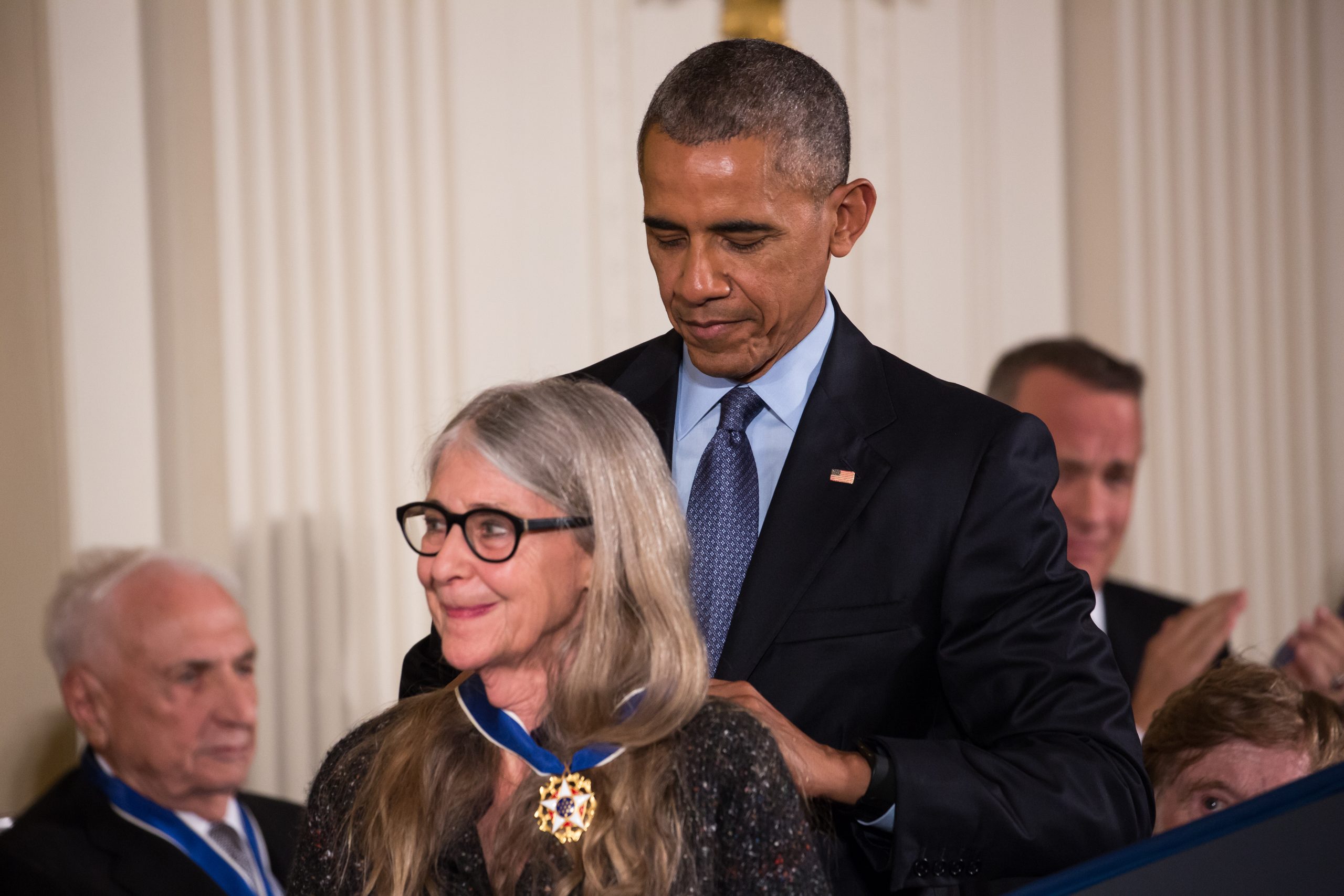
In 2016, President Barack Obama awarded her the Presidential Medal of Freedom.
The recognition acknowledged her pioneering achievements in computer science and her leadership in developing the onboard flight software used during NASA’s Apollo moon missions.
By that time, the significance of her work had become increasingly visible to audiences beyond the field of computing.
The honor also emphasized the importance of recognizing individuals whose achievements supported historic accomplishments without placing them directly in the public spotlight.
Hamilton’s role in the Apollo program was especially meaningful because the success of complex technological missions depends on the work of many specialized teams.
Her leadership represented a crucial part of that wider effort.
The Presidential Medal of Freedom served as a public acknowledgment of a career that helped shape both space exploration and the professional understanding of software development.
Balancing a Demanding Career With Family Life
Alongside her professional achievements, Margaret Hamilton was also a mother.
She balanced the demanding responsibilities of her work with raising her daughter, Lauren.
Her career required exceptional attention to detail and a sustained commitment to developing reliable software for missions of extraordinary importance.
At the same time, family life remained an important part of her personal story.
This combination of responsibilities provides another perspective on her accomplishments.
Her achievements were not made in isolation from everyday life, but alongside the commitments and relationships that shaped her experiences beyond the laboratory.
Remembering that aspect of Hamilton’s life helps present a fuller understanding of the person behind the technical accomplishments.
She was a pioneering engineer whose work contributed to a historic mission, and she was also a parent navigating the responsibilities of raising a child.
Both dimensions belong to her story.
The Importance of Preparing for the Unexpected
One of the most enduring lessons from Hamilton’s career is the importance of anticipating problems before they become emergencies.
Her approach to software development recognized that complicated systems can encounter circumstances that were not part of their ordinary operating conditions.
In such situations, the ability to distinguish essential operations from less urgent tasks can make an enormous difference.
The Apollo 11 computer alarms demonstrated this principle under extraordinary circumstances.
The system encountered more demands than it could process in the usual way, but its design allowed the most important functions to continue.
That capability had been developed through planning and engineering decisions made before the spacecraft approached the moon.
The result illustrated why reliability must be considered from the beginning of a complex project.
Waiting until a problem occurs may leave little opportunity to correct it, particularly when a system is operating in an environment where intervention is difficult.
Hamilton’s work showed the value of preparing for difficulties even when their precise form cannot be predicted.
The People Behind Humanity’s First Steps on the Moon
The Apollo 11 landing is often remembered through the astronauts who traveled to the moon and the extraordinary images associated with their journey.
Yet the mission also depended on specialists working far from the lunar surface.
Engineers, programmers, and other technical professionals contributed essential knowledge that helped make the achievement possible.
Hamilton and her team belonged to this wider group of people whose work supported the mission’s success.
While the astronauts faced the immediate challenges of the descent, the onboard software reflected years of preparation by those responsible for building dependable systems.
The computer alarms during the landing made the importance of that preparation particularly visible.
At a moment when the mission encountered an unexpected technical difficulty, software designed to maintain essential operations helped support the decision to continue.
This episode became an important part of Hamilton’s legacy because it connected her engineering philosophy with one of the most recognizable events in modern history.
A Legacy That Reaches Beyond Space Exploration
Although Margaret Hamilton is closely associated with Apollo, the broader significance of her achievements lies in the recognition she helped bring to software engineering.
Her career demonstrated that software is not merely a supporting detail in complicated technological projects.
It can be central to how those projects function, respond to difficulties, and achieve their objectives.
The principles illustrated by her Apollo work remain meaningful whenever software must perform reliably under demanding conditions.
Careful planning, clear priorities, and the ability to handle unexpected events are all essential concerns in the development of dependable systems.
Hamilton helped establish the importance of approaching those responsibilities with engineering discipline.
Her achievements also offer an important reminder about scientific recognition.
Historic accomplishments are often represented by a small number of familiar names, even when their success depended on the contributions of many people.
Recognizing Hamilton’s work provides a more complete picture of what made the Apollo missions possible.
Remembering Margaret Hamilton After Her Death at 90
Margaret Hamilton’s death on September 30, 2026, at the age of 90 marked the end of a remarkable life dedicated to advancing the possibilities of computing and engineering.
Her professional achievements connected her to one of humanity’s most celebrated technological milestones.
As the leader of Apollo’s onboard flight software development at MIT, she helped create systems designed to continue operating when unexpected difficulties arose.
During Apollo 11’s lunar descent, that preparation became critically important as computer overload alarms threatened to complicate the landing.
The software’s prioritization of essential tasks, together with Mission Control’s approval, allowed the mission to proceed.
Her later recognition, including the Presidential Medal of Freedom in 2016, reflected the extraordinary importance of those contributions.
But Hamilton’s legacy extends beyond awards and historic photographs.
It includes her role in establishing software engineering as a serious discipline and her insistence that dependable technology must be designed with unexpected problems in mind.
The Woman Whose Work Helped Make History Possible
When people remember Apollo 11, they often picture the moon’s surface, the spacecraft that carried the astronauts, and the remarkable achievement of human exploration beyond Earth.
Support Causes
Margaret Hamilton’s story adds another essential part to that history.
It reminds us that extraordinary journeys require more than courage at the moment of departure.
They depend on preparation, technical expertise, and the ability to imagine what might go wrong before a mission begins.
Hamilton spent her career helping demonstrate the importance of those qualities.
Her work supported the Apollo program, strengthened the recognition of software engineering, and became an enduring example of how careful design can make ambitious achievements possible.
The photograph of Hamilton beside towering stacks of computer code remains a powerful symbol of the immense work carried out behind the scenes.
Her contributions belong alongside the history of the moon landing itself, even though she was not among those who traveled there.
As the world remembers Margaret Hamilton, her greatest legacy may be the lesson embodied in her work: progress depends not only on those who dare to pursue the impossible, but also on those who prepare thoughtfully for the unexpected.
Humanity’s historic journey to the moon was made possible by countless acts of determination and technical skill. Margaret Hamilton’s software helped ensure that, when an unexpected challenge appeared at a crucial moment, the mission could continue toward its extraordinary destination.