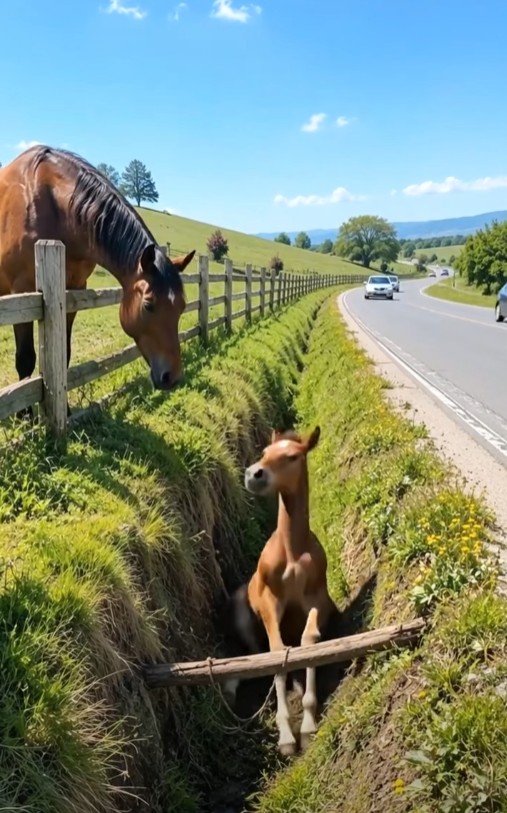
Desperate Mare Leads Farm Caretaker to Her Foal Trapped in Deep Mud
A Mother’s Urgent Warning Leads to a Dramatic Rescue in a Rain-Soaked Pasture
A quiet afternoon on a countryside horse farm turned into an urgent rescue when a mother horse began behaving unusually near a wooden pasture fence. The mare repeatedly called out, raced along the fence line, and appeared determined to attract the attention of a passing farm caretaker
Her distress had a heartbreaking explanation. Her three-week-old foal had slipped into a muddy irrigation trench and was unable to climb out.
With the young animal exhausted and trapped against the slippery clay, the mare’s persistent behavior became the first indication that something was seriously wrong.
What followed was a carefully coordinated effort involving farm workers, specialized lifting equipment, and veterinary care. By the end of the rescue, the foal was safely reunited with its mother, and the farm had taken steps to prevent another accident.
How the Young Foal Became Trapped
The incident began during a rainy afternoon when the three-week-old foal was moving through tall clover grass inside its pasture.
Young horses are naturally energetic, and the foal had been galloping across the field before approaching an unmapped drainage ditch.
The ground surrounding the trench had become slippery from the rain. As the foal reached the edge, it lost its footing and slid down the clay bank.
At the bottom of the trench, the animal became wedged on its side in deep, sticky mud. The wet clay made it difficult for the foal to move its slender legs or establish enough traction to climb out.
Every effort to regain its balance was complicated by the unstable surface beneath it.
The foal began making high-pitched distress calls that carried across the pasture.
Its mother quickly recognized that something was wrong and responded with urgent vocalizations of her own.
The Mother Mare Refused to Ignore Her Foal’s Cries
As the foal struggled below the edge of the drainage ditch, the mare became increasingly restless
She galloped along the perimeter of the pasture, repeatedly calling out and moving between the fence and the area where her foal was trapped.
Her behavior was noticeably different from ordinary movement around the paddock.
Instead of remaining near the grazing area, the mare appeared focused on attracting attention beyond the fence.
When a farm truck approached along the main driveway, she raced parallel to the vehicle’s path.
The horse tossed her mane, stopped repeatedly, and looked back toward the drainage trench.
These movements caught the attention of the equine caretaker driving the truck.
Recognizing the urgency of the mare’s behavior, he pulled over to investigate.
What initially appeared to be an agitated horse soon became an unmistakable warning that another animal needed help.
The Caretaker Followed the Mare Across the Muddy Field
The caretaker collected a long lead rope and an emergency halter before entering the pasture.
He followed the mare across the wet grass toward the drainage ditch, where the source of her distress became clear.
At the bottom of the trench lay the young foal, covered in thick mud and showing signs of exhaustion.
The animal was shivering and unable to free itself from the slippery clay.
The depth of the trench and the sticky conditions made a straightforward rescue
The caretaker understood that attempting to drag the foal out by its legs could place dangerous pressure on its developing joints.
Instead of pulling the animal directly, he arranged for equipment that would support its body during extraction.
A farm utility tractor and wide, padded webbing slings were brought to the scene.
With the mare remaining nearby, the rescue team began preparing a controlled lift.
A Careful Rescue Using Padded Slings and a Tractor
The rescuers needed to remove the foal from the mud without placing excessive strain on its limbs.
They carefully positioned two broad, padded transport straps beneath the
One sling supported the chest area, while the other helped stabilize the hindquarters.
This arrangement distributed the foal’s weight across a larger portion of its body rather than concentrating the lifting force on individual legs.
The straps were then attached to the tractor’s front-loader arm.
With the animal supported, the operator slowly activated the hydraulic lifting mechanism.
The foal was raised approximately six inches above the muddy bank, allowing rescuers to guide it away from the trench.
The team worked steadily to prevent sudden movement while the young horse remained suspended in the slings.
Once the foal was clear of the mud, the workers carefully lowered it onto a thick bed of straw prepared on dry grass beside the ditch.
The extraction was successful, but the rescuers still needed to determine whether the animal had suffered any injuries.
An Emotional Reunion Between Mother and Foal
As soon as the foal reached safe ground, the mother mare hurried to its side.
Her earlier frantic movements gave way to softer vocalizations as she approached the exhausted youngster.
The mare began licking the wet clay from the foal’s coat while remaining close beside it.
She also encouraged the young horse to stand, maintaining contact as it recovered from the ordeal.
For the caretaker and other workers, the reunion marked an important moment in the rescue.
The mare had spent the emergency attempting to attract assistance, and the animal she had been calling for was finally within reach again.
Although the immediate danger had passed, the team continued to monitor the foal’s condition.
Being trapped in cold, wet mud can present serious concerns for a young horse, particularly when the animal is unable to move freely.
A veterinary examination was therefore arranged before the foal returned to its normal routine.
Veterinary Examination Confirms the Foal Escaped Serious Injury
A local equine veterinarian examined the rescued foal after it had been moved to dry ground.
The assessment focused on whether the animal had experienced injuries or physical complications while trapped in the trench.
According to the account of the rescue, the examination found no bone fractures, muscle tears, or hypothermia.
That result was especially encouraging because the foal had been unable to free itself and had become visibly exhausted before help arrived.
The use of supportive lifting straps had allowed the team to remove the animal without pulling forcefully on its slender legs.
Once examined, the foal was able to remain with its mother and recover in familiar surroundings.
The successful outcome also prompted farm workers to review the conditions that had allowed the accident to happen.
The Farm Takes Action to Prevent Another Accident
Following the rescue, the farm crew addressed the drainage hazards within the pasture.
Workers installed wooden post-and-rail fencing around open ditches to restrict access to the most dangerous areas.
Shallow drainage trenches were also backfilled to reduce the possibility of animals slipping into them.
These changes were intended to make the pasture safer for both young foals and adult horses.
The accident demonstrated how an ordinary agricultural drainage feature could become hazardous after wet weather.
An unmapped ditch, slippery clay, and tall pasture grass had combined to create a dangerous situation for the young animal.
By improving the fencing and drainage conditions, the caretakers sought to prevent a similar emergency.
The rescue also reinforced the importance of monitoring areas where livestock move freely.
Why Deep Mud Can Be Dangerous for Young Horses
Mud entrapment presents particular difficulties for foals because of their relatively slender limbs and developing physical strength.
When a young horse slips into deep clay, the surrounding mud can restrict movement and make it difficult to reposition its body.
Without a stable surface beneath its hooves, the animal may be unable to generate enough traction to stand or climb.
Repeated attempts to escape can also leave the foal increasingly tired.
The conditions become more concerning when the animal is wet, cold, or unable to move for an extended period.
In this incident, the foal was discovered shivering and exhausted at the bottom of the trench.
Fortunately, the caretaker noticed the mare’s unusual behavior and reached the animal before more serious complications developed.
The account illustrates why a trapped foal should be handled cautiously and why professional veterinary assistance is important when an animal has been immobilized in mud.
Why Pulling a Trapped Foal by Its Legs Can Be Risky
One of the most important decisions during the rescue was the caretaker’s choice not to pull the foal from the trench by its limbs.
Forceful pulling can place considerable strain on a young horse’s joints and surrounding tissues.
When deep mud holds part of the body in place, additional force may increase the risk of injury rather than immediately freeing the animal.
The rescue team instead used broad, padded webbing straps to support the foal’s chest and hindquarters.
This approach allowed the animal’s weight to be distributed during the lift.
The tractor’s hydraulic equipment provided controlled elevation, while the workers guided the foal toward a prepared resting area.
Such operations require careful judgment, suitable equipment, and attention to the animal’s condition. A lifting method appropriate for one horse or situation may not be suitable for another.
In this case, the coordinated effort resulted in a successful extraction without the injuries the caretaker had feared.
How Mares May Signal Distress When Their Foals Are in Trouble
The mother mare’s actions were central to how the emergency was discovered.
Her repeated whinnies, rapid movement along the fence, and tendency to look back toward the drainage ditch all attracted the caretaker’s attention.
Mares maintain close relationships with their young foals, and changes in a foal’s behavior or location can trigger noticeable responses from the mother.
When a foal becomes separated, trapped, or distressed, a mare may call repeatedly or become restless.
In the described incident, the mare’s behavior appeared directed toward both the trapped foal and the approaching farm vehicle.
By following her movements, the caretaker discovered the young horse in the trench.
Although unusual animal behavior does not always indicate an emergency, persistent distress near a particular location can provide a useful reason for caretakers to investigate.
The mare’s actions ultimately played an important role in bringing assistance to her foal.
The Foal Returns to the Pasture After Its Rescue
After the extraction and veterinary examination, the rescued foal gradually returned to its normal activities.
The following morning, sunlight spread across the farm’s green fields and wooden fencing as the young horse moved beside its mother.
The foal was described as trotting comfortably through the paddock, no longer restricted by the mud that had trapped it the previous afternoon.
Later, it rested in the shade of a maple tree and nursed peacefully.
These scenes marked a sharp contrast with the frantic calls and urgent rescue effort that had taken place earlier.
Meanwhile, the caretaker continued routine inspections of the property.
Drainage areas, paddock gates, and fence rails were checked to ensure the newly improved pasture remained secure.
The farm’s usual activities resumed as the horses returned to grazing, resting, and moving through their surroundings.
A Reminder of the Importance of Farm Safety and Animal Care
The incident brought attention to two important elements of livestock management: recognizing unusual animal behavior and maintaining safe pasture conditions.
The mare’s persistent calls and movements alerted the caretaker to a problem he might otherwise have overlooked.
His decision to investigate quickly led him to the trapped foal.
Once the animal was located, the workers avoided a forceful extraction and selected equipment designed to support the foal during lifting.
The subsequent veterinary assessment confirmed that the young horse had avoided the serious injuries that can accompany such incidents.
Finally, the farm’s decision to fence dangerous drainage areas and fill shallow trenches addressed the conditions that contributed to the accident.
Together, those steps turned an emergency into an opportunity to improve safety for the remaining animals.
A Mother’s Determination Helped Save Her Foal
By the time the farm returned to its peaceful routine, the three-week-old foal was once again moving freely beside its mother.
The muddy ditch that had nearly turned an ordinary afternoon into a tragedy was no longer accessible in the same way, and the caretakers had strengthened their safety inspections.
For the mare, the most important outcome was simple: her foal was back on safe ground.
Her frantic whinnies and repeated movements along the pasture fence had prompted a caretaker to stop and investigate.
That timely response, followed by a carefully planned extraction and veterinary examination, helped bring the emergency to a successful conclusion.
As the young horse rested, nursed, and eventually trotted through the pasture again, the farm had a reassuring reminder of how much attentive care can matter.
What began with a mother’s desperate calls ended with her newborn safely beside her, a rescue team relieved by the outcome, and a pasture made safer for the animals that call it home