Why Geckos Climb Walls and Shed Their Skin—and What an Unusual Sighting Cannot Explain
A Small Reptile Raises Questions About Everyday Wildlife
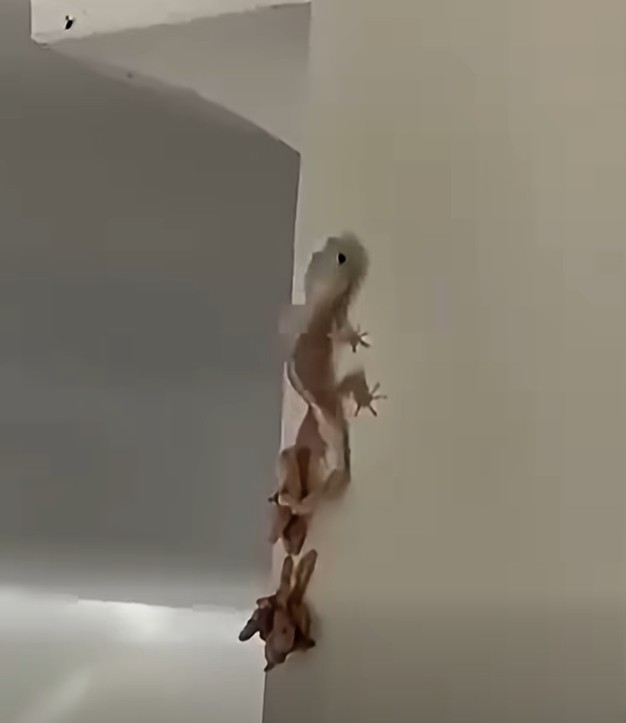
A description of a pale reptile on an interior wall draws attention to unfamiliar brownish material hanging beneath its body. The animal appears to be a gecko, but the material itself has not been identified.
Shedding skin is mentioned as one possible explanation, although the available description does not establish that this is what is happening. It also provides no confirmed species identification or background about the encounter.
Those uncertainties leave the particular situation unresolved. They do not diminish the interest of the animal’s better-understood characteristics, including the climbing abilities that allow many geckos to move across walls and ceilings.
Geckos also replace their outer skin, hunt small prey and use a range of defenses against predators. These adaptations help explain why such small reptiles can live successfully in environments that include human buildings.
Why Geckos Appear Inside Buildings
In warmer regions, house geckos are familiar visitors to homes and other structures. Buildings can offer shelter and access to small insects, making indoor and outdoor walls useful places to search for food.
Artificial lighting can attract insects such as moths and flies. A gecko feeding nearby is responding to an available food source rather than seeking interaction with people.
Its presence may still be startling, especially when someone notices it high on a bedroom wall or moving across a ceiling. Those locations are difficult for people to reach, but they can be accessible to a suitably adapted reptile.
Common house geckos generally avoid contact with humans. Their insect-feeding habits can also make them beneficial visitors, although their presence does not mean they will eliminate every household pest.
Different species have different abilities and habits. A general account of house geckos should therefore not be treated as a complete description of every reptile that resembles one.
The Microscopic Structures Behind Their Grip
Many geckos have specialized structures on their toes that help them maintain contact with surfaces. Their climbing ability involves much more than simply pressing a foot against a wall.
The toe pads contain microscopic, hairlike structures called setae. These branch into still smaller contact structures, allowing a large number of tiny points to interact closely with the surface beneath them.
At that scale, weak molecular attractions known as van der Waals forces contribute to adhesion. Each interaction is small, but their combined effect can support the animal’s weight.
The result is a grip that allows many species to move across surfaces that would otherwise offer little purchase. What looks effortless from a distance depends on contact occurring at a microscopic level.
This mechanism differs from a foot coated in ordinary glue. It also means that describing geckos as relying entirely on claws misses an important part of how many wall-climbing species move.
Releasing a Foot Is as Important as Holding On
A strong grip would be of limited use if the gecko could not release it efficiently. Moving requires the animal to alternate between secure contact and controlled detachment.
Changing the angle of the toes and their microscopic structures allows a foot to disengage. The gecko can then reposition that foot and establish contact again.
Repeated across its steps, this process makes climbing appear smooth and continuous. The animal is managing attachment rather than remaining permanently stuck to the wall.
These features have attracted interest in materials and engineering. Gecko-inspired designs explore ways to create useful adhesion while retaining the ability to release and reuse a surface.
However, not all geckos possess the same toe-pad adaptations. Their diversity is important, and the abilities of a wall-climbing species should not be assigned automatically to every member of the group.
Shedding Is a Normal Part of Reptile Life
Geckos periodically replace their outer layer of skin through a process called ecdysis. This allows the old outer layer to be removed as new skin takes its place.
Before a shed, an animal may look duller, paler or slightly cloudy. As the old layer separates, loose portions may become noticeable around the body, limbs or tail.
A gecko may rub against a suitable surface or use its mouth to help remove loosened skin. The process can briefly give an otherwise familiar animal an unusual appearance.
Many geckos also eat their shed skin. This is a normal behavior and should not, by itself, be mistaken for an indication that something is wrong.
Shedding frequency varies with species, age, health and environmental conditions. Young animals generally shed more often as they grow, so there is no single schedule that applies to all geckos.
Why Shedding Cannot Be Confirmed in This Encounter
Knowing that geckos shed does not establish that every unfamiliar object near one is loose skin. A biological possibility remains different from an identification.
The account describes brownish shapes beneath the animal without explaining their texture, attachment or movement. It does not establish whether the material belongs to the reptile or is a separate object.
Those missing details prevent a reliable conclusion. The animal’s pale appearance also cannot establish its species, health or stage of shedding on its own.
The most accurate description is therefore limited: an apparent gecko is associated with material whose nature remains uncertain. Any more specific explanation would require additional evidence.
This distinction allows the unusual encounter to prompt an informative discussion without turning a suggested explanation into a confirmed event.
Tail Loss Provides Another Form of Defense
Some gecko species can detach part of their tail when threatened. The detached tail can distract a predator and provide an opportunity for the animal to escape.
This ability is a defense mechanism, rather than something that should be deliberately triggered. Avoiding unnecessary handling reduces the chance of frightening or injuring a small reptile.
Many geckos can grow a replacement tail over time. The regenerated tail may differ in shape or appearance from the original.
Tail regeneration and skin shedding are separate processes. Neither should be used to explain unidentified material around an animal without evidence connecting the observation to that process.
Nighttime Activity and Communication
Numerous gecko species are active after dark. Their ability to navigate and locate prey in dim conditions helps them make use of environments that remain busy with insects at night.
For people, this can make an encounter feel sudden. An animal that went unnoticed during daylight may become visible while moving across a wall near an indoor light.
Some geckos also produce chirping or clicking sounds. Vocal communication is another characteristic that can surprise people more familiar with quiet household wildlife.
These traits vary between species, just as climbing ability and appearance do. Together, they illustrate a group of reptiles adapted to different habitats and ways of living.
Sharing Space With Small Reptiles
Common house geckos are generally not a physical danger to people, but normal hygiene remains important. Like other reptiles, they can carry bacteria even when they appear healthy.
Unnecessary handling is best avoided. Hands should be washed after contact, and food preparation areas should be kept clean.
If a wild house gecko needs to leave a room, providing a safe route outside may be preferable to chasing or grabbing it. The aim is to resolve the encounter without harming the animal.
The broader lesson is one of careful observation. A small reptile on a wall can demonstrate remarkable adaptations, while an unfamiliar detail beside it can remain unidentified until there is enough information to explain it.